R E S E A R C H
Open Access
SWIPT in mMIMO system with
non-linear energy-harvesting terminals: protocol
design and performance optimization
Kui Xu, Ming Zhang
*, Jie Liu, Nan Sha, Wei Xie and Lihua Chen
Abstract
In this paper, we design the simultaneous wireless information and power transfer (SWIPT) protocol for massive multi-input multi-output (mMIMO) system with non-linear energy-harvesting (EH) terminals. In this system, the base station (BS) serves a set of uplink fixed half-duplex (HD) terminals with non-linear energy harvester. Considering the non-linearity of practical energy-harvesting circuits, we adopt the realistic non-linear EH model rather than the idealistic linear EH model. The proposed SWIPT protocol can be divided into two phases. The first phase is designed for terminals EH and downlink training. A beam domain energy beamforming method is employed for the wireless power transmission. In the second phase, the BS forms the two-layer receive beamformers for the reception of signals transmitted by terminals. In order to improve the spectral efficiency (SE) of the system, the BS transmit power- and time-switching ratios are optimized. Simulation results show the superiority of the proposed beam-domain SWIPT protocol on SE performance compared with the conventional mMIMO SWIPT protocols.
Keywords: Massive MIMO, Beam-domain channel representation, Simultaneous wireless information and power transfer, Beamforming, Achievable sum-rate
Introduction
With the rapid rise of the Internet of Things (IoT) industry [1], massive intelligent devices will be deployed in any-where to monitor engineering structures, diagnose the physical condition of the patients, report the real-time traffic information, and so on. A major problem facing is that how to prolong the life of the energy-constrained devices, so that they could be utilized in a sustainable and low-cost way. Currently, a feasible solution is to adopt the radio frequency (RF) signal-based wireless energy transfer (WET) technique [2–4], as RF signal is controllable, sta-ble, and efficient compared to the natural sources such as solar and wind.
As one of the key technologies of fifth-generation (5G) communication system, massive input multiple-output (mMIMO) [5] technology can obtain the diversity gain and multiplexing gain, and hence can greatly improve the spectrum efficiency (SE) of wireless networks [6–8].
*Correspondence:[email protected]
College of Communication Engineering, Army Engineering University of PLA, No. 2, Biaoying Street, Nanjing, China
Compared with traditional MIMO, the spatial resolution of mMIMO systems is significantly improved [9], which can greatly reduce various types of interference [7].
As a practical solution to improve the energy effi-ciency (EE) of battery-powered IoT network in 5G systems and hence extend the service lifetime of the IoT net-work, RF energy-harvesting (EH) technology has been widely studied [10–12]. In an actual simultaneous wire-less information and power transfer (SWIPT) system [13], the base station (BS) or access point (AP) provides the receiver with concurrent information and energy supply. Currently, the practical SWIPT receiver architecture can be mainly classified as time-switching (TS) and power-splitting (PS) [14] according to the signal partition method for EH and information decoding (ID). The TS SWIPT receiver alternates between EH and ID according to the TS ratio [15], and as a result, the received RF signal is first sent to the energy harvester and then to the infor-mation decoder. For the PS SWIPT receiver, the received RF signal is split into two parts according to the PS ratio [13]; one portion is sent to the energy harvester, and the remainder is sent to the information decoder.
In [16], the TS and PS protocols were designed for the amplify-and-forward (AF) one-way single-antenna SWIPT relay networks. In [17], the SWIPT protocol was designed for one-way MIMO relay network, where the MIMO relay can simultaneously harvest energy from the signal sent by the destination and decode the signal sent by the source. Since two-way relaying (TWR) system can further improve the SE of multi-hop relay system [18–20], recently, SWIPT protocol for TWR systems were stud-ied in many literatures. The authors in [21] studstud-ied the SWIPT protocol in the AF TWR system, wherein the RF-powered AF relay node is applied to help the two source nodes exchange information. In [22], the problem of maximizing the sum throughput in the TWR networks with wireless-powered nodes was studied. The authors in [23] considered the SWIPT protocol design in multiple relay AF TWR networks, where two source nodes harvest energy from multiple relays.
In [16,17,21–23], it was assumed that the amount of energy harvested by the EH circuit is linearly proportional to the received RF power, namely, the linear EH model. However, as studied in recent literature [24–29], the linear EH model is too idealistic and impractical because linear assumptions do not hold in practice. The energy con-version efficiency of an actual EH circuit is a non-linear function of the received RF signal due to various causes of non-linearity, e.g., diode non-linearity, and saturation non-linearity. In addition, the sensitivity of the energy har-vester is limited [30], that is, signals with power around communications sensitivity can be decoded at a SWIPT receiver but cannot be exploited for energy-harvesting purposes. Therefore, in practice, the amount of harvested energy is clearly a non-linear function of the received power.
In [31], the SWIPT protocol for three-dimensional (3D) mMIMO system is designed, where the matched filter (MF) precoder is applied. In [32], the SWIPT protocol for multi-pair mMIMO TWR system is designed, where lin-ear precoders, i.e., zero-forcing (ZF) and maximal ratio combining (MRC), are employed at the relay. A low-complexity SWIPT scheme with retrodirective maximum ratio transmission (MRT) beamforming is introduced in [33]. In [34], each frame is divided into three phases: the uplink channel estimation phase, the downlink wire-less energy transmission phase, and the uplink wirewire-less information transmission phase. ZF and MRC beamform-ing are applied at the access point. For SWIPT system with mMIMO, instantaneous full-dimensional channel state information (CSI) is required to perform trans-mit and receive precoding [34]. The above four works [31–34] have considered linear energy harvesters. To obtain full dimensional CSI, the uplink training overhead is linearly proportional to the number of user equipments, thus causing significant bottlenecks on the achievable SE.
Methods
In this paper, the beam-domain SWIPT protocol for mMIMO system with fixed half-duplex (HD) non-linear energy-harvesting terminals (TEs) is designed, and the system spectral efficiency performance is maximized by optimizing the TS ratio and transmit power of the BS1. The contributions are summarized as follows.
– We consider the SWIPT protocol design for TEs with non-linear energy harvesters in mMIMO systems. Moreover, a more practical power consumption model is employed at the TE. In particular, after the energy-harvesting phase, a portion of the harvested energy is used for necessary processing, such as the energy consumption of channel estimation, channel feedback, and energy consumption of the circuit, to achieve its primary task. The remainder energy is used for the subsequent wireless information transmission. – Based on the idea of TS, the entire transmission
process of the proposed beam-domain SWIPT protocol can be divided into two phases. The first phase is designed for TEs EH and downlink training. During this phase, the BS transmits energy signals to the TEs. The TEs utilize one portion of the received energy signals for EH and the remainder for downlink channel estimation. After obtaining the channel CSI, TEs feedback it to the BS. The beam-domain energy beamforming method is employed for wireless energy transmission. In the second phase, the BS forms the two-layer receive beamformers for the reception of signals transmitted by TEs.
– In order to improve the SE of the system, the base station transmit power and time-switching ratio are optimized. The simulation results show that compared with the traditional mMIMO SWIPT protocol, the proposed beam-domain SWIPT protocol has superior performance in SE performance.
The rest of the paper is organized as follows. The system and channel model are introduced in Section1. Section1 illustrates the proposed beam-domain mMIMO SWIPT transmission scheme. Section 1 analyzes the achievable sum-rate performance and proposes the optimization method. Section 1 presents the simulation results. Our conclusions are presented in Section1.
Notations: In this paper,E(·) denotes the expectation. A{B1,B2} is the submatrix ofAcontaining rows of set B1
and columns of set B2. A{B,:} andA{:,B} are the subma-trix ofAcontaining rows and columns of setB, respec-tively.δ(·)denotes the dirac delta function.(·)T,(·)∗,(·)H,
ceilings, respectively.IV denotesV ×V identity matrix. ·,· denotes the inner product operator.
System model
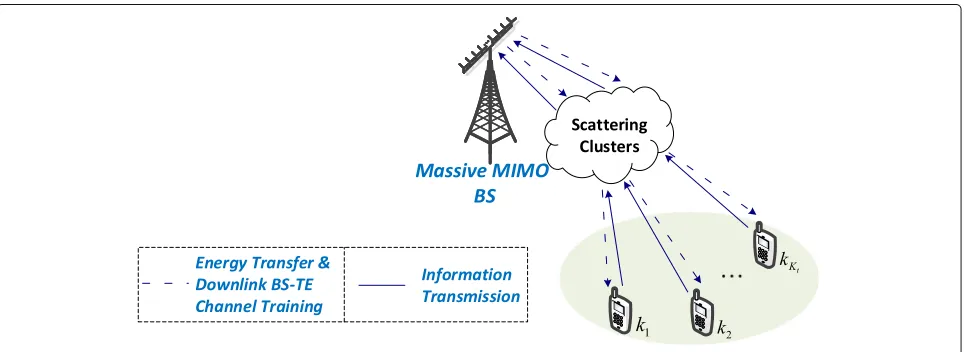
We consider a mMIMO SWIPT system, where the BS serves a set ofKtfixed uplink TEsKT = {k1,k2,· · ·,kKt},
as shown in Fig.1. We assume that all TEs are uniformly distributed in the coverage area of the BS. The BS is equipped with a massive antenna array with N anten-nas. We assume that all TEs operate in HD mode and are equipped with a single antenna. Each TE employs a non-linear energy harvester to collect energy and uses the harvested energy for subsequent data transmission.
In this paper, the frame-based SWIPT protocol is designed for mMIMO system. The length of one frame is fixed to T symbols, and we assume that T is less than the coherence interval of the fading channel. Let huk
i ∈ C
N×1 andhd ki ∈ C
N×1 denote the channel
vec-tor of the uplink channel between transmit antenna array of BS and TE ki and corresponding downlink channel
vector. We assume that the channel reciprocity between uplink and downlink channels can be exploited, that is, the uplink channel can be obtained by the downlink channel estimation.
Uplink/downlink channel model
In this paper, we apply the general cluster-based chan-nel model [35], that is, the signal of TE ki received by
the BS is the sum of the contributions from Mu
scat-terings. Similarly, the signal of the BS received by the TE ki is the sum of the contributions from Md
scatter-ings. We assume that the direction of arrival (DOA) or direction of departure (DOD) of signals from cluster m is within the regionθko,min
i,m ,θ o,max
ki,m
,o ∈ {u,d}, then the
uplink/downlink channel vector between the BS and TEki
can be written as [35]
hok
i= Mo
m=1
θo,max
ki,m
θo,min
ki,m
a(θ)rko
i,m(θ)dθ (1)
wherea(θ)=1, expj2πdλsin(θ),· · ·,expj2πd(N−λ1)sin(θ)T represents the array response vector, d denotes the antenna spacing, and λ denotes the carrier wavelength. rok
i,m(θ) denotes the complex uplink/downlink channel
response gain.
Theuplink/downlink channel vectorhok
ican be expanded
by a set of uniform basis vectors{f1,f2,· · ·,fN} ∈ CN×1
by utilizing the basis expansion model (BEM) [36], that is,
hok
i= N
n=1
˜
hok
i,nfn=Fh˜ o
ki (2)
whereF=[f1,f2,· · ·,fN], and the basis vectorfnis also called
a beam [37]. The vectorh˜ok
i =
˜
hok
i,1,h˜ o
ki,2,· · ·,h˜ o ki,N
T
is called beam-domain (BD) channel vector [38] and can be obtained by
ho ki=F
Hho ki=
Mo
m=1
θo,max
ki,m
θo,min
ki,m
FHa(θ)rko
i,m(θ)dθ (3)
Usually, the effective channel length of the mMIMO chan-nel, that is, the number of elements with non-negligible channel gains in vectorh˜ok
i, is far less than the number
of antennas. Therefore, applying BEM can greatly reduce the size of the channel that needs to be estimated and the number of CSIs that need feedback. Thus, for a given
set of beams, we can approximate the channel vector
where Bki is the index set of the selected active beams of the terminal ki. The approximation in the middle of
(4) comes from the assumption that the channel gain of the terminal ki on the beams corresponding to the
index set Bki is not negligible, and the channel gain on
other beams is close to zero and can be neglected, that
is,
ing active beam (AB) space with columns are indexed in the setBki. The channel vector with reduced-dimension
h Bki
o,ki ∈C Bki×1
is named as the BD effective channel and (4) holds with equality asN→ ∞.
dimension BD effective channel estimation is enough. As a result, the consumption of training resources will be significantly reduced.
As introduced in [11], all TEs can be partitioned into groups according to their AB sets. Letgtdenote the group
index and Bgt denote the corresponding AB set of the
groupgt. Based on the orthogonality of active beam space
across disjoint groups, that is,Bgt
Bgt = ∅whengt =
gt, the BD effective channel dimensions of TEs within groupgtis reduced to|Bgt| =bgt.
Energy-harvesting model
At present, the total energy collected by wireless-powered terminals in the wireless charging stage can usually be modeled as two models: the ideal linear EH model, and the practical non-linear EH model.
In linear EH model [21–23], the collected energy of the terminalkican be expressed as
EkL
i=ηP
EH
ki Th (6)
where 0< η <1 denotes the constant energy conversion efficiency for converting RF energy to electrical energy,
PEHk
i denotes the total received RF power at
wireless-powered user ki, andTh denotes the duration of energy
harvesting.
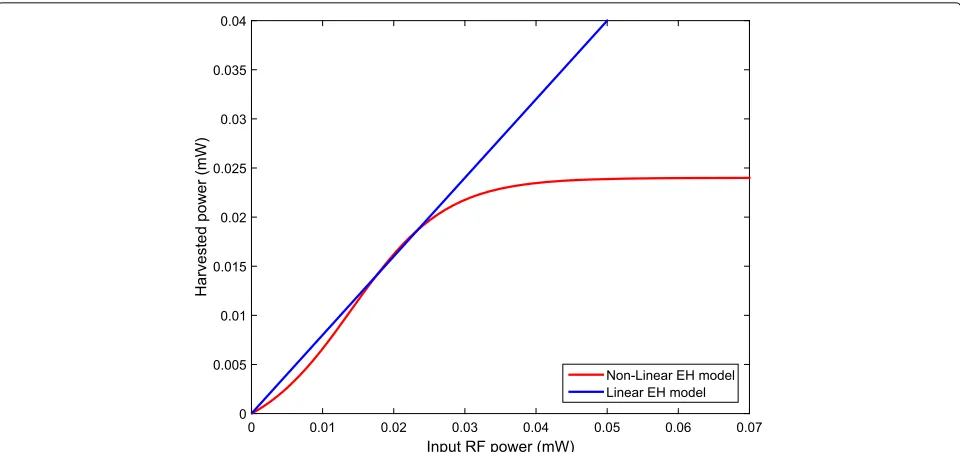
In the practical non-linear EH model, the amount of the harvested energy is modeled using the logistic (or sig-moid) function, i.e., S-shaped curve, as follows [28,29]:
EkNLi =
where Ps denotes the maximum amount of harvested
power when the EH circuit is saturated, and a and b are positive constants related to the circuit specification [28,29]. Figure 2 illustrates the practical non-linear EH model given in (7) and the conventional linear EH model given in (6). We assume that all the EH TEs apply the same non-linear energy harvester.
Energy consumption model
Most of the previous works assume that all harvested energy is used for power amplifier during the wireless information transmission phase [11,21–23]. In this work, we employ a more practical power consumption model for the TE. In particular, after the energy-harvesting phase, one portion of the harvested energy is used for neces-sary processing at TE to achieve its main task, and the remainder energy is used for uplink transmission during the wireless information transmission phase. Note that the similar model has also been applied in [39]. LetEPk
idenote
the processing energy2; in the wireless information trans-mission phase of time periodTI, the transmit power of TE kican be expressed as
puki= E
Note that (9) has assumed that the harvest energy is larger than the processing energy. Otherwise,puk
i should be set
to zero and an outage occurs.
Proposed beam-domain SWIPT protocol
In this paper, the frame-based protocol is applied to realize beam-domain SWIPT in the cellular system with mMIMO BS. The whole transmission process is divided intoNframes. Each frame can be divided into two phases based on the idea of TS, i.e.,phase Iandphase II, as shown in Fig.3.
Fig. 2A comparison between the linear EH model and the non-linear EH model. For linear EH model,η=0.8, for non-linear EH model [28,29],
Ps=0.024 mW,a = 150, andb = 0.014
the received energy signals for EH and the remainder for downlink channel estimation. In this phase, the main pur-pose of the protocol design is to enable TEs to collect as much energy as possible.
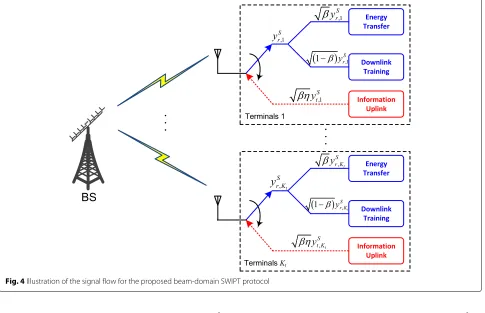
Specifically, the BS transmits the energy signals to all the TEs. The signal received byith TE can be expressed asySr,i. Part of the received energy signal,√βySr,i, is used for EH and part of the received signal,√1−βySr,i, is used for downlink channel estimation, whereβdenotes the PS ratio, as shown in Fig. 4. The detailed training signals design will introduced in the next subsection.
In phase II of time period(1−α)T, the TEs feedback the uplink CSI to the BS and transmit their data during the interval(1−α)Tusing the harvested energy. Specifically, theith TE transmits signal√βηySt,ito the BS. Note that the resource consumption for CSI feedback of TEs are omitted in this paper.
Energy signal design
LetEgt ∈ Cτt×Kgt be the orthogonal energy sequence set
transmit by the BS to the TE groupgt, whereKgt denotes
the number of TEs in groupgt, τt denotes the length of
Fig. 4Illustration of the signal flow for the proposed beam-domain SWIPT protocol
energy sequence and satisfiesτt ≥ bgt, and
E
gt
j,k
2 =
τtpdgt,k.p d
gt,k denotes the power of each energy symbol. Let
Gt denote the terminal group set, the time allocated for
the TEs EH isαT≥max{bgt|gt∈Gt}.
Energy transfer and TE downlink channel estimation
During phase I of framen, the received signal of TE group gtcan be expressed as
Ydgt[n]=HHd,g
t[n]
gt∈Gt
F Bgt[n],:
E
gt
T
+Ndgt[n]
(10)
where Hd,g
t[n]=
hdgt,1[n] ,· · ·,hdgt,
Kgt[n]
and Ndgt[n] denote additive white Gaussian noise (AWGN) with vari-ance σ2. The received signal at the gt,kth TE can be
expressed as
ydgt,k[n]=(hdgt,k[n])H
gt∈Gt
F Bgt[n],:
E
gt
T
+ndgt,k[n] (11)
wherengt,k[n]∼CN(0,σ
2)denotes the AWGN at TEg
t,k.
The TE harvests energy from one portion of the whole received signal, that is, √βydgt,k[n]. For signal with large transmit power, the energy of noise is negligible in the har-vested energy [16]. In the linear EH model, the harhar-vested energy of TEgt,kduring the framencan be written as
˜
EgL
t,k[n]=ηβ
(hdgt,k[n])H
gt∈Gt
F Bgt[n],:
E
gt
T
2
(12)
Based on the orthogonality of active beam space across
disjoint groups, that is,
F{Bgt[n],:},F Bgt[n],:
= 0 when Bgt[n]=Bgt[n], we have the following approximation
˜
EgL
t,k[n]≈ηβ
(hdgt,k[n])HF{Bgt[n],:}E gt
T
2 =ηβτtpdgt,k[n]
h˜{dB,ggt[n]}
t,k [n]
2ηβαTpˆHd,g
t,k
(13)
wherepˆHd,g
t,k =qgt,kp d
gt,k[n] andqgt,k =h˜ {Bgt[n]} d,gt,k [n]
2. In the adopted non-linear model, the amount of the harvested energy atgt,k is modeled using the logistic (or
sigmoid) function, i.e., S-shaped curve, as follows [28]:
˜
EgNLt,k[n]≈ PsαT
⎡
⎣ 1
1+exp
−a
βpˆHd, gt,k−b
−
⎤ ⎦
1−
Another portion of the TEgt,k received signal, that is, √
1−βydg
t,k[n], is used for the channel estimation. Since
the TE knows the values ofβ and hence can accurately compensate it, we omit it in the following channel estima-tion. The least square (LS) estimator [38] of the downlink channel can be expressed as
˜
where ek denotes the unit vector with the kth element is 1 and the rest of the elements are 0. The linear min-imum mean square error (LMMSE) estimate [38] of the downlink channel can be expressed as
˜ BS by using the CSI feedback3.
TE uplink information transmission
In phase II of time period(1−α)T, the TEs send signal using one portion of the harvested energy during phase I, and the BS uses the estimated effective channels to per-form receive beamper-forming and receive data sent byKT
TEs. The transmit power of TEgt,kcan be expressed as
pug
gt,k[n] denotes the currently available energy in
thenth frame, which can be expressed as the difference between the cumulative harvested energy and the con-sumed energy during the{1, 2,· · ·,n−1}th frame, that is,
energy, processing energy, TS ratio, and transmit power in theith frame, respectively.
Letsu
gt,k[n] denote the transmit signal of TEgt,k, and the
transmit power of TEgt,kis set topugt,k[n]=
sugt,k[n]2. The received signal at the BS can be expressed as
yut[n]=
AWGN vector with varianceσ2. In this paper, we apply the two-layer beamforming scheme. The first-layer
beam-former is a matrix composed of active beam setsF Bgt[n],: signal of the BS from groupgtcan be expressed as
˜ of group gt, the BS employs the second-layer receive
beamforming, i.e., y˙ugt[t]= WHgt[n]y˜ugt[n] and Wgt[n]=
The signal-to-interference-and-noise ratio (SINR) of the BS received signal from TEgt,kcan be expressed as
Let h˜{t,Bgtgt,k[n]} denote the channel estimation error of
power introduced by channel estimation error (CEE), inter-user interference (IUI), and inter-group interference (IGI), respectively. gt[n]= E
sugt[n](sugt[n])H
denotes the diagonal covariance matrix of groupgt.
The optimal wgt,k[n] is the vector that maximizes the SINRgt,k[n], and, thus, the second-layer beamformer can
be obtained by
The problem in (24) is in generalized Rayleigh quotient form. The maximum value in (24) can be obtained when wgt,k[n] equals to the generalized eigenvector correspond-ing to the maximum generalized eigenvalue [11], which can be written as
wgt,k[n]=
Achievable sum-rate analysis and optimization When optimizing the system achievable sum-rate, the fol-lowing two constraints should be considered: Firstly, the harvested energy at the TEs should be enough for the
signal transmission in the subsequent information trans-mission. Secondly, the minimum transmission rate of TEs should be guaranteed.
To guarantee the effective transmission of the power-limited devices, the currently available energy E˘gNLt,k[n] in thenth frame should be enough for the signal sion at devices in the subsequent information transmis-sion , that is,
whereðdenotes the minimum transmission energy con-straint of TEs.
With the help of the bounding technique [40] and according to (21), the average achievable rates at TEgt,k
can be expressed as
Rgt,k(P[n] ,α[n])=(1−α[n])log2
CEE, IUI, and IGI are introduced in (41). The system achievable rate can be expressed as
RSUM(P[n] ,α[n])= set transmitted by the BS to each TE and the uplink rate Rgt,k of TEgt,k are given in (41). LetRmindenote the
max
where PEd denotes the maximum transmit power con-straint at the BS during phase I. One can check that (30) is non-convex due to the constraints in p2 ∼ p6, and therefore it is not straightforward to obtain the globally optimal solution. To tackle this difficulty, we apply the lower bound of the available energy in the framen, that is,E˘NLgt,k[n]≥ ˜ENLgt,k[n]−EgPt,kn]≥ð. Since (14) is a transcen-dental function, this inequality cannot be solved directly. Fortunately, we know that the collected energyE˜NLgt,k[n] is bounded byPsαT; hence, to ensure the subsequent uplink
transmission of TEs, we havePsαT > EPgt,k[n]+ð, and if
this condition can be met, we have
α[n]> E P
gt,k[n]+ð
PsT α¨gt,k
[n] (31)
whereis given in (8). Hence, the SE optimization prob-lem in (30) can be rewritten as
max
In order to simplify the representation, we omit the frame indexnin the following derivations.
OptimizePfor fixedα
We fixα to α = α0. The uplink rate Rgt,k given in (41) the SINR of TEgt,k received signal can be expressed as
γgt,k = p
positive variables. Specifically,bgt,k =
on (41) and omit the group index, we can rewrite the SE optimization problem as
(34) is the constraint p5. We can see from Fig.ˆ 2 that pugt,k is a monotonic function of pdgt,k, the solution P of problem (33) is equivalent to the optimization ofPu =
pu
The form of SE optimization problem (33) is close to a geometric programming (GP) except that the target function is not in the posynomial form [41]. The convex optimization tools can be applied to solve (33) by using the technique in [42] to approximate the target. Specifi-cally, 1+γt,k can be approximated byλt,kγtμ,kt,k close to
. Thus, (33) can be rewritten as
min
Constraintsc1 can be re-expressed as
c1 : 1
Algorithm 1Solving problem (33) by GP:
1. Initialization: Compute the initial valueγˆt(,0k),i=1, set the value of toleranceεand maximum iteration numberL. 2. Forthenth iteration:
– Computeμt,k= ˆγt(,nk)1+ ˆγt(,nk) 4.Get the solutionPaccording to (14).
When the solutionPuof (35) is obtained, we can get the solutionPaccording to (14).
Optimizeαfor fixedP
We fix the transmit power of BS to P = P∗. Since the ratio used for information transmission can be adjusted by changing the duration of phase II, that is,(1−α)T. The uplink rateRgt,k(α)can be expressed as tremendous gain of antenna array applied in mMIMO sys-tem, it is reasonable to assume that the uplink received SINR given by (1) is much greater than 1. Hence, we can treatb˜gt,k,c˜gt,kas positive variables that are irrelevant toα.
From (34) we know that
pug tionally efficient resource allocation algorithm, we focus on a lower bound of the objective function:
max
of simplification, we ignoreP∗in the following derivation. The partial derivative ofRSUM(α) can be expressed as
∂RSUM(α)
The two order derivative ofRSUM(α)can be expressed as
∂2RSUM(α)
In this paper, we assume that the power of CEE, IUI, and IGI is much larger than AWGN. Hence, we have
∂2R
(42) is a transcendental equation, we can resort to Newton iterative method to solve this problem, that is, αˆk+1 = ˆαk − ∂RSUM∂α(α)/∂
Joint optimization ofαandP
Algorithm 2Solving problem (32):
1): InitialαandP. Set the value of toleranceξ. 2): For thek-th iteration:
– For fixedα, solve (33) by Algorithm 1 and get the optimalP(k)in this iteration.
– For fixedP, solveαusing the Newton iterative method, that is,
α(k)=α(k−1)− ∂RSUM(α) ∂α /
∂2RSUM(α)
∂2α |α=α(k−1).
Ifα(k)satisfies
1> α(k)≥ max
,
max{bgt|gt∈Gt}, max{ ¨αgt,k|k∈KT}
-T ,
thenα(k)=α(k). Otherwise,
α(k)= max
,
max{bgt|gt∈Gt}, max{ ¨αgt,k|k∈KT}
-T .
3): If|B(α(k))−RSUM(α(k)| < ξ, stop, else setk = k+1 and back to step 2).
In each iteration of Algorithm 2, the update ofαis per-formed by evaluating the first-order condition numerically, whose complexity is similar with the approach in [43].
Results and discussion
In this section, the performance of the proposed beam-domain SWIPT protocol is evaluated using the 3GPP LTE simulation model in macro-cell environment [44]. The
center frequency and bandwidth are set to 2.4 GHz and 20 MHz, respectively. The path loss between BS and TEs is modeled as 2.7+42.8 log10(R)[dB] and the path loss between terminals are modeled as 55.78+40 log10(R)[dB], whereRdenotes the distance. Thermal noise density is set to−174 dBm/Hz. The power ratio used for energy har-vestingβ is set to 0.8. The energy conversion efficiency ηfor linear harvester is set to 0.8. For the non-linear EH [28,29],Psin this paper is set to 0.024 mW,a= 150, and
b= 0.014, as shown in Fig.2. Hence, the energy conver-sion efficiency for non-linear EH is not a fixed number. For comparison, the performance of traditional mMIMO SWIPT protocol with MF precoder [31], with ZF precoder [32], and with MRT precoder [33] are also simulated. In the simulations, the uplink transmit power of TEs in [31–33] is also harvested from the BS downlink transmit signal. In simulations, the CSI obtained by beam-domain channel estimation is adopted in the above schemes, respectively.
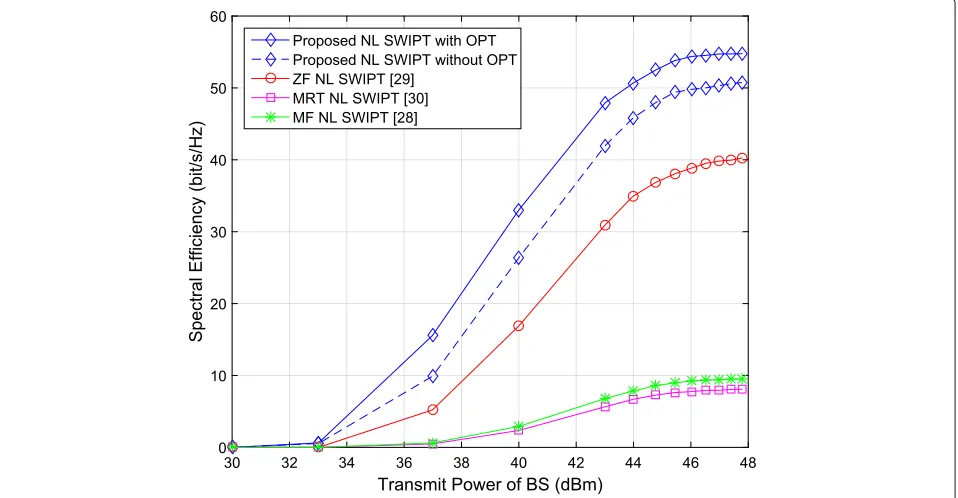
Figure5illustrates the SE of the proposed beam-domain SWIPT protocol for mMIMO system. All the TEs are gathered into three groups, respectively. Each group con-tains four TEs, and the DOA regions of TEs in each group are identical. The detailed DOA regions of three groups are [− 45◦,− 35◦], [ 12◦, 22◦], and [ 42◦, 52◦], respectively. The resulting AB sets for all the groups satisfy the TE grouping criteria in [11]. The transmit power of the BS is set to 20.2 dBm, and the distance between TEs and BS is set to 500 m. As a result, the aver-age BS receive signal-to-noise ratio (SNR) is 10 dB. We
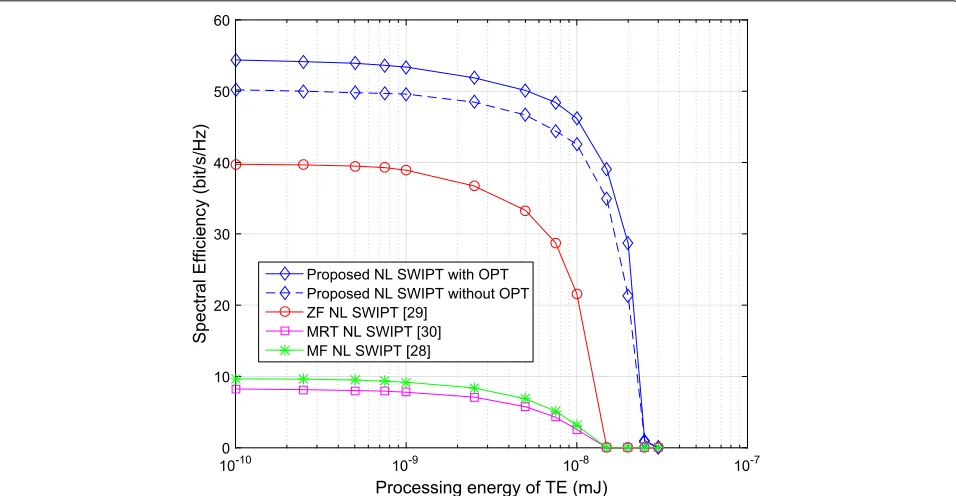
Fig. 6Spectral efficiency of the proposed SWIPT protocol with the varying of the processing energy of TE, the channel coherent time is 300 symbols,N = 256. The transmit power of the BS is set to 46 dBm
can see from Fig. 5 that with estimated effective beam-domain CSI, the required length of pilot sequence can be reduced significantly; hence, significant SE gain can be achieved over the traditional mMIMO SWIPT protocols [31–33].
Figure6depicts the SE of the proposed beam-domain SWIPT protocol with the varying of the processing energy of TE. In Fig. 6, the number of antennas at the BS is N = 256 antennas. We can see from Fig.6that by opti-mizing the TS ratio and the transmit powers of the BS for
different terminals, the proposed beam-domain SWIPT protocol obtains the best performance. When the pro-cessing energy of TE is grater than 2.6×10⁻⁸ mJ, the SE performance of all the schemes is close to 0. Figure7 depicts the SE of the proposed beam-domain SWIPT pro-tocol with the varying of the processing energy of TE. We can conclude from Fig. 7 that the SE performance gap between the proposed scheme and traditional mMIMO SWIPT protocols [31–33] will increase as the number of antennas increases.
Conclusion
In this paper, we propose a beam-domain SWIPT protocol for mMIMO system with non-linear energy harvesting. In order to reduce the pilot and feedback resource cost used for channel estimation, we resort BEM to represent mMIMO channel. In the wireless energy transmission phase, the beam domain energy beamforming is applied. In the information transmission phase, the two-layer receive beamforming is applied for the reception of signals transmitted by TEs. In order to improve the SE of the sys-tem, the BS transmit power- and time-switching ratio are optimized. Simulation results show the superiority of the proposed protocol on spectral efficiency compared with the conventional mMIMO SWIPT protocols.
Endnotes
1Different from the previous works in [45,46], in this
paper, the nonlinear energy harvesting model is applied, while in [45, 46], the linear energy harvesting model is applied. A practical energy consumption model is applied in this paper. Hence, this paper will meet new problems such as more practical harvested energy and available power at TEs, the sum-rate performance optimization under new constraints.
2Processing energy includes all energy consumption
except for TE uplink transmission, such as the energy consumption of the channel estimate, the energy con-sumption of the circuit, etc.
3This scenario is currently widely studied [43, 47]. In
this paper, we use beam domain downlink channel esti-mation. Since the effective channel length in the beam domain is greatly compressed, the feedback overhead for downlink channel estimation will be greatly reduced.
Abbreviations
3D: Three-dimensional; 5G: 5th-generation; AB: Active beam; AF:
Amplify-and-forward; AP: Access point; AWGN: Additive white Gaussian noise; BD: Beam-domain; BEM: Basis expansion model; BS: Base station; CEE: Channel estimation error; CSI: Channel state information; DOA: Direction of arrival; DOD: Direction of departure; EE: Energy efficiency; EH: Energy harvesting; GP: Geometric programming; HD: Half-duplex; ID: Information decoding; IGI: Inter-group interference; IoT: Internet of Things; IUI: Inter-user interference;
LMMSE: Linear minimum mean square error; LS: Least square; MF: Matched filter; MIMO: Multi-input multi-output; MRC: Maximal ratio combining; MRT: Maximum ratio transmission; PS: Power splitting; RF: Radio frequency; SE: Spectral efficiency; SNR: Signal-to-noise ratio; SI: Self-interference; SINR: Signal-to-interference-and-noise ratio; SWIPT: Simultaneous wireless information and power transfer; TE: Terminal; TS: Time switching; TWR: Two-way relaying; WET: Wireless energy transfer; ZF: Zero-forcing
Acknowledgements
The authors would like to thank the reviewers for their careful readings and valuable comments. This work is supported by Jiangsu Province Natural Science Foundation under Grant BK20160079, National Natural Science Foundation of China (No. 61671472,61771486).
Funding
This work is supported by Jiangsu Province Natural Science Foundation under Grant (BK20160079, BK20181335), National Natural Science Foundation of China (No. 61671472,61771486).
Availability of data and materials
Not applicable.
Authors’ contributions
KX is the main writer of this paper and proposed the main idea. MZ, ZS, NS, WX, and LC assisted in the simulations and analysis. All authors read and approved the final manuscript.
Authors’ information
Kui Xu was born in 1982. He received the B.S. degree in wireless
communications and the Ph.D. degree in software defined radio from the PLA University of Science and Technology, Nanjing, China, in 2004 and 2009, respectively. He is currently an Associate Professor with the College of Communications Engineering, Army Engineering University of PLA, Nanjing, China. Since 2013, he has been a Postdoctoral Fellow with the PLA University of Science and Technology. His research interests include broadband wireless communications, signal processing for communications, network coding, and wireless communication networks. He has authored about 50 papers in refereed journals and conference proceedings and holds five patents in China. He is currently serving on the Technical Program Committee of the IEEE WCSP 2014. He received the URSI Young Scientists Award in 2014 and the 2010 Ten Excellent Doctor Degree Dissertation Award of PLAUST. He also serves as the Reviewer of the IEEE TRANSACTIONS ON WIRELESS COMMUNICATION, the IEEE TRANSACTION VEHICLE TECHNOLOGY, the IEEE COMMUNICATIONS LETTER, the IEEE SIGNAL PROCESSING LETTERS.
Ming Zhang was born in 1992. He received the B.E. degree in communications engineering from the Xidian University in 2015, he is currently working toward the Ph.D. degree with the Institution of Communications Engineering in Army Engineering University of PLA. His research interests include MIMO techniques, heterogeneous network, full-duplex communication, and network coding. Jie Liu was born in 1984. He received the B.E. and M.S. degrees in communications engineering from the PLA University of Science and Technology in 2006 and 2009. His research interests include MIMO techniques, heterogeneous network, full-duplex communication, and network coding. Nan Sha was born in China, 1981. He received the B.S. degree in wireless communications and the Ph.D. degree in software defined radio from the PLA University of Science and Technology, Nanjing, China, in 2003 and 2013, respectively. He is currently an Associate Professor with the College of Communications Engineering, Army Engineering University of PLA, Nanjing, China. His research interests include broadband wireless communications, signal processing for communications, network coding, and wireless communication networks.
Wei Xie was born in 1972. He received the B.S. and Ph.D degrees in communication engineering in 1999 and 2015, respectively, from the PLA University of Science and Technology, Nanjing, China. His research interests include MIMO techniques, heterogeneous network, full-duplex
communication, and network coding.
PLA, Nanjing, China. Her research interests include new generation wireless mobile communication system, radio resource management, and network coding in wireless communication.
Competing interests
The authors declare that they have no competing interests.
Publisher’s Note
Springer Nature remains neutral with regard to jurisdictional claims in published maps and institutional affiliations.
Received: 6 December 2018 Accepted: 21 February 2019
References
1. F. Javed, M. K. Afzal, M. Sharif, B. Kim, Internet of Things (IoT) operating systems support, networking technologies, applications, and challenges:
a comparative review. IEEE Commun. Surv. Tutor.20(3), 2062–2100 (2018)
2. X. Lu, P. Wang, D. Niyato, D. I. Kim, Z. Han, Wireless charging technologies:
fundamentals, standards, and network applications. IEEE Commun. Surv.
Tutor.18(2), 1413–1452 (2016)
3. I. Krikidis, S. Timotheou, S. Nikolaou, G. Zheng, D. W. K. Ng, R. Schober,
Simultaneous wireless information and power transfer in modern
communication systems. IEEE Commun. Mag.52(11), 104–110 (2014)
4. Z. Ding, et al., Application of smart antenna technologies in simultaneous
wireless information and power transfer. IEEE Commun. Mag.53(4),
86–93 (2015)
5. F. Rusek, D. Persson, B. K. Lau, E. G. Larsson, T. L. Marzetta, O. Edfors, F. Tufvesson, Scaling up MIMO: opportunities and challenges with very large arrays. IEEE
Signal Proc. Mag.30(1), 40–60 (2013)
6. J. Hoydis, S. Brink, M. Debbah, Massive MIMO in UL/DL of cellular
networks: how many antennas do we need? IEEE J. Sel. Areas Commun.
31, 160–171 (2013)
7. E. G. Larsson, F. Tufvesson, O. Edfors, T. L. Marzetta, Massive MIMO for next
generation wireless systems. IEEE Commun. Mag.52(2), 186–195 (2014)
8. C. Sun, X. Gao, S. Jin, M. Matthaiou, Z. Ding, C. Xiao, Beam division multiple
access transmission for massive MIMO communications. IEEE Trans.
Commun.63(6), 2170–2184 (2015)
9. X. Xia, K. Xu, Y. Wang, Y. Xu, A 5G-enabling technology: benefits, feasibility,
and limitations of in-band full-duplex mMIMO. IEEE Veh. Technol. Mag.
13(3), 81–90 (2018)
10. D. K. Nguyen, D. N. Jayakody, S. Chatzinotas, J. Thompson, J. Li, Wireless energy harvesting assisted two-way cognitive relay networks: protocol
design and performance analysis. IEEE Access.5, 7–21460 (2017)
11. K. Xu, Z. Shen, X. Xia, Y. Wang, D. Zhang, Hybrid time-switching and power splitting SWIPT for full-duplex massive MIMO systems: a beam-domain
approach. IEEE Trans. Veh. Technol.67(8), 7257–7274 (2018)
12. K. Xu, Z. Shen, X. Xia, Y. Wang, D. Zhang, Beam-domain hybrid time-switching and power-splitting SWIPT in full-duplex massive MIMO
system. EURASIP J. Wirel. Commun. Networking.2018, 1–21 (2018)
13. G. Pan, H. Lei, Y. Yuan, Z. Ding, Performance analysis and optimization for
SWIPT wireless sensor networks. IEEE Trans. Commun.65(5), 2291–2302
(2017)
14. Z. Liu, W. Du, D. Sun, Energy and spectral efficiency tradeoff for massive MIMO systems with transmit antenna selection. IEEE Trans. Veh. Technol.
66(5), 4453–4457 (2017)
15. K. Huang, X. Zhou, Cutting the last wires for mobile communications by
microwave power transfer. IEEE Commun. Mag.53(6), 86–93 (2015)
16. A. A. Nasir, X. Zhou, S. Durrani, R. A. Kennedy, Relaying protocols for wireless energy harvesting and information processing. IEEE Trans. Wirel.
Commun.12(7), 3622–3636 (2013)
17. Y. Huang, B. Clerckx, Relaying strategies for wireless-powered MIMO relay
networks. IEEE Trans. Wirel. Commun.15(9), 6033–6047 (2016)
18. C. Li, H. J. Yang, F. Sun, J. M. Cioffi, L. Yang, Multiuser overhearing for
cooperative two-way multiantenna relays. IEEE Trans. Veh. Technol.65(5),
3796–3802 (2016)
19. C. Li, S. Zhang, P. Liu, F. Sun, J. M. Cioffi, L. Yang, Overhearing protocol design exploiting inter-cell interference in cooperative green networks.
IEEE Trans. Veh. Technol.65(1), 441–446 (2016)
20. C. Li, P. Liu, C. Zou, F. Sun, J. M. Cioffi, L. Yang, Spectral-efficient cellular communications with coexistent one-and two-hop transmissions. IEEE
Trans. Veh. Technol.65(8), 6765–6772 (2016)
21. Z. Chen, B. Xia, H. Liu, inIEEE Global Conference on Signal and Information
Processing (GlobalSIP). Wireless information and power transfer in two-way amplify-and-forward relaying channels (IEEE Press, Piscataway, 2014), pp. 168–172
22. K. Tutuncuoglu, B. Varan, A. Yener, Throughput maximization for two-way relay channels with energy harvesting nodes: the impact of relaying
strategies. IEEE Trans. Commun.63(6), 2081–2093 (2015)
23. D. Li, C. Shen, Z. Qiu, in2013 IEEE International Conference on
Communications (ICC). Two-way relay beamforming for sum-rate maximization and energy harvesting (IEEE Press, Piscataway, 2013), pp. 3155–3120
24. B. Clerckx, Wireless information and power transfer: nonlinearity, waveform design, and rate-energy tradeoff. IEEE Trans. Signal Process.
66(4), 847–862 (2018)
25. H. Tran, G. Kaddoum, K. T. Truong, Resource allocation in SWIPT networks under a nonlinear energy harvesting model: power efficiency, user
fairness, and channel nonreciprocity. IEEE Trans. Veh. Technol.67(9),
8466–8480 (2018)
26. T. Le, G. Kaddoum, O. Shin, Joint channel resources allocation and beamforming
in energy harvesting systems. IEEE Wirel. Commun. Lett.7(5), 884–887 (2018)
27. H. Tran, G. Kaddoum, in 2018IEEE Wireless Communications and
Networking Conference (WCNC). Green cell-less design for RF-wireless power transfer networks, (Barcelona, 2018), pp. 1–6
28. E. Boshkovska, D. W. K. Ng, N. Zlatanov, A. Koelpin, R. Schober, Robust resource allocation for MIMO wireless powered communication networks
with non-linear EH model. IEEE Trans. Commun.65(5), 1984–1999 (2017)
29. B. Clerckx, R. Zhang, R. Schober, D.WK. Ng, D.I. Kim, H.V. Poor,
Fundamentals of wireless information and power transfer: from RF energy harvester models to signal and system designs. IEEE J. Sel. Areas
Commun.37(1), 4–33 (2019)
30. P. N. Alevizos, A. Bletsas, Sensitive and nonlinear far-field RF energy
harvesting in wireless communications. IEEE Trans. Wirel. Commun.17(6),
3670–3685 (2018)
31. L. Fan, H. Zhang, Y. Huang, L. Yang, Exploiting BS antenna tilt for SWIPT in 3-D
massive MIMO systems. IEEE Wirel. Commun. Lett.6(5), 666–669 (2017)
32. X. Wang, J. Liu, C. Zhai, Wireless power transfer based multi-pair two-way
relaying with massive antennas. IEEE Trans. Wirel. Commun.16(11),
7672–7684 (2017)
33. S. Lee, Y. Zeng, R. Zhang, Retrodirective multi-user wireless power transfer
with massive MIMO. IEEE Wirel. Commun. Lett.7(1), 54–57 (2018)
34. G. Yang, C. K. Ho, R. Zhang, Y. L. Guan, Throughput optimization for massive mimo systems powered by wireless energy transfer. IEEE J. Sel.
Areas Commun.33(8), 1640–1650 (2015)
35. 3GPP TR 25.996, Universal mobile telecommunications system (UMTS); spatial channel model for multiple input multiple output (MIMO)
simulations. v.12.0.0 (2012).www.3gpp.org. Accessed 7 Mar 2019
36. G. B. Giannakis, C. Tepedelenlioglu, Basis expansion models and diversity techniques for blind identification and equalization of timevarying
channels. Proc. IEEE.86(10), 1969–1986 (1998)
37. A. Sayeed, Deconstructing multiantenna fading channels. IEEE Trans.
Signal Process.50(10), 2563–2579 (2002)
38. X. Xia, K. Xu, D. Zhang, Y. Xu, Y. Wang, Beam-domain full-duplex massive MIMO: realizing co-time co-frequency uplink and downlink transmission
in the cellular system. IEEE Trans. Veh. Technol.66(10), 8845–8862 (2017)
39. S. Kashyap, E. Björnson, E.G. Larsson, On the feasibility of wireless energy
transfer using massive antenna arrays. IEEE Trans. Wirel. Commun.15(5),
3466–3480 (2016)
40. B. Hassibi, B. M. Hochwald, How much training is needed in
multiple-antenna wireless links? IEEE Trans. Inf. Theory.49(4), 951–963
(2003)
41. S. Boyd, L. Vandenberghe,Convex Optimization. (IEEE Press, Piscataway,
2004)
42. P. C. Weeraddana, M. Codreanu, M. Latva-aho, A. Ephremides, Resource allocation for cross-layer utility maximization in wireless networks. IEEE
Trans. Veh. Technol.60(6), 2790–2809 (2011)
43. Z. Chang, Z. Wang, X. Guo, Z. Han, T. Ristaniemi, Energy-efficient resource allocation for wireless powered massive MIMO system with imperfect CSI.
44. 3GPP TR 36.828, Further enhancements to LTE time division duplex (TDD) for downlink-uplink (DL-UL) interference management and traffic
adaptation. v.11.0.0 (2012).www.3gpp.org. Accessed 7 Mar 2019
45. K. Xu, Z. Shen, Y. Wang, X. Xia, Resource allocation for hybrid TS and PS
SWIPT in massive MIMO system. Physical Communication.28, 201–213
(2018)
46. K. Xu, Z. Shen, Y. Wang, X. Xia, Beam-domain SWIPT in massive MIMO
system with energy-constrained terminals. IET Communications.12(15),
1900–1909 (2018)
47. M.M. Zhao, Q. Shi, Y. Cai, M.J. Zhao, Joint transceiver design for full-duplex cloud radio access networks with SWIPT. IEEE Trans. Wirel. Commun.