The Ellogon Pattern Engine: Context-free Grammars over Annotations
Georgios Petasis
Software and Knowledge Engineering Laboratory Institute of Informatics and Telecommunications National Centre for Scientific Research (N.C.S.R.) “Demokritos”
GR-153 10, P.O. BOX 60228, Aghia Paraskevi, Athens, Greece [email protected]
Abstract
This paper presents the pattern engine that is offered by the Ellogon language engineering platform. This pattern engine allows the application of context-free grammars over annotations, which are metadata generated during the processing of documents by natural language tools. In addition, grammar development is aided by a graphical grammar editor, giving grammar authors the capability to test and debug grammars.
Keywords:context-free grammar, grammar over annotations, LARL parser
1.
Introduction
Developing pipelines of tools for many tasks of natural lan-guage processing, such as named-entity recognition or sen-timent analysis, has never been an easy task. One research direction that tried to alleviate this difficulty, was research on infrastructures/platforms for natural language engineer-ing: Within this context of research several platforms have been developed and made publicly available, usually dis-tributed with open source libraries. Indeed, platforms like GATE1 (Cunningham et al., 2013), Ellogon2 (Petasis et
al., 2002) or Apache UIMA3 have made the development
of natural language processing pipelines easier, by provid-ing suitable infrastructure for many common tasks, includ-ing corpora management, models for the linclud-inguistic meta-data, a modular environment where components interoper-ate, metadata visualisation tools, and toolboxes of ready-to-be-used natural language processing tools. The availability of ready-to-use tools, such as ANNIE (Cunningham et al., 2002), has increased the popularity of these platforms, es-pecially through their use as “black boxes”, that perform tasks such as information extraction.
However, there are situations where the provided by a plat-form tools and pipelines are not enough: Either the per-formance is not enough for specific tasks, or the task at hand requires modifications, or even new tools. In such cases, components offered by a platform must be modified, or new components must be written for the platform, which requires developers to be first acquainted with the internal organisation and programming interfaces of the platform, and then to develop the required components. Typically, a component inside a platform operates on the text of the doc-ument to be processed, taking into consideration linguistic metadata that has been produced by other processing com-ponents, while the component is expected to enrich this lin-guistic metadata.
On the other hand, there are grammars which are play-ing an important role in many natural processplay-ing tasks, and their use is widespread in a much broader audience,
1
http://gate.ac.uk/
2
http://www.ellogon.org/
3http://uima.apache.org/
including non-developers, such as linguists. Despite the fact that grammars are usually associated with sequences of characters and strings, it is feasible to apply them on “sequences” of any kind of objects, which may be far more complex than characters. The work presented in this paper tries to combine grammars with component development, by implementing a pattern engine that can apply context-free grammars on linguistic metadata, in the form of an-notations of the Ellogon language engineering platform. This pattern engine can apply a grammar on theannotation
graph of a document, which models the linguistic
meta-data/information kept for a document within Ellogon. The motivation behind this pattern engine is to allow users to perform transformations of the linguistic metadata with-out the need to develop a component in languages such as C/C++/Java/Tcl/Python/Perl, and instead construct a gram-mar that contains rules and actions, in a “neutral” language, that is not tied to a specific programming language. Obvi-ously, the linguistic tasks that can be modelled through such an engine, clearly depend on the expressivity of both the rules, that must be matched on the annotation graph, and the actions, which define the operations that can be performed on the linguistic metadata. Thus, we have opted context-free grammars over regular grammars for the rules, while actions can be augmented with Tcl code, if the provided action types are found insufficient for a specific natural lan-guage processing task.
2.
Related Work
pattern-matching, semantic extraction, and many other op-erations in the context of the ANNIE (Cunningham et al., 2002) information extraction system, included in the GATE platform. TextMarker (Kl¨ugl et al., 2008; Kluegl et al., 2009) is another rule-based engine, aiming also at informa-tion extracinforma-tion, which has been integrated into the Apache UIMA4 platform, leading to Apache UIMA Ruta5
(Rule-based Text Annotation). UIMA Ruta offers an “imperative rule language extended with scripting elements”6. A rule is
composed of a sequence of rule elements and a rule element essentially consists of four parts: A matching condition, an optional quantifier, a list of conditions and a list of actions. In addition, a workbench is provided, which provides edit-ing support (i.e. syntax checkedit-ing), rule application debug-ging, and rule learning through the included “TextRuler” framework, which is able to induce rules and, therefore, enable semi-automatic development of rule-based compo-nents.
“Stanford TokensRegex”7is a framework included in
Stan-ford CoreNLP, for defining regular expressions over text and tokens, and mapping matched text to semantic objects. Implemented as a set of stages, the TokensRegex pipeline reads extraction rules from a file and applies them sequen-tially over text and tokens, followed by “composite” rules which are repeatedly applied until no changes are detected. Then, at the last stage, “filtering” rules are applied to to dis-card any expressions that should not be matched. Unitex8 is a corpus processing system, based on automata-oriented technology. It offers a pattern engine, allowing regular ex-pression over tokens associated with simple morphological information, such as token shapes. Despite the fact that it is more limited that the aforementioned systems, it still allows regular expressions not only on text, but also on lin-guistic metadata. Finally, “graph expression” or “GExp”9,
according to its authors, is similar to GATE JAPE, and al-lows expressions to be applied on graphs. However, not much information is available for this pattern engine, with the exception of a few examples.
One common aspect of all these engines, is their bias to-wards regular languages: All approaches presented so far employ some form of either regular grammars or Perl-style regular expressions (which are slightly more expres-sive than regular grammars), and they tend to handle cases that need greater expressiveness with the cascade applica-tion of different grammars. The fact that no engine tries to implement a more expressive language, motivated us to ex-plore context-free grammars, in order to evaluate their ap-plicability on the task of component construction, and de-cide whether a more expressive formalism has more advan-tages over disadvanadvan-tages when compared to regular gram-mar formalisms. Potential advantages include applicability in more complex tasks (that require higher level
dependen-4http://uima.apache.org/
cies than those that can be handled by regular expressions), and more “elegant”, “compact” and easier to handle gram-mars. On the other hand, context free grammars can be less efficient with respect to their application and more am-biguous, leading to multiple parses. However, the Ellogon’s Pattern Engine is a fairly recent addition to the Ellogon plat-form, with limited usage so far, which does not allow us to draw any conclusions over the advantages of using context-free grammars over regular ones. To our knowledge, the only uses of the Ellogon’s Pattern Engine are limited to a) a shallow syntactic parser that identifies phrases for Greek (included in Ellogon), and b) to a commercial sentiment analysis system for Greek (Petasis et al., 2014).
3.
Ellogon’s Data Model
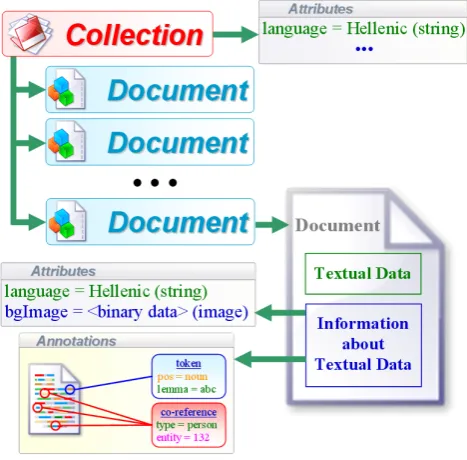
The data model of Ellogon is based on the data model of the TIPSTER (Harman, 1992) project. Due to this, it shares some basic features with other TIPSTER-based infrastruc-tures, but it also offers a large number of features that dif-ferentiate it from such infrastructures. The central element for storing data in Ellogon is the Collection. A collection is a finite set of Documents. An Ellogon document consists of textual data as well as linguistic information about the tex-tual data. This linguistic information is stored in the form of attributes and annotations.
An attribute associates a specific type of information with a typed value. An annotation associates arbitrary informa-tion (in the form of attributes) with porinforma-tions of textual data. Each such portion, named span, consists of two character offsets denoting the start and the end characters of the por-tion, as measured from the first character of some textual data. Annotations typically consist of four elements (fig-ure 1):
• A numeric identifier. This identifier is unique for ev-ery annotation within a document and can be used to unambiguously identify the annotation.
• A type. Annotation types are textual values that are used to classify annotations into categories.
• A set of spans that denote the range of the annotated textual data.
• A set of attributes. These attributes usually encode the necessary linguistic information.
The vast majority of the linguistic metadata about a doc-ument is represented through annotations, which associate an arbitrary set of attributes with one or more segments in the document’s text.
4.
A Pattern Engine for Context-free
Grammars
Figure 1: The data model of Ellogon.
parser (Earley, 1970), depending on the grammar. The re-sulting parser is then serialised into an object, which can later be loaded into Ellogon in order to process documents and their annotations.
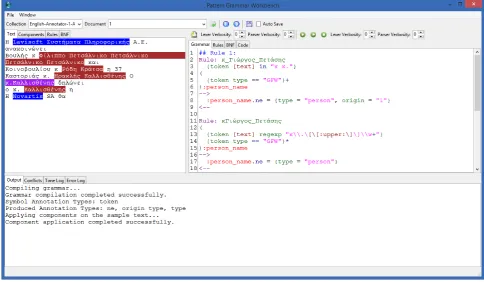
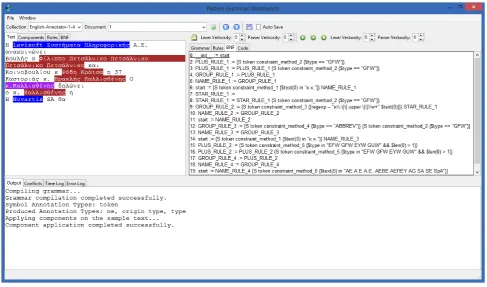
The pattern engine will try to generate optimised parsers, and will silently perform some simple optimisations on the input grammar, in order to improve processing efficiency and detect some common problematic cases, which may cause efficiency problems, such as some types of recur-sion. In addition, it offers a simple development environ-ment, where the grammar author can edit the grammar, see the various intermediate steps (such as the rules in BNF), apply the grammar on text and visualise the results of the matched actions. This development environment, with a simple grammar that adds an attribute to all verbs in a doc-ument, is shown in figure 2. Figures 3 and 4 show a slightly more complex grammar, which tries to detect some simple named-entities, and the entities that have been detected by applying this grammar on the sample text on the left part of the editor. Finally, figure 5 shows the grammar after its conversion to BNF. The editor, beyond being an editor and a test environment for a grammar, it additionally provides some simple debugging capabilities, in the sense that the user can apply the grammar “step-by-step”, and examine how the generated parser matches each annotation found in the linguistic metadata. Grammars can use and mix any type of annotations, no matter what their level in the pro-cessing chain is.
4.1.
The Pattern Engine Grammar Language
The grammar of the Ellogon’s pattern engine is loosely modelled after CPSL – Common Pattern Specification Lan-guage10, upon which JAPE11is also based. JAPE is asimi-10
http://www.ai.sri.com/˜appelt/TextPro/
11http://gate.ac.uk/sale/tao/index.html#
x1-2120008
lar pattern engine, which implements regular expressions over annotations within the GATE language engineering platform. Since both pattern engines share common ances-try, interoperability may be easier between these two en-gines than, for example, Apache Ruta, which uses a dif-ferent grammar formalism. GATE Jape, having a history of more than ten years, provides a significant number of grammars (i.e. within the open source ANNIE system) that can allow the future comparison of the two engines, if these grammars get ported to the Ellogon’s pattern engine. How-ever, despite being based on a common ancestor and bear-ing some similarities, the two grammar languages are not identical, and grammars from one platform are not expected to operate on the other platform without modification. We expect that it will be easier to port grammars from JAPE to Ellogon’s pattern engine than doing the opposite, which will be applicable only on Ellogon’s grammars that are not context-free.
A grammar consists of a set of rules, each of which consists of a set of patterns (the left-hand-side (LHS) of the rule) and an action (the right-hand-side (RHS) of the rule). When the LHS of a rule is matched over the input, the RHS is exe-cuted and modifies the linguistic metadata, usually through the addition of new annotations or new attributes to exist-ing annotations. Actions can refer to various parts of the pattern in the LHS by means of labels that are attached to pattern elements. Consider the following example:
R u l e : s e t a t t r i b u t e t o s o m e t o k e n s {t o k e n p o s match ”V∗”}: a n n −−>
: a n n . t o k e n = {i s v e r b = ” t r u e ”}; <−−
Figure 2: The development environment of the pattern engine, with a simple grammar loaded.
Figure 3: The development environment of the pattern engine, with a slightly more complex grammar loaded.
rules. More information about the grammar language can be found in the Ellogon developers manual12.
12http://www.ellogon.org/index.php/
download/documentation
pro-Figure 4: The development environment of the pattern engine, with a grammar applied on the sample text and the results of the actions visible.
cessing tools. The pattern engine is accompanied by a sim-ple graphical grammar editor, which offers simsim-ple debug-ging facilities in order to facilitate grammar development. Having a pattern engine which can modify the linguistic metadata driven by a grammar and according to actions as-sociated to grammar rules, can constitute a valuable tool for modelling a significant set of natural language process-ing tasks, such as named-entity recognition or sentiment analysis, without the need to develop an new component for the language engineering platform. The described pat-tern engine is a recent addition to the Ellogon platform, with limited usage so far, which does not allow us to draw any conclusions over the advantages of using context-free grammars over regular ones. As a result, future work will concentrate into writing grammars for this new en-gine, in order to evaluate the advantages and disadvantages of using a formalism with greater expressivity than regu-lar patterns. Finally, the described pattern engine and the graphical grammar editor are distributed along with the El-logon language engineering platform, freely available from http://www.ellogon.org under the LGPL version 3 open source license.
6.
References
Appelt, D. E. and Onyshkevych, B. (1998). The com-mon pattern specification language. In Proceedings of a Workshop on Held at Baltimore, Maryland: October 13-15, 1998, TIPSTER ’98, pages 23–30, Stroudsburg, PA, USA. Association for Computational Linguistics. Cunningham, H., Maynard, D., and Tablan, V. (2000).
Jape: a java annotation patterns engine. Technical re-port, University of Sheffield, Department of Computer Science.
Cunningham, H., Maynard, D., Bontcheva, K., and Tablan, V. (2002). GATE: A Framework and Graphical Devel-opment Environment for Robust NLP Tools and Applica-tions. InProceedings of the 40th Anniversary Meeting of the Association for Computational Linguistics (ACL’02). Cunningham, H., Tablan, V., Roberts, A., and Bontcheva, K. (2013). Getting more out of biomedical documents with gate’s full lifecycle open source text analytics.
PLoS Comput Biol, 9(2):e1002854, 02.
DeRemer, F. (1969). Practical Translators for LR(k) Lan-guages. MAC-TR. Project Mac, Massachusetts Institute of Technology.
Earley, J. (1970). An efficient context-free parsing algo-rithm. Commun. ACM, 13(2):94–102, February. Harman, D. (1992). The darpa tipster project. SIGIR
Fo-rum, 26(2):26–28, October.
Kluegl, P., Atzmueller, M., and Puppe, F. (2009). Textmarker: A tool for rule-based information extrac-tion. In Chiarcos, C., de Castilho, R. E., and Stede, M., editors, Proceedings of the Biennial GSCL
Confer-ence 2009, 2nd UIMA@GSCL Workshop, pages 233–
240. Gunter Narr Verlag.
Kl¨ugl, P., Atzm¨uller, M., and Puppe, F. (2008). Integrat-ing the rule-based ie component textmarker into uima. In Baumeister, J. and Atzm¨uller, M., editors,LWA, vol-ume 448 ofTechnical Report, pages 73–77. Department of Computer Science, University of W¨urzburg, Germany.
Petasis, G., Karkaletsis, V., Paliouras, G., Androutsopou-los, I., and SpyropouAndroutsopou-los, C. D. (2002). Ellogon: A New Text Engineering Platform. In Proceedings of the 3rd International Conference on Language Resources and Evaluation (LREC 2002), pages 72–78, Las Palmas, Ca-nary Islands, Spain, May 29–31. European Language Re-sources Association.
Petasis, G., Spiliotopoulos, D., Tsirakis, N., and Tsantilas, P. (2014). Sentiment analysis for reputation manage-ment: Mining the greek web. InA. Likas and K. Blekas
and D. Kalles (Eds.): SETN 2014, LNCS 8445, pages