TO ANALYSIS THE EFFECT OF RLC
LOAD ON HARMONIC DISTORTION OF
IGBT BASED VOLTAGE STABILIZATION
Jyoti Lalotra
1, Abhinav Sharma
2, Saleem khan
3, Parveen Lehana
4M.Tech Student, Dept. of EEE, Arni University, Kathgarh H.P, India1 M.Tech Student, Dept. of EEE, Arni University, Kathgarh H.P, India2 PhD Scholar, Dept. of Physics and Electronics, University of Jammu, J&K, India3 Associate professor, Dept. of Physics and Electronics, University of Jammu, J&K, India4
Abstract: This paper describes the concept of harmonics in power systems. Investigations are carried out to analyse the effect of loads (combination of resistive, inductive and capacitive) on the IGBT based Voltage stabilization. Harmonic distortions in the input and output voltage of the system is calculated. Eight Different combinations of the load are taken inductance ranging from approximate value of 1.232H to 269.1mH keeping resistance 36 Ω and capacitance 2.5μF. Input and output voltages waveforms were recorded processed using Gold wave and digital signal processing software respectively. The sampling rate and duration of measurement are kept at value of 16000 and 1s respectively.
Keywords: Harmonic distortion, IGBT, load effect, power system, voltage stabilization.
I. INTRODUCTION
Harmonics have existed in power systems for many years. In the past, most electrical equipment is using balance linear load. A linear load in a power system distribution is a component in which the current and voltage are perfect sinusoidal [1]. Examples of linear loads are induction motor, heaters and incandescent lamps [2]. But the rapid increase in the electronics device technology such as diode, thyristors, etc cause industrial loads to become non-linear. These components are called non-linear load [3]. The non-linear load connected to the power system distribution will generate harmonics current and voltage [4] [5]. Power system harmonic are not new fact. It is mainly caused by saturation of loads such as transformers, industrial arc furnaces, cables, Switching mode power supplies and other devices [6][7].
A harmonic is a sinusoidal component of a complex wave or quantity having a frequency that is an integral multiple of the fundamental frequency [8].
( )
h
f
h
(Fundamental frequency) where h is an integerHarmonic distortions waveform extremely alters the shape of the sinusoid. However, no matter the level of complexity of the fundamental wave, it‟s just a combination of multiple waveforms called harmonics.
The research work is carried out to investigate the effect of impedance i.e. change in the inductance keeping capacitance and resistance constant on the designed IGBT based power system. Signal processing technique is used to evaluate the effect of the impedance and calculation of total harmonic distortion (THD).
Harmonic solution is divided into two ways drive and rectifier solutions and solutions for Commercial facilities for solution of harmonics.
A. Drive and rectifier
It has low cost current harmonics
percent of impedance are available at different values
Increased the protection for AFD and its semiconductors are provided Reduction in voltage and current harmonics by using source reactance. less voltage drop
B. Solutions for commercial facilities Decrease phase current Reduce neutral current [10].
There are some popular technologies that help to reduce the harmonics:
A. Passive filter
Passive filter is made up of several different components like resistors, capacitors and inductors. It is simply apply for a given transfer function. Passive filter is best because they require less power supplies and little noise occurs as compared to active gain elements [11].
B. Active filter
Active filters use, specially op amps with resistors and capacitors Active filters can have high input impedance, low output impedance the design of active filter are simpler than passive filter. This is most important attribute is that they lack inductors, thereby help to reduce the harmonics [12].
C. The switched – capacitor filter
Another types of filter are used to reduce harmonics is switched and capacitor types filter .the switched filter are used for last decade. Switched capacitor filters need external capacitors or inductors and their cut off frequencies by an external clock frequency [13].
D. Steps for reducing the telephone interferences The steps are as following:
Increase spacing
Improve balance of AC power lone by transmission Ground based telephone circuit should be replaced Use of underground telephone cables
III.METHODOLOGY
Voltage Measurement
circuit
Microcontroller based stabilizer
Input voltage level shifting
Combination of Load RLC
Load voltage level shifting
Sound card
PC
in
V
Fig. 1 Schematics of the complete block diagram of the system
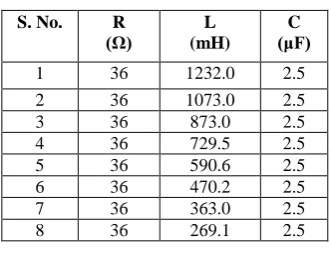
IGBT and other peripheral and the output from microcontroller based stabilizer is applied to load block. In this block load consists of series combinations of resistor, capacitor and inductor. Different combinations of impedance are taken shown in Table 1. Eight different combinations of the load are taken inductance ranging from 1.232H to 269.1mH keeping resistance 36 Ω and capacitance 2.5μF. The input and output voltages are recorded in the PC using sound card and voltage level shifting block. This block is required to bring down the voltage level from hundreds of volts to millivolts, so that it can be applied to sound card. Signals are recorded and processed using Gold wave and digital signal processing software respectively. The sampling rate and duration of measurement are kept at value of 16000 and 1s respectively.
TABLEIDIFFERENTCOMBINATIONOFLOADRLC
S. No. R
(Ω) (mH) L
C (μF)
1 36 1232.0 2.5
2 36 1073.0 2.5
3 36 873.0 2.5
4 36 729.5 2.5
5 36 590.6 2.5
6 36 470.2 2.5
7 36 363.0 2.5
8 36 269.1 2.5
IV.RESULT AND DISCUSSION
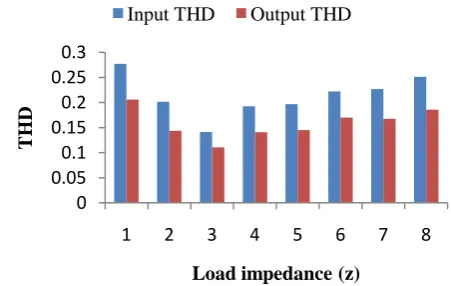
input and output total harmonic distortion for eight different load values are given in Tables 2. The calculated experimentally values of input and output of THD are plotted in Fig. 3 with different impedance values.
TABLE II INPUT AND OUTPUT VALUE OF THD
S. No. Impedance Z
Input THD
Output THD
1 886.9 0.2772 0.2059
2 936.8 0.2015 0.1434
3 999.6 0.1412 0.1107
4 1044.7 0.1923 0.1409
5 1088.3 0.1968 0.1452
6 1126.1 0.2218 0.1700
7 1159.8 0.2269 0.1675
8 1189.2 0.2511 0.1855
As the values of the impedance is decreased i.e. variation in the value of inductance from Henry (H) to mH, the input and output value of total harmonic distortion (THD) rises giving maximum and minimum values of 0.2772 and 0.1412 and output value is 0.2059 and0.1107 respectively. There is also some difference in input and output value of THD is seen in the plot for certain combinations which may arise due to leakage of the inductive or capacitive components. Form the calculated values of THD in input and output it is observed that the harmonic distortion in the output is comparatively less than the input.
(a). Z = 886.9 (b). Z = 936.8
(e). Z = 1088.3 (f). Z = 1126.1
(g). Z = 1159.8 (h). Z = 1189.2
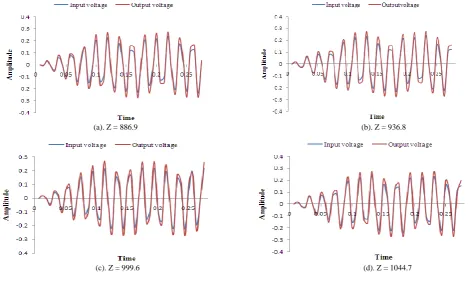
Fig. 2(a-h) Input and output voltage signal with eight varying values of inductance and constant values of resistance and capacitance. Signal recorded at 16,000 sampling rate.
Fig.3 Experimental values of input and output of THD with different impedance values.
V. CONCLUSION
In this research work carried out effect of loads (combination of resistive, capacitive, and inductive) on the IGBT based voltage stabilization causing harmonic distortion is investigated. Eight different combinations of the load are taken with
0 0.05 0.1 0.15 0.2 0.25 0.3
1 2 3 4 5 6 7 8
T
H
D
REFERENCES
[1] J. Isokorpi, J. Rautee, T. Keikko and L. Korpinen, “Effect of Power Frequency Harmonics on Magnetic Field Measurements”, Radiat Environ
Biophys, Springer-Verlag, 39, pp. 67-71, 2000.
[2] J. Arrillaga and N. Watson, “Power Systems Harmonics”, 2nd edition, Wiley, New York, 2003.
[3] A.E. Emanuel, “Summary of IEEE standard 1459: definitions for the measurement of electric power quantities under sinusoidal, non
sinusoidal, balanced or unbalanced conditions”, IEEE Transactions on Industry Applications, Vol. 40, pp. 869- 876, 2004.
[4] Valery Knyazkin, Claudio Canizares and lennart Soder, “On the parameter estimation and modeling of aggerate power system loads”, Applied
to IEEE Transaction on Power System”, pp.1-9, 2003.
[5] J.S. Tepper, J.W. Dixon, G. Venegas and L. Moran, “A simple frequency independent method for calculating the reactive and harmonic
current in a nonlinear load,” IEEE Transactions on Industry Power Electronics”, Vol. 43, pp.647-653, 1996.
[6] Francisco C. De La Rosa, “Harmonics and Power Systems”, Taylor &Francis Group, CRC Press, pp.1-184, 2006.
[7] J. R. Subjak and J. S. McQuilkin, “Harmonics-causes, effects, measurements, and analysis: update”, IEEE Transaction Industry Applications,
Vol. 26, pp.1034-104, 1990.
[8] Mukhtiar Ahmed Mahar, Muhammad Aslam Uqaili and Abdul Sattar Larik, “Harmonic analysis of ac-dc topologies and their impacts on power systems”, Mehran University Research Journal of Engineering& Technology, Vol. 30, pp-173-178, 2011.
[9] Savita soma and Nagabhushan, “Reduction of harmonics in a power system through series compensation”, World Journal of Science and
Technology,Vol.1, pp.140-143, 2011. www.worldjournalofscience.com
[10] Daniel J. Carnovale, Thomas J. Dionise and Thomas M. blooming, “Price and performance considerations for harmonic solution,” Power
Systems World, Power Quality Conference, Long Beach, California, 2003.
[11] Y. Kusumalatha, Ch. Saibabu, and Y.P. Obulesu, “Minimization of Harmonic Distortion of Industrial Motor Drives with Active Power Filter
in Paper Mill - a Case Study”, Proceedings of The International Multi Conference of Engineers, 2012.
[12] Ismail Daut, Rosnazri Ali and Soib Taib, „„Design of a Single-Phase Rectifier with Improved Power factor and low THD using boost
convertor Technique”, American Journal of Applied Sciences, Vol.3, pp. 1902-1904, 2006.
[13] P. Potta, N. Srinivasan and R. Balakrishnan, “Harmonic analysis for distribution systems”, International Technology Research Letters, Vol. 1,
pp.44-50, 2012.
[14] S. Rao, “EHV-AC, HVDC Transmission and Distribution Engineering”, 3rd edition, Khanna publishers, 2011.
[15] O. Bouhali, M. Berkouk, B. Francois, c. Saudemontand and S. Labiod, “Solving harmonics elimination problem in three-phase voltage
controlled inverter using artificial neural networks”, Journal of. Electrical Systems, Vol.1, pp. 39-51, 2005.
[16] S. Jain, S.S. Thakur and S.P. Phulambrikar, “Improve power quality and reduce the harmonics distortion of sensitive load”,International Journal of Engineering Research and Applications (IJERA), Vol. 2, pp.806-815, 2012.
[17] Power System Harmonics Causes and Effects of Variable Frequency Drives Relative to the IEEE 519-1992 Standard Bulletin No.
BIOGRAPHY
Er. Jyoti Lalotra received her Bachelor degree in Electrical Engineering from M.B.S.C.E.T, affiliated to University of Jammu (J&K) and also received the Master of Business Administration from Lovely Professional University Jalandhar (Punjab). She received her Advance Diploma in industrial Automation & System Design from C-DAC, Mohali, Punjab and also received Advance Certificate in Power Distribution Management from Indira Gandhi National Open University, New Delhi, India. She is currently pursuing the M.Tech. in EEE from Arni University, kathgarh, Himachal Pradesh, India.
Er. Abhinav Sharma received his B.E. Degree in Electrical Engineering from Mahant Bachitttar Singh College of
Engineering and Technology, Babliana, Jeewan Nagar Road, Miran Sahib, Jammu, (J&K) affiliated to University of Jammu, Jammu (J&K). He received his Advance Diploma in industrial Automation & System Design from C-DAC, Mohali, Punjab and also received Advance Certificate in Power Distribution Management from Indira Gandhi National Open University, New Delhi, India. He is currently pursuing the M.Tech. in Electrical and Electronics Engineering from Arni University, Kathgarh (H.P).
Saleem khan received his M Phil degree from Jammu University. He is currently doing the PhD degree in physics and electronics department from Jammu University.
Dr. P.K Lehana (Associate Professor) received his Master‟s degree in Electronics from Kurukshetra University in