NICE, RACHEL LAUREN. The Relation between Parenting Behavior and Self-Regulation among Physically Abused Children. (Under the direction of Dr. Mary Haskett).
Children who are physically abused are likely to display negative social, academic, and mental health outcomes; however, some children are resilient despite a history of
maltreatment. One process that may lead to positive outcomes for some physically maltreated children compared to others is appropriate self-regulation of behavior and emotion. Studies of non-physically maltreated samples indicate that parents who display sensitive, positive parenting have children who develop better self-regulation, but it is unclear whether this association also exists in children who have been physically maltreated. This study
investigated the relation between parenting behaviors and child self-regulation in a sample of eighty-five 4 to 7 year-old physically maltreated children and their parents. Parenting
measures included parent-child interactions coded for sensitivity, intrusiveness, positive regard for the child, and negative regard for the child. Child self-regulation was measured using relevant scales on the teacher report form of the Behavior Rating Inventory of
by
Rachel Lauren Nice
A thesis submitted to the Graduate Faculty of North Carolina State University
in partial fulfillment of the requirements for the degree of
Master of Science
Psychology
Raleigh, North Carolina 2014
APPROVED BY:
_______________________________ ______________________________
Mary E. Haskett, Ph.D. William Erchul, Ph.D.
Committee Chair
BIOGRAPHY
Rachel Nice grew up in Derry, New Hampshire. After graduating from Pinkerton Academy in 2002, she attended Wake Forest University. In 2006 she graduated cum laude with her Bachelor of Arts in Psychology. After graduating, she took time away from
academia to work in London, England for some time before entering the School Psychology graduate program at North Carolina State University. There she was a part of the Family Studies research team, studying child maltreatment and parenting. In the future she wishes to pursue interests related to parenting interventions for military families and academic
ACKNOWLEDGMENTS
Most importantly, thank you to Dr. Mary Haskett, my advisor and committee chair, whose optimism and patience toward me has been unending. Thank you for teaching me that success does not require perfection. Thank you also for two important lessons you have taught me about balance – that being a successful professional and a loving, present mother are not mutually exclusive goals, and being a quality researcher is not enough unless you also get out of the lab and advocate for and serve the populations you research.
Amanda Matson and Taryn Patterson, thank you for keeping me sane and for the constant reminders of what is most important. Thank you to my fellow graduate students, especially Mary Whitehouse, Chelsea Bartel, and Bindiya Sajith, who taught me the lesson that a journey toward a meaningful career looks very different for each of us. Some of our most important professional and personal discoveries would never have been possible without each other, and I am grateful for that.
Thank you to the former students on the Family Studies research team who tirelessly collected data for the current study when the first publication was still years away. Without you, the important work coming out of that data wouldn’t be possible.
Finally, to Jacob, thank you for continually challenging me to become a better version of myself.
TABLE OF CONTENTS
LIST OF TABLES ... v
LIST OF FIGURES ... vi
INTRODUCTION ... 1
LITERATURE REVIEW ... 4
Child Maltreatment and Children’s Functioning ... 4
Self-Regulation ... 7
Self-Regulation and children’s functioning ... 10
Self-regulation and functioning of physically maltreated children ... 11
The role of parenting in the development of self-regulation ... 13
Parenting Behaviors of Abusive Parents ... 17
Parenting and Physically Maltreated Children’s Self-Regulation ... 20
STATEMENT OF THE PROBLEM ... 23
METHOD ... 25
Participants ... 25
Instrumentation ... 26
Procedures ... 28
RESULTS ... 31
Data Reduction for Parenting Behavior ... 31
Descriptive Statistics and Check for Covariates ... 32
Hypothesis Testing: Parenting quality and self-regulation ... 33
Research Question: Grade as a moderator of the relation between parenting and self-regulation ... 34
Table 1 ... 38
Table 2 ... 39
Table 3 ... 40
Table 4 ... 41
Table 5 ... 42
Table 6 ... 43
Figure 1 ... 44
Figure 2 ... 45
Figure 3 ... 46
Table 7 ... 47
Table 8 ... 48
Table 9 ... 49
DISCUSSION ... 50
Hypothesis Testing: Parenting quality and self-regulation ... 52
Research Question: Grade as a moderator of the link between parenting and self-regulation ... 54
Limitations and Future Directions ... 56
Implications and Conclusions ... 59
LIST OF TABLES
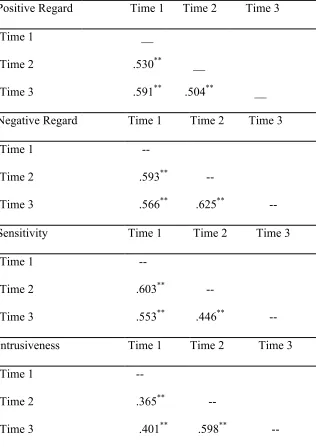
Table 1 Correlations Among Parenting Scores across Timepoints ... 38
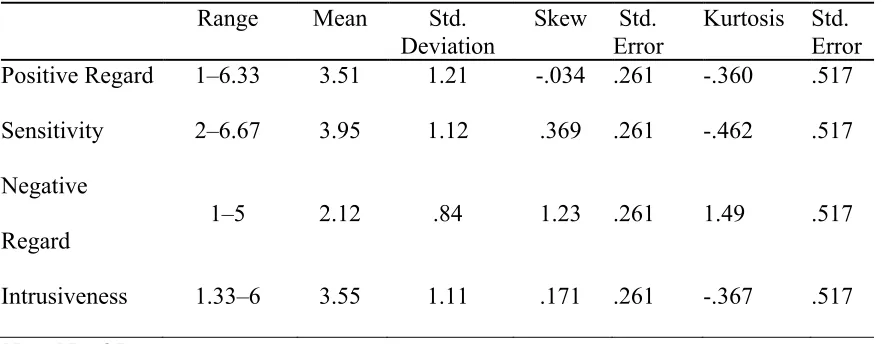
Table 2 Descriptive statistics of parent behavior variables ... 39
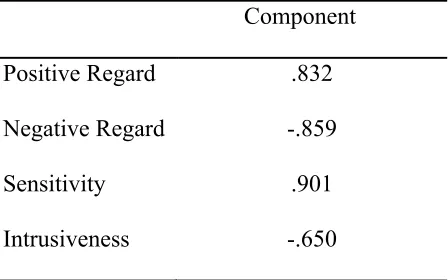
Table 3 Principal component analysis of parenting variables ... 40
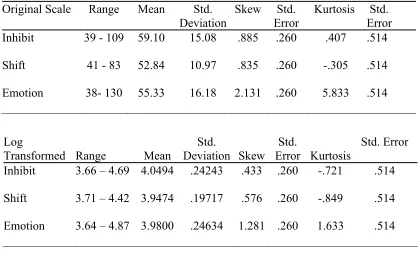
Table 4 Descriptive statistics of self-regulation variables ... 41
Table 5 Correlations among dependent variables and potential covariates ... 42
Table 6 Correlations among BRIEF subscales ... 43
Table 7 Regression analysis of the effect of grade on the relation between emotion control and parenting quality ... 47
Table 8 Regression analysis of the effect of grade on the relation between shifting and parenting quality ... 48
LIST OF FIGURES
Figure 1 The moderating effect of grade on the relation between parenting
quality and emotion control ... 44 Figure 2 The moderating effect of grade on the relation between parenting
quality and shifting ... 45 Figure 3 The moderating effect of grade on the relation between parenting
THE RELATION BETWEEN PARENTING BEHAVIOR AND SELF-REGULATION AMONG PHYSICALLY ABUSED CHILDREN
Despite advances by researchers and policymakers in understanding and preventing child abuse, it remains a significant problem in scope as well as severity. The US Department of Health and Human Services estimated 681,000 victims of substantiated child abuse or neglect in 2011 in the United States. Of those children, 1,570 died as a result of the abuse or neglect. In the United States, the Child Abuse Prevention and Treatment Act defines child abuse and neglect as: “any recent act or failure to act on the part of a parent or caretaker which results in death, serious physical or emotional harm, sexual abuse or exploitation; or an act or failure to act which presents an imminent risk of serious harm.” Beyond the immediate physical and emotional harm inherent in the definition of child abuse, there is substantial evidence that child abuse is associated with a host of short-term and long-term negative developmental outcomes. Negative outcomes associated with child abuse include internalizing symptoms such as depression, anxiety, and withdrawal (Bolger & Patterson, 2001a; Toth, Manly, & Cicchetti, 1992; Mills, Scott, Alati, O’Callaghan, Najman, & Strathearn, 2013); cognitive and academic difficulties such as poor grades in school and on standardized tests (Eckenrode, Laird, & Doris, 1993); and social problems such as aggression and peer rejection (Bolger & Patterson, 2001b; Salzinger, Feldman, Hammer, & Rosario, 1993). Because of the prevalence of this problem and the potential negative effects of abuse, investigation into the processes and contextual variables surrounding abuse is imperative.
McPherson, 2006, for a review). Within a developmental context, this phenomenon is referred to as resilience and can be defined as “meeting age-salient developmental tasks in spite of serious threats to development,” (Masten & Reed, 2002, p. 76). It is important to examine individual differences among physically maltreated children to better understand resilience, specifically to better understand the protective factors or processes that may qualify the pathway to good outcomes for some victims of physical child abuse.
One important process within the child that has received increased attention in the developmental literature as a source of individual differences is the broad concept of self-regulation, the process by which a child monitors and controls his or her behavior according to the demands of a situation (Posner & Rothbart, 2000) across many levels, including the emotional, attentional, social, and cognitive levels (Calkins & Fox, 2002). Children must develop the capacity to regulate their emotions, behaviors, and thoughts so they can function appropriately as they encounter an increasingly wide range of socially and cognitively demanding environments during the progression from early childhood into the school years and beyond. Children who are able to self-regulate their behaviors and emotions display better social and academic adjustment than those who display poor self-regulation (Eisenberg et al., 2001; Maughan & Cicchetti, 2002). Although many physically maltreated children are poor regulators of their emotions and behaviors (Rieder & Cicchetti, 1989; Shields &
Cicchetti, 1998), there is variability across physically maltreated children in this domain of functioning. Given the strong association between self-regulation and other positive
development of poor self-regulation in some physically maltreated children and effective self-regulation in others. Such was the purpose of the current study.
Although many variables in a child’s environment, and the interactions among these variables, are likely to influence the development of self-regulation in physically maltreated children, one especially important variable to examine is parenting. The literature on self-regulation of typically developing children illuminates the role of parenting in the
socialization of emotion and behavioral regulation in children – warm, sensitive, responsive parenting is associated with the development of effective regulatory skills within children (e.g., Colman, Hardy, Albert, Raffaelli & Crockett, 2006; Eisenberg, et al., 2005) and harsh, controlling, negative parenting is associated with poor self-regulation (e.g., Berlin & Cassidy, 2003; Chang, Schwartz & Dodge, 2003; Morris, et al., 2002). In infancy, it is the caregiver that first has the responsibility of regulating the child’s environment and reactivity on behalf of the child. As cognitive and motor skills develop through the first year of life and beyond, the child becomes his or her own regulatory agent for increasingly complex tasks, and this develops in the context of a caregiver’s scaffolding of these tasks within the context of a warm and supportive environment.
parenting and self-regulation that are present in the literature on normative populations, then, also might be present in abusive children and may serve to explain variability in
self-regulation of abused children.
The current study, therefore, attempts to explain this variability in abused children’s self-regulation by investigating parenting as a predicting variable. Purposes for studying this link in the present study were to develop a better understanding of the pathways from
maltreatment to social and academic outcomes and to gain a clearer picture of parenting and self-regulation in the general population through the study of this unique, at-risk population (Cicchetti, Ganiban & Barnett, 1991).
To provide a richer context for the current study, a review of the literature on maltreatment, self-regulation, and parenting follows. First, there will be a review of the literature on maltreatment and its relation to children’s social development. Next, there will be a review of the literature on self-regulation and the role of regulation in serving as a pathway to positive social outcomes. Parenting in typical populations and links between parenting and development of self-regulation in children will then be addressed, followed by parenting in maltreating samples. The literature review will conclude with a discussion of the limitations of the current research on parenting and self-regulation in physically maltreated children.
Literature Review Child Maltreatment and Children’s Functioning
caregiver and child. These children are exposed to inconsistent, absent, or harsh parenting that fails to scaffold appropriate early social and cognitive development in the child, setting them on a trajectory for later negative outcomes. There is a vast body of literature that documents these negative effects of child abuse in many domains of functioning. In the academic domain, for example, physically maltreated children tend to score lower than their peers on reading, spelling, and math achievement tests (Kinard, 2001). In a study of
kindergarten through 12th grade students, physically maltreated children scored lower than their non-physically maltreated peers on class grades and standardized tests, and they were more likely to be retained (Eckenrode, Laird, & Doris, 1993).
Child abuse is associated with negative psychological adjustment as well. For example, physically abused 6 to 13 year olds had lower self-esteem, greater levels of depression, and more feelings of hopelessness about the future than their non-abused counterparts (Kazdin, et al., 1985). There is evidence that these consequences are often maintained over time. A long-term longitudinal study by Silverman, Reinherz, and Giaconia (1996), for example, revealed that physically maltreated children displayed more symptoms of depression, anxiety, psychiatric disorders, emotional problems, and suicidal ideation in late adolescence than their non-physically maltreated peers.
abused children displayed low levels of reciprocity in their peer relationships, were rated by their peers as more aggressive and less cooperative, and held lower status in peer groups. Further, children who were physically abused in early childhood had significantly more social problems, aggression, and social withdrawal in 11th grade than did non-physically maltreated students in the same prospective study (Lansford, et al., 2002).
When this literature is considered together, it is clear that many physically maltreated children display maladaptive social, cognitive, and psychological outcomes when compared to their non-physically maltreated peers. However, a vast amount of the literature
documenting outcomes for physically maltreated children focuses on the overall group differences in development between physically maltreated children and non-physically maltreated children, and a comparatively smaller portion of the literature examines
differences within the physically maltreated population. Some physically maltreated children are resilient (Haskett, et al., 2006), and our understanding of this group is limited until we identify the processes that lead to differential outcomes.
A growing body of literature highlights the factors associated with resilient
functioning in physically abused children. Cognitive functioning (Herrenkohl, Herrenkohl, & Egolf, 1994), internal locus of control (Bolger & Patterson, 2001a; Moran & Eckenrode, 1992), and self-esteem (Cicchetti & Rogosch, 2009; Moran & Eckenrode, 1992) are related to positive outcomes (e.g., lower school drop-out, fewer internalizing and externalizing symptoms) among physically maltreated children. Looking beyond within-child
maternal affection and low hostility (Herrenkohl et al. 1994), low family conflict (Brown & Kolko, 1999), and coherence of the family environment (Sagy & Dotan, 2001) are related to positive outcomes in physically maltreated children. Finally, there are some factors beyond the immediate family context that also play a role in predicting resilient functioning in physically maltreated children. For example, having friends who engage in positive behaviors rather than risky behaviors, being in a positive school climate (Perkins & Jones, 2004), and having a strong sense of school membership (Sagy & Dotan, 2001) are associated with more positive outcomes.
Many of the factors that lead to positive outcomes for abused children are
conceptualized as manifestations of the underlying ability of self-regulation. The following section includes a discussion of the process of self-regulation and some definitional issues, followed by its relation to child outcomes in the normative and physically maltreated populations.
Self-Regulation
challenging situations. These regulatory skills become increasingly important as the child encounters new situations independent of the caregiver and beyond the home, into the school setting. As the school years commence, the child must apply these self-regulatory abilities to complex social situations and effortful cognitive situations to avoid frustration, isolation from peers, and academic failure.
There is a large theoretical and empirical literature on this developmental task of self-regulation, and this concept has been conceptualized in many ways. Self-regulation has been understood to be the part of temperament that modulates a person’s reactivity to the
environment (Rothbart & Derryberry, 1981). Posner and Rothbart (2000) specify that self-regulation modulates reactivity according to the demands of the situation. One area of discussion within the self-regulation literature has been the various levels, modalities, or manifestations of self-regulation. While there has been a focus on emotion components of self-regulation (Gross, 1998; Cole, Martin, & Dennis, 2004; Calkins, 1994), others have taken a multidimensional approach to self-regulation, understanding it as an individual’s ability to monitor and control responses to the environment at the emotional, cognitive, social, and attentional levels (Calkins & Fox, 2002). Although any one of these areas alone may be a legitimate focus of study in the investigation of self-regulation, there is growing consensus that these domains are related and must be understood together.
For example, Shields, Cicchetti, and Ryan (1994) contend that it is particularly important to study affective and behavioral aspects of self-regulation together because of empirically demonstrated overlap between these two aspects of self-regulation. Many
aspects of self-regulation in relation to each other (e.g., Calkins, Smith, Gill, Johnson, 1998; Carlson & Wang, 2007; Cole, Dennis, Smith-Simon, & Cohen, 2009: Feng, et al., 2008). Investigators generally agree that although the use of emotion regulation versus other types of cognitive regulation can appear very different, they represent an underlying self-regulation process likely rooted in attentional networks in the brain (Posner & Rothbart, 2000). For example, a child with poor emotion regulation may cry or throw a tantrum when it is time to be left at preschool without a parent because he does not have the ability to comfort himself to alleviate the anxiety of the unknown situation. The same child may have a difficult time waiting his turn when playing a game with peers because he does not know how to follow the rules during the low-arousal situation of waiting his turn. He must inhibit his desire to play the game in order to give way to his peers. Then, he must shift his attention between
cognitive tasks required in the classroom. These distinct behaviors – some requiring
suppression of emotion, some requiring shifting of attention, and others requiring inhibition of responses – are different types of executive functions that may represent a similar
underlying deficit in the ability to regulate states that are different from what the child normally experiences or from what is normally regulated for him by an adult.
self-regulation has been operationalized in the past, in order to gain a clearer understanding of this construct and how researchers communicate about it.
Self-regulation and children’s functioning. This section includes highlights from a substantial body of literature that shows that (a) there is a well-documented link between self-regulation and children’s functioning in a variety of domains, (b) this link exists for both emotion and cognitive/attentional regulation, and (c) this link is documented in longitudinal studies, showing the importance of self-regulation across development.
First, we see support for the link between emotion self-regulation and a variety of outcomes over time. Hill, Degnan, Calkins, and Keane (2006) identified several profiles of externalizing behavior typically displayed by children across the ages 2, 4, and 5, and showed that emotion regulation at age 2 was a significant predictor of a chronically clinical profile for girls. Specifically, emotion regulation (measured through observations of
reactivity to a frustrating event and behavioral regulation of this frustration) differentiated girls who had clinical levels of externalizing behavior across all time points from girls who started with nearly clinical externalizing behavior and showed reductions in externalizing from age 4 to 5. These findings suggest that emotion regulatory skills in very early childhood are particularly important in predicting whether children at-risk for later externalizing
preschool and in first grade. Additionally, preschoolers who were not expressive had more symptoms of anxiety and depression in first grade.
Next, we see support for the link between self-regulation and a variety of outcomes over time. Eisenberg and members of her lab are leaders in the field and have shown evidence for the link between behavioral self-regulation and a variety of outcomes in children over time. For example, in a sample of preschoolers followed over four years, self-regulation measured by parent and teacher report of attention control, attention shifting, and inhibitory control predicted social functioning measured by parent report, teacher report, and child self-report (using a puppet procedure) concurrently and longitudinally (Eisenberg et al., 1997). In 2001, Eisenberg and colleagues found that children categorized as high on
externalizing problems (parent and teacher report) had poorer behavioral self-regulation as measured by persistence on a behavioral task, reaction to a disappointing gift, and a sitting still task than controls or those with internalizing problems only. In sum, self-regulation of emotion and attention are associated with a variety of child outcomes, and these links exist across early to late childhood, suggesting it is an important process that underpins the development of children’s social, academic, and psychological adjustment.
Self-regulation and functioning of physically maltreated children. Not only is the link between self-regulation and children’s functioning well-established in the normative population, this link has also been established for samples of physically maltreated children. For children at risk of maltreatment, observed and maternally reported behavior and emotion regulation predicted behavior problems in 3-year-olds (Schatz, Smith, Borkowski, Whitman,
overcontrolled emotion regulation patterns in physically maltreated children than non-physically maltreated children in response to a simulated angry exchange between a parent and a research assistant; these patterns of dysregulated emotion were associated with behavior problems and symptoms of anxiety and depression. Teisl and Cicchetti (2008) found that physically maltreated and non-maltreated children with poorer emotion regulation were more likely than their peers to be peer-nominated for behavior problems, and emotion regulation partially mediated the association between maltreatment and behavior problems. Shields and colleagues also studied links among emotion regulation, maltreatment, and adjustment, consistently finding that both maltreated and non-maltreated children with poor behavioral and emotion regulation were more socially maladjusted. Specifically, they displayed more aggression (Shields & Cicchetti, 1998), peer rejection (Shields, Ryan, & Cicchetti, 2001), bullying and victimization (Shields & Cicchetti, 2001), and social incompetence (Shields & Cicchetti, 1994). Additionally, two studies investigating self-regulation and children’s outcomes using the larger dataset that the present study used found that among physically maltreated children, parents’ and teachers’ reports of children’s self-regulation were significantly related to teachers’ reports of internalizing, externalizing, and adaptive behavior in the classroom setting (Kim-Spoon, Haskett, Longo, & Nice, 2012; Haskett, Stelter, Proffit & Nice, 2012).
Not only is there a documented link between self-regulation and children’s
functioning in the physically maltreated population, there is also evidence that self-regulation is one mechanism through which maltreatment status is associated with negative child
paragraph (Shields & Cicchetti, 1998; Shields, Ryan, & Cicchetti, 2001; Shields & Cicchetti, 2001; Shields & Cicchetti, 1994) the relation between maltreatment and social maladjustment was explained (completely or partially) by self-regulation of behavior. In sum, self-regulation broadly manifested plays a central role in organizing early socio-emotional development for children with and without a history of maltreatment.
Despite the increase in the attention given to this concept of self-regulation and its role in explaining adjustment in abused children, gaps remain in our understanding of factors that are associated with individual differences in self-regulation in this unique population. Most research on self-regulation in abused children has focused on group differences between abused and non-abused children. As demonstrated by the studies described above and others, abused children tend to have less well-developed self-regulation skills than their non-abused counterparts (e.g., Rieder & Cicchetti, 1989; Shields & Cicchetti, 1998, 2001) and poorer understanding of negative emotion (e.g., Smith & Walden, 1999). However, not all physically maltreated children display poor self-regulation in every setting, and very little research investigates factors that predict variations in self-regulatory abilities within
physically maltreated samples and across contexts in each maltreated child. Examining factors that predict self-regulation of abused children may contribute to understanding the process by which some physically maltreated children display poor social-emotional outcomes and others do not – thus informing efforts to decrease these negative outcomes in abused children.
multitude of factors both within the child and external to the child likely interact with one another along developmental pathways to shape a child’s self-regulatory skills. It is generally agreed, however, that parents (or other primary caregivers) have the opportunity to play a particularly important role in these pathways in early childhood. It is thought that because the parent-child relationship is the most salient social relationship in the early years, and parents mediate much of children’s experience of the world, children’s initial emotion and behavior regulation skills develop within the context of this relationship (Thompson, 1994). Early primary caregivers are responsible for meeting the needs of their children and soothing their children when the children are experiencing distress; thus, this relationship can create the structure – or lack of structure – in which children learn about modulating their behaviors and emotions on their own (Kopp, 1989). Furthermore, parents often have the ability to control their children’s access to situations in which self-regulation can be practiced, they can assist their children in regulating their emotions or behaviors, and they can explicitly teach regulatory strategies. For example, in one study of emotion regulation in parent-child dyads, parents who were observed using appropriate regulation strategies with their children had children who were better regulators of their own emotion and behavior later on (Spinrad, Stifter, Donelan-McCall & Turner, 2004). Mothers in that study used fewer emotion-regulation strategies across the three time points with their children as the children became more capable of performing these tasks on their own.
children’s self-regulation. Specifically, sensitive, responsive, positive parenting is associated with effective self-regulation in children; harsh, controlling, and negative parenting predicts poor self-regulation in children. Research to support these links is provided below.
Calkins, Smith, Gill, and Johnson (1998) found that toddlers whose mothers
displayed more negative control during parent-child observations were less likely to use the self-regulation strategy of distraction when faced with a situation designed to elicit negative emotion. Inhibition of inappropriate behavior in a “stop-play” task as well as compliance in a “clean-up” task also were related to negative parental control. Negative control included parental behaviors such as frequent scolding, derogatory remarks, anger, physical control, and verbal direction of their children’s activity. In a study of first and second grade students, children’s perceptions of their mothers’ hostility, measured by a puppet interview, were related to mothers’ ratings of their children’s self-regulation, as assessed by rating scales of inhibitory control and attention (Morris, et al., 2002). Additionally, inconsistent discipline has been shown to be associated with low self-regulation of anger and sadness (Garner & Spears, 2000). These studies provide evidence that parents who are hostile, controlling, and negatively expressive have children with poor inhibition of inappropriate behavior and poor regulation of attention and emotion. Controlling, hostile, and negative parenting are thought to teach the child to suppress emotions in the face of negative reactions from parents toward emotion and behavior expressions instead of learning appropriate ways to regulate them.
affect regulation of the children (Davidov & Grusec, 2006). A longitudinal study indicated that high levels of observed parental positive support when children were 2 years old were associated with greater increases in children’s self-regulation between the ages of 2 and 4 years than for children with parents who displayed lower levels of positive support
(Moilanen, Shaw, Dishion, Gardner & Wilson, 2009). Positive support included observations of engagement with the child, positive reinforcement, and providing developmentally
appropriate structure for the child. These and other studies (e.g., Calkins & Johnson, 1998; Smith & Walden, 2001) indicate that positive parenting, which includes characteristics such as responsiveness, reciprocal behavior, positive expression, appropriate structure, and
sensitivity, is related to effective self-regulation in young children. These parenting qualities indicate an awareness of the child’s needs that allows the parent to help regulate the emotions and behaviors of the child when appropriate and assist the child in using self-regulation strategies that allow for more autonomous emotion and behavior regulation later on, and it also may allow the child to express emotions appropriately without being criticized or punished.
(e.g., intrusiveness, criticism, anger) and children’s compliance was negative and significant. However, these associations were weak in magnitude. Also, positive and negative parental control were not related to two other types of self-regulation – inhibition and emotion regulation. Further, parental responsiveness (e.g., positive affect, sensitivity, warmth, responsiveness to child’s cues) was not significantly related to children’s compliance,
inhibition, or emotion. Moderating factors could explain overall insignificant and weak effect sizes in this meta-analysis despite stronger and significant associations in individual studies; unfortunately, the meta-analysis study did not include a sufficiently large number of studies to examine many of the potential moderating factors of interest. This meta-analysis,
considered together with the rest of the literature in this area, indicates that there are associations between positive and negative parenting behaviors and children’s
self-regulation, but these associations are likely complex and deserve further study. This area of research is especially lacking in studies investigating the relation between parenting and regulation in physically maltreated children, who might be at particular risk for poor self-regulation given their parents’ approach to caretaking.
Parenting Behaviors of Abusive Parents
children’s behavior, and display contradictory emotional signals to their children. Neglecting parents tend to interact infrequently with the child, exhibit a lack of emotional expression toward the child, engage in little eye contact, and maintain physical distance from the child. On the other hand, mothers who were neither abusive nor neglecting displayed responsive behavior that was consistent with the goals of the child, responsiveness to the child’s cues, and affectionate.
As would be expected given these parenting behaviors, children of abusive parents on the whole have worse self-regulation than non-abused children (e.g., Maughn & Cicchetti, 2002; Rieder & Cicchetti, 1989; Shields & Cicchetti, 1998, 2001). Some empirical literature suggests that the relation between maltreatment history and self-regulation is accounted for – at least in part – by parenting behaviors (e.g., Shipman & Zeman, 2001). That is, the history of maltreatment predicts differences in self-regulation through the pathway of unsupportive, insensitive parenting behaviors. More specifically, physically maltreated children tend to have parents who use patterns of insensitive parenting, which in turn affects children’s self-regulation, rather than the event of maltreatment directly influencing self-regulation.
the abusive group – one that was characteristic of warm, sensitive, engaged parenting and one characteristic of negative, insensitive parenting. It may seem dissonant that a subgroup of abusive parents may exhibit sensitive parenting. However, it is important to remember that the etiology and sequelae of maltreatment varies among abusive parents, with some abuse incidents representing a pervasive pattern of insensitive parenting, and other abuse incidents being an isolated aberration in an otherwise well-functioning parent-child relationship. Such differences in parenting may place physically maltreated children on very different
developmental pathways. Indeed, the subgroups of abusive parents identified by both Haskett and colleagues (2004) and Oldershaw and colleagues (1989) were differentially predictive of various child outcomes, suggesting differential developmental trajectories for children whose parents belonged to the different subgroups. Thus, abusive parents – a group that has often been regarded in the literature as homogeneous – may parent their children more differently from one another than previously acknowledged.
Parenting and Physically Maltreated Children’s Self-Regulation.
Very little research investigates the link between parenting and self-regulation among physically maltreated children. Robinson and her colleagues (2009) investigated the link between parenting behaviors and emotion regulation in 1 to 4 year-old physically maltreated children and found that parents who displayed more hostile behavior during a parent-child interaction had children who displayed more hostile behavior, less effortful control, and less positive affect in the same parent-child interaction. Also among these dyads, parents who displayed more positive affect had children who likewise displayed more positive affect. One limitation of this study is the authors’ operational definition of emotion regulation. They used three measures of children’s emotion regulation: hostility (frequency and intensity of
subset of physically maltreated children and it is possible the findings do not generalize to less extreme cases of maltreatment, which may constitute the majority of cases.
In an unpublished dissertation, Schatz (2007) examined parenting across time and its relation to regulation in a sample of children from 4 months to 2 years old whose mothers were at risk for maltreatment. Multiple indicators of parenting were used and three aspects of self-regulation were measured (behavioral, physiological, and emotional). Parenting across the children’s first two years of life predicted children’s self-regulation at 2 years of age. Further, declines in good parenting over time were associated with poorer children’s self-regulation at 2 years of age. This study is important in its pursuit to understand parenting and regulation processes in the earliest years of a child’s life; however, it is limited by
measurement of a very early form of self-regulation when the child is only 2 years old, a time when a child has not yet experienced the developmental stages in which self-regulation independent from parents and other adults is required. Another limitation is the use of a sample at-risk for maltreatment, rather than a sample of children with substantiated histories of abuse. Lastly, the parent was the only rater for the self-regulation measure and no
information on the validity of the scale was given.
and non-physically maltreated children. However, it is not clear whether these parenting behaviors are predictive of self-regulation in the maltreatment group alone. Further, the authors did not report whether they conducted a significance test to determine whether the portion of the effect of maltreatment on self-regulation mediated by parenting was
significantly different from zero.
Furthermore, no study investigates the relation between parenting behavior and self-regulation in abused children specifically during the developmentally important time of preschool, kindergarten, and first grade, when children are faced with the new social and cognitive demands of entering into formal schooling. During this time period, parenting by abusive parents tends to get worse rather than better, though there is much variability from parent to parent (Haskett, Neupert & Okado, 2013). Stress tends to accumulate over time, and for parents under high stress this may translate into degrading parenting behavior. Knowing whether the association between this decline in parenting quality and children’s
Statement of the Problem
As described in the preceding literature review, a large body of research has
documented the negative effects of child maltreatment. Emotion and behavior self-regulation are important processes that may account for the relatively poorer adjustment of physically maltreated children compared to non-physically maltreated children. However,
comparatively little research examines predictors of differences in self-regulation among physically maltreated children. One important influence on self-regulation in the general population is parenting behavior, but this variable has not been adequately examined as a predictor of self-regulation among physically maltreated children despite the empirical support that exists for differences in parenting behavior among abusive parents. Within the small body of research that does examine parenting and self-regulation among physically maltreated children, several limitations are present: (a) lack of generalizability of the sample (e.g., risk-of-maltreatment sample rather than substantiated abuse cases; out of home
placement), (b) inadequate operational definition of emotion or behavioral self-regulation, or (c) reliance on only parent ratings of self-regulation.
Much is already known about how physically maltreated children and their parents differ from the normative population; it is now necessary to examine parent and child characteristics – as well as characteristics of the parent-child interaction – within this population. Doing so will allow for a clearer understanding of individuals within the
physically maltreated population. Because self-regulation is associated with later adjustment, investigating possible parenting influences on self-regulation in physically maltreated
children progress to positive or negative outcomes. Understanding these pathways may inform the development of targeted intervention techniques that focus on the parenting behaviors that matter the most for children’s development. Further, understanding this unique group will also allow for a better grasp of the role of parenting in the normative population.
It is also necessary to investigate the variations in parenting of maltreating parents – rather than simply comparing these parents to matched control groups – because of the ambiguous methods used to identify and classify physically maltreated children and the lack of information about the characteristics of the abuse history of these children. Examining other important variables (such as parenting) within groups of physically maltreated children may be a less error-laden method for understanding individual differences that will yield a clearer picture of the maltreatment context. Finally, reliance on parent reports for measures of parenting and children’s regulation is a limitation of prior research. The current study used observations of parenting and teacher reports of children’s self-regulatory processes to avoid problems associated with shared method variance and to determine the degree to which parenting predicted children’s regulation outside the family context. Hypotheses are outlined below.
Hypotheses and Research Questions
(Hypothesis 1), children’s ability to inhibit inappropriate behavior (Hypothesis 2), and children’s ability to appropriately shift attention (Hypothesis 3). An additional research question investigated was whether the relation between parenting behavior and abused children’s self-regulation in the school setting varied depending on the child’s current grade; there was no directional hypothesis put forth.
Method Participants
Participants were 85 physically abused children and their parents who were participants in a larger study of 93 physically maltreated children’s social and academic adjustment from preschool to first grade. The larger study was a longitudinal study for which data were collected at three time points: preschool (time 1), kindergarten (time 2), and first grade (time 3). For purposes of the current study, one time point was selected at random for each parent-child dyad for cross-sectional analyses. Eight dyads were excluded because there was not a single time point for which all study measures were available.
Children were 51-89 months old (M = 69 months; SD = 9.4 months) and were in preschool (n = 29), kindergarten (n = 27), or first grade (n = 29). The majority of the children were African American (73%) and male (61%). Ten of the children had one or more siblings in the study, but each parent-child dyad was unique so sibling pairs were retained in the dataset. Parents and caregivers ranged from 19 to 58 years of age and all were the mother or grandmother of the child. The Hollingshead (1975) measure of socioeconomic status
Instrumentation
Children’s self-regulation. The Behavior Rating Inventory of Executive Function (BRIEF; Gioia, Isquith, Guy, & Kenworthy, 2000) and the Behavior Rating Inventory of Executive Function-Preschool Version (BRIEF-P; Gioia, Espy, & Isquith, 2003) were used as the measure of self-regulation. The BRIEF was administered to teachers of the children when they were in kindergarten and first grade, and the BRIEF-P was administered to teachers of the children when they were in preschool. The BRIEF will be described first, followed by the BRIEF-P.
using conversion tables for gender and age group, based on the normative samples of 720 children. Psychometric properties of the BRIEF are strong. For Emotion Control, Shift, and Inhibit, Cronbach’s alphas range from .91 to .96 in a clinical sample and normative sample (Gioia, et al., 2000). Test-retest correlations (average of 3.5 weeks between test
administrations) are good at .91 for Inhibit, .83 for Shift, and .92 for Emotion Control. Most scales on the BRIEF teacher form have good content validity, assessed by agreement of expert raters. Convergent and divergent validity are shown with scales on the Child Behavior Checklist, the Behavior Assessment System for Children, and the Conner’s Rating Scale (Gioia, et al., 2000).
The BRIEF-P (Gioia, et al., 2003) is a parallel form of the BRIEF, with items that are theoretically appropriate for preschool-age children (2 years through 5 years, 11 months) and empirically validated on a preschool normative sample. It contains 63 items that comprise 5 subscales, including Inhibit, Shift, and Emotion Control scales, which are very similar to the scales on the BRIEF with the same name. Items are similar or identical to the items on the BRIEF scales and they theoretically measure the same underlying self-regulatory processes. Reliability and validity are very similar to that of the BRIEF. For the scales used in this study, internal consistency ranges from .90 to .94, test-retest reliability over an average period of 4.2 weeks ranges from .65 to .94, and there is evidence for content and construct validity (Gioia, et al., 2003).
(c) sensitivity, (d) intrusiveness, (e) detachment, and (f) flatness of affect. For each of the three segments of the parent-child interaction (described below), a coder rated the parent’s behavior on a 7-point rating scale (1= not at all characteristic of this category; 7 = highly characteristic of this category). The categories positive regard, negative regard, sensitivity, and intrusiveness were used in the present study because of the research supporting links with these parenting characteristics and children’s self-regulation. Positive regard for the child is frequency and intensity of verbal or physical warmth and positive expression (e.g. smiles, hugs) toward the child; negative regard is frequency and intensity of verbal or physical hostile, negative behaviors (e.g., name-calling, pushing away); sensitivity is the degree to which parent behavior is responsive and reciprocal, according to the child’s needs; and intrusiveness is the degree to which parents’ behavior dominates the interaction in such a way that the child is not allowed to follow his or her own interests, needs, and desires. This coding system and other similar coding systems have been used widely in parenting research and have demonstrated reliability and validity (e.g., Haskett, Ahern, Ward, & Allaire, 2006; Haskett, et al., 2004).
Procedures
children who met these criteria, social service staff conducted a review of the child protection registry and mailed descriptions of the study to those parents who were eligible. The letters informed parents they would receive $70 for time 1, $80 for time 2, $90 for time 3,
transportation reimbursement, and child care if they qualified for the study. Parents who were interested voluntarily contacted the project office and completed a psychosocial interview. After the interview, data collection was scheduled for those who met the criteria. To further encourage participation, parents were entered into a drawing for a $50 bonus when they scheduled each data collection appointment.
For each data collection session, families were provided with taxi transportation to the data collection site, and parents were offered child-care during the three-hour session for any children who did not participate. Before data collection, parents gave their informed consent and children gave their assent for their participation. They were given the option to decline participation in any part of the data collection. Parents also were given a Certificate of Confidentiality from the federal Department of Health and Human Services, protecting them from research data being used in court. Data were labeled with parent and child identification numbers that were not associated with their identities, and all materials were stored in locked file cabinets. The university Institutional Review Board approved these procedures.
children separately in adjacent rooms, after which parents and children were reunited and participated together in the videotaped parent-child interaction.
For the parent-child interaction, each parent-child dyad was observed and videotaped through a camera disguised as a clock for three eight-minute segments. The parent-child dyads were told that they were going to film a movie together doing things that are fun for families. For the first segment, the parent was instructed to play with her child in a room with toys. For the second segment, the parent was instructed to ask their child to clean up the toys, draw a picture of a person, then sit quietly while the parent read a magazine. For the last segment, the child was given two puzzles to complete and the parent was told to help the child without touching the puzzle pieces. The research assistant set a timer in front of the parent and child to show them how much time remained to complete the puzzles. After parent-child data collection at the university clinic, parents were given compensation and parenting support materials; children were given a toy.
Videotaped parent-child interactions were coded by trained undergraduate and graduate student research assistants who were not involved in data collection. Research assistants were trained on the coding system until each trait in each segment was scored reliably (i.e., 80% interrater agreement with the trainer). After reliability was reached, research assistants coded videotapes independently, and 25% of tapes were coded to
No more than two weeks after parent-child data collection, teachers were contacted and asked to assist in the study by completing several measures and allowing observers to conduct observations during recess on the playground. Measures were mailed to teachers at their schools and collected in person when research assistants conducted the playground observations, at which time teachers were given compensation of $15.
Results Data Reduction for Parenting Behavior
Across the three parent-child interaction tasks, ratings within each parenting variable (positive regard for the child, negative regard for the child, sensitivity, intrusiveness) were moderately and significantly correlated (Table 1). Therefore, one score for each parenting variable was created by computing the mean of the ratings from the three tasks. Combining scores across segments in this way was conceptually appropriate because the objective was not to measure parenting behavior in a specific context, but rather to measure typical parenting behavior across settings. Table 2 displays the means, standard deviations, and intercorrelations of the four parenting variables across segments.
solution explained 66% of the total variance and factor loadings were strong (Table 3), with negative regard and intrusiveness loading negatively onto the factor. One global parenting score was created by taking the mean of positive regard, sensitivity, negative regard (reverse coded) and intrusiveness (reverse coded). This composite parenting variable was labeled “parenting quality,” with higher values indicating more sensitivity and positive regard and less negative regard and intrusiveness.
Descriptive Statistics and Check for Covariates
Mean, standard deviation, range, kurtosis, and skew statistics were computed for each independent and dependent variable (Table 4). Variables were checked for normality by performing significance testing to determine if the skewness or kurtosis statistics were significantly greater than zero. The skewness statistic was divided by the standard error of skewness to obtain the z-score of the skewness statistic, which was then compared to the cutoff of 1.96; the same was done for kurtosis (Field, 2009). Parenting Quality was not significantly skewed or kurtotic according to the 1.96 z-score cutoff. Emotion control, shifting, and inhibition were all significantly skewed in the positive direction, and emotion control was significantly kurtotic. Boxplots for the three self-regulation variables indicated there were seven significant outliers across the three measures, two of which were extreme outliers. To reduce skewness, lessen the influence of outliers, and (in the case of emotion control) reduce kurtosis, each of these variables was transformed using a natural log
skewness was reduced to non-significance. Additionally, the transformation eliminated the most extreme outliers.
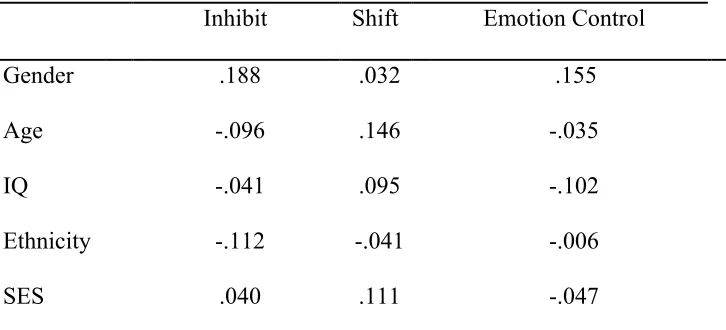
To determine the appropriateness of including key demographic variables in the regression models to account for potential confounding effects, correlation analyses were performed among child’s IQ, age, gender, socioeconomic status, ethnicity (dichotomized into African American and non-African American) and the three regulation variables (inhibit, shift, and emotion control) (Table 5). None of the demographic variables were significantly correlated with any of the self-regulation variables. Although it is well documented that age and gender are strongly associated with self-regulation and executive function, the use of age- and gender-specific norming information when translating raw scores on the BRIEF to T-scores probably removed some of the effects of these variables on T-scores.
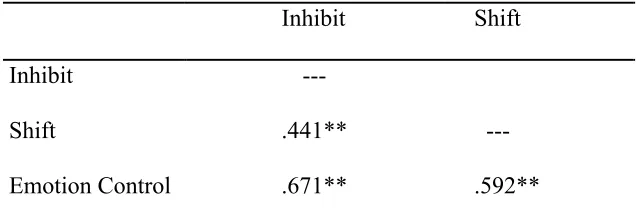
Intercorrelations of the three BRIEF subscales were calculated to understand the relatedness of the dependent variables. All correlations were significant and positive. The correlation between inhibition and emotion control had the highest magnitude, and the correlation between shifting and inhibition had the lowest magnitude. The values for these correlations can be viewed in Table 6.
Hypothesis Testing
quality accounted for 7.3% of the variability in shifting and 3.2% of the variability in inhibition. There was no significant correlation between parenting quality and emotion control, though the correlation approached significance r(84) = -.17, p = .057.
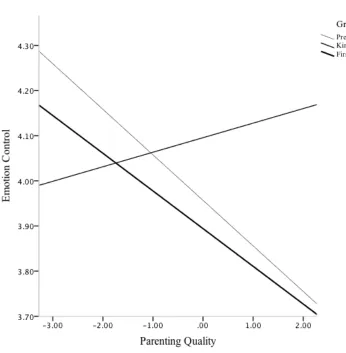
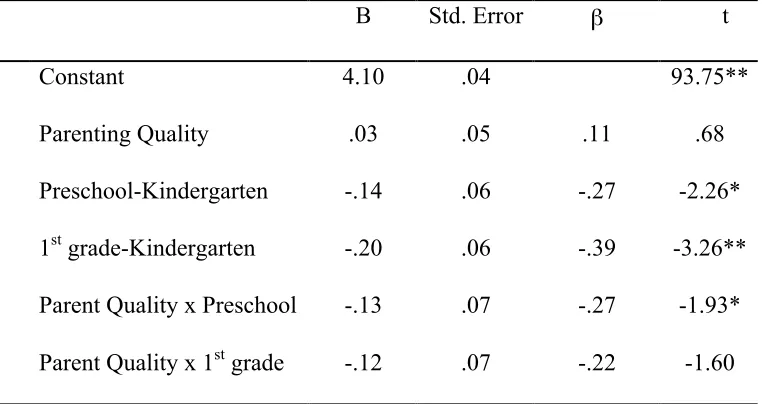
Grade as a moderator of the relation between parenting and self-regulation. A series of multiple regressions was conducted to explore whether the relation between parenting and children’s self-regulation depended on the child’s grade in school (Howell, 2010). First, parenting quality was centered to minimize multi-collinearity between the independent variable and the interaction terms. Dummy variables were created for the grade variable (preschool, kindergarten, first grade) so children could be compared categorically. Kindergarten was used as the reference grade. Next, regression analyses were performed with parenting quality and grade (dummy variables) entered as predictors into the model first, followed by the interaction term for grade and parenting. This was done with each self-regulation variable (inhibit, shift, emotion control) as the dependent variable. Diagnostic statistics were then calculated to determine if there were any problems with the model (violations of assumptions, outliers, or overly influential cases).
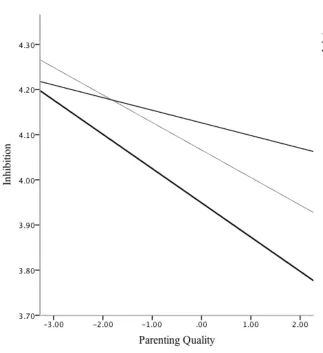
significantly negative for children in preschool (t = -2.50, p =.02) and first grade (t = -2.12, p =.04), but it was non-significant for children in kindergarten (t = .50, p=.63; see Figure 1).
There was no evidence of substantial multicollinearity among the predictors, as indicated by variance inflation factor (VIF) and tolerance values within the expected range (i.e., no VIF greater than 10 and average VIF not substantially greater than 1, per Bowerman & O’Connell, 1990). The residuals appeared to be normally distributed upon visual
inspection of the histogram and normal probability plots. Further evidence for normal distribution of the residuals was found when only four cases (5% of the total number of cases) had a standardized residual with an absolute value greater than 1.96, and only two cases had absolute values greater than 2.5. Two leverage values greater than three times the average leverage (Stevens, 1992) suggested these could be overly influential cases to the model; however, Cook’s distance was less than 1 for all cases (Cook & Weisberg, 1982), and only one Mahalanobis distance was above the 5% cutoff for five predictors and a sample size of approximately 100 (Barnett & Lewis, 1978). A visual inspection of the plot of the
residuals against the predicted values indicated some heteroscedasticity in the data, with residuals becoming more disbursed at higher levels of the predicted values. The Durbin-Watson statistic of 1.53 shows that the assumption of independence of errors was not violated.
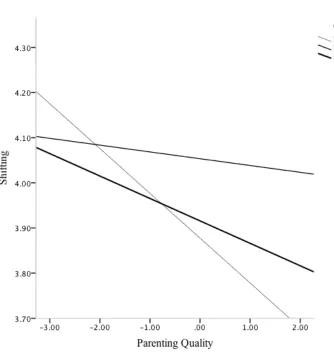
Shifting. The next moderation analysis, which tested for an effect of grade on the link between parenting quality and shifting, showed the slopes for the three grades were not significantly different from each other (Table 8), as indicated by the non-significant
kindergarteners (t = -1.59, p=.12) and kindergarteners to first graders (t = -.62, p =.53). Although there was no significant interaction effect, a simple slopes analysis indicated the relation between parenting quality and shifting was significantly negative for children in preschool (t = -2.76, p =.01), but for children in kindergarten (t = -.35, p =.73) and first grade (t = -1.40, p =.17) there was no significant relationship (Figure 2).
As with the previous regression model, there was no evidence of substantial
multicollinearity among the predictors, as indicated by VIF and tolerance values within the expected range, and the residuals appeared to be normally distributed upon visual inspection of the histogram and normal probability plots. Only one standardized residual was above the 1.96 cutoff. Also similar to the pattern found in the previous model, two cases had leverage values higher than three times the average expected leverage value given the sample size, but Cook’s distance was less than 1 for all cases and only one Mahalanobis distance above the 5% cutoff. The plot of the residuals against the predicted values indicates some
heteroscedasticity in the data, with residuals becoming more disbursed at higher levels of the predicted values. The Durbin-Watson statistic was 1.92; thus, there was no autocorrelation of errors.
Inhibition. The moderation analysis to test for the effect of grade on the link between parenting quality and inhibition also did not indicate a significant interaction effect (see Table 9). The slope of parenting and inhibition for kindergarteners was not significantly different from the slope of parenting and inhibition for preschoolers (t = -.47, p = .64) nor for first graders (t = -.65, p =.52). Additionally, the simple slope was not significant for
=.60), or first grade (t = -1.53, p =.14). Although there were no significant slopes or interactions, Figure 3 displays the trend of these slopes.
Table 1
Correlations Among Parenting Scores across Timepoints
Positive Regard Time 1 Time 2 Time 3
Time 1 __
Time 2 .530** __
Time 3 .591** .504** __
Negative Regard Time 1 Time 2 Time 3
Time 1 --
Time 2 .593** --
Time 3 .566** .625** --
Sensitivity Time 1 Time 2 Time 3
Time 1 --
Time 2 .603** --
Time 3 .553** .446** --
Intrusiveness Time 1 Time 2 Time 3
Time 1 --
Time 2 .365** --
Time 3 .401** .598** --
Table 2
Descriptive Statistics for Parent Behavior Variables
Range Mean Std. Deviation
Skew Std. Error
Kurtosis Std. Error Positive Regard 1–6.33 3.51 1.21 -.034 .261 -.360 .517 Sensitivity 2–6.67 3.95 1.12 .369 .261 -.462 .517 Negative
Regard 1–5 2.12 .84 1.23 .261 1.49 .517
Table 3
Principal Component Analysis of Parenting Variables
Component
Positive Regard .832 Negative Regard -.859
Sensitivity .901
Table 4
Descriptive Statistics for Self-regulation Variables
Original Scale Range Mean Std. Deviation
Skew Std. Error
Kurtosis Std. Error Inhibit 39 - 109 59.10 15.08 .885 .260 .407 .514 Shift 41 - 83 52.84 10.97 .835 .260 -.305 .514 Emotion 38- 130 55.33 16.18 2.131 .260 5.833 .514
Log
Transformed Range Mean
Std.
Deviation Skew
Std.
Error Kurtosis
Std. Error
Table 5
Correlations among Dependent Variables and Potential Covariates
Inhibit Shift Emotion Control
Gender .188 .032 .155 Age -.096 .146 -.035 IQ -.041 .095 -.102 Ethnicity -.112 -.041 -.006 SES .040 .111 -.047
Note. Pearson correlations for age, IQ, and SES. Point-biserial correlations
Table 6
Correlations among BRIEF Subscales
Inhibit Shift
Inhibit ---
Shift .441** ---
Emotion Control .671** .592**
Table 7
Regression Analysis of the Effect of Grade on the Relation between Emotion Control and Parenting Quality
B Std. Error β t
Constant 4.10 .04 93.75**
Parenting Quality .03 .05 .11 .68
Preschool-Kindergarten -.14 .06 -.27 -2.26*
1st grade-Kindergarten -.20 .06 -.39 -3.26** Parent Quality x Preschool -.13 .07 -.27 -1.93*
Parent Quality x 1st grade -.12 .07 -.22 -1.60 Notes. R2=. N=85. Emotion control variable was log transformed.
Table 8
Regression Analysis of the Effect of Grade on the Relation between Shifting and Parenting Quality
B Std. Error β t
Constant 4.05 .033 121.04**
Parenting Quality -.015 .037 -.07 -.41
Preschool-Kindergarten -.176 .047 -.43 -3.73**
1st grade-Kindergarten -.138 .047 -.33 -2.91**
Parent Quality x Preschool -.084 .053 -.22 -1.59
Parent Quality x 1st Grade -.035 .056 -.08 -.62
Table 9
Regression Analysis of the Effect of Grade on the Relation between Inhibition and Parenting Quality
B Std. Error β t
Constant 4.13 .044 93.11**
Parenting Quality -.028 .048 -.100 -.58
Preschool-Kindergarten -.060 .062 -.118 -.96
1st grade-Kindergarten -.177 .063 -.345 -2.82**
Parent Quality x Preschool -.033 .070 -.069 -.47
Parent Quality x 1st Grade -.048 .073 -.091 -.65
Discussion
As noted in the introduction to this study, children who have been physically abused are more likely than children who were never abused to develop social and emotional
problems and perform poorly in school (e.g., Bolger & Patterson, 2001a; Bolger & Patterson, 2001b; Cicchetti & Toth, 2005; Eckenrode, et al., 1993; Mills et al, 2013; Salzinger, et al., 1993; Toth, Manly, & Cicchetti, 1992). The failure to develop appropriate self-regulation may be one important part of understanding the pathways to negative outcomes later in life for these children. However, some children with a history of physical abuse do successfully develop appropriate self-regulation skills and, in turn, demonstrate typical social, emotional, and academic adjustment (Cicchetti & Rogosch, 2009). Thus, learning more about the experiences of these resilient children and understanding the conditions in which they develop successful regulation will aid in determining the most effective ways to prevent negative outcomes for other physically abused children.
strategies for regulating affective and cognitive experiences. Among all children, more sensitive, positive interactions with the child and less intrusiveness and harsh interactions are associated with better self-regulation, which creates a pathway toward a host of positive developmental outcomes. In the current study, I investigated whether the same was true among abusive caregivers and their children – that is, whether children with a history of physical abuse whose parents were warmer, more sensitive, and less hostile and intrusive toward their children showed better self-regulation with regard to their emotions, attention shifting, and inhibition of inappropriate behavior in the school setting.
One assumption central to the purpose of this study was that despite displaying overall poorer self-regulation than the normative population (i.e., mean T-scores on all BRIEF scales exceeded 50), physically abused children, as a group, have a wide range of self-regulatory abilities in the preschool to first grade years. In the current sample, average self-regulation was nearly one standard deviation above the non-clinical norming sample, and there was a range of self-regulatory skill, from one to two standard deviations below the norming group mean to several standard deviations above (lower scores indicate better self-regulation). In sum, although physically abused children showed poorer self-regulation in the classroom as a group in relation to their non-abused peers, many of these children displayed self-regulatory functioning well within the range considered normal by the test makers of the BRIEF. This confirms that there is a range of developmental outcomes among abused
behavior was not restricted; rather, there was a distribution along the range of possible parenting scores representing poor parenting among some parents and higher quality parenting among others. These descriptive findings support the underlying assumptions of the investigation.
Hypothesis Testing: Parenting quality and self-regulation
behavior and shifting attention. A history of physical child abuse does not necessarily negate the importance of sensitive and positive parenting.
The link between quality parenting and emotion self-regulation was not supported by the current study, however. There are several potential explanations for the failure to find a significant correlation between these constructs. First, although regulation of emotion is frequently understood as stemming from the same roots as other types of self-regulation, some theoretical and empirical literature addresses it as a qualitatively different process. Karreman and colleagues’ meta-analysis (2006) of 41 studies examining parenting and self-regulation in 2 to 5 year olds failed to find significant links between parenting quality and children’s emotion regulation, though there were significant associations between parenting and other forms of self-regulating behaviors. Among the associations that did exist, the effect sizes were small. This may suggest there are other important moderating factors that would clarify this link for emotion regulation even in the normative populations – perhaps the understanding of self-regulation of emotion and parenting link requires a more nuanced approach due to the complexities of how emotion is regulated in young children.
Also important to note is the possibility that the scaling of the T scores and the characteristics of the normative sample on the BRIEF for the emotion control subscale might be at fault for the failure to find a significant link between parenting and emotion
self-regulation. Specifically, the norming groups for the teacher-report BRIEF for 5- and 6-year-old boys and girls are quite small, and there are very few 5 year 6-year-olds included (eight 5-year-old and twenty-four 6-year-5-year-old boys in the boys’ norming group; twelve 5-year-5-year-old and seventeen 6-year-old girls in the girls’ norming group). The T score conversion tables for the 5-and 6-year-old girls shows that it is possible to score a T score of 130 on the emotion control subscale, and a difference in the teacher’s response to just a question or two could mean a large increase in T score, a characteristic that is not as dramatic in the other
subscales. It is understandable that a sample of only 29 5- and 6-year-old girls is unlikely to produce a T-score scale distribution that accurately represents the population, especially for a construct as complex as emotion control.
Research Question: Grade as a moderator of the link between parenting and self-regulation
Early childhood is an important time for the development of the ability to self-regulate behavior and emotions. During this time, caregivers play a critical role in
scaffolding a child’s learning about the world and their development of social and cognitive skills. Early school years are a time during which children develop rapidly as they face increasing demands for self-regulation both socially and cognitively in the school setting. The parent-child relationship undergoes many changes to accommodate this rapid