Copyright2000 by the Genetics Society of America
Estimating Recombinational Parameters in
Streptococcus pneumoniae
From
Multilocus Sequence Typing Data
Edward J. Feil,* John Maynard Smith,
†Mark C. Enright* and Brian G. Spratt*
*Wellcome Trust Centre for the Epidemiology of Infectious Disease, Department of Zoology, University of Oxford, Oxford OX1 3FY, United
Kingdom and†School of Biological Sciences, University of Sussex, Falmer, Brighton BN1 9QG, United Kingdom Manuscript received September 14, 1999
Accepted for publication December 28, 1999
ABSTRACT
Multilocus sequence typing (MLST) is a highly discriminatory molecular typing method that defines isolates of bacterial pathogens using the sequences ofⵑ450-bp internal fragments of seven housekeeping genes. This technique has been applied to 575 isolates of Streptococcus pneumoniae and identifies a number of discrete clonal complexes. These clonal complexes are typically represented by a single group of isolates sharing identical alleles at all seven loci, plus single-locus variants that differ from this group at only one out of the seven loci. As MLST is highly discriminatory, the members of each clonal complex can be assumed to have a recent common ancestor, and the molecular events that give rise to the single-locus variants can be used to estimate the relative contributions of recombination and mutation to clonal divergence. By comparing the sequences of the variant alleles within each clonal complex with the allele typically found within that clonal complex, we estimate that recombination has generated new alleles at a frequencyⵑ10-fold higher than mutation, and that a single nucleotide site isⵑ50 times more likely to change through recombination than mutation. We also demonstrate how to estimate the average length of recombinational replacements from MLST data.
R
ECOMBINATIONAL exchanges between isolates Zhouet al. 1997;Suerbaumet al. 1998;Holmes et al.1999) or from low levels of linkage disequilibrium be-of bacterial species are commonly observed in
genes whose products are subject to strong selection by tween the alleles present at different loci within a sample of the population (Istocket al. 1992; O’Rourke and the host immune system (Brunhamet al. 1993) or by
antibiotic usage (Spratt 1994), but the contribution Stevens1993). However, although a method based on the patterns of descent has recently been described of recombination to the accumulation of neutral genetic
(Maynard Smith1999), comparative estimates of rates variation within bacterial populations is controversial
of recombination in different species have proved diffi-(Maynard Smithet al. 1993; Guttman1997;Spratt
cult to obtain (Guttman 1997; Spratt and Maiden
andMaiden1999). Very low rates of recombinational
1999). Consequently, there are very different views on exchanges between different isolates of bacterial species
the relative importance of recombinational exchanges lead to high levels of linkage disequilibrium between
and point mutations in the diversification of bacterial alleles and a population structure that is characterized
lineages. by the presence of independent clonal lineages, which
GuttmanandDykhuizen(1994) proposed that the
diversify slowly by the accumulation of point mutations
relative impact of recombination and mutation on the (SelanderandMusser1990). With an increasing
con-evolution of bacterial populations can be estimated by tribution of recombinational exchanges, compared to
comparing the sequences of stretches of the chromo-point mutations, the levels of linkage disequilibrium
some in isolates that are very closely related. The identi-between alleles are reduced, and the clones within the
fication of the recombinational and mutational events population become increasingly unstable as their
integ-that have occurred since the recent common ancestor rity is disrupted by recombinational replacements (
May-of these isolates should be relatively simple, compared
nard Smithet al. 1993;Spratt andMaiden1999).
to comparisons between distantly related isolates where Evidence for a history of recombination within
bacte-ancient recombinational or mutational events are fre-rial populations has been obtained by analyzing the
quently obscured by more recent events. Using this ap-sequences of housekeeping genes from different isolates
proach,GuttmanandDykhuizen(1994) estimated (as (Dykhuizen and Green 1991; Feil et al. 1995, 1996;
an upper bound) that a single-nucleotide site in an
Escherichia coli housekeeping gene is 50 times more likely
to change by recombination than by mutation.
Corresponding author: Edward Feil, Wellcome Trust Centre for the This approach has also been used to estimate the
Epidemiology of Infectious Disease, Department of Zoology,
Univer-relative impact of recombination compared to point sity of Oxford, South Parks Rd., Oxford OX1 3FY, United Kingdom.
E-mail: [email protected] mutation in the diversification of Neisseria meningitidis
clones (Feil et al. 1999), using data obtained during in this analysis are assumed to have been mediated via this process. As transformation results in very localized the molecular characterization of isolates of this species
by multilocus sequence typing (MLST). MLST is a new exchanges (as discussed later), it is unlikely that single recombinational exchanges will affect more than one molecular typing method that is conceptually similar to
multilocus enzyme electrophoresis, except that allelic of the MLST loci. S. pneumoniae is the causative agent of a variety of diseases of man, ranging in severity from variation within housekeeping genes is detected directly
by sequencingⵑ450-bp internal fragments of the genes, otitis media and sinusitis to pneumonia, septicemia, and meningitis (FeldmanandKlugman1997). Despite be-rather than indirectly through the differing
electropho-retic mobilities of their gene products (Maiden et al. ing such an important human pathogen, very little is known about the population structure of pneumococci. 1998;EnrightandSpratt1999a). The variation within
these housekeeping genes is assumed to be largely neu- Our analysis of MLST data from 575 isolates of S.
pneu-moniae indicates that recombinational exchanges
gener-tral. Every different sequence at each of seven loci is
assigned an allele number, and isolates are defined by ate new alleles ⵑ10-fold more frequently than point mutations and that an individual nucleotide site within the alleles at the seven loci (the allelic profile). Besides
providing a powerful approach for the characterization a pneumococcal housekeeping gene isⵑ50 times more likely to change by recombination than by point muta-of isolates muta-of pathogens for epidemiological studies,
MLST provides the sequences of fragments of seven tion. We also demonstrate how MLST data can be used to estimate average replacement lengths and draw com-housekeeping genes from hundreds of isolates and
these data can be used to address aspects of the popula- parisons between S. pneumoniae and N. meningitidis. tion and evolutionary biology of bacterial species
(Spratt1999).
MATERIALS AND METHODS The relative contributions of recombination and point
mutation to the diversification of N. meningitidis clones Bacterial isolates:The sequences of the seven housekeeping has been estimated from MLST data by selecting the gene fragments used for MLST have been determined for 575 clusters of isolates that have identical allelic profiles S. pneumoniae isolates. The 575 isolates included a
collect-ion of 380 isolates from invasive disease in eight countries (clones) and identifying the minor variants that differ
(EnrightandSpratt1998;Enrightet al. 1999), 74 penicil-from the typical allelic profile of these clones at only
lin-resistant isolates recovered from hospitals in Taiwan (Shi one of the seven housekeeping loci (Feilet al. 1999). et al. 1998), and 66 isolates of the major Spanish
penicillin-The nucleotide sequence differences between the vari- resistant and multiply antibiotic-resistant clones (Zhouet al. ant allele and the allele typically present in the clone 2000). The allelic profiles of these isolates, associated epidemi-ological data, and the sequences of the alleles at the seven loci can be used to infer whether the clonal diversification
are available from the pneumococcal MLST database (isolates that has given rise to each variant has arisen by
recombi-OX1-OX575; http://mlst.zoo.ox.ac.uk). nation (multiple-nucleotide differences) or point
muta-Data analysis:The different sequences at each locus were tion (single-nucleotide difference). Meningococcal house- assigned as alleles, thus allowing each of the 575 pneumococ-keeping genes are relatively variable and, in the study cal isolates to be defined by its allelic profile, corresponding to the alleles present at each of the seven loci (Enrightand of Feil et al. (1999), the variant alleles differed from
Spratt1998). We defined a clonal complex as a group of at the typical alleles in the clone, either at a single site or
least two identical isolates, which we termed the consensus at ⱖ5 sites. The assumption that the former class of
group, plus those isolates differing from the consensus group variant alleles arose by point mutation, whereas the lat- at only one locus out of the seven (single-locus variants; SLVs). ter are due to recombinational imports, is therefore As it is extremely unlikely that two isolates will possess identical likely to be valid. However, housekeeping genes of many alleles at six out of the seven loci by chance (see below), isolates that are identical in allelic profile and the SLVs can bacterial species are more uniform than those of N.
be assumed to have a recent common ancestor. We assume
meningitidis, and some recombinational exchanges in
the isolates of the consensus group have the ancestral allelic these species will introduce only a single-nucleotide dif- profile and the SLVs are descended from isolates of the con-ference and may be mistaken as point mutations. Fur- sensus group. Comparisons between consensus groups and thermore, some variant alleles will differ at two sites, associated SLVs allowed an estimate of how many of the SLVs have arisen through mutation and how many by recombina-and the possibility that these represent two independent
tion. mutational events or a single mutational event altering
The consensus group was defined by the cluster of isolates two sites, rather than a recombinational event, has to
that had the most common allelic profile within a clonal
com-be considered. plex. Evidence to support the assumption that this group
In this article we describe procedures that may be represents the ancestral type of the clonal complex is discussed in the next section. In three cases (clonal complexes 1, 2, and used to estimate from MLST data the true number of
18; Figure 2), SLVs, each represented by multiple isolates, recombinational replacements and point mutations,
were themselves associated with a number of other SLVs and and thus the ratio of recombination to mutation, in a
was assumed to be ancestral to clonal complex 1(b) on the (Figure 2). The variant alleles in the SLVs were assigned basis that the latter group are all penicillin-resistant and proba- as descendant and were compared with the allele at the bly arose from the former (which are all
penicillin-suscep-corresponding locus in the consensus group, which was tible).
assigned as the ancestral allele. A recombinational re-The consensus groups and corresponding SLVs were
non-overlapping, except that one isolate was a SLV of two different placement is likely to introduce multiple nucleotide consensus groups and this isolate was removed from the analy- changes, whereas a point mutation will only result in a sis. The identification of the consensus groups and SLVs was single change. The number of polymorphic sites be-carried out using a program written in Visual Basic by E. J.
tween alleles therefore allows a provisional assignment Feil and was confirmed using the query software available on
of which descendant alleles have arisen through recom-the MLST web site (http://mlst.zoo.ox.ac.uk). Comparisons
of the sequences of variant alleles were carried out using bination and which by mutation (Figure 3).
“Sequence Output,” which is also available from the MLST Descendant alleles differing at three or more
nucleo-web site. tide sites from the ancestral allele can be assigned as
The single-nucleotide differences in those variant alleles
the result of recombination, as it is unlikely that an that differed at only a single site from the allele found in the
isolate will accumulate multiple independent point mu-consensus group were carefully rechecked on both strands,
using the original ABI377 sequencer traces. If there was any tations at a single locus and no changes at the other six cause for doubt, the gene fragment was reamplified by PCR loci. Thus, suppose that three mutations occur within and was resequenced on both strands. the seven loci. The probability that all three will be in the same locus isⵑ(1/7)2or 0.02. The possibility that alleles that differ at only two sites could be due to two RESULTS AND DISCUSSION
independent mutations is more serious and is discussed later.
The identification of clonal complexes: Of the 575
isolates, 410 were assigned to 28 clonal complexes, each However, it cannot be assumed that a descendant allele that differs at a single nucleotide site has arisen containing at least one consensus group (the isolates
with the predominant allelic profile) and one SLV. Of by point mutation. This is because single-nucleotide polymorphisms may have arisen through recombina-the orecombina-ther 165 isolates, 53 had allelic profiles that
dif-fered from those of all other isolates at two or more tional exchanges between very similar alleles. Descen-dant alleles that differ at a single site will therefore loci, and 112 were members of uniform clones that had
no SLVs, or of clonal complexes that only contained represent a mixture of recombinational replacements and point mutations (Figure 4). To estimate the impact double-locus variants. The relationships among the
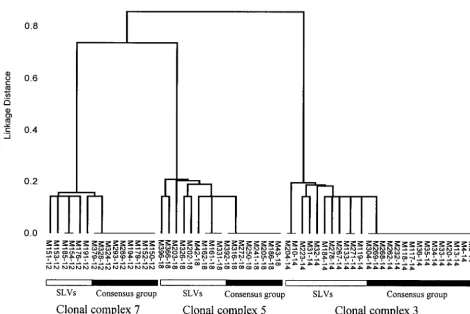
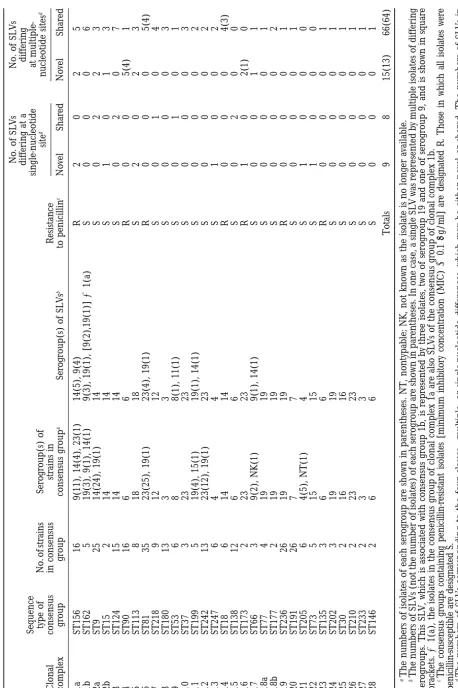
iso-lates within three representative clonal complexes are of recombination compared to point mutation, we need to be able to distinguish which of these alleles have shown as a dendrogram in Figure 1. The isolates within
each of the 28 clonal complexes are shown in Figure 2. arisen by mutation and which by recombination. Estimating the true number of mutations:Point muta-There was an average of ⵑ37 alleles per locus and
the pneumococcal MLST scheme can therefore resolve tions can also be distinguished from recombinational exchanges on the basis of the presence of the resultant billions of allelic profiles. The range in the number of
alleles per locus was 26–54, which implies that the loci allele elsewhere in the MLST data set. A point mutation will almost certainly result in a novel allele that is not were evolving at approximately the same rate, although
there is evidence that ddl is evolving faster than the found elsewhere in the data set, but a recombinational exchange that replaces the entire sequenced fragment other loci because of hitchhiking effects (see below).
Because of the large number of alleles per locus, pneu- will result in an allele that must be present elsewhere in the pneumococcal gene pool, but which may or may mococcal isolates with identical allelic profiles are highly
unlikely to occur by chance and can be assumed to be not be present in the sample of the population that constitutes the data set. We therefore examined the closely related by descent (EnrightandSpratt1998,
1999a;Spratt1999). This assumption is supported by occurrence of the variant alleles in the SLVs elsewhere in the data set. To remove the possibility that two isolates the observation that all isolates within 21 of the 28 clonal
complexes were uniform in serogroup (Table 1). Sero- share the same variant allele by virtue of descent rather than by horizontal gene transfer, we made comparisons group variation within the other seven clonal complexes
is likely to have arisen through recombinational ex- only between unrelated isolates, defined as those that differ at three or more loci.
changes at the capsular locus that determines serogroup
(Coffey et al. 1991), and this has been demonstrated In 17 of the 98 allelic comparisons the descendant allele differed from the ancestral allele at a single site; 11 experimentally for clonal complexes 1a and 6 (Coffey
et al. 1998, 1999), which correspond to the major penicil- of these single-nucleotide differences were synonymous. Nine (53%) of these 17 alleles were novel and 8 (47%) lin-resistant Spanish serotype 9V and 23F clones,
respec-tively (CrookandSpratt1998). were shared (i.e., they were found elsewhere in the data set). Of the 81 descendant alleles that differed at multi-Estimating the contributions of recombination and
Figure1.—Dendrogram showing the relatedness of isolates within three of the clonal complexes. A dendrogram was constructed by the unweighted pair-group method with arithmetic averages from the matrix of pairwise percentage differences between the allelic profiles of the 58 isolates assigned to clonal complexes 3, 5, and 7. The isolates within each clonal complex were identified as described inmaterials and methods.The serogroup of each isolate is shown, separated from the name of the isolate by a hyphen. The horizontal bars indicate the consensus groups and the corresponding SLVs. No inferences should be made about the genetic relationships between the clonal complexes.
novel descendant alleles that differed at a single site, set suggests that the large MLST data set contains the majority of alleles in the pneumococcal population and compared to those that differed at multiple sites, was
statistically significant using a 2⫻2 chi square test (P⬍ means that we can approximate the number of muta-tions as the number of novel descendant alleles that 0.01). This difference is to be expected, as descendant
alleles differing at single sites should include both point differ at a single site. However, there remain several potential sources of error that need to be considered. mutations (which are highly likely to result in a novel
allele) and recombinational events (which may well re- For example, it is possible that a point mutation may result in a shared allele by chance, or that some of the sult in a shared allele).
This observation also suggests that our assumptions novel alleles that differ at a single site are due to short (part-fragment) recombinational exchanges resulting about the directionality of events (i.e., the assignment
of alleles as either ancestral or descendant, based on the in novel mosaic alleles where at least one of the recombi-national crossovers is within the sequenced region. Al-frequency of isolates within putative consensus groups)
have generally been correct. Thus if we repeat the com- ternatively, a novel allele differing at a single site may be an imported allele that is not represented elsewhere parison, treating the ancestral alleles as if they were
descendant, and vice versa, we find no difference be- in the data set. Furthermore, the presence of hypermu-table sites would increase the probability that a point tween the proportion of novel alleles among the
single-nucleotide changes (2/17) compared to multiple-nucle- mutation will result in a shared allele and so be incor-rectly assigned as a recombinational exchange. A discus-otide changes (8/81; P ⬎0.1).
The high proportion (81%) of descendant alleles dif- sion of these potential sources of error is given in the
appendix.
fering at multiple sites (which we assume to have arisen
Figure 2.—The clonal complexes among the 575 isolates of S. pneumoniae. Each of the 28 clonal complexes is assigned a number, which is given above the clonal complex. Where two consensus groups were identified within a clonal complex, the labels a and b are given below the consensus groups. Consensus groups are represented as a small circle, and the number of isolates within the consensus group is given inside the circle. In cases where more than one SLV is associated with a consensus group (clonal complexes 1–18), the SLVs are enclosed in a larger circle around the consensus group. Each SLV is shown either as a dot (䊉) where the variant allele in the SLV differs at multiple (ⱖ2) sites from the ancestral allele in the consensus group or as a cross (⫻) where the variant allele differs at only a single nucleotide from the ancestral clonal allele. Where a SLV is represented by multiple isolates, the number of identical isolates of the SLV is given as a prefix (i.e., 2䊉refers to a SLV where the variant allele differs at multiple sites from the ancestral clonal allele and is represented by two identical isolates). In cases where only a single SLV is associated with a consensus group (clonal complexes 19–28), the relationship between the consensus group and the SLV is given by an open-headed arrow, which shows the assumed direction of descent. In the three cases where a clonal complex contains two consensus groups, the assumed direction of descent between the consensus groups is given by a closed-headed arrow.
in the appendix, is the possibility that some shared be considered. There were 20 descendant alleles that differed at two nucleotide sites; 5 of these were novel alleles that differ at a single-nucleotide site represent
point mutations that have subsequently been exported (25%) and 15 were shared alleles (75%). As it is very unlikely that the same two mutations will have occurred to unrelated isolates. There are two reasons why this is
unlikely to be a serious source of error. First, it is less independently within more than one isolate (the possi-bility of hypermutable sites can be ignored; see above parsimonious to assume that these alleles have been
exported out of a clonal complex (which would require and theappendix), the shared alleles can be assumed to have been generated through recombination. Although a point mutation followed by a recombination event),
rather than imported into a clonal complex. Second, two independent mutations would almost certainly pro-duce a novel allele, the percentage of novel alleles was the eight shared alleles that differed at single sites were
found in an average of⬎50 unrelated isolates represent- not significantly different for descendant alleles that differed at two sites compared to those that differed ing a number of distantly related lineages. The
wide-spread distribution of these alleles among distantly re- at three or more sites. Most of these novel alleles are therefore likely to be imports of alleles that are not lated lineages makes it likely that they predate the origin
of the SLVs and have been imported rather than ex- within the MLST database and the vast majority, if not all, of the variant alleles that differed at two nucleotide ported. A summary of the four most likely scenarios
leading to the generation of a single-locus variant is sites are probably due to recombination rather than two independent mutational events.
given in Figure 4.
Estimating the true number of recombinational re- In the analysis of the N. meningitidis MLST data set there were no descendant alleles that differed from placements:The possibility that a descendant allele that
differs from its ancestral allele at two nucleotide sites their ancestral alleles at between two, three, or four nucleotide sites (Feilet al. 1999). The absence of
Figure3.—Frequency distribution of the num-bers of nucleotide differences between ancestral and descendant alleles. Approximately half of the variant alleles that differ at a single-nucleotide site are assumed to represent point mutations, the other half representing recombination between very similar parental sequences (see text). The four highly diverged replacements (differing at 25, 28, 35, and 36 nucleotide sites) are all within
ddl, and, for reasons given in the text, these are
excluded from the analysis.
scendant alleles that differ at two to four sites is almost tional events to mutational events per gene fragment is ⵑ10:1.
certainly due to the higher levels of diversity within
meningococcal genes (average of ⵑ4.4%), compared The per site ratio of recombination to mutation: A more meaningful comparative measure is the relative to pneumococcal genes (average ofⵑ1.1%), such that
recombinational replacements in meningococci usually likelihood that an individual nucleotide site within a housekeeping gene will change by recombination com-result in the introduction of at least five nucleotide
differences within a 450-bp gene fragment. The absence pared to mutation (the per site r/m parameter). This can be calculated from the total number of nucleotide of descendant alleles that differed at two sites suggests
that two independent mutational events, or the intro- changes within the 89 alleles assumed to have arisen via recombination (592) compared to the number intro-duction of two nucleotide differences by a DNA repair
process, are rare events in meningococci. Although cau- duced by mutation (9). The resulting per site r/m pa-rameter ofⵑ66:1 implies that recombination changes tion is clearly required when extrapolating from
menin-gococci to pneumococci, this indirectly supports the an individual nucleotide site within a pneumococcal housekeeping gene ⵑ66 times more frequently than suggestion that the descendant pneumococcal alleles
that differ at two sites are due to recombinational events point mutation.
From Figure 3 it is apparent that four of the recombi-within a species of low sequence diversity. This view was
supported further by simulating 1000 whole-fragment national replacements in the SLVs have introduced highly diverged sequences, and each of these replace-recombinational replacements between randomly
cho-sen alleles at each of the seven pneumococcal loci. Ap- ments is within the ddl locus. These four replacements, which were all in SLVs of penicillin-resistant isolates, proximately 18% of these simulated allelic replacements
involved donor and recipient alleles that differed at only have introduced a total of 124 polymorphic sites, and their inclusion in the analysis markedly alters the per one or two nucleotide sites (data not shown).
Estimating the ratio of recombinational to mutational site r/m parameter in favor of recombination. The ddl gene is 783 bp downstream of the penicillin-binding events:A crude estimate of the ratio of recombinational
events compared to mutational events during clonal protein 2b (PBP2b) gene. Interspecies recombinational replacements that result in reduced affinity of PBP2b diversification can be obtained by assuming that the 81
descendant alleles that differ at multiple sites are due for-lactam antibiotics and increased resistance to these antibiotics sometimes extend into or through ddl. The to recombination and the 17 that differ at a single site
are due to point mutation. This provides a ratio per divergent ddl alleles are therefore the result of hitchhik-ing with a gene at which rare interspecies replacements gene fragment of ⵑ5:1, which, as outlined above, is
likely to be a considerable underestimate of the signifi- are strongly selected by antibiotic usage (Enrightand
Spratt1999b). Excluding these four replacements re-cance of recombinational replacements, as some of the
alleles that differ at a single site will be due to recombina- duced the per site r/m parameter to 52:1. There were 12 other SLVs where ddl was the altered locus. If we tion, rather than mutation. A more realistic approach
is to consider only the 9 novel alleles that differ at a also excluded these SLVs, the estimated per site r/m parameter reduced to 45:1. This suggests that, excepting single site to have arisen by mutation and the 81 alleles
that differ at multiple sites, plus the 8 shared alleles that the very diverged replacements, the inclusion of ddl does not markedly alter the per site r/m parameter. differ at a single site, to have arisen by recombination.
Figure4.—Scenarios for the generation of SLVs from an isolate belonging to a consensus group. Each allele is shown by a wavy line. The members of the consensus group have identical alleles at all seven loci whereas the SLVs differ from this group at a single locus. The nucleotide differences between the variant allele in each SLV and the allele present in the consensus group are represented by asterisks. Single-nucleotide changes are represented by a single asterisk and multiple-nucleotide changes are represented by four asterisks. The four scenarios are as follows: (A) A point mutation generates a novel variant allele that differs from the consensus allele at a single-nucleotide site. This class is believed to account forⵑ50% of the variant alleles that differ at a single site. (B) A recombinational replacement with a donor allele that differs at only a single-nucleotide site generates a shared allele that differs at a single site, as the donor allele is present in unrelated isolates in the pneumococcal MLST database. This class is believed to account forⵑ50% of the variant alleles that differ at a single site. (C) A recombinational replacement with a donor allele that differs at multiple-nucleotide sites generates a shared allele, as the donor allele is present in unrelated isolates in the MLST database. This class accounts forⵑ81% of the variant alleles that differ at multiple sites. (D) A recombinational replacement with a donor allele that differs at multiple-nucleotide sites generates a novel allele, as the donor allele is not present elsewhere in the MLST database. This class accounts forⵑ19% of the variant alleles that differ at multiple sites. It is also possible that a novel variant allele that differs at a single site may arise through a recombinational replacement with an allele not represented in the database, or that novel alleles may arise by intrafragment replacements. However, we believe these classes of alleles are rare (see text andappendix).
that the variation within the clonal complexes has oc- molecular evidence suggests this is unlikely as the three highly variable penicillin-binding protein genes confer-curred recently, but it is not possible to estimate the
age of most clonal complexes due to the absence of ring resistance to penicillin are almost always completely uniform within the penicillin-resistant clones (Zhouet
old isolates. However, it is possible to date the clonal
complexes that consist exclusively of penicillin-resistant al. 2000).
Replacement lengths in pneumococci and meningo-isolates, as these must have arisen since the introduction
of penicillin in the 1940s and have probably arisen in cocci:The per site r/m parameter is a product of three other parameters: the rate of recombination (i.e., the the last 25 years (CrookandSpratt 1998). Seven of
the clonal complexes contained isolates that were all rate at which the chromosome is affected by a recombi-national event as compared to mutation), the average penicillin-resistant (Table 1). The per site r/m
parame-ter estimated for these clones was 53:1, a very similar amount of diversity between the parental molecules, and the average size of recombinational replacements. value to that calculated for the data set as a whole. The
rate of clonal diversification is thus sufficiently high that Therefore, to compare the frequency of replacements, compared to mutation, in pneumococci and meningo-clones⬍50 years old are no longer uniform by MLST.
It is possible that penicillin resistance has emerged inde- cocci from the per site r/m parameter, it is necessary to estimate average replacement sizes.
The proportion of recombination events that result binational parameters for the meningococcus and the pneumococcus. Although these figures should be re-in replacement of only part of a gene fragment of known
size can be used to estimate the average size of recombi- garded only as approximate, we can begin to draw com-parisons between the two species.Feilet al. (1999)
re-national replacements as follows. Assume, for simplicity,
that all replacements have the same length, w bp, and cently observed a total of 18 recombinational events and five putative point mutations within meningococcal that the length of the gene fragment is d bp. A particular
replacement is characterized by the (unknown) position clonal complexes. However, one of the putative point mutations corresponded to a “shared” allele and, follow-of the upstream crossover point. The range follow-of positions
that affect a particular gene is w⫹ d, and, within this ing the criteria used in this article, was reassigned from a possible recombinational exchange to a probable re-range, a length of 2d results in a part-fragment
replace-ment. Hence if r is the fraction of recombination events combinational exchange. This changes the per site r/m parameter from⬎80:1 (Feilet al. 1999) toⵑ100:1 for that result in a part-fragment replacement, r⫽2d/(w⫹
d), or w⫽d(2⫺ r)/r. the meningococcus, which is roughly double that ob-served within the pneumococcus. However, the esti-Because estimates of replacement lengths are useful
when drawing comparisons between different species, mated average ratio of recombinational events to mu-tational events (the ratio at which SLVs arise by consider first the meningococcus (Feilet al. 1999). The
occurrence of a part-fragment replacement was deter- recombination compared to mutation) in the meningo-coccus is now ⵑ5:1 (19/4), or roughly half the ratio mined by two criteria: the nonrandom distribution of
polymorphic nucleotides (the confinement of polymor- observed for the pneumococcus (Table 2). Assuming that the average size of recombinational replacements phic sites to one end of the fragment) and the absence
of the variant allele in unrelated isolates in the database. is similar between these two species (see above), the difference between the ratio of recombinational events In the meningococcus, 18 clonal variants were identified
that differed from the ancestral allele at five or more compared to the per site r/m ratio is explained by the fact that the average sequence diversity between paren-nucleotide sites (Feilet al. 1999), and we assigned 2 of
these clonal variant alleles as part-fragment replace- tal molecules is approximately fourfold higher in the meningococcus (4.4%) than the pneumococcus (1.1%). ments. Hence, d ⫽ 450 and r ⫽ 1⁄
9, so the estimated
length of a typical recombinational replacement in the Thus, each replacement, on average, introduces four-fold as many polymorphisms in the meningococcus meningococcus is 7.6 kb.
The pneumococcal data are harder to interpret, be- compared to the pneumococcus. This increased diver-sity results in a higher per site r/m ratio in the meningo-cause the gene fragments contain fewer polymorphic
sites, and the polymorphisms tend to be clustered (prob- coccus, despite the frequency of recombinational events in the meningococcus being lower than that in the pneu-ably because of more ancient recombinational events).
This makes it difficult to identify part-fragment replace- mococcus.
The high degree of diversity within meningococcal ments, so we confined our analysis to two of the most
polymorphic gene loci, ddl and gki. Applying the same genes is due to the high frequency of interspecies recom-binational exchanges with closely related species in criteria, we concluded that 3/16 recombinants were
part-fragment replacements at these two loci, and hence housekeeping genes of this species (ZhouandSpratt
1992;Feilet al. 1995, 1996;Zhouet al. 1997). Interspe-w⫽ⵑ4.4 kb. This is in good agreement with a recent
experimental estimate that showed that 50% of replace- cies replacements within housekeeping genes of S.
pneu-moniae appear to be much less common (Enrightand ments were⬎5 kb. We conclude that, in both genera,
the typical size of a replacement is of the order of 5–10 kb. Spratt1998). The reason behind this difference is at present unclear, as commensal streptococcal species co-Further comparisons between the pneumococcus and
the meningococcus:Table 2 gives the estimated recom- habit the nasopharynx alongside the pneumococcus,
TABLE 2
Recombinational parameters for S. pneumoniae andN. meningitidis
Ratio of recombinational Average size of Average sequence to mutational events per recombinational diversity between
450-bp gene fragment replacements parental molecules (%) Per site r/m parameter
S. pneumoniae ⵑ10:1 5–10 kb 1.1 ⵑ50:1
N. meningitidisa ⵑ5:1 5–10 kb 4.4 ⵑ100:1
The value of the meningococcal per site r/m parameter is slightly different from that given previously (⬎80:1) as in line with the criteria used here, we reassigned one SLV that differed as a single site as the result of recombination since the resulting allele was present within an unrelated isolate in the meningococcal MLST database.
Coffey, T. J., C. G. Dowson, M. Daniels, J. Zhou, C. Martinet al.,
and interspecific recombinational imports from these
1991 Horizontal gene transfer of multiple penicillin-binding
species are known to occur in genes under strong selec- protein genes, and capsular biosynthetic genes, in natural popula-tions of Streptococcus pneumoniae. Mol. Microbiol. 5: 2255–2260. tion (Spratt1994).
Coffey, T. J., M. C. Enright, M. Daniels, J. K. Morona, R. Morona
Concluding remarks: There is now convincing
evi-et al., 1998 Recombinational exchanges at the capsular polysac-dence that recombination in S. pneumoniae, N. meningi- charide biosynthetic locus lead to frequent serotype changes among natural isolates of Streptococcus pneumoniae. Mol. Microbiol.
tidis, and E. coli has more impact than point mutation
27:73–83.
on sequence diversification at neutral loci. However, it
Coffey, T. J., M. Daniels, M. C. EnrightandB. G. Spratt,1999 is unwise to generalize from such a limited number of Serotype 14 variants of the Spanish penicillin-resistant serotype 9V clone of Streptococcus pneumoniae arose by large recombina-species as the rate of recombination among bacterial
tional replacements of the cpsA-pbp1a region. Microbiology 145: populations probably varies greatly (Maynard Smith
2023–2031.
et al. 1993). This results in a range of populations from Crook, D. W. M.,andB. G. Spratt,1998 Multidrug resistance in
Streptococcus pneumoniae. Brit. Med. Bull. 54: 593–608.
those with relatively stable clones (e.g., the clone of
Dykhuizen, D. E.,andL. Green,1991 Recombination in Escherichia
Salmonella enterica that causes typhoid fever;Selander
coli and the definition of biological species. J. Bacteriol. 173:
andMusser1990) to those in which recombination is 7257–7268.
Enright, M. C.,andB. G. Spratt, 1998 A multilocus sequence very common and clones cannot readily be discerned
typing scheme for Streptococcus pneumoniae : identification of (e.g., N. gonorrhoeae or Helicobacter pylori;O’Rourkeand
clones associated with serious invasive disease. Microbiology 144:
Stevens 1993; Suerbaum et al. 1998). Many species 3049–3060.
Enright, M. C.,andB. G. Spratt,1999a Multilocus sequence typ-appear to occupy the middle ground, where
recombina-ing. Trends Microbiol. 7: 482–487. tion leads to a higher frequency of nucleotide
substitu-Enright, M. C.,andB. G. Spratt,1999b Extensive variation in tion than point mutation, but is not sufficiently frequent the ddl gene of penicillin-resistant Streptococcus pneumoniae results from a hitchhiking effect driven by the penicillin-binding protein to prevent the emergence of transient clones (Spratt
2b gene. Mol. Biol. Evol. 16: 1687–1695. andMaiden1999).
Enright, M. C., A. Fenoll, D. GriffithsandB. G. Spratt,1999 The analysis presented here demonstrates how MLST The three major Spanish clones of penicillin-resistant Streptococcus
pneumoniae are the most common clones recovered from recent
data sets can be used to compare the relative importance
cases of meningitis in Spain. J. Clin. Microbiol. 37: 3210–3216. of recombination compared to point mutation in
bacte-Feil, E. J., G. CarpenterandB. G. Spratt,1995 Electrophoretic rial species. The great advantage of using MLST data is variation in adenylate kinase of Neisseria meningitidis is due to inter- and intra-species recombination. Proc. Natl. Acad. Sci. USA that databases for new species will become available
92:10535–10539.
(e.g., Staphylococcus aureus and Streptococcus pyogenes
Feil, E. J., J. Zhou, J. Maynard SmithandB. G. Spratt,1996 A MLST databases are now available; http://mlst.zoo.ox. comparison of the nucleotide sequences of the adk and recA genes of pathogenic and commensal Neisseria species: evidence for ex-ac.uk), and the existing meningococcal and
pneumo-tensive inter-species recombination within adk. J. Mol. Evol. 43: coccal databases will expand, as the method is
increas-631–640.
ingly used for molecular typing (Maiden et al. 1998; Feil, E. J., M. C. J. Maiden, M. AchtmanandB. G. Spratt,1999
The relative contributions of recombination and mutation to the
EnrightandSpratt1999a;Spratt 1999), which will
divergence of clones of Neisseria meningitidis. Mol. Biol. Evol. 16: allow refinements of the existing estimates.
Further-1496–1502.
more, any differences in the parameter within subpopu- Feldman, C.,andK. P. Klugman,1997 Pneumococcal infections. Curr. Opin. Infect. Dis. 10: 109–115.
lations of pneumococci and meningococci should
even-Guttman, D. S.,1997 Recombination and clonality in natural popu-tually be discerned (e.g., between clones with different
lations of Escherichia coli. Trends Ecol. Evol. 12: 16–22. epidemiological features or between invasive vs. carried Guttman, D. S.,andD. E. Dykhuizen,1994 Clonal divergence in isolates). Escherichia coli as a result of recombination, not mutation. Science
266:1380–1383.
The approach described here, combined with the
Holmes, E. C., R. UrwinandM. C. J. Maiden,1999 The influence generation of large MLST data sets for an increasing of recombination on the population structure and evolution of number of species, should therefore provide a much the human pathogen Neisseria meningitidis. Mol. Biol. Evol. 16:
741–749. improved view of the impact of recombination on
bacte-Istock, C. A., K. E. Duncan, N. FergusonandX. Zhou,1992 Sexu-rial population structure. This in turn should provide ality in a natural population of bacteria—Bacillus subtilis chal-clues as to which environmental, ecological, or biologi- lenges the clonal paradigm. Mol. Ecol. 1: 95–103.
Maiden, M. C. J., J. A. Bygraves, E. Feil, G. Morelli, J. E. Russell
cal factors determine the differences in recombination
et al., 1998 Multilocus sequence typing: a portable approach to rates among bacterial species. the identification of clones within populations of pathogenic
microorganisms. Proc. Natl. Acad. Sci. USA 95: 3140–3145. We are very grateful to Jiaji Zhou and Tracey Coffey for their
Maynard Smith, J.,1999 The detection and measurement of re-assistance in checking the data, to Man-Suen Chan for programming
combination from sequence data. Genetics 153: 1021–1027. advice and maintenance of the MLST web site, and to Martin Maiden
Maynard Smith, J., N. H. Smith, M. O’RourkeandB. G. Spratt,
for comments on the manuscript. This work was supported by the
1993 How clonal are bacteria? Proc. Natl. Acad. Sci. USA 90:
Wellcome Trust. B.G.S. is a Wellcome Trust Principal Research Fellow. 4384–4388.
O’Rourke, M.,andE. Stevens,1993 Genetic structure of Neisseria
gonorrhoeae populations: a non-clonal pathogen. J. Gen. Microbiol.
139:2603–2611.
LITERATURE CITED
Selander, R. K., andJ. M. Musser,1990 Population genetics of bacterial pathogenesis, pp. 11–36 in Molecular Basis of Bacterial
Brunham, R. C., F. A. PlummerandR. S. Stephens,1993 Bacterial
Infections, edited byB. H. IglewskiandV. L. Clark.Academic antigenic variation, host immune response, and pathogen-host
Shi, Z.-Y., M. C. Enright, P. Wilkinson, D. GriffithsandB. G. From the data, n2⫽ 63 and n3⫽ 992. We take n1⫽ Spratt,1998 Identification of three major clones of multiply
2637, the number of third sites. This is likely to be an antibiotic-resistant Streptococcus pneumoniae in Taiwanese hospitals
by multilocus sequence typing. J. Clin Microbiol. 36: 3514–3519. underestimate, since some of the SNCs are
nonsynony-Spratt, B. G.,1994 Resistance to antibiotics mediated by target mous. However, the estimates below are not sensitive alterations. Science 264: 388–393.
to the value chosen.
Spratt, B. G.,1999 Multilocus sequence typing: molecular typing
of bacterial pathogens in an era of rapid DNA sequencing and Then the proportions of the three types expected
the Internet. Curr. Opin. Microbiol. 2: 312–316. from point mutation are
Spratt, B. G.,and M. C. J. Maiden,1999 Bacterial population genetics, evolution and epidemiology. Philos. Trans. R. Soc.
Shared Shared nucleotide New
Lond. Ser. B 354: 701–710.
Suerbaum, S., J. Maynard Smith, K. Bapumia, G. Morelli, N. H.
n2/n1 (n3⫺n2)/n1 (n1⫺n3)/n1
Smithet al., 1998 Free recombination within Helicobacter pylori.
0.02 0.35 0.62
Proc. Natl. Acad. Sci. USA 95: 12619–12624.
Zhou, J.,andB. G. Spratt,1992 Sequence diversity within the argF,
fbp and recA genes of natural isolates of Neisseria meningitidis. If, as an initial guess, we assume all new SNCs to have
Interspecies recombination within the argF gene. Mol. Microbiol. been produced by point mutation, the expected values
6:2135–2146.
are 0.26 shared, 4.5 shared nucleotide, and 8 new. Note
Zhou, J., L. D. BowlerandB. G. Spratt,1997 Interspecies
recombi-nation, and phylogenetic distortions, within the glutamine synthe- that the expected number of shared nucleotide SNCs
tase and shikimate dehydrogenase genes of Neisseria meningitidis is greater than the observed number of 1.
and commensal Neisseria species. Mol. Microbiol. 23: 799–812.
Now consider the possibility that some new SNCs were
Zhou, J., M. C. EnrightandB. G. Spratt,2000 Identification of
the major Spanish clones of penicillin-resistant pneumococci via produced by part-fragment replacements. These could
the Internet using multilocus sequence typing. J. Clin. Microbiol. only be generated by replacements from outside the
(in press).
database. Such replacements would also generate
Communicating editor:L. Partridge shared nucleotide SNCs. However, 66 out of 81 multiple
nucleotide replacements, or 81%, were by alleles pres-ent elsewhere in the database. There is no reason why the proportion of part-fragment replacements from within the database should not be similar. Such replace-APPENDIX: ESTIMATING THE NUMBER
OF POINT MUTATIONS ments would necessarily be shared nucleotide SNCs, as would some fraction of replacements from outside the There are 17 cases in which the altered allele in a SLV
database. Hence part-fragment replacements are more differs from the ancestral allele by a single nucleotide.
likely to produce shared nucleotide than new SNCs. Such single-nucleotide changes (SNCs) could be caused
However, as pointed out above, the number of shared by (i) a point mutation; (ii) a whole fragment
replace-nucleotide SNCs expected (assuming most new SNCs ment; or (iii) a part-fragment replacement, altering a
to be caused by mutation) is already greater than the single nucleotide, even though the donor and recipient
number observed. It follows that part-fragment replace-fragments differ at many sites. The problem is to
esti-ments from outside the database have been rare or mate how many of the 17 cases were point mutations.
absent; they are ignored in what follows. Alleles that differ at a single site from an ancestral allele
There remains the possibility that SNCs have been could be (i) “shared”; that is, identical to an allele in
generated by whole-fragment replacements. Approxi-an unrelated isolate; (ii) “shared nucleotide”; that is,
mately 81% of these will be from within the database, with a changed nucleotide identical to one present in
and all these will be shared SNCs. The question is, how-the database (but not in a “shared allele”); or (iii) “new”;
ever, whether the remaining 19% from outside the data-that is, with a nucleotide not present elsewhere in the
base contribute a significant number of new SNCs. This database. The observed numbers were 8 “shared,” 1
is unlikely. The probability, pu, that a whole-fragment “shared nucleotide,” and 8 “new.” We start by estimating
replacement from outside the database carries a unique the proportions of these three types expected from
nucleotide can be estimated by the proportion of the point mutation.
n2 potential SNCs within the database that carry a
nucle-Summing over all ancestral alleles, let
otide not present elsewhere; that is, pu⫽33/63. In other
n1 represent the number of potential neutral mutations: words, the 19% of whole-fragment replacements will that is, possible mutations that are neutral, favorable, generate 50% new and 50% shared nucleotide SNCs. or, if deleterious, whose effect on fitness is not so Hence the proportions of the three types generated by large as to prevent their being represented in the whole-gene replacements are
database;
Shared Shared nucleotide New
n2 represent the number of alleles present in the
data-base, in unrelated isolates, that differ at only one site 0.81 0.095 0.095 from the ancestral allele; and
observed numbers of eight shared and eight new SNCs, numbers of shared and new SNCs. The observed num-ber of 1 is lower than the expected numnum-ber of 4.5. the best fit to observation is
The difference is barely significant (P⫽0.05), but it is Shared suggestive; a contributory factor may be that we have Shared nucleotide New Total underestimated n1, the number of potential neutral mutations. It is worth noting that there is no sign of Point
hypermutable sites; if such sites existed, we would expect
mutation 0.2 1 (3.6) 7 8.2
to see more and not fewer shared nucleotide SNCs. Whole
These calculations are unavoidably very approximate. fragment
However, they suggest that (i) part-fragment
replace-replacement 7.8 0 (0.9) 1 8.8
ments are rare or absent; and (ii) most new and shared Total
nucleotide SNCs are the result of point mutation, and
observed 8 1 8 17