ABSTRACT
MOEHRING, AMANDA JEAN. The Quantitative Genetic Basis of Mating Behavior and Speciation in Drosophila. (Under the direction of Trudy F. C. Mackay).
The widely-accepted Biological Species Concept defines species as populations that are reproductively isolated, i.e. are unable to mate with one another or produce viable and fertile progeny when given the opportunity. Speciation is characterized by the evolution of prezygotic (ethological barriers to interspecific mating) and postzygotic (reduced viability and fertility of interspecific hybrids) reproductive isolating
mechanisms. Although recent progress has been made towards understanding the genetic basis of postzygotic isolation, little is known of the genetic architecture of sexual isolation – arguably the most important form of reproductive isolation in animals. In addition, it has not been determined if reproductive isolation occurs due to selection acting on variation within a species or arises from novel mutations. In order to understand how new species arise, the genetic basis of variation in mating behavior within a species, as well as the genetic basis for prezygotic reproductive isolation between species, must be known.
segregate between a D. melanogaster strain selected for reduced male mating propensity (2b) and a standard wild-type strain (Oregon-R). Mating behavior was assessed in a population of 98 recombinant inbred lines derived from these two strains and QTL affecting mating behavior were mapped using composite interval mapping. There were four QTL affecting male mating behavior at cytological locations 1A;3E, 57C;57F, 72A;85F and 96F;99A. We used deficiency complementation mapping to map the autosomal QTL with much higher resolution to five QTL at 56F5;56F8, 56F9;57A2, 70E1;71F4, 78C5;79A1, and 96F1;97B1. Quantitative complementation tests performed for 45 positional candidate genes within these intervals revealed seven genes which failed to complement the QTL: eagle, 18 wheeler, Enhancer of split, Polycomb, spermatocyte arrest, l(2)05510 and l(2)k02206. None of these genes have been previously implicated in mating behavior, demonstrating that quantitative analysis of subtle variants can reveal novel pleiotropic effects of key developmental loci on behavior.
In a separate experiment, we mapped QTL contributing to pre-zygotic
to results for postzygotic isolation, no epistasis was detected between QTL for prezygotic isolation.
THE QUANTITATIVE GENETIC BASIS OF MATING BEHAVIOR AND SPECIATION IN DROSOPHILA
by
AMANDA JEAN MOEHRING
A dissertation submitted to the Graduate Faculty of North Carolina State University
in partial fulfillment of the requirements for the Degree of
Doctor of Philosophy
GENETICS
Raleigh 2003
APPROVED BY:
_____________________________ Chair of Advisory Committee
Trudy F. C. Mackay
_____________________________ Co-chair of Advisory Committee
Gregory C. Gibson
DEDICATION
BIOGRAPHY
ACKNOWLEDGEMENTS
In the outstanding academic environments that I have experienced, there are many people who deserve recognition for assisting me my development as a scientist, and in this research in particular.
First and foremost, I owe a tremendous thank you to my advisor, Trudy Mackay. Her tremendous intellect is immediately evident, yet she has the ability to explain the simplest concept without belittling the questioner.
I would also like to thank the other members of my committee: Robert Anholt, Greg Gibson and Coby Schal. Your input on my thesis, helpful discussions, and encouragement are greatly appreciated.
The many members of the Mackay lab were a wonderful source of information, advice, and most importantly, fun. I thank you all for helping to make graduate school an enjoyable experience. I would especially like to thank Richard Lyman and Ted Morgan for statistical help and Maria deLuca for molecular assistance.
Stephanie Curtis and Jim Mahaffey deserve thanks for the many candid discussions they shared with me about life as a research scientist and how to balance family and career.
Lisa Sardinia, Pam Lopez and Mary Fehrs were powerful role models for me as an undergraduate at Pacific University, and helped shape my future as a female in the pursuit of a career in science.
examples of love, honesty and hard work demonstrate who you are more eloquently than any words. My brothers, Carl and Jon, for driving me to be more, and my sister-in-law Rachelle, who is truly a sister to me, for always believing I am capable of accomplishing anything. I strive to be worthy of the respect you have shown me and to grow into the person you all think I am capable of becoming.
I would also like to thank Habitat for Humanity and the people of Cantel,
Guatemala, for shaping me as a human being. My experiences with you taught me to be grateful for the opportunities I have, for the life that is available to me, and how minor the troubles of my life are compared to those who truly have to struggle. Your
perseverance in the face of repeated hardship is an example I have never forgotten.
TABLE OF CONTENTS
LIST OF TABLES……….…… viii
LIST OF FIGURES……… ix
CHAPTER 1: Literature Review: The Genetics of Drosophila Mating Behavior… 1
Summary……… 2
Introduction……… 3
Mutants……….. 6
Sensory Mutants………. 8
Courtship Anomalies……….…. 15
Song Mutants………. 16
The Sex-Determination Pathway……… 17
Drosophila Pheromones………. 21
Commonalities of Genes Coding for Mating Behavior……….. 23
Future Prospects………. 24
Quantitative Genetics of Mating Behavior………. 26
Conclusions……… 32
Literature Cited……….. 35
CHAPTER 2: Literature Review: The Genetic Basis of Speciation in Drosophila… 51 Summary……….……… 52
Introduction……….……… 53
Geographical Conditions for Speciation………. 57
Allopatric Speciation……….……….. 57
Sympatric Speciation……….……….. 59
Reinforcement……….………. 60
Divergence with Gene Flow……….……… 61
Bottleneck Speciation……….……….. 62
Mechanisms of Reproductive Isolation……….……….. 63
Prezygotic Isolation……….………. 63
Postzygotic Isolation……….……… 65
Methods of Genetic Analysis……….………….. 72
Chromosome Substitution……….……… 73
Chromosome Introgression……….. 75
Recombination Mapping……….. 77
Deficiency Mapping………. 79
Quantitative Trait Locus (QTL) Mapping……… 84
CHAPTER 3: The Quantitative Genetic Basis of Male Mating Behavior in
Drosophila melanogaster……….………. 102
Abstract……….……… 103
Introduction……….………….. 104
Materials and Methods……….…………. 106
Results……….………….. 116
Discussion……….………… 144
Literature Cited……… 150
CHAPTER 4: Quantitative Trait Loci for Sexual Isolation Between Drosophila simulans and D. mauritiana………... 157
Abstract……….……… 158
Introduction……….……….. 159
Results and Discussion……….………. 160
Materials and Methods……….………. 172
Literature Cited………. 179
APPENDICES………182
Appendix 1 roo transposable element genotypes for the 98 RI lines……… 183
LIST OF TABLES
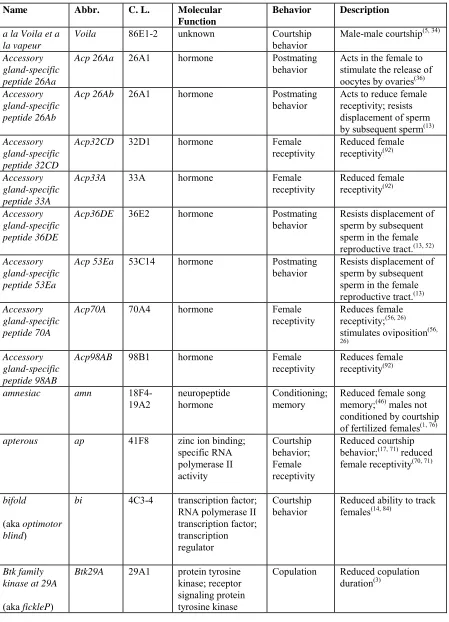
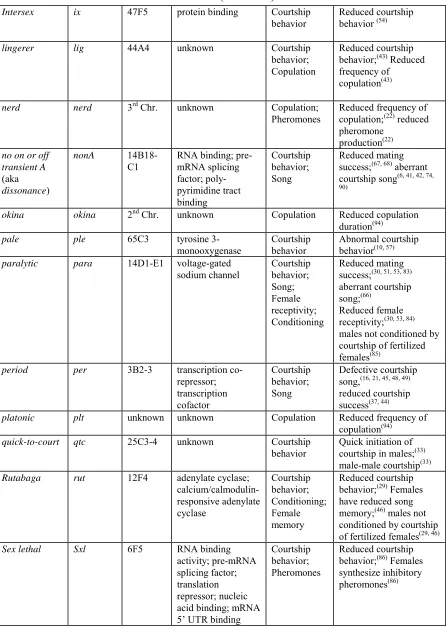
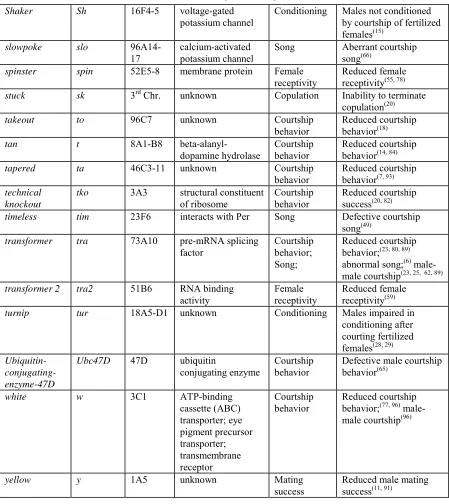
Table 1.1 An alphabetical list of genes shown to have an affect on
courtship or copulatory behavior ……… 9
Table 2.1 Summary of existing genetic analyses of species pairs that are reproductively isolated. The current mode of isolation, trait studied, experimental design and number of loci affecting speciation are listed……….. 69
Table 2.2 Quantitative genetic studies of speciation for which there is a molecular marker map……….. 81
Table 3.1 Cytological locations of roo transposable elements……… 108
Table 3.2 Stocks used for deficiency complementation mapping of QTL affecting mating behavior……… 112
Table 3.3 The genes that were tested for failure to complement and their cytological locations……… 115
Table 3.4 ANOVA for each mating behavior trait……….. 117
Table 3.5 G test results for courtship and copulation occurrence……… 118
Table 3.6 Genetic correlations among mating behavior traits………. 123
Table 3.7 Summary of QTL mapping results……….. 126
Table 3.8 Deficiency mapping results……….. 129
Table 3.9 P values from ANOVA for deficiencies that showed failure to complement……….. 134
Table 3.10 The genes that were tested for failure to complement……….. 138
Table 3.11 P values from ANOVA for candidate genes that showed failure to complement……….. 143
Table 4.1 Molecular markers and map positions………. 161
Table 4.2 QTL affecting prezygotic reproductive isolation………. 164
LIST OF FIGURES
Figure 1.1 The various stages of mating behavior……….. 5 Figure 1.2 The sine wave of the D. melanogaster courtship song……….. 18 Figure 1.3 Genetic network regulating sexual differentiation………. 19
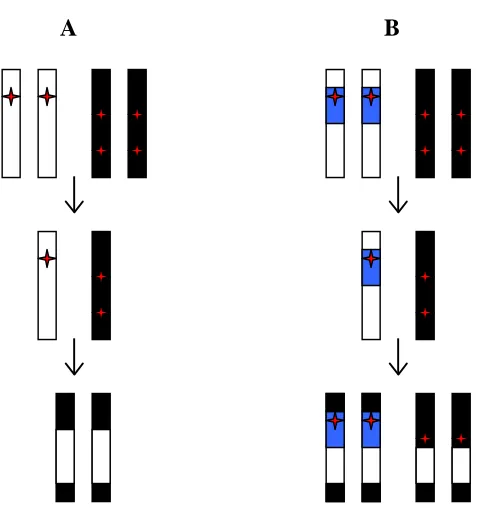
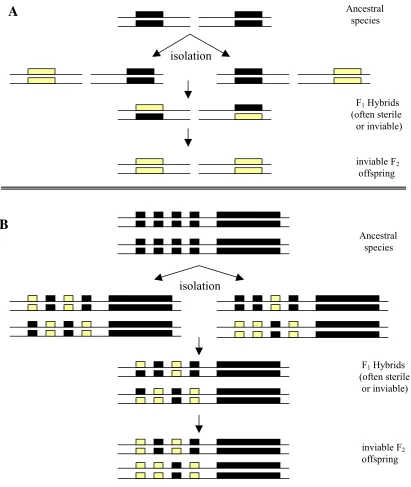
Figure 2.1 Model for the persistence of hybrid sterility when an
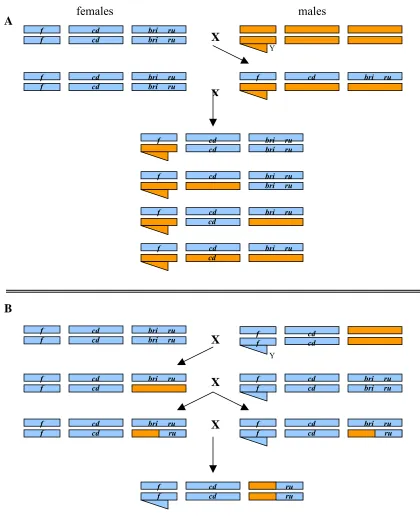
inversion is present………. 66 Figure 2.2 Duplicate genes as the mechanism for hybrid dysfunction………… 68 Figure 2.3 The creation of chromosomal introgression lines……… 74 Figure 2.4 The introgression of a P-element marked segment of
D. mauritiana into a D. simulans background by repeated
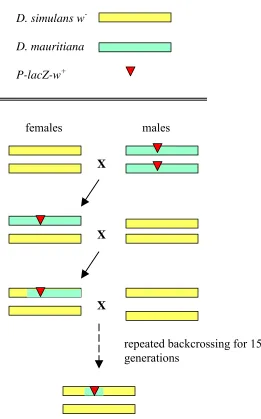
backcrossing……… 76 Figure 2.5 Identifying candidate regions or genes through recombination
mapping……….. 78
Figure 3.1 Continuous distribution of courtship latency means among 98
RI lines, sorted by shortest to longest courtship latency……… 119 Figure 3.2 Continuous distribution of courtship occurrence means among
98 RI lines, sorted by shortest to longest courtship occurrence…….. 119 Figure 3.3 Continuous distribution of copulation latency means among 98
RI lines, sorted by shortest to longest copulation latency………….. 120 Figure 3.4 Continuous distribution of copulation occurrence means among
98 RI lines, sorted by shortest to longest copulation occurrence…… 120 Figure 3.5 Continuous distribution of courtship duration means among 98
RI lines, sorted by shortest to longest courtship duration………….. 121 Figure 3.6 Correlations among line means for (a) courtship and copulation
latency, (b) courtship and copulation occurrence, (c) courtship
occurrence and latency and (d) copulation occurrence and latency… 124 Figure 3.7 Likelihood ratio (LR) scores and significance thresholds plotted
against chromosome location from multiple-trait composite interval mapping for courtship latency, courtship occurrence,
copulation latency and copulation occurrence……… 125 Figure 3.8 The significant regions from QTL mapping and deficiency
complementation mapping for the three major Drosophila
chromosomes………128 Figure 3.9 Deficiency complementation tests and the standard error for the
deficiencies and traits that showed failure to complement………….. 135 Figure 3.10 Complementation tests and the standard error for the genes and
Figure 4.1 QTL affecting prezygotic reproductive isolation between
Drosophila. simulans and D. mauritiana……… 162 Figure 4.2 The ratio of heterozygotes to homozygotes for BC females
crossed to D. simulans males, BC males crossed to D. mauritiana
CHAPTER 1
Literature Review:
“Studies of courtship and mating in the fruit fly offer a window on the ways genes influence the execution of complex behaviors”
R. J. Greenspan (1995)
SUMMARY
The mating behavior of Drosophila consists of a series of actions that exchange
auditory, visual and chemosensory signals between males and females. Although mating
behavior has been studied extensively in Drosophila, most known genes affecting mating
behavior have been located through the mutation of single genes. The genes affecting
genetic variation for mating behavior in natural populations are not known. The wide
range of variation in courtship behavior in natural populations is believed to arise from
the joint segregation of multiple quantitative trait loci (QTL) with varying effects that can
be influenced by the environment. Locating the QTL responsible for behavior has been
limited due to the complexity of behavior and the multiple factors involved in its
production. Due to its intricate nature, large sample sizes and numbers of molecular
markers are necessary to unravel the genetic basis of a behavior, which is why QTL have
not previously been identified for courtship behavior to the level of an individual gene.
This review will discuss the single genes that are known to affect mating and courtship
INTRODUCTION
The range of genetic variation within a species both underlies and limits the
degree to which a population can respond to selection. Populations evolve when
selection acts upon genetic variation, causing a shift in the allele frequency of
polymorphic genes affecting a particular trait. If two subpopulations diverge in the
frequency of a gene that can affect mating behavior to the degree that they no longer are
able to reproduce with one another, they will be devoid of gene flow and can then evolve
along separate paths. This reproductive isolation is therefore the basis of the formation of
new species. Hence, in order to understand the genetic basis of speciation, we must first
identify the genes producing variation in mating and courtship behavior, for it is
divergence in these traits that is thought to be responsible for the initiation of
reproductive isolation, and subsequently speciation.
Although behavioral traits have been studied for decades in an attempt to identify
the genetic basis of the variation seen within and among species, these studies were
limited until recently due to the difficulty of separating the individual behavioral
components, the necessity for a large panel of molecular markers, and the need for an
accurate statistical mapping technique and publicly available computational software to
implement the statistical analysis. With the recent availability of sequence data providing
a multitude of molecular markers and improved analytical techniques, we are beginning
to understand the genetic basis of naturally occurring variation in behavior, at least in
model genetic organisms. Drosophila is ideally suited for the study of complex
behaviors and the genetic tools available for understanding them.
The courtship behavior of Drosophila involves the exchange of information and a
dynamic mutual stimulation involving several sensory modalities. There are multiple
factors that comprise the whole of mating behavior. In Drosophila, this behavior follows
a series of steps (Figure 1.1) (Dethier, 1971). First, the male becomes aware of the
female and aligns himself with her. Then he taps her abdomen, the major site of female
pheromone production (Coyne and Oyama, 1995), sensing the pheromones through his
prothoracic legs (Dethier, 1971; Pikielny and Wang, 1996; Wang and Pikielny, 1997).
This transfer of pheromones is partially responsible for gender and species recognition.
Drosophila do not mate in flight, and as the female moves around, the male will follow
her and begin his wing vibration display, producing a courtship “song” (Wheeler et al.,
1991). The antennae permit the specialized perception and processing of this acoustical
information in the female while acting in the male to process some of the pheromonal
cues (Clyne et al., 1997). Several seconds to minutes after courtship initiation, the male
will then extend his proboscis and lick the female’s genitalia, creating another transfer of
pheromones (Dethier, 1971). Finally, the male attempts to copulate, curling his abdomen
by contracting the Muscle of Lawrence (MOL). If he is unsuccessful because the female
rejects him through avoidance (running away) or by extruding her ovipositor (if she has
previously mated), the male will either return to the following or singing stage and repeat
the cycle or begin anew with a different female (Hall, 1994). Receptive females raise
their wings, allowing the male to grip them and open the vaginal plate (Yamamoto and
Figure 1.1: The various stages of mating behavior. Figure taken from R. J. Greenspan
and even “anti-aphrodisiac” pheromones that make the female less appealing to other
males (Jallon, 1984).
Mating ability is a critical component of reproductive fitness in males (Partridge
et al., 1985), and can undergo significant inbreeding depression (Sharp, 1984). However,
there is a considerable amount of segregating variation for the individual components of
mating behavior, as well as for mating preference (Manning, 1961, 1963; Parsons, 1964);
this variation most likely persisting through genotype by sex interactions (Casares et al.,
1993; Nuzhdin et al., 1997; Vieira et al., 2000). Estimates of heritability (h2) for male
mating speed range from 0.3-0.6 (Manning, 1961, 1963; Parsons, 1964; Collins and
Hewitt, 1984; Casares et al., 1993), suggesting a strong genetic component for mating
behavior in Drosophila.
MUTANTS
By examining flies that have a mutation in a single gene, individual components
of development, morphology and behavior can be assessed. To locate single genes
involved in Drosophila mating behavior, point mutations can be created through
treatment with X-rays or ethyl methane sulfonate (EMS), through P-element-mediated
germ-line transformation (Bate and Martinez, 1993), or through the use of RNA
interference (RNAi) (Fire et al., 1998). Treatment with the ionizing radiation of X-rays
causes the release of electrons, and subsequently the formation of positively charged free
radicals that are highly chemically reactive. Ionizing radiation is mutagenic due to this
chromosomal rearrangements. EMS is an alkylating agent that induces chemical
mutagenesis through the transfer of an ethyl group to a DNA base, transforming its
chemical structure and resulting in point mutations due to altered base pairing.
P-elements are transposable elements whose transposition can be controlled by
simple crosses to strains containing a stable source of transposase (Engles, 1984). P
-elements typically insert in 5’ regulatory regions of genes, causing hypomorphic
mutations, but can also disrupt the coding sequence and produce null mutations
(Spradling etal., 1999). Several P-element insertions are known to disrupt genes that are
involved in courtship behavior. P-elements have also been constructed that enable
temporally restrictive gene expression by engineering the wild-type gene with a heat
shock promoter. If such a P-element construct is inserted into a stock homozygous for a
null allele, the only functional copy of that gene is the one present on the P-element.
‘Rescue’ of the mutant phenotype by applying a mild heat shock constitutes proof of
identity of the mutant gene. The P-element can be a vessel for the addition of gene
function as well when used in a binary system where the P-element is joined with an
upstream activating sequence (UAS) promoter. When the UAS line is crossed to a line
containing the GAL4 driver, the UAS transgene will be activated in all of the tissues that
express GAL4. The GAL4 driver can be universal or tissue-specific, allowing for the
expression of the gene in the whole organism or in a localized area, and can be fused to a
heat shock promoter, causing activation only when the flies are exposed to a dose of heat.
While eliminating gene function can provide clues as to the nature of that gene’s
original function, producing extraneous phenotypes (Sokolowski, 2001). Null mutations
also do not tell us how natural (functioning) allelic variants of that gene, which have the
most evolutionary relevance, affect the organism (Sokolowski, 2001).
Sensory mutants
While studying Drosophila almost a century ago, Thomas Hunt Morgan was
rewarded with the first of many mutants: the visual mutant white. A few years later,
Sturtevant showed that this mutation (and the mutations yellow and curved) reduced the
vigor of male courtship (Sturtevant, 1915). To date, many single-gene mutations have
been identified that affect behavior by disrupting the fly’s ability to sense its surroundings
(Table 1.1). Most of these “mating behavior” genes were located through the mutation of
single genes associated with abnormal development. Given that courtship behavior is
complex and utilizes most or all of the sensory modalities, it is not surprising that
mutations which disrupt vision, olfaction, and hearing produce behavioral defects. A
mutation in the development of the eye, causing a breakdown in the physical ability of the
fly to sense its surroundings, does not truly isolate the founding genetic factors of
courtship behavior, but rather shows that physical components are necessary in order to
carry out these behaviors. While it is difficult to separate those genes that are not truly
involved with the production of the underlying behavior itself from those that are, this
review will mainly focus on mutations that have been shown to have a distinct behavioral
effect beyond the cause-and-effect scenario seen with the disruption of a sensory
Table 1.1. An alphabetical list of genes shown to have an affect on courtship or
copulatory behavior. C.L. = cytological location. Molecular functions from The Flybase Consortium. All descriptions refer to the affect on male behavior, unless otherwise noted.
References: (1) Ackerman and Siegel, 1986; (2) Arthur et al., 1998; (3) Baba, 1989; (4)
Baker et al., 2001; (5) Balakireva et al., 1998; ; (6) Bernstein et al., 1992; (7)
Bien-Willner and Doane, 1997; (8) Billeter et al., 2002; (9) Bubis et al., 1998; (10) Buchner,
1991; (11) Burnet and Wilson, 1980; (12) Castrillon et al., 1993; (13) Clark et al., 1995;
(14) Cook, 1980; (15) Cowan et al., 1984; (16) Crossley, 1988; (17) Crossley and Zuill,
1970; (18) Dauwalder et al., 2002; (19) Dockendorff et al., 2002; (20) Emmons and
Lipton, 2003; (21) Ewing, 1988; (22) Ferveur and Jallon, 1993; (23) Ferveur et al., 1997;
(24) Finley et al., 1997; (25) Finley et al., 1998; (26) Fleischmann et al., 1995; (27)
Friedman et al., 1995; (28) Gailey et al., 1982; (29) Gailey et al., 1984; (30) Gailey et al.,
1986; (31) Gailey and Siegel, 1989; (32) Gailey et al., 1991; (33) Gaines et al., 2000; (34)
Grosjean et al., 1991; (35) Hall, 1984; (36) Heifetz et al., 2000; (37) Jackson et al., 1983;
(38) Jallon, 1984; (39) Joiner and Griffith, 1997; (40) Kerr et al., 1997; (41) Krejci et al.,
1994; (42) Kulkarni et al., 1988; (43) Kuniyoshi et al., 2002; (44) Kyriacou, 1990; (45)
Kyriacou and Hall, 1980; (46) Kyriacou and Hall, 1984; (47) Kyriacou and Hall, 1985;
(48) Kyriacou and Hall, 1986; (49) Kyriacou and Hall, 1988; (50) Kyriacou et al., 1978;
(51) Lilly and Carlson, 1989; (52) Lung and Wolfner, 2001; (53) Markow, 1987; (54)
McRobert and Tompkins, 1985; (55) Nakano et al., 2001; (56) Nakayama et al., 1997;
(57) Neckameyer, 1998; (58) Nitasaka, 1995; (59) Nitasaka and Yamakazi, 1994; (60)
O’Dell, 1993; (61) O’Dell et al., 1989; (62) O'Dell and Kaiser, 1995; (63) Orgad et al.,
1997; (64) Orgad et al., 2000; (65) Orgad and Segal, 1995; (66) Peixoto and Hall, 1998;
(67) Rendahl, 1992; (68) Rendahl and Hall, 1996; (69) Rendel, 1951; (70) Ringo et al.,
1991; (71) Ringo et al., 1993; (72) Romanova et al., 2000; (73) Ryner et al., 1996; (74)
Sandrelli et al., 2001; (75) Saudan et al., 2002; (76) Siegel and Hall, 1975; (77)
Sturtevant, 1915; (78) Suzuki et al., 1997; (79) Takahashi et al., 2001 (80) Taylor et al.,
1994; (81) Tempel et al., 1984; (82) Toivonen et al., 2001; (83) Tompkins et al., 1980;
(84) Tompkins et al., 1982; (85) Tompkins et al., 1983; (86) Tompkins and McRobert,
1995; (87) Villella and Hall, 1996; (88) von Schilcher, 1976; (89) Waterbury et al., 1999;
(90) Wheeler et al., 1989; (91) Wilson et al., 1976; (92) Wolfner et al., 1997; (93) Wood
and Butterworth, 1972; (94) Yamamoto et al., 1997; (95) Yokokura et al., 1995; (96)
Name Abbr. C. L. Molecular Function
Behavior Description a la Voila et a
la vapeur
Voila 86E1-2 unknown Courtship
behavior
Male-male courtship(5, 34) Accessory
gland-specific peptide 26Aa
Acp 26Aa 26A1 hormone Postmating
behavior Acts in the female to stimulate the release of oocytes by ovaries(36) Accessory
gland-specific peptide 26Ab
Acp 26Ab 26A1 hormone Postmating
behavior Acts to reduce female receptivity; resists displacement of sperm by subsequent sperm(13) Accessory
gland-specific peptide 32CD
Acp32CD 32D1 hormone Female
receptivity
Reduced female receptivity(92) Accessory
gland-specific peptide 33A
Acp33A 33A hormone Female
receptivity
Reduced female receptivity(92) Accessory
gland-specific peptide 36DE
Acp36DE 36E2 hormone Postmating
behavior
Resists displacement of sperm by subsequent sperm in the female reproductive tract.(13, 52) Accessory
gland-specific peptide 53Ea
Acp 53Ea 53C14 hormone Postmating
behavior
Resists displacement of sperm by subsequent sperm in the female reproductive tract.(13) Accessory
gland-specific peptide 70A
Acp70A 70A4 hormone Female
receptivity Reduces female receptivity;(56, 26)
stimulates oviposition(56, 26)
Accessory gland-specific peptide 98AB
Acp98AB 98B1 hormone Female
receptivity
Reduces female receptivity(92)
amnesiac amn
18F4-19A2
neuropeptide hormone
Conditioning; memory
Reduced female song memory;(46) males not
conditioned by courtship of fertilized females(1, 76) apterous ap 41F8 zinc ion binding;
specific RNA polymerase II activity Courtship behavior; Female receptivity Reduced courtship behavior;(17, 71) reduced female receptivity(70, 71)
bifold
(aka optimotor blind)
bi 4C3-4 transcription factor;
RNA polymerase II transcription factor; transcription regulator
Courtship behavior
Reduced ability to track females(14, 84)
Btk family kinase at 29A
(aka fickleP)
Btk29A 29A1 protein tyrosine
kinase; receptor signaling protein tyrosine kinase
Copulation Reduced copulation duration(3)
Calcium calmodulin kinase II
CaMKII 102D1-2 protein
serine/threonine kinase; calmodulin binding; calcium/calmodulin-dependent protein kinase Courtship
behavior Males not conditioned by courtship of fertilized females(39)
cabbage cab 11A2-3 unknown Courtship
behavior
Reduced courtship behavior(28) cacophony cac 10F8-11 voltage-gated
calcium channel Courtship behavior; song
Abnormal song pulse(6, 88); courtship defective(6) celibate cel 12E unknown Copulation Males court but do not
copulate(8)
chaste chaste 54A unknown Female
receptivity
Reduced female receptivity(94) coitus
interruptus
coi 7D unknown Courtship
behavior; Copulation
Reduced courtship behavior;(8) reduced
copulation duration(8)
courtless crl 14F1
ubiquitin-conjugating enzyme
Courtship behavior
Reduced courtship behavior(63, 64)
croaker cro 45E unknown Courtship
behavior; Song
Reduced mating success;(95) aberrant
courtship song(95)
cuckold cuc 27F6 unknown Courtship
behavior Males can not court or mate(12)
curved c 52D3-7 unknown Courtship
behavior
Reduced courtship behavior(66) desaturase 2 desat2 87B10 stearol-CoA
desaturase activity Pheromones Removes between two isolation populations(79)
dissatisfaction dsf 26A1-2 ligand-dependant
nuclear receptor; transcription factor; steroid hormone receptor Courtship behavior; Female receptivity Reduced female receptivity;(24, 25)
defective male abdominal curling;(25)
male-male courtship(24, 25)
don giovanni dg 5C2 unknown Conditioning Males not conditioned
by courtship of fertilized females(31)
Dopa
decarboxylase
Ddc 37C1 aromatic-L-amino
acid decarboxylase
Conditioning Males not conditioned by courtship of fertilized females(81)
doublesex dsx 84E5-6 DNA binding
activity;
transcription factor; RNA polymerase II transcription factor; specific RNA poly. II transcription factor; mRNA binding activity; zing ion binding
Courtship behavior; pheromones; Song; Female receptivity Defective female pheromone
production;(38) defective
male courtship and song;(2) male-male
courtship;(2) increased
female receptivity.(87)
Ductus ejaculatorius peptide 99B
Dup99B 99B Unknown Female
receptivity
Reduces female
receptivity;(75) stimulates
oviposition(75)
dunce dnc 1A-3C10 cAMP-specific
phosphodiesterase; 3’,5’-cyclic-nucleotide phosphodiesterase Female receptivity; Memory
Reduced female song memory;(44, 47) increased female mating(35, 44. 47)
ebony e 93D1
beta-alanyl-dopamine synthase
Courtship behavior; Song
Reduced courtship behavior;(17) reduced
mating success;(69)
abnormal song(50) ether a go-go eag 13A2-5 voltage-gated
potassium channel Courtship behavior; Conditioning
Males not conditioned by courtship of fertilized females;(15) reduced
courtship behavior(15)
flamenco flam 20A1-2 unknown Courtship
behavior
Reduced courtship and altered sequence of behaviors(72)
FmrI Fmr1
85F10-11 mRNA binding activity; RNA binding activity Courtship behavior Reduced courtship behavior(19)
freeze fez 22D unknown Courtship
behavior
Reduced courtship behavior(58, 59) fruitless fru 91A8 Zinc finger family
transcription factor; RNA polymerase II transcription factor
Courtship behavior; Song
Abnormal song production;(73, 90)
defective male abdominal curling;(32)
reduced courtship;(4)
male-male courtship(4) he’s not
interested
hni
89E7-90A7 unknown Courtship behavior Reduced courtship behavior(9, 27)
icebox ibx
7E10-8A5
unknown Female receptivity
Reduced female receptivity(40)
inactive iav 7A5-C1 ion channel Courtship
behavior; Female receptivity; Conditioning
Reduced courtship behavior;(61) Reduced
female receptivity;(60)
males not conditioned by courtship of fertilized females(60)
Intersex ix 47F5 protein binding Courtship
behavior Reduced courtship behavior (54)
lingerer lig 44A4 unknown Courtship
behavior; Copulation
Reduced courtship behavior;(43) Reduced
frequency of copulation(43)
nerd nerd 3rd Chr. unknown Copulation;
Pheromones
Reduced frequency of copulation;(22) reduced
pheromone production(22) no on or off
transient A
(aka
dissonance)
nonA
14B18-C1 RNA binding; pre-mRNA splicing factor; poly-pyrimidine tract binding Courtship behavior; Song Reduced mating success;(67, 68) aberrant
courtship song(6, 41, 42, 74, 90)
okina okina 2nd Chr. unknown Copulation Reduced copulation
duration(94)
pale ple 65C3 tyrosine
3-monooxygenase
Courtship behavior
Abnormal courtship behavior(10, 57) paralytic para 14D1-E1 voltage-gated
sodium channel Courtship behavior; Song; Female receptivity; Conditioning
Reduced mating success;(30, 51, 53, 83)
aberrant courtship song;(66)
Reduced female receptivity;(30, 53, 84)
males not conditioned by courtship of fertilized females(85)
period per 3B2-3 transcription
co-repressor; transcription cofactor Courtship behavior; Song Defective courtship song,(16, 21, 45, 48, 49)
reduced courtship success(37, 44)
platonic plt unknown unknown Copulation Reduced frequency of
copulation(94)
quick-to-court qtc 25C3-4 unknown Courtship
behavior Quick initiation of courtship in males;(33)
male-male courtship(33)
Rutabaga rut 12F4 adenylate cyclase;
calcium/calmodulin-responsive adenylate cyclase Courtship behavior; Conditioning; Female memory Reduced courtship behavior;(29) Females
have reduced song memory;(46) males not
conditioned by courtship of fertilized females(29, 46)
Sex lethal Sxl 6F5 RNA binding
activity; pre-mRNA splicing factor; translation repressor; nucleic acid binding; mRNA 5’ UTR binding
Courtship behavior; Pheromones
Reduced courtship behavior;(86) Females
synthesize inhibitory pheromones(86)
Shaker Sh 16F4-5 voltage-gated
potassium channel Conditioning Males not conditioned by courtship of fertilized females(15)
slowpoke slo
96A14-17 calcium-activated potassium channel Song Aberrant song(66) courtship spinster spin 52E5-8 membrane protein Female
receptivity
Reduced female receptivity(55, 78) stuck sk 3rd Chr. unknown Copulation Inability to terminate
copulation(20)
takeout to 96C7 unknown Courtship
behavior
Reduced courtship behavior(18)
tan t 8A1-B8
beta-alanyl-dopamine hydrolase
Courtship behavior
Reduced courtship behavior(14, 84)
tapered ta 46C3-11 unknown Courtship
behavior Reduced courtship behavior(7, 93) technical
knockout
tko 3A3 structural constituent
of ribosome
Courtship behavior
Reduced courtship success(20, 82)
timeless tim 23F6 interacts with Per Song Defective courtship
song(49) transformer tra 73A10 pre-mRNA splicing
factor Courtship behavior; Song;
Reduced courtship behavior;(23, 80, 89)
abnormal song;(6)
male-male courtship(23, 25, 62, 89)
transformer 2 tra2 51B6 RNA binding
activity
Female receptivity
Reduced female receptivity(59) turnip tur 18A5-D1 unknown Conditioning Males impaired in
conditioning after courting fertilized females(28, 29)
Ubiquitin- conjugating-enzyme-47D
Ubc47D 47D ubiquitin
conjugating enzyme
Courtship behavior
Defective male courtship behavior(65)
white w 3C1 ATP-binding
cassette (ABC) transporter; eye pigment precursor transporter; transmembrane receptor Courtship behavior Reduced courtship behavior;(77, 96)
male-male courtship(96)
yellow y 1A5 unknown Mating
success
Reduced male mating success(11, 91)
Courtship anomalies
There are several mutations in genes for which males rarely court females. These
include courtless (col) (Yamamoto and Nakano, 1998), cuckold (cuc) (Coyne, 1989), he’s
not interested (hni), (Yamamoto et al., 1997), pale (ple) (Buchner, 1991; Neckameyer,
1998), and tapered (ta) (Bien-Willner and Doane, 1997). While courtship activity is not
completely blocked in any of these mutants, some show a delayed age-of-onset of
courtship, and all show a reduced frequency of courtship. Several of the mutants also
court males as well as females. For example, males mutant at the ta locus do not court
females for about a week after eclosion and show a low level of courtship thereafter
without copulation. Voila1/+ mutants exhibit strong bisexual behavior while Voila1
UAS-tra mutants show a complete block of courtship behavior that is correlated with the
manipulation of a restricted part of the nervous system, namely the mushroom bodies
(Balakireva et al., 1998). In contrast, while quick-to-court males have a high level of
male-male courtship, they also have an abnormally quick onset of courtship when placed
with virgin females (Gaines et al., 2000).
The average copulation duration for D. melanogaster is about 18 minutes, but
averages range from species to species in Drosophila from 30 seconds (D. mulleri) to
over two hours (D. acanthoptera) (Markow, 1996). Multiple mutations have been
identified that alter the duration of copulation. Copulations involving the coitus
interruptus (coi) male are an average of 40% shorter than those of a wild-type male (Hall et al., 1980). On the other hand, males mutant for stuck (sk) cannot withdraw even
longest cases ending in death (Hall et al., 1980).
Typically, virgin females over three days old are very receptive to courting males
(Markow, 1996). However, virgin females mutant at the spinster (spin) (Suzuki et al.,
1997) or chaste (cht) (Yamamoto et al., 1997) loci persistently reject male advances. The
mutation dissatisfaction (dsf) (Finley et al., 1997) not only reduces a female’s receptivity,
but also prevents her from laying eggs after successful copulation due to a lack of motor
innervation in the uterus.
Song mutants
One of the most successful examples of mutant behavioral studies involves the
rhythmicity genes period (created through EMS mutagenesis) and timeless (created
through P-element mutagenesis) (Konopka and Benzer, 1971; Kyriacou and Hall, 1980;
Sehgal et al., 1994). While these genes were originally discovered to affect the circadian
rhythm of Drosophila (Konopka and Benzer, 1971), it was later shown that they affect the
oscillation frequency of the courtship song as well (Kyriacou and Hall, 1980).
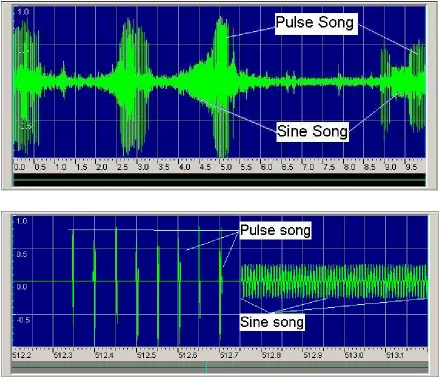
The courtship song consists of two species-specific components: the pulse song,
which is comprised of tone pulse trains, and the sine song, which is a modified sine wave
of around 160 Hz manifested as occasional bursts of humming (Yamamoto et al., 1997).
In Drosophila, there is a succession of temporally regulated events that regulate the sine
wave oscillation frequency, involving delays between peak levels of period (per) and
timeless (tim) mRNA and protein, subsequent post-translational modification, PER-TIM
the circadian and wing beat rhythms (Rosato et al., 1997). A handful of auxiliary genes
have also been identified that encode proteins that assist in the formation and transport of
the PER-TIM dimer (Rosato, et al., 1997; Yamamoto et al., 1997). Mutation of the per
or tim genes, or one of their associated factors, can lengthen or shorten the sine curve of
the courtship song, or abolish the song’s rhythm altogether (Figure 1.2).
The sex-determination pathway
The primary determinant of sex in Drosophila is the ratio of X chromosomes to
sets of autosomes (X:A ratio). Information about this ratio is facilitated through maternal
and genetic components and then passed through a cascade involving Sex-lethal (Sxl),
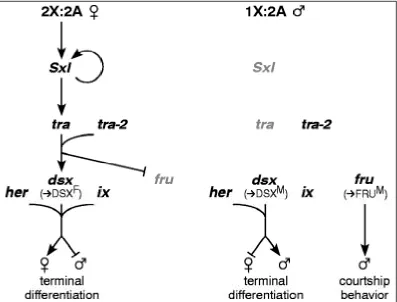
transformer (tra), transformer-2 (tra-2), doublesex (dsx), and fruitless (fru) (Figure 1.3)
(Cline, 1993; Barbash and Cline, 1995; MacDougall et al., 1995; Finley et al., 1997;
Schütt and Nöthiger, 2000). The execution of sexual behavior depends upon the integrity
of Sxl, tra, tra-2, and fru, but not on dsx (Schütt and Nöthiger, 2000). It was known that
the sex-determination pathway could affect courtship behavior, so when dsx mutants were
shown to have normal courtship behavior and normal formation of the Muscle of
Lawrence, features that are disrupted when the preceding parts of the sex-determining
pathway were interrupted, the fru branch of the sex-determining pathway was discovered
(Taylor et al., 1994). A disruption of fru or one of its predecessors can cause abnormal
courtship behavior by altering the “sexual orientation” of regions of the fly responsible
for generating the behavior. fru males court other fru and wild-type males, form long
Figure 1.2: The sine wave of the D. melanogaster courtship song. In the normal song the
interval between each beat (top) increases gradually over about 27 seconds and then decreases equally gradually. The top figure shows naturally-occurring courtship song while in the bottom figure the pulse and sine components have been artificially separated to allow for visualization of the separate components. Units on the X axis are in seconds. Figures from the web page of Becky Talyn
Figure 1.3. Genetic network regulating sexual differentiation. The genes forming
the primary signal encode transcription factors; Sxl, tra, and tra-2 encode proteins
involved in RNA processing and act at the post-transcription level. Figure 1 from
not attempt copulation with females (Kyriacou and Hall, 1994; MacDougall et al., 1995).
Males with severe mutations in fru no longer follow other flies (male or female), play a
courtship song, or attempt copulation (Roush, 1996).
To identify the regions of the brain that are responsible for the male courtship
behavior, a UAS-transformer construct has been utilized (Ferveur et al., 1995). The
female-spliced form of the transformer gene switches cells in an otherwise male fly to a
female pattern of development. Lines in which GAL4P-element constructs have been
mobilized to different genomic locations were crossed to those carrying the UAS-tra
construct. The transformer gene was activated in all of the tissues that express GAL4,
creating tissue-specific feminization. Behavioral assays revealed that some of the
transformed male flies courted males as well as females due to feminization of regions of
the antennal lobe or mushroom bodies (Balakireva et al., 1998), and that some of the
transformed males were courted by other males due to the feminization of the pheromone
profile (Ferveur et al., 1997). Feminization of the antennal lobe and mushroom bodies
disrupted the male’s ability to sense male-specific (courtship inhibitory) pheromones,
suggesting that these regions are involved in processing pheromonal signals. It has since
been determined that pheromonal cues are first received in the antennal lobe of the brain,
then sent to the mushroom bodies, where the olfactory information is processed
(Balakireva et al., 1998; Hall et al., 1980). A mutation in the mushroom bodies could
therefore remove the essential ability to identify the sex and mating status of another fly,
Drosophila pheromones
Pheromones are chemical signals produced by an organism that modify the
behavior or physiology of another organism of the same species (Karlson and Lüscher,
1959). Although it was long suspected that a chemical form of communication existed, it
was not until the late 1950’s that these molecules were isolated when Karlson and
Butenandt extracted pheromones from the gland of the female silk moth (Bombyx mori)
that attracted conspecific males from a long distance (Karlson and Butenandt, 1959).
Since that time, pheromones have been discovered in many species, principally in insects.
Although the major focus of research has been in moths, there has also been a concerted
effort to characterize pheromones in Drosophila due to the large amount of supplemental
information available on other molecular systems in the organism.
Like other insects, Drosophila have an outer layer of lipids and cuticular
hydrocarbons to prevent desiccation. In Drosophila, this outer layer also acts as female
and male contact pheromones (Cobb and Jallon, 1990; Coyne, 1996a). Drosophila males
receive species-specific pheromone cues that allow them to distinguish the female’s
species, reproductive maturity, and most importantly, if they are a female and not a male
(Jallon, 1984). Drosophila pheromonal hydrocarbons are long-chain (20-30 carbons)
relatively non-volatile compounds (Cobb and Ferveur, 1996). Drosophila express 12 to
17 different hydrocarbons (Cobb and Jallon, 1990), of which 1-3 predominate and act as
sex pheromones during courtship behavior (Ferveur, 1997). For example, females of the
D. melanogaster species sub-group primarily express cis 7-pentacosene (7-P), cis
(5,9-HD) with minor presence of one, two or all three of the other pheromone compounds.
Males of this sub-group show major expression of 6-tricosene, 7-T or 7-P. These
compounds differ only in the total number of carbons and the position of the double bond.
The female’s pheromones stimulate a conspecific male, and can be inhibitory when the
male is heterospecific if the two species’ females differ in their pheromone profiles.
However, males will still court and mate females who have had all of their cuticular
hydrocarbons eliminated (Savarit et al., 1999), suggesting that although pheromones can
act to inhibit courtship and copulation, they alone do not elicit a behavioral response.
Male pheromones, on the other hand, can act to inhibit the courtship behavior of other
males, reducing the frequency of homosexual courtship.
Drosophila pheromones are hydrocarbons, not proteins, so there is an indirect
genetic control of pheromone production. Mutations that change the phenotypic sex of
the fly (Sxl, tra, dsx) similarly alter the pheromone profile. A mutation in the fru, nerd, or
seven monoene-quantity genes of D. melanogaster decrease the amount of 7-T produced
by the male, while a mutation at the seven pentacosene locus will alter the 7-T:7-P male
hydrocarbon ratio (Cobb and Ferveur, 1996). A naturally-occurring polymorphism at the
desaturase 2 locus affects a pheromonal polymorphism that reduces mating between two
divergent populations of D. melanogaster (Takahashi et al., 2001).
The male can also identify if the female has mated another male recently through
the presence of anti-aphrodisiac pheromones deposited by another male (Jallon, 1984).
The male then “remembers” not to copulate with a previously-mated female, decreasing
male will not court even a virgin female after exposure to a mated female, either due to a
residual effect of the anti-aphrodisiac pheromones or due to learning (Kyriacou and Hall,
1994). The memory mutants dunce (Dunwalder and Davis, 1995), turnip (Tully, 1987),
rutabaga (Levin et al., 1992), amnesiac (Feany and Quinn, 1995), cabbage (Davis and
Dunwalder, 1991) and Don Giovanni (Gailey and Hall, 1989) are all deficient in the
experience-dependent modification of courtship, mostly through the disruption of CaM
kinase which is necessary for learning and memory (Griffith et al., 1993).
Commonalities of genes coding for mating behavior
Genes that affect mating behavior are scattered throughout the genome (Table
1.1), but this is not an even distribution. While the second and third chromosomes are
much larger than the X, the X chromosome contains the same number of mating behavior
genes as chromosome 2 and almost twice the number of genes found on chromosome 3.
This could mean that genes affecting mating behavior are located preferentially on the X,
or more likely, that studies on mating behavior have focused primarily on the X, and
therefore more genes have been identified on that chromosome than the autosomes. The
genes also code for a wide array of products, ranging from membrane proteins and
hormones to transcription factors. Although many of the gene products are unknown, it is
still clear that a large proportion of mating behavior genes code for transcription factors.
This supports the notion that genes that control mating behavior in Drosophila often have
pleiotropic effects (Sokolowski, 2001), which could easily result if their gene products
how a single mutation can affect a complex trait such as behavior: a single mutation
preventing the formation of a transcription factor can affect the transcription of many
downstream genes.
FUTURE PROSPECTS
Most studies which use mutants to identify genes affecting mating behavior did
not create the mutants specifically for that purpose. Usually known mutants that are
readily available from a stock center are assayed, rather than a specific broad saturation
screen for mutants affecting behavior. In fact, the identification of behavioral mutants
often occurs by accident while the researcher is investigating another trait. Since these
studies were not focused on the complex behavior, the genetic background of the mutant
flies is not controlled for, nor are there co-isogenic controls used as a comparison.
Epistatic interactions present in some mutant stocks and not others could therefore be
common, which can confound results. This necessity for a co-isogenic background is
confirmed in studies that have screened a large number of individuals for each line
containing a single P-element insertion (Lyman et al., 1996; Anholt et al., 2001). Under
these conditions, mutations with subtle effects on quantitative traits, which are more
likely to mimic natural variants, can be discriminated. In spite of these complications,
many mutants affecting mating behavior have still been identified. If this technique were
used to its full potential, with a large panel of mutants in an isogenic background and
co-isogenic control lines, the number of genes known to affect mating behavior would
Novel genes affecting mating behavior could potentially be identified through the
use of microarrays, which have already been used to identify putative candidate genes
affecting olfaction (Anholt et al., 2003). By removing or altering expression of a single
gene in an isogenic background and comparing whole-genome expression levels to a
co-isogenic control, one can reveal the epistatic effects that gene has on other genes involved
in that behavior pathway. The genes that are uncovered by this technique could then
hypothetically be tested individually for their test on behavior via RNA interference
(RNAi).
An RNAi construct can be used to eliminate the function of a gene suspected to
affect behavior in Drosophila (Fire et al., 1998; Kennerdell and Carthew, 1998). The
RNAi construct is composed of a cDNA and a genomic construct that are ligated together
into a vector that can be injected into Drosophila eggs. The presence of double-stranded
RNA interferes with the normal RNA produced by the gene of interest, eliminating its
ability to function. Original RNAi constructs involved the injection of double-stranded
RNA, whose effect is largely embryonic due to its eventual degradation. Genomic cDNA
fusions of RNAi constructs containing introns allow for the formation of hairpin dsRNA,
enabling for a continuous supply of RNAi (Kalidas and Smith, 2002). This provides the
means to study adult phenotypes. The RNAi construct could potentially be paired with a
heat shock promoter, which could allow for the study of genes that cause lethality when
eliminated during development, but produce a milder adult phenotype if gene function is
removed after development is complete. This technique has been used to successfully
RNAi’s substantial potential in the discovery or characterization of behavior genes.
QUANTITATIVE GENETICS OF BEHAVIOR
While the disruption of single genes has been used to identify a plethora of genes
that can affect mating behavior, it is only through naturally-occurring allelic variation that
a population can respond to selection. Drosophila typically show a wide intra- and
inter-specific variation in most aspects of courtship, such as copulation latency (time to
mating) and duration (total copulation time) (Markow, 1996). This broad range in
phenotypes suggests that quantitative trait loci (QTL), multiple loci whose effects can be
influenced by the environment, are responsible for the extensive variation seen in mating
behavior. However, the variation and complexity of mating behavior complicates the
process of separating out the individual genetic components that add together to form the
whole of courtship behavior.
Studies that seek to identify QTL responsible for mating behavior have tended to
focus on loci contributing to reproductive isolation in pairs of species that exhibit normal
mating when males of one species are paired with females of the other, but an absence of
mating when the reciprocal cross occurs. In this way, recombinants can be created and
tested for mating or no mating to identify loci contributing to mate preference, a relatively
simple behavioral trait to measure. Due to the inadequate number of molecular markers
available for genotyping at the time, chromosome substitution lines had previously been
employed to localize candidate regions to the Y chromosome (Zouros, 1981), X
autosomes (Coyne et al., 1999; Coyne, 1989; Coyne, 1992; Coyne, 1993; Coyne, 1996c;
Zouros, 1981). Other studies on pheromone perception have isolated genes responsible
for this trait to the X (Coyne, 1996a), second (Coyne, 1996a), and third chromosomes
(Coyne and Charlesworth, 1997; Coyne et al., 1994; Coyne, 1996a; Coyne, 1996b).
Combined, these studies have found candidate regions in almost the entire Drosophila
genome, the chromosome of the largest effect depending on the species being examined
and the laboratory in which the study was performed. To date, the smallest “candidate
region” for mating behavior QTL using this method has been the larger portion of a
chromosome arm (Ting et al., 2001). Given the large number of candidate genes that fall
within a region of that size, the localization of QTL for mating behavior through the more
precise mapping techniques currently available is necessary.
It has long been hypothesized that the loci contributing to quantitative traits vary
in the size of their effect (Robertson, 1967). Large sample sizes are required to detect
QTL with small effects, and to map QTL to the level of individual genes (McClearn,
1997). While QTL analysis has led to the identification of new sets of loci, ones with
important biological roles (Mackay, 2001), molecular characterization of these loci
remains difficult (Glazier et al., 2002), hindering the identification of genes that might
affect behavior (Liu, 1997).
In order to locate QTL, one must have two lines with divergent behavioral
phenotypes and a large number of molecular markers spanning the genome (Zeng, 1993).
Crossing the two lines to create backcross, F2 or recombinant inbred progeny produces a
that have a low heritability, such as mating behavior, since a single genotype can be tested
multiple times. Each individual (or multiple individuals per line, in the case of
recombinant inbred lines) is assayed for behavior. For a behavior that is easily affected
by the environment, a large sample size is necessary in order to surmount the high level
of standing variation and subsequently localize QTL.
Alleles that are polymorphic between the two parental lines, but fixed within each
line, can be used as molecular markers to genotype all individuals of the mapping
population. To have a high level of confidence in the estimated QTL position, one would
want markers to be evenly-distributed and at a high density (Jayakar, 1970). When using
visible markers to locate QTL for a trait, the effects of the markers themselves on that
trait must either be readily assessed or generally ignored; this is difficult to accomplish
for behavioral traits. Several studies have shown effects of the markers themselves on the
mating behavior of Drosophila, such as the eye-color marker white (Hall, 1994). This is
no longer a problem, however, with the advent of multiple molecular markers, which are
presumably neutral.
QTL are mapped by linkage to molecular markers if the difference in behavior in
the mapping population is associated with the marker genotype. A comparison between
genotype and phenotype can be done using several different statistical techniques. The
simplest approach is single marker analysis, which examines differences in trait means
between marker genotypes one marker at a time. This technique tends to underestimate
the QTL effect and confounds effect and position (Falconer and Mackay, 1996). Interval
improvement in single marker analysis in that it can estimate the position and effect of
QTLs, it does not account for the effects of QTL outside of the interval (Falconer and
Mackay, 1996). Composite interval mapping (CIM) allows for the identification of QTL
in the same manner as interval mapping by testing whether an interval between two
markers contains a QTL affecting the trait, but simultaneously controls for the effect of
QTL located outside of the interval by using a likelihood estimate (Zeng, 1994; Xu and
Atchley, 1996). The power of CIM in detecting QTL has been repeatedly demonstrated
by follow-up studies to fine-map QTL (e.g. Pasykova et al., 2000; Fanara et al., 2002; De
Luca et al., 2003). The most advanced technique to date is multiple interval mapping
(MIM) (Kao et al., 1999) which is similar to CIM but can include both main effects and
epistatic interactions. MIM is limited in practicality, however, since a very large sample
size is required for its application and no studies have confirmed its accuracy through
higher resolution mapping to date. For these reasons, CIM is the QTL mapping technique
of choice. CIM does not in itself allow for the identification of any specific candidate
genes since the mapping populations tend to be small and the intervals between markers
tend to be large. The identification of candidate genes for mating behavior is further
hindered due to the notion that almost any gene could potentially have a direct or indirect
effect on behavior. Fine-mapping techniques are necessary to further reduce the potential
number of candidate genes.
In most organisms, high-resolution recombination mapping is necessary in order
to further reduce the size of a candidate region, which has been done to successfully
can be time consuming and difficult since a large number of recombinants and a large
number of molecular markers are needed in order to narrow down candidate regions to a
manageable size. For example, 100 flies are needed to get just one recombinant in a 1 cM
interval, and 1000 flies are needed to get a single recombinant in a 0.1 cM interval, and a
trait with a high level of variation, such as behavior, will require multiple recombinants in
order to definitively map a region. Markers are also needed for each interval tested – the
smaller the refinement, the greater the number of markers. The use of recombinant
isogenic lines makes the task of mapping more manageable since behavioral assays are
only performed for informative recombinants and all flies of a single line are of the same
genotype and therefore a particular genotype can be tested multiple times.
Quantitative genetic mapping with CIM has not been used to test for mating
behavior directly, but two studies that focused on aspects that could potentially affect
mating success have been completed. In a study by Nuzhdin et al. (2000), recombinant
inbred lines were used to map loci affecting variation in sex comb tooth number in
Drosophila to two regions on the X chromosome (3E-6E and 12E-19A). Gleason et al.
(2002) mapped loci for interpulse interval in the Drosophila courtship song using these
same recombinant inbred lines and identified one QTL on the second chromosome
(22F-29F) and two on the third (61A-65D and 67D-69D). It is immediately apparent that the
QTL for these two traits do not overlap, suggesting that each component of mating
behavior might be controlled by different loci, although it is not certain that the traits that
were measured have any effect on mating success in the two parental lines used to create
In Drosophila, there are unique tools beyond recombination mapping available for
QTL mapping. One such technique is the use of deficiency lines (Pasyukova et al., 2000;
Fanera et al., 2002; De Luca et al., 2003). In these lines, a small region of the genome is
hemizygous, or possessing only one allele with the other being completely absent. These
lines are usually homozygous lethal, and are therefore maintained over a balancer (Bal)
chromosome which suppresses recombination and contains a dominant visible marker so
one can determine whether an F1 fly received the wild-type chromosome or the deficiency
(Df) chromosome. One can select multiple deficiency lines with short overlapping
segments within the candidate regions to determine which portions of the region
contributed to the variation in behavior. One can cross these deficiency lines to the
parental lines (P1, P2) to create four genetic classes of offspring: Df/P1, Df/P2, Bal/P1,
Bal/P2. By using a 2-way ANOVA, one can detect if quantitative complementation
occurs when (Df/ P1 – Df/ P2) = (Bal/ P1 – Bal/ P2) and there are no QTL present in a
region, or if quantitative failure to complement occurs when (Df/ P1 – Df/ P2) ≠ (Bal/ P1 –
Bal/ P2) and there is a QTL within the interval. Lines that exhibit the alternate behavioral
phenotype have a candidate gene within the region of the deficiency. Comparing across
the overlapping regions of the deficiencies, one can narrow the region further (if one
deficiency shows the alternate phenotype while a partially overlapping deficiency does
not, one can also rule out the overlap region as a candidate region). Although this method
does not usually reduce candidate areas to the gene level, it does reduce the potential
number of candidate genes. Genes for which a mutant stock is available can then be
One downside to deficiency mapping techniques is that epistatic interactions, which
undoubtedly occur among behavior QTL, can not be easily identified or isolated. New
methods of mapping QTLs that can recognize and isolate epistatic interactions would
greatly facilitate the search for behavioral QTL. An additional difficulty occurs when
attempting to identify putative candidate genes since there are many genes for which there
is no mutant stock available, making it impossible to test every gene within a candidate
region.
CONCLUSIONS
Understanding the genetic basis for behavior in Drosophila can open the door for
behavioral genetics research in a multitude of other species including humans. The
recently completed Drosophila genome project will allow further insight into the
underlying genetic components of behavior. The genome project identified ~13,600
genes, of which only a portion have been molecularly or phenotypically characterized
(Adams et al., 2000). Even though less than one-third of mutated genes have obvious
phenotypes, there are a multitude of single genes that have been identified as influencing
mating and courtship behavior, providing the genetic framework by which the formation
of sexual orientation, neural processing of external stimuli, and manifestation of response
are built. With the genome sequence in hand, transposon-induced mutations can now
easily be physically mapped by identifying the short segment of genomic sequence
flanking either side of the insertion site, expanding our current knowledge of the location
polymorphisms between strains of Drosophila can also be directly identified for
recombination mapping of induced mutations and QTL (Kornberg and Krasnow, 2000).
The formation of large panels of mutants in isogenic backgrounds will provide a
valuable tool with which to identify genes that have a subtle effect on behavior by
reducing variation due to epistatic interactions with genes elsewhere in the genome.
Genome-wide screens specifically designed for the identification of mating behavior
genes will allow for a less biased and more focused identification of the genetic
components of behavior. Studying allelic variants of genes affecting mating behavior
will provide a more accurate picture of how these genes affect behavior in
naturally-occurring populations. The use of binary P-element constructs or RNAi can allow for
tissue-specific or adult-specific expression, or ihnhibition of expression, of putative
candidate genes, providing a mechanism by which these genes can not only be tested, but
also allow for the precise characterization of where in the fly these genes are having their
effect.
The ability to study the quantitative genetic basis of behavior is relatively new due
to the only recent advent of analytical software and large numbers of molecular markers.
These advances have caused a heightened interest in studying naturally-occurring
variation, since it is this variation which affects subtle changes within populations as well
as evolutionary changes between populations. Identification of QTLs for mating behavior
will enable further characterization of the components responsible for the variation seen
within and among species in the courtship ritual, enhancing the picture of how genes and