THE STRUCTURE OF THE A MATING TYPE LOCUS I N COPRINUS LAGOPUS
P. R. DAY
John Innes Horticultural Institution, Bayfordbury, Hertford, Herts, England Received November 17, 1959
I N basidiomycetes with a tetrapolar mating system, compatibility between hap- loid monocaryons is controlled by the action of alleles at two independent loci A and B. If two monocaryons possess different alleles at both loci they may, by exchanging nuclei, form stable binucleate dicaryons. If they possess common alleles at either or both loci, they are incompatible but may form a heterocaryon. In many species the dicaryon is easily recognized by the presence of clamp con- nexions between adjacent cells. In the Hymenomycetes each mating type locus has a large number of alleles which has been calculated to be in the order of mag- nitude of 100 per locus in natural populations (WHITEHOUSE 1949). Ninety-six A alleles and 56 B alleles were found in a recent survey of Schizophyllum com-
mune (RAPER, KRONGELB, and BAXTER 1958a). KNIEP (1930) was the first to
find that nonparental alleJes may occur at both loci in single fruit bodies of S .
commune. Two such nonparental A factors, when intercrossed, gave rise to a
small proportion of the original A factors (six in 33 or 18.2 percent). PAPAZIAN (1951 ) also found nonparental A alleles in tetrads and random spores of S. com-
mune and attributed their origin to crossing over between subunits of the A locus.
KNIEP’S earlier data can also be explained in this way. RAPER, BAXTER, and MID- DLETON (1958b) have shown that both loci of S . commune are each made up of at least two subunits. The frequency of recombination between subunits at the A locus varied between 0.9 and 15.9 percent according to which stocks were inter- crossed. Recombinant mating type factors have also been described in the tetra- polar species Collybia velutipes (TAKEMARU 1957) and Pleurotus ostreatus
(TERAKAWA 1957;
RAPER
et al. 1958b).This paper reports studies of recombination within the A mating type locus of
Coprinus lagopus using linked markers. A preliminary report has already ap-
peared (DAY 1959b).
MATERIALS A N D METHODS
origin of stock 68 and the culture media used were given by
DAY
(1959a). Basid- iospores were germinated on dung decoction (100 gm horse dung boiled in one Lwater) cleared -by f i h t i o n through diatomaceous silica and solidified with two percent agar. Tetrads were isolated with a glass microneedle held in a Singer micromanipulator. The spores were separated and transferred to dung agar by hand using a glass needle with a small bead at the tip.
Mating types were determined by pairing unknown and tester stocks on com- plete medium in Petri dishes, 16 matings per dish. Clamp formation was scored after three days' incubation at 28°C.
The approximate linkage values and order of the A linked markers used are shown below
(DAY
and ANDERSON, unpublished).ad-8 ar 1 centromere
I I I I
4-
Ime-6 paba-2 A
12.0 0.54 1.27 2.2
RESULTS
Analysis of random spores: Several crosses were made between stocks bearing
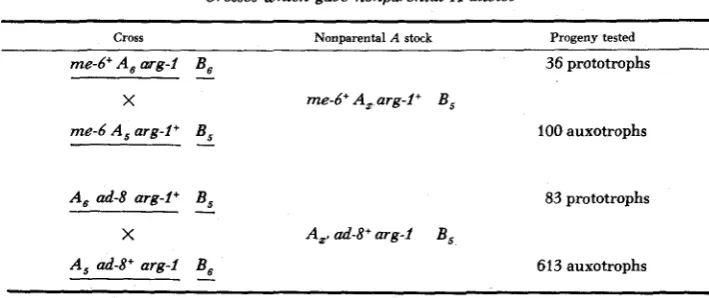
markers linked with the A locus before the order of the markers had been estab- lished. Cultures produced from basidiospores from these crosses were tested for A factors compatible with both parental A factors, A, and A,, in matings with A5B1 and A,B1 tester stocks. From a total of 1213 cultures tested, two (A,B5 and A,,BS) with stable nonparental A reactions were found. Their genotypes and the crosses from which they came are given in Table 1.
The A,B, culture was crossed with an A,B, stock and the dicaryon was fruited.
The alleles A , and A , segregated normally among 130 random basidiospore cul- tures tested for mating type. A recombinant culture, A,B,, was selected and mated with A,,B,. The mating was incompatible, and it was concluded that A , and Axt are identical. The genotypes of the two cultures with nonparental A re- actions are consistent with their each having arisen as the result of a single cross-
TABLE 1
Crosses which gave nonparental A alleles
~ ~~ ~ ~~~ ~ ~~~~~
Cross Nonparental A stock Progeny tested
me-6+ A , arg-i B , 36 prototrophs
-
x me-6+ A , arg-i + B ,
me-6 A , arg-i + B ,
-
100 auxotrophsA , ad-8 arg-Z+
-
B , 83 prototrophsX A,, ad-8' arg-i B ,
P. R. DAY 643
over between subunits of the A locus, but the reciprocal recombinants were not recovered.
Analysis of tetrads: In a study of the effects of temperature and marker com-
binations on patterns of crossing over within a region of the A chromosome
(DAY
and SWIEZYNSKI, unpublished) some 688 tetrads were available from three crosses and these were examined for. nonparental A and
B
factors. Four tetrads with nonparental A factors were found, but in one of the tetrads only three spores germinated. The constitution of the tetrads and the crosses from which they were produced are givenin
Table 2. No cultures with nonparental B reactions and no tetrads showing 3: 1 segregations of the A or B loci were found.Two cultures with nonparental A reactions were found in each of the tetrads
2397-2400 and 2689-2692, These cultures were mated with each other and with
cultures carrying the A , factor already recovered. The results of these matings are given in Table 3.
The test matings show that two new A specificities were present in each tetrad, one of which was identical with that of A,. The other was different from A , and was designated A,. A recombinant stock, A,,B,, was produced by crossing culture 2398 (A$,) with stock 6 8 ( A , B , ) . The results of crosses with the AuBl stock are also shown in Table 3.
TABLE 2
Tetrads ruith nonparental A reactions recovered from crosses
(1.) me-6 A , a d 4 arg-I' B , x me-6+ A , ad-8' arg-1 B , (U33 tetrads) (2.) me-6' A , ad4 arg-I+ B , x me-6 A , ad-8' arg-I B , (220 tetrads)
Cross Spore no. Genotype AB* AB,+
-
-
-
-
+
239i me-6' A , ad-8' mg-I B ,
-
2398 me-6+ A , a d 8 arg-I+ B ,
+
+
+
2399 me-6 A , add' arg-I B ,
+
2400 me-6 A , ad-8 arg-I' B ,
.+
+
(1.) 241 3 li me-6+ A? ad-8' arg-I+ B ,
+
24.14 me-6 A , a d 4 arg-I+ B ,
+
+
241 5 me-6 + A , ad-8+ mg-I B ,
-
2416 me-6 A , ad-8 arg-I+ B ,
+
(2.) 2689 m e 4 A , ad-8 urg-I+ B , -4-
+
2690 m - 6 + A , ad-8' arg-I B ,
+
+
-k
269 1 me-6+ A , ad-8 arg-I' B ,
-
2692 m e 4 A , ad-8' arg-I B ,
+
1957 * me-6' A? ad-8' arg-I+ B ,
+
+
+
1959 me-6 A , ad-8' arg-I B ,
+
(1.)
-
-
-
-
-
(2.)
1958 me-6+ A , ad-8 arg-I+ B ,
1960 ( m e 4 A? ad-8 mg-I B,)
-
* Phenotypes genotypes discussed in text.
TABLE 3
Results of intercrossing cultures with nonparental A factors
-
(-1; (-1
+
(-)
+
2398 A$, .
+
+
(--)
+
2399 AXE, . . . . (-1
+
2689 AXE, . . . . . .
+
2690 A$6 . . . . . . (-1
+
+
. . . . . . . .
+
2413 AZE, . . . . . .
+
(-1+
1957 AZE, . . . . . . . .
(-1
+
+
-
-
-
-
. . . . . . . . . .
A P ,
AXE,
~~ ~ ~ ~
-
(-) =Incompatibility due wholly or in part to common B factorsmc-6 paba-l A5 a 6 8 arg-l
1 I I I
I I I I I
A6
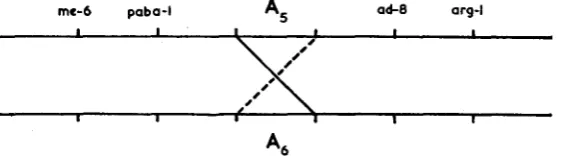
FIGURE 1.-Position of crossover recombining subunits of the A locus. A , recombinant shown by broken line. A , recombinant shown by unbroken line.
Both tetrads show the recombination of adjacent markers that would be ex- pected if the only crossover within the region me-6-ai-g-1 was between subunits of the A locus. Two recombinants (2398 and 2690) reacted as A,, whereas the reciprocal recombinants (2399 and 2689) reacted as A , (in Figure 1 , the un- broken line and the broken line, respectively).
Tetrad 2413-16 gave one culture (2413) with a nonparental A reaction and also showed a 3: 1 segregation for arginine independence. Culture 2413 was com- patible with A,B,, A,B,, A,B, and A,B,. The dicaryons produced by crossing 2413
with A,B, and A,B, were fruited, and basidiospore cultures from each cross were tested. The markers me-&, A , and ad-8 segregated in the cross with A,B, and markers A , and arg-l segregated in the cross with A,B,. The original culture showed occasional clamp connexions which failed to fuse with their neighboring cells (false clamps). Such clamps are produced by common B heterocaryons (SWIEZYNSKI and DAY 1960). It seems likelv that the culture was orieinallv Y .,
P. R. DAY 645
nuclei of the heterocaryon were sampled in the testcrosses which were fruited.
PITTENGER
(1954) has reported similar examples of disomics forming hetero- caryons in Neurospora crassa.Culture 1957 from the incomplete tetrad bore false clamps and was also com- patible with the tester stocks A,B,, A,B,, A&, and A$,. This culture produced oidia, which are uninucleate, and these, when sown, yielded 11 subcultures which were all me-6+ A, ad-8 arg-1 + B,. It is possible that the missing culture, (spore
1960) was me-6 A , ad-8+ arg-2 Z a n d was accidentally placed on the same slant
as spore 1957 during the transfer2 the tetrad to dung agar.
Analysis of prototrophs selected from crosses of linked auxotrophs in repulsion: The data from the tetrads established that the factors A, and A , were composed of two subunits each and that crossing over between them gave rise to the ex- pected reciprocal products. An attempt was then made to recover more than two crossover products from crosses of A, x A,. There is no direct means of selecting nonparental A factors. This difficulty was overcome by crossing stocks with two linked auxotrophic markers, one on either side of the A locus, in repulsion. If crossing over occurred between or within the subunits of the A locus, this would, provided it was the only crossover within the interval bounded by the auxotrophic markers, bring about their recombination ahd give rise to a prototrophic recom- binant and the reciprocal double mutant. Hence, half of the products of all single crossovers within the A locus would be recovered among the prototrophs. Since the distance of each marker from the A locus is known, the relative frequencies of prototrophs with parental and nonparental A reactions would give some indi- cation of the distance between the subunits. If crossing over within the subunits occurred, more than two specificities would be found among the nonparental A factors.
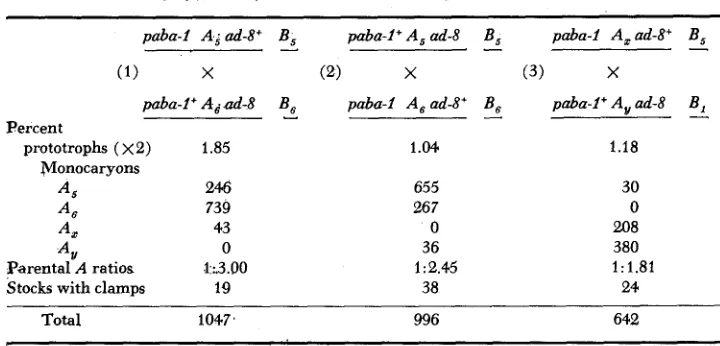
The markers p b a - 2 and ad-8, respectively 0.54 and 1.27 crossover units from A, were intercrossed in both repulsion crosses. Prototrophs were selected from random basidiospores spread on minimal medium and were mated with ASB, and
Ad?, to select cultures with nonparental A factors. The nonparental A cultures
were either monocaryons or had clamp connexions. Both types were again mated with A,B, and A,B,, and with A,B, and A$,. A summary of the results is shown in Table 4.
The monocaryon stocks with nonparental A reactions from each cross were only of one kind, A , or A,. This shows that either crossing over within subunits did not take place sufficiently frequently for the products to be recovered in this experiment or that the crossover products were not detected by the tests employed. Estimates of the frequency of crossing over between the markers, obtained b y
doubling the frequency of prototrophs, were 1.85 percent for the first cross and
1.04 percent for the second cross. The expected frequency was 0.54
+
1.27 = 1.81percent. The lower frequency ( 1.04 percent) in the second cross could have been due to differences in genetic background between the two crosses. This is SUP
ported by the lower frequency of nonparental A factors recovered, namely 3.61
TABLE 4
Summary of prototrophs isolated with?he aid of linked selectiue markers paba-1 A ; ad-8"
(1) X
paba- f + A , ad-8
Percent
prototrophs ( ~ 2 ) 1.85 Monocaryons
A , 246
A6 739
A , 43
A ,
Stocks with clamps 19 0 1 :.3.00 Parental A ratios
B ,
-
paba-I+ A , ad-8(2) X
B , paba-1 A,ad-8'
I
1.04.
655 26 7 0 36 1 : 2.45
38
B , paba-f Axad-8+ B ,
-
-
(3) X
B , paba-f+A,ad-8 B ,
-
-
1.18
30 0 208 380 1:1.81
24
Total 1047, 996 642
accept the interval between paba-1 and ad-8 as 1.81 units, then we may calculate the distance between the subunits of the A locus from each cross as
43 X 1.81 = 0.076 and 36 X 1.81 = 0.068 1028 95 8
-
-
(average = 0.072 units).
The relative frequency of crossing over expected in the two intervals, one on each side of the A locus, was 0.54: 1.27 or 1 :2.35. As shown in Table 4 the fre- quencies obtained were 1 : 3 and 1 :2.45 in the two crosses.
All 19 stocks with clamps from the first cross in Table
4
were subcultured to sterile dung to test their a.bility to fruit. All except one fruited readily. A , and A ,segregated in the progeny of four of these fruited cultures selected at random, no &er factors being found in the samples (32 colonies) tested. Adenine and PABA requirements segregated in two progenies while only one requirement segregated in the other two progenies. These results show that the four dicaryons which were progeny tested most likely arose by crossing between complementary compatible strains in the original platings of basidiospores to minimal medium.
Other stocks bearing clamps, produced in the second cross, were tested with similar results. Of 11 stocks tested six failed to fruit. These latter stocks produced many false clamps and appeared to be common B heterocaryons.
Reconstitution of parental A factors: An additional proof that crossing over was the mechanism by which the nonparental A factors arose was obtained by cross- ing the two stocks paba-2 A , ad-8+ B, X paba-2 + A , ad-8 B , . The results are sum-
marized in the last column of T a b l z . Of the 618 monocayon prototrophs tested
30 had nonparental A factors and were all incompatible with A,. Thus, one of the original parental A factors was recovered by crossing the recombinant factors A , and A,. The distance between the subunits calculated from this cross was 0.088
P. R. DAY 647
DISCUSSION
The structure of genes concerned with incompatibility has now been investi- gated in several different organisms. In some self incompatible flowering plants the S gene controlling incompatibility has been shown to have a two subunit structure in which one subunit controls stylar specificity and the other pollen specificity.
LEWIS
and CROWE (1953) working with Prunus avium and PANDEY(1956) working with Trifolium pratense and T . repens have shown that muta- tions to self-fertility (S.F.) may be induced at either subunit by X-ray treatment. S.F. mutations of the pollen subunit are easier to screen than
S.F.
mutations of the style subunit. BREWBAKER and SHAPIRO (1958) found that nonparental alleles may arise in Petunia inflata as a result of crossing over between the subunits so that an S allele is produced which has, say, S, pollen specificity but S, style spe- cificity and is consequently self-fertile.LEUPOLD (1958) has shown that the mating type gene of the yeast Schizosac-
churomyces pombe has two subunits which are thought to have arisen by duplica-
tion of a locus with two alleles,
+
and -,
controlling heterothallism. One sub- unit, however, only has one functional allele+
,
the other allele 0, is nonfunc- tional. The genotypes associated with the'+'
phenotype are++
or +0, while the genotype for the '-' phenotype is -0 and that for the homothallic phenotype is-+.
Thus when a homothallic recombinant (-+) is produced by crossing++
x
-0 a reciprocal'+'
strain is formed,+O
which can be distinguished from++
by genetic tests. The homothallic recombinant is analogous to the self-fertile recombinant of Petunia.RAPER et al. (1958b) and DAY and HOLLIDAY (1959) have discussed the rela- tionship between the subunits of the A and B loci of Schizophyllum commune. Here the subunits of each locus appear to be functionally indistinguishable and if a monocaryon has different alleles at both pairs of subunits (AI--P, B,-$) it is not self-fertile. If both subunits do have the same function, the simplest hypothesis is that a mating is compatible if at least three of the four subunits of each locus, brought together in a common cytoplasm, are different. These considerations also apply to the A locus of Coprinus (e.g., A , , is incompatible with A,-o, A,-,, A,-,
and A,, but is compatible with A,-,, A,-,, A8-,, and A ),,
.
If the subunits of the A locus of Coprinus or Schizophyllum have evolved by duplication of a pre-existing unit then it would be reasonable to expect that both subunits of a single locus might sometimes be identical. The reactions of three such loci (A4-,, A,-$ and A$-$) are shown above. With n different subunit specifi- cities, which can be imagined as an allelic series, there are n2 possible pairs, n of which will be identical pairs, n2 - n will be nonidentical pairs. With n2 A factors the total number of possible different matings is n4, and if we accept the restriction that at least three different subunits must be present for a mating be- tween any two A factors to be fertile, the number of fertile matings can be cal- culated as follows:
( 2 ) n(n - 1) nonidentical pairs are each compatible with n2 -
4
pairs.The total fraction of compatible matings = 8
n(n-I) (n-2)
+
n(n-I) (n-2) (n+2) = n(n-I) ( n - 2 ) ( ~ ~ 4 - 3 ) = n 3 - 7 d 6n4 n" n3 Curve (a) in Figure 2 shows the percentage of fertile matings plotted against values of rz between three and 30.
It can be seen that even for low values of n, between 10 and 20, the maximal frequency of compatible matings is already high, 93.6 to 98.3 percent.
In a collection of 114 strains of S. commune 97.05 percent of random matings between A factors were fertile (RAPER et al. 1958a), a condition which could be satisfied by either subunit occurring in one of 15 different alternate states.
If this model is correct, there are some further implications. If the subunits of a pair may have identical specificities, then AI-l is incompatible with A,-,,
A,-,,
As-I and A,, for reasons given above. All four A factors, when intercrossed, would appear to have the same specificity since they are cross incompatible. If these four A factors were present in a population with A,,, A,-,, etc., and if they are equally fertile with the other factors, and the population is large enough, it might be expected that all four would be retained. If, however, the population contains other factors with identical subunits, then all such factors will be at a selective disadvantage compared with the others since they are unable to mate with each other and can mate with fewer nonidentical pairs than the nonidenti- cal pairs themselves. Thus, or AZdl could mate with Ag-g while AI-I and As-$ could not; also can mate with A,-s but A,-, cannot.
PERCENT
FIGURE 2.-The psrcentage (P) of random matings, which are fertile, plotted against n, the
number of specificities at the two subunits of the A mating type locus. Curve a, including idexitical pairs, P = n3 - 7 n
+
6 x loo.n3
P. R. DAY 649 These considerations imply that identical subunits will almost certainly be rare in nature and may, in fact, only be found in the laboratory-through recog- nizing that two cross incompatible factors, and A,-,, may have different structures.
Curve b in Figure 2 shows that the frequency of cross compatible matings is increased by removing A factors with identical subunits. A minimum of nine different subunits are needed to account for RAPER’S finding that 97.05 percent of random matings between A factors were fertile. RAPER has already identified nine specificities at one A subunit and 19 at the other in his collections of Schizo- phyllum (J. R. RAPER, personal communication).
PAPAZIAN (1958) and RAPER et al. (1958b) have both speculated on models for the structure of the A locus and have arrived at estimates of the numbers of
specificities at each subunit to account for the numbers of A and B alleles found in nature. In both Schizophyllum and Coprinus the evidence so far indicates only two subunits. No clear example of recombination within subunits has been found. From our current knowledge of the structure of the gene ( PONTECORVO 1959), it seems most likely that the subunits are made Ap of smaller recombination units. It is also very likely that crossing over within the subunits would lead to non- parental subunit specificities detectable by the mating reaction. To obtain 32 dif- ferent subunit specificities would require only five different sites each with two alternate states. Th6 five percent upper fiducial limit on the total length of the two subunits was calculated from the data in Table 4 as the recombination frac- tion 2.08
x
Recombination of this frequency or greater would have been de- tected unless both pairs of subunits in the cross A ,x
A , and, hence, A , x A , were heterozygous at only one site. Since this is unlikely, we may conclude that the sites within the subunits are very tightly linked.SUMMARY
(1) Crosses between monocaryotic stocks of Coprinus lagopus bearing markers linked with the A mating type locus yield a low frequency of nonparental A
factors in tetrads and random spores. The marker arrangements in these non- parental cultures show that the new A factors arise as a result of crossing over between subunits of the A locus. Less extensive tests of the B locus have not re- vealed nonparental recombinants.
(2) Seventy-nine nonparental A factors, isolated with the aid of linked selec- tive markers, from crosses between A , and A , were of two types only, suggesting that only two subunits were able to recombine and give nonparental A factors. The original parental factor A , was recovered by intercrossing the two recom- binant factors. The frequency of recombination between the subunits was 0.068 to 0.088 percent.
A C K N O W L E D G M E N T S
It is a pleasure to acknowledge the many discussions with D R . R.
HOLLIDAY
and the invaluable technical assistance of M R S . MARGARET LAMDIN.
L I T E R A T U R E CITED
ANDERSON, G. E., 1959
BREWBAKER, J. L., and N. SHAPIRO, 1959
DAY, P. R., 1959a
Induced mutants in Coprinus lagopus. (Abstr.) Heredity 13: 411-412. Homozygosity and S gsne mutation. Nature 183:
A cytoplasmically controlled abnormality of the tetrads of Coprinus lagopus. 1209-1 21 0.
Heredity 13: 81-87.
1959b 49th Ann. Rept. John Innes Horticultural Institution for 1958. pp. 17-18.
DAY, P. R., and R. HOLLIDAY, 1959 Incompatibility in Schizophyllum commune. Am. Naturalist
KNIEP, H., 1930 Ober Selektionswirkungen in fortlaufenden Massenaussaaten von Schizophyl-
LEUPOLD, U., 1958 Studies on recombination in Schizosaccharomyces pombe. Cold Spring
LEWIS. D., and L. K. CROWE, 1953 PANDEY, K. K., 1956
repens. Genetics 41 : 327-343. PAPAZIAN, H. P., 1951
commune. Genetics 36: 441459.
93: 387-388.
lum. Z. Botan. 23: 510-536.
Harbor Symposia Quant. Biol. 13: 161-170.
Theory of revertible mutations. Nature 172: 501.
Mutations of self-incompatibility alleles in Trifolium pratense and T.
The incompatibility factors and a related gene in Schizophyllum 1958 The genetics of basidiomycetes. Advances in Genet. 9: 41-69.
PITTENGER, T. H., 1954
PONTECORVO, G., 1959
RAPER, J. R., G. S . KRONGELB, and M. G. BAXTER, 1958a The number and distribution of incom- patibility factors in Schizophyllum. Am. Naturalist 92 : 221-232.
RAPER, J. R., M. G. BAXTER, and R. B. MIDDLETON, 1958b The genetic structure of the incom- patibility factors in Schizophyllum commune. Proc. Natl. Acad. Sci. US. 44: 889-900. SWIEZYNSKI, K. M., and P. R. DAY, 1960 Heterocaryon formation in Coprinus Zagopuc. Genetical
Res. 1: 60-74.
TAKEMARU, T., 1957 Genetics of Collybia velutipes. V. Mating patterns bstween F,-mycelia of legitimate and illegitimate origins in the strain NL-55. Botan. Mag. (Tokyo) 70: 24.4-249. TERAKAWA, H., 1957 The nuclear behaviour and morphogenesis in Pleurotus ostreatus. Scientific
Papers of the College of Gen. Educ. Univ. Tokyo 7: 61-88.
WHITSHOUSE, H. L. K., 1949 Multiple-allelomorph heterothallism in the fungi. New Phytologist 48: 212-244.
The general incidence of pseudo-wild types in Neurospora crassa. Genetics 39 : 326-342.