Available online: https://edupediapublications.org/journals/index.php/IJR/ P a g e | 524
An Effective Overview to a Homogeneous Charge Compression
Ignition Engine
B.Shiva & K.Ranadheer Raju
1M.Tech(CAD/CAM), Dept. of Mechanical Engineering, Balaji Institute of Technology & Science, Warangal Rural, Telangana, India
2Asst. Professor, Dept. of Mechanical Engineering, Balaji Institute of Technology & Science, Warangal Rural, Telangana, India
Abstract: Homogeneous charge compression ignition
(HCCI) engine technology is comparatively newand has not developedadequately to be commercialisedrelated with conventionalengines. It can use spark ignition or compression ignition engine configurations,exploiting on the compensations of both: high engine efficiency with low emissionslevels. HCCI engines can use aextensive range of fuels with low emissions levels. Due tothese benefits, HCCI engines are appropriate for use in a hybrid engine configuration,where they can decrease the fuel consumption even more. On the other hand, HCCI engines havesome drawbacks, such as knocking and a low to medium operating load range,which need to be resolved before the engine can be commercialised.
Keywords-Diesel; HCCI; gasoline; natural gas; hydrogen
I. INTRODUCTION
Environmental security is a giant growth marketfor the
longer term. Within the years ahead,
“inexperienced”applied sciences that support enhance energy efficiency orreduce emissions will be principal development. Withthe appearance of increasingly stringent
gasolineconsumption and emissions requirements,
engineproducers face the difficult task ofsupplying traditional cars that abide by the aid of theserules. HCCI combustion has the capabilities tobe totally effective and to provide low emissions.HCCI engines can have efficiencies as high ascompression-ignition, direct-injection (CIDI)engines (a sophisticated version of the most of the timeidentified diesel engine), even as producing extremely-lowoxides of nitrogen (NOx) and particulate topic(PM) emissions. HCCI engines can operate onfuel, diesel gasoline, and most alternative fuels.While HCCI has been validated and recognized forrelatively a while, simplest the up to date creation
ofdigital sensors and controls has made HCCIengines an expertise functional reality.
HCCI represents the subsequent major step beyond highefficiency CIDI and spark-ignition, direct injection (SIDI) engines for use in transportationcars. In some regards, HCCI enginesincorporate the high-quality elements of each spark ignition(SI) gas engines and CIDI engines. Like an SIengine, the charge is well blended which minimizesparticulate emissions, and like a CIDI engine it'scompression ignited and has no throttling losses,which results in excessive efficiency. However, in contrast toboth of these conventional engines, combustionoccurs concurrently for the duration of the cylindervolume alternatively than in a flame front. HCCI engineshave the talents to reduce cost than CIDIengines for the reason that they would possibly use a
cut-downpressure fuel-injection procedure. The
emissionmanage programs for HCCI engines have thecapabilities to be much less luxurious and no more based onscarce valuable metals than either SI or CIDIengines. HCCI engines possibly commercialized inmild-responsibility passenger cars and as a lot as a half-million barrels of principal oil per day may be stored.
HCCI is potentially relevant to both light andheavy-obligation engines. Light-responsibility HCCI engines canrun on gas and have the knowledge to match orexceed the efficiency of diesel-fueled CIDIengines, without the fundamental task of NOx andPM emission manipulate or impacting gasoline-refiningcapacity. For heavy-obligation vehicles, successfulthe progress of the diesel-fueled HCCI engine isa major alternative technique within the event thatCIDI engines cannot acquire future NOx and PMemissions necessities.
Available online: https://edupediapublications.org/journals/index.php/IJR/ P a g e | 525 to tremendous transport engines. HCCIcan also be applied
to piston engines used outside thetransportation sector such as those used forelectrical energy new release and pipeline pumping.HCCI engines are notably well proper to serieshybrid automobile functions when we consider that the engine canbe optimized for operation over an extra restrictedthe range of speeds and masses in comparison with primaryengines used with conventional automobiles. Use ofHCCI engines in sequence hybrid automobiles mightextra leverage the advantages of HCCI to createextremely gasoline-efficient cars.
II. FUNDAMENTALS OF HCCI
COMBUSTION
In HCCI mode of combustion, the fuel and air are mixed prior to the start of combustion and themixture is auto-ignited spontaneously at multiple sites throughout the charge volume due to increase intemperature in the compression stroke [4, 6, 7]. In this mode, the combustion process is arranged in such a waythat the combustion takes place under very lean and dilute mixture conditions, which results in comparativelylower bulk temperature and localised combustion temperature, which therefore, considerably reduces the NOxemissions. Furthermore, unlike conventional CI combustion, in HCCI mode the fuel and air is well mixed(homogeneous). So, the absence of fuel rich regions in the combustion chamber results in considerable reductionin PM generation. Therefore, due to absence of locally high temperatures and a rich fuel-air mixture duringcombustion process, the simultaneous reduction of NOx and PM emissions is made possible.
As it is evident from Fig.1 that for conventional diesel combustion, the adiabatic flame temperature inair stretches through both the soot and NOx generation
regions. Conceptually, in a conventional
dieselcombustion, the fuel and air charge undergoes rich combustion of about Ө=4 at the end of the adiabatic mixingprocess during the ignition delay period, and then combustion moves to completion in a stoichiometric (Ө=1)diffusion flame. This rich combustion may cause soot production depending upon the soot formation tendencyof the fuel and the Ө-T distribution during the pre-mixed combustion period. Once the combustion of the fuelprepared to flammability limits during the ignition delay period is over, the rate of combustion further
dependson a mixing controlled basis. In the conventional diesel combustion, thermal NOX is produced when the local incylinder temperatures are in excess of 1800-2000K
and there is enough oxygen available.
Consideringapproximately adiabatic combustion, these combustion regions fall in soot and NOx regions respectively,resulting in high levels of emissions. SI combustion also generates significant amount of NOx emissions, butthey are removed by modern three-way catalysts.
Fig. 1 - Conventional combustion & variants of diesel combustion on T-Ө space [22]
As it is clear from Fig. 2 that the HCCI combustion fallsoutside the soot and NOx islands. In HCCI combustion as the flame temperatures are considerably lower thanthe conventional diesel combustion due to lean or diluted mixture, the NOx emissions are low. Furthermore, thewell premixed charge present in the cylinder leads to lower soot emissions as well. However, it is not necessaryfor combustion process to happen specifically in the HCCI region to avoid NOx and soot formation. LowTemperature Combustion (LTC) takes benefit of this fact by adjusting combustion to take place anywhere in thegray shaded region, while making effort to ensure that most of the fuel is mixed to Ө≤1 (the HCCI region),before the reactions are quenched by expansion for maintaining good combustion efficiency. Therefore, thoughdiesel LTC combustion is not fully premixed, it employs necessarily the same principles as HCCI to achievelow emissions.
III. HOMOGENEOUS CHARGE
Available online: https://edupediapublications.org/journals/index.php/IJR/ P a g e | 526 IC engines are wide employed in various applications:
vehicle engines, power generationand ships. The emissions generated from these applications have a significant impact on theenvironment, therefore different solutions are investigated to attain low emissionslevels [2, 3, 8-11]. a replacement mode of combustion is being sought-after so as to cut back theemissions levels from these engines: a possible candidate is that the homogenous ChargeCompression Ignition (HCCI) engine. Figure two shows the variations among SI, CI and HCCI engines, wherever SI engines have a sparking plug to initiate combustion with a flamefront propagating across the combustion chamber. CI engines have a fuel injector toinject the diesel and combustion takes place during a compressed hot air region. HCCIengines, on the opposite hand, don't have any spark plug or fuel injector and therefore the combustion startsspontaneously in multiple locations. High engine potency are often achieved with lowNOx and soot emissions. In HCCI combustion, a homogenous mixture of air and fuel iscompressed till auto-ignition happens close to the tip of the compression stroke, followedby a combustion method that's considerably quicker than either CI or SI combustion [11-14].
Since the mixture is lean and is fully controlled by chemical kinetics, there arenew challenges in developing HCCI engines: difficulty controlling the auto-ignition ofthe mixture and the heat release rate at high load operation, achieving a cold start,meeting emission standards and controlling knock [19, 20]. The advantages of usingHCCI technology in IC engines are:
1. High efficiency relative to SI engines - approaching the efficiency of CI enginesdue to the ability of these engines to use a high compression ratio (CR) and fastcombustion
2. The ability to operate with a wide range of fuels and
3. The ability to be used in any engine configuration: automobile engines,stationary engines, heavy duty engines or small engines.
Figure 2. The differences among SI, CI and HCCI engines, reproduced from Pitz andWestbrook [21].
On the other hand, HCCI engines have some disadvantages such as high levelsof unburned hydrocarbons (UHC) and carbon monoxide (CO). Knockingalso occurs under certain operating conditions and reduces the operating range of theengine. Emissions regulations are becoming more stringent and NOx andsoot emissions levels in HCCI engines have been greatly reduced without sacrificingefficiency, which is close to that of CI engines.
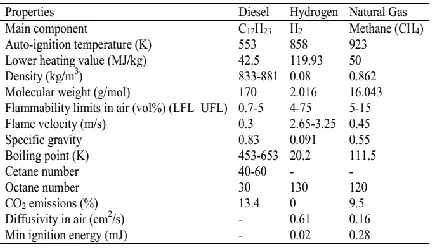
The combination of natural gas or hydrogen with diesel is reported to yield lowemissions and to some extent increase the engine efficiency, either in HCCI or CIcombustion model. Diesel alone is not suitable for HCCI engines due to its lowvolatility and high propensity to auto-ignite, while natural gas has a high resistance toauto-ignition, as reported by Kong [64]. Combinations of high octane number fuels(such as natural gas and hydrogen) with high cetane number fuels (such as diesel) areable to increase the engine durability, and under certain operating conditions reduceemissions levels such as soot, HC, CO and NOx. It was also reported that thesecombinations have a high thermal efficiency under early injection timing. Fuelswith a higher octane number have better resistance to knocking, while fuels with ahigher cetane number have a shorter ignition delay time, thus providing more time forthe fuel to complete the combustion. Therefore, a combination of both (high cetanenumber fuels and high octane number fuels) provides a soft engine run, wherebythe mixture can be operated at high CR and has a longer combustion duration.
Available online: https://edupediapublications.org/journals/index.php/IJR/ P a g e | 527 Table 2. Diesel properties compared to hydrogen and
natural gas
V. CONCLUSION
Intended for this purpose, it is possible to use fuel, diesel, typical gas, hydrogen or a comboof those in HCCI engines, considering that the engine can be operated with a broad range offuels. From the practicality point of view, the HCCI engine can be used in a hybridconfiguration, the place it could support diminish the gas consumption even extra. Manyreviews show that the HCCI engine has low NOx emissions, soot, and particulates.Nonetheless, HCCI engines still have unresolved disorders with knocking and excessive levels ofunburned HC and CO emissions. Extra sections have got to be carried out in an effort to clear upthese closing issues. To obtain this, the numerical approach is proposed for earlygain data of considering the fact that it has a satisfactory expertise over investigates in terms of cost and time.
REFERENCES
[2] Jonathan P. Responses to questions on the design elements of a mandatorymarket-based greenhouse gas regulatory system. World Resources Institute,Washington. 2006.
[3] Aziz Hairuddin A, Wandel AP, Yusaf T. Effect of different heat transfer modelson a diesel homogeneous
charge compression ignition engine. InternationalJournal of Automotive and Mechanical Engineering. 2013;8:1292-304.
[4] Kamil M, Rahman MM, Bakar RA. Integrated simulation model for compositionand properties of gases in hydrogen fueled engine. International Journal ofAutomotive and Mechanical Engineering. 2013;8:1242-155.
[5] Kamil M, Rahman MM, Bakar RA. An integrated model for predicting enginefriction losses in internal combustion engines. International Journal ofAutomotive and Mechanical Engineering. 2014;9:1695-708.
[6] Ogden JM, Steinbugler MM, Kreutz TG. A comparison of hydrogen, methanoland gasoline as fuels for fuel cell vehicles: implications for vehicle design andinfrastructure development. Journal of Power Sources. 1999;79:143-68.
[7] Trimm DL, Önsan ZI. Onboard fuel conversion for hydrogen-fuel-cell-drivenvehicles. Catalysis Reviews. 2001;43:31-84.
[8] Chan C. The state of the art of electric and hybrid vehicles. Proceedings of theIEEE. 2002;90:247-75.
[9] Cho HM, He B-Q. Spark ignition natural gas enginesA
review. EnergyConversion and Management.
2007;48:608-18.
[10] Taylor AM. Science review of internal combustion engines. Energy Policy.2008;36:4657-67.
[11] Mohanamurugan S, Sendilvelan S. Emission and combustion characteristics ofdifferent fuel In A HCCI
engine. International Journal of Automotive
andMechanical Engineering. 2011;3:279-92.
[12] Raitanapaibule K, Aung K. Performance predictions of a hydrogen-enhancednatural gas HCCI engine.
International Mechanical Engineering Congress
andExposition: American Society of Mechanical Engineers; 2005. p. 289-94.
Available online: https://edupediapublications.org/journals/index.php/IJR/ P a g e | 528 engine combustion characteristics. Journal ofMechanical
Engineering and Sciences. 2013;5:677-87.
[14] Noor MM, Wandel AP, Yusaf T. The simulation of biogas combustion in a mildburner. Journal of Mechanical Engineering and Sciences. 2014;6:995-1013.
[15] Epping K, Aceves S, Bechtold R, Dec J. The potential of HCCI combustion forhigh efficiency and low emissions. SAE Technical Paper No. 2002-01-1923;2002.
[16] Christensen M, Johansson B. Influence of mixture quality on homogeneouscharge compression ignition. SAE Technical Paper No. 982454; 1998.
[17] Kong S-C, Reitz RD. Use of detailed chemical kinetics to study HCCI enginecombustion with consideration of turbulent mixing effects. Journal of
Engineering for Gas Turbines and Power. 2002;124:702-7.
[18] Najt PM, Foster DE. Compression-ignited homogeneous charge combustion.SAE Technical Paper No. 830264; 1983.
[19] Kong S-C, Reitz RD. Numerical study of premixed HCCI engine combustionand its sensitivity to
computational mesh and model uncertainties.
CombustionTheory and Modelling. 2003;7:417-33.
[20] Soylu S. Examination of combustion characteristics and phasing strategies of anatural gas HCCI engine. Energy conversion and management. 2005;46:101-19.
[21] Pitz JW, Westbrook CK. Combustion Chemistry. 2011.
![Fig. 1 - Conventional combustion & variants of diesel combustion on T-Ө space [22]](https://thumb-us.123doks.com/thumbv2/123dok_us/7732289.1265967/2.612.337.550.246.388/fig-conventional-combustion-variants-diesel-combustion-o-space.webp)
![Figure 2. The differences among SI, CI and HCCI engines, reproduced from Pitz andWestbrook [21]](https://thumb-us.123doks.com/thumbv2/123dok_us/7732289.1265967/3.612.340.550.95.230/figure-differences-si-hcci-engines-reproduced-pitz-andwestbrook.webp)