A BSTRACT: In recent years, Cyber Secu rity h as b ecome rising issue where en cry p tio n is o n e o f s o lution and has a significant role in protecting th e d ata. Encryption algorithms are widely u tilized in in fo rmatio n s ecu rity are as y mmetric an d s y mmetric. Now a day’s A d v an ced En cry p tio n Standard (AES) is one of s y mmetric en cry p tio n th at mo s t u tilized o ften an d th e mo s t s ecu re en cry p tio n . S-b o xes are u s ed fo r th e imp lementation of the multiplicative invers es an d s h ared b etween en cry p tio n an d d ecry p tio n . Ho wever, AES encryption has slow comp u tatio n . A n ovel method to improve A ES alg o rith m with Sh ift Row and S-Box mo dification for Mix Column tran s fo rmatio n is p ro p o s ed in th is p ap er.
Key words: Advanced En cryption Standard (AES), Op timizatio n ; S b o x.
I. INTRODUCTION
Various techniques, such as cryptography,
steganography, watermarking, and
scrambling, have been developed for keeping data secure, private, and copyright protected. Cryptography is a necessary tool underlying virtually all networking and computer protection, traditionally utilized for military and espionage. Hence, there is a need for secure transactions in ecommerce, private networks, and secure messaging has moved encryption into the commercial realm. Advanced encryption standard (AES) was provided as Federal Information Processing Standards (FIPS) by National Institute of Standards and Technology (NIST) as a successor for data encryption standard (DES) algorithms.
A number of architectures for the VLSI implementation of AES Rijndael algorithm are reported in recent literature.
It can be observed that some of these architectures are of low performance and some provide low throughput. Further, many of the architectures are not area efficient and can result in higher cost when implemented in silicon.
In this paper, a high throughput, high performance and area efficient architecture of VLSI for Rijndeal algorithm is proposed which is suitable for low cost
silicon implementation. For high
throughput in the data rates of encryption and decryption we optimize the proposed architecture by utilizing pipelining. The multiplication of Polynomial is introduced by utilizing XOR operation instead of utilizing multipliers for decreasing the complexity of hardware. In the proposed architecture both the modes of encryption and decryption utilizes common hardware resources, hence making the design is area efficient.
Selective utilization of combinational logic and look-up tables further reduces the architecture’s memory optimization, area
and performance. Our proposed
architecture has a significant feature which is an effective solution of online (real-time) round key generation needing significantly less storage for buffering.
II. LITERATURE REVIEW As a non linear component with confusion effect in block cipher algorithms, the s-box
appears repeatedly in the round
transformation and key expansion
AN IMPROVED HIGH SECURE COMMUNICATION USING AES WITH S.R AND M.C
1SHAIK MOBEENA, 2T.BHAVANA
1M.tech-Scholar, Dept of ECE, Guntur Engineering College, Guntur, A.P, India.
algorithm. It plays a key role in the security of the entire cipher algorithms. The anti-attack capability of various block ciphers is related to S-box cryptography characteristics of the entire algorithms. Therefore, it is a prerequisite of the design
for analyzing S-box cryptography
characteristics.
We know the number of S box used in the block ciphers is more, the nonlinearity of the cryptographic algorithms is higher, and the confusion of the cipher algorithm is stronger. In fact, the bigger S box, which is used in the hardware structure, the calculation, check list and storage are also required more time and space. In this case, the algorithm becomes very low efficient. So how to choose a good S-box, we need to consider the security of algorithm and the work efficiency of implementation. The traditional method generates the S box, which has a good index of cryptography. However, it is difficult to use pure logic hardware implementation consuming a large number of logic units. What's worse, the use of look-up table costs too much memory resource. Ideally, the method needs 16
clock cycles to complete the
transformation, which is not conductive to
the high-speed implementation of
encryption system.
The new S box proposed by Wu Wenling et al. is implemented by a logic unit AND an OR gate. Although S
box generates with fast speed,
cryptography strength is not as strong as traditional S-box generation algorithm. After research, we propose an improved algorithm that is the dynamic S-box algorithm effectively compensating for
indicators on cryptography. The
improved algorithm can be not only satisfied with application for the advanced encryption algorithm AES, but also reduce hardware logic units and
improve the speed of encryption and decryption.
We employ the new S box proposed by Wu Wenling et al. as S box of AES
encryption system, and do some
extension on the basis of the S box. Utilizing the S box to generate time-shift bits selection function can get 8 groups of S boxes. Meanwhile, exchange position of the input high 4 bits and low 4 bits, then we can get another new 8 groups of S boxes, whose cryptography property is not changed. Finally, we construct 16 groups of S boxes, between which exists linear relationship. So we realize extension from one set to many sets of S boxes. Dynamic S box is used for the key expansion module, byte conversion module and byte inverse transformation module, which improve the encryption strength.
III.PROPOSED SYSTEM
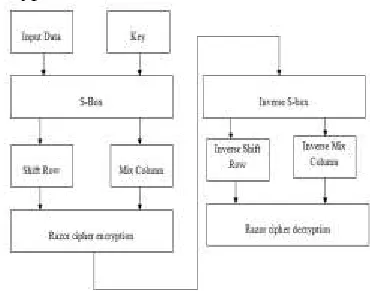
The Advanced Encryption Standard (AES) is a symmetric block cipher which is utilized by the U.S. government for protecting information which is classified and is performed in software and hardware throughout the world for sensitive data encryption.
FIG. 1 PROPOSED BLOCK DIA GRA M
Each cipher encrypts and decrypts the data by utilizing cryptographic keys of 128 bits, 192 bits and 256 bits, respectively in blocks of 128 bits. 14 rounds for 256-bit keys, 12 rounds for 192-bit keys and 10 rounds for 128-bit keys are there in advanced encryption standard.
A. AES Encryption
To implement the AES encryption
algorithm, we proceed exactly the same way as for the key expansion, i.e, we
initially implement the basic helper
functions and then move up to the main
loop. The functions considered as
parameter a state, which is, as already explained, a rectangular 4x4 array of bytes. The shift Rows function iterates over all the rows and then call shift Row with the correct offset. Shift Row does nothing yet for shifting a 4-byte array by the given offset.
This is the part that involves the round Key which was generated during each iteration. Here simply XOR each byte of the key to the respective byte of the state. The Mix Columns implementation was carried out by initial one would generate a column and then call mix Column, which
would then apply to the matrix
multiplication.
One AES round is which has to apply all four operations consecutively on the state. All we have to do is take the state, the Expanded Key and the number of rounds as parameters and then call the operations one after the other. Finally, all we have to do is put it all together. Our parameters are the input plaintext, the key of size key Size and the output. First, we calculate the number of rounds depends on the key Size and then the expanded KeySize based on the number of rounds. Then we have to map the 16 byte input plaintext in the correct order to the 4x4 byte state expand
the key by utilizing our key schedule, encrypt the state by utilizing our main AES body and finally un-map the state in the correct order to gain the 16 byte output cipher text.
B. AES Decryption
For the AES Decryption, the key schedule stays as similar, the only operations we have to develop are the inversed shift Rows and inverse mix Columns. As you can see, they are nearly identical to their encryption except that the rotation this time is to the right and that we use the inversed S-Box for the substitution. As for the operation of inversed mix Columns, the only difference is the multiplication matrix is different. Finally, the only thing left to do is to keep it all together in one inversed main algorithm. Please note that we use our expanded key backwards, starting with the last 16 bytes and then moving towards the start. The functional verification was carried out for all the test cases and hence the RTL modeling is taken to the synthesis process using the Xilinx tool.
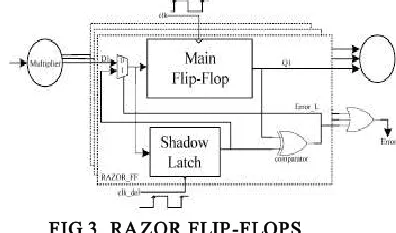
FIG 3. RA ZOR FLIP-FLOPS
incorrect result catches by the main flip-flop if the latched bit of the shadow latch is variant from that of the main flip-flop.
The error signal is set to 1 by the Razor flip-flop for notifying the system to re execute the operation if any errors occur and notify occurred an error in AHL circuit. For detecting whether an operation is examined to be a one-cycle pattern which can complete in a cycle by utilizing Razor flip-flops. If not the operation is re-executed with two cycles. While the execution is high cost, due to the re-execution frequency and overall cost is low.
IV. RESULTS
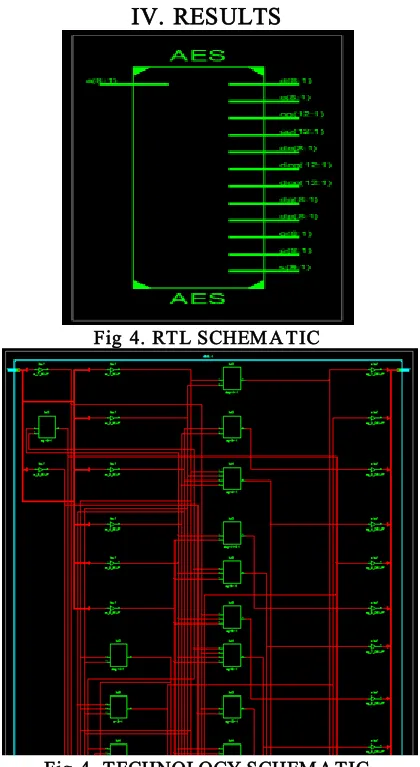
Fig 4. RTL SCHEM A TIC
Fig 4. TECHNOLOGY SCHEM A TIC
Fig 5. OUTPUT W A VEFORM
V. CONCLUSION
We have presented VLSI architecture for
the Rijndael AES algorithm which
executes both the encryption and
decryption. S-boxes are used for the
implementation of the multiplicative
inverses and shared between encryption and decryption. The round keys are
required for each round of the
implementation which is generated in real-time. The forward and reverse key
scheduling is developed and hence
allowing area minimization which is
efficient. Encryption algorithm is being utilized by military and government for a secure communication. The purpose of encryption is for hiding the data from unauthorized usage. We proposed a method for employing the crypto processor run in integration with a General Purpose Processor. We have proposed a AES algorithm which is a pipeline version that can encrypt data.
VI. REFERENCES
[1] S. P. Mohanty, K. R. Ramakrishnan, and M. S. Kankanhalli, “A DCT Domain
Visible Watermarking Technique for
Images,” in Proc of the IEEE International
Conf on Multimedia and Expo, 2000, pp. 1029–1032.
[2] M. S. Kankanhalli and T. T. Guan,
“Compressed-Domain Scrambler /
Descrambler for Digital Video,” IEEE
[3] B. M. Macq and J. J. Quisquater,
“Cryptography for Digital TV
Broadcasting,” Proceedings of the IEEE,
vol. 83, no. 6, pp. 944–957, Jun 1995. [4] H. Kuo and I. Verbauwhede, “Architectural Optimization for a 1.82 Gbits/sec VLSI Implementation of the
AES Rijndael Algorithm,” in Proceedings
of the Workshop on Cryptographic Hardware and Embedded Systems, 2001, vol. 2162, pp. 51–64.
[5] M. McLoone and J. V. McCanny, “Rijndael FPGA Implementation Utilizing
Look-up Tables,” in Proceedings of the
IEEE Workshop on Signal Processing Systems, 2001, pp. 349–360.
[6] A. Satoh, S. Morioka, K. Takano, and S. Munetoh, “A Compact Rijndael
Hardware Architecture with S-Box
Optimization,” in Proceedings of
Advances in Cryptology - ASIACRYPT 2001, 2001, pp. 171–184.
[7] S. Mangard, M. Aigner, and S.
Dominikus, “A Highly Regular and