Available online: https://edupediapublications.org/journals/index.php/IJR/ P a g e | 5563
A Study on differences in emotional intelligence among
normal and differently abled adolescents
Rimjhim Rajbhar
1& U. V. Kiran
2Student
1& Assistant Professor
2Department of Human Development and Family Studies, School for Home Sciences
Babasaheb Bhimrao Ambedker University, Lucknow
Email: [email protected]
ABSTRACT
The adolescents have to be encouraged to unique person with similarities and differences. Beside they emotional intelligence times, understanding emotion, understand motivation, empathy handling relation and concern which would needed the assistance of the elderly to cope with. This might be due to the fact that in some cases, the handicapped adolescent does not have many chances to interact with other adolescent outside the home which makes adolescent even more important. In present study multistage random sampling technique was adopted and a sample of 60 adolescents were selected from the identified schools of the selected ward. The sample was selected by identifying institutions working for disabled. A sample 60 orthepaedical adolescent were selected from the population. Lucknow city was purposively selected to conduct the study as it is convenient for the researcher to conduct the research study was conduct in Lucknow city. They were tested individually for emotional intelligence with the help of Emotional Intelligence Scale of Arun K.S. and Shruti.
Keywords: Emotional Intelligence, Adolescent
INTRODUCTION
Adolescence: transitional phase of growth and development between childhood and adulthood. The World Health Organization (WHO) defines an adolescent as any person between ages 10 and 19. This age range falls within WHO’s definition of young people, which refers to individuals between ages 10 and 24. (www.who.int/maternal_child_adolescent/topics/adolescence/dev/en/)
1. M.Sc. Student, 2. Assistant Professor, Dept. of Human Development & Family Studies, School for Home Sciences, Babasaheb Bhimrao Ambedkar University, Lucknow-226 025.
Available online: https://edupediapublications.org/journals/index.php/IJR/ P a g e | 5564 The concept of adolescence and the term teenagers seem to have originated within Western culture. The transitional period as described by Kaplan (2004, p. 1) varies by society and culture. Americans expect adolescents to achieve autonomy, identity, and independence due to a shared individualistic culture (Pipher, 1994).
The term adolescence is commonly understood to define the period of life between childhood and adulthood (Kaplan, 2004, p. 1). This time frame, however, not only describes a very diverse reality, but adolescence varies considerably across cultures, over time, and within individuals.
Researchers have produced a substantial body of work on the biological and psychological changes that occur during adolescence, as well as the family, peer, and cultural influences that shape adolescents’ lives in important ways. This evidence—as well as the evidence-based practice of health care practitioners and others who work with adolescents—can guide current and future efforts to promote healthy behaviour and also to prevent risky behaviour that are prevalent during this stage of development. The Institute of Medicine and the National Research Council formed the Committee on the Science of Adolescence, with the support of the U.S. Department of Health and Human Services’ Administration for Children, Youth, and Families (ACF), the Office of the Assistant Secretary of Planning and Evaluation (ASPE), and the National Institute on Drug Abuse (NIDA). The committee planned and convened a series of three public workshops in 2008 and 2009 to review the science of adolescence from a life-course perspective and to explore the implications of this research for the design, implementation, and evaluation of prevention programs for adolescents, as well as other means of fostering healthy development.
Available online: https://edupediapublications.org/journals/index.php/IJR/ P a g e | 5565 Emotional intelligence can be defined as the ability to monitor one's own and other people's emotions, to discriminate between different emotions and label them appropriately and to use emotional information to guide thinking and behaviour. Emotional intelligence also reflects abilities to join intelligence, empathy and emotions to enhance thought and understanding of interpersonal dynamics. However, substantial disagreement exists regarding the definition of EI, with respect to both terminology and operationalization’s. Currently, there are three main models of EI:
1. Ability model
2. Mixed model (usually subsumed under trait EI) 3. Trait model
Different models of EI have led to the development of various instruments for the assessment of the construct. While some of these measures may overlap, most researchers agree that they tap different constructs. Specific ability models address the ways in which emotions facilitate thought and understanding. For example, emotions may interact with thinking and allow people to be better decision makers (Lyubomirsky et al. 2005) a person who is more responsive emotionally to crucial issues will attend to the more crucial aspects of his or her life. Aspects of emotional facilitation factor is to also know how to include or exclude emotions from thought depending on context and situation. This is also related to emotional reasoning and understanding in response to the people, environment and circumstances one encounters in his or her day to day life.
Emotional intelligence (EI) or emotional quotient (EQ) is the capacity of individuals to recognize their own, and other people's emotions, to discriminate between different feelings and label them appropriately, and to use emotional information to guide thinking and behaviour. Although the term first appeared in a 1964 paper by Michael Beldoch, it gained popularity in the 1995 book by that title, written by the author, psychologist, and science journalist Daniel Goleman. Since this time Goleman's 1995 theory has been criticized within the scientific community.
Regarding life success, from an ability perspective, school children and adolescents who score high on EI (using the MEIS) are rated by their peers as lessaggressive and more prosocial (Rubin, 1999), are seenas more empathic (Ciarrochi, Chan and Chaputi, 2000) and are less likely to engage in tobacco and alcoholconsumption (Trinidad and Johnson, 2002; Trinidad, Unger, Chou and Anderson Johnson, 2004).
OBJECTIVE
Available online: https://edupediapublications.org/journals/index.php/IJR/ P a g e | 5566 REVIEW OF LITERATURE
Mayer & Salovey, 1997 (Jensen) Measuring Emotional Intelligence In response to the excitement over Emotional Intelligence (EI), several measures of EI have been developed. The measures vary in their definition of emotional intelligence as well as their format. The biggest distinction related to the definition of EI is between self-report measures (Emotional Quotient Inventory [EQ-i], Emotional and Social Competence Inventory [ESCI]), which are strongly related to traditional personality measures, versus the only non-self-report measure, the Mayer, Salovey, Caruso Emotional Intelligence Test (MSCEIT). MSCEIT scores are based on performance on a variety of tasks that require various forms of emotional intelligence. Correct answers are based on experts’ decisions or, alternatively, on popular consensus. While the MSCEIT has several deficits, it is theonly measure developed thus far that sufficiently distinguishes itself from traditional personality measures. These personality measures have a long history of being useful in predicting a variety of performance outcomes overlapping those predicted by self-report measures of EI.
Ghosh, D. (2015) explored gender differences on emotional intelligence among tribal and non-tribal adolescent school students of Tripura. Her study showed significant differences between tribal and non-tribal students on overall emotional intelligence. Further she revealed gender difference on emotional intelligence among school students. Another study conducted by Anjali, D. (2015) on the effect of gender, community culture and type of school on emotional maturity of tribal and non-tribal pre-adolescents in Gandhari area of the Nizamabad District in Telangana state and found that on the measure of emotional maturity non-tribal performed better than tribal community.
Available online: https://edupediapublications.org/journals/index.php/IJR/ P a g e | 5568 ability to use emotions for facilitating cognitive activities such as thinking and problem solving. Understanding emotions is the ability to comprehend the language of emotions and to understand the complex relationships between emotions. Management of emotions means the ability of managing own emotions and others’ emotions. (Salovey and Grewal 2005: 281). Especially, the abilities of knowing oneself (self-consciousness), self-management, motivation, empathy, social skills and communication skills are determinative for emotional intelligence. “Self-consciousness” explained as one’s deeper understanding of own emotions, powers, weaknesses, needs and awareness of self-existence whereas “self-management” is the liberation from being slave of one’s emotions, namely directing the emotions as desired; “motivation” is going beyond expectations and not losing the feeling of success even in hard times; “empathy” is the ability to understand emotions and needs of others and thus putting oneself into others’ shoes; “social skill” is the ability to establish relationships with other individuals and to ensure sustainability of such relationships, creating and managing a team and “communication skill” is the ability of expressing yourself clearly and entirely as well as listening to the others attentively and fully, accurately understanding what they say (Goleman 2004: 2-9; Cetinkaya and Alparslan 2011: 366).
METHODOLOGY
Research Design
The research Design followed in the present study is cross- sectional design “Cross-sectional studies (also known as cross- sectional analysis) for and a class of research method involve observations all of a population, or a representative subject, at a time, they different from cross-sectional study. Whereas case-control studies typically include individual with a specific characteristic, with a sample, often a tiny majority of the rest of the population. The emotional intelligence of normal and different abled adolescent was analysed using Emotional Intelligence Scale.
Locale of the study
Lucknow city was purposively selected to conduct the study as it is convenient for the researcher to conduct the research study was conduct in Lucknow city.
Sampling Procedure
The school going normal and different abled adolescents belonging to various categories were selected to assess and compare their emotional intelligence.
Available online: https://edupediapublications.org/journals/index.php/IJR/ P a g e | 5569 a) Normal Adolescent “Multistage random sampling technique was adopted and a sample of 60 adolescents was selected from the identified schools of the selected ward.”
b) Orthepaedical disabled The sample was selected by identifying institutions working for disabled. A sample 60 orthepaedical adolescent will be selected from the population.
Sample size
The derived sample size of 120 respondents were equally divided into experimental and control group.
Tool and Techniques
To carry out the present study following tools were used-
A self-made schedule to collect the general information of the respondents.
Methods of the data collection The data was collected through a self-structured questionnaire and emotional intelligence scale from the normal and different abled adolescents. The sample was identified and permission was sought from them to conduct the study on normal and different abled adolescents. The information of different abled adolescents was taken from Shakuntala University and EIS was administered on them. Normal adolescents were identified and the data was collected through EIS .While collecting the data, efforts were made to maintain accuracy, precision, and relevance of the answer. The data was then coded, scored, tabulated and analysed by using relevant statistical procedure.
Data Analysis Relevant statistical techniques were adopted and the data was analysed using PAS software.
RESULT AND DISCUSSION
.Table 4.1 Emotional intelligence difference among normal and different abled adolescents Factor Emotional
intelligence
Normal adolescent
Different abled adolescent
Available online: https://edupediapublications.org/journals/index.php/IJR/ P a g e | 5570 1 Understanding
emotion
2.50±0.79 2.56±0.90 0.42 0.23
2 Understanding motivation
6.38±1.18 5.83±1.19 2.53 0.34
3 Empathy 7.41±1.15 7.56±1.65 0.57 0.005
4 Handing
relation
22.98±3.35 22.75±2.82 0.41 0.11
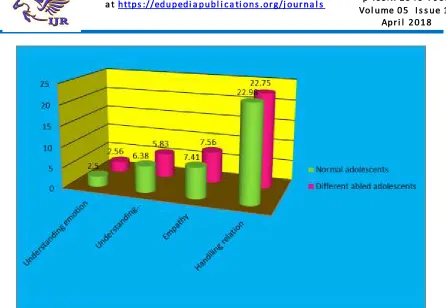
Available online: https://edupediapublications.org/journals/index.php/IJR/ P a g e | 5571 Fig. 4.1 Emotional intelligence difference a mong normal and different abled adolescents
To see the significant difference in emotional intelligence of normal and different abled adolescents, t-test statics was used and presented in Table 4.1 the emotional intelligence of adolescents was assessed considering the factors as explained in methodology (3.6).
The factor ‘1’ (An individual’s capacity to identify emotions in one’s and other’s physical states, feelings, and thoughts.). The mean scores of the normal and different abled (2.50 and 2.56)
adolescents tend towards low score i.e. below 5, describing both of their emotional intelligence and significant difference were observed in the area between both the groups.
Highly significant difference was found with regard factor ‘2’ in adolescents emotional intelligence scale describes the an high achievement drive together with the tendency to be optimistic and take intiative of adolescents .The mean scores clearly describes that the emotional intelligence of normal adolescent (6.38) describing the nature of children sometimes tendency to be optimistic and take initiative. Whereas the different abled adolescents (5.83) are always high achievement.
Available online: https://edupediapublications.org/journals/index.php/IJR/ P a g e | 5572 No significant difference was found with regard to factor’4’ to be able to manage and handle relation with others in better way. The mean score of the normal adolescents (22.98) tend towards high score describing handling relations.
The findings of the study showed emotional intelligence differences between two components of normal and differently abled adolescents. The study reveals that a highly significant difference was found with regard to factor “2” (understanding motivation) a high achievement drive together with the tendency to be optimistic and take initiative and No significant difference was found with regard to factor’4’ (handling relations) to be able to manage and handle relation with others in better way. The mean score of the normal adolescents tend towards high score describing handling relations.
CONCLUSION
The study indicates differences in emotional intelligence of normal and differently abled adolescents, factor “1” (understanding emotions) an individual’s capacity to identify emotions in one’s and other’s physical states, feelings, and thoughts. A highly significant difference was found with regard to factor “2” (understanding motivation) a high achievement drive together with the tendency to be optimistic and take initiative. The factor ‘3’ (empathy) which describes empathy, the emotional intelligence of normal adolescents with understand their perspectives, develop others, leverage diversity, read the mood of a group, discern political realities and a tendency to take an interest in the of others, whereas the different abled adolescents show a dual characters of sometime being ability to identify oneself mentally with others and to understand a adolescents. No significant difference was found with regard to factor’4’ (handling relations) to be able to manage and handle relation with others in better way. The mean score of the normal adolescents tend towards high score describing handling relations.
REFERENCES
1.
21. Lopes, P. N., Brackett, M. A., Nezlek, J. B., Schutz, A., Sellin, I., & Salovey, P.
(2004). Emotional intelligence and social interaction. Personality and Social
Psychology Bulletin, 30, 1018–1034.
2.
Brackett, M.A., Rivers, S., & Salovey, P. (2005). Emotional Intelligence and its
relation to social, emotional, and academic outcomes among adolescents.
Unpublished data, Yale University.
Available online: https://edupediapublications.org/journals/index.php/IJR/ P a g e | 5573