1556-6811/06/$08.00⫹0 doi:10.1128/CVI.13.1.53–58.2006
Copyright © 2006, American Society for Microbiology. All Rights Reserved.
Comparison of a New ESAT-6/CFP-10 Peptide-Based Gamma Interferon
Assay and a Tuberculin Skin Test for Tuberculosis Screening in a
Moderate-Risk Population
Emaeil Porsa,
1,2* Lee Cheng,
1Michael M. Seale,
1George L. Delclos,
2Xin Ma,
3Robert Reich,
3James M. Musser,
3and Edward A. Graviss
3,4Department of Family and Community Medicine, The University of Texas Health Science Center, Houston, Texas1; Division of
Environmental and Occupational Health, The University of Texas School of Public Health, Houston, Texas2; Center for
Human Bacterial Pathogenesis Research, Department of Pathology, Baylor College of Medicine, Houston, Texas3;
and Department of Medicine, Baylor College of Medicine, Houston, Texas4
Received 8 September 2005/Returned for modification 20 October 2005/Accepted 1 November 2005
Screening for latent tuberculosis infection (LTBI) with Mantoux tuberculin skin test (TST) has many limitations, including false-positive results due to exposure toMycobacteriumother than tuberculosis (TB) and BCG vaccination. A total of 474 adult inmates in a county jail were screened for LTBI using TST and a new ESAT-6/CFP-10 peptide-based whole-blood gamma interferon (IFN-␥) assay. LTBI prevalence was 9.0 and 5.4% as determined by TST and IFN-␥assay, respectively. Overall, agreement between test results was 90% ( ⴝ 0.25). Positive TST results were significantly associated with increased age (odds ratio [OR], 1.04; 95% confidence interval [CI], 1.01 to 1.08), African-American ethnicity (OR, 4.97; 95% CI, 1.58 to 15.68), foreign birth (OR, 20.20; 95% CI, 4.21 to 97.02) and prior incarceration (OR, 6.19; 95% CI, 1.48 to 25.95). Positive IFN-␥assay results were significantly associated with African-American ethnicity (OR, 5.58; 95% CI, 1.16 to 26.74). Factors associated with statistically significant discordance between TST and IFN-␥assay results were African-American ethnicity (OR, 0.29; 95% CI, 0.11 to 0.77), foreign birth (OR, 0.23; 95% CI, 0.07–0.80), and prior incarceration (OR, 0.06; 95% CI, 0.01–0.50). Among subjects born in the United States, African-American ethnicity was the only variable significantly associated with positive test results for both TST (OR, 4.26; 95% CI, 1.38 to 13.16) and IFN-␥assay (OR, 5.74; 95% CI, 1.19 to 27.75) and remained associated with statistically significant discordance between TST and IFN-␥assay results. The reactivity of the new IFN-␥assay is unaffected by prior BCG vaccination or serial TSTs but may be diminished in African-Americans. Future longitudinal studies are needed to assess the sensitivity and specificity of this new assay in detecting LTBI.
Among adults, tuberculosis (TB) is the world’s foremost cause of death from a single infectious agent (31, 32). In the United States, new TB cases continue to be reported in all states with a significant proportion of these cases residing in correctional facilities (11, 34). Transmission of TB in correc-tional facilities has been documented by several studies and shows this disease to be a public health problem not only for the inmates and employees of these facilities but also for the communities in which they reside (9, 13, 17, 22, 24).
Screening for persons at risk for latent tuberculosis infection (LTBI) is an essential step in a comprehensive approach to TB control and elimination (2, 18). The tuberculin skin test (TST) is currently the standard method of screening for LTBI in the United States despite its limitations, including the need for at least two patient contacts, uncertainty about the immune status of the person tested, false-positive results because of cross-reactivity with BCG vaccine and mycobacteria other thanM.
tuberculosis (MOTT), and errors related to subjectivity and
technical difficulties in administering the test or reading the results (1, 3, 12, 21).
A new whole-blood interferon-gamma (IFN-␥) assay has been approved by the U.S. Food and Drug Administration for the detection of LTBI and is commercially available as QuantiFERON-TB-GOLD (37). This assay detects in vitro cell-mediated immune responses to TB infection by quantify-ing the amount of the IFN-␥that is released in the plasma of whole blood incubated overnight with mixtures of overlapping peptides spanning the sequence of the early-secreted antigenic target 6-kDa protein (ESAT-6) and culture filtrate protein 10 (CFP-10) (QuantiFERON-TB-GOLD; Cellestis Ltd., Carnegie, Victoria, Australia). These antigens are the products of a genomic region (RD1) that is present in allM. tuberculosisand pathogenic M. bovis strains but absent in all BCG vaccine strains and nearly all MOTT (6, 25). Consequently, IFN-␥ assays utilizing ESAT-6 and CFP-10 either as recombinant antigens (5, 7, 38) or mixtures of overlapping peptides (8, 27, 37) have been shown to be significantly more specific than TST. In addition, these assays offer several advantages over TST, including the need for only a single patient contact, simultaneous measurement of a subject’s immune reactivity to mitogen (phytohemagglutinin) and nil control (normal saline) antigens, elimination of subjectivity in administering the test or reading the result, and the availability of test results within 24 h. IFN-␥assays utilizing ESAT-6 and CFP-10 antigens have been studied in the general population in several countries
* Corresponding author. Mailing address: Department of Family and Community Medicine, MSB-G.150, The University of Texas Health Science Center, Houston, TX 77002. Phone: (713) 755-6541. Fax: (713) 755-6011. E-mail: [email protected].
53
on August 17, 2020 by guest
http://cvi.asm.org/
including India, Korea, Italy, Denmark, The Netherlands, and Japan (5, 7, 8, 15, 23, 27, 29, 30, 38). To date, there are no published reports on comparison of TST to the newly approved IFN-␥assay in studies within the United States. The purpose of this cross-sectional study was to evaluate the performance of IFN-␥assay compared to TST for tuberculosis screening in a moderate-risk population in the United States.
MATERIALS AND METHODS
Study design.This was a cross-sectional study comparing a new whole blood IFN-␥assay to TST for tuberculosis screening. The institutional Committee for the Protection of Human Subjects approved the research protocol for the present study. All inmates gave written informed consent.
Study site and selection criteria.Adult inmates (ⱖ18 years of age) at the Harris County Jail (HCJ) in Houston, Texas were invited to participate in the present study during the months of June and July of 2004. Subjects with known history of LTBI (prior positive TST) or current tuberculosis disease and those on chronic immunosuppressive therapies (corticosteroids, chemotherapy, etc.) were excluded from the present study. All subjects were tested for human immuno-deficiency virus infection.
Procedures.After we obtained informed consent and authorization for the release of protected health information from each subject, sociodemographic data, past medical history (including history of BCG vaccination), and prior TB exposure information were obtained. A total of 10 ml of blood was then collected from each subject by venipuncture. No personal identifiers or clinical histories were available to laboratory personnel. IFN-␥assay testing was initiated within 12 h and in accordance with the manufacturer’s recommendations (Quanti-FERON-TB-GOLD; Cellestis, Ltd.). Briefly, blood samples were incubated with the stimulating antigens as part of the first stage of the IFN-␥assay. Plasma samples were harvested after 16 to 24 h of incubation, and the amount of IFN-␥ was quantified by enzyme-linked immunoassay (ELISA) method. Raw optical densities were measured by using Molecular Devices’ SpectraMax M2 (Sunnyvale, CA), and data from the ELISA reader were interpreted by using assay specific software provided by Cellestis, Inc. (Valencia, CA). IFN-␥assay results were interpreted as described in the Product Package Insert (QuantiFERON-TB-GOLD; Cellestis, Ltd.).
After the blood samples for the IFN-␥assay were collected, trained nursing
staff at the HCJ administered the TST (one-step method) according to the guidelines established by the Centers for Disease Control and Prevention (1). Briefly, 0.1 ml of the tuberculin PPD (TUBERSOL; Aventis Pasteur Ltd., Toronto, Ontario, Canada) containing five tuberculin units was injected intra-dermally on the volar surface of inmates’ forearms. After 48 to 72 h, the diameter of the area of induration around the injection site was measured across the forearm and was reported in millimeters. Reactions ofⱖ10 mm were considered positive. Treatment for LTBI among the study subjects was based solely on the TST results.
Statistical analysis.The primary outcome of the present study was the differ-ence in the prevaldiffer-ence of LTBI according to TST and IFN-␥assay as indicated by the frequency of positive results for each test. We then assessed the level of concordance between TST and IFN-␥assay results. Concordance was calculated as the overall percent agreement between the results of the two assays using 2⫻2 contingency tables. The strength of this agreement was examined by using Cohen’s kappa () withvalues of⬎0.75 representing excellent agreement beyond chance, 0.40 to 0.75 representing fair to good agreement beyond chance, and⬍0.40 representing poor agreement beyond chance (16).
Multivariable logistic regression models were used to identify variables signif-icantly associated with positive results for each assay and those variables asso-ciated with discordance between assay results.
The independent variables included in the multiple logistic regression models were gender, age (as a continuous variable), ethnicity, birth country, prior incar-ceration, close contact with a TB case, and living in a shelter which included housing in congregate settings such as drug rehab units, “bunk houses,” nursing homes, etc. All statistical analyses were conducted by using SAS statistical soft-ware (version 9.1; SAS, Inc., Cary, NC).
RESULTS
Of the 533 subjects who were initially contacted, 474 subjects (89%) participated in the present study and were screened for LTBI by both tests. Of these, 51 subjects left HCJ prior to reading their TST results while 11 subjects had “indetermi-nate” IFN-␥assay results. Only three subjects (0.6%) tested positive for HIV infection. These subjects were not included in the final analysis in order to maintain the homogeneity of data. Concomitant TST and IFN-␥assay results were available for 409 subjects. The average age of the subjects in years was 31.0 (median, 29.0 years). Subjects were predominantly male, Afri-can-American, born in the United States, and had a history of prior incarceration (Table 1).
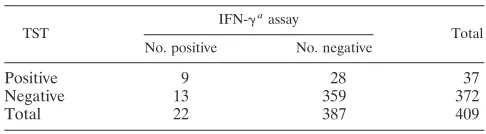
Among the 409 eligible subjects with concomitant results for both tests, 9.0% tested positive by TST and 5.4% by IFN-␥ assay (Table 2). The concordance between the TST and IFN-␥ assay results in the present study was 90.0% (95% confidence interval [CI], 87.1 to 93.0%) with avalue of 0.25 (95% CI, 0.10 to 0.41) (Table 2). Variables that were significantly asso-ciated with discordance between TST and IFN-␥assay results were African-American ethnicity (odds ratio [OR], 0.29; 95% CI, 0.11 to 0.77), foreign birth (OR, 0.23; 95% CI, 0.07 to 0.80), and prior incarceration (OR, 0.06; 95% CI, 0.01 to 0.50) (Table 1). In other words, subjects with discordant TST and IFN-␥ assay results were 3.4 times more likely to be African-American,
TABLE 1. Demographics and multivariate logistic regression for concordance between the TST and IFN-␥assay (n⫽409)
Variable n(%)
TST/-IFN-␥assay concordancea
Crude OR (95% CI)
Adjusted OR (95% CI)
Age 409 (100) 0.98 (0.95–1.01) 0.97 (0.94–1.01) Gender
Female 114 (27.9) 1.00 1.00
Male 295 (72.1) 0.93 (0.45–1.89) 0.85 (0.38–1.87) Ethnicity
Caucasian 145 (35.5) 1.00 1.00
African-American 173 (42.3) 0.30 (0.12–0.75)ⴱ 0.29 (0.11–0.77)ⴱ Hispanic 91 (22.2) 0.26 (0.10–0.71)ⴱ 0.34 (0.10–1.22) Birth country
United States 370 (90.5) 1.00 1.00
Other 39 (9.5) 0.38 (0.16–0.89)ⴱ 0.23 (0.06–0.80)ⴱ Prior incarceration
No 65 (15.9) 1.00 1.00
Yes 344 (84.1) 0.12 (0.02–0.88)ⴱ 0.06 (0.01–0.50)ⴱ Known TB contactb
No 358 (87.5) 1.00 1.00
Yes 51 (12.5) 0.83 (0.33–2.09) 0.63 (0.23–1.77) Lived in shelterc
No 326 (79.7) 1.00 1.00
Yes 83 (20.3) 1.94 (0.74–5.10) 2.38 (0.84–6.77) Intravenous drug use
No 356 (87.0) 1.00 1.00
Yes 53 (13.0) 1.08 (0.40–2.89) 0.90 (0.30–2.71)
aⴱ,P⬍0.05.
bKnown history of contact with a TB case.
cHistory of living in nursing homes, homeless shelters, drug rehabilitation centers, or “bunk houses.”
TABLE 2. Concordance and kappa () statistic for the TST and IFN-␥assay (n⫽409)
TST
IFN-␥aassay
Total No. positive No. negative
Positive 9 28 37
Negative 13 359 372
Total 22 387 409
aConcordance (%), 95% CI: 90.0, 0.87 to 0.93., 95% CI: 0.25, 0.10 to 0.41.
on August 17, 2020 by guest
http://cvi.asm.org/
4.3 times more likely to be foreign-born, and 16.7 times more likely to have a history of prior incarceration.
The distribution of concordant and discordant results with respect to gender and variables with statistically significant ORs in the logistical regression models is depicted in Table 3. For all discordant results, subjects were more likely to be TST positive, IFN-␥assay negative than TST negative, IFN-␥assay positive.
We used multivariate logistic regression models to further identify variables that were significantly associated with in-creased frequency of positive results for each assay. For TST, older age (OR, 1.04; 95% CI, 1.01 to 1.08), African-American
ethnicity (OR, 4.97; 95% CI, 1.58 to 15.68), foreign-birth (OR, 20.20; 95% CI, 4.21 to 97.02) and prior incarceration (OR, 6.19; 95% CI, 1.48 to 25.95) were significantly associated with positive test results (Table 4). For the IFN-␥assay, only Afri-can-American ethnicity (OR, 5.58; 95% CI, 1.16 to 26.74) was significantly associated with positive test results (Table 4).
When our logistical regression models were restricted to U.S. born subjects alone (n⫽370), African-American ethnic-ity became the only variable significantly associated with pos-itive test results for both tests (OR, 4.26; 95% CI, 1.38-13.16 and OR, 5.74; 95% CI, 1.19-27.75 for TST and IFN-␥assay, respectively) and the only variable associated with statistically significant discordance between TST and IFN-␥assay results (OR, 0.28; 95% CI, 0.11 to 0.75).
DISCUSSION
In this study of a population at moderate risk for TB, the prevalence of LTBI was estimated to be 9.0 and 5.4% by TST and IFN-␥assay, respectively. This is consistent with the⬍10% LTBI prevalence among the population of U.S. City and County Jail Systems according to a recent joint National Insti-tute of Justice/CDC survey (19). This is also consistent with the 3.3 to 10% monthly rates of positive TSTs at the HCJ over the past several years (unpublished data).
The overall agreement between TST and IFN-␥assay was high at 90% with a lowvalue of 0.25 (Table 1). Our results with an overall high percent agreement between TST and IFN-␥assay with low are consistent with and support the findings by other studies that have reported overall agreements of 81.4 to 95.0% withvalues of 0.08 to 0.87 (8, 23, 29, 30).
TABLE 3. Distribution of concordant and discordant results for the TST and the IFN-␥assay (n⫽409)
Variable
No. discordant/
total no. tested
Distribution (%)
⫹TST/
⫹IFN-␥
⫺TST/
⫺IFN-␥
⫹TST/
⫺IFN-␥
⫺TST/
⫹IFN-␥
Gender
Male 29/295 3.05 87.12 6.10 3.73
Female 12/114 0.00 89.47 8.77 1.75
Race
White 6/145 0.00 95.86 2.76 1.38
African-American 22/173 2.89 84.39 9.25 3.47
Hispanic 13/91 4.40 81.32 8.79 5.49
Birth country
United States 33/370 1.35 89.73 5.68 3.24
Other 8/39 10.26 69.23 17.95 2.56
Prior incarceration
No 1/65 3.08 95.38 1.54 0.00
Yes 40/344 2.03 86.34 7.85 3.78
TABLE 4. Multivariate logistic regression for positive TST and IFN-␥assay results (n⫽409)a
Variable
TST IFN-␥Interferon-gamma assay
% Positive (n)
Crude OR (95% CI)
Adjusted OR (95% CI)
% Positive (n)
Crude OR (95% CI)
Adjusted OR (95% CI)
Age NA 1.03 (0.99–1.06) 1.04 (1.01–1.08)ⴱ NA 1.00 (0.96–1.04) 1.00 (0.96–1.05)
Gender
Female 27.0 (10) 1.00 1.00 9.1 (2) 1.00 1.00
Male 73.0 (27) 0.96 (0.45–2.04) 0.80 (0.33–1.92) 90.9 (20) 0.25 (0.06–1.07) 0.30 (0.07–1.38) Ethnicity
Caucasian 10.8 (4) 1.00 1.00 9.1 (2) 1.00 1.00
African-American 56.8 (21) 4.87 (1.63–14.54)ⴱ 4.97 (1.58–15.68)ⴱ 50 (11) 4.86 (1.06–22.27) 5.57 (1.16–26.74)ⴱ Hispanic 32.4 (12) 5.36 (1.67–17.16)ⴱ 1.38 (0.27–7.11) 40.9 (9) 7.85 (1.66–37.19) 5.12 (0.87–30.27) Birth Country
United States 70.3 (26) 1.00 1.00 77.3 (17) 1.00 1.00
Other 29.7 (11) 5.20 (2.33–11.61) 20.20 (4.21–97.02) 22.7 (4) 3.06 (1.06–8.79) 2.86 (0.67–12.15) Prior incarceration
No 8.1 (3) 1.00 1.00 9.1 (2) 1.00 1.00
Yes 91.9 (34) 2.27 (0.68–7.61) 6.20 (1.48–25.95)ⴱ 90.9 (20) 1.94 (0.44–8.53) 2.60 (0.54–12.50) Known TB contactb
No 81.1 (30) 1.00 1.00 95.5 (21) 1.00 1.00
Yes 18.9 (7) 1.70 (0.70–4.09) 2.47 (0.90–6.84) 4.5 (1) 0.31 (0.04–2.38) 0.42 (0.05–3.49) Lived in shelterc
No 83.8 (31) 1.00 1.00 86.4 (19) 1.00 1.00
Yes 16.2 (6) 0.74 (0.30–1.84) 0.65 (0.24–1.80) 13.6 (3) 0.61 (0.18–2.10) 0.81 (0.22–3.01) Intravenous drug use
No 94.6 (35) 1.00 1.00 86.4 (19) 1.00 1.00
Yes 5.4 (2) 0.36 (0.08–1.54) 0.38 (0.08–1.87) 13.6 (3) 1.06 (0.30–3.73) 2.28 (0.55–9.43)
aⴱ,P⬍0.05.
bKnown history of contact with a tuberculosis case.
cHistory of living in nursing homes, homeless shelters, drug rehabilitation centers, or “bunk houses.”
on August 17, 2020 by guest
http://cvi.asm.org/
Kappa statistics have been accepted and widely used as a test of interobserver agreement (16). When one is assessing varia-tion between assays or interobserver variavaria-tion, kappa statistics not only present the level of agreement but also make adjust-ments for the amount of agreement that can be expected by chance alone (“proportion of chance agreement”) (14). A sel-dom-mentioned but frequently encountered problem in using kappa as a measure of the strength of agreement between assays or observers is the dependence of kappa on the under-lying population prevalence of a measured outcome. Thus, even when different studies reach the same high percentage of agreement, the strength of their agreement can range from poor to substantial because of a difference in prevalence of the measured outcome (33, 36). As a result, kappa statistics are seldom comparable across studies or populations (14, 35). Because of this limitation, the kappa statistics cannot stand alone as a simple measure of assay variation in the present study.
Compared to the general public, inmates of correctional facilities have been recognized as having a disproportionately higher number of personal risk factors for TB (19). In our subjects, only African-American ethnicity was significantly as-sociated with positive IFN-␥assay results (Table 4). Older age, African-American ethnicity, foreign birth, and prior incarcer-ation were significantly associated with positive TST results (Table 4). African-American ethnicity, foreign birth, and prior incarceration were also significantly associated with discor-dance between the TST and IFN-␥assay results.
Although older age had a significant association with in-creased frequency of positive results for TST and not the IFN-␥assay, this effect was very small (OR⫽1.04). In addi-tion, older age was not significantly associated with increased discordance between the results of these assays. Therefore, any clinical significance of the observed difference between these assays related to older age is unclear and may simply relate to our sample size.
All foreign-born subjects in the present study were from member countries of the World Health Organization’s Ex-panded Program on Immunization, where BCG vaccine is rou-tinely offered shortly after birth and again in early childhood and adolescence (40). These countries were Mexico, Jamaica, Nicaragua, Ecuador, El Salvador, Honduras, The Philippines, and Brazil (40). Studies have shown that self-reporting of BCG vaccination or even checking for BCG vaccination scars are poor indicators of the BCG vaccination status of individuals. People who have been given other vaccinations but not BCG may mistakenly report that they have had the BCG vaccine. People who have had BCG in infancy may not be aware of it. People who have had a previous skin test may have assumed that it was a “TB vaccination” and mistakenly report that they have had the BCG vaccine (28). In addition, while most BCG injection sites heal within 6 to 12 weeks leaving a scar, some persons who have been vaccinated with the BCG vaccine do not develop a scar and, in many individuals, the scar becomes less obvious with age (28). For these reasons, foreign birth in the present study was considered a more accurate albeit im-perfect estimate of the BCG vaccination status among our subjects and therefore a possible source of false-positive TST results. This was supported by our finding of only 8.9% discor-dant results in the United States-born subjects compared to
21% discordant results among the foreign-born subjects (Table 3). In addition, while the difference in the ratio of United Sates-born subjects with positive TST, negative IFN-␥assay results versus those with negative TST, positive IFN-␥assay results was minimal (5.7% versus 3.2%), the ratio of foreign-born subjects with positive TST, negative IFN-␥assay results was six times that of subjects with negative TST, positive IFN-␥ assay results (18% versus 2.6%) (Table 3). Even more signif-icantly, when foreign-birth (as an index of BCG vaccination) was excluded from our logistical regression models (n⫽39), African-American ethnicity became the only variable signifi-cantly associated with positive test results for both TST and IFN-␥assay.
A competing interpretation of the above findings in our foreign-born subjects could be that the IFN-␥ assay is less sensitive than TST. Foreign-born subjects in the present study were from countries with TB prevalence of 25 to 300 per 100,000 population compared to a TB prevalence of less than 10 per 100,000 population in the United States (4). This inter-pretation, however, would be in contrast to data showing that the sensitivity of IFN-␥assay has been directly estimated in patients with known TB disease (27). A more likely explana-tion of the apparent underestimaexplana-tion of LTBI by the IFN-␥ assay among the foreign-born subjects in the present study is the distinct immunological mechanisms that are responsible for positive results in either the TST or the IFN-␥assay. Al-though positive TST results are primarily medicated by the actions of memory T cells, positive IFN-␥assay results are mainly due to the presence of effector T cells (23, 39). Upon an initial exposure to the tubercle bacilli, effector T cells are formed to kill the bacilli. If successful, the effector T cells soon clear from the circulation after a small subset of them are programmed to become memory T cells. Memory T cells, in contrast, live a long life and patrol the body in small numbers only to become activated again upon re-encountering antigenic stimuli of the pathogen. Thus, a positive IFN-␥assay result indicates a more recent or an ongoing TB infection, whereas a positive TST result indicates a remote TB infection. In our foreign-born subjects with TST-positive, IFN-␥-negative assay results, the discordant results may then primarily point to these subjects’ remote tuberculosis exposure in their home countries. Because inmates at HCJ undergo repeat tuberculin skin testing each time they are incarcerated more than 90 days after their last release, multiple incarcerations, while a moderate risk factor for TB infection, can also lead to a misleading increase in the frequency of positive TST results. This is be-cause of the “booster” response of repeat TSTs within 1 year after an initially negative TST (26). This can be due to either false-positive TST results because of remote exposure to atyp-ical mycobacteria, BCG vaccination, hypersensitivity to PPD antigens or remote TB infections. This is consistent with our findings of only one subject with discordant TST and IFN-␥ assay results among subjects with no prior incarceration history versus 40 subjects with discordant TST and IFN-␥assay results among subjects with multiple prior incarcerations (Table 3).
Our finding that among United States-born subjects, African-American ethnicity is the only variable associated with statis-tically significant discordance between TST and IFN-␥assay results has not been previously reported. Our subjects with African-American ethnicity were significantly more likely to be
on August 17, 2020 by guest
http://cvi.asm.org/
TST positive, IFN-␥assay negative than TST negative, IFN-␥ assay positive, adjusting for all other TB risk factors previously mentioned. This observation is consistent with the finding by Hill and coworkers that among a group of close TB contacts in Gambia, enzyme-linked immunospot assay utilizing ESAT-6 and CFP-10 antigens was less sensitive than TST for the diag-nosis of tuberculosis infection (20). This phenomenon may be related to differences in the expression of major histocompat-ibility complexes in persons of African ancestry, making the ESAT-6 and CFP-10 antigens less likely to be recognized by this population. This hypothesis needs further investigation in future studies.
Weaknesses of the present study include the cross-sectional study design, the relatively small sample size, and the use of a convenience sampling scheme. In addition, the present study suffers from the same major weakness of all studies investigat-ing new diagnostic assays for tuberculosis infection, namely, the lack of a true “gold standard” test, which limits our ability to make unequivocal assessments of the sensitivity and speci-ficity of the new assays. In the face of our inability to follow individuals at risk for developing tuberculosis, because of the cost and the ethical issues of not treating LTBI suspects, we are left with the option of comparing the new assays to TST in order to determine which assay agrees most with the likelihood of true tuberculosis infection based on the clinical and epide-miological characteristics of individuals.
In summary, our study showed that the new MTB-specific IFN-␥assay was unaffected by prior BCG vaccination or serial TSTs but that it may be less sensitive than TST in African-Americans. The improved specificity of the new MTB specific IFN-␥assay is particularly important in individuals with mul-tiple risk factors for TB who are also at increased risk of false-positive screening results due to prior BCG vaccinations and serial TSTs such as the correctional facility inmates and health care workers. Future prospective studies are required to determine the sensitivity and specificity of the new generation of tuberculosis screening assays and the potential costs and benefits associated with replacing the TST.
ACKNOWLEDGMENTS
This study was supported in part by Health Resources and Services Administration Bureau of Health Professions Grant D14 HP00045. QuantiFERON-TB-GOLD kits were provided by Cellestis, Inc., Aus-tralia. E.P. and E.A.G. have received research support from Oxford Immunotec, Ltd., and E.A.G. has served as a consultant to Oxford Immunotec, Ltd. The remaining authors of this study do not have a commercial interest or any other associations that might pose a conflict of interest.
We thank Jeffery Baker, Allison Boyle, and Michelle Chong for their invaluable contribution to this effort.
REFERENCES
1.American Thoracic Society.2000. Diagnostic standards and classification of tuberculosis in adults and children. Am. J. Respir. Crit. Care Med.161:1376– 1395.
2.American Thoracic Society/Centers for Disease Control and Prevention. 2000. Targeted tuberculin testing and treatment of latent tuberculosis infec-tion: joint statement of the American Thoracic Society (ATS) and the Cen-ters for Disease Control and Prevention (CDC). Am. J. Respir. Crit. Care Med.161:S221–S247.
3.Anonymous.2004. Tuberculin purified protein derivative (Mantoux). [On-line.] http://www.vaccineshoppe.com/US_PDF/752–21_4611.pdf.
4.Anonymous.2001. Prevalence of tuberculosis worldwide. [Online.] http: //www.gobroomecounty.com/safety/PrevalenceOfTBWorldMap2001.pdf. 5.Arend, S. M., A. C. F. Engelhard, G. Groot, K. DeBoer, P. Anderson,
T. H. M. Ottenhoff, and J. T. van Dissel.2001. Tuberculin skin testing compared to T-cell response toMycobacterium tuberculosis-specific antigens for detection of latent infection on persons with recent tuberculosis contact. Clin. Diagn. Lab. Immunol.8:1089–1096.
6.Behr, M. A., M. A. Wilson, W. P. Gill, H. Salamon, G. K. Schoolnik, S. Rane, and P. M. Small.1999. Comparative genomics of BCG vaccines by whole-genome DNA microarray. Science284:1520–1523.
7.Brock, I., M. E. Munk, A. Kok-Jenson, and P. Anderson.2001. Performance of whole blood IFN-␥test for tuberculosis diagnosis based on PPD or the specific antigen ESAT-6 and CFP-10. Int. J. Tuberc. Lung Dis.5:462–467. 8.Brock, I., K. Weldingh, T. Lillebaek, F. Follmann, and P. Anderson.2004.
Comparison of tuberculin skin test and new specific blood test in tuberculosis contacts. Am. J. Respir. Crit. Care Med.170:65–69.
9.Bur, S., J. E. Golub, J. A. Armstrong, K. Myers, B. H. Johnson, D. Mazo, J. F. Fielder, H. Rutz, G. Maltas, R. McClain, W. A. Cronin, N. G. Baruch, L. F. Barker, W. Benjamin, and T. R. Sterling. 2003. Evaluation of an extensive contact investigation in an urban community and jail. Int. J. Tuberc. Lung Dis.7:S417–S423.
10.Centers for Disease Control and Prevention.1995. Division of Tuberculosis Elimination: controlling TB in correctional facilities: epidemiology of TB in correctional facilities. Centers for Disease Control and Prevention, Atlanta, Ga. 11.Centers for Disease Control and Prevention.1996. Prevention and control of tuberculosis in correctional facilities: recommendations of the Advisory Council for the Elimination of Tuberculosis. Morb. Mortal. Wkly. Rep. 45:1–27.
12.Centers for Disease Control and Prevention.2000. Core curriculum on tuberculosis: what the clinician should know, 4th ed. Centers for Disease Control and Prevention, Atlanta, Ga.
13.Centers for Disease Control and Prevention.2004. Tuberculosis transmis-sion in multiple correctional facilities – Kansas, 2002–2003. Morb. Mortal. Wkly. Rep.53:734–738.
14.Feinstein, A. R., and D. V. Cicchetti.1990. High agreement but low kappa: the problems of two paradoxes. J. Clin. Epidemiol.43:543–549.
15.Ferrara, G., M. Losi, M. Meacci, B. Meccugni, R. Piro, P. Roversi, B. M. Bergamini, R. D’Amico, P. Marchegiano, F. Rumpianesi, L. M. Fabbri, and L. Richeldi.2005. Routine hospital use of a commercial whole blood inter-feron-gamma assay for tuberculosis infection. Am. J. Respir. Crit. Care Med. PMID:15961696.
16.Fliess, J. L.1981. The measurement of inter-rater agreement, p. 212–236.In
R. A. Bradley (ed.), Statistical methods for rates and proportions. John Wiley & Sons, Inc., New York, N.Y.
17.Freudenberg, N.2001. Jails, prisons, and the health of urban populations: a review of the impact of the correctional system on community health. J. Urban Health78:214–235.
18.Geiter, L. (ed.)2000. Ending neglect: the elimination of tuberculosis in the United States, p. 122–148. National Academy Press, Washington, D.C. 19.Hammett, T. M., P. Harmon, and L. M. Maruschak.1997. Tuberculosis, p.
85–90.InU.S. Department of Justice (ed.), Issues and practices: 1996-1997 update: HIV/AIDS, STDs, and TB in correctional facilities. [Online.] U.S. Department of Justice, Washington, D.C. http://www.ncjrs.org/pdffiles1/ 176344.pdf.
20.Hill, P. C., R. H. Brookes, A. Fox, K. Fielding, D. J. Jeffries, D. Jackson-Sillah, M. D. Lugos, P. K. Owiafe, S. A. Donkor, A. S. Hammond, J. K. Out, T. Corrah, R. A. Adegbola, and K. P. W. J. McAdam.2004. Large-scale evaluation of enzyme-linked immunospot assay and skin test for diagnosis of
mycobacterium tuberculosisinfection against a gradient of exposure in the Gambia. CID38:966–973.
21.Huebner, R. E., M. F. Schein, and J. B. Bass, Jr.1993. The tuberculin skin test. Clin. Infect. Dis.17:968–975.
22.Jones, T. F., A. S. Craig, S. E. Valway, C. L. Woodley, and W. Schaffner.1999. Transmission of tuberculosis in a jail. Ann. Intern. Med.131:557–563. 23.Kang, Y., H. W. Lee, H. I. Yoon, B. Cho, S. K. Han, Y. S. Shim, and J. J. Yim.
2005. Discrepancy between the tuberculin skin test and the whole-blood interferon gamma assay for the diagnosis of latent tuberculosis infection in an intermediate tuberculosis-burden country. JAMA293:2756–2761. 24.MacIntyre, C. R., N. Kendig, L. Kummer, S. Birago, N. M. H. Graham, and
A. J. Plant.1999. Unrecognized transmission of tuberculosis in prisons. Eur. J. Epidemiol.15:705–709.
25.Mahairas, G. G., P. J. Sabo, M. J. Hickey, D. C. Singh, and C. K. Stover. 1996. Molecular analysis of genetic differences betweenMycobacterium bovis
BCG and virulentM. bovis. J. Bacteriol.178:1274–1282.
26.Menzies, R., B. Vissandjee, I. Rocher, and Y. St. Germain.1994. The booster effect in two-step tuberculin testing among young adults in Montreal. Ann. Intern. Med.120:190–198.
27.Mori, T., M. Sakatani, F. Yamagishi, T. Takashima, Y. Kawabe, K. Nagao, E. Shigeto, N. Harada, S. Mitarai, M. Okada, K. Suzuki, Y. Inoue, K. Tsuyuguchi, Y. Sasaki, G. H. Mazurek, and I. Tsuyuguchi.2004. Specific de-tection of tuberculosis infection. Am. J. Respir. Crit. Care Med.170:59–64. 28.National Health and Nutrition Examination Survey.2005. Tuberculosis skin
test procedures manual. [Online.] http://www.cdc.gov/nchs/data/nhanes/tb.pdf. 29.Pai, M., K. Gokhale, R. Joshi, S. Dogra, S. Kalantri, Mendiratta, DK., P.
Narang, C. L. Daley, R. M. Granich, G. H. Mazurek, A. L. Reginold, L. W.
on August 17, 2020 by guest
http://cvi.asm.org/
Riley, and J. M. Colford, Jr.2005.Mycobacterium tuberculosisinfection in health care workers in rural India. JAMA293:2746–2755.
30.Pai, M., L. W. Riley, and J. M. Colford, Jr.2004. Interferon gamma assays in the immunodiagnosis of tuberculosis: a systematic review. Lancet Infect. Dis.4:761–776.
31.Raviglione, M. C., and R. J. O’Brian.1998. Tuberculosis, p. 1004–1014.In
A. S. Fauci, F. Braunwald, K. J. Isselbacher, et al. (ed.), Harrison’s principles of internal medicine, 14th ed. McGraw-Hill Book Co., New York, N.Y. 32.Raviglione, M. C., D. E. Snider, Jr., and A. Kochi.1995. Global epidemiology
of tuberculosis: morbidity and mortality of a worldwide epidemic. JAMA 273:220–226.
33.Sargeant, J. M., and S. W. Martin.1998. The dependence of kappa on attribute prevalence when assessing the repeatability of questionnaire data. Prev Vet. Med.34:115–123.
34.Simone, P. M., and M. Pusis.1998. Tuberculosis screening, p. 101–109.InM. Pusis, B. J. Anno, R. L. Cohen, et al. (ed.). Clinical practice in correctional medicine. Mosby, St. Louis, Mo.
35.Thompson, W. D., and S. D. Walter. 1988. A reappraisal of the kappa coefficient. J. Clin. Epidemiol.41:949–958.
36.Thomsen, N. O., L. H. Olsen, and S. T. Nielsen.2002. Kappa statistics in the assessment of observer variation: the significance of multiple observers clas-sifying ankle fractures. J. Orthoped. Sci.7:163–166.
37.U.S. Food and Drug Administration.2005. Center for Devices and Ra-diological Health: QuantiFERON-TB-P010033–S006. Premarket ap-proval database. [Online.] http://www.accessdata.fda.gov/scripts/cdrh/cfdocs /cfPMA/PMA.cfm?ID⫽3372.
38.Van Pinxteren, L. A. H., P. Ravn, E. M. Agger, J. Pollock, and P. Anderson. 2000. Diagnosis of tuberculosis based on the two specific antigens ESAT-6 and CFP-10. Clin. Diagn. Lab. Immunol.7:155–160.
39.Pathan, A. A., K. A. Wilkinson, P. Klenerman, H. McShane, R. N. Davidson, G. Pasvol, A. V. S. Hill, and A. Lalvani.2001. Direct ex vivo analysis of antigen-specific IFN-gamma-secreting CD4 T cells inMycobacterium tuber-culosis-infectedindividuals: association with clinical disease state and effect of treatment. J. Immunol.167:5217–5225.
40.World Health Organization. 2005. Expanded program on immunization. [Online.] http://www.who.int/immunization_monitoring/en/globalsummary /timeseries/tscoveragebcg.htm.