1556-6811/06/$08.00⫹0 doi:10.1128/CVI.00122-06
Copyright © 2006, American Society for Microbiology. All Rights Reserved.
Group B Streptococcal Type II and III Conjugate Vaccines:
Physicochemical Properties That Influence Immunogenicity
Francis Michon, Catherine Uitz,† Arun Sarkar,‡ Anello J. D’Ambra,§
Maryline Laude-Sharp, Samuel Moore,* and Peter C. Fusco
BioVeris Corporation, Gaithersburg, Maryland 20877
Received 30 March 2006/Returned for modification 16 May 2006/Accepted 30 May 2006
Recent efforts toward developing vaccines against group B streptococci (GBS) have focused on increasing the immunogenicity of GBS polysaccharides by conjugation to carrier proteins. However, partial depolymerization of GBS polysaccharides for the production of vaccines is a difficult task because of their acid-labile, antigeni-cally critical sialic acids. Here we report a method for the partial depolymerization of type II and III polysaccharides by mild deaminative cleavage to antigenic fragments with reducing-terminal 2,5-anhydro-D
-mannose residues. Through the free aldehydes of their newly formed end groups, the fragments were conju-gated to tetanus toxoid by reductive amination. The resulting conjugates stimulated the production in animals of high-titer type II- and III-specific antibodies which induced opsonophagocytic killing of type II and III strains of group B streptococci. For the type II conjugates, immunogenicity increased as oligosaccharide size decreased, whereas for type III conjugates, the size of the oligosaccharides did not significantly influence immunogenicity. When oligosaccharides of defined size were conjugated through sialic acid residues, the resulting cross-linkages were shown to affect immunogenicity. When oligosaccharides were conjugated through terminal aldehyde groups generated by deamination, modification of the exocyclic chain of sialic acid did not influence immunogenicity.
Group B streptococci (GBS) are an important cause of neo-natal sepsis and meningitis and of invasive infections in non-pregnant adults with underlying illnesses (7). Although anti-bodies directed to the capsular polysaccharide (CPS) antigens are protective, these antigens are variably immunogenic (6). The immunogenicity of GBS CPS antigens has been increased by covalent coupling to proteins to form CPS-protein conju-gate vaccines (1–5, 18, 21, 23, 25, 29). Experimental GBS type III polysaccharide (GBSP-III)- and oligosaccharide-tetanus toxoid conjugate vaccines of different designs have been devel-oped and their immunogenicity tested in animals (21, 29). (The term “oligosaccharide” is generally used to designate carbohy-drates containing between 2 and 10 monosaccharide units per molecule [12]. For convenience and consistency with related published material [12, 15, 23, 25, 29], the term oligosaccharide is used in this paper to indicate a fragment obtained by chem-ical or enzymatic cleavage of a native polysaccharide.) Gener-ating GBS oligosaccharides is a difficult task because of the acid-labile, antigenically critical sialic acid residues present at the termini of the side chains of all GBS CPS serotypes. En-zymatic digestion of the type III CPS with endo- -galactosi-dase allowed the production of oligosaccharide-tetanus toxoid (TT) conjugates which proved to be immunogenic in animals (21). Unfortunately, the specificity of the endo--galactosidase
is restricted to type III CPS. We sought a facile chemical degradation for the type III polysaccharide (PS) and possibly those of other CPS serotypes, keeping in mind the acid lability of the sialic acid residues. Recently, Laferriere and coworkers (15) applied a classical carbohydrate degradation technique, sequentialN-deacetylation and nitrous acid deamination (16), to the fragmentation of the specific antigen of type 14 pneu-mococci, structurally related to the CPS of GBS type III. The oligosaccharides thus produced were used in the synthesis of conjugate vaccines. Here we report the practicability of pre-parative deaminative cleavage of GBS polysaccharides and the subsequent construction of conjugate vaccines for the charac-terization of immunologically important structural properties of GBS polysaccharides and conjugates. The resulting series of vaccines allowed the study of the influence of oligosaccharide chain length, modification of the side chain terminal sialic acid residues, and conjugate cross-linking on the immunogenicity and efficacy of type II and III GBS conjugate vaccines.
In previous studies, we concluded that the degree of the polysaccharide-protein cross-linking influenced the immuno-genicity and protective efficacy of III-TT conjugate vaccine (30). The immunodominant conformational epitope of type III GBS (9, 13, 14, 20, 28) has recently been proposed to be exclusively located on extended helical domains of the poly-saccharide (9). The terminal sialic acid residues control the orientation of the penultimate -D-galactopyranose residues
with respect to the backbone of the native antigen (13). These results have guided us to further investigate the optimal anti-body response to III-TT conjugate vaccine through a series of vaccines whose preparation was based on the partial deamina-tion method.
To test the effect of polysaccharide-protein cross-linking on immunogenicity, a series of vaccines was constructed by using
* Corresponding author. Mailing address: Department of Vaccine Research, BioVeris Corporation, Gaithersburg, MD 20877. Phone: (301) 869-9800. Fax: (301) 947-5312. E-mail: [email protected].
† Present address: NABI, Research and Development, 12276 Wilkins Avenue, Rockville, MD 20852.
‡ Present address: Glycomimetics, 101 Orchard Drive, Gaithersburg, MD 20878.
§ Present address: Novartis Knowledge Center, East Hanover, NJ 07936.
936
on August 17, 2020 by guest
http://cvi.asm.org/
degradation of GBS-III polysaccharide to oligosaccharides of defined molecular weight. These fragments were then coupled directly to tetanus toxoid to yield single-ended neoglycoconju-gate vaccines.
MATERIALS AND METHODS
Bacterial strain.GBS strains M781 (type III) and 18RS21 (type II) were used to prepare type-specific polysaccharide by methods described previously for the purification of type III polysaccharide (29).
Purification of tetanus toxoid monomer.Tetanus toxoid (Statens Seruminsti-tut, Copenhagen, Denmark), obtained as a 1.6-mg/ml solution, was concentrated to 9 mg/ml through a Diaflo YM-30 membrane (Amicon, Inc., Beverly, MA). A 20-ml sample of this protein concentrate was passed through a 2.6- by 90-cm column of Superdex G-200 (Pharmacia) which was eluted with phosphate-buff-ered saline (PBS) containing 0.01% thimerosal. The purification proceeded as previously described (29) to yield tetanus toxoid monomer.
Preparation of single-ended neoglycoconjugate vaccines using type II and III fragments generated by deamination.Native type II PS with an average molec-ular weight of⬃200,000 was partially N-deacylated as follows. The polysaccha-ride was dissolved in 3 ml of 0.5 N NaOH, and the solution was then divided into three parts. The samples (S1 to S3) were heated at 70°C for 60, 90, and 180 min, respectively, and then chilled in an ice-water bath. Glacial acetic acid (125l) was added to each sample to bring the pH to 4. The partially N-deacylated product was deaminated by the addition of 200l of 5% (wt/vol) NaNO2. The samples were stirred at 4°C for 2 h. Each of the three samples was then diluted to 5 ml with deionized water and diafiltered against deionized water through an Amicon Diaflo YM 10 membrane. The retentates were lyophilized. Three type II polysaccharide fragment preparations (II-1, II-2, and II-3) of different molecular weight distributions were obtained.
The fragments of type III polysaccharides were prepared by deamination as described above except that native type III PS (125 mg) was divided into five parts. The samples (S1 to S5) were heated at 70°C for 60, 90, 120, 180, and 240 min, respectively, to yield five fragment preparations (III-1 through III-5) of different molecular weight distributions.
Conjugates were typically prepared as follows. Dry tetanus toxoid monomer (4 mg) and fragmented polysaccharide (10 mg), which may have been further processed as described below, were dissolved in 200l of 0.2 M sodium phos-phate buffer, pH 7.5, and recrystallized NaBH3CN (8 mg) was added to the solution. The reaction mixture was incubated at 37°C for 4 days. Conjugate reaction mixtures were purified by size exclusion chromatography on a column of Superdex G-200 (Pharmacia) eluted with PBS containing 0.01% (wt/vol) thimer-osal. Fractions containing the conjugates were pooled, sterile filtered through a 0.22-m Millipore membrane, and analyzed for their protein and sialic acid contents by the methods of Bradford (8) and Svennerholm (24), respectively. The average total amount of carbohydrate in each type II and III conjugate was calculated by multiplying the sialic acid content by correction factors based on the composition of their respective repeating units (4 for type II, 3.3 for type III).
Multisite cross-linked conjugate vaccines prepared from deamination-frag-mented type III polysaccharide with varying degrees of oxidation.Fragmentation of native type III polysaccharide preceded by deamination was performed as described above; deamination was carried out for 2 h at 70°C. Fragmented GBSP-III (72.69 mg) was dissolved in 2 ml of a solution of 0.1 M NaOH; NaBH4 (20 mg) was then added to the reaction solution. After 2 h at room temperature,
fragments with multiple active sites were then conjugated to a recombinant streptococcal Cprotein (rC) by reductive amination. Conjugates were then purified by gel filtration using a Superdex 200 column.
Single-ended neoglycoconjugate vaccines prepared from native type III poly-saccharide oxidized to varying degrees and then fragmented by deamination.A 50-mg portion of GBSP-III powder (30.2 mg of pure GBSP-III) was dissolved in 10 ml of deionized water. A 150-l aliquot of 0.1 M NaIO4was added, with the theoretical target degree of oxidation being 35%, and the reaction mixture was stirred for 2 h in the dark at room temperature. The reaction was quenched by the addition of 20l of ethylene glycol. The reaction mixture was then dialyzed against deionized water, and the retentate was lyophilized, yielding 37 mg of solid material. This material was then treated in 0.1 M NaBH4in 0.1 M NaOH as described above. The product was lyophilized to yield 33 mg of oxidized and reduced GBSP-III ([O]/[H]-GBSP-III). Identical conditions were used, except with twice the amount of NaIO4, to produce [O]/[H]-GBS-III with a targeted degree of oxidation of 80%.
The fragments of [O]/[H]-GBSP-III polysaccharides were prepared by deami-nation as described above, except the fragment preparation was then fraction-ated by gel filtration chromatography on a Sephadex G75 column (Pharmacia). The material eluting at the left of the major peak was pooled, dialyzed against deionized water, and lyophilized to yield material of 10,000 average molecular weight.
Conjugation of the fragment of [O]/[H]-GBSP-III polysaccharide to tetanus toxoid monomer was accomplished by the well-characterized reductive amina-tion coupling method as described above.
Sizing of polysaccharide fragments.The average molecular weight of each fragment was estimated by size-exclusion chromatography on a Superose-12 column (Pharmacia) calibrated with a series of defined dextran standards (Phar-macia) of average molecular weights ranging from 10,000 to 2,000,000. The voided volume and total volume were determined with dextran of 2,000,000 average molecular weight and sodium azide, respectively.
1H NMR analysis of the polysaccharide fragments.The structural integrity of
each polysaccharide fragment preparation with respect to its parent native poly-saccharide was established by high resolution one-dimensional1H nuclear mag-netic resonance (NMR) spectroscopy at 500 MHz. Spectra were acquired at a molecular weight of 300,000 for samples dissolved in D2O on a Bruker AMX 500 spectrometer. Critical resonances examined were those signals at␦2.82 ppm and 1.83 ppm corresponding to H3eand H3aof terminal sialic acid residues. The intensity of these signals was compared with one at 2.09 ppm corresponding to the overlappingN-acetyl (N-COCH3) resonance of sialic acid andN-acetyl-D
-glucosamine residues of type II and III repeating units. For these signals, a ratio of intensity of ca. 1:6 was observed in each polysaccharide fragment.
Immunogenicity of conjugates in mice.Groups of 10 female Swiss Webster outbred mice (4 to 6 weeks old) (Harlan Sprague-Dawley, Inc., Indianapolis, IN) were injected subcutaneously with 2g of native type II or III polysaccharide or their corresponding oligosaccharide tetanus toxoid conjugates. The vaccines were adsorbed on aluminum hydroxide gel (Alhydrogel; Superfos Biosector a/s, Vedbaek, Denmark) at 1 mg of elemental Al/ml in 10 mM PBS containing 0.01% thimerosal. Mice received the vaccine at days 0, 21, and 42 and finally were exsanguinated at day 52. Sera were collected and stored at⫺70°C.
Antiserum pools.Aliquots of serum samples from individual mice were pooled for each vaccine condition for further analyses. Pooled sera were chosen rather than geometric or arithmetic means of individual serum samples as representa-tive of experimental outcomes from the immunizations. Typically, in our hands, titer values obtained from pooled sera were relatively representative of the mean
on August 17, 2020 by guest
values of individual serum assays, perhaps slightly higher on average than the geometric mean titers and very similar to arithmetic mean titers.
ELISA.Direct enzyme-linked immunosorbent assay (ELISA) titers of polysac-charide-specific antibody were determined using native type II or III GBSP-human serum albumin conjugates as coating antigens (11, 26). Microtiter plates (NUNC PolySorp; Nalge Nunc International Corp., Rochester, NY) were coated by adding 100l per well of native type II or III polysaccharide-human serum albumin conjugate (1g/ml) in PBS with 0.02% azide. The plates were incubated at 37°C for 1 h. The plates were washed with PBS containing 0.05% Tween 20 (PBS-T) and blocked with 0.5% bovine serum albumin in PBS for 1 h at room temperature. The wells were then filled with 100l of twofold serial dilutions of primary mouse antisera in PBS-T, and the plates were incubated for 1 h at room temperature. The plates were washed five times with PBS-T, and the wells were filled with 100l of peroxidase-labeled goat anti-mouse immunoglobulin G (IgG) heavy plus light chains diluted 1:2,500 in PBS-T (Kirkegaard & Perry Laboratories [KPL], Gaithersburg, MD) and incubated for 1 h at room temper-ature. The plates were again washed five times with PBS-T. Finally, 50l of TMB peroxidase substrate (KPL) was added to each well, and following incubation of the plates for 10 min at room temperature, the reaction was stopped by the addition of 50l of 1 M H3PO4. The plates were read immediately at 450 nm, with the reference wavelength set at 650 nm.
Opsonic activity of conjugate antisera.The functional activity of the sera was determined in an opsonophagocytic assay using the HL-60 cell line as described previously (10, 19, 22). Briefly, 200 CFU of GBS type II strain 18RS21 cells or type III strain M781 cells were mixed in an equal volume with serum antibodies, and samples were shaken for 15 min at 35°C in an incubator in 5% CO2. Baby rabbit complement and HL-60 cells (5⫻105) cultured for 5 days in the presence of 90 mM dimethyl formamide were added to the mixture and incubated at 37°C for 1 h under shaking. Aliquots were removed for quantitative culture. Titers were determined by extrapolating the antibody dilution corresponding to 50% live bacteria.
Efficacy of GBS vaccines in mice.The protective efficacy of GBS conjugate vaccines was measured with the maternal immunization-neonatal mouse chal-lenge model of GBS infection, as described previously (17, 30).
RESULTS
Depolymerization and activation of native GBS type II and III PS. The backbone 2-deoxy-2N-acetamido--D
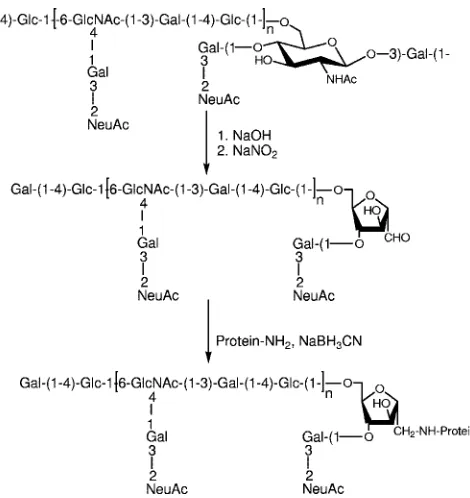
-gluco-pyranosyl residues in the type II and III GBS polysaccharides (Fig. 1 and 2, respectively) were partially N-deacetylated in 0.5 M NaOH. The resulting glucosamine residue was then suscep-tible to nitrosation with nitrous acid and acetic acid to form an unstableN-nitrosoamine. The subsequent deaminative cleav-age resulted in the production of fragments having terminal aldehyde groups.
Three type II fragments of 51,000, 33,000, and 15,000
aver-age molecular weights and five type III fragments of 41,000 to 11,000 average molecular weights were obtained (Table 1). Comparison of the 500 MHz1H NMR spectra of the type II
and III fragments with those of their respective native poly-saccharides indicated that no structural change had occurred during the chemical processes and, most importantly, that ter-minal sialic acid residues had been preserved during the nitro-sation treatment process.
Synthesis of single-ended GBS type II and III conjugates with variations in size of their oligosaccharide chains. The aldehyde group in the resulting 2,5-anhydro-D-mannose resi-due formed following deamination at the reducing end of the polysaccharide fragment was used directly, without further chemical manipulation for linking through reductive amination to the tetanus toxoid monomer. The resulting neoglycoconju-gates contain saccharide chains attached to the carrier protein by a single covalent bond. The biochemical characteristics of a series of such type II and III single-ended oligosaccharide
FIG. 1. Deaminative cleavage of GBS type II polysaccharide and conjugation to tetanus toxoid.
FIG. 2. Deaminative cleavage of GBS type III polysaccharide and conjugation to tetanus toxoid.
TABLE 1. Average molecular weights of GBS type II and III fragments
PS
fragment Kav
a(range) Avg mol wt Range
II-1 0.23 (0.13–0.34) 51,000 26,000–99,000 II-2 0.30 (0.19–0.40) 33,000 17,000–68,000 II-3 0.43 (0.30–0.50) 15,000 9,000–33,000 III-1 0.21 (0.11–0.27) 41,000 28,000–81,000 III-2 0.26 (0.17–0.38) 30,000 13,000–53,000 III-3 0.29 (0.18–0.40) 24,000 12,000–50,000 III-4 0.37 (0.23–0.44) 14,000 9,000–36,000 III-5 0.41 (0.31–0.47) 11,000 8,000–21,000
aKav⫽(v
e⫺vo/(vt⫺vo), wherevtis the total volume of gel in the column,
vois the void volume, andveis the volume at peak maximum.
on August 17, 2020 by guest
http://cvi.asm.org/
ride are listed in Table 2. Conjugates containing the larger fragments had approximately one oligosaccharide chain per molecule of TT, but conjugates prepared from smaller frag-ments contained larger numbers of chains per molecule of TT. As expected, in a competitive binding ELISA using antibodies induced by whole cells of type II and III GBS organisms, all of these conjugates, regardless of the size of their saccharide chains, had similar binding to their homologous antibodies.
Preparation of cross-linked type III oligosaccharide conju-gates. To test the effect of conjugate cross-linking (multisite coupling) on the immunogenicity of the above-described con-jugates, we prepared a type III fragment of ca. 9,000 Da (nine repeat units) by deamination of the native PS. The generated oligosaccharide was first treated with sodium borohydride to reduce the 2,5-anhydromannose terminal aldehyde. Aldehyde groups were then introduced to varying degrees into the ter-minal sialic acids of the oligosaccharide (30) to achieve theo-retical oxidation levels of 20, 40, and 60%. The resulting oxi-dized oligosaccharides were then conjugated to tetanus toxoid to produce a series of lattice conjugates with different degrees of carbohydrate-to-protein cross-linking. A conjugate with no oxidation in its sialic acid was also prepared as a control. The biochemical characterization of these conjugates is reported in Table 3. The relative compositions of carbohydrate and pro-tein were comparable among all conjugate preparations.
Preparation of single-ended conjugates containing varia-tions in the degree of modification of their sialic acid residues.
To test whether modification of the side chain between carbons 8 and 9 of the terminal sialic acids would have any influence on the immunogenicity of the resulting oligosaccharide conjugate, a series of type III fragments containing various degrees of oxidation, i.e., various amounts of 8-carbon sialic acid residues,
corresponding C-8 primary hydroxyl groups. The resulting modified polysaccharides were then deaminated to generate a PS fragment of ca. 10,000 average molecular weight. These fragments were then conjugated to tetanus toxoid. The bio-chemical characterization of the resulting single-ended neoglyco-conjugates is reported in Table 4. The carbohydrate content of these conjugates was 18% for the fragment preparation originating from native PS and 31 and 33%, respectively, for the corresponding modified 35 and 80% oxidized-reduced fragments.
Influence of the size of the oligosaccharide chains on the immunogenicity of single-ended and cross-linked conjugates.
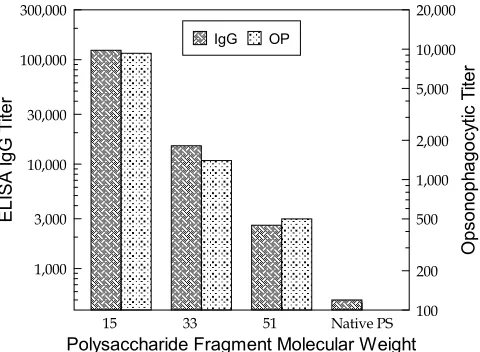
Type II PS-specific IgG titers of mice vaccinated with native type II PS or type II fragment PS-tetanus toxoid conjugates are shown in Fig. 3. There was a significant increase in PS-specific IgG levels as the size of the oligosaccharide chain of the con-jugates decreased from 51,000 average molecular weight (titer of 2,600), through 33,000 average molecular weight (titer of 15,000), and to 15,000 average molecular weight (titer of 123,000). Similarly, the opsonophagocytic (OP) titers of these antisera, as measured with an HL-60 human cell line as a source of polymorphonuclear leukocytes, followed the same trend, where the antisera raised against the conjugate with the smallest oligosaccharide gave the highest OP titer (9,300) and the sera raised against the largest oligosaccharide gave the
FIG. 3. Effect of oligosaccharide size on immunogenicity of GBS type IIOS-TT conjugates in mice. Molecular weight is shown in thousands. TABLE 3. Biochemical characteristics of GBS cross-linked tetanus
toxoid and rCconjugate vaccines
Conjugate Avg mol wt of
PS chains
Protein (g/ml)
CHO (g/ml)
% CHO in conjugatea
III0%-TT 9,000 78 35 31
III20%-TT 9,000 230 177 44
III40%-TT 9,000 297 218 42
III60%-TT 9,000 259 206 44
III-C 10,000 259 92 26
III-C 40,000 172 105 37
III-C Native 340 520 60
aFor Cconjugates, percentages of CHO in conjugate are wt/wt.
on August 17, 2020 by guest
smallest titer (⬍500) (Fig. 3). For these antisera, there was a good positive correlation between PS antibody levels and cor-responding OP activity. Thus, it is clear that the size of the oligosaccharide chains in those conjugates significantly influ-enced their immunogenicity. The native uncoupled type II PS was not immunogenic.
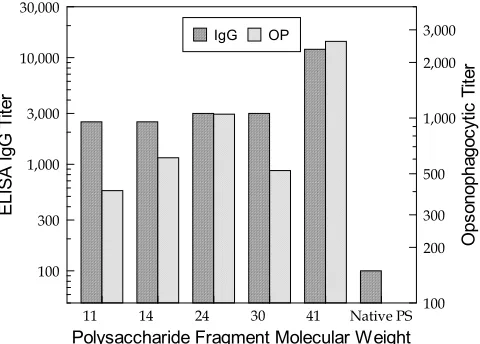
Type III PS-specific IgG titers of mice vaccinated with either native type III PS or type III fragment PS-tetanus toxoid con-jugates are shown in Fig. 4. Unlike for the type II fragment-TT conjugates, and perhaps lending more clarity to a previous report (20), the size of the oligosaccharide chains in the type III conjugates did not significantly influence the functional activity of the immune response. There was no real significant difference in type III PS-specific IgG titers between the sera raised against the smallest oligosaccharide (11,000 average mo-lecular weight) conjugate (titer of 2,800) and the sera raised against the 30,000-average-molecular-weight oligosaccharide conjugate (titer of 3,000), with perhaps a modest increase in type III PS-IgG toward the largest oligosaccharide (41,000 average molecular weight). Again, as for the type II, OP titers correlated well with antibody levels (Fig. 4) with no real sig-nificant difference in the antibody titers among the different groups (range, 400 to 2,600). The native type III PS was not immunogenic.
The efficacy in a neonatal mouse model of single-ended conjugate with a short type III oligosaccharide chain (11,000 average molecular weight) was compared with its homologous lattice (multisite coupling) form constructed with the native PS in which aldehyde groups were introduced into the terminal sialic acids (29). The native uncoupled type III PS was also used as a control. Both conjugates were highly potent in the model, and no significant difference in protection was observed between the two constructs (Fig. 5). The uncoupled PS was not protective.
Efficacy in the neonatal mouse model was also examined, with conjugates prepared using type III fragments that were produced by ozonolysis (17, 27) and in which aldehydes were introduced into the terminal sialic acid (Table 3). No signifi-cant differences in protection were observed between the dif-ferent constructs regardless of their size (Fig. 6).
Efficacy determinations for the type II single-ended neoglyco-conjugates with different saccharide sizes were also carried out in the mouse model. The conjugate with the small oligosac-charide size (15,000 average molecular weight) appeared to offer the best protection (Fig. 7); however, the difference in efficacy between this conjugate and the other two was not as dramatic as the difference observed in the antibody and OP titers in the immunogenicity study reported above. The GBS type II PS conjugate was comparable in its efficacy to the small oligosaccharide size conjugate. In this study, however, there was a clear indication that the type II PS-specific antibody, as measured by ELISA, had been transported across the placenta from the mothers to their offspring.
Effect of oligosaccharide-protein cross-linking on immuno-genicity. To test the effect of oligosaccharide-protein cross-linking on immunogenicity, a series of vaccines was con-structed by using a type III GBS oligosaccharide (ca. 9,000
FIG. 4. Effect of oligosaccharide size on immunogenicity of GBS type
IIIOS-TT conjugates in mice. Molecular weight is shown in thousands. FIG. 5. Efficacy of GBS type III conjugate vaccines in the neonatal
mouse model.
FIG. 6. Efficacy of GBS type III conjugate vaccines produced by ozonolysis in the neonatal mouse model. CB, rC; 10K, 10,000 molec-ular weight; 40K, 40,000 molecmolec-ular weight.
on August 17, 2020 by guest
http://cvi.asm.org/
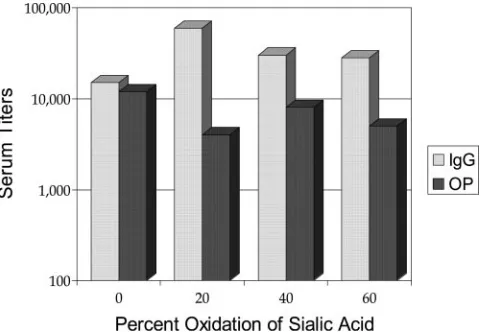
average molecular weight or nine repeat units) generated by deamination. The levels of oxidation in the sialic acids were 20, 40, and 60%; a control conjugate with no oxidation in its sialic acid was also prepared. All of these conjugates had similar oligosaccharide-to-protein ratios, indicating similar loading scenarios regardless of the degree of OS oxidation. Immuno-genicity testing of these conjugate vaccines was carried out in mice. As shown in Fig. 8, the cross-linked (or lattice-struc-tured) conjugates were more immunogenic, producing more type III PS-specific IgG. However, the opsonic activity pro-duced by the oxidized conjugates was not significantly different than or even slightly reduced compared to that produced by the non-cross-linked PS conjugate (Fig. 8).
Effect of sialic acid modification on immunogenicity. A study was designed to examine whether or not cleaving the bond from C-8 to C-9 in the exocyclic chain of the terminal sialic acids of a short GBS type III oligosaccharide (10,000 average molecular weight) would affect immunogenicity. We constructed two single-ended conjugates (i.e., linked through
their terminal reducing 2,5-anhydromannose) that had 35 and 80% of their sialic acid oxidized and reduced, thus leaving primary hydroxyl groups at C-8. The immunogenicity of these conjugates was compared to that of the control single-ended conjugate described above. As shown in Fig. 9, the three con-jugates had similar immunogenicities, indicating that shorten-ing the sialic acids from 9 to 8 carbons had no effect on the immunogenicity of the resulting vaccines.
DISCUSSION
Similar to what was reported for the production of pneumo-coccal type 14 conjugates (15), the deaminative cleavage of the native GBS type II and III polysaccharides allowed for the simple and well-characterized preparation of single-ended neoglycoconjugates, which gave sufficient uniformity to their structures to enable a legitimate comparison to be made. All of the GBS PS fragments were terminally linked exclusively at the reducing end. The methodology is a nice extension to what is already available to successfully depolymerize the GBS poly-saccharides (21, 27) with the absolute requirement of preserv-ing the important sialic acids that control the shape of the protective epitopes (9, 13, 14). In addition, the methodology offers the added advantage of arming the PS fragments with a reactive aldehyde group readily available for subsequent cou-pling to proteins by reductive amination. This methodology is of course applicable only to GBS II and III serotypes due to the presence ofN-acetyl-D-glucosamine residues in the side chains of the other GBS serotypes.
In this study, a comparison of the performance of various configurations of type II and III GBS tetanus toxoid conjugates as vaccine immunogens was undertaken. These conjugates var-ied in the size of their oligosaccharide chains or in the way they were linked, whether through a single site as neoglycoproteins or as cross-linked or lattice-structured through multiple-site attachment to the carrier protein. There was a clear indication, for the type II neoglycoconjugates, that decreasing the size of the PS fragment was accompanied by an increase in immuno-genicity that also correlated with OP activity. This could have
FIG. 7. Efficacy of GBS type II conjugate vaccines in the neonatal mouse model. 15K, 15,000 molecular weight; 33K, 33,000 molecular weight; 51K, 51,000 molecular weight.
FIG. 8. Effect of oligosaccharide-to-protein cross-linking on im-munogenicity.
FIG. 9. Effect of sialic acid modification (percentage of C-8 NeuAc) on immunogenicity.
on August 17, 2020 by guest
been suggestive of two things: either that, as the length of the oligosaccharide increased, the resulting conjugate had more T-cell-independent antigen properties (20) or that, unlike for the type III polysaccharide, there is less of a conformational protective epitope in the GBS type II polysaccharide, regard-less of the presence of sialic acid in its structure.
For the GBS type III neoglycoconjugates, however, the re-sults were markedly different, with no real impact on op-sonophagocytic activity observed with increased size of the PS fragment, and perhaps some indication for an increase in im-munogenicity and OP activity toward the higher size of the type III PS fragment (beyond 30 repeats). These data are in good agreement with immunogenicity data obtained with neo-glycoconjugates of the pneumococcal type 14 PS fragments (24); however, it contrasts with an earlier report that suggested an optimum immunogenicity for a size of 13 repeats in the case of the type III fragment (20), although the immunogenicity studies were conducted in rabbits and the conjugates were prepared by a slightly different chemistry (21). In the previous study (20), the type III oligosaccharide fragments were ob-tained by digestion of the native PS with an endo- -galactosi-dase, followed by the introduction of a galactosyl spacer arm into the terminal reducing end of the generated fragment. Single-ended neoglycoconjugates were then produced after treatment of the galactosylated fragment with galactose oxi-dase to generate aldehyde groups at C-6 of the spacer terminal galactose, followed by subsequent coupling to TT by reductive amination.
In this study, we also examined the effect of oligosaccharide to protein cross-linking on immunogenicity. In a previous study (30), the effect of polysaccharide to protein cross-linking was examined, and it was demonstrated that higher PS-specific antibody responses were obtained as the extent of cross-linking increased. OP activity, however, was greatest in mouse antisera raised to a moderately (under 66%) cross-linked conjugate, suggesting that some antibodies evoked by highly cross-linked conjugates were directed to a nonprotective epitope (30). In support of the previous study and further examining a range of moderate cross-linking of oligosaccharides, our data indicated that increasing the oligosaccharide to protein cross-linking through terminal sialic acids (from 20 to 60%) had no signif-icant effect on both the PS-specific antibody response or on the opsonic activity. It is also possible that perhaps because of the smaller size of the oligosaccharide chain (10,000 Da), no non-protective epitopes had been induced.
To verify whether or not cleaving the exocyclic chain of the sialic acid residues from 9 to 8 carbons would have any effect on immunogenicity, several neoglycoconjugate constructs of GBS type III oligosaccharide with various amounts of modified sialic acids were prepared. The results indicated that such modification of the sialic acids, in an oligosaccharide conjugate context (i.e., with short oligosaccharide chains), did not influ-ence immunogenicity. It is worth noting that such sialic acid modification in a polysaccharide protein conjugate context with a much larger saccharide might have been the reason for the induction of nonprotective epitopes.
All of these results could have important implications to improve the design of a multivalent GBS conjugate vaccine. A GBS oligosaccharide conjugate formulation would cer-tainly be advantageous from a manufacturing standpoint,
with a product easier to process and characterize, and thus better defined.
REFERENCES
1.Anderson, P.1983. Antibody responses toHaemophilus influenzaetype b and diphtheria toxin induced by conjugates of oligosaccharides of the type b capsule with the nontoxic protein CRM197. Infect. Immun.39:233–238. 2.Anderson, P., M. E. Pichichero, and R. A. Insel.1985. Immunogens
consist-ing of oligosaccharides from the capsule of Haemophilus influenzae type b coupled to diphtheria toxoid or CRM197. J. Clin. Investig.76:52–59. 3.Anderson, P. W., M. E. Pichichero, E. C. Stein, S. Porcelli, R. F. Betts, D. M.
Connuck, D. Korones, R. A. Insel, J. M. Zahradnik, and R. Eby.1989. Effect of oligosaccharide chain length, exposed terminal group, and hapten loading on the antibody response of human adults and infants to vaccines consisting ofHaemophilus influenzaetype b capsular antigen uniterminally coupled to the diphtheria protein CRM197. J. Immunol.142:2464–2468.
4.Anderson, P. W., M. E. Pichichero, R. A. Insel, R. Betts, R. Eby, and D. H. Smith.1986. Vaccines consisting of periodate-cleaved oligosaccharides from the capsule of Haemophilus influenza type b coupled to a protein carrier: structural and temporal requirements for priming in the human infant. J. Immunol.137:1181–1186.
5.Avery, O. T., and W. F. Goebel.1931. Chemo-immunological studies on conjugated carbohydrate-proteins. V. The immunological specificity of an antigen prepared by combining the capsular polysaccharide of type III pneu-mococcus with foreign protein. J. Exp. Med.54:437–447.
6.Baker, C. J., and D. L. Kasper.1985. Group B streptococcal vaccines. Rev. Infect. Dis.7:458–467.
7.Baker, C. J., and M. S. Edwards.1990. Group B streptococcal infections, p. 742–811.InJ. S. Remington and J. O. Klein (ed.), Infectious diseases of the fetus and the newborn, 3rd ed. The W. B. Saunders Co., Philadelphia, Pa. 8.Bradford, M. M.1976. A rapid and sensitive method for the quantitation of microgram amounts of protein utilizing the principle of protein-dye binding. Anal. Biochem.72:248–254.
9.Brisson, J.-R., S. Uhrinova, R. J. Woods, M. van der Zwan, H. C. Jarrell, L. C. Paoletti, D. L. Kasper, and H. J. Jennings.1997. NMR and molecular dynamics studies of the conformational epitope of the type III group B
Streptococcuscapsular polysaccharide and derivatives. Biochemistry36:3278– 3292.
10.Fusco, P. C., J. W. Perry, S.-M. Liang, M. S. Blake, F. Michon, and J. Y. Tai.
1997. Bactericidal activity elicited by the beta C protein of group B strepto-cocci contrasted with capsular polysaccharides. Adv. Exp. Med. Biol.418:
841–845.
11.Guttormsen, H.-K., C. J. Baker, M. S. Edwards, L. C. Paoletti, and D. L. Kasper.1996. Quantitative determination of antibodies to type III group B streptococcal polysaccharide. J. Infect. Dis.173:142–150.
12.IUPAC-IUB Joint Commission on Biochemical Nomenclature (JCBN).1982. Abbreviated terminology of oligosaccharide chains. Recommendations 1980. Eur. J. Biochem.126:433–437.
13.Jennings, H. J., C. Lugowski, and D. L. Kasper.1981. Conformational aspects critical to the immunospecificity of the type III group B streptococcal polysaccharide. Biochemistry20:4511–4518.
14.Jennings, H. J., E. Katzenellenbogen, C. Lugowski, F. Michon, R. Roy, and D. L. Kasper.1984. Structure, conformation and immunology of sialic acid. Pure Appl. Chem.56:893–905.
15.Laferriere, C. A., R. K. Sood, J. M. De Muys, F. Michon, and H. J. Jennings.
1998.Streptococcus pneumoniaetype 14 polysaccharide-conjugate vaccines: length stabilization of opsonophagocytic conformational polysaccharide epitopes. Infect. Immun.66:2441–2446.
16.Lindberg, B., J. Lonngren, and S. Svensson.1975. Specific degradation of polysaccharides. Adv. Carbohydr. Chem. Biochem.31:185–240.
17.Madoff, L. C., J. L. Michel, E. W. Gong, A. K. Rodewald, and D. L. Kasper.
1992. Protection of neonatal mice from group B streptococcal infection by maternal immunization with beta C protein. Infect. Immun.60:4989–4994. 18.Ma¨kela¨, O., F. Peterfy, I. G. Outschoorn, A. W. Richter, and I. Seppa¨la¨.1984.
Immunogenic properties of alpha(136) dextran, its protein conjugates, and conjugates of its breakdown products in mice. Scand. J. Immunol.19:541– 550.
19.Michon, F., P. C. Fusco, C. A. Minetti, M. Laude-Sharp, C. Uitz, C. H. Huang, A. J. D’Ambra, S. Moore, D. P. Remeta, I. Heron, and M. S. Blake.
1998. Multivalent pneumococcal capsular polysaccharide conjugate vaccines employing genetically detoxified pneumolysin as a carrier protein. Vaccine
16:1732–1741.
20.Paoletti, L. C., D. L. Kasper, F. Michon, J. DiFabio, H. J. Jennings, T. D. Tosteson, and M. R. Wessels.1992. Effects of chain length on the immuno-genicity in rabbits of group BStreptococcustype III oligosaccharide-tetanus toxoid conjugates. J. Clin. Investig.89:203–209.
21.Paoletti, L. C., D. L. Kasper, F. Michon, J. DiFabio, K. Holme, H. J. Jennings, and M. R. Wessels.1990. An oligosaccharide-tetanus toxoid con-jugate vaccine against type III group BStreptococcus. J. Biol. Chem.265:
18278–18283.
22.Perry, J. W., P. C. Fusco, F. Michon, and J. Y. Tai.1996. An