1556-6811/10/$12.00 doi:10.1128/CVI.00044-10
Copyright © 2010, American Society for Microbiology. All Rights Reserved.
Oral Vaccination with Attenuated
Salmonella enterica
Strains Encoding
T-Cell Epitopes from Tumor Antigen NY-ESO-1 Induces Specific
Cytotoxic T-Lymphocyte Responses
䌤
Jia-Zi Meng,
1,2Yu-Jun Dong,
3He Huang,
4Shuang Li,
1,2Yi Zhong,
3Shu-Lin Liu,
5,6and Yue-Dan Wang
1,2*
Department of Immunology,1Laboratory for Immunology and Microbiology, BioMedical Education Center,2and The First Hospital of
Peking University,3Peking University Health Science Center, Beijing, People’s Republic of China; Institute of Pathogen Biology,
Chinese Academy of Medical Science, Beijing, People’s Republic of China4; Genomics Research Center,
Harbin Medical University, Harbin, People’s Republic of China5; and Department of Microbiology and
Infectious Diseases, University of Calgary, Calgary, Alberta, Canada6
Received 31 January 2010/Returned for modification 9 March 2010/Accepted 28 March 2010
Bacterial fimbriae can accept foreign peptides and display them on the cell surface. A highly efficient gene
replacement method was used to generate peptide vaccines based onSalmonella entericaserovar Typhimurium
SL3261. The T-cell epitopes (NY-ESO-1 p157-165 and p157-167) from NY-ESO-1, which is a promising target antigen in patients for the specific immune recognition of cancer, were incorporated into the gene encoding
AgfA (the major subunit protein of thin aggregative fimbriae ofSalmonella) by replacing an equal length of the
DNA segment. To improve cytotoxic T-lymphocyte recognition, both termini of the peptide were flanked by double alanine (AA) residues. Immunofluorescence microscopy with AgfA-specific antiserum verified the expression of chimeric AgfA, which was also proved by a Congo red binding assay. Oral immunizations of HLA-A*0201 transgenic mice with recombinant SL3261 strains encoding NY-ESO-1 p157-165 or p157-167
induced NY-ESO-1 p157-165-specific CD8ⴙT cells, detected by an HLA-A*0201 pentamer, and induced a T-cell
response detected by an enzyme-linked immunospot assay. TheSalmonellafimbrial display system was efficient
at the induction of an antitumor cellular immune responsein vivo, providing a new strategy for the
develop-ment of efficient cancer vaccinations.
Modulating the immune system to control cancer has been a challenge for cancer immunotherapists for many years. A num-ber of clinical trials have indeed demonstrated that objective tumor regressions can occur in the setting of cancer vaccina-tions (1, 19, 31). One of the major problems, however, is that robust clinical responses or durable clinical benefits are not consistently seen, and concerted efforts are being made to optimize vaccination strategies (1, 31).
It has been clearly established that the use of attenuated
Salmonellastrains as live oral vaccines is a safe and effective means of inducing significant humoral and secretory antibody responses in animal species, including humans and mice (8, 16, 21, 32–34). The use of plasmid-based expression systems to elevate foreign antigen levels inSalmonellalive vaccine vectors is ideal, but these systems have the serious disadvantages of instability and selective requirementsin vivo (10, 14, 17, 38). The problem of plasmid instability can be overcome by inte-grating the genes for the foreign antigens into theSalmonella
chromosome, but the level of expression of the antigens from a single locus is usually below the desired levels (33). One solution is to express the foreign antigen from theSalmonella
chromosome as part of a preexisting, cellular protein carrier which is expressed at a high level. The cell surface organelles
called fimbriae (or pili) are excellent candidates for use for the presentation of heterologous antigens.
Fimbriae are composed of a large number of polymerized protein subunits called fimbrins and are found on the surfaces of a wide variety of pathogenic bacteria. In addition, many are known to be involved in the colonization of host cell surfaces. They are polymers composed of large numbers of identical protein subunits called fimbrins. Thin aggregative fimbriae (called Tafi or curli inEscherichia coli) and the major subunit AgfA (CsgA or curlin inE. coli) have been found in a wide range ofSalmonella entericasubsp.entericaserovars, such asS. enterica subsp. enterica serovars Typhimurium (S. Typhi-murium) and Enteritidis (S.Enteritidis) (6). Tafi fimbriae are highly flexible at displaying foreign antigens and could induce a viral epitope-specific immune response, but it is unknown whether this presentation system could act as a carrier of tumor antigens to induce specific immune responses against cancer antigens (36, 37).
In the study described here, we used the Tafi display system to present T-cell epitopes of the tumor antigen NY-ESO-1 and evaluated its immune effects. We engineered theagfAgene of attenuatedS. Typhimurium SL3261 (anS.TyphimuriumaroA -negative mutant) by replacing a 48-bp segment with a DNA segment encoding a T-cell epitope, i.e., NY-ESO-1 p157-165 and p157-167 (4, 7, 12, 20). Oral immunization of transgenic mice carrying a human class I major histocompatibility com-plex (MHC) antigen, HLA-A*0201, with the engineered bac-terial strains induced an epitope-specific cytotoxic T-lympho-cyte (CTL) response.
* Corresponding author. Mailing address: Department of Immunol-ogy, Peking University Health Science Center, 38th Xueyuan Rd. Haidian, Beijing 100191, People’s Republic of China. Phone and fax: 86 10 82801388. E-mail: [email protected].
䌤Published ahead of print on 7 April 2010.
889
on August 17, 2020 by guest
http://cvi.asm.org/
MATERIALS AND METHODS
Mice, bacterial strains, media, and growth condition.We maintained HLA-A*0201 transgenic mice in a pathogen-free facility. HLA-A2.1 cell surface ex-pression by transgenic mice was verified by flow cytometry with a fluorescein isothiocyanate (FITC)-conjugated mouse anti-human HLA-A*0201 antibody (Biolegend) on a FACSCanto II flow cytometer (Becton Dickinson).
S.Typhimurium SL3261 was grown in Luria-Bertani (LB) broth or on LB agar
for 14 to 18 h at 37°C. SL3261 orE. colicontaining a recombinant plasmid was
grown in LB broth or on LB agar supplied with kanamycin (50g/ml) for 20 to
24 h at 28°C, as described by White et al. (37). To express the AgfA fimbrin, strain SL3261 isolates were grown on T agar for 48 to 60 h at 28°C, as described by Romling et al. (32a). For Congo red (CR) binding experiments, the strains
were grown on T agar supplemented with 100g CR/ml (TCR).
Construction of SL3261 strains containingagfA::eso9oragfA::eso11in the chromosome.The chimericagfA::eso9genes were generated by two-step overlap extension PCR with primers A, B, C, and D (Fig. 1). The primers used are listed
in Table 1. The chimeric genes were recombined into the chromosome of SL3261 by the procedures outlined by White et al. (35, 37) and replaced the wild-type
agfAgene (Fig. 1). To facilitate the presentation of the ESO9 epitope, two
alanine residues flanked both sides of the epitope. Using the same procedure, we
replaced a DNA segment in theagfAgene with theeso11gene. The chimeric
agf::esogenes produced by PCR were then cloned into pHSG415.
The resultant recombinant plasmids, pHSG-ESO9 and pHSG-ESO11, were used to construct two bacterial strains. Using the same procedure, we replaced a
DNA segment in theagfAgene with several termination codons to construct an
AgfA-deficient (⌬agfA) strain. For the final confirmation of gene replacement,
fragments containingagfAand the surrounding DNA region were amplified with
primers agf1 and agf2 and sequenced by BGI LifeTech (Beijing, China).
High-fidelityTaqenzyme, restriction enzymes, and ligase were supplied by New
En-gland Biolabs.
CR binding assay.The CR binding assay was performed as described by White et al. (36). Strain SL3261 and the ESO9, ESO11, and
SL3261-⌬agfAmutant strains were grown on TCR plates; the cells were then scraped off
the plates and suspended in 10 mM Tris buffer (pH 7.0) at anA650value of 1.0.
The cell suspension was equilibrated at room temperature for 1 h, and 1-ml
aliquots were transferred into Eppendorf tubes containing 50l of 30%
poly-ethylene glycol 8000 in 100 mM Tris buffer (pH 7.0). The cells were removed
from the suspension by centrifugation (15,000⫻gfor 5 min), before
determi-nation of the amount of CR released into the supernatant by measuring the absorbance at 480 nm with a spectrophotometer.
Immunofluorescence.Bacterial cells were heat fixed on glass slides prior to incubation with AgfA-specific rabbit anti-AgfA antiserum (5). The secondary antibody, Alexa Fluor 488 goat anti-rabbit IgG (heavy and light chains), was purchased from Invitrogen. The cells were examined and photographed with a
fluorescence microscope (BX60-32FB3-E01; Olympus, Japan) with a⫻100
mag-nification oil immersion lens.
Animal immunization.Female HLA-A2*0201 transgenic mice (age, 6 to 8 weeks; six mice per group) were immunized with wild-type strain SL3261,
SL3261-ESO9, or SL3261-ESO11. Each mouse was administered a dose of 108
CFU bacteria orally in 100l saline (0.9% NaCl solution) by pipette. As a
negative control, a group of mice was immunized with saline only, without bacteria. The oral immunization was repeated twice, at intervals of 14 days, for a total of three immunizations.
HLA-A*0201 pentamer staining.One week after the last immunization, the spleens of all immunized mice were removed and monosplenocytes were pre-pared. Splenocytes were incubated for 15 min at room temperature with the allophycocyanin-labeled Pro5 HLA-A*0201/SLLMWITQC pentamer (Pro-Immune, United Kingdom) in staining buffer (phosphate-buffered saline, 0.5% bovine serum albumin, 0.05% sodium azide, pH 7.2 to 7.4), and then FITC-labeled anti-mouse CD8 antibody (ProImmune) was added for additional 20 min at 4°C. The cells were washed twice in staining buffer, fixed with fix buffer (staining buffer supplemented with 1% formaldehyde), and analyzed by flow cytometry on a FACSCanto II flow cytometer (Becton Dickinson).
Synthetic peptides and ELISPOT assay.The HLA-A*0201-restricted CTL epitope derived from the NY-ESO-1 protein, referred to as peptide p157-165
(NH2-SLLMWITQC-COOH), was used in this study and was synthesized by
BGI LifeTech. The peptides were dissolved in dimethyl sulfoxide at 1 mg/ml and
stored at⫺20°C. A mouse gamma interferon (IFN-␥) enzyme-linked
immuno-spot (ELISPOT) assay kit was purchased from U-CyTech Biosciences. The mice were euthanized 1 week after the last immunization, and their spleens were removed. Monosplenocytes were prepared and cultured for 7 days in RPMI 1640
(Gibco) supplemented with 10% calf serum (Gibco), 100g/ml streptomycin,
100 U/ml penicillin, and 10 U/ml murine interleukin (IL-2; PeproTech); the
FIG. 1. Schematic of generation ofSalmonella entericaserovar Ty-phimurium SL3261 strains carrying a foreign epitope in fimbrin. Sal-monella entericaserovar Typhimurium SL3261 genome DNA was used as the target for amplification of the chimericagfAgenes by two-step overlap PCR. The chimeric genes were constructed in pHSG415, which is an unstable and temperature-sensitive plasmid, to generate pHSG-ESO9 and pHSG-ESO11. The recombinant plasmids were then transferred into SL3261. Finally, we obtained mutant strains through gene replacement by the use of temperature control and biotic pres-sure, as described in the text.
TABLE 1. Primers used to generateagfA::eso9andagfA::eso11
Primera Sequenceb(5⬘–3⬘)
eso9-A...GACTGGATCCTGTCCGTTATTTCACAAG
eso9-B ...CTGAGTAATCCACATAAGAAGAGAAGCTGCTTTACGGGCATCGCTTTG eso9-C ...CTTCTTATGTGGATTACTCAGTGCGCTGCGGGCCAGGGTGCGGATAAC eso9-D...GACTCTGCAGAGGGTTCGTTTAATGTGA
eso11-A...GACTGGATCCTGTCCGTTATTTCACAAG
eso11-B ...GAAGCACTGAGTAATCCACATAAGAAGAGACGCTGCTTTACGGGCATCGCTTTG eso11-C ...CTTCTTATGTGGATTACTCAGTGCTTCCTTGCTGCGGGCCAGGGTGCGGATAAC eso11-D...GACTCTGCAGAGGGTTCGTTTAATGTGA
a
Primers used to generateagfA::eso, as noted in Fig. 1.
b
Boldface nucleotides encode the NY-ESO-1 epitopes.
on August 17, 2020 by guest
http://cvi.asm.org/
culture medium was refreshed every 48 h after the start of incubation. On the day
before testing by the ELISPOT assay, 10g/ml of peptide NY-ESO-1 p157-165
was added to the cell culture clusters. Cells were collected and counted before the ELISPOT assay was performed under the conditions specified by the
man-ufacturer. Four replicates of 5⫻105and 1⫻105cells per well were added to
96-well mixed polyvinylidene difluoride plates precoated with anti-mouse IFN-␥
antibody, and each well was supplemented with 10g/ml synthesized peptides
and 10 U/ml murine IL-2. No peptides were applied to the medium for the negative-control group. After incubation at 37°C for 24 h without agitation, the plates were washed and first incubated with a biotinylated secondary antibody and then with alkaline phosphatase-conjugated streptavidin, followed by addition of freshly prepared 3-amino-9-ethylcarbazole (AEC) substrate buffer. The plates were photographed and analyzed with an immunospot analyzer (Cellular Tech-nology Ltd.).
Statistical analyses.The experimental data were analyzed by one-way analysis of variance (ANOVA), followed by Tukey’s multiple range test for significant
differences. In all cases, the criterion for statistical significance was aPvalue of
⬍0.05.
RESULTS
Generation of mutants and expression of AgfA in SL3261
strains. Two individual strains of S. Typhimurium SL3261
were engineered to express chimeric AgfA proteins containing the NY-ESO-1 T-cell epitope. Strain SL3261-ESO9 contained ESO-1 p157-165 and strain SL3261-ESO11 contained NY-ESO-1 p157-167, and each NY-NY-ESO-1 T-cell epitope was flanked by two alanine residues at both ends. An AgfA-defi-cient (⌬AgfA) strain of SL3261 was also generated.
The two SL3261 mutant strains, along with the SL3261 par-ent strain, were analyzed for their ability to bind to the hydro-phobic dye Congo red. The level of binding of Congo red to
Salmonellastrains is proportional to the relative amounts of thin aggregative fimbriae (Tafi, curli) produced (36). The mu-tated strains had a morphology similar to that of the SL3261 parent strain on TCR plates, indicating that the AgfA::ESO9 proteins and the AgfA::ESO11 proteins were expressed and assembled into functional Tafi fimbriae. The level of binding of CR by the three mutated strains with chimeric AgfA was a little less than or equal to that by the parent strain but signif-icantly higher than that by the⌬agfAstrain (P⬍ 0.05) (Fig. 2A). This verified the expression of AgfA in the constructed strains and demonstrated that the insertion of ESO9 and ESO11 did not cause a significant reduction in the level of AgfA expression.
The expression of AgfA in the SL3261 strains grown on TCR plates was further examined by immunofluorescence, and the expression of thin aggregative fimbriae on the cell surface of the SL3261 parent strain (Fig. 2B, panel i) and the SL3261 mutant strains (Fig. 2B, panels iii and iv) but not the⌬agfA
strain (Fig. 2B, panel ii) was shown.
HLA-A*0201 pentamer staining in mice immunized with
SL3261 vaccine strains.The presence of NY-ESO-1-specific
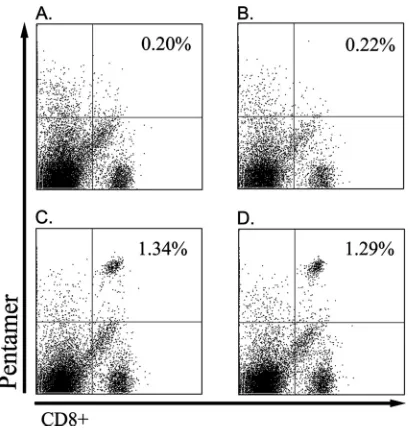
CD8⫹ T cells in the mice immunized with the transgenic SL3261 mutant strains was detected by NY-ESO-1 p165-157/ HLA-A*0201 pentamer staining. The positive cells occupied 1.34%⫾0.15% (SL3261-ESO9) and 1.29%⫾0.09% (SL3261-ESO11) of the whole splenocytes or 9.97%⫾1.54% (SL3261-ESO9) and 9.84%⫾1.43% (SL3261-ESO11) of the CD8⫹T cells, whereas CD8⫹T cells from the mice immunized with the SL3261 parent strain and the mice treated with saline showed negative staining (Fig. 3).
Epitope-specific T-cell immune response in mice immunized
with SL3261 vaccine strains.The epitope-specific T-cell
im-mune response in HLA-A*0201 transgenic mice immunized with the SL3261 vaccine strains with the parental strain and saline as the controls was analyzed by the ELISPOT assay. The two SL3261 mutant strains both induced p157-165 pep-tide-specific T-cell responses in the mice, and there was no significant difference between these two groups (Fig. 4). In mice immunized with parental SL3261 strain or saline, the ELISPOT assay showed no p157-165 peptide-specific spot-forming cells (SFCs).
DISCUSSION
This is the first report of an attenuated Salmonella thin aggregative fimbria-based tumor antigen peptide vaccine that
FIG. 2. Expression of chimeric fimbriae. (A) Congo red binding assay. The amount of Congo red bound by 1A650unit ofSalmonella
cells from TCR plates was measured. The SL3261 mutants can bind similar amounts of Congo red as parent strain SL3261, but the amount bound by the⌬AgfA strain was much less than that bound by the other strains (P⬍0.05). (B) Immunofluorescence of SL3261 strains by rabbit anti-AgfA serum. Cells were scraped from T medium and fixed on glass slides. AgfA-specific antiserum was applied. (i) strain SL3261; (ii) strain SL3261 ⌬AgfA; (iii) strain SL3261-ESO9, and (iv) strain SL3261-ESO11. Scale bars, 5m.
on August 17, 2020 by guest
http://cvi.asm.org/
induced epitope-specific T-cell responses in transgenic mice. In this study, we used a site-specific chromosomal gene replace-ment system (35, 37) to introduce foreign DNA encoding a heterologous peptide intoagfA, which encodes the major sub-unit of Salmonella thin aggregative fimbriae. The bacterial strain used in our study wasS.Typhimurium SL3261, which is
aroAdeficient and attenuated (2, 15, 24). We have also dem-onstrated that the inserted chimeric ESO9 gene and ESO11 gene, which were recombined into the chromosome ofS. Ty-phimurium SL3261, can be expressed and that an epitope-specific T-cell response was induced in transgenic mice by this recombinant organism.
Through growth on TCR plates, a Congo red binding assay, and AgfA immunofluorescence, we found that the two SL3261 mutant strains (strains SL3261-ESO9 and SL3261-ESO11) had functional and antigenic properties similar to those of the SL3261 parental strain, which indicated that the chimeric AgfA genes were expressed and assembled into functional Tafi with-out causing a significant reduction in AgfA expression. This means that the AgfA::ESO9 proteins and the AgfA::ESO11 proteins can be stably expressed on theSalmonellathin aggre-gative fimbriae.
However, the differences shown by immunofluorescence may be due to the change in the fimbrial structure caused by the insertion of foreign peptides; meanwhile, these data also confirm the expression of the various chimeric proteins in the mutated SL3261 strains. As NY-ESO-1 p157-165 and p157-167 are T-cell epitopes, we failed to detect the epitopes on the fimbriae by immunofluorescence with the NY-ESO-1 poly-clonal antibody (data not shown).
In our research, the target epitopes applied were T-cell epitopes NY-ESO-1 p157-165 and p157-167. NY-ESO-1 is a
promising target antigen for the specific immune recognition of cancer in patients because it has restricted expression in healthy tissue but frequently occurs on human tumors. The presence of NY-ESO-1 is seen in approximately one-third to one-fourth of all cases of melanoma and lung, ovarian, esoph-ageal, bladder, and prostate cancers; and expression is often associated with high-grade tumors (13). NY-ESO-1 is sponta-neously immunogenic in 50% of these patients, eliciting both CD8 and CD4 T-cell responses that correlate with the pres-ence of serum antibodies to NY-ESO-1 (11, 13, 19). However, the immune responses to the antigen are downregulated by regulatory T cells (Tregs) and are not protective. It has previ-ously been shown that stimulation of the innate immune sys-tem is essential to break immunological tolerance (18).S. Ty-phimurium is able to induce strong innate immune responses through Toll-like receptor signals, which not only can block the suppressive activity of CD4⫹CD25⫹Tregs but also can break the tolerance of CD8 cells, even in the presence of CD4⫹ CD25⫹Tregs (28–30, 39).
To be of value, we used transgenic mice carrying a human class I major histocompatibility complex antigen, HLA-A2, to assay the efficacies of the vaccines. Due to the central role of MHC in the generation of an immune response, transgenic mice carrying human MHC products (HLA-A*0201) could provide an important model system in which to assess the induction of an HLA-associated immune response (3, 22). An-tigen processing and presentation by murine cells can reveal the same set of HLA-restricted antigenic epitopes recognized by human T cells.
To determine the T-cell response in immunized mice, we conducted MHC class I pentamer staining and the ELISPOT assay. Compared to the CD8⫹T cells from the mice immu-nized with the SL3261 parental strain and the mice treated with saline, the CD8⫹T cells from the mice immunized with the SL3261 mutant strains expressing chimeric AgfA::ESO9 or AgfA::ESO11 showed positive staining with the NY-ESO-1 p157-165 peptide/HLA-A*0201 pentamer, but there were no
FIG. 4. ELISPOT assay of IFN-␥ of mouse spleen cells. HLA-A*0201 transgenic mice were euthanized 1 week after the last immu-nization, and their spleens were removed. Single-cell suspension of spleen cells were prepared and cultured in RPMI 1640 for 7 days with IL-2. The ELISPOT assay was performed by use of a mouse IFN-␥ ELISPOT assay kit. The values on thexaxis indicate the NY-ESO-1 p157-165-specific SFCs (106splenocytes)⫺1in each group. The error
bars indicate the significant differences for each group. Epitope-spe-cific SFCs were observed in the mutant strain groups but not in the parental SL3261 group or the saline group.
FIG. 3. HLA-A*0201/NY-ESO-1 p157-165 pentamer staining of mouse spleen cells. One week after the last immunization, spleen cells were stained with the HLA-A*0201/NY-ESO-1 p157-165 pentamer. The mean response for a typical mouse from a group of four mice is shown. The mean response for each group is provided. (A) SL3261 parental group; (B) saline group; (C) SL3261-ESO9 group; (D) SL3261-ESO11 group.
on August 17, 2020 by guest
http://cvi.asm.org/
significant differences between these two groups. Our result is similar to or better than the results of former studies with a naked DNA vaccine encoding polypeptide or a virus-based whole antigen vaccine or peptide vaccine (26, 27).
Consistent with the results of the pentamer staining assay, we found that in transgenic mice, the SL3261 mutant strains expressing chimeric AgfA::ESO9 or AgfA::ESO11 that we constructed induced epitope-specific T-cell immune responses, determined by ELISPOT assay with the NY-ESO-1 p157-165 peptide. However, there was no significant difference between the intensity of the immune responses of the two groups, which suggests that both the AgfA::ESO9 proteins and the AgfA::ESO11 proteins had the same antigen presentationin vivoand that both were efficient in supporting the recognition of epitopes by CTLs. The frequency of epitope-specific SFCs was 106 ⫾ 67/106 splenocytes for SL3261-ESO9 or 104 ⫾
59/106 splenocytes for SL3261-ESO11. In a former study, a
lentivirus-based NY-ESO-1 vaccine elicited a three times greater T-cell response, which may have been due to the high level of replication of lentivirus in the spleen, but this approach needed a subcutaneous injection and had a biosafety problem (9, 23). Another study employed aSalmonellaserovar Typhi-murium vaccine strain to deliver NY-ESO-1 through a type III protein secretion system and showed a rate of IFN-␥-secreting T cells and tumor regression in mice similar to that found in the present study (25). In this system, the recombinant salmo-nellae specifically secreted NY-ESO-1 into Salmonella -in-fected cells and the tumor antigen could be efficiently pre-sented to T cells, but the plasmid-based expression system was instable and needed selectionin vivo.
All together, from the results of the specific CD8⫹ T-cell responses of the mice immunized with the SL3261 mutant strains, we conclude that SL3261 mutants expressing the tumor antigen NY-ESO-1 p157-165 peptide can invite a specific T-cell immune responsein vivo, which also proves that the anti-gen display system that we constructed is effective at delivering a foreign antigen to the mouse immune system. In contrast to other vaccine strategies for the treatment of cancer, this vac-cine strategy has the following advantages. First,Salmonella
replicates directly in lymphoid organs, and antigens are pre-sented more efficiently; second, fimbriae are strong immuno-gens which can serve as an effective natural adjuvant; third, epitopes have stable and high levels of expression in this sys-tem, which is very advantageous, since by conventional meth-ods recombinant proteins are either unstable or poorly ex-pressed; and fourth, oral immunization is very convenient and economical. This study describes a good means of delivery of peptides that may be used to combat tumor diseases in the future.
ACKNOWLEDGMENTS
This work was supported by NSFC (no. 30771995 and no. 30671962) and NFFTBS (no. J0630853/J0108).
REFERENCES
1.Ayyoub, M., A. Zippelius, M. J. Pittet, D. Rimoldi, D. Valmori, J. C. Cerot-tini, P. Romero, F. Lejeune, D. Lienard, and D. E. Speiser.2003. Activation
of human melanoma reactive CD8⫹T cells by vaccination with an
immu-nogenic peptide analog derived from Melan-A/melanoma antigen
recog-nized by T cells-1. Clin. Cancer Res.9:669–677.
2.Benitez, A. J., N. McNair, and J. R. Mead.2009. Oral immunization with attenuated Salmonella enterica serovar Typhimurium encoding
Cryptospo-ridium parvum Cp23 and Cp40 antigens induces a specific immune response
in mice. Clin. Vaccine Immunol.16:1272–1278.
3.Bernhard, E. J., A. X. Le, J. A. Barbosa, E. Lacy, and V. H. Engelhard.1988. Cytotoxic T lymphocytes from HLA-A2 transgenic mice specific for HLA-A2
expressed on human cells. J. Exp. Med.168:1157–1162.
4.Choi, E. M., J. L. Chen, L. Wooldridge, M. Salio, A. Lissina, N. Lissin, I. F. Hermans, J. D. Silk, F. Mirza, M. J. Palmowski, P. R. Dunbar, B. K. Jakobsen, A. K. Sewell, and V. Cerundolo.2003. High avidity antigen-specific
CTL identified by CD8-independent tetramer staining. J. Immunol.171:
5116–5123.
5.Collinson, S. K., L. Emody, K. H. Muller, T. J. Trust, and W. W. Kay.1991. Purification and characterization of thin, aggregative fimbriae from
Salmo-nella enteritidis. J. Bacteriol.173:4773–4781.
6.Doran, J. L., S. K. Collinson, J. Burian, G. Sarlos, E. C. Todd, C. K. Munro, C. M. Kay, P. A. Banser, P. I. Peterkin, and W. W. Kay.1993. DNA-based diagnostic tests for Salmonella species targeting agfA, the structural gene for
thin, aggregative fimbriae. J. Clin. Microbiol.31:2263–2273.
7.Ebert, L. M., Y. C. Liu, C. S. Clements, N. C. Robson, H. M. Jackson, J. L. Markby, N. Dimopoulos, B. S. Tan, I. F. Luescher, I. D. Davis, J. Rossjohn, J. Cebon, A. W. Purcell, and W. Chen.2009. A long, naturally presented immunodominant epitope from NY-ESO-1 tumor antigen: implications for
cancer vaccine design. Cancer Res.69:1046–1054.
8.Echchannaoui, H., M. Bianchi, D. Baud, M. Bobst, J. C. Stehle, and D. Nardelli-Haefliger.2008. Intravaginal immunization of mice with recombi-nant Salmonella enterica serovar Typhimurium expressing human papillo-mavirus type 16 antigens as a potential route of vaccination against cervical
cancer. Infect. Immun.76:1940–1951.
9.Garcia Casado, J., J. Janda, J. Wei, L. Chapatte, S. Colombetti, P. Alves, G. Ritter, M. Ayyoub, D. Valmori, W. Chen, and F. Levy.2008. Lentivector immunization induces tumor antigen-specific B and T cell responses in vivo.
Eur. J. Immunol.38:1867–1876.
10.Garmory, H. S., R. W. Titball, K. A. Brown, and A. M. Bennett.2003. Construction and evaluation of a eukaryotic expression plasmid for stable
delivery using attenuated Salmonella. Microb. Pathog.34:115–119.
11.Gnjatic, S., D. Atanackovic, E. Jager, M. Matsuo, A. Selvakumar, N. K. Altorki, R. G. Maki, B. Dupont, G. Ritter, Y. T. Chen, A. Knuth, and L. J.
Old.2003. Survey of naturally occurring CD4⫹T cell responses against
NY-ESO-1 in cancer patients: correlation with antibody responses. Proc.
Natl. Acad. Sci. U. S. A.100:8862–8867.
12.Gnjatic, S., E. Jager, W. Chen, N. K. Altorki, M. Matsuo, S. Y. Lee, Q. Chen, Y. Nagata, D. Atanackovic, Y. T. Chen, G. Ritter, J. Cebon, A. Knuth, and L. J. Old. 2002. CD8(⫹) T cell responses against a dominant cryptic HLA-A2 epitope after NY-ESO-1 peptide immunization of cancer patients.
Proc. Natl. Acad. Sci. U. S. A.99:11813–11818.
13.Gnjatic, S., H. Nishikawa, A. A. Jungbluth, A. O. Gure, G. Ritter, E. Jager, A. Knuth, Y. T. Chen, and L. J. Old.2006. NY-ESO-1: review of an
immu-nogenic tumor antigen. Adv. Cancer Res.95:1–30.
14.Haga, T., S. Kumabe, A. Ikejiri, Y. Shimizu, H. Li, Y. Goto, H. Matsui, H. Miyata, and T. Miura.2006. In vitro and in vivo stability of plasmids in attenuated Salmonella enterica serovar Typhimurium used as a carrier of
DNA vaccine is associated with its replication origin. Exp. Anim.55:405–409.
15.Hoiseth, S. K., and B. A. Stocker.1981. Aromatic-dependent Salmonella
typhimurium are non-virulent and effective as live vaccines. Nature291:238–
239.
16.Huang, H., Y. J. Wang, A. P. White, J. Z. Meng, G. R. Liu, S. L. Liu, and Y. D. Wang.2009. Salmonella expressing a T-cell epitope from Sendai virus are
able to induce anti-infection immunity. J. Med. Microbiol.58:1236–1242.
17.Isoda, R., S. P. Simanski, L. Pathangey, A. E. Stone, and T. A. Brown.2007. Expression of a Porphyromonas gingivalis hemagglutinin on the surface of a
Salmonella vaccine vector. Vaccine25:117–126.
18.Iwasaki, A., and R. Medzhitov.2004. Toll-like receptor control of the
adap-tive immune responses. Nat. Immunol.5:987–995.
19.Jager, E., Y. Nagata, S. Gnjatic, H. Wada, E. Stockert, J. Karbach, P. R. Dunbar, S. Y. Lee, A. Jungbluth, D. Jager, M. Arand, G. Ritter, V. Cerun-dolo, B. Dupont, Y. T. Chen, L. J. Old, and A. Knuth.2000. Monitoring CD8 T cell responses to NY-ESO-1: correlation of humoral and cellular immune
responses. Proc. Natl. Acad. Sci. U. S. A.97:4760–4765.
20.Karbach, J., S. Gnjatic, C. Pauligk, A. Bender, M. Maeurer, J. L. Schultze, K. Nadler, C. Wahle, A. Knuth, L. J. Old, and E. Jager.2007. Tumor-reactive
CD8⫹T-cell clones in patients after NY-ESO-1 peptide vaccination. Int. J.
Cancer121:2042–2048.
21.Kulkarni, R. R., V. R. Parreira, S. Sharif, and J. F. Prescott.2008. Oral immunization of broiler chickens against necrotic enteritis with an attenu-ated Salmonella vaccine vector expressing Clostridium perfringens antigens.
Vaccine26:4194–4203.
22.Le, A. X., E. J. Bernhard, M. J. Holterman, S. Strub, P. Parham, E. Lacy, and V. H. Engelhard.1989. Cytotoxic T cell responses in HLA-A2.1 trans-genic mice. Recognition of HLA alloantigens and utilization of HLA-A2.1 as
a restriction element. J. Immunol.142:1366–1371.
23.Lopes, L., M. Dewannieux, U. Gileadi, R. Bailey, Y. Ikeda, C. Whittaker, M. P. Collin, V. Cerundolo, M. Tomihari, K. Ariizumi, and M. K. Collins.
2008. Immunization with a lentivector that targets tumor antigen expression
on August 17, 2020 by guest
http://cvi.asm.org/
to dendritic cells induces potent CD8⫹and CD4⫹T-cell responses. J. Virol.
82:86–95.
24.Massis, L. M., C. J. Braga, M. E. Sbrogio-Almeida, C. Lauand, S. M. Newton, P. E. Klebba, and L. C. Ferreira.2008. Anti-flagellin antibody responses elicited in mice orally immunized with attenuated Salmonella enterica serovar Typhimurium vaccine strains. Mem. Inst. Oswaldo Cruz
103:606–610.
25.Nishikawa, H., E. Sato, G. Briones, L. M. Chen, M. Matsuo, Y. Nagata, G. Ritter, E. Jager, H. Nomura, S. Kondo, I. Tawara, T. Kato, H. Shiku, L. J. Old, J. E. Galan, and S. Gnjatic.2006. In vivo antigen delivery by a Salmo-nella typhimurium type III secretion system for therapeutic cancer vaccines.
J. Clin. Invest.116:1946–1954.
26.Palmowski, M. J., E. M. Choi, I. F. Hermans, S. C. Gilbert, J. L. Chen, U. Gileadi, M. Salio, A. Van Pel, S. Man, E. Bonin, P. Liljestrom, P. R. Dunbar, and V. Cerundolo.2002. Competition between CTL narrows the immune
response induced by prime-boost vaccination protocols. J. Immunol.168:
4391–4398.
27.Palmowski, M. J., L. Lopes, Y. Ikeda, M. Salio, V. Cerundolo, and M. K. Collins.2004. Intravenous injection of a lentiviral vector encoding
NY-ESO-1 induces an effective CTL response. J. Immunol.172:1582–1587.
28.Pasare, C., and R. Medzhitov.2004. Toll-dependent control mechanisms of
CD4 T cell activation. Immunity21:733–741.
29.Pasare, C., and R. Medzhitov.2003. Toll pathway-dependent blockade of
CD4⫹CD25⫹T cell-mediated suppression by dendritic cells. Science299:
1033–1036.
30.Peng, G., Z. Guo, Y. Kiniwa, K. S. Voo, W. Peng, T. Fu, D. Y. Wang, Y. Li, H. Y. Wang, and R. F. Wang.2005. Toll-like receptor 8-mediated reversal of
CD4⫹regulatory T cell function. Science309:1380–1384.
31.Peterson, A. C., H. Harlin, and T. F. Gajewski.2003. Immunization with Melan-A peptide-pulsed peripheral blood mononuclear cells plus recombi-nant human interleukin-12 induces clinical activity and T-cell responses in
advanced melanoma. J. Clin. Oncol.21:2342–2348.
32.Qu, D., S. Wang, W. Cai, and A. Du.2008. Protective effect of a DNA vaccine delivered in attenuated Salmonella typhimurium against Toxoplasma gondii
infection in mice. Vaccine26:4541–4548.
32a.Ro¨mling, U., Z. Bian, M. Hammar, W. D. Sierralta, and S. Normark.1998.
Curli fibers are highly conserved betweenSalmonella typhimuriumand
Esch-erichia coliwith respect to operon structure and regulation. J. Bacteriol.
180:722–731.
33.Spreng, S., G. Dietrich, and G. Weidinger.2006. Rational design of
Salmo-nella-based vaccination strategies. Methods38:133–143.
34.Wang, Y. J., Y. Hou, H. Huang, G. R. Liu, A. P. White, and S. L. Liu.2008. Two oral HBx vaccines delivered by live attenuated Salmonella: both
elicit-ing effective anti-tumor immunity. Cancer Lett.263:67–76.
35.White, A. P., E. Allen-Vercoe, B. W. Jones, R. DeVinney, W. W. Kay, and M. G. Surette.2007. An efficient system for markerless gene replacement applicable in a wide variety of enterobacterial species. Can. J. Microbiol.
53:56–62.
36.White, A. P., S. K. Collinson, P. A. Banser, D. J. Dolhaine, and W. W. Kay.
2000. Salmonella enteritidis fimbriae displaying a heterologous epitope re-veal a uniquely flexible structure and assembly mechanism. J. Mol. Biol.
296:361–372.
37.White, A. P., S. K. Collinson, J. Burian, S. C. Clouthier, P. A. Banser, and W. W. Kay.1999. High efficiency gene replacement in Salmonella enteritidis: chimeric fimbrins containing a T-cell epitope from Leishmania major.
Vac-cine17:2150–2161.
38.Xu, C., Z. S. Li, Y. Q. Du, Y. F. Gong, H. Yang, B. Sun, and J. Jin.2007. Construction of recombinant attenuated Salmonella typhimurium DNA
vac-cine expressing H. pylori ureB and IL-2. World J. Gastroenterol.13:939–944.
39.Yang, Y., C. T. Huang, X. Huang, and D. M. Pardoll. 2004. Persistent Toll-like receptor signals are required for reversal of regulatory T
cell-mediated CD8 tolerance. Nat. Immunol.5:508–515.