Available Online atwww.ijcsmc.com
International Journal of Computer Science and Mobile Computing
A Monthly Journal of Computer Science and Information Technology
ISSN 2320–088X
IJCSMC, Vol. 3, Issue. 10, October 2014, pg.732 – 740
RESEARCH ARTICLE
Coal Mining Data for Data Mining Techniques
V.Renugadevi,
M.Phil. (Computer Science)K.Rajeswari,
M.Sc., M.Phil.Research Scholar, Assistant Professor in Computer Science
Vivekanandha College for Women, Unjanai, Tiruchengode, India
Abstract: Classification is an important problem in data mining. Given a database of records,
each with a class label, a classifier generates a concise and meaningful description for each
class that can be used to classify future records whose classes are unknown. A number of
popular classifier exists like naïve bays classifier, Neural Network, SVM classifier, CARD etc.
In this paper we applied classification algorithm for coal mines dataset. We also discussed
decision tree, nearest neighbor classifier, NN classifier for prediction of class label.
Keywords: Data Mining algorithm, C4.5 algorithm, Naïve Bayes Algorithm, Intelligent Data
mining for coal data
1. Introduction
Classification is an important problem in data mining. Under the guise of supervised
learning, classification has been studied extensively by the machine learning community as a
possible solution to the “knowledge acquisition” or “knowledge extraction” problem. The input to
set of attribute values defines each record. Attributes with discrete domains are referred to as
categorical, while those with ordered domains are referred to as numeric. The goal is to induce a
concise model or description for each class in terms of the attributes. The model is then used by
the classifier to classify (i.e., assign class labels to) future records whose classes are unknown. It
thus, reduces outlier problem. The classification model of dataset
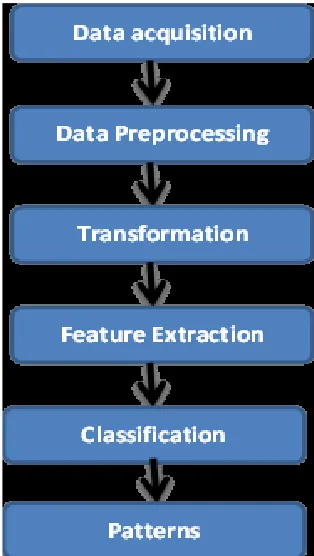
Fig. Data mining process
1.1. Data Acquisition process
The data is acquired from coal mines where the blasting processes for mines are
performed. The spacing (M) denotes the space between holes. The class label Boulder denotes
after the blasting the size of boulder produced in blasting.
1.2.Data Pre-processing
Data pre-processing is an often neglected but important step in the data mining process.
The phrase “Garbage in, Garbage Out” is applicable in data mining and machine learning. Data
combination, missing values. Analyzing data that has not been carefully screen for such problems
can produce misleading results. The representation and quality of data is first and foremost before
running an analysis. In our dataset we filled the missing value by mean of whole data set of
specified attributes. Some data values the range is given, we computed the mean value and it is
replaced by mean of the data e.g. for stemming (M) the range is given 3.5 to3.75 that data is
replace by 3.625.
1.3. Data Transformation
In data transformation, the data are transformed or consolidated into forms appropriate for
mining. Data transformation processes are follows.
Normalization- where the attribute data are scaled in the range such as -1.0 to +1.0.
1.4. Feature Selection
The main idea of feature selection is to choose a subset of input variables by eliminating
features with little or no predictive information. Feature selection can significantly improve the
comprehensibility of the resulting classifier models and often build a model that generalizes better
to unseen points. In machine learning and statistics, feature selection also known as variable
selection, attribute selection or variable subset selection, is the process of selecting a subset of
relevant features for use in model construction. The central assumption when using a feature
selection technique is that the data contains many redundant or irrelevant features. Redundant
features are those which provide no more information than the currently selected features, and
irrelevant features provide no useful information in any context. Feature selection techniques are a
subset of the more general field of feature extraction. Feature extraction creates new features from
functions of the original features, whereas feature selection returns a subset of the features.
Feature selection techniques are often used in domains where there are many features and
2. Classification
There are various classifiers to classify the data like NN, SVM, Decision tree and others.
2.1. Nearest Neighbour
Nearest neighbour (NN) also known as Closest Point Search is a mechanism that is used to
identify the unknown data point based on the nearest neighbor whose value is already known. It
has got a wide variety of applications in various fields such as Pattern recognition, mage
databases, Internet marketing, Cluster analysis etc. A fast algorithm that finds the nearest
neighbor (NN) of an unknown sample from a design set of labeled samples is proposed. This
algorithm requires a quite moderate preprocessing effort and a rather excessive storage, but it
accomplishes substantial computational savings during classification. The performance of the
algorithm is described and compared to the performance of the conventional one.
The NN algorithm can also be adapted for use in estimating continuous variables. One
such implementation uses an inverse distance weighted average of the k-nearest multivariate
neighbors. This algorithm functions as follows:
1. Compute Euclidean or Mahalanobis distance from target plot to those that were sampled.
2. Order samples taking for account calculated distances.
3. Choose heuristically optimal k nearest neighbor based on RMSE done by cross validation
technique.
2.2. Decision Tree
Decision Tree Classifier a decision tree is a class discriminator that recursively partitions
the training set until each partition consist entirely or dominantly of examples from one class.
Each leaf node of the tree contains one or more attributes and determines how the data is
partitioned.
A decision tree classifier is built in two phases growing phase followed by pruning phase.
“pure” or sufficiently small. To prevent over fitting: The MDL principle is applied to prune the
tree build in the growing phase and make it more general.
Using the fewest number of bits. To find the sub tree of the tree that can be encoded with the least
number of bits.
The algorithm for building tree.
Procedure buildTree (S)
1) Initialize root node using dataset S
2) Initialize queue Q to contain root node
3) While Q is not empty do {
4) dequeue the first node N in Q
5) if N is not pure {
6) for each attribute A
7) Evaluate splits on attributes A
8) Use best split to split node N into N1 and N2
9) Append N1 and N2 to Q
10)}
11) }
2.3. Bayesian Network
Bayesian network (BN) is also called belief networks. A BN is a graphical representation
of probability distribution. It belongs to the family of probabilistic graphical models .This BN
consist of two components. First component is mainly a directed acyclic graph (DAG) in which
the nodes in the graph are called the random variables and the edges between the nodes or random
Second component is a set of parameters that describe the conditional probability of each variable
given its parents. The conditional dependencies in the graph are estimated by statistical and
computational methods. This prior expertise about the structure of Bayesian network algorithm
work as follows.
1. Declare that a node is root node.
2. Declare that a node is leaf node.
3. Declaring that a node has direct effect of another node.
4. Declaring that a node is not directly connected to another node.
5. Declaring that two nodes are independent, giving a condition set.
6. Providing partial ordering among the nodes.
2.4. Artificial Neural Network
Artificial Neural Network (ANN) is a computational model based on biological neural network.
ANN also called Neural Network [ANN]. It contains interconnected group of artificial neurons
and processes the information by a connectionist approach. ANN is an adaptive system because it
changes its structure based on information flow during the learning phase.
Output
Input
Hidden
Actual algorithm for a 3-layer network (only one hidden layer):
Initialize the weights in the network (often randomly)
Do
For each example e in the training set
O = neural-net-output(network, e) ; forward pass
t = teacher output for e
1) Calculate output , y=x1w1+x2w2,
2) Calculate error (T - O) at the output units E= (t-y)2
3) Compute delta_wh for all weights from hidden layer to output layer ; backward pass
4) Compute delta_wi for all weights from input layer to hidden layer; backward pass continued.
5) Update the weights in the network
The different classification techniques and their comparative charts.
DIFFERENT CLASSIFICATION TECHNIQUES
Method Generative
/Discriminative
Loss Functions
K-Nearest Neighbour Discriminative -log P(X,Y) or Zero one
Decision tree Discriminative Zero –One loss
Bayesian Network Generative -log O(X,Y)
3. Proposed Work
3.1. Support Vector Machine Classifiers:
SVMs, also support vector networks are supervised learning models with associated
learning algorithms that analyze data and recognize patterns, used
for classification and regression analysis. Given a set of training examples, each marked as
belonging to one of two categories, an SVM training algorithm builds a model that assigns new
examples into one category or the other, making it a non-probabilistic binary linear classifier. An
SVM model is a representation of the examples as points in space, mapped so that the examples
of the separate categories are divided by a clear gap that is as wide as possible. New examples are
then mapped into that same space and predicted to belong to a category based on which side of
the gap they fall on.
A good classification method:
Avoid underfitting: small training error
Avoid overfitting: small testing error
1. Conduct simple scaling on the data
2. Consider RBF kernel K(x, y) = e
−γkx−yk
3. Use cross-validation to find the best parameter C and γ
4. Use the best C and γ to train the whole training set
5. Test
4. Experimental Result
The experiments were perform in weka machine learning software in pentium IV machine with 1
47 instances, 6 attributes i.e. Number_of_holes, Burden, Depth, Primer, SME and Class. In test
mode:10-fold cross-validation are perform. All the numeric data is converted to categorical data
all <50 values denotes „Effective‟ Boulders and remaining are converted as „Not-Effective‟
Boulders.
5. Conclusion
In this paper we applied data mining process in coal mining data. The mining process start with
data preparation is an important issue for data mining, as real world data tends to be incomplete,
noisy and inconsistent. Data preparation includes data cleaning, data integration, data
transformation and data reduction. In order to mine the effective size of Boulders (Nos.) the
attribute effective are analysed. Decision tree model gives 87% of accuracy to correctly predict
the class label where as Neural Network model predict 84% correct class label. we try to
implement support vector machine classifier in order to improve the accuracy of classifier.
References
[1] YongSeog Kim, W. Nick Street, and Filippo Menczer. Feature Selection in Data Mining.
[2] http://en.wikipedia.org/wiki/Feature_selection
[3]. Ms. Aparna Raj, Mrs. Bincy G,, Mrs. T.Mathu. Surveyon Common Data Mining
Classification Techniques. International Journal of Wisdom Based Computing, Vol. 2(1), April
2012