© 2014, IJCSMC All Rights Reserved
476
Available Online atwww.ijcsmc.com
International Journal of Computer Science and Mobile Computing
A Monthly Journal of Computer Science and Information Technology
ISSN 2320–088X
IJCSMC, Vol. 3, Issue. 8, August 2014, pg.476 – 481
RESEARCH ARTICLE
Finger Print Enhancement Using
Minutiae Based Algorithm
Mallipamula Megha Sai Sree
1, S. Shravani
2¹M.Tech 2
ndYear, Dept. of CSE, TITS, JNTU, HYDERABAD, INDIA
²Assistant Professor, Dept. of CSE, TITS, JNTU, HYDERABAD, INDIA
1
[email protected];
2[email protected]
Abstract— The popular Biometric used to authenticate a person is Fingerprint which is unique and permanent throughout a person’s life. A minutia matching is widely used for fingerprint recognition and can be classified as ridge ending and ridge bifurcation. In this paper we projected Fingerprint Recognition using Minutia Score Matching method (FRMSM). For Fingerprint thinning, the Block Filter is used, which scans the image at the boundary to preserves the quality of the image and extract the minutiae from the thinned image. The false matching ratio is better compared to the existing algorithm.
This paper describes Minutiae based Fingerprint Verification and Recognition Algorithm for Offline Systems. Reprocessing stage includes Image Enhancement, Binarization, Segmentation, ROI extraction and Thinning. Quality of poor and distorted images is improved by Image Enhancement. Improved images are binarized and segmented to extract Region of Interest (ROI). This image is thinned to extract Minutiae. Feature extraction stage includes the extraction of Minutiae i.e. Ridge Terminations and Ridge Bifurcations. Post processing stage includes removal of False Minutiae and then saving of templates. In matching stage, template generated by test image was matched with the saved one. This algorithm has been tested with FVC-2004 database and resulted 90 % accuracy with 5% FAR (False Acceptance Ratio) & 2% FRR (False Rejection Ratio).
Keywords: Fingerprint, Gradient, Coherence, Dominant local orientation angle, Centre Area Features, Canny Edge Parameters
I. INTRODUCTION
© 2014, IJCSMC All Rights Reserved
477
The fingerprint system has two types, identification and verification. Identification is one to many comparison of test fingerprint with database to identify the unknown person whereas verification is one to one comparison of a test fingerprint with stored template to verify the claimed person. Usually Identification take more processing time as the test fingerprint is to be compared with all the fingerprint templates of the data base. Minutiae matching essentially consist of finding the best alignment between the template (set of minutiae in the database) and a subset of minutiae in the input fingerprint, through a geometric transformation.
a)
b)
Fig. 1. Example of a) ridge ending and b) bifurcation
II. EXISTING SYSTEM
Fingerprint recognition is one of the oldest methods. Fingerprints have been studied for many years ago. The study about the properties of fingerprints started at 16th century and in 20th century, fingerprint recognition was formally accepted as valid personal identification [12]. There are a number of different strategies and published approaches through which fingerprint identification can be done, among which verification through minutiae points is the most simple and easy[11]. Many researchers develop new fingerprint matching algorithms that have high performance than the previous ones or they create a new way to match. Other researchers try and search to hybrid the existing matching algorithms to minimize the errors. And other uses the existing algorithm and matching methods for improving the accuracy of fingerprint. Due to the high complexity, many techniques are not usable to match and verify the fingerprint because, i) Extracting minutiae from poor‐quality image is difficult. ii) Size and orientation of fingerprint are changed, and then accuracy is low.
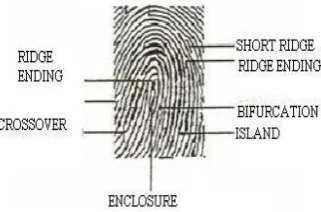
1. Fingerprint Representation: - A representation offingerprint is classified into three parts.
1) Global Level Representation: - This type ofrepresentation is known as pattern, which is an aggregate characteristic of ridges, and minutiae points.
Figure 1 Finger Print
2) Local Level Representation: - Local representation consists of several components within a restricted region in the fingerprint. Which are unique features found within the pattern that are used to unique identification. In this some small points are represented.
© 2014, IJCSMC All Rights Reserved
478
2. Very Fine Level Representation: - A small point which iscalled a minutiae point is sometimes
opening in the skin or other surface.
Figure 3 Very Fine Level Representations
III.PROPOSEDSYSTEM
Figure 4 gives the block diagram of FRMSM which is used to match the test fingerprint with the template database using Minutia Matching Score.
Fingerprint Image: The input fingerprint image is the gray scale image of a person, which has intensity values ranging from 0 to 255. In a fingerprint image, the ridges appear as dark lines while the valleys are the light areas between the ridges. Minutiae points are the locations where a ridge becomes discontinuous. A ridge can either come to an end, which is called as termination or it can split into two ridges, which is called as bifurcation. The two minutiae types of terminations and bifurcations are of more interest for further processes compared to other features of a fingerprint image.
Figure 4 Block Diagram of FRMSM
© 2014, IJCSMC All Rights Reserved
479
Figure 5 : (a) Original Fingerprint (b) Binarized image.
Block Filter: The binarized image is thinned using Block Filter to reduce the thickness of all ridge lines to a
single pixel width to extract minutiae points effectively. Thinning does not change the location and orientation of minutiae points compared to original fingerprint which ensures accurate estimation of minutiae points. Thinning preserves outermost pixels by placing white pixels at the boundary of the image, as a result first five and last five rows, first five and last five columns are assigned value of one. Dilation and erosion are used to thin the ridges. A binarized Fingerprint and the image after thinning are shown in Figure 6
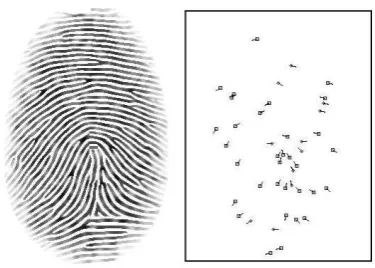
Minutiae Extraction: The minutiae location and the minutiae angles are derived after minutiae extraction. The
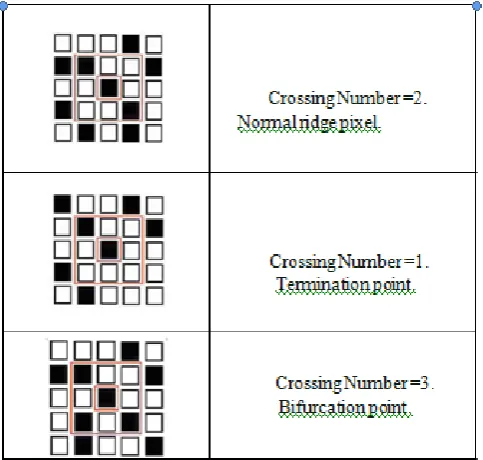
terminations which lie at the outer boundaries are not considered as minutiae points, and Crossing Number is used to locate the minutiae points in fingerprint image. Crossing Number is defined as half of the sum of differences between intensity values of two adjacent pixels.
If crossing Number is 1, 2 and 3 or greater than 3 then minutiae points are classified as Termination, Normal ridge and Bifurcation respectively, is shown in figure 7.
Figure 7: Crossing number and Type of Minutiae
To calculate the bifurcation angle, we use the advantage of the fact that termination and bifurcation are dual in nature. The termination in an image corresponds to the bifurcation in its negative image hence by applying the same set of rules to the negative image, we get the bifurcation angles.
© 2014, IJCSMC All Rights Reserved
480
Fig 8: (a) Gray-scale Fingerprint (b) Minutiae points.IV.ALGORITHM
Problem definition: Given the test Fingerprint Image the objectives are, 1. Pre-processing the test Fingerprint.
2. Extract the minutiae points.
3. Matching test Fingerprint with the database.
Table 1 gives the algorithm for fingerprint verification, in which input test fingerprint image is compared with template fingerprint image, for recognition.
Table 1: Algorithm of FRMSM
V. PERFORMANCEANALYSISANDRESULTS
For evaluation of fingerprint accuracy we have used three types of dataset. Each data set consists of 8
fingerprint images. These datasets are experimented and result is evaluated.
© 2014, IJCSMC All Rights Reserved
481
VI.CONCLUSION&FUTUREWORKIn this paper, a minutia matching systems has been described. A minutiae-based fingerprint verification system is divided in two main blocks: the feature extraction block and the matching block. Main problem in feature extraction section is quality of fingerprint image. Low quality areas of fingerprint occurs large number of false minutiae point. Most important in matching stage, is selection of tolerance distances and transformation method. When tolerance values are increasing, then false accept rate is also rising. When transformation of input minutiae set is not precise, then false reject rate value is high.
REFERENCES
[1] BEBIS G., DEACONU T., GEORGIOPOULOS M., Fingerprint Identification Using Delaunay Triangulation, Proc. of Int. Conf. on Information Intelligence and Systems, pp. 452-459, Washington, DC, USA, 1999.
[2] AMENGUAL J., JUAN A., PREZ J., PRAT F., SEZ S., VILAR J., Real-time minutiae extraction in fingerprint images, Proc. of the 6th Int. Conf. on Image Processing and its Applications, pp. 871–875, Ireland, 1997.
[3] MEHTRE B. M., Fingerprint image analysis for automatic identification, Machine Vision and Applications 6, 2, pp. 124–139, India, 1993.
[4] BOASHASH B., DERICHE M., KASAEI S., Fingerprint feature extraction using block-direction on reconstructed images, IEEE region TEN Conf., digital signal Processing applications, TENCON pp. 303–306, Australia, 1997.
[5] GOVINDARAJU V., JEA T., Minutiae-based partial fingerprint recognition, Pattern Recognition, Vol. 38, pp. 1672-1684, USA, 2005.
[6] CHEN S., JAIN A., RATHA K., Adaptive Flow Orientation-Based Feature Extraction in. Fingerprint Images, Pattern Recognition, Vol. 28, No. 11, pp. 1657-1672, USA, 1995.
[7] PAVLIDIS T., A thinning algorithm for discrete binary images. Computer Graphics and Image Processing, Vol. 13, pp.142–157, 1980.
[8] TAMURA H., A comparison of line thinning algorithms from digital geometry viewpoint. Proc. of the 4th Int. Conf. on Pattern Recognition, pp. 715–719, 1978.
[9] MALTONI D., MAIO D., JAIN A.K., PRABHAKAR S., Handbook of Fingerprint Recognition. Springer, New York, 2003.