Article
What smart campuses can teach us about smart cities:
a case study on open data
Roza Vasileva1, *, Lucelia Rodrigues2, Nancy Hughes3, Chris Greenhalgh4, Murray Goulden5 and Jeni Tennison6
1 The University of Nottingham, the U.K.; [email protected] 2 The University of Nottingham, the U.K.; [email protected] 3 The University of Nottingham, the U.K.; [email protected] 4 The University of Nottingham, the U.K.; [email protected] 5 The University of Nottingham, the U.K.; [email protected] 6 The Open Data Institute, the U.K.; [email protected]
* Correspondence: [email protected]; Tel.: +44-7491-872276
Abstract: Universities, like cities, have embraced novel technologies and data-based solutions to improve their campuses with ‘smart’ becoming a welcomed concept. Campuses in many ways are small-scale cities. They increasingly seek to address similar challenges and to deliver improved experiences to their users. How can data be used in making this vision a reality? What can we learn from smart campuses that can be scale up to smart cities? A short research study was conducted over a three-month period at a public university in the United Kingdom employing stakeholder interviews and user surveys, aiming at gaining insight into these questions. Based on the study, the authors suggest that making data publicly available could bring many benefits to different groups of stakeholders and campus users. These benefits come with risks and challenges such as data privacy and protection and infrastructure hurdles. However, if these challenges can be overcome, open data could contribute significantly to improving campuses and user experiences, and potentially set an example for smart cities.
Keywords: Smart city; smart campus; open data.
1. Introduction
Many cities around the world have announced and started implementing a smart city vision in the last few years, and the United Kingdom has seen the same trend [1,2]. Open data is data that “anyone can access, use or share” as defined by the Open Data Institute [3] (p. 5) and is often considered one of the key components of ‘smart city’ projects [4].
University campuses have similar facilities to small cities (multi-use buildings, retail outlets, sports and medical centers, transport networks, security systems, waste and energy generation/distribution systems) and consequently similar challenges [5]. Recently, universities have also started putting forward ‘smart campus’ projects [6] and whenever possible publicly releasing data on campuses and university operations. Southampton University (http://data.southampton.ac.uk/building/11.html?energy) and the University of Cambridge (http://www.environment.admin.cam.ac.uk/energy-dashboards) provide full access to energy data for all facilities throughout the campus to the public. Glasgow University plans to deliver a smart campus platform, which among other things will be “a place to gather and display open data about the Campus.” [7] (p. 36). This poses the question, could these projects set an example for smart cities initiatives? What can be learnt and scale up to city level?
The study presented in this paper aimed to develop an understanding of the possible role of data in making campuses ‘smarter’. The project explored the extent to which campus users are willing
to share data and the implications of using such data, particularly regarding issues around privacy and security.
The rest of the paper was structured as follows. The next section discusses relevant academic works, expanding on how the current literature covers the concept of a ‘smart campus’ and relates it to a ‘smart city.’ In section 3, the methods of the study are presented. In section 4, the results of the study were summarized. Section 4 presents a discussion on using and releasing campuses data in an open format, and the benefits, risks and challenges of this approach as perceived by the study participants. At the end, the conclusion outlines the need for further research on implementing open data for smart campuses and using these to support smart cities.
2. Smart cities and campuses
In recent years, our daily life has become extensively penetrated by a wide range of ‘smart’ things: smart meters for electricity, smart homes equipped with sensors for heating and light controls, smart phones to bring these applications together coupled with smart watches for everything else. Now we increasingly live in smart cities, which have been rising in all parts of the world in response to two modern phenomena: dramatic growth of the world’s urban population and the digital revolution [8].
Although the term ‘smart city’ has been in use for over 20 years [9], it has only recently become a buzzword [1]. Many authors have attempted to define a smart city; however, the area is complex and influenced by many disciplines [10,11]. Gil-Garcia, Pardo, and Nam [12] conducted an extensive review of available definitions of a smart city and identified the following common features between many of them: (1) technology; (2) critical infrastructures; (3) better services for population; (4) integration of systems and infrastructures; and (5) vision for a better future. The notion of ‘forward-looking’ underpins many of the definitions, and sustainability and livability are identified as the main outcomes of being ‘smart’. More recent interpretations of a ‘smart city’ also highly emphasize people’s and the community’s needs as well as sustainable development [1,13,14]. “Citizens can, and should, play a leading role in conceiving, designing, building, maintaining our cities of the future” [15] (p. 2). Having ‘engaged citizens’ has become an important condition for a smart city. Abuelyaman [16] defines a ‘smart campus’ as one that “deploys smart teachers and gives them smart tools and ongoing support to do their jobs while assessing their pedagogical effectiveness using smart evaluation forms” and at the same time “provides its students with reliable services anytime and anywhere access to the Internet is available. The smart use of instructional and supporting technology strengthens the options a smart campus can offer students and faculty” [16] (p. 12). This definition does not bring more clarity.
the definitions of a smart city, ‘engagement’ here does not assume a role of the users in the creation of a smart campus but rather it is a function enabled by ‘smart’ technologies.
Xiong (2017) offers a more comprehensive understanding of a smart campus that supports wider school development with a focus on the IoT and integration of systems: “Smart Campus is to use the Internet of Things, data fusion, cloud computing, data mining and other information technologies, to integrate the independent business systems and resources of schools into an organic whole with highly collaborated capability, perception as well as service ability to support school development” [24] (p. 919). This understanding of a smart campus emphasizes the integration of systems and various applications of data as the main components.
Overall, the scan of the literature suggests that in describing a ‘smart campus’ the emphasis remains on digital technology as a key element of the term without attempting to provide a definition or connecting it to the wider objectives of an academic institution. Discussion on the role of opening campus data to the public for a ‘smart campus’ or how smart campuses can provide testing grounds for smart cities seem to be absent from the literature.
3. Methods
To achieve the objectives of the study, we carried out 23 interviews with key stakeholders, who represented included faculty staff and researchers (10), management and services staff (4), the Estates Office (3), the Student Union (3), management staff of a neighboring university (2) and the City Council (1), including several that are currently involved in shaping a smart campus vision at this University. This had the objective of eliciting their insights, particularly regarding what kind of data is already being collected and shared. In line with the goals of the interviews, the questions related to three categories shown in Figure 1.
Figure 1. Questions of a semi-structured interview
asked to rate how each of the areas impacted upon their experience on a scale: ‘very positive’, ‘positive’, ‘no impact’, ‘negative’, ‘very negative’, or ‘not applicable’ if this area does not apply to them. The responses from these multiple-choice questions were analyzed quantitatively. The respondents were also asked to provide written comments for the areas to which they responded ‘negative’ or ‘very negative’. Using a thematic analysis technique, responses from this section were reviewed to identify common trends and new areas (‘other’), which people felt were challenging and why.
The second category of questions was related to people’s willingness to share data collected on campus with a third party to improve services on campus and their interest to use the data themselves. The list of datasets from 18 different sources was offered (these included card access to buildings, class attendance, access to Wi-Fi, etc.) with the options ‘other’ and ‘none of the above’. Questions in this category were analyzed quantitatively to discover for each data source how people felt about sharing their data and having access to them for their own benefit.
The final category was related to smart campus concept and initiatives. People were asked to provide written responses to the following questions on what ‘smart’ initiatives they were aware of, what could make campuses ‘smarter’, what are key benefits and disadvantages of using technologies to make campus ‘smarter’. The responses from this section were analyzed both quantitatively (count of words and ‘none’-responses) and qualitatively to identify common themes. Questions in this section were purposefully open-ended to allow the respondents to “think outside the box” and provide their own ideas and perceptions without any more specific directions.
Data collected through interviews and open-ended survey questions were analyzed qualitatively using thematic analysis, the most common qualitative approach used for interview data analysis [25]. Themes were developed using open coding and following inductive process as data were being collected and analyzed. Structured survey data were analyzed quantitively, which are presented in Figures 2 and 3.
4. Results
A short research study was conducted over a three-month period (January to April 2017) at a public university in the United Kingdom, with over 32,000 students combined in the U.K. and overseas campuses. The University has been actively developing a ‘smart’ vision for its campuses in the last two years. A key part of this vision is the development of a data platform to make data open, i.e. publicly available and accessible.
4.1. Improving user experience through smart campus
Figure 2. Rating by survey participants how much each of the listed aspects impacts positively or negatively their daily experience of the campus (sorted on ‘very negative’ and ‘negative’ impacts combined)
126 people provided written comments to elaborate the issues they were facing as campus users, which is over 60% of the respondents. Much of the feedback included constructive suggestions on how things could be improved and provided alternative scenarios, for example: “Green space is underused – perhaps have football nets/cricket wicket there would be good,” or “needs to be a landlord 'approved-list' and a 'black-list' written by the uni and 2/3rd year students so future students don't end up with horrible houses/horrible landlords when living outside of uni.”
The area that received the majority of negative ranking was ‘Vehicle parking,’ primarily cost and availability of parking spaces, and the size of parking slots: the response ‘parking spaces are too tight’ was among the most frequent in this category. Some people felt very strongly about parking issues: “This is enough to make me reconsider whether I really want to work here - the campus is beautiful and I love working at/for the University but travel - and indeed parking after 8am - are really off-putting.” or “…student parking rules meant going to the library at 5pm.”
Three travel related areas combined made 30% of people who indicated that they negatively impact their experiences of the campuses are all related to mobility: travel to/from campus, travel between campuses and distance between classes. There was a wide range of comments in these areas: inconvenient locations of bus stops or route of public transportation, “single-decker buses at peak times do not meet demand of number of travelers,” travel not available between campuses at certain times on certain days of the week, not being able to access campus from the direction of the home (e.g. if coming from Beeston), unclear bike loan scheme, long distances between buildings/long walks. One person put that they felt like the University is “always putting some form of barrier between me and where I want to be.”
Comments regarding food services were mostly related to lack of healthy foods and high prices. There were no comments about religious or dietary restrictions but rather poor variety and quality of healthy foods or lack of incentive to buy healthier food options because they were more expensive. In general, variety of food especially on smaller campuses was one of the major concerns. “The food on campus is very expensive ... and varies a lot across campus – negative if you're only at one location on campus.”
A striking number of the issues reported by the survey respondents could be improved by providing timely access to information about campus services. Consequently, the majority of ‘Smart’ solutions proposed by the users largely included ways to share and display of real-time information (e.g. occupation of study areas, temperature feedback in the rooms, parking availability, class location and time changes, knowing the peak times at each food outlet, campus news app, etc.), improvement of connectivity (more reliable and consistent eduroam, Wi-Fi outside buildings, better mobile phone access, etc.), better communication (asking what people want/need, more information on smart uses of the campus, better information about services, etc.), simplifying information technologies (IT) services (interactive IT/conferencing solutions, touch screen information points, more services on phone or tablet, single sign-on for all software, etc.).
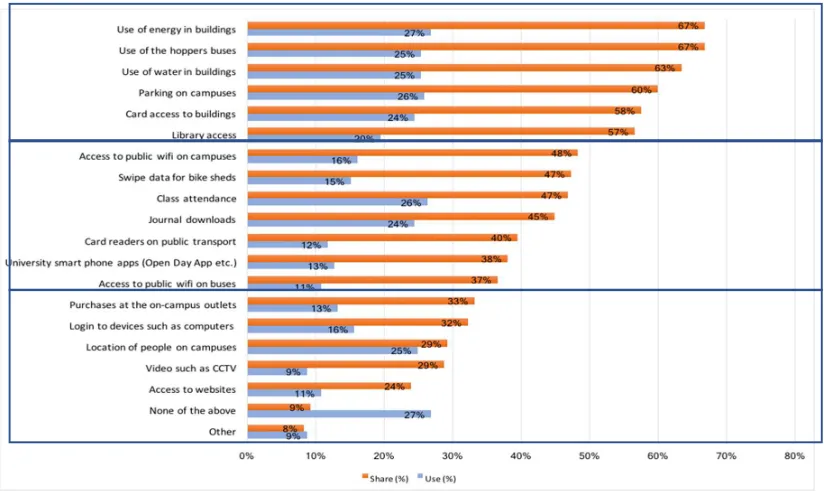
We also asked which kinds of personal data should be shared to help improve the university campuses and services, and which kinds of data participants would be interested in using if they could gain access. Percentages of positive responses distributed as shown in Figure 3.
Figure 3. Perceptions of sharing data with third parties to improve services on campus (Share) in comparison to the interest in gaining access to the data (Use)
would be handled and used (e.g. anonymized) to gain user consent to using and making these data publicly available.
5. Discussion
Universities generally collect massive amounts of data, but as one of study interviewees observed: “smart campus is not about data collection but about improving environment and creating healthier spaces”. Interviewees who represented the university management team felt that using data analysis to understand the user needs and in particular movement data is important in pursuing a ‘smarter’ campus. It is important for an institution to understand what the data can be used for, but also to unlock the data for others to use to address these issues [26]. Interviewees who represented faculty staff, researchers and the Student Union stressed the need for data to be open and accessible to everyone at the university and to the public. In general, the interviewees had a very positive outlook on making data on university and campuses available. This includes data on building management and operations, safety, academic performance, transport schedules, facilities availability and other data routinely collected by the University including real-time data on services on its campuses. Although it does not have to be on the same portal, it must be easily accessible as suggested by faculty staff and researchers in the interviews.
5.1. Benefits of open campus data
Interviewees from different stakeholder groups discussed benefits appropriate for their needs and roles at the university. A summary table organized by types of benefits and stakeholder groups discussed in the interviews is presented in Table 1.
Groups of benefits
Stakeholder groups Administrative and
management staff
Academic staff and students
Public visitors and city
Reputation and trust
Credible rankings and performance
achievements
Open to public
Trust in university achievements
Perception of campuses as open to public
Data analysis
Free data analysis
New insights for improved decision making and planning
Using campus data as learning material
Practicing data analysis skills applicable in many disciplines
Community members can analyze data
Integration with the city open government data portal Services and resource utilization
Higher uptake of campus services
Better utilization of resources
Timely information about services on campuses
Better participation in campus events and activities
User engagement
More engaged students and public
Higher engagement with campuses
Higher engagement with campuses
Table 1. Benefits of open data on campus for different stakeholder groups
such, despite holding regular public events and encouraging use of the campus amenities and services. Sharing data could contribute to creating an environment of openness and fostering trust [27]. For example, some participants felt the University’s open data should evidence its achievements as a high-ranking institution in the global UI GreenMetric. One interviewee noted: “Not all will care but those who do care are the most vocal. The university needs to be proactive in providing information.” “Another interviewee echoed this statement by saying: There is a big push from public to be green but how can we trust the rankings if we cannot find information supporting it?”
“It gives a good reputation of being open if you have a good pool of data and can get analysis for free.” This quote by one of the faculty staff links to another important benefit of open data, i.e. encouraging data users to analyze the data. At the same time, faculty staff and researchers found it was somewhat hard to get a hold of the data to perform analysis of different functions of the university. Faculty members expressed strong interest, especially in the School of Computer Science, to engage students with the smart campus initiative and to use data on the university campuses. Student projects are actively seeking ‘smart campus’ ideas and collect campus data, which is felt to be difficult to acquire through the university for their studies. The student potential appears largely underutilized. Our study revealed a number of student projects, which could use campus data and provide practical smart campus solutions and provide invaluable learning material for students from different disciplines.
Many interviewees who represented university management and the Estates Office spoke of a ‘smart campus’ in terms of resource availability and accessibility noting that the main benefit of a smart campus is efficient utilization of resources combined with improving student experiences: “improving the actual day-to-day experience of the campus for students and reducing the costs for students as well because the university is running more efficiently.” Providing timely information to students and other campus users on availability of different services and hence improving utilization of resources was described by interviewees who represented the University management as one of the key benefits of a smart campus.
Student engagement was reported as a challenge in the interviews, and at the same time could a critical element of any smart campus. Undergraduate students are the largest user group (over 71%) of the U.K. campuses of the University which was studied. A low response rate of responses from the undergraduate students (8%) to the survey of our study presents a limitation to understanding of this campus user group’s perspective. This also indicated a strong need to find ways to engage with the students. From the Student Union representatives, we also learned that there has been minimal communication and collaboration on the concept of a ‘smart campus’ and open data. Despite an absence of significant empirical evidence, in the expert community open data is believed to enhance citizen engagement [28], and this could apply to open data on campuses. By making campus data open and available to students and members of surrounding communities, the University could increase the engagement and public participation in campus activities.
5.2. Risks and challenges to releasing open data on campuses
While the interviewees mentioned a host of benefits that could come with open data. One of the primary challenges mentioned was privacy and security of the data, including how data is being released and used. This was echoed in survey responses. Among key disadvantages of a smart campus respondents acknowledged Big Brother issues, privacy issues, data security and misuse, cyber security, poor and inconsistent delivery, costs, failure of technology, less human/student interaction.
what data is being used and how. Based on these perceptions, the first step would be to implement the process of consent to collect the data and provide full information on how data is being used and an option to opt out.
Disconnected and outdated information systems and infrastructure for data collection and management can impose another barrier to creating a connected smart system. Technical experts reported that the information systems at most universities and the building management data collection systems need to be updated and linked. Most of the current systems are typically disjointed [29] although some universities have prioritized the upgrade of data systems, which are all linked and interconnected. For example, a neighboring university has implemented a data-based student engagement platform and provides opportunities to supply and use linked data. There seems to be a real opportunity for universities to invest in improving its wireless networks and data collection and management systems. Any new infrastructure investment should consider how data is being collected and shared and enable better integration of data systems.
6. Conclusions
The empirical work related to conceptualizing a ‘smart campus’ is fragmented, and only touches upon some technology solutions for a campus that are referred to as ‘smart’ solutions. More work needs to be done to understand what a ‘smart campus’ is and how it can provide valuable lessons for smart cities and integrate with them.
Our research suggests that handling and releasing data on campus openly and easily accessible could be central to a ‘smart campus’ concept. Through interviews with key stakeholders of a ‘smart campus’ initiative and campus user surveys we were able to identify attitudes towards having an open data initiative on campus including key benefits, challenges and risks. However, the kinds of data that people are willing to share to improve the campus vary – the more private the data is to the users the less they are willing to share. There is an opportunity for the University to open data on building management and transportation quickly to enable potential benefits of data re-use discussed in this paper. Using and releasing open data that potentially is more personal will require additional work, perhaps including explaining to the users the benefits of using the data and how the procedures of keeping it private and secure are followed. These more sensitive includes individual movement data, which many interviewees felt was important to analyze in achieving a ‘smart campus’.
Based on our study, we suggest that a smart campus should be underpinned by open data accessible to anyone. This brings a number of benefits for various stakeholders, which based on respondents’ comments we allocated into four groups:
Reputation and trust;
Data analysis;
Services and resource utilization; and,
User engagement.
While opening data may seem risky from the data privacy and security perspectives, our study participants mostly agreed that these risks could be mitigated by following appropriate data protection and anonymization mechanisms. An interconnected and updated data management system and information technology (IT) infrastructure typically also needs to be in place to support a smart campus.
is significant potential to use smart campuses to come up with more ideas and test out the possibilities, which could be scaled up later to the smart city.
Usage of data and making data on campus available freely has several potential benefits. Our study shows that although people associate ‘smart’ initiatives with data privacy issues, when presented with the benefits many users suggested that they would share their data. However, the benefits of using the data need to be explained and adequate data privacy and protection measures put in place.
Open data for smart campus needs to be further investigated to create the right framework for data release and use, as well as to understand in greater depth how it could provide valuable lessons for open data initiatives in smart cities.
Author Contributions: Conceptualization, Roza Vasileva, Lucelia Rodrigues and Nancy Hughes; Methodology, Roza Vasileva, Lucelia Rodrigues and Nancy Hughes; Formal Analysis, Roza Vasileva; Resources, Roza Vasileva, Lucelia Rodrigues and Nancy Hughes; Original Draft Preparation, Roza Vasileva; Writing-Review & Editing, Roza Vasileva, Lucelia Rodrigues, Chris Greenhalgh, Murray Goulden and Jeni Tennison; Supervision, Lucelia Rodrigues and Nancy Hughes; Project Administration, Roza Vasileva.
Funding: This research received no external funding.
Acknowledgments: This article was produced as part of the PhD research funded by Horizon Centre for Doctoral Training in My Life in Data. The Horizon Centre for Doctoral Training (CDT) is based at The University of Nottingham and is supported by a £9.3 million investment from Research Councils UK, The University of Nottingham and over 30 industry partners.
Conflicts of Interest: The authors declare no conflict of interest.
References
1 Albino, V.; Berardi, U.; Dangelico, R. M. Smart Cities: Definitions, Dimensions, Performance, and Initiatives. J. Urban Technol.2015, 22 (1), 3–21.
2 Chourabi, H.; Nam, T.; Walker, S.; Gil-Garcia, J. R.; Mellouli, S.; Nahon, K.; Pardo, T. A.; Scholl, H. J. Understanding Smart Cities: An Integrative Framework. Proc. Annu. Hawaii Int. Conf. Syst. Sci.2012, 2289–2297.
3 Landry, J.-N.; Webster, K.; Wylie, B.; Robinson, P. How Can We Improve Urban Resilience with Open Data?; 2016.
4 Näslund, E. Open Data within a Smart City Initiative. 2017.
5 Shoup, D. Parking On A Smart Campus. Calif. Policy Options 20052006, 117–149.
6 Sari, M. W.; Ciptadi, P. W.; Hardyanto, R. H. Study of Smart Campus Development Using Internet of Things Technology. IOP Conf. Ser. Mater. Sci. Eng.2017, 190 (1).
7 Hill, D.; Ginty, G.; Gibb, E.; Vikornova, A.; Schmeer, C.; Mookerjee, C. A Smart Campus for University of Glasgow; 2015.
8 Bouskela, M.; Casseb, M.; Bassi, S.; De Luca, C.; Facchina, M. The Road toward Smart Cities Migrating from Traditional City Management to the Smart City; 2016.
9 Dameri, R. P.; Cocchia, A. Smart City and Digital City : Twenty Years of Terminology
10 Kondepudi, S. N.; Ramanarayanan, V.; Jain, A.; Singh, G. N.; Nitin Agarwal, N.; Kumar, R.; Singh, R.; Bergmark, P.; Hashitani, T.; Gemma, P. Smart Sustainable Cities: An Analysis of Definitions; The ITU-T Focus Group for Smart Sustainable Cities, 2014.
11 Lee, J. H.; Hancock, M. G.; Hu, M.-C. Towards an Effective Framework for Building Smart Cities: Lessons from Seoul and San Francisco. Technol. Forecast. Soc. Chang.2014, 89, 80–99.
12 Gil-Garcia, J. R.; Pardo, T. A.; Nam, T. What Makes a City Smart? Identifying Core Components and Proposing an Integrative and Comprehensive Conceptualization. Inf. Polity 2015, 20, 61–87.
13 Nam, T.; Pardo, T. A. Conceptualizing Smart City with Dimensions of Technology, People, and Institutions. Proc. 12th Annu. Int. Digit. Gov. Res. Conf. Digit. Gov. Innov. Challenging Times - dg.o ’112011, 282.
14 Neirotti, P.; De Marco, A.; Cagliano, A. C.; Mangano, G.; Scorrano, F. Current Trends in Smart City Initiatives: Some Stylised Facts. Cities2014.
15 Hemment, D.; Townsend, A. Smart Citizens. Futur. Everything Publ.2013, 4.
16 Abuelyaman, E. S. Making a Smart Campus in Saudi Arabia. Educ. Q.2008, 31 (2), 10.
17 Kaneko, A.; Sugino, N.; Suzuki, T.; Ishjjima, S. A Step Towards the Smart Campus : By a Hybrid Video Conferencing System. 2000.
18 Halawani, T.; Mohandes, M. Smart Card for Smart Campus: KFUPM Case Study. In
Proceedings of the IEEE International Conference on Electronics, Circuits, and Systems; IEEE, 2003; Vol. 3, pp 1252–1255.
19 Qian, L. Constructing Smart Campus Based on the Cloud Computing and the Internet of Things. Comput. Sci.2011, 38 (10A), 5.
20 Nie, X. Constructing Smart Campus Based on the Cloud Computing Platform and the Internet of Things. Proc. 2nd Int. Conf. Comput. Sci. Electron. Eng. (ICCSEE 2013)2013, No. Iccsee, 1576– 1578.
21 Cui-ping, J. The Construction of the Smart Campus Information Platform. Mod. Educ. Technol. 2012, 1, 11.
22 Guo, M.; Guo, J. Constructing Smart Campus Network Based on Ubiquitous Sensor Technology. 2015 5th Int. Conf. Inf. Sci. Technol. ICIST 20152015, 265–268.
23 Huang, R.; Zhang, J.; Hu, Y.; Yang, J. Smart Campus: The Developing Trends of Digital Campus. Open Educ. Res.2012, 4 (004).
25 Jugder, N. The Thematic Analysis of Interview Data : An Approach Used to Examine the Influence of the Market on Curricular Provision in Mongolian Higher Education Institutions; 2016.
26 ODI (Open Data Institute). How to Support the Capacity of Open Data Initiatives with Assessment Tools. 2016, 1–30.
27 Janssen, M.; Charalabidis, Y.; Zuiderwijk, A. Benefits, Adoption Barriers and Myths of Open Data and Open Government. Inf. Syst. Manag.2012, 29 (4), 258–268.
28 Gurin, J. Open Governments, Open Data: A New Lever for Transparency, Citizen Engagement, and Economic Growth. SAIS Rev. Int. Aff.2014, 34 (1), 71–82.