Available Online at www.ijcsmc.com
International Journal of Computer Science and Mobile Computing
A Monthly Journal of Computer Science and Information Technology
ISSN 2320–088X
IJCSMC, Vol. 4, Issue. 12, December 2015, pg.185 – 190
Qualitative Based Study of Hybrid
Routing Protocols in MANET
Nawneet Raj
1, Priyanka Bharti
2, Sanjeev Thakur
31Department of Computer Science and Engineering, Amity University, India
²Department of Computer Science and Engineering, Siddaganga Institute of Technology, India
3Department of Computer Science and Engineering, Amity University, India 1 [email protected], 2 [email protected], 3 [email protected]
Abstract: Mobile ad-hoc network (MANET) is the collection of various mobile nodes which are connected together over a wireless medium having no fixed infrastructure. In recent years, a broad research has been done in the domain of Mobile Ad-hoc Networks (MANETs). Ad hoc routing protocols for MANETs are classified into: proactive, reactive and hybrid approaches. Hybrid routing approach is introduced to overcome the shortcomings of both reactive and proactive routing approaches. It merges the advantages of both proactive and reactive approaches. In this paper we have discussed the qualitative and quantitative based comparison of hybrid routing protocol with proactive and reactive routing approaches.
Keywords: MANET, Wireless Networks, Routing Protocol, Dynamic Topology, Synchronization
I. INTRODUCTION
Ad-hoc networks are mobile wireless networks having no fixed infrastructure. There are no fixed routers – instead each node acts as a router and forwards traffic from other nodes. MANETs are self configured and topology changes frequently. The rate of change of topology depends on the velocity of the nodes. MANET is also called as the mobile mesh network. The node’s mobility in MANETs raises degree of connection flexibility and complications of routing protocols. MANET can be easily used in battlefields, natural disasters etc where it is very difficult to use the wired network. With the progress in wireless communication as well as the portability of the mobile device is increasing day by day importance of ad-hoc network is increasing continuously. In MANETs nodes are free to join and leave the network at any point of time to maintain the connection. Some of typical application includes [1]:
Emergency and Rescue operation Aircrafts
Military application Wireless sensor networks
Exhibitions Commercial use
Personal area network and Bluetooth
II. ROUTING PROTOCOLS TERMINOLOGY
No specific routing decisions or routing protocols are necessary if only two nodes wish to communicate to each other and are placed very nearby. Whereas, if several mobile nodes want to communicate out of the transmission range, then the main role of routing protocol comes into picture. As in this scenario some severe decision has to be performed, such as, choosing the optimal path from sender to receiver. These decision making tasks are very crucial, because mobile nodes work on battery power. To minimize the power consumption it is necessary to send the data with minimum delay. To obtain the least packet drop quality of service support is also needed. For effective utilization of bandwidth, compression might be associated which could be supported by protocol. Some other aspects which must be taken into account while selecting a routing protocol for MANETs are given below:
A. MULTICASTING:
Multicasting is the capability to deliver data packets to numerous nodes simultaneously. It is just like broadcasting concept other than the case that broadcasting is accomplished to entire nodes present in the network. It is crucial because it takes minimum time to transmit data packets to various nodes.
B. LOOP FREE:
A routing loop is very popular problem with numerous types of networks, especially computer networks. To enhance the performance, routing approach should assure that the paths given are loop free. This prevents misuse of CPU consumption or bandwidth.
C. MULTIPLE PATHS:
The protocol should grant multiple paths establishment. If due to some reason one of the path gets destroyed, then the data packets could also be sent through some other path.
D. DISTRIBUTED VS CENTRALIZED:
In distributed approach, the decision of route is shared with the network nodes. Whereas in centralized approach, all route selections are performed by a pivotal node.
E. STATIC VS ADAPTIVE:
In static algorithms, the path used by sender- receiver pairs is fixed being separate from traffic conditions. Here path for passage changes only in a link failure or response to a node. Under a broad range of traffic input arrangements such types of algorithms cannot obtain high throughput. In contrast, adaptive algorithms in response to traffic may change the path between the sender and receiver.
F. FLAT VS HIERARCHICAL:
For the flat routing approach, flat addressing is one of the pre-requisite. Each elemental node taking part in routing plays an extensive role and no particular gateway nodes are present, i.e. all nodes have same responsibilities. In other hand, hierarchical routing commonly appoints distinct roles to network nodes.
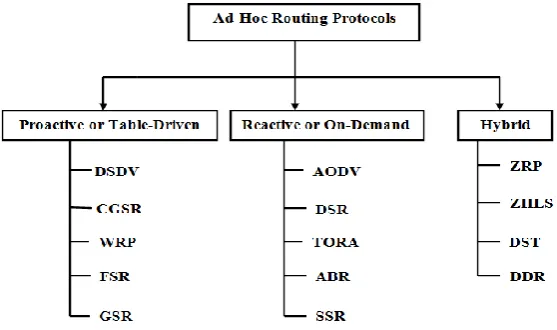
III. ROUTING APPROACHES IN MANET
FIGURE 1: Classification of Routing Protocols
IV. HYBRID ROUTING PROTOCOLS
There is a compromise between table driven and on-demand routing protocols. Proactive or table driven protocols have less latency and more traffic, while reactive or on-demand protocols have more latency and less traffic. Hybrid routing approach is introduced to overcome the shortcomings of both reactive and proactive routing approaches. It merges the advantages of both proactive and reactive approaches. It uses table maintenance technique of proactive and route discovery mechanism of reactive protocols, so as to avoid overhead issue and latency in the network. Hybrid routing approach is relevant for large networks. This broad network is divided into sets of zones. Proactive and reactive approach can be applied inside and outside the zone respectively. There are numerous popular hybrid routing approaches for MANET like Zone Routing Protocol (ZRP), Zone-Based Hierarchical Link State Routing Protocol (ZHLS), Dynamic Source Tracing Protocol (DST) and Distributed Dynamic Routing Protocol (DDR) [3][4][5][6][7].
A. ZONE ROUTING PROTOCOL (ZRP):
ZRP divides the nodes into two zones: Intra-zone and Inter-zone. When the destination node and source node both are in the same zone then ZRP uses the concept of intra-zone routing protocol and when destination node is out of the zone of source then ZRP uses the concept of inter-zone routing protocol. For Intra-zone routing it uses the proactive approach and for inter-zone routing it uses the reactive approach.
[3][4]. Advantage:
Reduced transmission Disadvantage:
Overlapping zones
B. ZONE-BASED HIERARCHICAL LINK STATE ROUTING PROTOCOL (ZHLS):
ZHLS is a hierarchical structured based protocol in which network is split into non-overlapping zones. In this approach, one unique zone ID and node ID is assigned to each node, which are computed using geographical information. Node level and zone level types of topological structure exist for network. Zone level LSP (Link State packet) and node level LSP are the two types of link state updates. Routing overhead of ZHLS is low as compared to DSR and AODV.
Advantage:
Low control overhead Disadvantage:
Static zone map required
C. DYNAMIC SOURCE TRACING PROTOCOL (DST):
Advantage:
Reduced transmission Disadvantage:
Root node
D. DISTRIBUTED DYNAMIC ROUTING PROTOCOL (DDR):
The DDR algorithm is composed of six phases: Preferred neighbor election, Intra-tree clustering, Inter-tree clustering, forest construction, zone naming and zone portioning. HARP is used to find the routes. To determine the stable path, inter-zone and intra-zone routing tables constructed by DDR are used by HARP.
Advantage:
No zone coordinator or zone map Disadvantage:
Neighbours may become bottlenecks
Here table 1 shows the comparison of some of existing hybrid routing approach.
TABLE 1: Comparison of Hybrid Routing Protocols
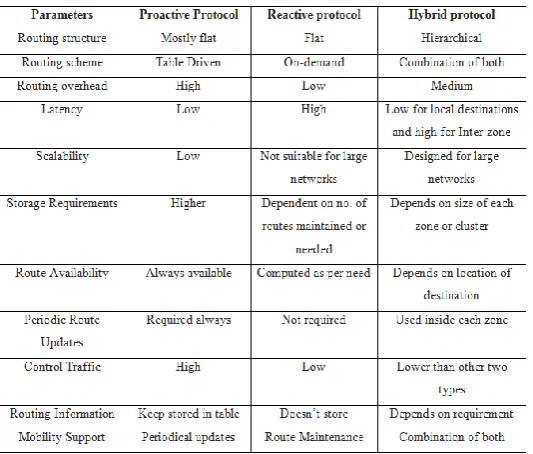
V. COMPARISON BETWEEN THREE CATEGORIES OF ROUTING PROTOCOLS
Here in this section we have discussed the qualitative and quantitative based comparison between proactive,
reactive and hybrid routing approaches in tabular form [2], [3]-[22].
VI. CONCLUSION
In this paper qualitative and quantitative based comparison of hybrid routing protocol has been done with proactive and reactive routing protocols on the basis of different metrics i.e. routing structure, routing scheme, routing overhead, latency, scalability, storage requirements, route availability, periodic route updates, control traffic, routing information and mobility support. Performance of all the routing protocols is considered as well. Further this consideration will benefit the researcher to get an outline of the existing protocols and advice which protocols may have better performance with respect to changing network scenario.
REFERENCES
[1]. Nawneet Raj, Priyanka Bharti, Sanjeev Thakur, “Vulnerabilities, Challenges and Threats in Securing Mobile Ad-Hoc Network”, Fifth IEEE International Conference on Communication System and Network Technologies, April 2015, pp. 771-775.
[2]. Apoorva Chandra, Sanjeev Thakur , “Qualitative Analysis of Hybrid Routing Protocols Against Network Layer Attacks in MANET”, IJCSMC, Vol. 4, Issue. 6, June 2015, pp. 538 – 543.
[3]. Jieying Zhou, Yi Lin, Hiping Hu, “Dynamic Zone Based Multicast Routing Protocols for Mobile Ad Hoc Networks”, IEEE International Conference on Wireless Communication, Networking and Mobile Computing, Sept. 2007, pp. 1528-1532.
[4]. Patel B, Srivatava S, “Performance analysis of zone routing protocols in Mobile Ad Hoc Networks”, IEEE International Conference on Communications (NCC), Jan. 2010, pp. 1-5.
[5]. Hamma T, Katoh T, Bista B B , Takata T, “ An efficient ZHLS Routing Protocol for Mobile Ad Hoc Networks’, 17th International Workshop on Database and Expert Systems Applications, 2006, pp. 66-70.
[6]. Khatkar A, Singh Y, “Performance Evaluation of Hybrid Routing Protocols in Mobile Ad Hoc Networks”, 2nd International Conference on Advance Computing and Communication Technologies, Jan 2012, pp. 542-545.
[7]. Kathiravelu T, Sivasuthan S, “A hybrid reactive routing protocol for Mobile Ad Hoc Networks”, 6th IEEE International Conference on Industrial and Information Systems, Aug. 2011, pp. 222-227.
[8]. Mbarushimana C, Shahrabi A, “Comparative Study of Reactive and Proactive Routing Protocols Performance in Mobile Ad Hoc Networks”, 21 st International Conference on Advanced Information Networking and Applications Workshops, IEEE, 2007, Volume-2, May 2007, pp. 679-684.
[9]. Javaid N, Bibi A, Javaid A, Malik S A, “Modeling routing overhead generated by wireless proactive routing protocols” GLOBECOM Workshops (GC Wkshps), IEEE, Dec 2011, pp. 1072-1076.
[10]. Mahmood D, Javaid N, Qasim U, Khan Z A, “ Routing Load of Route Calculation and Route Maintenance in Wireless Proactive Routing Protocols”, 7th International Conference on Broadband, Wireless Computing, Communication and Application (BWCCA),IEEE, November 2012, pp. 149-155. [11]. Pan-long Yang, Chang Tian, Yong Yu, “ Analysis on optimization model for proactive ad hoc Routing
protocol” Military Communication Conference (MILCOM), IEEE, Volume-5, Oct. 2005, pp. 2960-2966. [12]. Garnepudi P, Damarla T, Gaddipati J, Veeraiah D, “ Proactive, reactive, hybrid multicast routing protocols for Wireless Mess Networks”, International Conference on Computational Intelligence and Computing Research (ICCIC), IEEE, Dec. 2013, pp. 1-7.
[13]. Vanthana S, Prakash V S J, “ Comperative Study of Proactive and Reactive AdHoc Routing Protocols Using NS2”, IEEE Conference on Computing and Communication Technologies (WCCCT), March 2014, pp. 275-279.
[14]. Rohankar R, Bhatia R, shrivastava V, Sharma D K, “Performance analysis of various routing protocols (proactive and reactive) for random mobility models of Adhoc networks”,1st International conference on Recent Advances in information Technology (RAIT), IEEE, March 2012, pp. 331-335.
[15]. Shenbagapriya R, Kumar N, “ A survey on proactive routing protocols in MANETs”, International Conference on Science Engineering and Management Research (ICSEMR), Nov. 2014, pp. 1-7.
[16]. Sholander P, Yankopolus A, Coccoli P, Tabrizi S S, “ Experimental comparison of hybrid and proactive MANET routing protocols”,IEEE Conference on Military Communication, Volume 1, Oct. 2002, pp. 513-518.
[17]. Samar P, Haas Z J, “ Strategies for broadcasting updates by proactive routing protocols in mobile ad hoc networks”, IEEE Conference on Military Communication , volume 2, Oct. 2002, pp. 873-878.
[18]. Rahman M A, Anwar F, Naeem J, Abedin M S M, “ A simulation based performance comparison of routing protocol on Mobile Ad-hoc Network (proactive, reactive, hybrid)”, IEEE International Conference on Computer and Communication Engineering (ICCCE), May 2010, pp. 1-5.
[20]. Rajput M, Khatri P, Shastri A, Solanki K. “ Comparison of Ad-hoc reactive routing protocols using OPNET modeler”, International Conference on Computer Information System and Industrial Management Applications (CISIM), Oct. 2010, pp. 530-534.
[21]. Naserian M, Tape K E, Tarique M, “ Routing overhead analysis for reactive routing protocols in wireless ad hoc networks”, IEEE International Conference on Wireless And Mobile Computing, Networking and Communications (WiMob), Volume-3, Aug. 2005, pp. 87-92.