© 2014, IJCSMC All Rights Reserved 96 Available Online atwww.ijcsmc.com
International Journal of Computer Science and Mobile Computing
A Monthly Journal of Computer Science and Information Technology
ISSN 2320–088X
IJCSMC, Vol. 3, Issue. 9, September 2014, pg.96 – 104
RESEARCH ARTICLE
Analysis of Student Behavior in Teacher’s
Evaluation: Based on Time Spent Method
Safi Ullah Hidayat
1,
Muhammad Ramzan Talib
21, 2
Department of Computer Science, Government College University, Faisalabad, Pakistan
Abstract
Teacher evaluation is a method of assessing an instructor’s effectiveness in the classroom. The main
purpose of the teacher evaluation is to: judge student learning level, improving it, measures the
performance of individual teacher and guides the teacher as they reflect and improve the effectiveness of
the teaching. True and accurate teacher’s evaluation by the student places an important role in education
department but unluckily the purpose of teacher evaluation is not fulfilled due to student immature
attitude in teacher’s evaluation. In this paper we have discussed that how to: identify the wrong teacher’s
evaluation by the student and student behavior in teacher’s evaluation by the student.
I.
Introduction:
Teacher evaluation is a method of assessing an instructor’s effectiveness in the classroom. True and accurate teacher’s evaluation places an important role in education department because each educational institute wants to improve: student learning level, teacher’s professional ethics and teacher guidance [1]
but unluckily the purpose of teacher evaluation is not fulfilled due to student immature attitude in teacher
evaluation. According to our oral survey with the students of different universities: a student may not
© 2014, IJCSMC All Rights Reserved 97
1. It is natural fact that we personally like or dislike anybody but when we are talking about
professional teaching ethics then student’s personal liking and disliking may create some
degree of bias because of teacher's age, gender, ethnic/economic background and social
relations.
2. A student wants to submit his/her teacher’s evaluation performa without consuming required
time because he/she may be in hurry
3. A student may confuse from similar nature questions and may check a grade that is totally
different from his point of view.
4. Student may not be interested in teacher’s evaluation if he/she thinks: it is formality.
There may be four different possibilities to fill the teacher evaluation performa by the student:
a) Teacher is good and has very good teaching skills and student grade him/her excellent.
b) Teacher is not good as he/she may: have lake of confidence, be a new teacher or have not good
teaching skills. And student does not grade him/her: excellent or as an average teacher.
c) Teacher is good in his/her professional skills but student grade him/her as poor skills.
d) The evaluating teacher has not proper teaching skills but student grades him/her as excellent
grade.
II.
Methodology:
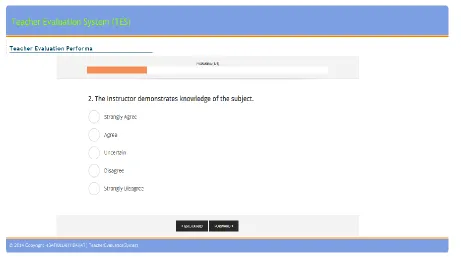
In this paper we have supposed a web based teacher’s evaluation system where each question of teacher’s
evaluation performa: has time quantum and student has five options: A – Strongly Agree, B – Agree, C –
Uncertain (Considering as space option), D – Disagree and E – Strongly Disagree to grade his /her
teacher. Similarly Teacher’s Evaluation performa has time quantum which is “over all time” quantum of
© 2014, IJCSMC All Rights Reserved 98
Figure 1.1: Teacher Evaluation Performa
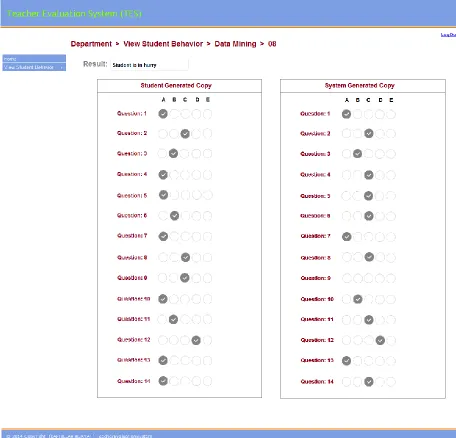
The purposed system generates three types of outputs: Student Generated Evaluation Copy, System
Generated Evaluation Copy and shows the behavior of the student.
Student Generated Evaluation Copy:
It is a copy of performa which is filled by the student.
System Generated Evaluation Copy:
It is a copy of performa that is generated by the system after analyzing the each question of student
generated copy. The efficiency of the student in each question is calculated by the using the simple
percentage formula:
((Spent Time by the student on each question/ Assigned Time for the question)*100).
Now when student select his/her asked question’s option then system analyzes time quantum of that
particular question and on the bases of results from the given above formula system selects an option on
system generated copy which may or may be different from student selected option.
Now let for the sake of discussion admin (Manager of Teacher’s Evaluation) had set minimum 5 seconds to answer the question then student’s selection method creates four cases:
Case 1:
Student consumes more than 80% of time then system will also select student selected option as there are
© 2014, IJCSMC All Rights Reserved 99
the problem is: what will happen if student consumes more than 100% of time? Suppose admin had set 3
seconds for a question but student consumes 5 seconds for that question which is 166.7% of assigned time
in this case system will select student selected option and will consider that student has consume 100%
time because for predicting student performance in teacher’s evaluation the sum of all question’s
percentage is calculated and more than 100% of time may generate lot of difference in calculations.
Case 2:
Student consumes less than 80% of time but more than 60% of time then system will select one option
behind from student selected option. Let in case-2 student has selected option A then system will select
option B or if student has selected option E then system will select option D because of space attraction.
Now question is if student has selected option C then which option will be selected by the system as we
are considering option C as a space option? Well in this case system will also select option C because of
space attraction: as in case-2 we are considering minimum 60% of time mean majority of time is in the
interested side of space so instead of discarding we select option C as there are little chances that student
has answer the question after understanding statement.
Case 3:
If student uses less than 60% but more than 40% of time then system will select space option or will not
select any option of that particular question because there are rare chances that student has answer the
question after understanding the statement.
In this situation there are two further cases:
Case 3.1: if student has selected option A or E then system will select option C.
Case 3.2: student has selected option B or D then system will analyze time quantum further deeply: if
student has consumed more than 50% of time then system will select option C because the majority of
time is in the student interested area or if student has used less than 50% of time then system will not
select any option.
Case 4:
If student consume less than 40 percent of time then system will not select any option because it is not
© 2014, IJCSMC All Rights Reserved 100
III.
Results and Discussions
:
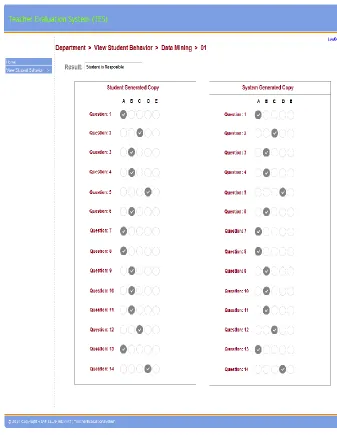
Student Is Responsible:
A student is called responsible if:
He/she consumes his/her whole “over-all-time” Quantum.
System generated copy is as it is student generated copy.
© 2014, IJCSMC All Rights Reserved 101
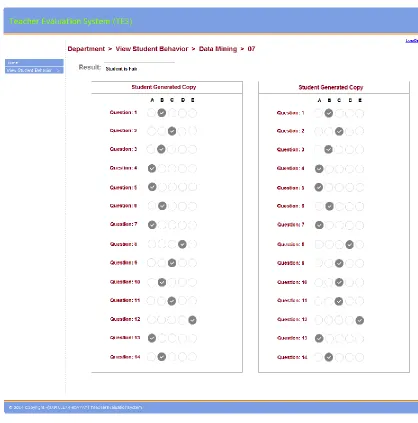
Student Is Fair:
A student is fair in Teacher’s evaluation if:
He/she uses full “over-all-time” Quantum.
Difference between system generated evaluation copy and student generated evaluation copy is
not more than 10% but less than 15 %.
© 2014, IJCSMC All Rights Reserved 102
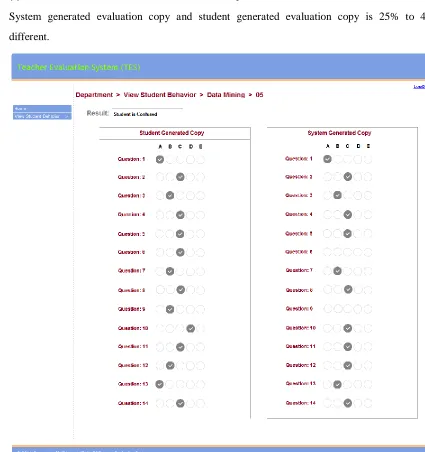
Student is Confused:
A student is said to be confused by the system if:
(s)he consumes more than 65% of “over-all-time” Quantum
System generated evaluation copy and student generated evaluation copy is 25% to 40%
different.
© 2014, IJCSMC All Rights Reserved 103
Student is in hurry:
System will mark a student as in hurry if:
(s)he does not consume his/her “over-all-time” quantum
More than 75% difference between system generated evaluation copy and student generated
evaluation copy.
© 2014, IJCSMC All Rights Reserved 104
IV.
Conclusions:
Some time student does not evaluate teacher’s performance due his/her immature behavior in teacher’s
evaluation. In this paper it is discussed that it is possible to identify the wrong grading and predicting
student behavior in teacher’s evaluation by placing time quantum (required time for understanding the
question) in each question. System generated evaluation copy is achieved after analyzing student
generated evaluation copy based on time spent on each question. Then by comparing: student generated
evaluation copy, system generated evaluation copy and overall time quantum of teacher’s evaluation
performa student behavior is achieved. But there is still more work needs to be done in this area.
References
[1] The Teaching Assessment and Evaluation Guide© is published by the Senate Committee on
Teaching and Learning (SCOTL), York University