Available Online atwww.ijcsmc.com
International Journal of Computer Science and Mobile Computing
A Monthly Journal of Computer Science and Information Technology
ISSN 2320–088X
IMPACT FACTOR: 5.258
IJCSMC, Vol. 5, Issue. 5, May 2016, pg.40 – 45
NOVEL APPROACH FOR MAKING DIGITAL
ARTIFACTS ON SECURITY ESSTENTIALS
OF WEB VERIFIABLE AND RELIABLE
K.Akhil Raj1, G.Gayathri2, K.Mani Deepika3, K.Lakshmana Rao4, B.Koteswara Rao5
1, 2, 3,4,5
Pursuing B.Tech (CSE) from St. Ann’s College of Engineering & Technology Chirala, Andhra Pradesh - 523 187 INDIA
Ms. K.Lakshmi Sobhana, Assistant Professor (CSE) St. Ann’s College of Engineering & Technology,
Chirala,Andhra Pradesh - 523 187 INDIA
Dr. P.Harini, Prof & HOD (CSE) St. Ann’s College of Engineering & Technology Chirala,Andhra Pradesh - 523 187 INDIA
[email protected], [email protected], [email protected] [email protected], [email protected]
© 2016, IJCSMC All Rights Reserved 41
on the Web verifiable, unchangeable, and permanent. This approach includes cryptographic hash values created by using Base 64 algorithm in Uniform Resource Identifiers (URIs).
A cryptographic hash value is a short random sequence of bytes .If the input is same, it always leads to exactly the same hash value, whereas just little modified input returns a completely different value. There are many number of possible inputs that lead to a given hash value, it is impossible to reconstruct any of the possible inputs just from the hash values that are acquired from the base 64 algorithm. Which means if we give some input and an unmatched hash value, we can be sure that hash value can be obtained from exactly that input. By doing this, our proposed approach goes down to the idea that references can be made completely clear and verifiable if they contain some hash value of the digital artifact. This method will not be applicable to all URI’s, but only to those which are are meant to represent a specific digital artifact.
But there is no mechanism currently to showcase this. This is very well-known that even artifacts that are supposed to be unchangeable will change over the time, by often keeping the same URI reference in the concept. For the approaches like nano publications, it is important to specify exactly on what resource they are based on, and no one should be given the opportunity to modify their published contributions. With the approach, nano publications can be identified with trusty URIs which contains cryptographic hash values calculated on the RDF content. We can simply search for the content on Web without worrying whether the source is trustworthy or not.
2. RELATED WORK
ROPOSED MODEL
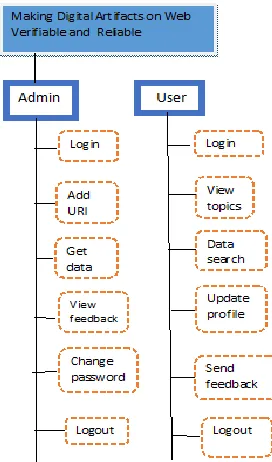
System architecture:
3. RESULTS & DISSCUSSIONS:
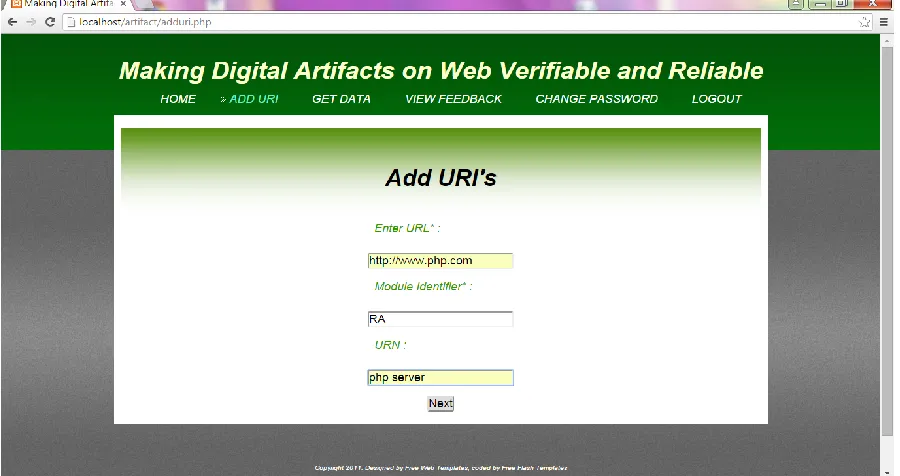
© 2016, IJCSMC All Rights Reserved 43 Figure 2: login page
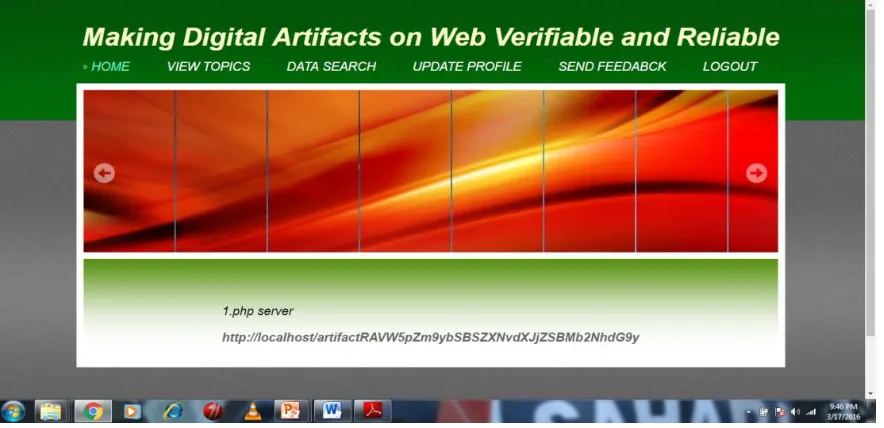
Figure 4:Hash codes
:
© 2016, IJCSMC All Rights Reserved 45 4. CONCLUSION & FUTURE WORK
We have proposed trusty URI references to make digital artifacts on the Web verifiable, unchangeable, and permanent. It would have a considerable impact on the structuring and functioning of the semantic web, it would improve the efficiency and reliability of tools using Web resources, and could become an important technical pillar for the Semantic Web, in particular for scientific data, where provenance and verifiability are important. Scientific data analyses, for example, might be conducted in the future in a fully reproducible manner within projects analogous to today’s software projects. Those dependencies in the form of datasets could be automatically retrieved from the Web, but decentralized and verifiable. Web resources, and could become an important technical pillar for the sematic web. In particular for scientific data, where the reliability and verifiability are important.
REFERENCES:
1. PHP and MYSQL Web Development, 3rd Edition, Laura Thomson (Author).
2. HTML and XHTML: The Complete Reference (Osborne Complete Reference Series)
Thomson Powell (Author).
3. Web Database Applications with PHP and MYSQL Hugh E. Williams (Author), David Lane
(Author).