CHARIOT: Cloud-Assisted Access Control for the
Internet of Things
Cl´ementine Gritti
Eurecom
Sophia Antipolis, France [email protected]
Melek ¨
Onen
Eurecom
Sophia Antipolis, France [email protected]
Refik Molva
Eurecom
Sophia Antipolis, France [email protected]
Abstract—The Internet of Things (IoT) technology has ex-panded widely across the world, promising new data manage-ment opportunities for industries, companies and individuals in different sectors, such as health services or transport logistics. This trend relies on connecting devices/things to collect, exchange and store data. The exponentially increasing number of IoT devices, their origin diversity, their limited capabilities in terms of resources, as well as the ever-increasing amount of data, raise new challenges for security and privacy protection, precluding traditional access control solutions to be integrated to this new environment. In this paper, we propose a reliable server-aided policy-based access control mechanism, named CHARIOT, that enables an IoT platform to verify credentials of different devices requesting access (read/write) to the data stored within it. CHARIOT permits IoT devices to authenticate themselves to the platform without compromising their privacy by using attribute-based signatures. Our solution also allows secure delegation of costly computational operations to a cloud server, hence relieving the workload at IoT devices’ side.
Index Terms—Access Control, Cloud Computing, Internet of Things
I. INTRODUCTION
The Internet of Things (IoT) has been developed to enable the interconnection between various devices, such as mo-bile phones, sensors and actuators, that collect and transmit data at large-scale. This technology has been integrated to multiple and diversified environments such as environmental production, health services and traffic monitoring. With the explosion of the amount of data exchanges between these devices and their large number, the need for security and privacy countermeasures becomes crucial. Several studies [1]– [3] report on different vulnerabilities of the technology.
While many platforms are available for the IoT, access control issues are often overlooked. Various attacks exist against such platforms; for example, vulnerabilities in ToyTalk products were discovered among which the majority originated from the lack of security at the platform level whereby an adversary was easily able to log-in to the platform at any time1. Preventing unauthorized access to the platform and consequently to the data stored in there becomes extremely challenging due to the nature of IoT devices. The latter, that are often simple and resource-constrained, cannot perform any costly computational operations. Since platforms are usually
1https://motherboard.vice.com/en
us/article/more-security-vulnerabilities-found-in-hello-barbie-toys-servers
installed at untrusted third parties, such as data centers and cloud servers, such parties must not obtain any information about the identity of IoT devices and the data that is being collected or accessed.
Traditional credential-based access control systems do not suit this environment as such resource-limited devices are often not able to generate credentials or signatures to satisfy the access control policy defined for an IoT platform. We hence aim to develop a server-aided access control solution, named CHARIOT, which ensures the privacy of the devices’ identity and of the data towards the platform. CHARIOT relies on the use of attribute-based signatures to ensure the proper authentication of devices, by defining an access control policy for the data stored at the IoT platform. Furthermore, CHARIOT enables an IoT device to delegate most of the access control operations to a more powerful third party such as a cloud server, and only perform minor operations at its side in order to optimize the use of its resources. The outsourced computation of the credentials is based on a simple secret sharing of the signing key between the cloud server and the IoT device. Once the cloud server has executed the main part of the generation of the signature, the IoT device performs very few additional operations to finalize it and sends the resulting signature to the platform. CHARIOT ensures that no information about the devices’ attributes in the credentials is leaked to the platform nor to the cloud server.
In the following section, we detail the problem raised by designing an access control protocol suitable to the IoT envi-ronment. In Section I-B, we highlight the main features of our cloud server-assisted access control protocol for IoT. Section II describes the proposed solution CHARIOT and analyzes its security. In Section III, we evaluate the performance of our solution and recall the existing work. We finally conclude the paper in Section IV.
A. Problem Statement
technol-ogy mainly because of the very limited computing resources of IoT devices in terms of memory, CPU, storage and battery. A suitable technique allowing the secure authentication of devices to the platform is Attribute-Based Signature (ABS) [4]. Informally speaking, an ABS protocol in the IoT environment ensures that given an access policy, whenever a device signs a message using its attributes, if the attributes satisfy this access policy, then this signature is valid and the device successfully authenticates and accesses the platform. Additionally, ABS ensures that these attributes remain hidden in the signature, and thus the device’s identity remains private. Indeed, during the verification phase, the platform cannot discover any infor-mation except that the access control policy is satisfied.
However, current ABS solutions [5], [6] suffer from the computational burden of the signature generation. Since the signature computation involves multiple modular exponentia-tions and their number increases linearly with the policy’s size, the existing tools are not yet suitable to the IoT environment.
B. Idea
Most of the existing ABS solutions are very costly in terms of computation and storage: the generation of the signature and its size depend on the number of attributes in the signing policies. In the context of an IoT environment, a typical access control policy may contain numerous attributes because of the large number of IoT devices and their heterogeneity. Herranz et al. [6] present a Threshold ABS scheme with compact signatures whereby their size does not depend on the number of attributes in the policies. While the solution is suitable for the IoT technology, the computational cost still remains significant: the number of modular exponentiations is linear with the number of attributes and therefore cannot be afforded by resource-constrained IoT devices.
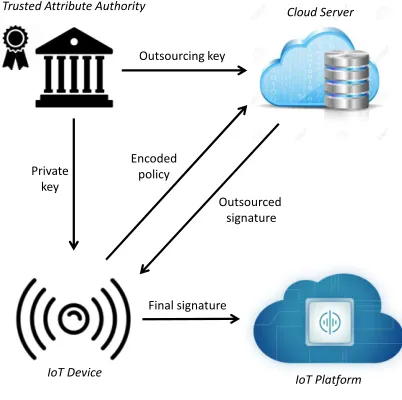
We propose to improve the computational cost of the above solution at the device’s side by delegating most of the signature generation to a powerful cloud server. Similarly to [7], the signing key is secretly shared between the cloud server and the IoT device, ensuring a secure delegation of the signature computation. The cloud server computes a partial signature using an outsourcing key, and sends it to the IoT device. The latter finalizes the signature by performing additional lightweight operations using its private key, and forwards it to the platform. The signature is accepted by the platform if the device’s attributes, embedded into the signature, satisfy the access control policy.
Yet, the ABS solution in [6] incurs extra computational and storage overhead since the signature generation is fixed to an upper bound due to the use of dummy attributes. Following a technique introduced in [8], we modify the original ABS in [6] by removing the presence of dummy attributes. We hence obtain a more efficient Threshold ABS scheme with constant-size signatures and no dummy attributes whereby the most computationally-intensive operations are securely delegated to a cloud server. The proposed solution guarantees privacy of participating IoT devices against the platform and cloud server.
Fig. 1. CHARIOT protocol overview
Encoded policy
Outsourced signature
Final signature Private
key
Outsourcing key
Trusted Attribute Authority Cloud Server
IoT Platform IoT Device
II. CHARIOT
A. Environment
We define an Outsourced Threshold Attribute-Based Sig-nature protocol as follows. The first two algorithms, Setup
and Keygen, are run to initialize the protocol. The Setup
algorithm is run to generate the public parameters accessible to all participating parties, and a master secret key forwarded to an off-line trusted attribute authority. TheKeygenalgorithm is run by the trusted attribute authority to create the outsourcing key for the cloud server and the private key for the IoT device, regarding the access attributes of this device.
The following algorithms, Request, Signout, Sign and
Verify, are the core algorithms to enable secure authentication of the IoT device towards the platform. First, the IoT device runs Request to hash the access policy for the cloud server using a Keyed-Hash Message Authentication Code (HMAC). The access policy is defined by the platform and made accessible to the device, but should remain hidden from the cloud server’s view. Then, the cloud server, given this hashed access policy, creates the outsourced signature using its outsourcing key. It forwards the outsourced signature to the IoT device. From there, the device finalizes the signature generation by using its private key and choosing the message. It forwards the final signature to the IoT platform. The latter executesVerifyto check the validity of the device’s signature and thus its right for access.
Figure 1 illustrates the CHARIOT protocol where a trusted attribute authority, an IoT platform, a cloud server and an IoT device participate. More details on the components (keys and signatures) are given in the next section.
B. Preliminaries
Let g ∈ G and ~v = (v1, v2, v3)> where vi ∈ G
for i ∈ [1,3]. We denote E(g, ~v) the pairing-based vec-tor (e(g, v1), e(g, v2), e(g, v3))> where e(g, vi) ∈ GT for
i ∈[1,3]. In addition, we let the multiplication between two column vectors be (v1, v2, v3)>·(v01, v20, v03)> = (v1·v10, v2·
v02, v3·v30)> wherev0i∈Gfor i∈[1,3].
Let X be an attribute set, atbe an attribute in X,τ be an injective encoding such that allτ(at)are pairwise-distinct, and γbe an element inZp. We denoteFX(γ) =Qat∈X(γ+τ(at))
the polynomial of degree |X| for attributesat∈X.
Bilinear Pairings.LetGandGT be two cyclic multiplicative
groups of prime order p. Let e be an efficiently computable mapping e:G×G→GT such that:
• e(ga, hb) =e(g, h)abfor any g, h∈Ganda, b∈Zp,
• e(g, h)6= 1GT wheneverg, h6= 1G.
We call e an admissible pairing. Moreover, e is symmetric: for allg, h∈G,e(g, h) =e(h, g).
DLIN Assumption [6]. The Decisional LINear problem related to the group G is defined as follows. Let g be a
generator of Gandγ be an unknown exponent in Zp. Given
an integer n∈N and the valuesg,{gγ
i
}i∈[1,2n]\{n+1} in G,
the aim is to computegγn+1.
(q,n,s,t)-aMSE-CDH Assumption [6], [8]. The Augmented Multi-Sequence of Exponents Computational Diffie-Hellman problem related to the group pair (G,GT) is defined as
follows. Let g0, h0 be two generators of G. Let f(x), g(x)
be two co-prime polynomials defined as f(x) = Qq
i=1(x+
xi)andg(x) =Qsi=1(x+x0i) wherexi, x0i are given. Given
q, n, s, t, f(x), g(x)and the following values in G:
g0, h0,{g αγi
0 }i∈[0,q+n], g
αf(γ)γs−t 0 ,{g
βγi
0 }i∈[0,q+t],
{g0ωγi}i∈[0,q+t],{h αγi
0 }i∈[0,2n], h αg(γ)γn
0 ,
{hβγ0 i}i∈[0,n+t−2],{h ωγi
0 }i∈[0,n+t]
whereα, β, γ, ω are unknown exponents of Zp, the aim is to
compute e(g0, h0)αβf(γ)γ
n+s−1 .
C. Building Blocks
Similarly to Herranz et al. [6], our ABS scheme relies on two main features, namely the Attribute-Based Encryption (ABE) scheme with constant-size ciphertexts proposed by [9] and the Groth-Sahai proof systems for bilinear groups [10].
The ABE scheme in [9] is designed for the threshold case, where users are authorized to decrypt if they have at least t attributes matching the ones from an attribute universe, for some threshold t chosen by the party who encrypts the message. Such scheme relies on expressing a polynomial as the product of irreducible factors of degree1with coefficients equal to the attributes from either the user’s set or the universe. Fraction of such polynomials can thus be simplified when t attributes among the user’s set and the universe match.
Herranz et al. [6] design their Threshold ABS scheme by enabling the signer to implicitly prove that it can decrypt a ciphertext generated as in the ABE scheme [9]. To do so, the signer generates a Groth-Sahai proof [10] in which the message and access policy are binded using a technique from [11]. Informally, by hashing the to-be-signed message using Waters’ techniques [12] and embedding it into the Groth-Sahai Common Reference String (CRS), the technique in [11] allows signatures of knowledge.
In addition, we modify the ABS scheme presented in [6] by enabling the outsourcing of the signature generation to a cloud server. Similarly to Chen et al. [7], we let the cloud server and the IoT device hold shares of a secret element chosen by the trusted attribute authority, and use them to generate the signature such that the combination of the two shares recover the secret.
Groth-Sahai Proofs. Groth-Sahai proofs [10] are used to construct signatures in our protocol. Based on the DLIN assumption and symmetric pairings, they guarantee unforge-ability and privacy of signatures. Letg1, g2, g∈Gand vectors
~g1= (g1,1, g)>, ~g2= (1, g2, g)>, ~g3∈G3
be defined in the CRS used in Groth-Sahai proof systems. Let r, s, t∈Zp and
~
C= (1,1, X)>·(~g1)r·(~g2)s·(~g3)t
where X ∈ G is the element to commit. Let ξ1, ξ2 ∈ Z∗p
be randomly chosen such that ~g3 = (~g1)ξ1 ·(~g2)ξ2. Let the
elements of
~
C= (gr+ξ1t
1 , g s+ξ2t
2 , X·g
r+s+t(ξ1+ξ2))>
be the resulting commitments. As mentioned in [6], [10], the elements ofC~ are ciphertexts from the Boneh-Boyen-Shacham encryption scheme [13] that can be decrypted usinglogg(g1)
andlogg(g2).
Let~g3= (~g1)ξ1·(~g2)ξ2·(1,1, g−1)>. Hence,~g1, ~g2, ~g3are
linearly independent vectors andC~ is a perfectly hiding com-mitment. Thus, proofs are perfectly witness indistinguishable. The committed group elements are proved to satisfy some relations when there are one commitment per variable and one proof element (made of a constant number of group elements) per relation. In the context of pairing-based systems, let tT be constant in GT, Ai be constant in G, Bi ∈ Gand
ai,j ∈Zp, fori, j ∈[1, k]. The pairing-product equations are
Qk
i=1e(Ai, Bi)·Q k i=1
Qk
j=1e(Bi, Bj)ai,j =tT.
In addition, Non-Interactive Zero-Knowledge (NZIK) proofs are available with pairing-product relations. Let Si, Ti, for i ∈ [1, k0] and k0 ∈ N be constant values and
tT = Q k1
i=1e(Si, Ti) be a target element. These extra
Threshold ABS.LetΩS= Ω∩S whereΩis the attribute set
of the signer and Sis the attribute set included in the signing policyΓ = (t, S), where|S|=sandtis the threshold. Letτ be an injective encoding such that for all attributes atinΩS,
the values τ(at)are pairwise distinct.
Let r be the randomness in the cloud server’s outsourcing key and γ be part of the master secret key held by the trusted attribute authority. The cloud server receives the tuple
{gγ+τr(at), τ(at)}at
∈Ω in its outsourcing key. The outsourced
signature generation requires the cloud server to pick the components gγ+τr(at) and τ(at) for at ∈ Ω
S ⊆ Ω and to
compute g r
Q
at∈ΩS(γ+τ(at)) ∈G given these components. This is done using the algorithmAggregate[14].
Let xi = τ(at) for all at ∈ ΩS where |ΩS| = t. Given
νi = g
r
γ+xi and xi for i ∈ [1, t], for any (j, l) such that
1≤j < l≤t,
Lj,l=ν
1
Qj
i=1(γ+xi)
l = (g
r (γ+xl))
1
Qj
i=1(γ+xi).
The Aggregatealgorithm consists in computing sequentially Lj,l for j ∈ [1, t−1] and l ∈ [j+ 1, t] using the induction
Lj,l = (Lj−1,j/Lj−1,l)
1
xl−xj and setting L
0,l = νl for
l∈[1, t]. The algorithm finally outputs Lt=Lt−1,t.
The Threshold ABS scheme in [6] uses polynomial fractions to enable the pairing-based verification process. Informally, attributes at the denominator will cancel out if and only if the signer has t attributes matching the ones in the access policy. The algorithm Aggregate [14] enables to compute the denominator of these polynomial fractions by obtaining g
r FΩS(γ)
∈ G, while the numerator is calculated given the
public parameters and the attributes in S.
Let the polynomial F(S∪Dn+t−1−s)\ΩS(γ) from [6] be de-fined as follows:
F(S∪Dn+t−1−s)\ΩS(γ)
=
Q
at∈S(γ+τ(at))
Q
at∈Dn+t−1−s(γ+τ(at))
Q
at∈ΩS(γ+τ(at))
= Y
at∈(S∪Dn+t−1−s)\ΩS
(γ+τ(at))
The setDn+t−1−scorresponds to the set of dummy attributes.
WhenΩS = Ω∩S has exactlyt elements, then the degree of
the polynomialF(S∪Dn+t−1−s)\ΩS(γ)iss+(n+t−1−s)−t= n−1. Letaibe the coefficients of the polynomial. We re-write
as:
F(S∪Dn+t−1−s)\ΩS(γ) =
n−1
X
i=0
γiai= n−1
X
i=1
γiai+a0
where a0 = Qat∈(S∪Dn+t−1−s)\ΩSτ(at). The private key contains the components hrγi for i ∈ [0, n−2], and thus the element h1γr(F(S∪Dn+t−1−s)\ΩS(γ)−a0)=hr
Pn−1 i=1γ
i−1a i=
Qn−1
i=1(h rγi−1
)ai = Qn−2
j=0(h rγj
)aj+1 is computable. How-ever, if |ΩS| < t, then the polynomial F(S∪Dn+t−1−s)\ΩS(γ) has degree strictly greater than n −1. Thus, the element
hγ1r(F(S∪Dn+t−1−s)\ΩS(γ)−a0)is not computable since the com-ponents hrγi fori > n−2are missing in the private key.
Yet, the use of dummy attributes to enable the correctness of the polynomial setting brings extra storage and computa-tional costs. Similarly to [8], we modify the Herranz et al.’s polynomial setting in a such way that dummy attributes are no longer required. Let the polynomial FS\ΩS(γ)in CHARIOT be defined as follows:
FS\ΩS(γ) =
Q
at∈S(γ+τ(at))
Q
at∈ΩS(γ+τ(at))
= Y
at∈S\ΩS
(γ+τ(at))
WhenΩS = Ω∩S has exactlytelements, then the degree of
the polynomialFS\ΩS(γ) iss−t. Let bi be the elements of the polynomial. We re-write as:
FS\ΩS(γ) =
s−t
X
i=0
γibi=γs−tbs−t+ s−t−1
X
i=0
γibi
wherebs−t= 1. Given the indexi∈[0, s−t−1], we observe
that(i+n−s+t)∈[n−s+t, n−1]such thatn−s+t >0. In addition, γn−s+tr(F
S\ΩS(γ)−γ
s−t) = γn−s+tr(γs−t+
Ps−t−1
i=0 γibi − γs−t) = γn−s+tr(P s−t−1
i=0 γibi) =
r(Ps−t−1
i=0 γ
i+n−s+tb
i). The private key contains the
components hrγi for i ∈ [1, n−1], and thus the element
hγn−s+tr(FS\ΩS(γ)−γs−t) = Qs−t−1
i=0 (h
rγi+n−s+t )bi is computable. However, if |ΩS| < t, then the polynomial
FS\ΩS(γ) has degree strictly greater than s−t. Thus, the element hγn−s+tr(FS\ΩS(γ)−γs−t) = Qs−t−1
i=0 (h
rγi+n−s+t)bi
is not computable since components hrγi for i > n−1 are missing in the private key.
Outsourced Signature Generation. The off-line trusted at-tribute authority generates two keys regarding the set of the device’s attributes by picking at random β1 ∈R Zp and
using its master secret key embedding β ∈ Zp. The first
key is an outsourcing key embedding β2 = β+β1, that is
forwarded to the cloud server. The second key is a private key embeddingβ1, that is kept secret by the IoT device. The cloud
server computes an outsourced signature using its outsourcing key, and thus β2, and the current signing policy. Then, the
device finalizes the signing process by choosing the message and using its private key, and thus β1. The exponent β2 is
canceled out and the final signature contains β = β2−β1.
The verification is hence possible since it requires the public parameters, whose components embedβ, and the signature of the signing device. The device’s signature is finally checked by a verifier: the signature is valid for the chosen message if device’s attributes embedded in the signature satisfy the signing policy.
information about the attributes of the devices and of the signing policies. We use an HMACτ such that inputsat are warranted to be authentic and have not been modified. We assume that τ sends an attribute at ∈ P onto an element τ(at)∈Z∗p such that all valuesτ(at)are different, and hides
the attributes from the cloud server’s view. The HMAC τ is shared among the attribute authority and the device, and used for generating the outsourcing key (such that all the device’s attributes are hashed using HMAC) and the HMAC-hashed signing policy for the cloud server respectively. Hence, the latter computes the outsourced signature such that it does not learn anything from the attributes unless whether t attributes match between the signing policy and the device’s attribute set.
D. Overview
In this section, we give a sight of our protocol in which three main phases occur. The first one enables to set up the protocol and to generate the public parameters and key material. The second phase lets a device ask for access to the IoT platform by outsourcing the computation of its request to a cloud server. The platform verifies the request and access rights of the device, and gives authorization for access accordingly.
Protocol Setup.First, a setup algorithm is run once to initiate the CHARIOT protocol. It generates the public parameters made available to all the participating parties, along with the master secret key given to the off-line trusted attribute authority. Then, the latter creates an outsourcing key delivered to the cloud server, a unique private key forwarded to the IoT device and a secret key given to the IoT platform. The outsourcing key embeds the attributes of the device in their HMAC-hashed form while the private key is calculated in order to enable the device to complete its access requests to the platform. Informally, the outsourcing key and the device’s private key contain shares of a secret enabling to apply the outsourced signature generation technique.
Access Request. When the device wants to access the IoT platform, it first asks the cloud server for some assistance. Given the outsourcing key and the current (HMAC-hashed) policy, the cloud server generates an outsourced request, under the form of a signature, and forwards it to the device. The latter modifies it into its final request by using its private key and by choosing a personal message. It finally sends its request to the platform.
Outsourced and final signatures are constructed as in the threshold case, based on polynomial fractions defined over the attributes of the device and of the access policy. By doing so, if the device holds less attributes than a certain threshold, the signature verification will fail and the device will not have access to the platform. Contrary to [6], the signature generation does not require the use of dummy attributes into polynomials to reach correctness of the verification process. Moreover, signatures embed Groth-Sahai
proof systems allowing the device to implicitly prove that it can decrypt a ciphertext corresponding to the ABE scheme [9].
Access Verification. Once receiving an access request from the IoT device, the platform checks the validity of the corre-sponding signature using the public parameters, the current policy and the chosen message. If the result is positive, meaning that the device has the required attributes satisfying the policy, then it is authorized for access.
The verification phase works thanks to the correctness of the ABE scheme [9] and to the perfect completeness, soundness and composable zero-knowledge of the Groth-Sahai proofs.
E. Construction
The CHARIOT construction is made of six algorithms run among a trusted attribute authority, an IoT platform, a cloud server and an IoT device:
• Setup(λ,P, n) →(params, msk). On inputs the security parameterλ, an attribute universeP and an integern that is an upper bound on the size of threshold policies, the algo-rithm outputs the public parameters params (which contain (λ,P, n)) and the master secret key msk (for the trusted attribute authority) as follows:
The algorithm first chooses two cyclic groups G,GT of
prime order p > 2λ with an efficiently computable bilinear
map e : G×G → GT. Let g, h be two generators of G
and H : {0,1}∗ → {0,1}k be a collision-resistant hash
function for some k. Let τ be a HMAC that, given a key K, sends an attributeat∈ P onto an elementτ(K, at)∈Z∗p
such that all output values are different. The algorithm then picks α, β, γ ∈R Z∗p and computes u = gβ, vi = g
α γi
and hi = hαγ
i
for i ∈ [0, n]. It generates the Groth-Sahai CRS by first choosing two generators g1, g2 of G. Then, it
defines the vectors~g1= (g1,1, g)> and~g2= (1, g2, g)>. For
i ∈ [0, k], it picks ξi,1, ξi,2 ∈R Zp and defines the vector
~g3,i= (~g1)ξi,1·(~g2)ξi,2 = (g ξi,1
1 , g ξi,2
2 , g
ξi,1+ξi,2)>. Exponents
{ξi,1, ξi,2}i∈[0,k]can then be discarded since they are no longer
needed.
Finally, the algorithm sets the public parametersparams= (λ,P, n, p,G,GT, e, g, h, u,{vi}i∈[0,n]{hi}i∈[0,n], ~g1, ~g2, {~g3,i}i∈[0,k], H, τ)and the master secret keymsk= (α, β, γ).
•KeyGen(params, msk,Ω)→(oskΩ, skΩ, skP T).On inputs
the public parametersparams, the master secret keymsk, an attribute setΩ⊂ P, the trusted attribute authority outputs the outsourcing key oskΩ (for the cloud server), the private key
skΩ(for the IoT device) and the secret keyskP T (for the IoT
platform) as follows:
Let K be a random key to be shared between the device and the platform, that will be used to hash the attributes. Let Ω⊂ P be an attribute set. The authority picks β1∈RZ∗p and
sets β2 = β +β1. It then chooses r ∈R Z∗p and computes
The authority sets the outsourcing key oskΩ =
({gγ+τ(rK,at), τ(K, at)}at
∈Ω, {hrγ
i
}i∈[1,n−1], h(r−β2)γ
n , gβ1) for the cloud server, the private keyskΩ= (hβ1γ
n
, K)for the IoT device and the secret keyskP T =Kfor the IoT platform.
• Request(Γ, skΩ)→Γ˜.On inputs a threshold signing policy
Γ = (t, S) where the set S ⊂ P has |S|=s ≤n attributes and 1 ≤ t ≤ s and the private key skΩ, the IoT device
hashes each attribute at ∈ S with τ resulting into τ(K, at), and creates the HMAC-hashed set S˜ containing the values τ(K, at) for all at ∈S. It sets the HMAC-hashed threshold signing policy Γ = (˜ t,S˜)and forwards it to the cloud server.
• Signout(params, oskΩ,Γ)˜ → σ0. On inputs the public
parametersparams, the outsourcing keyoskΩand an
HMAC-hashed threshold signing policy Γ = (˜ t,S˜) where S˜ is the HMAC-hashed set of S ⊂ P and 1 ≤t ≤s≤n, the cloud server outputs an outsourced signatureσ0 as follows:
The cloud server returns 1 if |Ω∩S| < t; otherwise, it finds a subset ΩS ⊂ Ω∩S such that |ΩS| = t. The cloud
server works on the HMAC-hashed sets to verify the number of attributes contained in the intersection, since it should not get any information about the attributes in Ω and S except that there are at leastt matching attributes.
For all at ∈ ΩS, the cloud server then runs
the algorithm Aggregate({gγ+τ(rK,at), τ(K, at)}at
∈ΩS) = g
r
Q
at∈ΩS(γ+τ(K,at)) = g r FΩ
S(γ) = T1. Let the polynomial FS\ΩS(γ) be as FS\ΩS(γ) =
Q
at∈S\ΩS(γ+τ(K, at)) =
Ps−t
i=0γ ib
i such that bs−t = 1. Then, it computes T20 =
h(r−β2)γn ·Qs−t−1
i=0 (h
rγi+n−s+t)bi that is possible given the public parametersparamsand the outsourcing keyoskΩ. The
obtained valuesT1 andT20 should satisfy the equality:
e(T20, vn−−1s+t)·e(T1, hαFS(γ)) =e(u·gβ1, hs−t)
Then, it picks r1, s1, r2, s2 ∈R Zp and computes C~T01 = (1,1, T1)>·(~g1)r1·(~g2)s1andC~T02 = (1,1, T
0
2)>·(~g1)r2·(~g2)s2.
Letθ∈Gwith commitmentC~θ0 = (1,1, θ)>·(~g1)rθ·(~g2)sθ for
rθ, sθ∈RZp, which takesθ=hs−tand proves the following:
e(T1, HS) = e(u·gβ1, θ)·e(T20, vn−s+t) (1)
e(g, θ) = e(g, hs−t) (2)
whereHS=hαFS(γ)=hα
Q
at∈S(γ+τ(K,at)). Equations 1 and 2 are called proofs ~π01 and~π02 respectively, and are given by ~
π10 = (Hr1
S ·(ug
β1)−rθ·v−r2
n−s+t, H s1
S ·(ug
β1)−sθ·v−s2
n−s+t,1)>
and~π02= (grθ, gsθ,1)>. It also computesgβ1rθ andgβ1sθ.
Finally, the cloud server sets the outsourced signature σ0 = (C~T0
1, ~C 0
T2, ~C 0
θ, ~π
0
1, ~π02, T20, HS, gβ1rθ, gβ1sθ) and
forwards it to the IoT device.
• Sign(params, skΩ,M, σ0) → σ. On inputs the public
parameters params, the private key skΩ, a message Mand
an outsourced signatureσ0, the IoT device outputs a signature σ as follows:
Given T20 from the outsourced signature σ0 and hβ1γn from the private key skΩ, the IoT device computes T2 =
T20 ·hβ1γn = h(r−β2)γn ·Qs−t−1
i=0 (h
rγi+n−s+t)bi · hβ1γn =
h(r−β)γn
·Qs−t−1
i=0 (h
rγi+n−s+t
)bi. The obtained valuesT
1and
T2 should satisfy the equality:
e(T2, v−n−1s+t)·e(T1, hαFS(γ)) =e(u, hs−t) (3)
Thereafter, it computesM =m1· · ·mk =H(M)∈ {0,1}k.
It uses M to form a message-specific Groth-Sahai CRS
gM= (~g1, ~g2, ~g3,M). More specifically, for alli∈[0, k],~g3,i
is parsed as (gX,i, gY,i, gZ,i)> and the device sets ~g3,M =
(gX,0 ·Q k i=1g
mi
X,i, gY,0 ·Q k i=1g
mi
Y,i, gZ,0 · Q k i=1g
mi
Z,i)>. The
device then generates the Groth-Sahai commitments to the values T1 and T2 using gM. It picks t1, t2 ∈R Zp and
computes:
~
CT1 = C~ 0
T1·(~g3,M)
t1
= (1,1, T1)>·(~g1)r1·(~g2)s1·(~g3,M)t1
~
CT2 = C~ 0
T2·(1,1, h
β1γn)>·(~g
3,M)t2
= (1,1, T2)>·(~g1)r2·(~g2)s2·(~g3,M)t2
Then, it generates the NZIK proof that the pair of committed variables(T1, T2) satisfies the pairing-product in Equation 3.
To do so, let the commitmentC~θ=C~θ0·(~g3,M)tθ = (1,1, θ)>·
(~g1)rθ·(~g2)sθ·(g~3,M)tθ for tθ∈RZp, which takesθ=hs−t
and proves the following:
e(T1, HS) = e(u, θ)·e(T2, vn−s+t) (4)
e(g, θ) = e(g, hs−t) (5)
whereHS =hαFS(γ). Equations 4 and 5 are called proofs~π1
and~π2 respectively, and are given by:
~π1 = ~π01·(g−β1rθ, g−β1sθ, H t1
S ·u
−tθ ·v−t2
n−s+t)>
= (Hr1
S ·u
−rθ·v−r2
n−s+t, H s1
S ·u
−sθ·v−s2
n−s+t,
Ht1
S ·u
−tθ·v−t2
n−s+t)
>
~π2 = ~π02·(1,1, g
tθ)>= (grθ, gsθ, gtθ)>
Finally, the IoT device sets the signature σ =
(C~T1, ~CT2, ~Cθ, ~π1, ~π2)and sends it to the IoT platform.
• Verify(params, skP T,M, σ,Γ) → 0/1. On inputs the
public parameters params, the secret key skP T, a message M, a signature σ, a threshold policy Γ = (t, S), the IoT platform outputs0 if the signature is valid and1 otherwise.
The IoT platform computes M = m1· · ·mk =
H(M), forms the vector ~g3,M = (gX,0 ·Q k i=1g
mi
X,i, gY,0·
Qk
i=1g mi
Y,i, gZ,0 · Q k i=1g
mi
Z,i)>, and sets HS = hαFS(γ) =
hαQat∈S(γ+τ(K,at)) where K = skP T. Let ~πj = (πj,1, πj,2, πj,3)> for j∈ {1,2}. It returns0if and only if:
E(HS, ~CT1) = E(u, ~Cθ)·E(vn−s+t, ~CT2)·E(π1,1, ~g1)
·E(π1,2, ~g2)·E(π1,3, ~g3,M)
Correctness. For any λ ∈ N, any integer n, any
universe P, any public parameters and master secret key (params, msk) ← Setup(λ,P, n), any set Ω ⊂ P, any threshold policy Γ = (t, S) where 1 ≤ t ≤ |S| ≤ n, and any message M, it is required that Verify(params, skP T,M,Sign(params,
skΩ,M,Signout(params, oskΩ, Request(Γ, skΩ))),Γ) = 0
whenever (oskΩ, skΩ, skP T) ← KeyGen(params, msk,Ω)
and|Ω∩S| ≥t. The correctness is demonstrated based on the one for Groth-Sahai proofs [10]. We verify the correctness of Equation 3:
e(T2, v−n−1s+t)·e(T1, hαFS(γ))
= e(h(r−β)γn· s−t−1
Y
i=0
(hrγi+n−s+t)bi, g
−α γn−s+t)
·e(g r FΩ
S(γ), hαFS(γ))
= e(h(r−β)γn· s−t−1
Y
i=0
((hrγi)γn−s+t)bi, g
−α γn−s+t)
·e(g, h)αrFS\ΩS(γ)
= e(h(r−β)γs−t· s−t−1
Y
i=0
(hrγi)bi, g−α)
·e(g, h)αrFS\ΩS(γ)
= e(hrγs−t·h(−β)γs−t· s−t−1
Y
i=0
(hrγi)bi, g−α)
·e(g, h)αrFS\ΩS(γ)
= e(h(−β)γs−t· s−t
Y
i=0
(hrγi)bi, g−α)
·e(g, h)αrFS\ΩS(γ)[wherebs−t= 1]
= e(g, h)αβγs−t·e(g, h)−αrFS\ΩS(γ)
·e(g, h)αrFS\ΩS(γ)
= e(g, h)αβγs−t =e(u, hs−t)
F. Security Analysis
Unforgeability. The CHARIOT protocol can be proven selective-policy and adaptive-message unforgeable under chosen-message attacks assuming that H is a collision-resistant hash function, the DLIN problem holds in G and
the (q, n, s∗, t∗)-aMSE-CDH problem holds in(G,GT). The
adversary A (group of colluding parties that put their out-sourcing/private keys together) selects the signing policyΓ∗= (t∗, S∗)that it wishes to attack at the beginning of the game, while the messageM∗linked to an eventually forged signature is not chosen in advance.Acan query for valid signatures on messages and signing policies of its choice. We give a sketch of the proof and let the reader refer to [6], [8], [15] for more details.
Let ~g1, ~g2,{~g3,i}i∈[1,k] be a modified distribution of the
vectors that are inputs for the Groth-Sahai CRS generation.
Let an integer ν ∈R [0, k], exponents ξi,1, ξi,2 ∈R Zp and
integersρi ∈R [0,2qS−1]be randomly chosen for i∈[0, k]
where qS is the number of signature queries. Then, let a, b
be picked at random in Zp, g1 = ga, g2 = gb, and ~g1 =
(g1,1, g)> and~g2= (1, g2, g)>. Let~g3,0= (~g1)ξ0,1·(~g2)ξ0,2·
((1,1, g)>)ν·2qS−ρ0 and~g
3,i= (~g1)ξi,1·(~g2)ξi,2·((1,1, g)>)ρi
for i ∈[1, k]. In the way that the tuple (~g1, ~g2,{~g3,i}i∈[1,k])
is calculated, a successful adversaryAagainst unforgeability will successfully help: i) either an algorithm to find collisions on the hash functionH; ii) or an algorithm to solve the DLIN problem; iii) or a challengerBinteracting withAto solve the (q, n, s∗, t∗)-aMSE-CDH problem.
For the item iii), let q be the cardinality of the attribute universe P, n be the upper bound on the size of threshold policies, s∗ be the cardinality of the target attribute set S∗ andt∗ be the target threshold value.
Initialization:Bspecifies the universeP of attributes whileA
chooses the signing policy Γ∗= (t∗, S∗).
Setup:Breceives the elements from the aMSE-CDH assump-tion such that it encodes each attribute fromP with either the polynomialf(x)forat /∈S∗ or g(x)forat∈S∗.
Outsourcing Key and Private Key Queries: The exponent r is calculated with a random exponent r0 ∈R Zp and
the polynomial FΩS∗(γ) where ΩS∗ = S∗ ∩Ω is known.
x+τ(ati)|f(x)FΩS∗(x) since ati is either in Ω\ΩS∗ or inΩS∗
Signature Queries: B computes M = H(M) = m1· · ·mk,
evaluates the functions:
• J(M) =ν·2qS+ρ0+P k
i=1ρi·mi,
• K1(M) =ξ0,1+Pki=1ξi,1·mi and
• K2(M) =ξ0,2+P k
i=1ξi,2·mi,
and sets ~g3,M = (~g1)K1(M)·(g~2)K2(M)·((1,1, g)>)−J(M).
If J(M) = 0, then B aborts; otherwise, it generates σ by simulating NZIK proofs.
Forgery: A outputs (M∗, σ∗ = (C~∗
T1, ~C ∗
T2, ~C ∗
θ, ~π1∗, ~π∗2),Γ∗). B then evaluates J(M∗), K1(M∗), K2(M∗) for
M∗ = H(M∗) = m∗
1· · ·m∗k. If there is a signature
query on M such that M 6= M∗ and H(M) = H(M∗), then B aborts. This breaks the resistance against collisions of the hash function H. If J(M∗) 6= 0, then B aborts.
gM∗= (~g1, ~g2, ~g3,M∗)is a perfectly sound Groth-Sahai CRS.
WhenJ(M∗) = 0, the NIZK proofs must be valid regarding
gM∗. Hence, gM∗, ~C∗ T1, ~C
∗
T2 are extractable Groth-Sahai commitments. Therefore, B obtains T1 and T2, and finds a
solution for the aMSE-CDH problem.
Privacy.The CHARIOT protocol can be proven computation-ally private assuming that the DLIN problem holds inGand
Game0is defined as the real privacy game given in [6]. When
Setup is run, B chooses the vectors ~g1, ~g2,{~g3,i}i∈[0,k] such
that~g3,i is linearly dependent on~g1 and~g2, fori∈[0, k].
Game1 is similar to Game0, except that~g3,i is linearly
inde-pendent of~g1 and~g2, for i∈[0, k].
The modification between the two games is indistinguish-able if the DLIN problem is hard to solve [10]. In Game1,
~
CT1, ~CT2, ~π1 could possibly leak information about the se-lected attributes, but commitments and proofs are perfectly hiding since they reveal no information about the committed values T1 and T2. Hence, attributes’ privacy is preserved
in Game1. Moreover, the outsourcing key does not leak
anything about the attributes of the IoT device except that a certain number of them satisfy the signing policy. Indeed, the HMAC τ ensure that, given the key K secretly shared between the device and the IoT platform, at ∈ P is sent onto τ(K, at)∈Z∗p such that all output values are different.
The function τ protects the attributes for data integrity and authenticity, and securely hides the attributes from the cloud server’s view.
III. PERFORMANCEANALYSIS
A. Performance Comparison
We compare the computational and storage costs between our CHARIOT scheme and the original Threshold ABS scheme [6]. In the following tables, ”ExpG”, ”MultG” and ”PairGT” denote exponentiation and multiplication in Gand
pairing operation in GT respectively. Let ”n.a.” mean ”non
available”. Letnbe the upper bound on the size of the policies and k be the parameter used for the Groth-Sahai proofs. Let Ω be the device’s attribute set,S be the signing attribute set such that s=|S|, t be the threshold value andΩS = Ω∩S
such that |ΩS|=t.
TABLE I COMPUTATIONAL COST
Threshold ABS [6] CHARIOT
MultG ExpG MultG ExpG
Setup - 2n+ 3k+ 5 - 2n+ 3k+ 6 KeyGen - |Ω|+n - n+|Ω|+ 2 Signout n.a. n.a. s−t+ 17 2s+t2−t+ 32 Sign d+s d+ 2s 3k+ 5 3k+ 4
−t+ 17 +t2−t+ 32 +3k+ 5 +3k+ 4
Verify 3k s+ 3k+ 1 3k s+ 3k+ 1
In Table I, let d be the number of dummy attributes such that d = n+t −1 −s ≤ n−1 as in [6]. The sign −
means no computation of the given operation. Using dummy attributes in [6] increases the number of multiplications and exponentiations in Gduring the signature generation. By
re-moving dummy attributes, up ton−1modular multiplications and exponentiations are cut for the CHARIOT signing phase. Then, in CHARIOT, the computations done by a device are limited to the Groth-Sahai proofs’ ones; all other calculations are delegated to the cloud server. Therefore, with the assistance
TABLE II CHARIOTSTORAGE COST
params msk oskΩ skΩ σ
−d−1 +1 +|Ω|+n+ 3 −|Ω| −n+ 2 =
of a cloud server, the device is relieved from most of the signing computations.
In Table II, only the storage difference in CHARIOT com-pared to the ABS scheme in [6] is taken into account: an element+1(resp. an element−1) in one cell means that there is one extra element (resp. there is one less element) in the CHARIOT protocol compared to Herranz et al.’s protocol. The sign=in a given column denotes that storage is identical in the two protocols regarding the component linked to this column. The number d of dummy attributes is equal to n−1 as in [6]. Hence, in [6], a set of n−1 dummy attributes should be stored in params in order to let the device generate its signature, while in CHARIOT, such storage cost is saved. An extra secret element is required inmskin CHARIOT to enable the outsourcing of signing computations. The outsourcing key oskΩin CHARIOT is mainly the private keyskΩin [6]. The
device in CHARIOT simply receives an extra element from the shared secret and the key for the HMAC τ as its private keyskΩ. Signatures are of equal size in Herranz et al.’s ABS
[6] and CHARIOT schemes, and independent of the number of attributes.
B. Performance Benchmarking
We evaluate the performance of our CHARIOT protocol by calculating the timings of each algorithm. We implement CHARIOT in Charm [16] based on Python language. We set two different configurations, one for the trusted attribute authority, the cloud server and the IoT platform, and another one for the IoT device. We assume that the attribute authority, the cloud server and the platform have similar noticeable resources, while the device has much less resources than these three parties. The experiments are tested:
• Configuration1(for the attribute authority, cloud server and platform): on a processor Intel Core i5-2500 CPU @3.30GHz×4with RAM16GiB and OS Linux Ubuntu 14.04LTS;
• Configuration2(for the device):on a processor Genuine Intel(R) U2300 CPU @1.20GHz with RAM 2GiB and OS Linux Ubuntu17.10.
in order to avoid collisions with high probability. The given timings are an average from 10 rounds of the CHARIOT protocol.
TABLE III TIMINGS IN MILLISECONDS
k= 10 k= 20 k= 40 Configuration1 Setup 143.77 190.67 284.54 (attribute authority, KeyGen 76.19 75.47 75.17 cloud server Signout 265.07 272.69 271.55 and platform) Verify 65.66 108.93 194.12 Configuration2 Request 0.16 0.16 0.17 (device) Sign 182.55 322.01 601.6
In Table III, the setup phase is costly but should be executed only once. It largely depends on the upper boundnon the size of threshold policies and on the parameter kused for Groth-Sahai proofs. The key generation phase is also performed only once by the trusted attribute authority, and is relatively fast since it only relies on n that should not exceed30in an IoT environment.
By outsourcing the signature generation to a cloud server, we speed up by three times the computational timing. Indeed, the cloud server approximately needs270milliseconds to run the algorithm Signout while the device would require 870
milliseconds to do the same (when setting Configuration 2 as for the device). We recall that the algorithm Signout does
not depend on the parameterk, and thus does not variate with it. Most of the signature generation is thus done by the cloud server running the algorithm Signout. The finalization of the signature generation is accomplished by the device by running the algorithmSignand remains less than870milliseconds (re-sulting from running the algorithmSignoutwith Configuration 2). However, timings for signature finalization and verification increase with the parameterkas these two phases largely rely on such parameter. Hence,kshould not exceed40in order to keep the advantage of outsourcing the signature generation to a cloud server.
In the CHARIOT protocol, the parameter k refers to the bit-size of the hashed message. This parameter k should be selected such that collisions are highly avoided. If the dictionary of messages to be signed is really small, then k = 10 is optimal. Otherwise, if the dictionary is slightly bigger, then k = 20 is still a reasonable choice. In addition, signature finalization and verification take similar timings to be performed since they are composed of the same kinds of computations. The difference comes from the constant number (equal to27) of pairing operations carried out when checking the validity of the signature. Because of the number of pairing computations required for verification, the Groth-Sahai proof systems appear to be inefficient. Blazy et al. [19] propose a significant reduction of the cost of Groth-Sahai proof systems by using batch verification techniques. The authors improve the verification cost up to four times the number of pairings per proof verification. We can integrate their batch verification techniques into the CHARIOT protocol to improve the timings of the verification phase.
C. Related Work
ABS.Maji et al. [20] explicitly introduce the notion of ABS and suggest several schemes with very expressive signing policies. The most practical one is only proven secure in the generic model, while the one with security in the standard model is not efficient since the signatures have size linear in the number of group elements in the security parameter. Okamoto et Takashima [21] propose an ABS construction where the size of the signatures grows linearly in the size of the span program, which is greater than the number of selected attributes in the signing policies. Other works on ABS are given in [5], [22], [23]. Subsequently, Okamoto and Takashima [24] present a fully secure ABS scheme that supports general non-monotone policies. More recently, Herranz et al. [6] suggest an ABS construction with threshold policies and constant-size signatures, which requires the presence of dummy attributes following the technique from Dynamic Threshold Public-Key Encryption [14].
Outsourcing Computations. Several papers deal with the problem of securely outsourcing expensive computations such as matrix multiplications and quadrature computations, edit distance computations, linear algebraic computations and lin-ear programming computations [25]–[29]. Nevertheless, the aforementioned schemes are not suitable to alleviate the computational burdens that signers meet when generating signatures. Server-aided signature schemes [30]–[32] aim to decrease the computational cost due to exponentiation cal-culations by outsourcing the latter to a server. Nevertheless, these schemes are not suitable for access control management based on credentials. Mediated cryptographic protocols [33]– [35] require a partially trusted on-line server and provide efficient revocation but cannot be used to extend ABS into an outsourced ABS. More recently, Chen et al. [7] present two outsourced ABS schemes. While the first solution achieves a constant number of exponentiation calculations at the signer’s side, the size of the signature remains linear in the number of selected attributes. The second solution obtains constant-size signatures; however, the number of exponentiations depends on the number of dummy attributes in addition to the number of selected attributes. Yet, the cloud server must know the attributes of the signers and of the signing policies in plain in order to proceed, compromising privacy.
IV. CONCLUSION
our scheme suitable for securely authorizing devices with constrained resources to access an IoT platform.
REFERENCES
[1] J. Gubbi, R. Buyya, S. Marusic, and M. Palaniswami, “Internet of things (iot): A vision, architectural elements, and future directions,” Future Generation Computer Systems, vol. 29, no. 7, pp. 1645–1660, 2013. [2] R. H. Weber, “Internet of things - new security and privacy challenges,”
Computer Law & Security Review, vol. 26, no. 1, pp. 23 – 30, 2010. [3] C. M. Medaglia and A. Serbanati, “An overview of privacy and security
issues in the internet of things,” inProceedings of the 20th Tyrrhenian Workshop on Digital Communications, ser. The Internet of Things’10, 2010, pp. 389–395.
[4] J. Su, D. Cao, B. Zhao, X. Wang, and I. You, “ePASS: An expressive attribute-based signature scheme with privacy and an unforgeability guarantee for the internet of things,” Future Generation Computer Systems, vol. 33, no. Supplement C, pp. 11 – 18, 2014.
[5] J. Li, M. H. Au, W. Susilo, D. Xie, and K. Ren, “Attribute-based signature and its applications,” inProceedings of the 5th ACM Sym-posium on Information, Computer and Communications Security, ser. ASIACCS’10, 2010, pp. 60–69.
[6] J. Herranz, F. Laguillaumie, B. Libert, and C. R`afols, “Short attribute-based signatures for threshold predicates,” inProceedings of the 12th Conference on Topics in Cryptology, ser. CT-RSA’12, 2012, pp. 51–67. [7] X. Chen, J. Li, X. Huang, J. Li, Y. Xiang, and D. S. Wong, “Secure outsourced attribute-based signatures,”IEEE Transactions on Parallel and Distributed Systems, vol. 25, no. 12, pp. 3285–3294, 2014. [8] W. Susilo, G. Yang, F. Guo, and Q. Huang, “Constant-size ciphertexts
in threshold attribute-based encryption without dummy attributes,” In-formation Sciences, vol. 429, no. C, pp. 349–360, Mar. 2018. [9] J. Herranz, F. Laguillaumie, and C. R´afols, “Constant size ciphertexts in
threshold attribute-based encryption,” inProceedings of the conference on Public Key Cryptography, ser. PKC’10, 2010, pp. 19–34.
[10] J. Groth and A. Sahai, “Efficient non-interactive proof systems for bilinear groups,” in Proceedings of the 27th Annual International Conference on Theory and Applications of Cryptographic Techniques, ser. EUROCRYPT’08, 2008, pp. 415–432.
[11] T. Malkin, I. Teranishi, Y. Vahlis, and M. Yung, “Signatures resilient to continual leakage on memory and computation,” inProceedings of the 8th Conference on Theory of Cryptography, ser. TCC’11, 2011, pp. 89–106.
[12] B. Waters, “Efficient identity-based encryption without random oracles,” inProceedings of the 24th Annual International Conference on Theory and Applications of Cryptographic Techniques, ser. EUROCRYPT’05, 2005, pp. 114–127.
[13] D. Boneh, X. Boyen, and H. Shacham, “Short group signatures,” in Proceedings of the 24th Annual International Cryptology Conference, ser. CRYPTO’04, 2004, pp. 41–55.
[14] C. Delerabl´ee and D. Pointcheval, “Dynamic threshold public-key en-cryption,” inProceedings of the 28th Annual Conference on Cryptology, ser. CRYPTO’08, 2008, pp. 317–334.
[15] J. Herranz, F. Laguillaumie, B. Libert, and C. R`afols, “Short attributebased signatures for threshold predicates,” HAL archives ouvertes -Report 00611651, 2012, https://hal.archives-ouvertes.fr/hal-00611651. [16] J. A. Akinyele, M. D. Green, and A. D. Rubin, “Charm: A framework for
rapidly prototyping cryptosystems,” Cryptology ePrint Archive, Report 2011/617, 2011, https://eprint.iacr.org/2011/617.
[17] X. Yao, Z. Chen, and Y. Tian, “A lightweight attribute-based encryption scheme for the internet of things,”Future Generation Computer Systems, vol. 49, no. Supplement C, pp. 104 – 112, 2015.
[18] M. Ambrosin, A. Anzanpour, M. Conti, T. Dargahi, S. R. Moosavi, A. M. Rahmani, and P. Liljeberg, “On the feasibility of attribute-based encryption on internet of things devices,”IEEE Micro, vol. 36, no. 6, pp. 25–35, Nov 2016.
[19] O. Blazy, G. Fuchsbauer, M. Izabach`ene, A. Jambert, H. Sibert, and D. Vergnaud, “Batch groth-sahai,” inProceedings of the 8th Interna-tional Conference on Applied Cryptography and Network Security, ser. ACNS’10, 2010, pp. 218–235.
[20] H. K. Maji, M. Prabhakaran, and M. Rosulek, “Attribute-based signa-tures,” inProceedings of the 11th International Conference on Topics in Cryptology, ser. CT-RSA’11, 2011, pp. 376–392.
[21] T. Okamoto and K. Takashima, “Homomorphic encryption and signa-tures from vector decomposition,” inProceedings of the 2nd Interna-tional Conference on Pairing-Based Cryptography, ser. PAIRING’08, 2008, pp. 57–74.
[22] S. F. Shahandashti and R. Safavi-Naini, “Threshold attribute-based signatures and their application to anonymous credential systems,” in Proceedings of the 2Nd International Conference on Cryptology in Africa, ser. AFRICACRYPT’09, 2009, pp. 198–216.
[23] J. Li and K. Kim, “Hidden attribute-based signatures without anonymity revocation,”Information Science, vol. 180, no. 9, pp. 1681–1689, 2010. [24] T. Okamoto and K. Takashima, “Efficient attribute-based signatures for non-monotone predicates in the standard model,” inProceedings of the 14th International Conference on Practice and Theory in Public Key Cryptography, ser. PKC’11, 2011, pp. 35–52.
[25] M. J. Atallah, K. N. Pantazopoulos, J. R. Rice, and E. H. Spafford, “Se-cure outsourcing of scientific computations,” Advances in Computers, Tech. Rep., 1998.
[26] M. J. Atallah and J. Li, “Secure outsourcing of sequence comparisons,” Information Security, vol. 4, no. 4, pp. 277–287, 2005.
[27] D. Benjamin and M. J. Atallah, “Private and cheating-free outsourcing of algebraic computations,” in Proceedings of the 2008 Sixth Annual Conference on Privacy, Security and Trust, ser. PST’08, 2008, pp. 240– 245.
[28] M. J. Atallah and K. B. Frikken, “Securely outsourcing linear algebra computations,” inProceedings of the 5th ACM Symposium on Informa-tion, Computer and Communications Security, ser. ASIACCS’10, 2010, pp. 48–59.
[29] C. Wang, K. Ren, and J. Wang, “Secure and practical outsourcing of linear programming in cloud computing,” in Proceedings of the International IEEE Conference on Computer Communications, ser. INFOCOM’11, 2011, pp. 820–828.
[30] M. Jakobsson and S. Wetzel, “Secure server-aided signature generation,” in Proccedings of the 4th International Workshop on Practice and Theory in Public Key Cryptosystems, ser. PKC’01, 2001, pp. 383–401. [31] K. Bicakci and N. Baykal, “Server assisted signatures revisited,” in Pro-ceedings of the 2004 International Conference in Topics in Cryptology, ser. CT-RSA’04, 2004, pp. 143–156.
[32] ——, “Improved server assisted signatures,” Computer Networks, vol. 47, pp. 351–366, 2005.
[33] D. Boneh, X. Ding, G. Tsudik, and C. M. Wong, “A method for fast revocation of public key certificates and security capabilities,” in Proceedings of the 10th Conference on USENIX Security Symposium, ser. SSYM’01, 2001.
[34] D. Boneh, X. Ding, and G. Tsudik, “Fine-grained control of security capabilities,”ACM Transactions on Internet Technology, vol. 4, no. 1, pp. 60–82, 2004.