Available Online at www.ijcsmc.com
International Journal of Computer Science and Mobile Computing
A Monthly Journal of Computer Science and Information Technology
ISSN 2320–088X
IJCSMC, Vol. 2, Issue. 11, November 2013, pg.364 – 370
RESEARCH ARTICLE
COMPARATIVE STUDY OF NODE
ENERGY CONSTRAINTS FOR
MANET ROUTING PROTOCOLS
Soumya.C.P
1, Girija.G
2, Gowdhami.N
3PG Scholar, Bannari Amman Institute of Technology, Sathyamangalam1,2,3 [email protected], [email protected], [email protected]
Abstract—Ad-hoc routing technology has been developed primarily for networks of mobile nodes. Mobile nodes have limited battery energy, when a battery discharges then it becomes very difficult to recharge or replace the battery of the nodes. These nodes need to be energy conserved to maximize the battery life as well as lifetime of nodes. The routing protocols affect the performance of the mobile node energy. There are three types of routing Protocols i.e. Proactive, Reactive and Hybrid Routing protocols. We have considered one protocol from each type: AODV, ZRP & STAR. By using the protocols in mobile ad hoc networks the energy performance metrics, routing power and residual energy in all the three modes (transmitting, receiving, and idle) are evaluated. The other performance metrics of application layer are also evaluated i.e. throughput and average jitter. The simulation has been carried out using QualNet 5.0.2. Finally, the observations are compared and the impact of energy constraints on a node in physical layer of the networks the STAR protocol offers the best combination of energy consumption and throughput performance
Keywords: Wireless Sensor Network; TCP; throughput; delay; jitter; Qualnet
I. INTRODUCTION
© 2013, IJCSMC All Rights Reserved 365
processing and communication. The energy consumed during processing is less when compared to the energy consumed during communication. So, the communication system must be energy efficient to optimize the energy consumption at different states of the communication. The wastage of battery power decreases the lifetime of the wireless nodes. A general constraint of wireless communication is the short lifetime of mobile terminals, since batteries provide limited power to operate the nodes. Hence, power management is one of the most challenging problems in wireless communication. In this paper performance of three different types of routing protocols are compared with scenarios of different number of nodes (10, 20, 30, 40, 50) using QualNet Simulator from Scalable Networks platform to perform simulations. The simulator setup and finally the results are discussed.
II. PROTOCOLS ANALYSED
The following protocols are considered for analysis:
AODV
STAR
ZRP
A. Adhoc on demand routing (AODV)
AODV has a routing table and all of them will be assured by a series of numbers. The routing table is updated when all node receives the control packet. The AODV routing protocol is mainly developed for ad hoc mobile networks. It is able to handle unicast and multicast routing. The AODV is working only on demand. It has quite a few advantages, specifically; they are loop free and self starting. The AODV develop a route using two routers one for route reply and another one is for route request. The route is maintained only at the time when it is being used by the router and if it is not maintained accurately the probability of getting expired is more.
This protocol is completely based on source-initiated on-demand routing. Only when the source node desired the routes have been created. Source when it demands the route discovery process starts. This procedure is completed once a route is found or each and every one possible routes have been explored. It provides unicast, broadcast, along with multicast communication in networks. Routes are maintained as extended they are wanted by the source node. AODV nodes maintain a route table in which next hop routing information for destination nodes is stored.
B. Source tree adaptive routing protocol (STAR)
The Source Tree Adaptive Routing (STAR) is a table-driven, link-state protocol that can be run with an emphasis on a small routing overhead measured as network load. The STAR protocol is intended for use by nodes (static and mobile) in an ad hoc network or an internet. A router in STAR communicates to its neighbors the parameters of its source routing tree consists of each and every link that the router needs to reach the known destination (and address range) in the ad hoc network or internet. To conserve energy and transmission bandwidth, a router communicates changes to its source routing tree only when the router detects new destinations, the possibility of network partitions, or the possibility of node failures or network looping. The STAR routing protocol can be run either by using an optimum routing approach (ORA) or by using a least overhead routing approach (LORA). The first approach tries to fulfil a requirement to provide optimal paths between nodes in accordance with a defined metric and will not consider the volume of routing messages - in fact its performance characteristics will depend on the frequency of routing tables updates. On the other hand, the LORA approach in accordance with its name strives to keep the overhead of routing messages to a minimum while sacrificing the optimality requirement of ORA. In STAR, each router i maintains a Topology Graph (TG), i.e. a view of the network that is formed by aggregating the router's knowledge of its adjacent links and information gathered from its neighbouring routers. Based on TGi the router runs a route selection algorithm and constructs a Source Tree (ST), which consists of all preferred paths to all nodes known to the router. For every node j known to i there is an entry in the routing table stating the first hop (the successor) in the path.
C. Zone routing protocol (ZRP)
used to reduce the control overhead of proactive routing protocols and decrease the latency caused by route discovery in reactive routing protocols. The ZRP defines a zone in the region of every node which consists of the node's k-neighborhood (that is, every node inside k hops of the node). For within the routing zones the intra zone routing protocol is measured. There are two types of zone routing protocol they are intra zone routing protocol and inter zone routing protocol. The inter zone routing protocol is used in among the nodes.
III. SIMULATION ENVIRONMENT
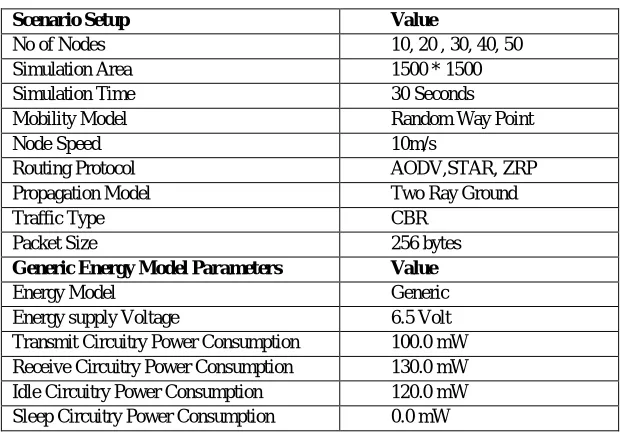
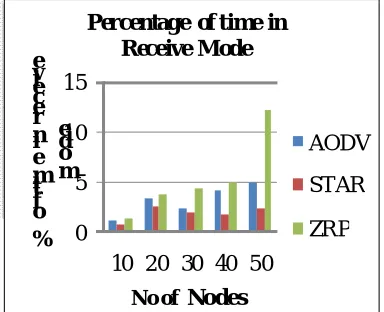
The simulation process of MANET is implemented using simulator Qualnet 5.0.2. Performance metrics used in this paper are Throughput, Average jitter, Energy consumed in transmit and receive mode and percentage of time in transmit and receive mode.CBR (Constant bit rate) application is used for in the scenarios. The no: of nodes used in the scenarios are 10,20,30,40 and 50. At last result is achieved for different scenarios and the three routing protocols are compared.
TABLE I
SIMULATION PARAMETERS
Scenario Setup Value
No of Nodes 10, 20 , 30, 40, 50
Simulation Area 1500 * 1500
Simulation Time 30 Seconds
Mobility Model Random Way Point
Node Speed 10m/s
Routing Protocol AODV,STAR, ZRP
Propagation Model Two Ray Ground
Traffic Type CBR
Packet Size 256 bytes
Generic Energy Model Parameters Value
Energy Model Generic
Energy supply Voltage 6.5 Volt
Transmit Circuitry Power Consumption 100.0 mW
Receive Circuitry Power Consumption 130.0 mW
Idle Circuitry Power Consumption 120.0 mW
Sleep Circuitry Power Consumption 0.0 mW
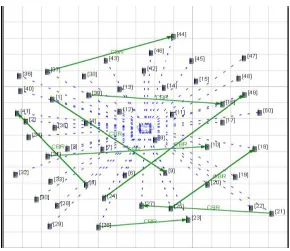
© 2013, IJCSMC All Rights Reserved 367 Fig. 1 Scenario with 50 nodes
IV. PERFORMANCE METRICS
The following parameters are analyzed and comparison is made for the above routing protocols
Average jitter
Throughput
Energy Consumed in transmit mode
Energy Consumed in receive mode
Percentage of time in transmit mode
Percentage of time in receive mode
V. SIMULATION RESULTS
A. Throughput
Throughput performance is high for AODV when compared to STAR protocol.ZRP performance is very poor.
B. Average Jitter
From the graph the average jitter is low for STAR while using less nodes as well as more nodes. AODV has high value of average jitter.
0 0.01 0.02 0.03 0.04
10 20 30 40 50
Av
e
r
a
g
e
J
it
te
r
(s
)
No of Nodes Average Jitter
AODV
STAR
ZRP
Fig. 3 Average Jitter Versus Number of Nodes
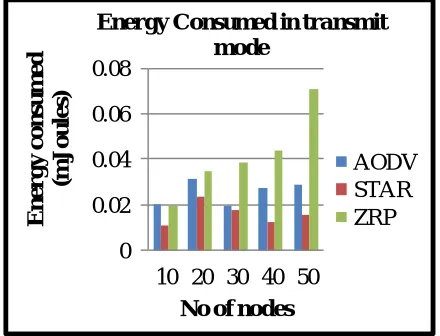
C. Energy Consumed in Transmit Mode
Energy consumption in transmit mode is very low for STAR protocol when compared to the other two.
0 0.02 0.04 0.06 0.08
10 20 30 40 50
E
n
e
rg
y
c
o
n
su
m
e
d
(m
J
o
u
le
s)
No of nodes
Energy Consumed in transmit mode
AODV STAR ZRP
© 2013, IJCSMC All Rights Reserved 369
D. Energy Consumed in Receive Mode
STAR routing protocol consumes less power than other protocols in receive mode.
0 0.02 0.04 0.06 0.08 0.1 0.12 0.14
10 20 30 40 50
E
n
er
gy
con
su
m
ed
(m
Jo
u
le
s)
No of Nodes
Energy Consumed in receive
mode
AODV
STAR
ZRP
Fig. 5 Energy consumed in receive mode
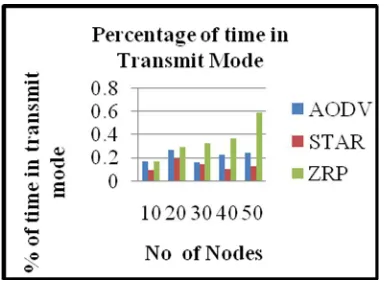
E. Percentage of time in Transmit Mode
Percentage of time taken by STAR routing protocol is less when compared to other protocols.ZRP takes much time when compared to AODV and STAR.
Fig. 6 Percentage of time in Transmit Mode
F. Percentage of time in Receive Mode
Fig. 7 Percentage of time in receive mode
VI. CONCLUSION
Energy saving is an important optimization objective in Mobile Adhoc Network, the energy consumed during communication is more dominant than the energy consumed during processing because of Limited storage capacity, Communication ability, computing ability and the limited battery are main restrictions in sensor networks. By the observations we compare that the impact of energy constraints on a nodes in physical layer and application layer of the networks that STAR offers the best combination of energy consumption and throughput performance. STAR gives better throughput, average jitter and delay performance compared to ZRP followed by AODV. If we increased numbers of nodes also increase maximum energy consumption in STAR followed by ZRP then AODV due to routing control packets in the network. Future work, we can reduce the waste energy consumption of the nodes by reducing the number of routing control packets and reducing the energy consumed by nodes in a large network to increase the life time of network.
REFERENCES
[1] Dharam Vir, Dr.S.K.Agarwal and Dr.S.A.Imam, “A Simulation Study on Node Energy Constraints of Routing Protocols of Mobile Adhoc Networks use of QualNet Simulator” in International Journal of Advanced Research in Electrical,Electronics and Instrumentation Engineering, Vol.1,Issue 5, November 2012.
[2] Jun-Hoong , Au-Yong, “Comparison of On Demand Mobile Ad Hoc Network Routing protocols Under ON/OFF Source Traffic Effect”, Proc. Of IASTED International Conference, March 29-31, 2006, Chiang Mai, Thailand.
[3] Ahmed Al-Maashri and M. Ould-Khaoua, “Performance Analysis of MANET Routing Protocols in the Presence of Self-Similar Traffic”, Proceeding 31st IEEE Conference on Local Computer Networks, pp- 801-807, 2006. [4] Dhiraj Nitnaware and Ajay Verma, “Energy Evaluation of Proactive and Reactive Protocol for MANET under ON/OFF Source Traffic”, Proceeding of ACM International Conference on advances in Computing, Communication and Control (ICAC3-2009), pp 451-455, Fr. Conceicao Rodrigues College of Engg. Bandra, Mumbai, January 23-24, 2009.
[5] Qualnet Developers Guide-5.0.2
[6] A.K.Vatsa, Prince Chauhan, Meenakshi Chauhan and Jyothi Sharma, “Routing Mechanism for MANET in Disaster Area”, International Journal of Networking and Mobile Technologies, Vol 2 / ISSUE 2/ MAY 2011. [7] Scalable Network Technology, QualNet5.0 simulator tutorial and Qual-Net Forum, http://www.scalable-etworks.com/forums
[8] H.Chang and L.Tassiulas, “Energy Conserving Routing in Wireless Ad-hoc Networks”, Proc. IEEE INFOCOM, Tel Aviv, Israel, Pages 22-31, March 2000
[9] Ankit Bhardwaj, Divya and Sanjeev Sofat, “An Efficient Energy Conserving Scheme for IEEE 802.11 Adhoc Networks”, IEEE 1-4244-1005-3/07, 2007.
[10] Juan-Carlos and Pietro Manzoni, “A Performance Comparison of Energy Consumption for Mobile Ad Hoc Networks Routing Protocols”, Proceedings of the 2000 IEEE page no: 57-63
0 5 10 15
10 20 30 40 50
% o f ti m e i n r e c ei v e m o d e
No of Nodes Percentage of time in
Receive Mode
AODV
STAR