© 2014, IJCSMC All Rights Reserved 639
Available Online atwww.ijcsmc.com
International Journal of Computer Science and Mobile Computing
A Monthly Journal of Computer Science and Information Technology
ISSN 2320–088X
IJCSMC, Vol. 3, Issue. 6, June 2014, pg.639 – 650
RESEARCH ARTICLE
MAXIMIZING SYSTEM LIFETIME
OF WSN BY SCHEDULING OF
WIRELESS SENSOR NODES
Swapnil Jain
1, Sunita Gupta
2¹(M.Tech.) Department of CSE & JECRC University, Jaipur, India
²(Assistant Professor) Department of CSE & JECRC University, Jaipur, India
1
[email protected];
2[email protected]
Abstract— Wireless sensor network are nowadays become the most prominent network in our technologies field. And service oriented wireless sensor network is increasing day by day which is basically known as service provider. Energy efficiency is one of the important thing that need to be think out since when the sensor node are coming with limited battery. And its battery is not rechargeable and replaceable. So especially a scheduling scheme is mentioned in this research and it is being developed. And this research is totally motive to increase the lifetime of the system by using a different variety of sensor nodes available for this purpose and also increasing their life also. We use MATLAB (Matrix Laboratory) to implement this theoretical concept into the practical with the help of some concepts of language C. Here in this paper we just discuss the algorithm ASS (Active Sleep Scheduling). And result will show that by this algorithm implementation there is vastly extend of lifetime will be there.
Keywords— Network; Wireless sensor network; Energy efficiency; Active Sleep Scheduling; Matrix laboratory; service oriented network
1. INTRODUCTION
© 2014, IJCSMC All Rights Reserved 640
is to divide all of the sensors into such a way that it consists disjoint sensor subsets or sensor covers and those sensors cover mainly used to satisfy the coverage constraints so that it function in a well manner. In that only one sensor cover is active means working to provide the functionality while all the others sensor covers are in the sleeping mode means they are not active. When the active sensor cover runs out of energy means when it not more workable and consequently are not able to maintain coverage constraints, then other sensor cover will be chosen for that work and it is going to enter the active state and provide the function that is done by previous one. So this is the way that node are turning on and off. If the nodes are in active state means they are in working state and if their energy or battery is ended then it goes to the sleep state and the next node is turning on means going to the active state. Our main objective is to use energy wisely for the transfer of information that is taking place through sensor nodes to the base station. Hence to complete the task each and every sensor node should go through this. And to use their energy wisely we try different thing to save their energy.
Structure and Operation of Wireless Sensor’s:-
Wireless sensors are one of the devices which are mainly uses these days as these device are very useful in many places. Some of the functions of wireless sensors are:
1. First it consist of sensing unit that is basically developed to sense whatever comes in front of us in our daily
life like for example it may be light, temperature ,humidity etc
2. Second there is converter that transforms the signal which is sensed. It just converts the signal analog to a
digital signal.
3. Third there is a microprocessor we can say a controlling component that consists a processor, memory and
OS (operating system).
4. Fourth there is a radio component which consists of a receiver and a transmitter.
5. And at last powering source of these components is one or two small batteries. Mainly the wireless sensors
utilized in applications are not using batteries as a power source as these sensors are using constantly the wired
© 2014, IJCSMC All Rights Reserved 641
Figure 2 Berkeley’s SmartDust Crossbow’s Mica mote (appx. 60 mm across)
There are several environment exist in our life which are internal and external. But in an environment which is
external and whose power source is batteries and that is mainly considered in this research. As our main motive
is to increase the lifetime of system of wireless sensor nodes. So wireless sensor nodes are being placed in that
area which we want to be monitored randomly. While the sensors of that nodes are monitoring up to some area
which was decided by parameters. And then sending the information to the base station or central node. All the
data is being collected by the base station (central node) from sensors. Mainly this central node is same as other
node in case of its requirements which is higher so it is the sophisticated one with more energy and power. The
major and quite important advantage of wireless sensors is that they may be deployed or placed in an area for
long periods of time, without the need of any controlling or guiding by any human. It works without anything
means automatic and monitored whole environment without any operation. By this it establishes power is the
limiting part in the sensors.
2. RELATED WORK
The first topic in the “Related Work” section has to do with the power usage of the wireless sensor nodes. This
has often been considered a function strictly of transmission – what routing protocol or algorithm is being used
for sending data, messages, network traffic, etc. As I demonstrate in this paper, and is also documented in some
of the following papers, energy is also consumed by the other components of the node, and this can be
significant. Another distinction to be made on this topic is that some papers are focused on minimizing power
usage, by whatever means – and thereby extending network life, and some papers focus on maximizing network
© 2014, IJCSMC All Rights Reserved 642
2.1 Review process adopted:-
2.1.1 The work by Schurgers, [1] et al, “Energy Efficient Routing in Wireless Sensor Networks”, discusses two
approaches to making the most efficient use of limited energy in sensors, and thereby extending the life of the
network system. The first approach is to use a concept they termed Data Combining Entities, or DCE’s. This
concept is similar to clustering, but it does not specifically designate a cluster head; instead it picks a node that
has other streams of network traffic flowing through it as the DCE. In this manner, nodes that are in close
proximity to the DCE relay their packets to the DCE which can compress and then forward these nodes’ packet
for them. Their simulations demonstrate that energy consumption using this method can be reduced by a factor
of 2 to 3. [1]
The second technique demonstrated by Schurgers [1] to reduce energy consumption in a wireless sensor
network is the spreading of network traffic over the entire network. This is opposed to network traffic passing
through a few critical nodes, which is typical of how network traffic with randomly placed nodes normally
evolves. The energy in these few critical nodes understandably is depleted quickly as it passes other nodes’
message traffic.
“The idea is to divert new streams away from nodes that are currently part of the path of other streams. A node
that receives packets tells all its neighbours, except to the one from where the stream originates, that its height
has increased.” [1]
The “height” is another term for number of hops to the base node. In this manner, it is telling its neighbours that
it is not an efficient route to the base. By attempting to spread the network traffic over more of the network in
this manner, simulations demonstrate the network remains intact 90% longer than a stochastic routing protocol.
2.1.2 Slijepcevic, et al, in the [2] paper “Power Efficient Organization of Wireless Sensor Networks”, focuses on
reducing the overall power in the network system by grouping the sensor nodes into mutually exclusive sets. In
this manner, the coverage throughout the surveillance area is maintained by the sensor nodes, and turning on
only one of sensor nodes of the set at a time. This technique assumes that sensor nodes are placed stochastically.
There are many more research topics that demonstrate energy, or power, saving, efficiency, optimization in
wireless sensor networks. The subjects range from, but are not limited to, energy conservation with regard to
routing protocols, operating systems, software systems, grouping or clustering nodes for power savings,
placement of nodes, energy efficient electronic and radio transmission devices, and communication techniques.
In short, every component and operation of the individual nodes and the network as a whole has been researched
© 2014, IJCSMC All Rights Reserved 643
2.1.3 “Maximizing System Lifetime in Wireless Sensor Networks” by Dong, is one of the first papers to
differentiate between the “time” and “transmission” approaches to overall lifetime of a wireless sensor node
network. Dong refers to these as the “time based model” and the “packet based model”. This research considers
many different time based models, and also packet based models; the purpose of the paper is not to put forth
scheme that is supposed to be the best. Rather, considering different combinations of models, it does an analysis
of the models and determines the complexity of each of the models. In the time based model, it is shown that the
problem of extending network lifetime while maintaining connectivity the complexity is NP-hard. In the packet
based model, it is demonstrated that all models are NP-hard, with the exception of “cases where each node has a
fixed transmission power, many-to-one unicast life time, one-to-many unicast lifetime, and one-to-one unicast
lifetime are polynomially solvable; also, many-to-many unicast lifetime is also polynomially solvable in the
single commodity model”. [4]
2.1.4 The next paper considered is “Minimum Power Configuration for Wireless Communication in Sensor
Networks”, by Xing et al. This paper approaches the power / network lifetime problem as actually two problems:
one, minimizing the number of active nodes in the network to only those required for coverage and connectivity;
two, adjusting the configuration of the power consumed for transmissions by the nodes. This paper demonstrates
that the optimum power configuration depends on the data rates of the network. Furthermore, it is demonstrated
that problem of solving the minimum power configuration is an NP-hard problem. Also, there are two protocols
presented: the minimum power configuration protocol (MCPC), and minimum active subnet protocol (MACP).
Unique to MPCP, the protocol will dynamically reconfigure the network power usage configuration based on
the current data rates. [5]
2.1.5 Chao-Lieh Chen et al authored the paper “Energy-proportional Routing for Lifetime extension of
Clustering-Based Wireless Sensor Networks”. In this research paper, an algorithm is presented that will
determine the energy usage for nodes in an upcoming round of data collection and transmission; it then
determines if a cluster-head or a node should be used for forwarding tasks or transmit data to intermediate hops.
In this manner, the algorithm helps to use energy evenly throughout the network. Testing and mathematical
proofs validate that network lifetime can be extended by dissipating energy evenly throughout the network. [6]
In addition to Schurgers, [1] this is another paper that promotes energy being used evenly throughout the entire
network will extend overall network life.
2.1.6 The next paper that deals with extending the lifetime of wireless sensor nodes introduces the concept of
© 2014, IJCSMC All Rights Reserved 644
one that will make an improvement in an element of a system without making any of the other elements of the
system worse off. An overall adjustment to the system configuration is said to be Pareto optimal if no further
Pareto improvements can be made, or in other words, an improvement to one element will introduce some type
of disadvantage [7] to another element.
2.1.7 Hence, “A Theory for Maximizing the Lifetime of Sensor Networks”, by Joseph C. Dahger et al, is
introduced. This paper makes some strict assumptions on the type of network its algorithm is applicable to. It
assumes static network conditions in a unicast multi-hop wireless sensor network. It initially draws on the
solution for this type of network that was discussed in Chang. [8] The iterative algorithm attempts to find a
Pareto Optimal solution to maximizing the lifetime of the network. In the first iteration of the algorithm, the
minimum lifetime of the network is maximized. If the solution is not Pareto Optimal a second iteration of the
algorithm is performed, and this algorithm is performed until a Pareto Optimal solution is found. Extensive
theorems and experimental results are presented that establish that the algorithm can be used to “guarantee” a
solution that maximizes the network lifetime. [9]
2.1.8 The next paper reviewed basically introduces an algorithm for identifying which subset of the network
should be used, and scheduling transmissions based on a stochastic shortest path and which node has the most
energy left. Yunxia Chen et al, present the paper “Transmission Scheduling for Optimizing Sensor Network
Lifetime: A Stochastic Shortest Path Approach”. [10] The subset of transmitting nodes does so through a fading
channel, which is a radio channel that is experiencing attenuation through a propagation medium. The process of
determining which sensors should transmit is solved by a stochastic (random) shortest path Markov decision
process, or MDP. A Markov decision process is one in which outcomes are determined part randomly and part
by some decision maker. MDP’s are used extensively in situations where there exists a selection of options and
the outcomes are unknown, but the outcome is desired to be optimized, according to some measurement. Much
overhead network transmission, and therefore network energy, is required for a centralized transmission scheme,
so the transmission algorithm used is one based on the sensor node itself knowing its communication
characteristics and available channels. The scheduling algorithm is based on a shortest path multi-armed bandit
problem which uses a Gittins index to optimize the transmission scheduling. A “multi-armed bandit” problem
takes its name from the “one-armed bandit”, or slot machine. For a multi-armed bandit, there are sequences of
levers that can be pulled with each one having a payoff. The object is to optimize/maximize the total payout
over a sequence of lever pulls. In Brief, a Gittins index is a measure of the payout over a sequence of actions.
© 2014, IJCSMC All Rights Reserved 645
evenly over the entire network. Another paper reviewed, “Lifetime Extension for Surveillance Wireless Sensor
Networks with Intelligent Redeployment” also extends network life by evenly distributing network traffic over
the entire network.
3. Proposed Solution 3.1 problem statement:
“The main problem is to select an active node from the subset of nodes so that selected node can cover the
whole area of network where the sensors are being placed”
More clearly that if the set of nodes in the network is X , then its subset node of X should be selected for the active state so that it can cover the entire area or network and the remaining node are put to sleep so that they can turn on later in activation state to continue their work And to check the coverage of whole area is not the easy task it is as tough as another task of this research. This is difficult because someone has to monitor a large number of points in the field to become sure of all the point is being covered during our task. That’s why some of the authors just proposed some methods of converting the area coverage problem into the point coverage. And in this research of ours we just convert the area coverage problem into the target coverage and goes on. And then we just divide the area into the region which is of square shaped and to check the entire coverage of area or square region we have to just check the region is under the coverage of at least one of the wireless sensor nodes. We assume that sensor nodes are location-aware and are able to locally determine the cells they can cover. Furthermore, we assume that the sensing ranges of all nodes are equal and the monitoring environment is a two dimensional rectangular area, through which nodes are deployed randomly. In this thesis title is “Maximizing the lifetime of system of WSN by scheduling of wireless sensor nodes” so we got this problem
statement that how to select a active node so that it can perform consistently. So practically we achieve this problem statement. By this we can able to maintain the order of nodes and we are reliable to use the node as active state and sleep state otherwise there is big confusion about that and certainly it can happen a node battery backup is there and we are not using it since we have it so there should be proper use of batteries so that we can achieve our goal.
3.2 Implementation of system
System implementation occurs mainly on specific tools such as languages which is programmed, libraries and
components that is going to produce the output of high brand means software. Implementation is that stage of
research project where our theoretical knowledge and its design is being implemented into the working system.
There it is considered to be most complex stage in achieving new output with new system and maintaining the
user satisfaction and its confidence that the work done to implement that will be nice and workable.
3.2.1 Requirement of software is as follows:
MATLAB tool of any version with its proper libraries such as command window, editor, workspace etc,
© 2014, IJCSMC All Rights Reserved 646
3.2.2 ASS Algorithm
First of all in experiment carried out I just want to propose an algorithms which is named Active Sleep Scheduling (ASS) algorithm. These algorithms basically first arranged and second the algorithms is being operated or carried out.
So first arrangement is done then basic operation is taking place. when traffic load is increased then scheduling
is performed that is known as sleep-wake. When traffic load is increases too much and it’s differ from the other
region means they differ based on their region and their connectivity issue, their occurrence of event based on
these factors. Each and every node basically determines it’s active and sleep state by their own and that
according to that determination they just switches their positions.
Algorithm 1: Active Sleep Scheduling algorithm Input: WInormal the Wake Interval Normal
Output: sleep/wakeup schedule begin
check region status by each node
if region status is region 1 then
set wake interval to 3 × WInormal
else
if region is region 2 then
set wake interval to 2 × WInormal
else
set wake interval to WInormal
endif
check topology status by each node
if topology status is critical then
set wake interval to 2 × WInormal
else
set wake interval to WInormal
endif and
if event occurs then
set wake interval of event occurrence node to 3 × WInormal
set wake interval first hop neighbors of event occurrence node to
2 × WInormal and send the message about the changed wake interval to the first hop neighbours
endif
end
4. Simulation Analysis and Enhancement
4.1 Simulation analysis
© 2014, IJCSMC All Rights Reserved 647
processor, 3 GB RAM and 300gb hard disk. In our research the sensor nodes, targets are being randomly placed in a square field and the field dimensions can be any. And its requirement related to research is randomly generated. Basically we are focusing on increasing the lifetime of system by scheduling of wireless sensor nodes. So we are just concentrating on the energy consumption during whole research. In this we are using some assumption as if there is a node which is using some amount of energy in up to some slot when it is in active state and spend negligible energy when it is in sleep state. Then we assumed the threshold is up to half of total approx 50%. . On the basis of these settings where sensing field is in meters. Number of nodes (N) is taken 100; initial energy of nodes Eo is being taken 0.5. And maximum number of rounds is 200. In our research we use MATLAB r2009b version 7.9.0529 it is based on win32. MATLAB is one of the most important tool of the today’s implementation areas as it is quite easy to work in MATLAB. MATLAB is easy to install and easy to use as compared to other tools. By this tool we can implement different ideas practically. And by their evaluation like graph or something we can show how our ideas actually work. Basically this tool works in its own language but it also using the C and JAVA concepts also. In this research of ours we used the concepts of C like if, else, for, while and do. With the help of the concepts of C we are able to implement our ideas in MATLAB. In these we use different parameters for the following ideas as we wrote above. By the help of parameters we can actually implement our ideas in the field. In these we have implemented three ideas of placing the sensor nodes in a field to monitored the area.
4.2 First Enhancement:
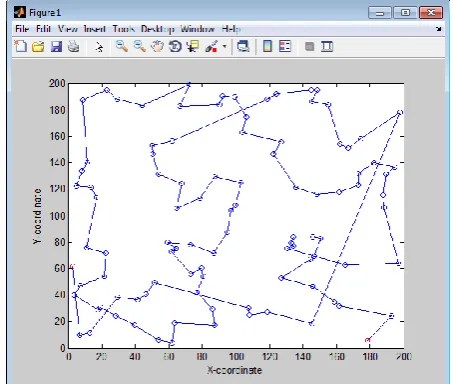
Our enhancement first step is to practically implement the field with nodes close to each other and forming a bond means they are connecting each other. If this is done then we can extend the network lifetime vastly up to above the limit. This can be happen when the nodes are near to each other so that they can combined up or make pair to meet the target. Our target is to send the information or data in the form of messages. But this can only happen when the nodes in field are close to each other. Then chance by chance each and every node become active means one by one they become active and then another one goes on sleep state so that they can send the information to the base station. And by this the theoretically it will prolong the life of the system by increasing the life of sensor nodes. Because while pairing up this or chain forming time their life is suddenly increases that will help our goal to be achieved.
For example if there is field whose dimension is of X, Y coordinate that is of 200m,200m and nodes are 100 then the nodes are connecting each other as they are forming a chain. Then if these nodes are working as chain then there is fast working to meet our goal. All the node which are connecting for example if there are A to Z nodes in chain then there are designed to minimum area or field by that they can extend the lifetime. And by that there will be no misunderstanding of making modes active as the close nodes can never be active at the same time. So this increases the life of sensor nodes too.
4.3 Second Enhancement: In second enhancement we are showing the status of the network. Basically we are very bounded through these but to complete our implementation we have to implement the status of the network that what it consists the sensor nodes are placing in the field with certain dimensions. If the parameter to that varies then the status of the network also varies but we take some parameters for these so that we can implement our further goal to extend the lifetime of the network. So basic parameter for this is shown in table of setting of simulation.
Sensing field(x,y) 100 m 100 m
Number of nodes(N) 100
Service satisfaction threshold 50%
© 2014, IJCSMC All Rights Reserved 648
Table 1 Setting of Simulation
5. RESULTS
Results are being obtained at last on the basis of what implementation is being done so this is the result of our research based on ASS (active sleep scheduling). Here are the result which are divided in to three phases . first is nodes which are close to each other . second the status of the network is being shown . finally there is graph of extended lifetime of network.
First enhancement showing nodes near to each other
.
Probability of node to become head(P) 0.1
Maximum number of rounds (rmax) 200
Range of communication 40 m
Decay factor 60
Time period for reconstructing scheduling (max) 50
© 2014, IJCSMC All Rights Reserved 649
.
Showing the status of the wireless sensor network.
Showing the extended lifetime of network
6. CONCLUSION AND FUTURE WORK
© 2014, IJCSMC All Rights Reserved 650
REFERENCES
[1] Schurgers, Curt and Mani Srivastava. "Energy Efficient Routing in Wireless Sensor Networks." MILCOM'01, Vienna, VA (October 28-31, 2001): 357-361,
[2] Slijepcevic, Sasa and Miodrag Potkonjak. "Power Efficient Organization of Wireless Sensor Networks." IEEE International Conference on Communications (ICC'01), Helsinki, Finland, June 2001 (2001): 472-476,
[3] Chandrakasan, Anantha and Rex Min, Manish Bhardwaj, Seong-Hwan Cho,. "Low Power Wireless Sensor Networks." The 14th Annual Conference on VLSI Design (VLSID'01) (2001): 205
[4] Dong, Qunfeng. “Maximizing System Lifetime in Wireless Sensor Networks”. 2005.
[5] Xing, Guoliang, Chenyang Lu, Ying Zhang, Qingfeng Huang, Robert Pless. “Minimum Power Configuration for Wireless Communication in Sensor Networks”. 2005. Web. February 21, 2011. [6] Chen, Chao-Lieh, Kuan-Rong Lee, Jung-Hsing Wang, Yau-Hwang Kuo. “Energy-proportional routing
for Lifetime Extension of Clustering-based Wireless Sensor Networks”. International Journal of Pervasive Computing and Communications, 2007, Volume 3, Issue 3, pages 304 – 321.
[7] GameTheory.net. Pareto Optimal. April 8, 2011.
[8] Chang, Jae-Hwan, Leandros Tassiulas. “Maximum Lifetime Routing in Wireless Sensor Networks”. 2004. Web. February 21, 2011.
[9] Dagher, Joseph C., Michael W. Marcellin, Mark A. Neifeld. “A theory for maximizing the lifetime of sensor networks”. 2007.