(Thesis format: Monograph)
by
Arif Raza
Graduate Program in Electrical and Computer Engineering
A thesis submitted in partial fulfillment of the requirements for the degree of
Doctor of Philosophy
The School of Graduate and Postdoctoral Studies The University of Western Ontario
London, Ontario, Canada
ii
THE UNIVERSITY OF WESTERN ONTARIO School of Graduate and Postdoctoral Studies
CERTIFICATE OF EXAMINATION
Supervisor
______________________________ Dr. Luiz Fernando Capretz
Supervisory Committee
______________________________
______________________________
Examiners
______________________________ Dr. Ajit Singh
______________________________ Dr. Kamran Sedig
______________________________ Dr. Abdelkader Ouda
______________________________ Mr. Danny Ho
The thesis by
Arif Raza
Entitled:
A Usability Maturity Model for Open Source Software
is accepted in partial fulfillment of the requirements for the degree of
Doctor of Philosophy
iii
Abstract
User satisfaction has always been a major factor in the success of software, regardless of
whether the software is closed proprietary or open source software (OSS). Although
user-centered designs are gaining recognition among the OSS community, many design scenarios
still do not incorporate usability as one of their primary goals. Accordingly, many individuals
believe that if OSS was more usable, its popularity would increase tremendously. Although
there are strong examples of usable open source software, there is still potential to improve
the usability of OSS.
The usability assessment of open source projects is an area where relatively little research has
been conducted, and, accordingly, the main contribution of this work is a methodology that
evaluates the usability maturity of an OSS project. Consequently, we present a usability
maturity model that is aimed at usability-related issues for open source projects. The model
has been developed in response to a need for measuring the extent to which open source
software projects support usability. Specifically, it is intended for assessing and improving
the usability aspect in open source software development.
The proposed model examines the relationship between open source projects and their
usability aspects. The measuring instrument for the model contains factors that have been
selected from four of our empirical studies, which examine the perspectives of OSS users,
developers, contributors and the industry. In addition to presenting the usability maturity
model, this thesis discusses assessment questionnaires, a rating methodology and two case
iv
Keywords
v
Dedicated To My Parents
vi
Acknowledgments
First of all, I am grateful to Allah Almighty for all of His blessings. I am especially thankful for being given the opportunity to carry out my Ph.D. studies. It is my firm belief that this thesis would not have been possible unless I was particularly blessed.
I am extremely thankful for and owe my deepest gratitude to my supervisor, Dr. Luiz Fernando Capretz, whose encouragement, guidance and support throughout all stages of the thesis process enabled me to develop an understanding of the subject. I consider myself fortunate that I had the opportunity to work under his candid supervision.
I owe my sincere gratitude to Dr. Faheem Ahmed of the United Arab Emirates University. He has provided many forms of guidance and tremendous support throughout all the phases of this research work.
Moreover, I would like to show my appreciation to my wife and my children, whose love and reassurance allowed me to return to school and encouraged me through all of the hardships of academia. My sisters and their families are also close to my heart, as I greatly appreciate their moral support and their prayers for my success.
I am particularly thankful to National University of Sciences and Technology (Pakistan), for sponsoring my Ph.D. studies.
I would also like to thank my friends and well-wishers, including Mrs. Linda Munn, Mr. Mark Matsumoto and Mr. Najam Naqvi, who selflessly offered their assistance and supported my endeavor to start a new life in Canada.
vii
Table of Contents
CERTIFICATE OF EXAMINATION... ii
Abstract ... iii
Dedicated To My Parents... v
Acknowledgments... vi
Table of Contents... vii
List of Tables ... x
List of Figures ... xiv
List of Appendices ... xvi
List of Abbreviations and Symbols... xvii
Chapter 1... 1
1 Introduction ... 1
1.1 Open Source Software and Usability... 2
1.2 Research Questions... 4
1.3 Problem Definition... 5
1.4 Research Methodology & Approach ... 7
1.5 Contribution of the Thesis ... 9
1.6 Overview of the Thesis ... 10
Chapter 2... 13
2 Open Source Software Usability Assessment ... 13
2.1 OSS – Definition and Distribution Terms ... 13
2.2 OSS - Quality Issues ... 15
2.3 Usability - General Issues, Assessment and Measurement... 17
2.4 Usability Issues in Open Source Projects ... 19
viii
2.6 Software Process Assessment Models ... 28
2.7 Existing Usability Maturity Models... 32
Chapter 3... 37
3 Users’ Perspective of Open Source Usability: An Empirical Study... 37
3.1 Usability Factors from the Perspective of Users: Literature Review of Concepts 37 3.2 Research Model and Hypotheses ... 40
3.3 Research Methodology ... 42
3.4 Hypotheses Testing and Results ... 47
3.5 Critical Analysis of the Study ... 52
Chapter 4... 56
4 Open Source Software Usability: An Empirical Evaluation from the Developers’ Perspective ... 56
4.1 Usability Factors from the Perspective of Developers: A Literature Survey ... 56
4.2 Hypotheses Model ... 60
4.3 Research Methodology ... 62
4.4 Empirical Analysis and Findings ... 68
4.5 Discussion of the Results ... 72
Chapter 5... 77
5 Contributors’ Viewpoint of Open Source Software Usability: An Empirical Study... 77
5.1 Usability Factors: Literature Review of Concepts... 77
5.2 Research Organization and Hypotheses... 80
5.3 Research Methodology ... 81
5.4 Study Results ... 86
5.5 Study Discussion... 90
Chapter 6... 94
ix
6.1 Literature Review of Key Factors... 94
6.2 Study Model and Hypothesis ... 95
6.3 Research Methodology ... 97
6.4 Hypothesis Testing and Results ... 102
6.5 Discussion of Results... 105
Chapter 7... 109
7 An Open Source Usability Maturity Model (OS-UMM)... 109
7.1 Framework of OS-UMM ... 109
7.2 Performance Scale and Rating Methodology ... 126
7.3 Reliability and Validity Analysis of Questionnaires ... 128
7.4 Case Studies ... 131
7.5 Discussion ... 139
Chapter 8... 141
8 Conclusions and Future Work... 141
8.1 Major Contributions... 141
8.2 Conclusions... 142
8.3 Future Work ... 144
References... 146
Appendix A... 154
Appendix B ... 155
Appendix C ... 156
x
List of Tables
Table 2.1 Open Source Distribution Terms ···13
Table 2.2 Relations between factors and criteria in QUIM ···26
Table 2.3 Capability Maturity Levels in CMM, SPICE and CMMI ···31
Table 2.4 Maturity Levels and Process Attributes···32
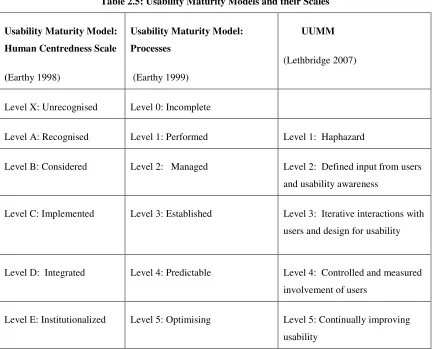
Table 2.5 Usability Maturity Models and their Scales ···35
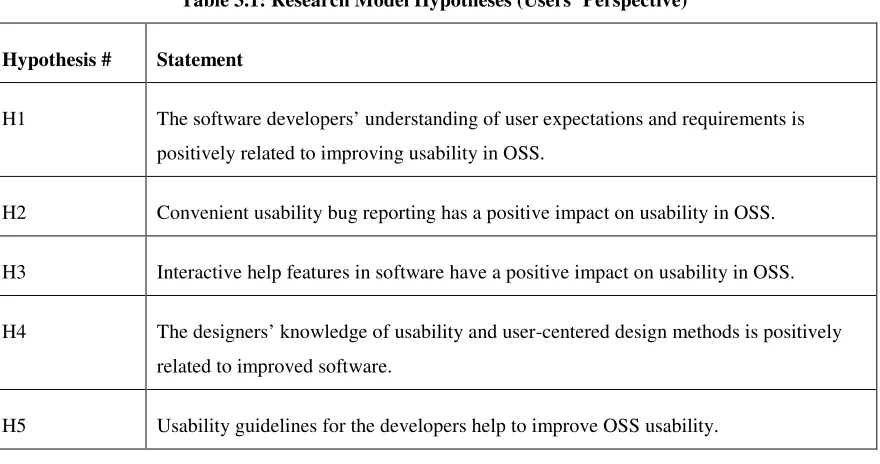
Table 3.1 Research Model Hypotheses (Users’ Perspective) ···42
Table 3.2 Users’ Expectations Measurement Instrument ···44
Table 3.3 Usability Bug Reporting and Fixing Measurement Instrument···44
Table 3.4 Interactive Help Features Measurement Instrument ···44
Table 3.5 Usability Learning Measurement Instrument ···45
Table 3.6 Usability Guidelines for OSS Developers Measurement Instrument ··45
Table 3.7 OSS Usability Measurement Instrument ···45
Table 3.8 Coefficient Alpha and Principal Component Analysis of variables (Users’ Perspective)···46
Table 3.9 Hypotheses testing using parametric and non-parametric correlation coefficients (Users’ Perspective) ···49
Table 3.10 Hypotheses testing using Partial Least Square regression (Users’ Perspective)···50
Table 3.11 Multiple Linear Regression Analysis of the User Model ···51
xi
Table 4.2 Users’ Requirements Measurement Instrument···64
Table 4.3 Usability Experts’ Opinions Measurement Instrument ···65
Table 4.4 Incremental Design Approach Measurement Instrument ···65
Table 4.5 Usability Testing Measurement Instrument···65
Table 4.6 Knowledge of UCD Methods Measurement Instrument ···66
Table 4.7 OSS Usability Measurement Instrument ···66
Table 4.8 Coefficient Alpha and Principal Component Analysis of variables (Developers’ Perspective) ···67
Table 4.9 Hypotheses testing using parametric and non-parametric correlation coefficients (Developers’ Perspective) ···70
Table 4.10 Hypotheses testing using PLS regression (Developers’ Perspective) ···71
Table 4.11 Multiple Linear Regression Analysis of the Research Model (Developers’ Perspective) ···72
Table 5.1 Study Model Hypotheses (Contributors’ Viewpoint) ···81
Table 5.2 User’s Feedback Measurement Instrument···83
Table 5.3 Usability at Architectural Level Measurement Instrument···83
Table 5.4 Design Techniques Measurement Instrument···83
Table 5.5 Usability Assessment Measurement Instrument···84
Table 5.6 Documentation Measurement Instrument···84
Table 5.7 OSS Usability Measurement Instrument ···84
xii
Table 5.9 Hypotheses testing using Pearson correlation and Spearman correlation
coefficients (Contributors’ Viewpoint)···88
Table 5.10 Hypotheses testing using PLS regression (Contributors’ Viewpoint) ···89
Table 5.11 Multiple Linear Regression Analysis of the Study Model (Contributors’ Viewpoint) ···90
Table 6.1 Study Model Hypotheses (Industrial Perspective)···96
Table 6.2 UnderstandabilityMeasuring Instrument···99
Table 6.3 LearnabilityMeasuring Instrument···99
Table 6.4 OperabilityMeasuring Instrument ···99
Table 6.5 AttractivenessMeasuring Instrument ···99
Table 6.6 OSS Usability Measuring Instrument ···100
Table 6.7 Coefficient Alpha and Principal Component Analysis of Variables (Industrial Perspective) ···101
Table 6.8 Hypotheses testing using parametric and non-parametric correlation coefficients (Industrial Perspective) ···103
Table 6.9 Hypotheses testing using PLS regression (Industrial Perspective)···104
Table 6.10 Multiple Linear Regression Analysis of the Study Model (Industrial Perspective)···105
Table 7.1 Configuration of OSS Usability Assessment Methodology ···111
Table 7.2 Framework of OS-UMM ···126
Table 7.3 Performance Scale ···127
xiii
Table 7.5 Reliability Analysis of Usability Factors using Coefficient Alpha ···130
Table 7.6 Convergent Validity of Usability Factors using Eigen Value-1 ···131
Table 7.7 Details of Assessment Results of Case Study A···133
Table 7.8 Details of Assessment Results of Case Study B ···135
Table 7.9 Summary of Assessment Results of Case Studies ···137
Table 7.10 The Inter-Rater Agreement Analysis of Project A ···138
xiv
List of Figures
Figure 1.1 OSS Usability Maturity Model - Research Phase I ···8
Figure 1.2 OSS Usability Maturity Model - Research Phase II···9
Figure 1.3 OSS Usability Maturity Model - Research Phase III ···9
Figure 2.1 A Comprehensive Model of Usability···23
Figure 2.2 Revised Usability Model ···27
Figure 2.3 Usability Engineering Process Model – UEPM ···28
Figure 2.4 Capability Maturity Model – CMM® Structure···29
Figure 2.5 CMM Maturity Framework: Five Levels ···30
Figure 2.6 Entity relationship diagram of the model ···33
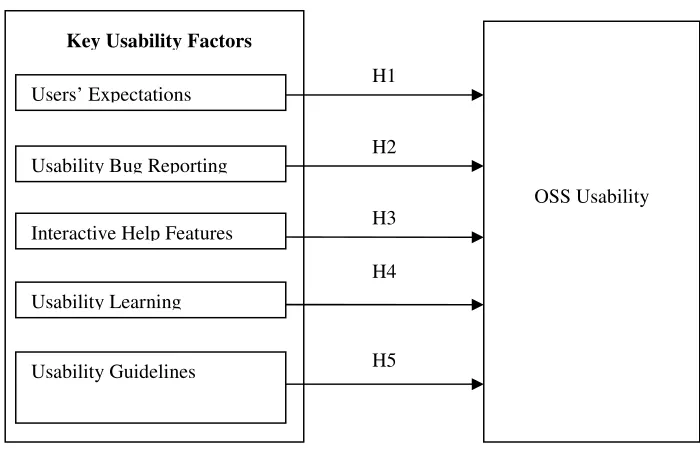
Figure 3.1 Research Model (Users’ Perspective) ···41
Figure 3.2 Respondents’ Distribution ···42
Figure 3.3 Experience of Users···43
Figure 4.1Research Model (Developers’ Perspective) ···61
Figure 4.2 Pie chart of Software Category ···63
Figure 4.3 Experience of OSS Developers ···63
Figure 4.4 OSS Development Teams···64
Figure 5.1 Study Model (Contributors’ Viewpoint) ···80
xv
Figure 6.1 Study Model (Industrial Perspective) ···96
xvi
List of Appendices
Appendix A Screen Shot of Empirical Study Survey ···154
Appendix B Screen Shot of OS-UMM Survey···155
xvii
List of Abbreviations and Symbols
OSS Open Source Software···iii
OS-UMM Open Source Usability Maturity Model···1
HTTP Hypertext Transfer Protocol···2
QA Quality Assurance ···3
ISO/IEC The International Organization for Standardization and the International Electrotechnical Commission ···3
HCI Human Computer Interaction···4
RQ Research Question···4
OSI Open Source Initiative···13
IS Information Systems ···17
SE Software Engineering···17
QUIM Quality in Use Integrated Measurement ···25
UEPM Usability Engineering Process Model···27
CMM Capability Maturity Model···29
SEI Software Engineering Institute···29
KPA Key Process Areas···29
SPICE Software Process Improvement and Capability dEtermination ···30
CMMI Capability Maturity Model Integration ···30
xviii
SECM Systems Engineering Capability Model···30
IPD-CMM Integrated Product Development Capability Maturity Model ···30
HCD Human Centred Development···34
UUMM User and Usability Maturity Model ···34
UI User Interface ···38
CS Computer Science ···39
HIG Human Interface Guidelines ···40
PCA Principal Component Analysis···46
PLS Partial Least Square···47
GUI Graphical User Interface ···53
UCD User-Centered Design ···59
UR Users’ Requirements ···112
UFB Users’ Feedback ···112
UL Usability Learning···112
U Understandability ···112
L Learnability ···112
O Operability···112
Att Attractiveness···112
UBR Usability Bug Reporting ···112
xix
D Documentation ···112
UF Usability Factor···112
ML Maturity Level···112
S Statement···112
UN Usability Factor Number···112
URt Usability Rating ···127
NF Number of Fulfilled Statements ···127
PT Passing Threshold ···127
UML Usability Maturity Level ···127
Chapter 1
1
Introduction
The use of free and open source software has increased significantly in recent years, mainly due to the accessibility and availability of the Internet. However, OSS has experienced a number of challenges, including geographically distributed developers, minimal documentation and post release software management. In addition, the
experience of end users has become an important issue. With a significant increase in the use of OSS by both individuals and organizations, the level of usability and its related issues must be addressed more thoroughly. However, the usability aspects of open source software cannot be improved unless there are ways to test and measure these aspects. The increasing popularity of open source projects among novice, non-technical users
necessitates a usability evaluation methodology. Paulk et al. (1995) maintain that process maturity is the extent to which an organization is able to define, manage, measure, and control a specific process. Accordingly, the main purpose of this research is to study the usability issues of OSS projects from the perspective of different stakeholders.
Specifically, the main goals of this research are:
1. To identify the factors that can improve OSS usability.
2. To use the identified key factors as a measuring instrument in presenting the Usability Maturity Model for assessing the usability of OSS projects.
3. To apply the Open Source Usability Maturity Model (OS-UMM) for assessing the current maturity of OSS projects.
from four dimensions, which are based on the perspectives of OSS developers, users, contributors, which include architects, designers, developers, testers, and users, as well as the industry. Consequently, the model is used to assess the current maturity of an OSS project by defining an assessment methodology and conducting case studies. Once the assessment results of the individual dimensions are evident, the methodology for
evaluating an OSS project’s usability maturity profile is utilized as an integral feature of OS-UMM.
Overall, this research work presents a usability maturity model for open source projects. In particular, it provides a methodology for evaluating the current usability maturity of an OSS project. Therefore, this work contributes towards the establishment of a
comprehensive and integrated strategy for the usability maturity evaluation of OSS projects. The Usability Maturity Model will assist OSS designers and developers in conducting usability assessments of their projects, thus enhancing their ability to plan improvement strategies.
1.1 Open Source Software and Usability
Open source software refers to software that is equipped with licenses providing current and future users with the right to use, inspect, modify, and distribute modified or
unmodified versions of the software to others (Raymond 1999). Raymond maintains that the development culture of OSS, along with the concept of providing free access to the software and its source code, raises the status of OSS to that of a phenomenon.
OSS has influenced almost every dimension of the software development area, thus indicating its significant progress and development. The most successful examples of this influence include the GNU/Linux operating system, the Apache HTTP server, the
assurance (QA) as well as the post-release management of OSS projects are some of the areas where closed source proprietary software is superior.
The International Organization for Standardization and the International Electrotechnical Commission ISO/IEC 9126-1 (2001) classifies software quality attributes into six
categories: functionality, reliability, usability, efficiency, maintainability and portability. Bevan (2009), in referring to the international standards for usability, states that “these standards provide a great way to integrate usability with quality, but do not help if
quality is a low priority in your organization.” Additionally, he identifies four
human-centered activities for software design, which include understanding and specifying the context of use, specifying the user requirements, the design solutions and the evaluation.
The users of open source software have free access as well as the ability to modify the source code (Aberdour 2007). Nevertheless, it is likely that usability is the least
addressed area in OSS research and development. Traditionally, OSS was designed for technically adept users, thus resulting in a lack of distinction between developers and users. Consequently, usability has never been a top priority for OSS developers. However, OSS is no longer used solely by computer developers; the number of non-technical and novice computer users are growing at a fast pace, highlighting the necessity of understanding and addressing their requirements and expectations (Iivari 2009-a). Accordingly, the usability element of OSS is challenged by the variety of users, who have both technical and non-technical backgrounds as well as cultural diversity, possessing unique needs, expectations and demands. Nichols and Twidale (2005) address another reason as to why usability aspects are neglected in favor of functionality issues; the latter possess more challenges and recognition factors from the community. According to these authors, “the existence of a problem does not necessarily mean that all OSS interfaces are bad or that OSS is doomed to have hard to use interfaces, just a recognition that the
interfaces ought to be and can be made better.”
context of use.” Furthermore, they suggest the need for expert opinions as well as
realistic user feedback at an earlier OSS design stage. According to Çetin and Göktürk (2008), OSS usability is a multidimensional problem area, particularly due to the fact that it is not a primary goal of OSS projects; OSS developers are not aware of the importance of usability and of users’ requirements, and there is a lack of interaction between the developers and the Human Computer Interaction (HCI) Community. Moreover, Hedberg et al. (2007) state that the target users of OSS projects are no longer only co-developers; consequently, OSS systems need to be designed to meet the requirements, expectations and demands of non-technical users.
1.2 Research Questions
The experience of end users has profound impacts on the success of software projects; hence, usability and its related issues has been a key area of research in the open source community. In order to identify precisely where improvement is required, assessment needs to be conducted. OSS is a relatively new software arena, as traditionally, software was produced “by engineers for engineers” (Benson et al. 2004). However, with the continual increase in the number of both technical and non-technical OSS users, OSS usability evaluation requires a comprehensive strategy that has not yet been fully explored.
Therefore, the main purpose of this research is to find answers to a series of formulated research questions in order to fill the research gap in the area of open source software usability assessment. The answers to these questions would thus provide a comprehensive methodology for assessing the usability maturity of open source software projects. The following seven research questions compose the theme of this thesis:
RQ-1: What are the key factors that influence the usability of open source software projects from the perspective of users?
RQ-3: From the perspective of OSS contributors, what are the key factors that affect OSS usability?
RQ-4: What are the key factors that contribute towards the maturity assessment of OSS usability from the perspective of the industry?
RQ-5: Are we able to develop a methodology to assess the usability maturity of an open source software project?
RQ-6: Can specific scales represent the extent of usability maturity in an OSS project?
RQ-7: Can we develop a methodology for evaluating the project’s usability maturity level once the assessment results are manifested?
Thus, the answers to the above questions will hopefully provide a comprehensive methodology for performing the usability maturity assessment of OSS projects. In particular, the answers to each individual question will lead to a combination and integration of answers that will solve the overall research problem. For example, the answers to the first four questions provide us with a measuring instrument for assessing the usability maturity of OSS projects. Furthermore, the answers to RQ-5 and RQ-6 foresee the development of the usability maturity model and its related scales, while RQ-7 will provide the rating methodology.
1.3 Problem Definition
This section proposes a usability assessment framework to develop a comprehensive strategy for an OSS project maturity model. Specifically, the framework identifies various maturity scales for the individual dimensions of users, developers, contributors and the industry. The important steps of the research include:
• Problem Identification – I-a: Empirical investigation of the key factors from
the perspective of users
• Problem Identification – I-b: Empirical investigation of the key factors from the perspective of developers
• Problem Identification – I-c: Empirical investigation of the key factors from
the perspective of contributors
• Problem Identification – I-d: Empirical investigation of the key factors from
the industrial perspective
• Problem Identification – II: Development of a “Usability Maturity Model” for open source software projects: OS-UMM
• Problem Identification – II-a: Development of maturity scales for assessing
OSS usability
• Problem Identification – II-b: Assessment Questionnaires for all usability
factors in each maturity scale of OS-UMM
• Problem Identification – II-c: Development of rating methodology for OS-UMM
• Problem Identification – III: Application of Usability Maturity Model for
assessing the current maturity of an OSS project
• Problem Identification – III-a: Definition of Assessment Methodology
• Problem Identification – III-b: Case Studies
1.4 Research Methodology & Approach
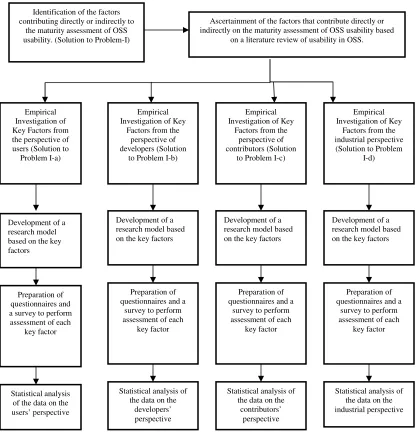
Our main objective is to develop a Usability Maturity Model for the assessment of an OSS project. As demonstrated below, Figures 1.1, 1.2 and 1.3 illustrate our research plan to develop the Usability Maturity Model for an OSS project; each stage defines the research objectives and the milestones. We plan to address the three problems identified in Section 1.3 by providing appropriate solutions. Our research methodology includes a comprehensive literature review for defining the maturity level scales based on the key factors of OSS usability and the assessment approach to derive the scales intuitively.
Figure 1.1: OSS Usability Maturity Model - Research Phase I
Identification of the factors contributing directly or indirectly to
the maturity assessment of OSS usability. (Solution to Problem-I)
Ascertainment of the factors that contribute directly or indirectly on the maturity assessment of OSS usability based
on a literature review of usability in OSS.
Development of a research model based on the key factors
Preparation of questionnaires and a survey to perform assessment of each
key factor
Statistical analysis of the data on the users’ perspective
Empirical Investigation of Key Factors from the perspective of users (Solution to Problem I-a)
Empirical Investigation of Key
Factors from the perspective of developers (Solution
to Problem I-b)
Empirical Investigation of Key
Factors from the perspective of contributors (Solution
to Problem I-c)
Empirical Investigation of Key
Factors from the industrial perspective (Solution to Problem
I-d)
Development of a research model based on the key factors
Development of a research model based on the key factors
Development of a research model based on the key factors
Preparation of questionnaires and a
survey to perform assessment of each
key factor
Preparation of questionnaires and a
survey to perform assessment of each
key factor
Preparation of questionnaires and a
survey to perform assessment of each
key factor
Statistical analysis of the data on the
developers’ perspective
Statistical analysis of the data on the
contributors’ perspective
Figure 1.2 illustrates Phase II of our research plan for addressing the solution to Problems II, II-a, II-b and II-c, as identified in Section 1.3.
Figure 1.2: OSS Usability Maturity Model - Research Phase II
Figure 1.3 illustrates Phase III of our research plan for addressing the solution to Problems III, III-a, III-b and III-c, as identified in Section 1.3.
Figure 1.3: OSS Usability Maturity Model - Research Phase III
1.5 Contribution of the Thesis
The assessment of open source usability is an important area of research, and a lot of work needs to be done in order to establish a comprehensive and unified strategy for
Development of a “Usability Maturity Model” for OSS
(Solution to Problem-II)
Development of maturity scales for the usability of OSS on the basis of research models from Phase-1
(Solution to Problem II-a)
Preparation of questionnaires and guidelines for performing the usability assessment of OSS
(Solution to Problem II-b)
Development of rating methodology (Solution to Problem II-c)
Application of the Usability Maturity Model of OSS for assessing the current maturity of an OSS project.
(Solution to Problem-III)
Collection and interpretation of assessment data (Solution to Problem III-c)
Case studies (Solution to Problem III-b) Development of assessment methodology
evaluating the maturity of usability in an OSS. Accordingly, this research contributes towards OSS usability assessment in the following ways:
1. An identification of the factors contributing directly or indirectly to the maturity assessment of OSS usability.
2. Empirical evaluation and validation of key factors from the perspective of different stakeholders, including OSS users, developers, contributors and the industry.
3. The development of an open source usability maturity model using the empirically validated key factors as a measuring instrument.
4. The application of OS-UMM for assessing the current maturity of an OSS project.
1.6 Overview of the Thesis
The organization of this thesis is based on five articles that have been published or are currently under review in software engineering journals. These papers are cited
accordingly in the corresponding chapters. In Chapter 2, we present the definition of OSS and distribution terms as well as provide a literature review that is related to OSS quality issues. Additionally, we discuss general issues related to usability as well as a literature review of usability assessment and measurement. Lastly, we examine usability issues in open source projects and provide a brief review of existing usability and maturity assessment models that motivated this research.
Chapter 3 presents an empirical investigation for studying the impact of key factors on OSS usability from the perspective of end users, establishing the relationship between the key usability factors from the viewpoint of end users and OSS usability. The study
provides justification for considering these key factors as a measuring instrument for a maturity model that assesses the usability of open source software projects.
OSS developers need to consider several key usability factors in order to improve the general usability aspects of software as well as their specific projects. Accordingly, Chapter 4 presents a research model of an empirical investigation that establishes a relationship between the key usability factors from the perspective of developers and OSS usability. This study is among a series of four studies that are conducted for the improvement of OSS usability from the viewpoints of OSS developers, users,
contributors and the industry. The results of this investigation show that the key factors in our research model assist in improving OSS usability.
Chapter 5 presents an empirical investigation for studying the impact of several key factors on OSS usability from the perspective of contributors, including architects, designers, developers, testers and users. In this study, we investigate the effects of key usability factors on OSS usability and discover answer to the research question stated in this investigation. The study shall enable OSS development teams to improve their understanding of the relationship between the key factors and the usability of their projects.
Although user-centered designs are gaining popularity in OSS, many design scenarios still do not consider usability as one of their primary goals. Accordingly, Chapter 6 presents a research model of the study establishing a relationship between the key
usability factors and OSS usability from the industrial perspective. This research study is the fourth in the series of our empirical investigations, in which we analyze the impact of the key usability factors, including understandability, learnability, operability and
attractiveness, on OSS usability. Indeed, these four key factors have been incorporated from the standard ISO/IEC 9126-1 (2001). The empirical results of our study strongly support the hypotheses that understandability, learnability, operability and attractiveness have a positive impact on the usability of OSS projects.
between open source projects and their usability aspects. The measuring instrument of the model contains factors that have been selected from four of our empirical studies, which examine the perspectives of OSS users, developers, contributors and the industry. In addition to presenting the usability maturity model, this chapter discusses assessment questionnaires, a rating methodology and two case studies.
Chapter 2
2
Open Source Software Usability Assessment
The use of free and open source software has increased significantly in recent years, largely due to the accessibility and availability of the Internet. Although it is generally believed that OSS is used mostly by technically adept users, obscuring the boundary between the developers and users, most users of OSS are actually novice or non-technical users. Thus, three challenges for improving OSS usability include gaining a better
understanding of users’ expectations through empirical investigation, adapting new approaches to OSS designs, and quantifying usability metrics.
2.1 OSS – Definition and Distribution Terms
Open source refers to the use of shared source codes, open standards, and collaboration among software developers and users worldwide for building software, identifying and correct errors, and making enhancements (O’Reilly 1999). According to Hansen et al. (2002), OSS means that “the source code is distributed along with the executable
program. It is free to use. It includes a license allowing anyone to modify and redistribute
the software.” Open Source Initiative (OSI) is a non-profitable corporation with the aim
of enhancing awareness about OSS and its benefits. According to OSI, OSS is not only about free access to the source code. Rather, a specific set of criteria, provided in Table 2.1, must be met in order to fulfill the distribution terms of open-source software.
1. Free Redistribution
The license shall not restrict any party from selling or giving away the software as a component of an aggregate software distribution containing programs from several different sources. The license shall not require a royalty or other fee for such sale.
2. Source Code
The program must include source code, and must allow distribution in source code as well as compiled form. Where some form of a product is not distributed with source code, there must be a well-publicized means of obtaining the source code for no more than a reasonable reproduction cost preferably, downloading via the Internet without charge. The source code must be the preferred form in which a programmer would modify the program. Deliberately obfuscated source code is not allowed. Intermediate forms such as the output of a preprocessor or translator are not allowed.
3. Derived Works
The license must allow modifications and derived works, and must allow them to be distributed under the same terms as the license of the original software.
4. Integrity of The Author's Source Code
The license may restrict source-code from being distributed in modified form only if the license allows the distribution of "patch files" with the source code for the purpose of modifying the program at build time. The license must explicitly permit distribution of software built from modified source code. The license may require derived works to carry a different name or version number from the original software.
5. No Discrimination Against Persons or Groups
6. No Discrimination Against Fields of Endeavor
The license must not restrict anyone from making use of the program in a specific field of endeavor. For example, it may not restrict the program from being used in a business, or from being used for genetic research.
7. Distribution of License
The rights attached to the program must apply to all to whom the program is redistributed without the need for execution of an additional license by those parties.
8. License Must Not Be Specific to a Product
The rights attached to the program must not depend on the program's being part of a particular software distribution. If the program is extracted from that distribution and used or distributed within the terms of the program's license, all parties to whom the program is redistributed should have the same rights as those that are granted in conjunction with the original software distribution.
9. License Must Not Restrict Other Software
The license must not place restrictions on other software that is distributed along with the licensed software. For example, the license must not insist that all other programs
distributed on the same medium must be open-source software.
10. License Must Be Technology-Neutral
No provision of the license may be predicated on any individual technology or style of interface.
2.2 OSS - Quality Issues
that many organizations are still reluctant to use open source software, mainly due to “an inherent distrust of OSS quality.” However, according to these authors, the use of OSS,
especially in comparison to closed proprietary software, produces a higher quality of software.
Due to the involvement of and acceptance by big commercial IT vendors, OSS products have progressed from a fringe activity to enter into the mainstream (Fitzgerald 2006). von Krogh and Spaeth (2007) argue that the possession of an open license is one of the major reasons for the existence of OSS. Specifically, they believe that in order to maximize the efficiency of this open source phenomena, “information systems research should remain open to dialog with other areas and disciplines.” Levesque (2005) argues that OSS must
address issues such as user interface design, documentation, feature-centric development, self-programming and “religious blindness” in order to be widely accepted.
However, Polancic et al. (2004) question the quality of OSS projects, proposing an assessment model for evaluating these products. Paulson et al. (2004) maintain that defects are found and fixed more rapidly in OSS as compared to closed source software products. In their empirical findings, Capra et al. (2008) suggest that “quality, mainly measured in terms of coupling and inheritance, is a must in OS projects to enable more
open governance mechanisms, which, in turn, increase development effort, while quality
per se does not increase effort.” Koch and Neumann (2008) explore the influence of
different forms of OSS development processes on the resulting software and verify their effects on different quality aspects. These authors attempt to ascertain whether different variants of OSS development processes significantly influence the resulting products, analyzing “the impact on quality and design associated with the numbers of contributors and the amount of their work, using the GINI coefficient as a measure of inequality
within the developer group.”
Zhao and Elbaum (2003) investigate the relationship between the unique features of OSS and software quality. In particular, they examine how software quality assurance is performed in the OSS environment, how is it different from traditional software
better quality OSS products. The outcome of their study demonstrates that a new
dimension in large-scale distributed software development has occurred as a result of the OSS development approach. By developing an OSS success model from an existing Information Systems (IS) model, Lee et al. (2009) identify the determinants for OSS success and conclude that “software quality and community service quality have
significant effects on user satisfaction.” Furthermore, they recommend that “usefulness,
ease of use, and reliability” are some of the major factors that OSS practitioners should
heed in order to improve OSS quality.
Although OSS products are ultimately dependent on the skills of the developers, Hedberg et al. (2007) believe that high-quality software can be produced by OSS. Similarly, Michlmayr et al. (2005), argue that to some extent, OSS applications meet the
expectations and quality requirements of users. However, these authors emphasize the need for empirical investigations to study quality related problems in OSS. Specifically, they argue that OSS “is an area where synergies between the academic world and the free software community may be possible. The implementation of quality improvement
strategies also requires tools and metrics to measure and assess different aspects of
quality.”
We can thus conclude here that although there are many examples of high quality OSS, quality-related issues need to be addressed at a high priority.
2.3 Usability - General Issues, Assessment and
Measurement
In the ISO 9241-11 (1997) Standard, usability is defined as “the extent to which a product can be used by specified users to achieve specified goals with effectiveness,
efficiency and satisfaction in a specified context of use.” However, ISO/IEC 9126-1
(2001), states that usability is “the capability of the software product to be understood, learned, used and attractive to the user, when used under specified conditions.”
the user-centered design techniques that are developed by HCI teams, as developers often have specific usability techniques that they have created. According to these authors, these two communities could achieve a harmonious coexistence if these obstacles could be realized and hence avoided. In order to understand and overcome such obstacles, a forum should be created to share ideas between the two fields so that a cohesive relationship can be built between them.
Te’eni (2007) maintains that for thirty years, organizational tasks and contexts have been the main focus of management information systems. Consequently, research should be conducted to determine which higher level tasks users wish to perform and how users interact with the computer to achieve these tasks. Koppelman and Dijk (2006) focus on the role of clients and users in projects. Specifically, they discuss issues such as learning to deal with different stakeholders who view the product from different perspectives, communicating with these various groups and involving the users and clients in the design process. In their examination, they suggest that the designers should not simply rely on their own experiences and instincts.
Aspects of usability cannot be improved unless there are ways to test and measure them. While studying current practices in usability measurement, Hornbaek (2006)
acknowledges the fact that usability cannot be directly measured. He identifies several challenges to usability measurement, such as understanding the relationship between objective and subjective measures of usability, measuring learnability, extending
satisfaction measures beyond post-use questionnaires and studying correlations between different measures. In discussing two usability case studies, Craven and Booth (2006) state that “cognitive walkthroughs, heuristic evaluation, expert usability evaluations and usability audits, are often directed more towards expert usability testing rather than
managing the user testing in-house.” Miller (2006) considers usability testing as a
process that starts with a project’s beginning and continues through prototyping,
completion, and even after releasing. He maintains that “just because the project is done doesn’t mean the project’s usability work is finished.” Moreover, he believes that in such
usability testing and rational product processes. Çetin and Göktürk (2008) observe that although software testing traditionally consumes considerable time, there is a limited amount of formal testing conducted by OSS developers. Furthermore, the authors realize that usability is a non-functional quality attribute, and, as it is a “subjective” matter, it cannot be measured directly. Lastly, they maintain that OSS developers need to recognize the usability level of their projects.
Golden et al. (2005) support the idea of addressing usability issues at the software architecture design level. They insist that the separation of usability concerns from functionality at the architecture level is ineffective, even when the intention is to consider usability issues at a later testing stage. Rather, this approach leads to extensive
re-structuring and even the “re-architecting of software systems.”
2.4 Usability Issues in Open Source Projects
In the future, OSS is expected to have an increasing diversity of users, including those with technical and non-technical backgrounds as well as those from varying cultures, each with their own needs, expectations and demands. Even in the environment of closed proprietary software, usability is a complicated issue; however, in OSS, it is even more difficult, especially considering that the domain is relatively newer with developers working on a voluntarily basis and where there is generally no HCI or usability expert.
While examining usability practices in OSS, Nichols and Twidale (2006) highlight the need to address usability issues more arduously. These authors discuss the failure of certain commercial closed source software projects, which result from unusable systems or poor handling usability issues. Specifically, they believe that these failures are an indication of usability being an “unresolved” issue even in proprietary software, which is considered more usable than OSS, as closed source software is more mature than OSS, and it is equipped with more resources, both in terms of experienced manpower and financial resources. According to the authors, “research in open source usability has the potential to be valuable to all kinds of software development, not just OSS.” In their
Aberdour (2007) contrasts the “formal and structured testing” that is typical in closed software development with the “unstructured and informal testing” in OSS development. On the other hand, Hedberg et al. (2007) maintain that the processes of “test coverage, test-driven development and testing performed by developers” require more attention in
OSS projects through formal and detailed test plans that ensure errors are caught before the release of the software. Andreasen et al. (2007) argue that remote usability testing is very relevant in an OSS environment. Specifically, they believe that remote usability testing has the potential to cross geographical and organizational boundaries for supporting OSS development.
Viorres et al. (2007) highlight a general trend in OSS development; instead of following the software engineering practice of design, specifications, testing and prototyping, most OSS systems incorporate a “bottom-up” approach that focuses on the development of technical issues and individual components. In this approach, system modeling, as well as the user interface and related issues, are a lower priority. Otte et al. (2008) discuss the structured defect handling processes, where there is a significant use of configuration and bug tracking tools. Specifically, they highlight the high rate of user participation, user testing and peer reviews in OSS projects.
Çetin and Göktürk (2007) believe that traditionally, usability and user-centric designs have been challenging in open source software. Nevertheless, they indicate their optimistic belief that usability is beginning to become institutionalized in open source projects. They also refer to lack of user-centered design in an OSS development
environment, arguing that that there is a need for more collaboration between interaction designers and OSS developers as well as contributions from usability expert in order to improve the overall quality of OSS.
According to Feller and Fitzgerald (2000), OSS users have traditionally been the developers, testers, documenters or field experts, resulting in an overlap between
usability. Specifically, they maintain that the requests of experienced OSS users do not necessarily reflect the requirements of non-experienced users. These authors emphasize the importance of building effective communication systems for involving novice users and endowing them with usability knowledge. Similarly, Bodker et al. (2007) perceive the lack of user-friendly products in OSS as a serious threat towards its popularity, arguing that this paucity results because OSS developers do not have a complete
understanding of user situations. In their empirical study, Andreasen et al. (2006) found that although OSS developers realize the importance of end users, they still fail to prioritize usability related issues. Specifically, these authors state that “currently, most developers have a very limited understanding of usability. Moreover, there is a lack of
resources and evaluation methods fitting into the OSS paradigm.” Similarly, Yunwen
and Kishida (2003) stress the need for more interaction between software users and developers, suggesting that OSS projects can succeed with the development of a collaborative platform between the two communities. These authors realize that OSS differs from closed proprietary software in more ways than the user having free access and the right to modify a source code. Rather “the fundamental difference is role transformation of the people involved in the project.” Unlike closed source software
projects, the OSS development environment does not clearly and strictly define the boundaries between users and developers.
Porter et al. (2006) observe the inconsistency in open source software, which mainly results from “short feedback loops between users and core developers.” They believe that the frequent release of beta versions frustrates many users who would prefer more stable software. They also identify unsystematic and undocumented software testing in OSS. In their empirical study, Stamelos et al. (2002) conclude that user satisfaction is related to the average size of components in an open source application. In addition, they support the idea of OSS having its own quality standards. Similarly, Crowston et al. (2003) emphasize that the measurement of success and quality of an OSS project is necessary, as millions of users are dependent on OSS systems. In particular, they
these factors include the number of users, the quality of codes and documentation, the user ratings, the downloads, and the reuse of code.
Hedberg et al. (2007) consider usability as a research area in OSS that needs to be examined. Specifically, they state that “user feedback should be sought early, and the design solution should be iterated based on the user feedback.” Moreover, they associate
the improvement in OSS quality with usability and with issues related to “naïve, non computer professional” users, who, according to these authors, are increasing on a daily
basis, and hence, their expectations are also increasing. These authors observe that since software developers are neither paid nor have any formal authority, the only means of assuring OSS quality is their commitment. They also highlight a few problem areas, such as the obscure distinction between users and developers, the lack of usability knowledge in typical OSS developers and the absence of HCI personnel or usability experts in the development of an OSS project.
2.5 Existing Usability Models
A literature survey of existing work in this research area reveals many usability models. However, the vast majority of these models do not provide validation for their proposed metrics or they are not specifically aimed at issues related to open source projects.
2.5.1
A Comprehensive Model of Usability by Winter et al. (2008)
Winter et al. (2008) propose a two-dimensional usability model relating system properties to user activities. The authors claim that their model “fosters preciseness and
completeness”, “serves as a central and structured knowledge base for the entire quality
assurance,” provides a basis for analysis and measurement and describes the system’s
Figure 2.1: A Comprehensive Model of Usability (Winter et al. 2008)
This model separates system properties and activities, thus specifically describing quality attributes and their related impact on the use of software. Furthermore, the model
distinguishes between facts and attributes; facts are a way of hierarchically depicting the system use without quality criteria, whereas attributes provide the facts with low-level quality criteria, such as consistency, ambiguousness or existence. Specifically, the model hierarchically decomposes user activities as part of the interaction with the system. Based on ISO 9126-4, the usability quality model makes use of “Efficiency” as -the utilization of resources, “Effectiveness” as the sharing of successful tasks, “Satisfaction” as the enjoyment of product use and “Safety” for defining the usability goals of the system. The root node “use” shown in the activity tree of the usability model denotes any use of the software-based system. The two offspring of the root node are “execution of secondary tasks” and “interacting with the product.” The “execution of secondary tasks” deals
with all additional user tasks that are not directly related to the software product, and the activity “interacting with the product” is further decomposed into seven stages of action. A case study has been presented in order to evaluate this usability model using the ISO 15005 Standard.
2.5.2
A Measurement Based Framework for Assessment of
Usability-Centricness of Open Source Software Projects by
Çetin and Göktürk (2008)
Çetin and Göktürk (2008) maintain that OSS usability aspects cannot be improved unless there are ways to quantitatively measure them. Specifically, they stress the importance of testing and measurement by stating that “one can't improve what is not measured.” Additionally, the authors highlight the OSS development approach, which entails developing “feature-centric projects rather than following a user centered design.” According to them, OSS developers generally do not realize the importance of usability. As a result, they state that “usability can also be used as a set of approaches while creating products, leading to reducing costs and increase the user satisfaction, by
including people in the design stage who are directly the users of that particular
product.” These authors believe that OSS lacks an understanding of inner principles as
well as an in-depth analysis of metrics and quality work. Accordingly, they have conducted two surveys to examine the correlation between the working procedures of usability and OSS developers.
Çetin and Göktürk (2008) define the user-centered design process as “a design philosophy in which the requirements of the user of a product are given key attention
during the whole project life cycle.” Based on their survey results, they conclude that the
“user centered design process should be a part of a project which is carried online.”
Furthermore, their survey results, as well as their literature review, highlight the need for a bug tracker, especially one with a proper configuration and user-friendly features. In addition, they believe that for an OSS project, “a user profile, a proper guideline and critical user tasks list and a conceptual modeling is also required.” Moreover, their
survey results consider the services of usability experts as vital for OSS projects. Finally, the authors believe that “designers need to learn how different users from distinct
cultures interact with interfaces, and benefit from cultural interaction models in order to
build culture-friendly interfaces. For an open source project, this requires a methodology
Accordingly, the authors have proposed a metric model using literature research and survey findings to measure and analyze the usability of an OSS project. However, no validation of the proposed metrics has been presented, as they state that “the main
lacking part of this paper is that no validation of the proposed metrics has been done. It's
required to apply the provided metrics to various F/OSS projects for which their usability
is known to a specific extent. Another method could be to measure the usability of these
applications and try to find a correlation between them.”
2.5.3
Quality in Use Integrated Measurement (QUIM) Model by
Seffah et al. (2006)
Seffah et al. (2006) review and highlight the benefits and shortcomings of existing standards and models, and subsequently, they present a consolidated, hierarchical Quality in Use Integrated Measurement (QUIM) model for measuring software usability.
Specifically, they believe that their model “brings together usability factors, criteria, metrics, and data mentioned in various standards or models for software quality and
defines them and their relations with one another in a consistent way.”
This hierarchical model consists of 10 factors representing a specific facet of usability; these factors are decomposed into a total of 26 sub-factors, which are further divided into 127 specific metrics. The 10 factors include Efficiency, Effectiveness, Productivity, Satisfaction, Learnability, Safety, Trustfulness, Accessibility, Universality, and
Table 2.2: Relations between factors and criteria in QUIM (Seffah et al. 2006)
However, the authors consider their model as a first step towards their goal, stating that “more attention to the information about the user and the context is also required to
facilitate the selection and the customization of many of the proposed metrics and
higher-level criteria.”
2.5.4
A Consolidated Model for the Evaluation of Software
Usability by Abran et al. (2003)
present a consolidated usability model. Consequently, they discover that ISO-9241-11 was developed by HCI specialists, whereas ISO-9126 resulted from the efforts of software engineering experts. Subsequently, the authors propose a revised integrated usability model that includes “learnability” and “security” as their baseline from ISO-9241. The structure of the model is shown in Figure 2.2.
Figure 2.2: Revised Usability Model (Abran et al. 2003)
Specific measures of these characteristics have also been presented by using the
structured hierarchy from ISO-9126. However, the authors realize that more work needs to be done in the area of usability modeling; specifically, this area requires a greater level of consensus among researchers, and it needs a more comprehensive model.
2.5.5
The Usability Engineering Process Model (UEPM) by
Granollers et al. (2003)
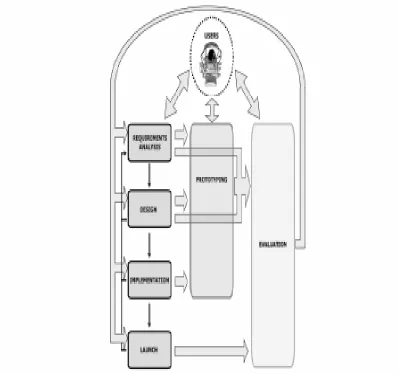
Granollers et al. (2003) have created The Usability Engineering Process Model (UEPM), which integrates SE with HCI activities and focuses on usability. The structure of the model is shown in Figure 2.3.
The UEPM contains three columns: the traditional Software Engineering life cycle, Prototyping, and Evaluation. SE protection activities, such as Configuration
Management, Software Quality Assurance and Risk Management, are also used for
supporting the software development process. Specifically, the authors present their “Process Model as an offer for the development of interactive applications integrating
the specific models and tasks of usability with the life cycle of SE.”
Figure 2.3: Usability Engineering Process Model – UEPM (Granollers et al. 2003)
2.6 Software Process Assessment Models
2.6.1
Capability Maturity Model (CMM)
The Capability Maturity Model (CMM) proposed by the Software Engineering Institute (SEI) has been accepted by the software industry. The structure of CMM is shown in Figure 2.4; each maturity level is composed of several Key Process Areas (KPAs), and each KPA is organized into common features that specify the essential practices that, when collectively addressed, accomplish the goals of the KPA (Paulk et. al. 1995).
Figure 2.4: Capability Maturity Model – CMM® Structure (Paulk et. al. 1995)
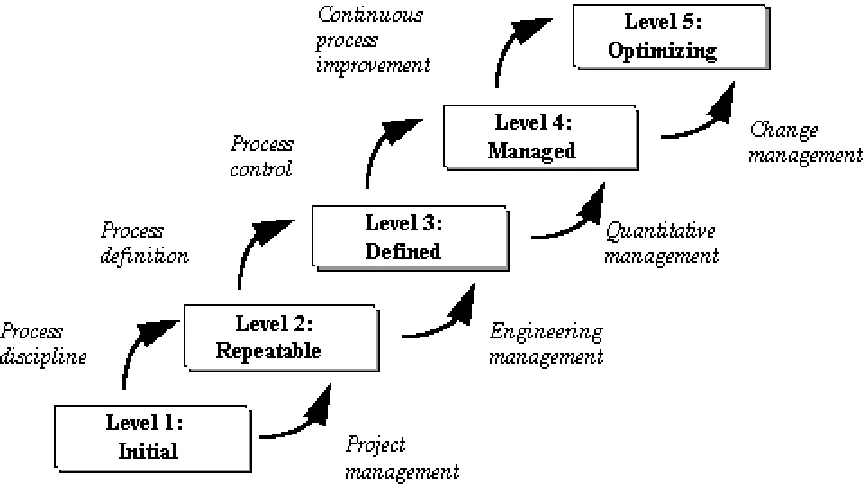
The CMM is divided into five maturity levels, ranging from Level 1 to Level 5, as shown in Figure 2.5. Level 1 is called “Initial”, a level at which software processes are
quality are collected so that process effectiveness can be determined in a quantitative manner. For an organization to achieve the fifth or “optimizing” level, they require quantitative feedback in order to achieve continuous process improvement.
Figure 2.5: CMM Maturity Framework: Five Levels (Paulk et. al. 1995)
2.6.2
Software Process Improvement and Capability
dEtermination (SPICE)
“SPICE provides a measure of the maturity of a process against a defined model of best
practice, rather than a pass/fail result as with ISO9001” (Mackie 1997). Software
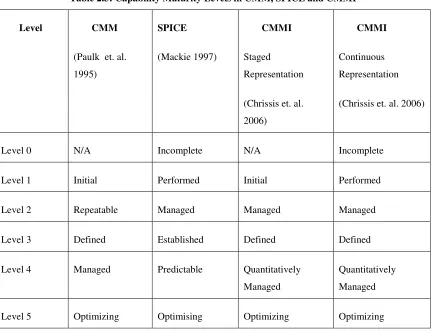
Process Improvement and Capability dEtermination (SPICE), or ISO 15504, defines a reference model of process capabilities, thus forming the basis of any model to be used and providing a framework for software process assessment. Additionally, it extends the five maturity models proposed by CMM, to six, as shown in Table 2.3.
2.6.3
Capability Maturity Model Integration (CMMI)
improvement paths are supported by CMMI; the term “capability level” denotes
continuous representation, and the term “maturity level” indicates staged representation. According to Chrissis et. al. (2006), “continuous representation is concerned with selecting both a particular process area to improve and the desired capability level for
that process area.” Because it is important to indicate whether a process is incomplete or
performed, the continuous representation path has six capability levels, with the “incomplete” level as Level 0. In contrast, staged representation, which is concerned
with qualitatively illustrating the maturity of an organization, has five maturity levels, as shown in Table 2.3.
2.6.4
Comparison of CMM, SPICE and CMMI
A comparison of scales used in CMM, SPICE and CMMI is presented in Table 2.3.
Table 2.3: Capability Maturity Levels in CMM, SPICE and CMMI
Level CMM
(Paulk et. al. 1995)
SPICE
(Mackie 1997)
CMMI
Staged Representation
(Chrissis et. al. 2006)
CMMI
Continuous Representation
(Chrissis et. al. 2006)
Level 0 N/A Incomplete N/A Incomplete
Level 1 Initial Performed Initial Performed
Level 2 Repeatable Managed Managed Managed
Level 3 Defined Established Defined Defined
Level 4 Managed Predictable Quantitatively Managed
Quantitatively Managed
2.7 Existing Usability Maturity Models
2.7.1
Usability Maturity Model: Human Centredness Scale by
Earthy (1998)
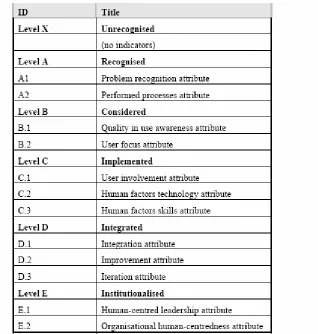
Earthy (1998)’s “Usability Maturity Model: Human Centredness Scale” demonstrates the way in which organizations can progress through six levels of human-centered processes. Accordingly, the model has six levels that are defined by a set of attributes, each of which is described by one or more management practices that apply to that particular level. The Human-Centredness Scale, which conforms to ISO 15504, describes six sets of process, technology and attitude indicators that define levels of organizational maturity relating to human-centredness. Overall, the model is designed to assess the maturity level of a human-centred approach in an organisation, and different management activities are used to define each maturity level, as shown in Table 2.4.
Moreover, the model discusses the extent to which each attribute needs be comprehended for a particular maturity level to be achieved. According to Earthy, “the scale is mainly intended for use in a ‘stand-alone’ mode. In this mode the assessor will usually be a
human factors consultant or a member of an organisation’s staff charged with
determining and improving an organisation’s level of capability in human factors, or
with improving the quality in use of an organisation’s products.” In addition, Earthy
discusses an assessment methodology for evaluating the rating of human-centred activities in an organisation.
Despite the thoroughness of the model, however, there is currently no empirical validation of the proposed attributes that determine a capability level achievement in Earthy’s maturity model.
2.7.2
Usability Maturity Model: Processes by Earthy (1999)
In his report, Earthy (1999) presents a “Usability Maturity Model: Processes” for assessing an organization’s capability to perform activities that are related to human-centered processes. Shown in Figure 2.6, “the model conforms to and extends ISO DIS 13407 Human-Centred Design Processes for Interactive Systems.” Specifically, the
model comprises seven sets of practices describing the required accomplishments during the lifecycle, thus representing and including users.
Additionally, the model consists of seven human-centred development (HCD) processes that may occur during system development. The processes, HCD.1 to HCD.7, are named and described as the following: “Ensure HCD content in systems strategy, Plan and manage the human-centred design process, Specify the user and organisational
requirements, Understand and specify the context of use, Produce design solutions,
Evaluate designs against requirements, Introduce and operate the system.” Each of these
processes contains different base practices, which help in achieving a certain capability level. Conforming to ISO 15504, this model also entails six capability levels: “Level 0 Incomplete (not able to carry out process), Level 1 Performed (individuals carry out
process), Level 2 Managed (quality, time and resource requirements for process known
and controlled), Level 3 Established (process carried out as specified by organisation,
resources are defined), Level 4 Predictable (performance of process within predicted
resource and quality limits),Level 5 Optimising (organisation can reliably tailor process
to particular requirements).” Each capability level above 0 is associated with certain
attributes of the process that demonstrate the achievement of that level.
It is stated that the model “can be used in the assessment of an organisation’s capability to carry out the human-centred processes described in the model.” However, for process
assessment, “the reader is referred to ISO 15504 for details of the qualification of assessors, quality processes associated with assessments etc.” Furthermore, no empirical
validation of the proposed attributes, which determine a capability achievement in each level, has been provided.
2.7.3
The UUMM: User and Usability Maturity Model by Lethbridge
(2007)
Lethbridge (2007) presents the User and Usability Maturity Model (UUMM), which is based on the Capability Maturity Model. The UUMM, which can assess an organization’s capabilities with users and usability-related issues, covers four dimensions, including “involvement with users, training of the team, development processes and evaluation
processes.” The author suggests that the profitability of organizations could be improved