Exploring Universal Features in
Quantum Matter
Steffen Klug
der Ludwig-Maximilians-Universität, München vorgelegt von Steffen Klug geb. Müller
aus Stuttgart am 30. April 2013.
Erstgutachter: Priv.-Doz. Dr. Johanna Karen Erdmenger Zweitgutachter: Prof. Dr. Dieter Lüst
Tag der mündlichen Prüfung: 09. Juli 2013
In der vorliegenden Arbeit wird mit Hilfe der verallgemeinerten Eichtheorie/Gravitations-Duali-tät, welche stark gekoppelte Eichtheorien mit schwach gekrümmten gravitativen Theorien ver-bindet, stark korrelierte Quantenzustände der Materie untersucht. Der Schwerpunkt liegt da-bei in Anwendungen auf Systeme der kondensierten Materie, insbesondere Hochtemperatur-Supraleitung und kritische Quantenzustände bei verschwindender Temperatur. Die Eichtheorie/-Gravitations-Dualität entstammt der Stringtheorie und erlaubt eine Umsetzung des holographi-schen Prinzips. Aus diesem Grund wird eine kurze Einführung in die Konzepte der Stringtheorie und ihre Auswirkungen auf das holographische Prinzip gegeben. Für das tiefere Verständnis der effektiven Niederenergie-Feldtheorien wird zusätzlich die Supersymmetrie benötigt. Ausgestat-tet mit einem robusten Stringtheorie-Hintergrund wird die unterschiedliche Interpretation der Dirichlet- oder D-Branen, ausgedehnte Objekte auf denen offene Strings/Fäden enden können, diskutiert: Zum einen als massive solitonische Lösungen der Typ II Supergravitation und auf der anderen Seite, ihre Rolle als Quelle für supersymmetrische Yang-Mills Theorien. Die Verbindung dieser unterschiedlichen Betrachtungsweise der D-Branen liefert eine explizite Konstruktion der Eichtheorie/Gravitations-Dualität, genauer der AdS5/CFT4 Korrespondenz zwischen derN “4 supersymmetrischen SUpNcq Yang-Mills Theorie in vier Dimensionen mit verschwindenderβ
-Funktion in allen Ordnungen, also eine echte konforme Theorie, und Type IIB Supergravitation in der zehn dimensionalen AdS5ˆS5Raumzeit. Darüber hinaus wird das Wörterbuch, das zwi-schen den Operatoren der konformen Feldtheorie und den gravitativen Feldern übersetzt, im Detail eingeführt. Genauer gesagt, die Zustandssumme der stark gekoppeltenN “4 supersym-metrischen Yang-Mills Theorie im Grenzwert großerNc, ist identisch mit der Zustandssumme der
Supergravitation unter Berücksichtigung der zugehörigen Lösungen der Bewegungsgleichungen, ausgewertet am Rand des AdS-Raumes. Die Anwendung der perturbativen Quantenfeldtheo-rie und die Verbindungen zur quantenstatistischen Zustandssumme erlaubt die Erweiterung des holographischen Wörterbuchs auf Systeme mit endlichen Dichten und endlicher Temperatur. Aus diesem Grund werden alle Aspekte der Quantenfeldtheorie behandelt, die für die Anwen-dung der “Linear-Response”-Theorie, der Berechnung von Korrelationsfunktionen und die Be-schreibung von kritischen Phänomenen benötigt werden, wobei die Betonung auf allgemeine Zusammenhänge zwischen Thermodynamik, statistischer Physik bzw. statistischer Feldtheorie und Quantenfeldtheorie liegt. Des Weiteren wird der Renormierungsgruppen-Formalismus zur Beschreibung von effektiven Feldtheorien und kritischen Phänomene im Kontext der verallge-meinerten Eichtheorie/Gravitations-Dualität ausführlich dargelegt. Folgende Hauptthemen wer-den in dieser Arbeit behandelt: Die Untersuchung der optischen Eigenschaften von holographi-schen Metallen und ihre Beschreibung durch das Drude-Sommerfeld Modell, ein Versuch das Homes’sche Gesetz in Hochtemperatur-Supraleitern holographisch zu beschreiben indem ver-schiedene Diffusionskonstanten und zugehörige Zeitskalen berechnet werden [1], das mesoni-sche Spektrum bei verschwindender Temperatur und schlussendlich holographimesoni-sche Quantenzu-stände bei endlichen Dichten [2]. Entscheidend für die Anwendung dieses Rahmenprogramms auf stark korrelierte Systeme der kondensierten Materie ist die Renormierungsgruppenfluss-Interpretation der AdS5/CFT4 Korrespondenz und die daraus resultierenden emergenten,
In this dissertation strongly correlated quantum states of matter are explored with the help of the gauge/gravity duality, relating strongly coupled gauge theories to weakly curved gravita-tional theories. The main focus of the present work is on applications to condensed matter systems, in particular high temperature superconductors and quantum matter close to criticality at zero temperature. The gauge/gravity duality originates from string theory and is a particular realization of the holographic principle. Therefore, a brief overview of the conceptual ideas be-hind string theory and the ramifications of the holographic principle are given. Along the way, supersymmetry and supersymmetric field theories needed to understand the low energy effective field theories of superstring theory will be discussed. Armed with the string theory background, the double life of D-branes, extended object where open strings end, is explained as massive solitonic solutions to the type II supergravity equations of motion and their role in generating supersymmetric Yang-Mills theories. Connecting these two different pictures of D-branes will give an explicit construction of a gauge/gravity duality, the AdS5/CFT4correspondence between
N “4supersymmetricSUpNcqYang-Mills theory in four dimensions with vanishingβ-function
to all orders, describing a true CFT, and type IIB supergravity in ten-dimensional AdS5ˆS5 spacetime. Furthermore, the precise dictionary relating operators of the conformal field theory to fields in the gravitational theory is established. More precisely, the partitions functions of the strongly coupledN “4supersymmetric Yang-Mills theory in the largeNclimit is equal to the
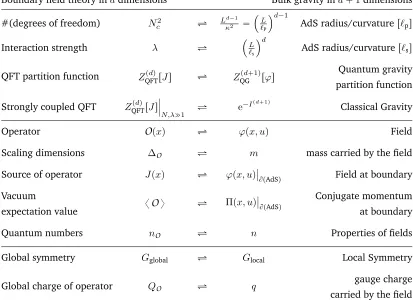
on-shell supergravity partition evaluated at the boundary of the AdS space. Applying the knowledge of perturbative quantum field theory and its relation to the quantum partition function the dictio-nary may be extended to finite temperature and finite density states. Thus, all aspects of quantum field theory relevant for the application of linear response theory, the computation of correlation functions, and the description of critical phenomena are covered with emphasis on elucidating connections between thermodynamics, statistical physics, statistical field theory and quantum field theory. Furthermore, the renormalization group formalism in the context of effective field theories and critical phenomena will be developed explaining the critical exponents in terms of hyperscaling relations. The main topics covered in this thesis are: the analysis of optical prop-erties of holographic metals and their relation to the Drude-Sommerfeld model, an attempt to understand Homes’ law of high temperature superconductors holographically by computing dif-ferent diffusion constants and related timescales [1], the mesonic spectrum at zero temperature and holographic quantum matter at finite density [2]. Crucially for the application of this frame-work to strongly correlated condensed matter systems is the renormalization flow interpretation of the AdS5/CFT4 correspondence and the resulting emergent holographic duals relaxing most of the constraints of the original formulation. These so-called bottom up approaches are geared especially towards applications in condensed matter physics and to linear response theory, via the central operational prescription, the holographic fluctuation-dissipation theorem. The main results of the present work are an extensive analysis of the R-charge- and momentum diffusion in holographic s- and p-wave superconductors, described by Einstein-Maxwell theory and the Einstein-Yang-Mills model, respectively, and the lessons learned how to improve the understand-ing of universal features in such systems. Secondly, the stability of cold holographic quantum
List of Figures IX
List of Tables XI
List of Program Codes XIII
1. Introduction 1
2. Field Theory 13
2.1. Quantum Field Theory 13
2.1.1. Path integral formulation of quantum mechanics 14
2.1.2. Functional integrals & quantum field theory 19
2.1.3. Perturbation theory 23
2.1.4. Thermal field theory & statistical field theory 25
2.2. Linear Response Theory 28
2.2.1. External sources & response functions 29
2.2.2. Analytic structure of imaginary time correlation functions 32 2.2.3. Spectral functions, sum-rules & Kramers-Kronig relations 34
2.3. Critical Phenomena & Renormalization 37
2.3.1. Classification of phase transitions 37
2.3.2. Symmetries in quantum field theories 39
2.3.3. Symmetry breaking, massless excitations & massive “gauge” fields 44
2.3.4. Mean field theory & universality 48
2.3.5. Effective theories & renormalization 53
2.3.6. Fixed points & renormalization flow diagrams 56
2.3.7. Scale invariant theories & conformal field theories 63
3. Gauge/Gravity Duality 69
3.1. Quantum Gravity & the Holographic Principle 70
3.1.1. Black hole thermodynamics 70
3.1.2. Bosonic string theory 75
3.1.3. Supersymmetry 81
3.1.4. Superstring & supergravity 85
3.2. D-branes & AdS/CFT Correspondence 89
3.2.1. D-branes 89
3.2.2. The AdS5/CFT4correspondence 92
3.3. Holographic Dictionary 95
3.3.1. Overview ofd“4,N “4supersymmetricSUpNcqYang-Mills Theory 95
3.3.2. Field-operator map 97
3.3.3. Test of the AdS/CFT correspondence 103
3.4. Gauge/Gravity Duality & Renormalization 104
3.4.1. Emergent holography 104
3.4.2. Finite temperature & density deformations 107
3.5. Linear Response & Holography 109
3.5.1. Holographic fluctuation-dissipation theorem 109
3.5.2. Short introduction to the Keldysh formalism 111
4. Universal Properties in Holographic Superconductors 117
4.1. Holographic s-Wave Superconductor 118
4.1.1. Einstein-Maxwell action & equations of motion 119
4.1.2. Background equations of motion for scalar hair black branes 121
4.1.3. Background equation of motion in the normal phase 127
4.1.4. Background equations of motion in the probe limit 130
4.1.5. Fluctuations about background fields 131
4.2. Holographic p-Wave Superconductor 137
4.2.1. Einstein-Yang-Mills action & equations of motion 138
4.2.2. Numerical solutions of the p-wave background equations of motion 139
4.3. Applied Holography of Optical Properties of Solids 143
4.3.1. Maxwell equations ind“D`1dimensions 144
4.3.2. Dielectric function inddimensions 145
4.3.3. Drude-Sommerfeld model 146
4.3.4. Different ways of computing the plasma frequency 148
4.3.5. Sum rules and Kramers-Kronig relations 149
4.3.6. Holographic description of the normal metallic phase 152
4.4. Towards a Holographic Realization of Homes’ Law 160
4.4.1. Homes’ law in condensed matter 161
4.4.2. Homes’ law in holography 165
4.4.3. The Drude-Sommerfeld model & holography 167
4.5. Holographic Realization of Homes’ Law in s- & p-Wave Superconductivity 168
4.5.1. Quasi-normal-mode analysis & phase diagram 168
4.5.2. Momentum & charge diffusion constants 175
4.5.3. Diffusion constants in s-wave superconductivity 177
4.5.4. Diffusion constants in p-wave superconductivity 181
5. Cold Holographic Matter 185
5.1. AdS/CFT with Fundamental Matter 186
5.1.1. Adding fundamental flavor degrees of freedom to AdS/CFT 187
5.1.2. Ten-dimensional background fields 189
5.1.3. Bosonic sector ofD3{Dp-systems with flat zero temperature embeddings 196 5.1.4. Zero temperature and finite density embedding ofDp-branes 199
5.2. Stability & Fluctuations 202
5.2.1. Fluctuations in zero density backgrounds 203
5.2.2. Fluctuations of D7-brane in zero temperature, finite density backgrounds 216
5.3. The Spectrum of Quasi-Normal Modes in Finite Density Systems 225
5.3.1. Low-frequency expansion of fluctuations 226
5.3.2. A Numerical method for irregular singular points: The zig-zag method 228
6. Conclusion & Outlook 237
6.1. Homes’ Law 237
6.1.1. Overview of Homes’ law results 237
6.1.2. Outlook 239
6.2. Cold Holographic Matter 240
6.2.1. Main results of the holographic analysis 240
6.2.2. Future research directions 241
Appendix 242
A. Some Useful Relations Concerning Determinants & Derivatives 243
A.1. Series Expansions 243
A.1.1. Series expansion of analytic functions 243
A.1.2. Expansions of determinants 244
A.2. Several Useful Relations Between Derivatives 244
A.3. Coordinate Transformation of2ndOrder Differential Equations 245
B. Gaussian Integrals, Wick’s Theorem & Thermal Averages 247
B.1. Gaussian Integrals & Wick’s Theorem 247
B.2. Connected Green Functions & Thermal Averages 248
B.3. Self Adjoint vs.Hermitian Operators 252
C. Full Set of Equations of Motion for Holographic S-Wave Superconductor 255
C.1. Scalar Field Fluctuation Equations of Motion 255
C.2. Gauge Field Fluctuation Equations of Motion 256
D. Listings ofMathematica-Code 259
D.1. Solutions to Holographic Background Equations in the Probe Limit 259
D.2. Different Root-Finding Algorithms 267
D.3. Three-Point Search Algorithm for Minimization 270
E. Production Notes 275
Bibliography 277
1.1. Quantum phase transitions & quantum critical points 6
1.2. State of the art QCD phase diagram 7
1.3. Phase diagram of high temperature superconductivity 9
2.1. Connection between quantum mechanics & field theory 20
2.2. Pole structure of advanced & retarded Green functions 33
2.3. Contour for Green/spectral function and Kramers-Kronig relation 36 2.4. Renormalization flow diagram with stable, unstable & mixed fixed points 58 2.5. Renormalization flow diagram of the Landau-Ginzburg-Wilson theory 60
2.6. Conformal map of an analytic function 63
3.1. Thermal & statistical physics properties of black holes 73
3.2. Nambu-Goto action of the bosonic string 76
3.3. Worldsheet traced out by string and associated coordinate functions 77 3.4. Dirichlet & Neumann boundary conditions for open string solutions 78
3.5. Massless excitations of open & closed strings 79
3.6. String interactions & topologies of respective worldsheets 79
3.7. T-duality in string theory 86
3.8. M-theory as a “unifying framework” for all superstring theories 88
3.9. Closed & open string viewpoint ofDP-branes 91
3.10. The AdS5/CFT4correspondence arising from a stack ofD3-branes 93
3.11. Conceptual overview of the gauge/gravity duality 98
3.12. Connections between RG flow & AdS-space 105
3.13. Black branes in asymptotic AdS-space 109
3.14. Close time contour used in the Keldysh formalism 113
4.1. Holographic s-wave superconductivity: order parameter & optical conductivity 137
4.2. Different excitation states of the p-wave solution 141
4.3. Condensate in holographic p-wave superconductors 142
4.4. Drude-Sommerfeld optical conductivity & dielectric function 148 4.5. Holographic metal optical conductivity & dielectric function 160 4.6. Sum rule & missing area in optical conductivity indicating superconductivity 162 4.7. Experimental data of various superconductors establishing Homes’ law 163
4.8. Phase diagram of holographic s-wave superconductors 170
4.9. Effective AdS2masses in three & four dimensions 173
4.10. Gravitational picture of s-wave superconductivity 175
4.11. Dimensionful diffusion constants of s-wave superconductivity 178 4.12. Momentum diffusion ind“3holographic s-wave superconductors 179 4.13. Momentum diffusion ind“4holographic s-wave superconductors 179
4.14. R-charge diffusion in holographic s-wave superconductors 180
4.15. Phase structure of hairy black branes at zero baryon chemical potential 181 4.16. Momentum & charge diffusion in holographic p-wave superconductors 182
5.1. The AdS/CFT correspondence with fundamental matter 189
5.2. Various probe brane embeddings in a thermal background 199
5.3. R-spin diffusion mode in finite density systems 229
5.4. Illustration of the zig-zag method in the complexρ¯plane 231
5.5. Quasi-normal mode spectra ofΦpρ¯q 232
5.6. Asymptotic velocities of the quasi-normal mode dispersion relation 233
5.7. Quasi-normal mode spectra ofΦ`pρ¯q 234
5.8. Quasi-normal mode spectra ofΦ´pρ¯q 234
2.1. Dictionary relating Euclidean quantum field theory to statistical field theory 28 2.2. Overview of common discrete symmetry groups in physical models 41
2.3. Continuous symmetry groups in physical models 42
2.4. Various Nambu-Goldstone excitations 46
2.5. List of critical exponents 50
2.6. Critical exponents of the Ising universality class in various dimensions 51 2.7. IR & UV behavior of Euclidean QFT and in critical phenomena 54
3.1. Minimal dimension of spinorial representations 82
3.2. Supermultiplets for various extended supersymmetries 83
3.3. List of relations between mass & scaling 101
3.4. Holographic dictionary relating field theories to gravity 103
3.5. Extension of holographic dictionary for finite temperature/density theories 108 4.1. Various solutions of the Einstein-Maxwell action for holographic superconductors 121 4.2. Dp/Dq system exhibiting holographic p-wave superconductivity 140 4.3. Dielectric function & conductivity in the Drude-Sommerfeld model 149 4.4. Dielectric function & optical conductivity of holographic metals 158 4.5. Scalar field mass, operator scaling & critical backreaction 174
5.1. Possible supersymmetry preservingD3/Dpconstructions 187
5.2. Overview of different types of modes 213
D.1. Asymptotic.nb 259
D.2. SolutionBackground–d4–m2i.nb 263
D.3. Numerical–Methods.nb 267
D.4. Step–Search–Method.nb 270
1
Introduction
Modern physics is and has been very successful in approaching the explanation of physical phe-nomena by resting on two seemingly very different philosophies: The first approach has been dominating for centuries and followed the reductionist viewpoint of finding a unified fundamen-tal description of all physical phenomena. The second approach takes into account the lessons learned from quantum mechanics and confusingly entangled systems to identify the dominating, emergent degrees of freedom characterizing the observed phenomena. Recently, these two ap-proaches have been coming closer and may even be connected by a fascinating duality involving string theory and strongly coupled non-perturbative quantum field theories with the help of a new principle, known as theholographic principle, which is not fully understood yet.
Before the onset of modern physics in the 20th century, the main driving idea of understanding
the physical world was to find a accurate simplification and subsequent description in terms of the available contemporary mathematics. Every physical system described by a collection of ex-perimentally measured data can be eventually described by a single closed theory that may even allow for predicting yet unobserved phenomena. Starting from Newton’s theory of point particles extended by many physicist such as d’Alembert, Laplace, Lagrange,etc. which finally culminated in Hamilton’s principle, describing our classical mechanical world by a simple quantity, known as the action. Ontologically1, the physical world was viewed as a large, intricate mechanical system whose evolution in time is mathematically described by Hamilton’s principle of an ex-tremized action. The same reductionist approach even succeeded for systems with incredible large number of particles such as gases, liquids and solids. Their thermodynamic properties may be encoded in a single function, nowadays known as the entropy. It was possible to describe all known classical interactions, the magnetic and electric phenomena and of course gravity by a unified potential theory. By the end of the 19th century the reductionist approach presented
the physical knowledge in a deterministic closed theory, where the last closing links between the microscopic world of point particles and the macroscopic world of thermodynamics were filled in by Boltzmann’s statistical mechanics.
1Ontology is a branch of philosophy that studies the structure of existence and reality; or simply put tries to answer the
question ’what is?’.
In the beginning of the 20th century physics radically shifted to completely new paradigms.
theory including gravity, the precise details are not completely understood so far,2 yet it gives rise to astonishing mathematical relations that shed light on different areas of theoretical and mathematical physics, mostly in the form of “unexpected” dualities. One of these amazing re-lations, the gauge/gravity duality and its applications to quantum matter is the main focus of this thesis. The gauge/gravity duality is a particular realization of the holographic principle of gravitational systems. The holographic principle follows from the unusual thermodynamic be-havior of black holes and in a wider sense every mass distribution that will eventually collapse to a black hole. A black hole is the simplest spherical symmetric solution to Einstein’s equations characterize only by its mass, charge and angular momentum. In particular its entropy is related to the event horizon and thus scales as the area of the black hole and not the volume. Taking the holographic principle seriously, it suggest that the complete information of a four dimensional physical theory is encoded in a three dimensional horizon. The gauge/gravity duality connects a four dimensional strongly coupled quantum field theory to a five dimensional weakly curved gravitational system. The strong/weak duality is essentially needed to evade the Weinberg-Witten theorem stating that gravity cannot emerge from a four dimensional local quantum field theory. In this sense gauge/gravity teaches us two important lessons: A strongly coupled quan-tum theory characterizing strongly correlated quanquan-tum states of matter can be described by a simple classical gravitational theory in one dimension higher. Intricate entangled theories with emergent excitations,e.g. quantum liquids, are simple related to properties of black hole hori-zons. Thus, in a wider sense we may view the gauge/gravity duality not only as a strong/weak duality, but also as a unification of emergent phenomena with reductionistic fundamental theo-ries. Both of these lessons will play an important role in applying the gauge/gravity duality to condensed matter systems exhibiting exotic quantum phases of matter.
The condensed matter “standard model” is fairly incomplete as well. There are condensed matter systems that cannot be described by the Fermi liquid theory in conjunction with the traditional Wilsonian effective theory viewpoint. Two very prominent systems that demands a new classifi-cation scheme for quantum matter are the fractional quantum Hall effect and high temperature superconductivity. The former arises in two-dimensional cold electron systems subject to large magnetic fields with plateaus in the transverse resistivity at fractional values of the ratio of par-ticle number to magnetic flux quanta in contrast to the integer quantum Hall effect with integer values. This particular state of matter, an incompressible gapped liquid, cannot be described by a long-range ordered phase and the conventional symmetry breaking mechanism, but rather by a new kind of order arising from topological quantities. The discovery of novel phases of quan-tum matter boosted the need for a new classification scheme in condensed matter physics to characterize these exotic states of matter. Tremendous support came with the discovery of high temperature superconductors, that ultimately heralded the new era of modern condensed mat-ter physics. Recently, experimental progress in controlling strongly correlated electronic systems and the exploration of strongly coupled fermionic/bosonic systems with the help of ultracold gases presented a new picture of nature. Famous examples of novel quantum matter states are spin liquids, high temperature superconductors, heavy fermion compounds, topological insula-tors, quantum critical regions – sometimes called strange metals – connected to quantum critical points, and as explained above the (fractional) quantum Hall states3Let us give a brief overview
2The lack of success in explaining natural phenomena is surely not to blame on the theory itself, since the theory is far
from being understood. From my point of view it might be almost impossible to work out a physical theory without experimental data. It would have been certainly impossible to identify the relevant degrees of freedom of the effective low-energy theory of QCD, without studying/knowing hadrons. Similarly, no one could have guessed that electrons interacting via the strong Coulomb interaction give rise to a simple quasi-particle description if not nature would have experimentally told us so.
of the possible proposed classifications [9]:
• Looking at low-energy excitations of quantum matter with long-range entanglement
§ Gappedquantum matter,i.e. systems without zero energy excitationsÝÑspin liquids, quantum Hall liquids.
§ Conformal quantum matter,i.e. system with relativistic dispersion relationsÝÑ an-tiferromagnets, graphene at zero voltage, ultracold atoms e.g. in superfluid insulator transition in optical lattices
§ Compressiblequantum matter,i.e. systems with ground states that changes smoothly the expectation value of conserved charges ÝÑ Fermi liquids, Graphene at finite chemical potential, strange metals in high temperature superconductors, superfluids, (super-)solids, spin liquids
• Looking at ordering mechanism of zero temperature ground states
§ Gappedtopological order,i.e. systems with topological degenerate ground statesÝÑ fractional quantum Hall liquids, spin liquids, superconductors
§ Gaplessquantum order,i.e. systems described by quantum phase transitions without symmetry breakingÝÑFermi liquids, strange metals
The classifications might not even be complete and we may hope to find more exotic quantum states of matter. For example one might think of a gapless topological state protecting gapless fermionic excitations or even massless gauge bosons in the spirit of the bosonic Nambu-Goldstone modes arising in the symmetry breaking formalism [4]. These different phases characterized by different quantum order are connected by quantum phase transitions [6],c.f. Figure1.1, exhibit-ing sexhibit-ingularities in the ground state energy functional upon variation of external parameters in the corresponding Hamiltonian. Several of the above system are strongly correlated liquids not susceptible to perturbative methods. In particular kinetic theory and quasi-particle concepts fail to accurately describe the quantum phases, for example in the above mentioned superfluid-insulator transition the results are highly contradictory upon approaching the quantum critical point (see [10] and references therein). In the strongly interacting cases, the “mapping” be-tween the relevant degrees of freedom in the low-energy regime and the microscopic degrees of freedom are far from being clear and understood. Furthermore, it seems that quantum field theory alone is not enough to tackle strongly correlated systems and to explain these new states of quantum matter. In particular solving strongly coupled quantum field theories poses some challenges. First, there is no analytic recipe to calculate correlation functions or thermodynamic properties. Thus one needs to resort to numerical analysis. This is usually done by lattice gauge theories, working with discretized path integrals that can be handled by numerical approaches such as the quantum Monte-Carlo method. This already leads to some problems. First, it is not mathematically clear if the lattice gauge theory represents the entire continuous gauge theory in the limit of vanishing lattice spacing. Secondly, for fermionic systems whose functional integral representation cannot be bosonized the infamous sign problem renders any computation totally useless. In general, this applies to high-density fermionic matter as found in strongly correlated electronic systems, nuclear matter in neutron stars or heavy nuclei, the ground state properties of quarks and the QCD phase diagram,c.f. Figure1.2. Furthermore, transport properties needs to be calculated in real time which introduces a highly oscillatory integrand eiS. The same is
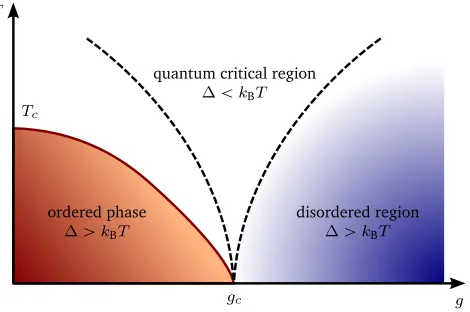
T
gc g
ordered phase ∆ąkBT
disordered region ∆ąkBT
quantum critical region ∆ăkBT
Tc
Figure 1.1. A quantum phase transition is indicated by a non-analyticity in the ground state energy which is driven by quantum fluctuations at zero temperature. Tuning the external parameter gin the full Hamiltonian close to the critical value, the char-acteristic energy scale ∆, associated with the low-energy excitations above the ground state, approaches zero. For an infinite lattice this amounts to the limit of an avoided or an actual level-crossing. For continuous quantum phase transi-tions, ∆ „ J|g´gc|zν close to the quantum critical point where J denotes the
intrinsic/microscopic energy scale of the system,zandν are the dynamical scaling exponent and a critical exponent, respectively. The correlation length of the quan-tum fluctuations diverges at the critical pointi.e.ξ´1„λ|g´gc|νwithλbeing the
inverse lattice spacing. In the finite temperature case, we may find a thermal phase transition indicated by the solid line ( ). Typically this thermal phase transition is of BKT type i.e. topological, since the quantum ordered phase does not break any symmetries. Above the quantum critical point we find the quantum critical region characterized by quantumandthermal fluctuations for∆ăkBT, exhibiting a long-range quantum entanglement. In this region the classical description breaks down since the imaginary time path integral is not sufficient to capture both ther-mal fluctuations andquantum fluctuations and hence we need to resort to a full complex valued functional in the partition function. Typically the classical theory of thermal phase transitions can only be applied close to the thermal phase transi-tion line ( ) terminating at the quantum critical point. The dashed lines ( ) denote crossovers from the quantum critical region into the effectively classical re-gions∆ąkBT where quantum effects may be neglected since the timescale of the relevant long-distance fluctuations isτ " ¯h{kBT. On the other hand in the
quan-tum critical region we are close to the shortest possible equilibration time allowed by the uncertainty principle, i.e. τ „ ¯h{kBT. Quantum critical points are found
in heavy fermion compounds, pnictides, magnetic insulators and are suspected in high temperature superconductors under the superconducting dome, where the strange metal phase corresponds to the quantum critical region (see [7] and refer-ences therein).
µB
T
vacuum
hadron gas nuclear matter
neutron stars hadronic phase
chiral symmetry broken
2SC two flavor locking
superconductor
CFL
color-flavor-locking phase chiral & baryon symmetry broken QGP
quark-gluon plasma deconfined phase chiral symmetry restored
cr
o
ss
o
ve
r
experiments @ RHIC/LHC
Figure 1.2. This is the state of the art QCD diagram including experimental data, lattice sim-ulations and educated guesses. The experimental accessible region to study the quark-gluon plasma lies at small densities and high temperatures, by smashing heavy ions at high speed. In particular the critical endpoint of the first order chiral phase transition line ( ) separating the confined hadronic phase from the de-confined quark-gluon plasma (QGP) phase has been found in heavy ion collisions. Note that so far we do not have sufficient data to understand the QGP phase in detail. For finite light quark masses of the up uand d down quarks compared to heavy strange squarks, we find a crossover for small baryon densities. In the hadronic phase the chiral symmetry is explicitly broken by the finite quark masses. Cranking up the baryon chemical potential at low temperature, leads to a hadron gas of individual nucleons, in the spirit of very small droplets of hadronized matter until we reach the condensing phase where we find a nuclear matter liquid. For ex-tremely low temperature, a cold nuclear superfluid is formed which is believed to be found in the degenerated matter of neutron stars. For extremely high densities, the difference of theu,dandsquarks are negligible, so flavor and color degrees of freedom are locked in a collective mode, forming cooper pairs with common Fermi momenta. There are two different phases of color superconductivity due to the hierarchy of the quark masses with the strange quark mass much larger as the up and down quark masses,ms "md «mu. If only the flavors of the up and down
quark are locked to the colors red and green, say, chiral symmetry is restored and we find the two color superconducting phase denoted by 2SC. The color symmetry group is broken fromSUp3qctoSUp2qc, hence8´3“5gluons become massive.
So far, no counterexample has been found that forbids a generalization of the original duality to finite temperature, densities, non-supersymmetric backgroundsetc. Therefore, we simply need to find an appropriate gravity theory that describes the essential key features of our strongly coupled field theory and solve the corresponding classical gravity theory.
Strongly correlated condensed matter and gauge/gravity duality
Gauge/gravity duality has proved to be a valuable tool for exploring strongly coupled regimes of field theories. The best studied example so far for applications to experimentally accessible strongly coupled systems is the application to the quark-gluon plasma. A very important calcu-lation is the derivation of the famous result for the ratio of the shear viscosity and the entropy density [14],
η s “
1 4π
¯
h
kB. (1.1)
Here the physical constants¯handkB are written out explicitly in order to illustrate the influ-ence of quantum mechanics and thermal physics. The result seems to be supported by lattice gauge theory computations and measurements conducted at RHIC. Recently the anomalous be-havior of strongly correlated liquids and thermalization processes are in the focus to be tackled by gauge/gravity methods [15]. The even more exotic phases of QCD are under investigation
e.g. [16], however, results should be taken carefully especially outside the experimentally reach-able regimes since the holographic dual of QCD maynotreproduce all features correctly. It has been shown [17–19] that the universal result for the ratio of shear viscosity over entropy density applies universally for any isotropic gauge/gravity duality model based on an Einstein-Hilbert ac-tion on the gravity side. Excepac-tions are found by considering higher curvature correcac-tions [20] or anisotropic configurations, see [21,22] and [23].
As explained above condensed matter physics presents a huge plethora of experimentally con-trolled and well-studied quantum states of matter, where a theoretical description is lacking. For example, the pairing mechanism of the high-temperature superconductors and the existence of a quantum critical point below the superconducting dome are pressing open questions, c.f. Figure 1.3. Recently, the focus of applying the tools of the gauge/gravity duality has been widened to other strongly coupled systems in physics, especially to problems in condensed matter physics [24]. In particular, significant progress has been made in describing holographic fermions (see [25–27] and references therein), superconductors/superfluids (for instance [28–32] and references therein) and to some extent also to lattices [33–39]. For obtaining a solid general framework for condensed matter applications of the gauge/gravity duality, it would be very useful to derive a universal relation, similar in importance to (1.1), designed in particular for ap-plications in condensed matter physics. Interestingly, the result (1.1) may be understood in the context of condensed matter physics by a time scale argument. Here, the properties of quantum critical regions [6,7] give rise to a universal lower bound
τ¯h“
¯
h
kBT, (1.2)
sometimes called “Planckian dissipation” [40] which can be compared to the possible lower bound for η{s given in (1.1). This seems to imply that the “strange metal phase” is a nearly
perfect fluid without a quasi-particle description as is the quark-gluon plasma, since both cases do not allow for long-lived excitations compared to the energy
¯
h
T
hole doping
ant
if
er
ro
m
ag
ne
tic
ph
as
e
pseudo-gap
superconducting dome
strange metal quantum critical phase(?)
conventional Fermi liquid
Figure 1.3. The phase diagram of a typical high temperature superconductor: many uncon-ventional high temperature superconductors, known as cuprates, feature an ef-fectively two-dimensional electronic system in a copper-oxide (CU2) layer back-ground. The low-doping ground state of many oxides is described by an antiferro-magnetic phase. Upon increasing the hole doping, the system enters the so-called pseudo-gap region, describe by states with partial energy gaps in the Fermi surface. The superconducting phase exhibiting the Meißner-Ochsenfeld effect, expelling magnetic fields characterizing an ideal diamagnet, and vanishing direct current resistivity is often called superconducting dome due to its shape. Optimal doping refers to the top of the dome where the critical temperature is maximized. Above the superconducting dome there is a non-Fermi liquid phase with unusual ther-modynamic properties deviating from the Fermi liquid behavior. It is conjectured that this phase might be a quantum critical phase with a quantum critical point, located somewhere below the superconducting dome. At high doping we again find a conventional Fermi liquid. The pairing or gluing mechanism inducing su-perconductivity is still unknown, but it is highly unlikely a phonon induced attrac-tion of electrons since no isotope effect has been detected. Since electron carries charge and spin, there are other possibilitiese.g. the exchange of spin fluctuation-s/magnons or exotic quantum ordered states facilitate charge-spin separation. The phase diagram of electron doped high temperature superconductors is roughly the mirrored image along the temperature axis.
but rather describe a regime characterized by
τ„ ¯h
ǫ. (1.4)
In the case of the quark-gluon plasma, a possible characteristic time scale can be defined by
η„ǫτ. (1.5)
between traditional and modern condensed matter physics since it displays a relation that works for conventional superconductors and high temperature superconductors which can be regarded as representatives of the old and the yet to be developed framework. So the main focus of the present work lies in universal properties of quantum states of matter and their appropriate realization as holographic models.
Outline of the thesis
The main topics covered in this thesis are: the analysis of optical properties of holographic met-als and their relation to the Drude-Sommerfeld model, an attempt to understand Homes’ law holographically by computing different diffusion constants and related timescales, the mesonic spectrum at zero temperature and holographic quantum matter at finite density. The thesis is structured as follows: In Chapter2 we will extensively cover the all aspects of quantum field theory relevant for the application of linear response theory, computing correlation functions, and describing critical phenomena. In particular, the emphasis lies on elucidating connections between thermodynamics, statistical physics, statistical field theory and quantum field theory. The renormalization group formalism in the context of effective field theories and critical phe-nomena will be developed explaining the critical exponents in terms of hyperscaling relations. The chapter is concluded by a discussion of conformal field theories arising at critical points in thermal field theory. In Chapter3 we give a brief overview of the conceptual ideas behind string theory and the ramifications of the holographic principle. Along the way we will discuss supersymmetry and supersymmetric field theories needed to understand the low energy effec-tive field theories of superstring theory. Armed with the string theory background, we move on to explain the double life of D-branes, extended object where open strings end, as massive solitonic solutions to the type II supergravity equations of motion and their role in generating supersymmetric Yang-Mills theories. Connecting these two different pictures of D-branes will give an explicit construction of a gauge/gravity duality, the AdS5/CFT4correspondence between
N “4supersymmetricSUpNcqYang-Mills theory in four dimensions with vanishingβ-function
to all orders, describing a true CFT, and type IIB supergravity in ten-dimensional AdS5ˆS5 space-time. Furthermore, we will establish the precise dictionary relating operators of the conformal field theory to fields in the gravitational theory. More precisely, the partitions functions of the strongly coupledN “4supersymmetric Yang-Mills theory in the largeNclimit is equal to the
on-shell supergravity partition evaluated at the boundary of the AdS space. Applying our knowledge of perturbative quantum field theory and its relation to the quantum partition function we may extend the dictionary to finite temperature and finite density states. The last part of this chapter deals with the renormalization flow interpretation of the AdS5/CFT4correspondence and the re-sulting emergent holographic duals relaxing most of the constraints of the original formulation. These so-called bottom up approaches are geared especially towards applications in condensed matter physics and to linear response theory, closing the chapter with the central operational prescription, the holographic fluctuation-dissipation theorem. In Chapter4we will discuss holo-graphic s- and p-wave superconductors. In particular, we discuss the bottom-up approaches to model the properties of superconductors or more precisely superfluids,i.e. the Einstein-Maxwell theory and the Einstein-Yang-Mills model. The full holographic s-wave fluctuation equations ind
calculate universal features of real world superconductors a holographic realization of Homes’ law is proposed. Homes’ law as explained above is not directly accessible to holographic calcu-lations due to the very different nature of the gravitational dual. Thus, we explicitly rewrite the original Homes’ law relation in terms of a simple universal statement about diffusive processes
i.e.DpTcqTc“const. . The chapter concludes with an extensive analysis of the R-charge diffusion
and momentum diffusion in holographic s- and p-wave superconductors and the lessons learned how to improve our understanding of universal features in such systems. In Chapter5 we in-vestigate the stability of a top-down construction describing cold holographic quantum matter. As already realized in the previous chapter an intriguing quantum critical point arises in the zero temperature finite density gravity background with finite entropy density, indicating a large ground state degeneracy. The existence of charged bosonic and fermionic degrees of freedom let us anticipate a non-trivial meta-stable state of quantum matter. Studying mesonic fluctuations described by the fluctuations of the worldvolume fields of a singleD7-brane embedded in a zero temperature and finite density background doesnot reveal any instability and seems to imply that the finite density AdS2 ground state is stable. In order to conduct the numerical quasi-normal mode analysis we need to devise a new numerical scheme dubbed the “zig-zag” method to deal with numerical instabilities arising from irregular singular points in the fluctuation equa-tions about the finite density background. After complexifying the radial integration variable, we invent an integration contour that avoids the entanglement of in- and outgoing waves and allows for an easy extraction of the correct solution while avoiding branch cuts in the complex radial plane of the finite density solution. Along the way, we discover an interesting additional diffusion mode, which can be interpreted as an “R-spin diffusion”, resembling spin diffusion in itinerant electronic systems where the spin decouples from the orbital momenta and becomes an internal global symmetry. The lack of instabilities and the existence of a zero sound and diffusion mode indicates that cold holographic matter is closely described by an effective hydrodynamic theory. The final Chapter 6 gives an extensive discussion of the results obtained and how to improve the approaches to gain an even deeper knowledge of universal features and the nature of the strongly coupled ground states. An outlook to extend the top-down program to fermionic excitations and to check Luttinger’s theorem in hyperscaling violating backgrounds is given.
Main results of this thesis
In the following the main results of this thesis are listed. Let me emphasize that all analytic and numerical computation presented in this thesis have been executed by myself. Most of the work reproduces known results in a different context and is used as a consistency check of my derivations and extension. Yet some of the work is original and other parts have been derived in close collaboration with the authors of [1,2].
• Universality in high temperature superconductors/Homes’ law:
The original empirically found relation by Homes et al. [42,43] between the superfluid density at vanishing temperature and the direct current conductivity measured at the crit-ical temperature times the critcrit-ical temperature, i.e. ρs “ CσDCpTcqTc, is not amenable
to a direct holographic formulation. We first reformulate Homes’ law in a way that we can relate it to the aforementioned “Planckian dissipation” following [40] and construct a holographic function describing the proportionality constant of Homes’ law in terms of the black hole charge in our gravity dual. The proposed holographic version of Homes’ law is given by
CMˇˇd
“3“4πTcDMpTcq “
ˆ
1` 4 ¯Q
2 3´Q¯2
˙´1
CRˇˇd
“4“4πTcDMpTcq “
p2´Q¯2qp2`Q¯2q
2p1`Q¯2q , (1.6)
CMˇˇd “4“
ˆ
1` 3 ¯Q
2 2´Q¯2
˙´1
.
where Homes’ law holds for these functions to be constant. This is true in the probe limit ¯
Q “ 0, where we neglect the backreaction of the matter content onto the background geometry. Unfortunately, the black hole chargeQ¯ as a function of the critical chemical po-tential is not constant but rather monotonically decreasing. The ramifications of this result are discussed in detail in Chapter6. Independent of Homes’ law the derivation of the phase diagram and the computation of the diffusion constant yield invaluable insight into holo-graphic superconductors/superfluids, such as a non-trivial relation between the density of a holographically ideal conductor and the superfluid density in the superconducting phase.
• Properties of cold holographic matter:
2
Field Theory
In this chapter we will lay the groundwork for understanding thermal properties and dynamical processes of complex physical systems. These systems typically involve a large amount of in-teracting entities and thus we need to adapt our mathematical language to efficiently deal with the essential information we want to extract. One of the major tools to treat such systems are field theoretic methods, encoding the minimal amount of information, crucial to understand and reproduce measurable effects. The main concern lies on systems that are related to condensed matter phenomena found in nature, such as metals and superconductors. In particular we will see that the field theoretic methods developed and explained here fail to cope with novel types of condensed matter system that cannot be classified using the traditional scheme of symmetry breaking and renormalization.
2.1. Quantum Field Theory
Overview
• Why use field theory?
Ñcalculate measurable observables,e.g. correlators of operators, spectral densities,... .
• Quantum mechanics is just a0`1dimensional field theory.
• Thermal field theory/statistical field theory is related to quantum field theory.
There are several ways to approach field theories. What is common to all approaches is the removal of any discrete entities by an averaging prescription in such a way that the physically measurable quantities are unchanged. This can be done since averaging lies at the very heart of any measuring device. In principle there is always a finite resolution, so there are no exact “point-like” measurements.1 Here we will start from the quantum mechanical viewpoint and
1Experimentally, it is possible to do a single measurement to determine the spin of a single atom, for instance. The
extend it to infinitely many degrees of freedom. This procedure is somewhat strange because we will restructure the theory which is usually known under the (misleading) term “second quantization”.
2.1.1. Path integral formulation of quantum mechanics
Quantum mechanics is an intrinsically probabilistic theory. Although the time evolution is deter-ministic, it is not possible to predict the outcome of an experiment. Even worse, the experiment has to be iterated many times to obtain meaningful information about the system under the same initial conditions. If an experimenter would be allowed to do an experiment only once, the result would be absolutely meaningless. This statistical nature will be made explicit in the functional integral formulation of quantum mechanics. In quantum mechanics the path integral defines expectation values of quantum operators. It encodes the basic principle of quantum mechanics,
i.e. the superposition principle: we can view the path integral as a weighted summation over all possible paths of the system in phase space. Since the physical time is a true parameter in quantum mechanics (there is no time operatorˆt), we can understand this sum as the complete possible/accessible history of the physical system.2 The derivation is quite simple and will be outlined with emphasis on the physical implications:
i
View the path integral as a limit of n-slits placed atN discrete points, which effectivelydescribes free space in the limit n Ñ 8and N Ñ 8. Since we will construct the path integral in phase space (parametrized by the position q and the momentum p) we can apply thenÑ 8limit at the beginning.
ii
Take the unitary time evolution operatorU
pt1, tq “ e´h¯iHpt 1´tqΘpt1´tq, ˇˇΨpt1qD“
U
pt1, tq |Ψptq y, (2.1)whereΘpt1´tqdenotes the Heaviside distribution defined as
Θptq “ #
1 tą0
0 tă0 (2.2)
The time evolution operator is applied N times with discrete time step ∆t “ pt1´tq{N to
describe the time evolution of the system from the fixed initial state|qiy att “0 to the
final state|qfyatt1“t. The transition/probability amplitude for this process is given by
B qf
ˇ ˇ ˇ ˇ ”
e´i ¯ hH∆t
ıNˇˇ
ˇ ˇqi
F “
ż
Nź´1k“1
dqkAqf
ˇ ˇ ˇe´i
¯ hH∆t
ˇ ˇ ˇqN´1
E
ˆAqN´1
ˇ ˇ ˇ ¨ ¨ ¨ˇˇˇq1
E A q1
ˇ ˇ
ˇe´h¯iH∆t ˇ ˇ ˇqi
E
, (2.3) where we inserted the resolution of identity
ż
dqk|qky xqk| “1, (2.4)
at each intermediate time step in the q representation and omitted the limiting process
N Ñ 8.
statement "point-like" should be taken mathematically,i.e. it is impossible to read off an absolutely exact value instantaneously.
iii
Look at a single infinitesimal transition amplitude and note that the Hamiltoniangeneri-cally depends on both phase space variablesqandp, so we need to insert a complete set of
|pystates as well
A qk`1
ˇ ˇ
ˇe´h¯iH∆t ˇ ˇ ˇqk
E “
ż
dpkAqk`1
ˇ ˇ ˇpk
E A pk
ˇ ˇ
ˇe´h¯iHpq,pq∆t ˇ ˇ ˇqk
E
“ ż
dpkAqk`1
ˇ ˇ ˇpk
E A pk
ˇ ˇ ˇe´i
¯
hHpqk,pkq∆t`Op∆t2q ˇ ˇ ˇqk
E
« ż
dpkxqk`1|pky xpk|qkye´
i ¯
hHpqk,pkq∆t, (2.5)
where we used the Baker-Campell-Hausdorff formula to expand the product e´h¯iHpq,pq∆t “ e´
i ¯
hTppq∆te´ i ¯
hVpqq∆te 1 2p´
i ¯ hq
2
rTppq,Vpqqs∆t2
eOp∆t3q. (2.6) The factorization is exact only if“
T
pp
q,V
pq
q‰ “ 0. Alternatively and more general, we can write allp
operators to the left of allq
operators in the Hamiltonian up to linear order in∆t. Interestingly, this implies that for very short timescales the kinetic/momentum con-tributions disentangle from the potential/position concon-tributions. Since we are considering infinitesimal time steps in the limitN Ñ 8we can discard allp∆t2qterms. Additionally, the momentum space representation is the Fourier transform of the position space repre-sentation|qy “ ż
dp|py xp|qy “ ż
dp
2π¯he i ¯
hqp|py, xp|qy “ 1
2π¯he i ¯
hqp, (2.7)
so we finally get
A qk`1
ˇ ˇ
ˇe´h¯iH∆t ˇ ˇ ˇqk
E «
ż
dpkxqk`1|pky xpk|qkye´
i ¯
hHpqk,pkq∆t
“ ż d
pk
2π¯he ´i
¯
hqk`1pk e¯hiqkpk e´h¯iHpqk,pkq
“ ż
dpk
2π¯he ´i
¯ h
”qk
`1´qk
∆t pk`Hpqk,pkq ı
∆t
. (2.8)
Insert (2.8) into (2.3) to obtain
B qf ˇ ˇ ˇ ˇ ”
e´i ¯ hH∆t
ıNˇˇ
ˇ ˇqi
F «
ż
˜N´1 źk“1 dqk
¸ ˜N´1 ź
k“0 dpk
2π¯h ¸
ˆexp
« ´¯i
h∆t
Nÿ´1
k“0
qk`1´qk
∆t pk`Hpqk, pkq ff
. (2.9)
iv
Finally, take the N Ñ 8 and ∆t Ñ 0 limit (keepingt “ N{∆t fixed) which yields thecontinuous path integral. The measure will be denoted by
Drq, ps “ lim
NÑ8
Nź´1
k“1 dqk
Nź´1
k“0 dpk
2π¯h. (2.10)
Furthermore, the sum over the discrete set turns into an integral over the dense time intervalr0, tsand the difference quotient∆q{∆tconverges to the derivative
∆t
Nÿ´1
k“0 ∆tÑ0
ÝÝÝÝÝÑ
NÑ8 żt
0
dt1, qk`1´qk
∆t
∆tÑ0
ÝÝÝÝÝÑ
NÑ8
Bqpt1q
Bt1 ”q9ptq, (2.11)
so the Hamiltonian form of the path integral is given by
A qf
ˇ ˇ ˇe´¯hiHt
ˇ ˇ ˇqi
E “
ż
qf“qptq
qi“qp0q
Drq, psexp
„
i ¯
h ż0
t
dt1´ppt1qq9pt1q ´Hpqpt1q, ppt1qq¯. (2.12)
The path integral can be viewed as a collection of infinitely many integrals summed up for each point in time and weighted by the classical action in Hamiltonian form for all paths/configura-tions starting inqi and ending inqf. Quantum mechanically it describes the propagation of the
quantum system from the state|qiyto the state|qfywith respect to the Hamiltonian
H
There are mathematical issues which may impact physical calculations as well, so it is advisable to carry out the steps
iii
andiv
on page15explicitly for the problem at hand. Even forcal-culating the free quantum propagator the path integral should be evaluated in discretized form in order to regularize divergences. For quantum mechanical calculations we will ignore (at least for all practical purposes) the following mathematical problems:
• The path integral measure is in general ill-defined for arbitrary path integrals. However, for Gaussian integrals3 we can define a Wiener measure which is mathematically sound (see Section2.1.3)
• The weight function is a complex function and so weighting is strictly speaking not possible because the complex numbers defy any ordering. So in principle we are not able to dis-tinguish important contributions from insignificant contribution. It is also not clear if the integral does converge at all. We can argue that physically the contributions with large clas-sical action will be highly fluctuating and should average to zero. This argument is based on the stationary phase approximation (see Infobox Stationary Phase Approximationon page18)
After introducing functional integrals we will see that there are remedies to the problem when considering stochastic functional integrals (see Section2.1.4and Table2.1). Apart from the fact that the path integral is (maybe the most) “natural” representation of the quantum superposition principle mentioned above, there are further advantages:
• The classical limit can be easily obtained. In fact we can view the path integral as being composed of the classical solution (obeying the Hamilton equations of classical mechanics) and the quantum corrections due to quantum fluctuations.
3Unfortunately, these are the only integrals we are able to solve, so we will use good approximation and/or
• Non-perturbative effects such as the instanton solution to the quantum double well/tun-neling problem can be easily constructed.
• Path integrals can be easily extended to functional integrals describing physics ind`1 dimensional spacetime. In this case the time slicing in the construction of the path integral (see step
ii
on page 14) naturally gives rise to a time ordered correlations function ofoperators.
Lagrangian formulation of the path integral
The path integral in Hamiltonian form (2.12) can be transformed into a Lagrangian version if the momentum dependence of the Hamiltonian is purely quadratic
Hpq, pq “ p
2
2m `Vpqq, (2.13)
or can be brought into quadratic form by completing the square and shifting the integration variable such that we have a factorization of the position integral and a true Gaussian integral over the momentump
A qf
ˇ ˇ ˇe´h¯iHt
ˇ ˇ ˇqi
E “
ż
qf“qptq
qi“qp0q
Drqse´h¯i
ş0
tdt 1V
pqpt1qq ż
Drpse i ¯ h
ş0
tdt 1
´
ppt1qq9pt1q´pp2tm1q2 ¯
. (2.14)
The momentum integral evaluates to (usingpÝÑa¯h{ipand Gaussian integrals defined in Ap-pendixB.1)
Irps “ lim
NÑ8
ż
˜N´1 źk“0 dpk
2π?i¯h ¸
exp
#N´1 ÿ
k“0
«c
i ¯
h∆qkpk´
1 2pk
ˆ t N m ˙ pk +ff “ lim NÑ8 $ ’ & ’ %
p2πqN{2 ´
2π?i¯h¯N
det „ˆ t N m ˙ 1N
´1{2
¨exp « 1 2 t N
Nÿ´1
k“0
˜c
i ¯
h∆qk ¸ ˆ
t N m
˙´1˜c i ¯
h∆qk ¸ff+
“ lim
NÑ8 #
1
p2πi¯hqN{2 ˆ
t N m
˙´N{2 exp
«
i ¯
h
Nÿ´1
k“0 1
2mp∆qkq 2
ff+
. (2.15)
Here we strictly evaluate the discrete time sliced integral and take the continuum limitN Ñ 8. This is the reason why the timetsneaked into the denominator of the prefactor, which could have been easily missed by just applying the Gaussian integration formula. Executing the continuum limit on both sides of (2.15) and inserting it into (2.14) yields the path integral formulation with the classical action in Lagrangian from
A qf
ˇ ˇ ˇe´i
¯ hHt
ˇ ˇ ˇqi
E “
ż
qf“qptq
qi“qp0q
Drqse¯hi
ş0
tdt 11
2mq9pt 1
q2
´Vpqpt1qq
“ ż
qf“qptq
qi“qp0q
Drqse¯hi ş
dt1Lpqpt1q,q9pt1qq “ ż
qf“qptq
qi“qp0q
The path integral measureDrqshas been rescaled such that the prefactor in (2.16) is absorbed
Drqs “ lim
NÑ8 ˆ
N m t2πi¯h
˙N 2 Nź´1
k“1
dqk. (2.17)
For non-quadratic momentum integrals we need to employ the so-called stationary phase ap-proximation:
Stationary Phase / Saddle Point Approximation
For a contour integral over a complex analytic functionfpzqof the form
I“ ż
C
dz hpzqetfpzq «
tÑ8hpz0qe
tfpz0q, where d dzfpzq
ˇ ˇ ˇ ˇ
z0 “0,
in the limittÑ 8the value ofIis best approximated at points wherefpzqis extremized or
equivalently, the first derivative offpzqvanishes. The contourCmust be chosen such that
• the real part offpzqis maximized,
• the imaginary part is stationaryÝÑsmall fluctuations,
in order to obtain the correct approximation/asymptotic behavior ofI.
This follows from the analyticity condition of complex functions, where both the real and imagi-nary part have to solve the Laplace equations. Thus, neither the imagiimagi-nary part nor the real part can have an absolute extremum on the complex plane (except at the origin). In fact, Laplace equations for the real and imaginary part yields a saddle point such that the maximum along a certain contour is a minimum along another. The stationary curves forImfpzq “ const. are tangent to the gradient ofRefpzq, so the optimal contour follows the curve where the absolute value of the function is maximally decreasing when moving through the saddle point. Therefore, this approximation is sometimes called the “steepest descent method”.
Applying the stationary phase approximation to the Hamiltonian version of the path integral (2.12) we see that the Hamiltonian equations of motion
B Bpptq
´
pptqq9ptq ´Hpqptq, pptqq¯“q9ptq ´BHpqptq, pptqq Bpptq
!
“0, (2.18) satisfies the stationarity condition. Solving the Hamilton equations forq9ptqand inserting this into the integrand, removes thepptqdependence since it corresponds to the Legendre transfor-mation from the Hamiltonian formulations to the Lagrangian formulation. Thus, the momentum integration overpis dropped and the remaining factors can be absorbed into the definition of
Drqsfollowing (2.17). In general this can always be done since the Hamiltonian equation (2.18) is local inq9 andpand so it must hold for arbitraryk or at each time step, respectively. In the case of quadratic integrals (2.13) the stationary phase approximation becomes exact (up to the previous calculated normalization factor of the Gaussian integral).
Semi-classical approximation
solution which arise as corrections in 1{¯h. The solution to the saddle point equation are the classical equations of motion (2.18) that minimizes the classical action. Thus, we can expand about the saddle point solution up to quadratic order in the fluctuations
Srqs «Srqcls `1
2
ż
dtdt1pq´qclqptq δ
2Srqs
δqptqδqpt1q ˇ ˇ ˇ ˇ
q“qcl
pq´qclqpt1q. (2.19)
Note that Srqsis strictly a functional and so we need to apply second order functional deriva-tives. The first order functional derivative ofSrqsvanishes when evaluated on solutions of the equations of motion qcl. Note also that the second order functional derivative is positive
defi-nite since the classical solution minimizes the action and hence the convergence of the Gaussian integral is ensured. The stationary path integral reads then
ż
qf“qptq
qi“qp0q
Drqsei{¯hSrqs “ÿ
ℓ
ei{¯hSrqpclℓqs det ˜
i 2π¯h
δ2Srqpℓqs δqpfℓqδqipℓq
¸´1{2
, (2.20)
where the sum over ℓ runs over the contribution from different saddle point solutions. For ¯
h Ñ0 this is the dominant/leading term in the asymptotic expansion. To make the argument mathematically more rigorous one should start from the analytic continuation and expand to higher orders in the fluctuations. Then, the method of steepest descend ensures the convergence of the Gaussian integrals and enables us to choose the constant phase such that the derivatives of the function are real. For an even complex functionfpzqwe find
I“ ż
C
dz etfpzq « d
2π tf2pzqexp
„
tfpz0q `
3fpivqpz
0q
tf2pz0q
, (2.21)
where we see that higher order terms are suppressed with higher powers of t. This power counting carries over to non-Gaussian integrals arising from higher order fluctuation terms in the actionSrqs.4 In general we would find contributions to the path integral (2.20) scaling with
ż
qf“qptq
qi“qp0q
Drqsei{¯hSrqs „exp «
¯
h´1 ˜
Srqcls ` ÿ
ną2
neven
¯
hn{2 δ
nSrqs
δqn
N δn/2
Srqs δqn/2
ˇ ˇ ˇ ˇ
q“qcl ¸ff
, (2.22)
wherendenotes the (even!) expansion order in the fluctuation. Again for¯h Ñ0the classical action is the leading term in the asymptotic expansion. Since this is an asymptotic expansion, we can only truncate the series for systems where quantum fluctuations are small. With this final remark we conclude our discussion on path integrals. For a more in-depth discussion and detailed insight see the excellent textbooks [44,45].
2.1.2. Functional integrals & quantum field theory
When we switched to the path integral formulation of quantum mechanics something miraculous happened. The position and momentum operators somehow vanished from the actual calcula-tions and were replaced by a classical action relying only on classical position and momentum functions. Therefore, we are naturally led to the idea of demoting the position operator to a classical parameter such as the time and thus allowing us to treat space and time on the same
Classical Mechanics
Quantum Mechanics
Classical Field Theory
Quantum Field Theory
averaging procedure
8degrees of freedom
p
a
th
in
te
gr
a
l
for
m
a
lis
m
coherent states
functional integrals
ca
n
on
ic
a
l
qu
a
n
tiz
a
tion
quantu m statis
tics
imagin arytim
e
Figure 2.1. Various connection between the corner stones of theoretical physics. Formal sim-ilarities and analogs in mathematical representation allows for interconnections and methodical transfer between conceptual different physical frameworks. One of the most fruitful and interesting connection is the mapping of quantum statistics onto (classical) field theory.
footing.5 This gives way to a formulation where the quantum mechanical structure is imple-mented in field valued operatorsϕpt,xqdescribing the creation/annihilation of excitations from a vacuum state at given timetand pointx, in close analogy to wavelike excitations in classical field theory (see Figure2.1) The right eigenstates of the annihilation operators
a
k are calledcoherent states
|ϕy “exp
˜ ÿ
k
ϕk
a
k:¸
|0y,
a
k|ϕy “ϕk|ϕy @k. (2.23)Note that the “excitation number” is not constant and thus we cannot have an eigenstate for the creation operator. It is possible to take the Hermitian conjugate of (2.23) to define a left eigen-state for the creation operator
a
:. So for the functional integrals we will write the Hamiltonianin the coherent state representation replacing the momentum and position eigenstates of the path integral. Following the same steps
ii
toiv
on page15as for the derivation of the pathintegral we find the functional integral for quantum fields ind`1dimensions. The conceptional difference lies in the interpretation of the transition amplitude. Now all calculations are done with respect to the vacuum state|0y which removes our knowledge of the preparation of the state and thus the boundary conditions of the initial and final state are removed
xϕfpxq;tf|ϕipxq;tiy “
ż
ϕpti,xq“ϕipxq
ϕptf,xq“ϕfpxq
DϕeiSrϕs ÝÑ x0;8 |0;´8 y “ż DϕeiSrϕs. (2.24)
Note that we now need to use the Heisenberg picture where the state vectors are time indepen-dent in order to compare to time depenindepen-dent field operators, so we end up with the vacuum to vacuum transition amplitude attÑ ˘8. We see that the propagator is now a correlation func-tion of two field operators inserted at the spacetime points where excitafunc-tions are created and
5This choice amounts to a quantum mechanical unitary position operator. One might wonder if there could be a way