Efficient Pseudorandom Functions via On-the-Fly Adaptation
Nico D¨ottling1 and Dominique Schr¨oder2 1 Dept. of Computer Science, Aarhus University 2
Dept. of Computer Science, Saarland University, CISPA
Abstract. Pseudorandom functions (PRFs) are one of the most fundamental building blocks in cryp-tography with numerous applications such as message authentication codes and private key encryption. In this work, we propose a new framework to construct PRFs with the overall goal to build efficient PRFs from standard assumptions with an almost tight proof of security. The main idea of our frame-work is to start from a PRF for any small domain (i.e. poly-sized domain) and turn it into an`-bounded pseudorandom function, i.e., into a PRF whose outputs are pseudorandom for the first`distinct queries toF. In the second step, we apply a novel technique which we call on-the-fly adaptation that turns any bounded PRF into a fully-fledged (large domain) PRF. Both steps of our framework have a tight security reduction, meaning that any successful attacker can be turned into an efficient algorithm for the underlying hard computational problem without any significant increase in the running time or loss of success probability.
Instantiating our framework with specific number theoretic assumptions, we construct a PRF based on
k-LIN (and thus DDH) that is faster than all known constructions, which reduces almost tightly to the underlying problem, and which has shorter keys. Instantiating our framework with general assumptions, we construct a PRF with very flat circuits whose security tightly reduces to the security of some small domain PRF.
Keywords: Pseudorandom Functions, Efficient Reductions, DDH, K-LIN, LWE
1
Introduction
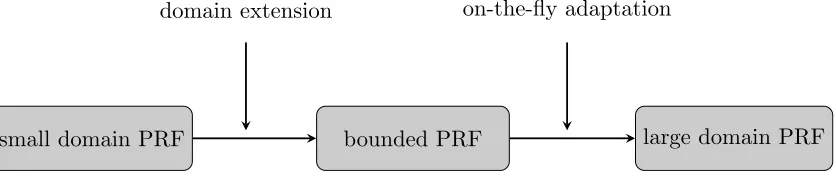
Goldreich, Goldwasser, and Micali (GGM) introduced pseudorandom functions (PRFs) in 1984 [13]. Roughly, a PRF is a keyed deterministic function, whose output is indistinguishable from a random function. PRFs are one of the most fundamental building blocks in cryptography, with numerous applications such as private-key encryption, message authentication codes, private-key derivation, and many more, e.g., [2,14,22,31,34]. In this work, we propose a novel framework to construct PRFs with the overall goal of constructingefficient PRFs based on standard assumptions with an almost tight proof of security. The basic idea of this framework is to transform a PRF for a small domain (i.e., poly-size) into a fully fledged domain that handles large input spaces. This transformation tightly reduces to the underlying small domain PRF. The main steps of our framework and the novel techniques are shown in Figure 1. We begin with a PRF that works over a small
small domain PRF
bounded PRF
large domain PRF
domain extension
on-the-fly adaptation
domain, say{0,1}log`, and which can be evaluated very efficiently in timepoly(λ,log`), for some parameter
`.
The first step in our framework is to extend the domain of a small-domain PRF into a bounded pseu-dorandom function (bPRF). A function F is an `-bounded pseudorandom function (for an` ≤poly(λ)), if the outputs of F are pseudorandom for the first ` distinct queries toF and if F can be computed “super efficiently” (i.e., in time poly(λ,log(`))). In some sense, this primitive can be seen as the computational analogue to`-wise independent functions.
The second step in our framework is a reduction technique we callon-the-fly adaptation. The goal of this technique is to construct a PRFF in which we can dynamically embed an `-bounded PRFF` for every ` that grows at most polynomially. Now assume we have a PPT distinguisher Dthat distinguishesF from a truly random function. SinceDis efficient, it sends at mostq=poly(λ) queries to its oracle (for an a-priori unknown q). On-the-fly adaptation allows us to turn this distinguisher against F into a distinguisher D0 against a bounded PRFFq that has the same advantage.
We will demonstrate this idea with a simple on-the-fly adaptation technique that works for any bounded PRF. The basic idea of this technique is to compute F as a sum of functions F`, for an exponentially increasing`. An important point is that all F` have thesame domain. The function F is computed by
F(K, x) = t M
i=0
F2i(K2i, x),
whereK= (K2i)i=1,...,t. If we choose the parametert=ω(log(λ)) slightly super-logarithmic, we will be able to embed anyF` intoF. Notice thatF can be computed efficiently, as we required that bounded PRFs can be computed in timepoly(λ,log(`)). To illustrate the main idea, assume that there exists a distinguisherD
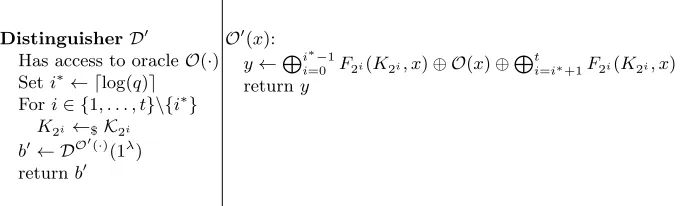
that makes at most q =poly(λ) queries distinguishes F from a truly random function. We will provide a reduction that turns this distinguisher into a distinguisher against the small domain PRFF2dlogqe. Observe that we can expressF by
F(K, x) = logq−1
M
i=0
F2i(K2i, x)⊕F2dlogqe(K2dlogqe, x)⊕ t M
i=logq+1
F2i(K2i, x).
The reduction can now replace the middle termF2dlogqe(K2dlogqe, x) by its own oracle and provide toDan oracleO0 that computes the function
O0(x) = logq−1
M
i=0
F2i(K2i, x)⊕ O(x)⊕ t M
i=logq+1
F2i(K2i, x).
Clearly, if Ocomputes the function F2dlogqe, thenO0 computes the functionF. On the other hand, ifO is a random function, thenO0 also is a random function. This reduction is tight. Notice that it is crucial for this technique to work that all F` have the same input domain. Basically the domain extension step in our framework is geared towardsequalizing the domains of small domain PRFs. This generic technique is similar to a transformation from non-adaptive to adaptive pseudorandom functions by Berman and Haitner [4]. The construction of [4] however yields no tight security proof (which was not the purpose of that work), as their construction does not start from bounded PRFs.
We will now discuss domain extension for arbitrary PRFs and provide a simple domain extension tech-nique that uses only linear functions to pre- and post-process a small domain PRF. This, together with the generic on-the-fly adaptation technique described above yields a PRF construction from any small domain PRF. We will discuss an instantiation of this general construction based on LWE.
PRF. However, this technique is vulnerable to a ”birthday attack”, which means that after a certain number of queries there is a high probability of finding a collision in the hash function. Levin’s technique also fails for small domain PRFs, i.e., PRFs with domains of polynomial size. Jain, Pietrzak, and Tentes [19] provided a domain extension technique which also works for small domains, but has an unfavorable security loss in this case. Moreover, as mentioned by the authors, their technique does not seem to be directly applicable to efficient PRF such as the one’s based on DDH [19]. The work of Jain et al. [19] was refined by Chandran and Garg [8]. Berman et al. [5] also showed how to bypass the birthday barrier via Cuckoo hashing.
We provide a simple general domain extension technique that preserves the parallel complexity of an underlying small domain PRF. This domain extension technique is inspired by the construction of universal hash functions by Ishai et al. [18] and can be seen as an amplified version of Levin’s trick. For a small domain pseudorandom functionPRF` :{0,1}log(2λ`)→ Y, we construct a large domain bounded PRFF` :X → Y by
F`(K0, x) = λ M
j=1
PRF`(K,BIN(j)kHj(x)),
whereK0= (K, H1, . . . , Hλ),H1, . . . , Hλ←$Hare randomly chosen universal hash functions from a family
Hthat mapsX to{0,1}log(2`)andBIN(j) is the log(λ) bit binary representation of an integerj∈ {1, . . . , λ}.
1.1 A General Transformation
Above we described our on-the-fly adaptation technique that works for any bounded PRF. Combining this technique with a general domain extension technique, we obtain large domain pseudorandom function with almost tight security (i.e., only a logarithmic loss) from any suitable small domain PRF. In a nutshell, a small domain PRF is suitable for this technique if its security loss only depends on the size of its input domain, but not (polynomially) on the number queries a distinguisher sends3. The computational problems from which PRFs with such a small security loss can be constructed usually have one feature in common: they support a statistical random self-reduction. Candidate PRFs with this property are PRFs based on the LWE [32,30] problem, such as the PRF of Banerjee, Peikert, and Rosen [1]. Using the BPR PRF as small domain PRF in our general construction, we obtain a large domain PRF which is secure under a weaker assumption, which has a tighter proof of security, and a shallower evaluation circuit than instantiating the BPR scheme with a large domain directly.
In the remaining part of this section, we discuss more efficient instantiations based on DDH and k-LIN. Here, we exploit specific number theoretic properties in order to improve the efficiency and security of the resulting PRF.
1.2 Efficient PRFs based on DDH and k-LIN
One appealing property of our framework is that it yields several new constructions of PRFs based on weak standard assumptions, such ask-LIN (and thus DDH) with an almost tight proof of security. A tight reduction means that a successful attacker can be turned into an efficient algorithm for the hard computational problem without any significant increase in the running time or significant loss of success probability4. We will provide a specific on-the-fly adaptation technique that exploits algebraic properties of the underlying number theoretic assumptions. We can thus avoid the blow up of the general on-the-fly adaptation technique described in the last paragraph and obtain PRFs that improve upon known constructions in terms of efficiency, security, and key-size.
3
The Naor Reingold PRF would be such a suitable PRF as its security reduction only loses a factor ofn. However, as discussed above we provide a much more efficient direct construction based on the NR PRF.
Instantiation based on DDH. In the following we discuss our construction based on the DDH assumption. Our underlying small domain PRF is the Naor-Reingold PRF based on DDH [28]. For an input domain
{0,1}n, the Naor Reingold PRFNR:K
n× {0,1}n→Gis defined by
NRn(K, x) =ga
Qn−1
j=0s
xj j ,
where K = (a, s0, . . . , sn−1) and a, s0, . . . , sn−1 ←$ Zp. In the first step, we turn the small domain PRF NRlog(`), which has a domain of size`into an`-bounded PRF that has input domain Zp, i.e., a large input domain. In contrast to our generic construction (that we will discuss later), we can exploit specific number theoretic properties in order to improve the efficiency, the tightness of the security reduction, and the key-size. The bounded PRFF`:K ×Zp→Gis defined as follows:
F`(K, x) =ga
Qlog(`)−1
j=0 (sj+x2 j
)
. (1)
We will briefly discuss why security of this PRF tightly reduces to the security ofNRlog(`). Expanding the exponent ofF`(K, x) yields
a
log(`)−1 Y
j=0
(sj+x2 j
) = X
c∈{0,1}log(`)
a log(`)−1
Y
j=0
s1j−cj
| {z }
E(c)
xPtj=1cj2j (2)
Now, observe that the term E(c) on the right side is an exponent of the Naor Reingold PRF NRlog(`). Specifically, it holds thatgE(c)=NR
log(`)(¬c) (where¬cis the bitwise negation ofc). Changing the sum on the right side of (2) to run over allj= 0, . . . ,2d`e−1 and settingc=BIN(j) (whereBIN(j) is the log(`)-bit binary representation ofj), we get thatF`can be equivalently computed as
F`(K, x) =
2dlog(`)e−1
Y
j=0
NRlog(`)(K,¬BIN(j)) xj
. (3)
Notice that this expression can still be efficiently computed as long as`≤poly(λ). Now, observe that if we replaceNRlog(`)by a random function in this expression, then F` becomes an (information theoretic)`-wise independent function. We can therefore use this alternative description ofF`to show that it is an`-bounded PRF.
The observation that functions of the form asF`in (3) can be computed in time log`via a closed form as (1) was previously made by Benadbbas, Gennaro, and Vahlis for the Naor-Reingold PRF [3] and Fiore and Gennaro for the Lewko-Waters PRF [12]. The fact that F` is a bounded PRF was independently observed by Hazay [15].
In the last step, we apply an “in-place” on-the-fly adaptation technique to this function. We will not use the generic technique described above, but one that exploits the specific algebraic properties ofF`. We define the full fledged PRFF by
F(K, x) =gaQtj−=01(sj+x2 j
)
,
where the parametert=ω(log(λ)) is chosen slightly super-logarithmic. Now, notice that we can embed the bounded PRFF`(for any`≤poly(λ)) intoF by
F(K, x) =
gaQlog(`)
−1
j=0 (sj+x2 j
)
Qtj−=log(1 `)(sj+x2 j
)
= (F`(K`, x))
Qt−1
j=log(`)(sj+x2 j
)
.
In the security proof, we replace F` by a truly random function. The main part of the proof consists in showing that the exponentQt−1
j=log(`)(sj+x2 j
Comparison to Naor-Reingold [27]. Our full fledged PRF with input domainZp improves upon the Naor-Reingold PRF (NR-PRF) in terms of tightness of the security reduction and compactness. In contrast to the NR-PRF, the loss of our security reduction is only a factor of log(q) (whereq =poly(λ) is the number of queries required by the distinguisherD), compared to a factornfor the NR-PRF. Our PRF is very compact as it only requiresω(log(λ))Zp elements for its key, whereas the Naor-Reingold needsnZp elements. Since the exponentiation is the dominating factor in the computation of both PRFs, the costs to evaluate both functions is roughly the same.
Instantiation based on k-LIN. In the main body, we directly provide a PRF construction based on a family of weaker computational problems known as k-LIN [33,17]. The decisional k-linear assumption becomes (generically) weaker as the parameterkgrows, where the instancek= 1 corresponds to DDH and
k= 2 to the linear assumption [6]. The main motivation for these assumptions is that groups are known where the DDH assumption is easy, but the computational Diffie Hellman problem is supposedly hard [16]. It is thus desirable to have constructions of cryptographic primitives based on the decisionalk-linear assumption instead of DDH. Our generalized PRF is defined as follows: Letk ≥1 be a positive integer,G=hgi be a
cyclic group of prime orderpand t=ω(log(λ)). The functionF :K ×Zp→Gk is defined by
F(K, x) =ga>·Qjt−=01(Sj+x2 j
·I),
where K= (a,S0, . . . ,St−1) witha←$ Zpk, S0, . . . ,St−1 ←$Zkp×k andIthe identity matrix. Clearly, if we only need a single group element as output, we can truncate the exponent and perform only 1 exponentiation.
Comparison to Lewko-Waters [21]. Our PRF improves upon the Lewko-Waters PRF (LW-PRF) in terms of efficiency, tightness of the security reduction, and compactness. A single evaluation of the LW-PRF involves n matrix multiplications and a single exponentiation. In our case, the computation requires only
t = ω(log(λ)) matrix multiplications and a single exponentiation. For larger k, the cost of the matrix multiplication dominates the cost of the exponentiation, so in this case our construction is more efficient. The security reduction of Lewko and Waters loses a factor ofk·nwhile our reduction only losses a factor of
klogq. The keys of the LW-PRF consist ofn k×kmatrices overZp, while ours consists merely oft=ω(logλ) such matrices.
1.3 Other Related Work
Many number-theoretic PRF constructions follow the GGM paradigm [13], such as [27,21,1]. Naor and Reingold introduced pseudorandom synthesizer (PRS) that can be used to construct parallel computable pseudorandom function [26,1]. A PRF construction that is not based on either the GGM or synthesizers paradigm is the PRF of Dodis-Yampolskiy, which is in fact a direct construction, but whose security is closely related to its underlying bilinearq-type assumption [10]. Recently, Chase and Meiklejohn showed that this
q-type assumption can be reduced to the subgroup hiding assumption in composite order groups [9]. The PRF of Naor, Reingold, and Rosen is a clever variant of the Naor-Reingold PRF that is secure under the factoring assumption [29]. The work of Boneh, Montgomery, and Raghunathan combines a generalization of the GGM tree with the Dodis-Yampolskiy PRF to get a large-domain (simulateable) verifiable random function [7].
2
Preliminaries
Definition 1 (Pseudorandom Functions).LetXλandYλ be two finite sets depending onλ. We say that
an efficiently computable keyed functionPRF:Kλ× Xλ→ Yλwith key-spaceKλ is a pseudorandom function
(PRF), if it holds for every PPT oracle distinguisherDthat
|Pr[DPRF(K,·)(1λ) = 1]−P r[DR(1λ) = 1]| ≤negl(λ),
whereK←$Kλ andR:Xλ→ Yλ is a randomly chosen function. If|X | ≤poly(λ), then we say thatPRFis
a small-domain PRF, otherwise we call PRFa large-domain PRF.
We will usually omit the λ subscript in the definition of K, X and Y. Moreover, we will henceforth implicitly assume that distinguisher gets 1λ as an additional input without explicitly stating this.
As mentioned in the outline, bounded pseudorandom functions can be seen as a computational analogue of limited-wise independent functions. Basically, the difference between true PRFs and bounded PRFs manifests itself in their security guarantee. While a distinguisher against a true PRF can query the PRF an a-priori unbounded number of times, a distinguisher against an`-bounded PRF can query the PRF with at most`
distinct queries.
Definition 2 (Bounded Pseudorandom Functions). LetX andY be finite sets (depending onλ). We say that a keyed function F` : K`× X → Y parametrized by a parameter ` is a bounded pseudorandom
function (bPRF), if F` is computable in time poly(λ,log(`)) and if it holds for all efficiently computable
`∗ = `(λ) ≤ poly(λ) and all `∗-query distinguishers D (i.e. distinguishers that send at most `∗ distinct queries) that
|Pr[DF`(K,·)= 1]−P r[DR= 1]| ≤negl(λ),
whereK←$K` andR:X → Y is a randomly chosen function.
Notice that in the definition of bounded PRFs we allow the key-space to depend on`, butX andY are independent of `. Moreover, as we require that F` is computable in time poly(λ,log(`)), we implicitly also require that |K`| ≤ poly(λ,log(`)). Requiring that F` can be computed in timepoly(λ,log(`)) allows us to evaluateF` for super-polynomial`, while we only require security for`∗ which are at most polynomial.
The following lemma states that if a functionF outputs uniformly random outputs underbenign inputs, then the statistical distance fromF to a uniformly random functionF0 can be bounded by the probability that a non-adaptive sequence of inputs is not benign. Intuitively, an adaptive distinguisherDlearns nothing about the set of bad inputs unless it finds such an input by chance, as otherwise the functionF reveals no information about the set of bad inputs. This lemma is a simplified version of a more general statement due to Maurer [23].
Lemma 1. Let X and Z be two finite sets. Let FK,aux : X → Z be a function that takes two addi-tional parameters K ∈ K and aux ∈ AUX. Let good(·,·) be a predicate with the following property: If
good({x1, . . . , xi},aux) holds, then FK,aux(x1), . . . , FK,aux(xi) are distributed uniformly at random over the
choice of K ←$ K. Let D be a (possibly unbounded) distinguisher that makes at most ` distinct queries,
K←$K,aux←$AUXand letF0 be a uniformly chosen function from X toZ. Then it holds that
|Pr[DFK,aux = 1]−Pr[DF0= 1]| ≤max
S Pr[¬good(S,aux)],
whereS runs over all subsets ofX of size at most `.
Proof. It suffices to prove the lemma for a deterministicD, as the statement for a randomizedDfollows by a standard coin-fixing and averaging argument. Thus assume thatDis deterministic. Define the transcript-function TS(F) as the sequence (x1, F(x1)), . . . ,(xr, F(xr)) of input/output pairs that D generates when having oracle access to the function F. We say that a sequenceT = ((x1, y1), . . . ,(xr, yr)) (for somer) is a
of allxsuch that a tuple (x, y) appears inT5. Clearly, for a (fixed)validtranscriptT = ((x
1, y1), . . . ,(xr, yr)) and a (randomly chosen) functionF it holds that
Pr[TS(F) =T] = Pr[F(x1) =y1, . . . , F(xr) =yr]. (4) Now fix aux, but let KandF0 be chosen at random. We will first show that
|Pr[DFK,aux = 1]−Pr[DF0 = 1]| ≤Pr[¬good(DQ(TS(F0)),aux)]. (5)
By the averaging principle it follows immediately that this also holds for a randomly chosenaux. Before we prove (5), we will show for every valid transcriptT that ifgood(DQ(T),aux) holds, then we have
Pr[DFK,aux= 1∧TS(F
K,aux) =T] = Pr[DF
0
= 1∧TS(F0) =T]. (6)
To see this, note first that the output ofD∗is a deterministic function of the transcript T (i.e. either 0 or 1 depending onT). Thus the above follows from
Pr[TS(FK,aux) =T] = Pr[TS(F0) =T].
But by (4) this is equivalent to
Pr[FK,aux(x1) =y1, . . . , FK,aux(xr) =yr] = Pr[F0(x1) =y1, . . . , F0(xr) =yr].
whereT = ((x1, y1), . . . ,(xr, yr)). But this follows immediately from the fact that theF0(xi) are distributed uniformly at random for distinctxi and also theFK,aux are distributed uniformly at random for distinctxi, as we assume thatgood(DQ(T),aux) =good({x1, . . . , xr},aux) holds.
We can now prove (5). It holds that
Pr[DF0 = 1] = Pr[DF0 = 1∧good(DQ(TS(F0)),aux)] + Pr[DF0 = 1∧ ¬good(DQ(TS(F0)),aux)]
≤ X
T s.t.good(DQ(T),aux)
Pr[DF0 = 1∧TS(F0) =T]
+ Pr[good(DQ(TS(F0)),aux)]
= X
T s.t.good(DQ(T),aux)
Pr[DFK,aux= 1∧TS(F
K,aux) =T]
+ Pr[good(DQ(TS(F0)),aux)] = Pr[DFK,aux= 1∧good(DQ(TS(F
K,aux)),aux)]
+ Pr[¬good(DQ(TS(F0)),aux)]
≤Pr[DFK,aux= 1] + Pr[¬good(DQ(TS(F0)),aux)].
It follows that
|Pr[DFK,aux = 1]−Pr[DF0 = 1]| ≤Pr[¬good(DQ(TS(F0)),aux)].
Now assume thataux←$AUXis chosen at random. AsF0 is independent ofaux, it holds that Pr[¬good(DQ(TS(F0)),aux)]≤max
S Pr[¬good(S,aux)], whereS is a set of queries that maximizes Pr[¬good(S,aux)]. Finally, this yields
|Pr[DFK,aux = 1]−Pr[DF0= 1]| ≤max
S Pr[¬good(S,aux)], which concludes the proof.
3
A Generic Construction
In this section, we will first provide an efficient construction of`-bounded pseudorandom function any small domain PRF with input space of (polynomial) sizen·`. Security of the`-bounded PRF follows tightly from the underlying small domain PRF. Second, we will provide a general construction of a PRF from`-bounded PRFs, where security also follows tightly.
3.1 Bounded PRFs via Domain Extension of Small Domain PRFs
We will need universal hash functions for our domain extension technique.
Definition 3 (Universal Hash Functions). Let X and Y be finite sets. We say that a family H of functions fromX toY is a family of universal hash functions, if it holds for allx6=x0 ∈ X thatPr[H(x) =
H(x0)]≤1/|Y|, where the probability is taken over the random choice ofH←$H. Universal hash functions can be constructed very efficiently, see e.g.,[18].
Construction 1 Let PRF` : K`× {0,1}log(2λ`) → {0,1}m be a keyed function with key space K`. Let H`
be a family of universal hash functions that map X to{0,1}log(2`). Let BIN(j)denote thelog(λ) bit binary
representation of a number j ∈ {1, . . . , λ}. We define the keyed function F` : K0× X → {0,1}m with key
spaceK0 `=H
λ× K ` by
F`(K0, x) = λ M
j=1
PRF`(K,BIN(j)kHj(x)),
whereHj←$H` forj = 1, . . . , λ,K←$K` andK0= (H1, . . . , Hλ, K).
Similar constructions haven been suggested before in different contexts, such as e.g., [24,25]. The following theorem states thatF`is an`-bounded pseudorandom function ifPRF` is a pseudorandom function. Theorem 1. Let PRF` andF` be as in Construction 1. If PRF` is a pseudorandom function, then F` is an
`-bounded pseudorandom function. More specifically, assume there exists an `∗ ≤poly(λ) and an `∗-query PPT distinguisherDthat distinguishesF`∗from a truly random function with advantage, then there exists
a PPT distinguisherD0with essentially the same runtime asDthat distinguishesPRF
`∗from a truly random
function with advantage at least−`∗·2−λ.
We will first prove two technical statements and then provide the proof for Theorem 1.
Definition 4. Let Y be a finite set and let y1, . . . ,y` ∈ Yk be vectors of length k. We say that a vector y1, . . . ,y` is cover free, if for everyi∈ {1, . . . , `} there exists aj ∈ {1, . . . , k}such that it holds for all i06=i
that yi,j6=yi0,j.
Lemma 2. Let`=poly(λ)and let X andY be two finite sets with |Y| ≥2`. LetHbe a family of universal hash functions mappingX toY. LetH1, . . . , Hλ←$ Hbe chosen uniformly at random and define H(x) := (H1(x), . . . , Hλ(x)). Then it holds for all pairwise distinct x1, . . . , x` ∈ X that H(x1), . . . , H(x`) are cover
free, except with probability`·2−λ over the choice of H
1, . . . , Hλ, i.e. Pr[H(x1), . . . , H(x`)not cover free]≤`·2−λ.
Proof. Fix pairwise distinct x1, . . . , x` ∈ X. We will first analyze the probability that a given the j-th component ofH(xi) is identical to thej-th component of someH(xi0) fori06=i. Clearly, this is exactly the case there exists ani0 6=i such thatHj(xi) =Hj(xi0). By a union-bound and the universality ofHit holds that
Pr[∃i06=i:Hj(xi) =Hj(xi0)]≤
X
i06=i
Pr[Hj(xi) =Hj(xi0)]
≤`· 1 |Y| ≤`·
1 2` =
As theH1, . . . , Hλare chosen independently, it holds that
Pr[∀j∃i0 6=i:Hj(xi) =Hj(xi0)] = λ Y
j=1
Pr[∃i0 6=i:Hj(xi) =Hj(xi0)]≤2−λ.
Finally, it holds by a union bound that
Pr[H(x1), . . . , H(x`) not cover free] = Pr[∃i∀j∃i06=i:Hj(xi) =Hj(xi0)]
≤
` X
i=1
Pr[∀j∃i0 6=i:Hj(xi) =Hj(xi0)]
≤`·2−λ.
Lemma 3. Fix functions H1, . . . , Hλ : X → Y and define H(x) = (H1(x), . . . , Hλ(x)). Let R1, . . . , Rλ be
randomly chosen functions from Y to{0,1}m. Define the function F :X → {0,1}mby
F(x) = λ M
j=1
Rj(Hj(x)).
It holds for all distinctx1, . . . , x`∈ X for whichH(x1), . . . , H(x`)are cover-free and ally1, . . . , y`∈ {0,1}m
that
Pr[F(x1) =y1, . . . , F(x`) =y`] = 2−`·m.
Proof. SinceH(x1), . . . , H(x`) are cover-free, we get that everyH(xi) has a unique coordinateHj(xi). This mean that the termRj(Hj(xi)) appears only in the sum
F(xj) = λ M
j=1
Rj(Hj(xj)).
AsRj(Hj(xi)) is distributed independently and uniformly at random, the same holds forF(xj). Thus, the
F(x1), . . . , F(x`) are distributed independently and uniformly at random, from which the statement of the lemma follows directly.
Given these tools, we are ready to prove Theorem 1.
Proof (Theorem 1). LetD be an`-query distinguisher with advantage against the pseudorandomness of
F`. Define the following hybrids, where in hybridiDhas oracle access to a functionF(i):X → {0,1}m. – Hybrid H1: The functionF(1) is given by F(1)(x) =F`(K, x), where K ←$ K` is a uniformly chosen
key.
– Hybrid H2: Let R1, . . . , Rλ be a uniformly random functions that map from {0,1}n to {0,1}log(2`). Define F(2) by
F(2)(x) = λ M
j=1
Rj(Hj(x)).
– Hybrid H3: The functionF(3) is chosen uniformly at random. This is the ideal experiment. Clearly, it holds that
|Pr[DF(1) = 1]−Pr[DF(3) = 1]| ≥ Define
1=|Pr[DF
(1)
= 1]−Pr[DF(2) = 1]|
2=|Pr[DF
(2)
By the triangle inequality it holds that
≤1+2. (7)
We will first show that 2 ≤`·2−λ. Define H(x) = (H1(x), . . . , Hλ(x)) and R(z) = L λ
j=1Rj(zj) and note that we can expressF(2)byF(2)(x) =R(H(x)). For a setS={x
1, . . . , xr} ⊆ X of size at most`define the predicate good(S, H) to be true if and only if H(x1), . . . , H(xr) are cover-free. By Lemma 3 it holds thatF(2)(x
1), . . . , F(2)(xr) are distributed independently and uniformly at random ifH(x1), . . . , H(xr) are cover-free. Thus, the conditions for Lemma 1 are given and it holds that
2=|Pr[DF
(2)
= 1]−Pr[DF(3)
= 1]|
≤ max
x1,...,x`
Pr[H(x1), . . . , H(x`) not cover-free].
By Lemma 2 it holds for all distinctx1, . . . , x`∈ X that
Pr[H(x1), . . . , H(x`) not cover-free]≤`·2−λ,
and we can conclude that2≤`2−λ. It follows by (7) that≤1+`·2−λand therefore1≥−`·2−λ. We will now construct a PPT distinguisher D0 that distinguishes the small domain PRF PRF
` from a uniformly random function with advantage 1. Since the input domain of PRF` has only polynomial size, we can assume wlog that D0 receives the entire function table of PRF
` as input. Let H` be the family of universal hash functions from Construction 1.
DistinguisherD0
Input: FunctionT:{0,1}log(λ)+log(2`)→ { 0,1}m
, encoded as a function table
H1, . . . , Hλ←$H
b0← DO(·) (1λ) returnb0
O(x):
y←Lλ
i=1T(BIN(i)kHi(x)) returny
First assume thatTis a functionT(x) =PRF`(K, x) for a randomly chosen keyK←$K`. Then the oracle
O0inD0’s simulation is identically distributed toF(1). On the other hand, ifTis a uniformly random function
R0, then fori= 1, . . . , λthe functionsR
i(y) =R0(BIN(i)ky) are independent and uniformly random functions from{0,1}log(2`)to{0,1}m. Thus, in this case the oracleOcomputes the functionO(x) =Pλ
i=1Ri(Hi(x)), which is identically distributed toF(2). Consequently, it holds that
Adv(D0) =|Pr[D0PRF`(K,·)= 1]−Pr[D0R0 = 1]|
=|Pr[DF(1) = 1]−Pr[DF(2) = 1]|= 1, i.e.D0distinguishesPRF
`from a uniformly random functionR0with advantage1≥−`·2−λ. This concludes the proof.
3.2 PRFs via On-the-Fly Adaptation of bounded PRFs
Construction 2 Lett=ω(log(λ))be slightly super-logarithmic. For a given parameter`, letF`:K`× X →
{0,1}mbe a keyed function with corresponding key space K
`. Define the functionF :K × X → {0,1}m with
key-spaceK=Qt
i=0K2i by
F(K, x) = t M
i=0
F2i(K2i, x),
whereK2i←$K2i fori= 1, . . . , tandK= (K2i)i=1,...,t.
We will now show thatF is in fact a pseudorandom function.
Theorem 2. LetF`andFbe as in Construction 2. Assume thatF`is an`-bounded PRF for every efficiently
computable`=`(λ). ThenF is a pseudorandom function. Specifically, if D is a PPT distinguisher against
F with advantagethat makes at mostq=poly(λ)distinct queries, then there exists a PPT distinguisherD0
(with essentially the same runtime asD) with advantage against F`∗, where`∗= 2dlog(q)e≤2q=poly(λ).
Proof. Let D be a PPT distinguisher against F with advantage that makes at most q distinct queries. Note that since q=poly(λ) and t=ω(log(λ)), it holds log(q)≤t (for a sufficiently large λ). We will now construct an`∗-query distinguisherD0 againstF
`∗, which is given in Figure 2.
DistinguisherD0
Has access to oracleO(·) Seti∗← dlog(q)e Fori∈ {1, . . . , t}\{i∗}
K2i←$K2i
b0← DO0(·) (1λ) returnb0
O0 (x):
y←Lii∗=0−1F2i(K2i, x)⊕ O(x)⊕Lti=i∗+1F2i(K2i, x) returny
Fig. 2.The distinguisherD0
Notice first that D0 sends at most q≤ 2dlog(q)e =`∗ queries to its oracle, asD sends at most q oracle queries. We will now analyze the distinguishing advantage ofD0. First, assume thatD0’s oracleOimplements the functionF`∗(K,·) for a randomly chosenK←$K`∗. Then, the oracleOprovided byD0toDimplements exactly the functionF(K,·) for a randomly chosenK←$K. On the other hand, ifObehaves like a uniformly random functionR0, then the oracleO0also implements a uniformly random functionR, asR0is independent of theK2i. Consequently, it holds that
Adv(D0) =|Pr[D0F`∗(K`∗,·)= 1]−Pr[D0R0 = 1]| =|Pr[DF = 1]−Pr[DR= 1]|=,
i.e.D0 distinguishesF` from a uniformly random functionR0 with advantage. This concludes the proof.
3.3 Instantiations
Combining Theorem 1 and Theorem 2 yields the following
Theorem 3. Let t=ω(log(λ)). LetPRF`:{0,1}log(2λ`)→ {0,1}m be a small domain PRF, letH` :X →
{0,1}log(2`)be a family of universal hash functions. Define the keyed functionF :K × X → {0,1}m by
F(K, x) = t M
i=1 λ M
j=1
whereK2i←$K2i fori= 1, . . . , tandH2i,j ←$H2i fori= 1, . . . , tandj= 1, . . . , λ.
If PRF` is a PRF for every ` = poly(λ), then F is a PRF. More specifically, if there exists an
distin-guisher Dthat makes at mostq=poly(λ)queries and distinguishesF with advantage , then there exists a distinguisherD0 with essentially the same runtime asDthat distinguishesPRF
2dqe with advantage−q·2−λ. We will briefly discuss efficiency aspects of the construction provided in Theorem 3. First of all notice that the transformation preserves the parallel complexity of the underlying small domain PRF. Moreover, the pre- and post-processing steps are entirely linear, i.e. the computation of universal hash functions and XOR-ing the results.
We will now discuss an instantiation of this PRF using a small domain PRF based on lattice problems. As already mentioned in the introduction, the main purpose of our constructions is obtaining PRFs from standard assumptions that are as tight as possible. Since the construction in the last section allows reducing the security of the constructed large domain PRF to the security of anadversary specificsmall domain PRF, we need a family of small domain PRFs with security as tight as possible. The Naor-Reingold PRF with domain{0,1}n allows for a security loss of a factor ofn, while the security loss of a comparable GGM PRF is q·n. This holds because the DDH problem possesses a statistical random self-reduction which allows to compute an arbitrary number of DDH samples from a given sample. The learning with errors (LWE) problem enjoys a similar property, which is stated explicitly in the assumption.
Definition 5 (Decisional LWE [32,30]). Let p=p(λ) be a modulus, k =k(λ) = poly(λ) be a positive integer andχr=DZ,r be a gaussian distribution with noise parameterr. Lets←$Zkp be chosen uniformly at
random. The goal of theLWE(p, n, χr)problem is to distinguish an arbitrary number of samples(a,ha,si+e)
wherea←$Zkp ande←$χα from samples(a, u)whereu←$Zp is chosen uniformly at random.
Banerjee, Peikert and Rosen [1] constructed a PRF based on the LWE problem. The PRF has a structure which is similar to the Lewko-Waters PRF but uses a rounding operation instead of exponentiation. Let
p1p2. For anx∈Zp1 definebxep2 =d(p2/p1)·xc modp2. For vectors x∈Z
k
p1 defineb·ep2
component-wise. We can now state the BPR PRF.
Theorem 4. Let n = n(λ) be a positive integer, r = r(n) be a noise parameter, k = k(λ) = poly(λ) be a positive integer and let p1, p2 be moduli such that p1 ≥ p2·n·(Cr
√
k)n·kω(1), where C is a universal
constant. The keyed function BPRn:Kn× {0,1}n→Zkp2 with key space Kn =Z
k p2× Z
k×k p2
n
is defined by
BPRn(K, x) = a
> n Y
j=1 Sxj
j
p
2
,
wherea←$Zkp1 andS1, . . . ,Sn←$χ
k×k
α andK= (a,S1, . . . ,Sn).
Assume that LWE(p1, k, χr)is hard. ThenBPRn is a pseudorandom function. Specifically, if there exists
a distinguisher D that distinguishes BPRn with advantage from a random function, then there exists a
distinguisher D0 with essentially the same runtime as D that distinguishes LWE(p1, k, χr) with advantage
/(k·n).
Observe that in Theorem 4 the underlying hardness assumption changes when we increase the input length
n. More specifically, the smaller the term p1/r is, the harder the underlying LWE problemLWE(p1, k, χr) becomes. The term p1/r is dominated by (Cr
√
k)n, thus we aim towards minimizing n. Observe that we can fix a modulusp2 for the whole familyBPRn, therefore all functions in this family have the same output domain. Plugging the BPRn as small domain PRF in the construction of Theorem 3 yields that n never becomes larger than log(q) for some q = poly(n). Thus we can base the security of the PRF in Theorem 3 on LWE(p1, k, χr) withp1 =p2·n·(Cr
√
While the construction from Theorem 3 preserves the parallel complexity of the small domain PRF, the overall complexity of evaluating the PRF may actually increase. We consider it an interesting problem to find a PRF construction which enjoys similar properties as thek-LIN based construction in Section 4, i.e. one improves the underlying small domain PRF in all aspects, in particular key size and evaluation complexity.
4
A Direct Construction from the
k-LIN Problem
In this section, we will provide our efficient constructions of number-theoretic PRFs. As discussed above, we will first develop a specialized domain extension technique and then construct a large domain PRF using a tailor-made on-the-fly adaptation strategy.
4.1 Preliminaries
In this section, we will generally index vectors of lengthnwith indices 0, . . . , n−1. We will denote the identity matrix inZkp×kbyI. For vectorsa∈Zpk we define exponentiation component-wise, i.e.ga= (ga0, . . . , gak−1). The decisionalk-linear assumption (k-LIN) [33,17] generalizes the decisional DDH problem. The decisional
k-Linear assumption becomes (generically) weaker when the parameter k grows, where the instancek = 1 corresponds to DDH andk= 2 to the linear assumption [6]. The main motivation for these assumptions is that groups are known, where the DDH assumption is easy, but the computational Diffie Hellman problem is supposedly hard [16].
Definition 6 (Decisionalk-LIN Problem).LetGbe a cyclic group of prime orderp. Letg0, g1, . . . , gk←$
Gands1, . . . , sk, r←$Zpbe chosen uniformly at random. The goal of thek-LIN problem inGis to distinguish
the distributions
(g0, . . . , gk, g1s1, . . . , g sk k , g
Pk i=1si
0 )and(g0, . . . , gk, gs11, . . . , g sk k , g
r 0).
We will use the PRF construction of Lewko and Waters [21] as underlying small domain PRF in our construction.
Theorem 5. Let k≥1 be a positive integer,G=hgibe a cyclic group of prime orderpandn=n(λ)be a positive integer. Define the keyed function LWn:Kn× {0,1}n →Gwith key space Kn=Zkp× Zkp×k
n
by
LWn(K, x) =ga >·Qn−1
j=0S
xj j ,
wherea←$Zkp,S0, . . . ,Sn−1←$Zpk×k andK= (a,S0, . . . ,Sn−1). If the k-LIN problem is hard inG, then
LWn is a pseudorandom function. More specifically, assume that there exists a PPT distinguisher D that
distinguishes LWn with advantagefrom a random function. Then there exists a PPT distinguisherD0 that
distinguishes the k-LIN problem with advantage/(k·n).
The Lewko-Waters PRFLWas described in the construction in Theorem 5 outputskgroup elements and therefore requireskexponentiations. We can truncate the output of the LW PRF to a single group element, thereby only requiring a single exponentiation.
4.2 A bounded PRF fromk-LIN
We will now provide an efficient construction of a bounded PRF fromk-LIN. The security of this bounded PRF tightly reduces to the security of a small domainLWPRF and therefore tok-LIN with only a logarithmic loss.
Construction 3 Let k ≥1 be a positive integer, G = hgi be a cyclic group of prime order p. The keyed
function F`:K`×Zp→Gwith key space K`=Zkp× Z k×k p
log(`)
is defined by
F`(K`, x) =ga
>·Qlog(`)−1
j=0 (Sj+x2 j
·I),
For a bit b∈ {0,1} let¬b = 1−b denote the negation ofb. For a bit-vectorc∈ {0,1}m let¬cdenote the bit-wise negation ofc. We will need the following technical lemma.
Lemma 4. Let p be a prime integer. It holds for all r ∈ N>0, all matrices S0, . . . ,Sr−1 ∈ Zkp×k and all
x∈Zp that
r−1 Y
j=0
(Sj+x2jI) = X
c∈{0,1}r
r−1 Y
j=0 S¬jcj
x
Pr−1
j=0cj2j.
The proof of Lemma 4 works by inductively expanding the left side of the equation.
Proof. We will inductively expand the terms on the left side of the equation. Clearly, the equation is correct forr= 1. Now assume that the equation is correct forr−1. It holds that
r−1 Y
j=0
(Sj+x2jI) =
r−2 Y
j=0
(Sj+x2jI)
(Sr−1+x2 r−1
I)
=
X
c∈{0,1}r−1
r−2 Y
j=0 S¬jcj
x
Pr−2
j=0cj2j
(Sr−1+x2 r−1
I)
= X
c∈{0,1}r−1
r−2 Y
j=0 S¬cj
j
S 1 r−1x
Pr−2
j=0cj2j+0·2r−1
+ X
c∈{0,1}r−1
r−2 Y
j=0 S¬cj
j
S 0 r−1x
Pr−2
j=0cj2
j+1·2r−1
= X
c∈{0,1}r
r−1 Y
j=0 S¬cj
j
x
Pr−1
j=0cj2
j
Theorem 6. Assume that thek-LIN problem is hard inG. Then the functionF` defined in Construction 3
is a bounded PRF. More specifically let`∗ ≤poly(λ)and assume that D is an `∗-query PPT distinguisher with advantageagainst the pseudorandomness ofF`∗. Then there exists a distinguisherD0 (with essentially
the same runtime as D) with advantage k·log(` ∗) againstk-LIN.
Proof. First observe that F` can be computed in time poly(λ,log(`)). Notice that LWlog(`) and F` have identical key-spaces. LetK= (a,S0, . . . ,Slog(`)−1) be a key forF`. It follows immediately by Lemma 4 that we can computeF`by
F`(K, x) =ga
>·Qlog(`)−1
j=0 (Sj+x2 j
·I)
=ga
>·P
c∈{0,1}log(`)
Qlog(`)−1
i=0 S
¬ci i
x
Plog(`)−1
i=0 ci2i
= Y
c∈{0,1}log(`)
ga
>·Qlog(`)−1
i=0 S
¬ci i
x
Plog(`)−1
i=0 ci2i
= Y
c∈{0,1}log(`)
LWlog(`)(K,¬c) x
Plog(`)−1
i=0 ci2i
For an integerj∈ {0, . . . ,2dlog(`)e−1}letBIN(j) denote the log(`) bit binary representation ofj, i.e. it holds thatj =Plog(`)−1
i=0 BIN(j)i2i. Thus, it holds that
F`(K, x) =
2dlog(`)e−1 Y
j=0
LWlog(`)(K,¬BIN(j)) xj
Now, let `∗ ≤ poly(λ) and assume that D is a `∗-query PPT distinguisher that distinguishes F`∗ with advantagefrom a random function. We will construct a PPT distinguisherD0 that distinguishesLW
log(`∗) from a random function with advantage. Since the function table of a function {0,1}log(`∗)
→Gk has size
2dlog(`∗)e·klog(|
G|)≤2`∗klog(|G|) =poly(λ), we can assume that D0’s input is an explicit function table.
DistinguisherD0
Input: FunctionT :{0,1}log(`∗)→
Gk,
encoded as a function table
b0← DO(·)(1λ) returnb0
O(x):
y←Q2dlog(`∗)e−1
j=0 (T(¬BIN(j))) xj
returny
First observe that D0 is efficient as D is efficient and the oracle O can be implemented efficiently (as 2dlog(`∗)e≤2`∗). We will now analyze the advantage ofD0. IfD0’s inputT is a functionLW
log(`∗)(K,·) for a randomly chosenK←$Klog(`∗), then clearly by (8) it holds that the oracleOimplements exactlyF`∗(K,·). On the other hand, ifT implements a random functionR0 :{0,1}log(`∗)→
Gk, then we can expressR0 by
R0(¬BIN(j)) =ga>j for allj = 0, . . . ,2dlog(` ∗)
e−1, where thea0, . . . ,a
2dlog(`∗)e−1←$Gk are chosen uniformly
at random. Thus, in this case the function computed byO is
O(x) =
2dlog(`∗)e−1 Y
j=0
ga>jxj
=gP2
dlog(`∗)e −1
j=0 a
> jx
j
,
which is an`∗-wise independent function. To see this, note thatg-exponentiation is an isomorphism and the function in the exponentP2dlog(`
∗)e −1
j=0 a>jxj is a random polynomial of degree 2dlog(` ∗)e
−1≥`∗−1, which is an `∗-wise independent function. Thus, from the view ofD the oracleO implements a random function
R, as Dsends at most`∗ distinct queries. We conclude
Adv(D0) =|Pr[D0LWlog(`∗)(K,·)= 1]−Pr[D0R0 = 1]|
=|Pr[DF`∗(K,·)
= 1]−Pr[DR= 1]|=.
By Theorem 5, the distinguisherD0 yields a distinguisherD00with advantage
klog(`∗) againstk-LIN.
4.3 In-Place On-the-Fly Adaptation
While the general on-the-fly adaptation strategy we will provide in Section 3.2 needs to replicate the the underlying bounded PRF t times, we will now provide a specific on-the-fly adaptation technique for the bounded PRFF`provided in the last paragraph that involves no expansion whatsoever. Due to the special algebraic structure of F`, this on-the-fly adaptation can be done in-place. To obtain an unbounded PRF from the bounded PRF of Construction 3, we will set the upper limit of the product in the exponent from log(`) to somet=ω(log(λ)). We thereby ensure thattis large enough that we can embedF`∗ in this PRF for any`∗≤poly(λ).
Construction 4 Let k ≥ 1 be a positive integer and G = hgi be a cyclic group of prime order p. Let
t=ω(log(λ)). The keyed function F :K ×Zp→Gwith key space K=Zkp× Z k×k p
t
is defined by
F(K, x) =ga>·Qjt−=01(Sj+x2 j
·I),
We still need the following auxiliary lemma which states that a randomly chosen matrix from Zkp×k has full rank, except with small probability.
Lemma 5. Let pbe a prime and S←$Zkp×k be chosen uniformly at random. Then it holds that
Pr[rank(S)< k]≤ 1
p−1.
The proof of Lemma 5 is standard.
Theorem 7. Assume that thek-LIN problem is hard inG. Then the function F defined in Construction 4 is a PRF. More specifically assume thatDis PPT distinguisher that makes at most q=poly(λ)queries and distinguishes F with advantage from a uniformly random function. Then there exists a PPT distinguisher
D∗ (with essentially the same runtime asD) with advantage 1 k·log(q)·
−(pqt−1)against k-LIN inG.
Proof. LetDbe a distinguisher with advantageagainst the pseudorandomness ofF which makes at most
q=poly(n) queries. Note that sinceq=poly(λ) andt=ω(log(λ)), it holds log(q)≤t−1 (for a sufficiently largeλ). We will define 3 hybrid experiments. In hybridiDis given access to a functionF(i):Zp→Gk.
– HybridH1: In this experimentDis given oracle access to the function F(1) given byF(1)(x) =F(K, x) for a randomly chosenK←$K.
– HybridH2: In this experimentDis given oracle access to the functionF(2) defined by
F(2)(x) =gr(x)>·Qtj=log(q)(Sj+x2 j
I),
where r:Zp→Zkp is a uniformly random function andSlog(q), . . . ,St−1←$Zkp×k.
– HybridH3: In this experimentDis given oracle access to a uniformly random functionF(3). Clearly, it holds that
|Pr[DF(1) = 1]−Pr[DF(3)= 1]| ≥. Define
1=|Pr[DF
(1)
= 1]−Pr[DF(2) = 1]|
2=|Pr[DF
(2)
= 1]−Pr[DF(3) = 1]|.
By the triangle inequality it holds that
≤1+2. We will first show that2≤qt/(p−1). Define
M(x) = t−1 Y
j=log(q)
(Sj+x2jI),
and observe thatF(2)(x) =gr>(x)·M(x). Now, if it holds for distinctx
1, . . . , xq ∈Zpthatrank(M(xi)) =kfor
i= 1, . . . , q, thenr>(x1)·M(x1), . . . ,r>(xq)·M(xq) are distributed independently and uniformly at random. Thus it also holds thatF(2)(x
1), . . . , F(2)(xq) are distributed independently and uniformly at random. We can define the predicategood({x1, . . . , xq},M) to be true if and only if it holdsrank(M(xi)) =kfori= 1, . . . , q. Applying Lemma 1 yields
2=|Pr[DF
(2)
= 1]−Pr[DF(3) = 1]|
≤ max
x1,...,x`
Pr[¬good({x1, . . . , xq},M)] = max
x1,...,x`
For a fixedxit holds thatrank(M(x))< k if there exists a j∈ {logq, . . . , t−1} withrank(Sj+x2jI)< k. SinceSj is chosen uniformly at random it holds by Lemma 5 that
Pr[rank(Sj+x2jI)< k] = Pr[rank(Sj)< k]≤ 1
p−1.
By a union bound over the j it holds that Pr[rank(M(x)) < k] ≤ t
p−1. By another union bound over
i= 1, . . . , qit holds that
Pr[∃i:rank(M(xi))< k]≤
qt p−1
We conclude2≤qt/(p−1) and therefore1≥−qt/(p−1).
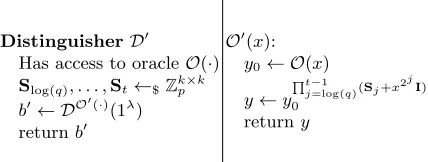
Now let `∗ = 2dlog(q)e. We will now construct a PPT distinguisher D0 that distinguishes the bounded PRFF`∗with advantage2. The distinguisherD0 is given in Figure 3.
DistinguisherD0
Has access to oracleO(·) Slog(q), . . . ,St←$Zkp×k
b0← DO0(·) (1λ) returnb0
O0(x):
y0← O(x)
y←y
Qt−1
j=log(q)(Sj+x 2jI)
0 returny
Fig. 3.The distinguisherD0
First assume thatD0’s oracleOimplements the functionF
`∗(K`∗, x) =ga
>Qlog(q)−1
j=0 (Sj+x2 j
I)whereK `= (a,S0, . . . ,Slog(q)−1) is a uniformly chosen key forF`∗. Then the oracleO0 implements the function
O0(x) =
ga>Qlog(j=0q)−1(Sj+x 2jI)
Qt−1
j=log(q)(Sj+x2 j
I)
=g
a>Qlog(q)−1
j=0 (Sj+x2 j
I)·Qt−1
j=log(q)(Sj+x2 j
I)
=ga>Qtj−=01(Sj+x2 j
I)
.
ThusO0 implements exactlyF(1). On the other hand, ifD0’s oracleOimplements a random functionRwith
R(x) =gr(x)>, wherer:
Zp→Zkp is a random function, then the oracleO0 implements the function
O0(x) =gr>(x)
Qt−1
j=log(q)(Sj+x 2jI)
=gr>(x)·
Qt−1
j=log(q)(Sj+x 2jI)
.
ThusO0(x) implements exactlyF(2). We conclude that
Adv(D0) =|Pr[D0F`∗(K`∗,·)= 1]−Pr[D0R= 1]| =|Pr[DF(1) = 1]−Pr[DF(2) = 1]|=
1≥−
qt p−1.
By Theorem 6 this yields a distinguisherD∗ with advantage 1 k·log(q)·
− qt
(p−1)
againstk-LIN inG. This
PRF with Shorter Keys. Escala et al. [11] suggested a framework that generalizes Diffie-Hellman like decisional assumptions and proposed a variant of the Lewko-Waters PRF with short keys based on the so-called Matrix-DDH (MDDH) assumption. The proof of Theorem 6 immediately generalizes to this setting. Theorem 7 also holds in this setting, given that the distribution of aggregated transformation matrices T corresponding to the matrix distribution D`,k (c.f. [11], Section 5.3) used in the MDDH problem satisfies Pr[rank(T+x·I)< k]≤negl for allx∈Zp.
References
1. Banerjee, A., Peikert, C., Rosen, A.: Pseudorandom functions and lattices. In: Pointcheval, D., Johansson, T. (eds.) EUROCRYPT 2012. LNCS, vol. 7237, pp. 719–737. Springer, Berlin, Germany, Cambridge, UK (Apr 15–19, 2012)
2. Bellare, M., Goldwasser, S.: New paradigms for digital signatures and message authentication based on non-interative zero knowledge proofs. In: Brassard, G. (ed.) CRYPTO’89. LNCS, vol. 435, pp. 194–211. Springer, Berlin, Germany, Santa Barbara, CA, USA (Aug 20–24, 1990)
3. Benabbas, S., Gennaro, R., Vahlis, Y.: Verifiable delegation of computation over large datasets. In: Rogaway, P. (ed.) CRYPTO 2011. LNCS, vol. 6841, pp. 111–131. Springer, Berlin, Germany, Santa Barbara, CA, USA (Aug 14–18, 2011)
4. Berman, I., Haitner, I.: From non-adaptive to adaptive pseudorandom functions. In: Cramer, R. (ed.) TCC 2012. LNCS, vol. 7194, pp. 357–368. Springer, Berlin, Germany, Taormina, Sicily, Italy (Mar 19–21, 2012)
5. Berman, I., Haitner, I., Komargodski, I., Naor, M.: Hardness preserving reductions via Cuckoo hashing. In: Sahai, A. (ed.) TCC 2013. LNCS, vol. 7785, pp. 40–59. Springer, Berlin, Germany, Tokyo, Japan (Mar 3–6, 2013) 6. Boneh, D., Boyen, X.: Efficient selective-ID secure identity based encryption without random oracles. In: Cachin,
C., Camenisch, J. (eds.) EUROCRYPT 2004. LNCS, vol. 3027, pp. 223–238. Springer, Berlin, Germany, Inter-laken, Switzerland (May 2–6, 2004)
7. Boneh, D., Montgomery, H.W., Raghunathan, A.: Algebraic pseudorandom functions with improved efficiency from the augmented cascade. In: Al-Shaer, E., Keromytis, A.D., Shmatikov, V. (eds.) ACM CCS 10. pp. 131–140. ACM Press, Chicago, Illinois, USA (Oct 4–8, 2010)
8. Chandran, N., Garg, S.: Balancing output length and query bound in hardness preserving constructions of pseudorandom functions. In: Meier, W., Mukhopadhyay, D. (eds.) INDOCRYPT 2014. LNCS, vol. 8885, pp. 89–103. Springer, Berlin, Germany, New Delhi, India (Dec 14–17, 2014)
9. Chase, M., Meiklejohn, S.: D´ej`a Q: Using dual systems to revisit q-type assumptions. In: Nguyen, P.Q., Oswald, E. (eds.) EUROCRYPT 2014. LNCS, vol. 8441, pp. 622–639. Springer, Berlin, Germany, Copenhagen, Denmark (May 11–15, 2014)
10. Dodis, Y., Yampolskiy, A.: A verifiable random function with short proofs and keys. In: Vaudenay, S. (ed.) PKC 2005. LNCS, vol. 3386, pp. 416–431. Springer, Berlin, Germany, Les Diablerets, Switzerland (Jan 23–26, 2005)
11. Escala, A., Herold, G., Kiltz, E., R`afols, C., Villar, J.: An algebraic framework for Diffie-Hellman assumptions. In: Canetti, R., Garay, J.A. (eds.) CRYPTO 2013, Part II. LNCS, vol. 8043, pp. 129–147. Springer, Berlin, Germany, Santa Barbara, CA, USA (Aug 18–22, 2013)
12. Fiore, D., Gennaro, R.: Publicly verifiable delegation of large polynomials and matrix computations, with appli-cations. In: Yu, T., Danezis, G., Gligor, V.D. (eds.) ACM CCS 12. pp. 501–512. ACM Press, Raleigh, NC, USA (Oct 16–18, 2012)
13. Goldreich, O., Goldwasser, S., Micali, S.: How to construct random functions (extended abstract). In: 25th FOCS. pp. 464–479. IEEE Computer Society Press, Singer Island, Florida (Oct 24–26, 1984)
14. Goldreich, O., Goldwasser, S., Micali, S.: On the cryptographic applications of random functions. In: Blakley, G.R., Chaum, D. (eds.) CRYPTO’84. LNCS, vol. 196, pp. 276–288. Springer, Berlin, Germany, Santa Barbara, CA, USA (Aug 19–23, 1984)
15. Hazay, C.: Oblivious polynomial evaluation and secure set-intersection from algebraic PRFs. In: Dodis, Y., Nielsen, J.B. (eds.) TCC 2015, Part II. LNCS, vol. 9015, pp. 90–120. Springer, Berlin, Germany, Warsaw, Poland (Mar 23–25, 2015)
16. Herranz, J., Hofheinz, D., Kiltz, E.: The kurosawa-desmedt key encapsulation is not chosen-ciphertext secure. Cryptology ePrint Archive, Report 2006/207 (2006), http://eprint.iacr.org/
18. Ishai, Y., Kushilevitz, E., Ostrovsky, R., Sahai, A.: Cryptography with constant computational overhead. In: Ladner, R.E., Dwork, C. (eds.) 40th ACM STOC. pp. 433–442. ACM Press, Victoria, British Columbia, Canada (May 17–20, 2008)
19. Jain, A., Pietrzak, K., Tentes, A.: Hardness preserving constructions of pseudorandom functions. In: Cramer, R. (ed.) TCC 2012. LNCS, vol. 7194, pp. 369–382. Springer, Berlin, Germany, Taormina, Sicily, Italy (Mar 19–21, 2012)
20. Levin, L.: One way functions and pseudorandom generators. Combinatorica 7(4), 357–363 (1987)
21. Lewko, A.B., Waters, B.: Efficient pseudorandom functions from the decisional linear assumption and weaker variants. In: Al-Shaer, E., Jha, S., Keromytis, A.D. (eds.) ACM CCS 09. pp. 112–120. ACM Press, Chicago, Illinois, USA (Nov 9–13, 2009)
22. Luby, M.: Pseudorandomness and Cryptographic Applications. Princeton University Press, Princeton, NJ, USA (1994)
23. Maurer, U.M.: Indistinguishability of random systems. In: Advances in Cryptology - EUROCRYPT 2002, Inter-national Conference on the Theory and Applications of Cryptographic Techniques, Amsterdam, The Netherlands, April 28 - May 2, 2002, Proceedings. pp. 110–132 (2002)
24. Maurer, U.M.: Indistinguishability of random systems. In: Knudsen, L.R. (ed.) EUROCRYPT 2002. LNCS, vol. 2332, pp. 110–132. Springer, Berlin, Germany, Amsterdam, The Netherlands (Apr 28 – May 2, 2002)
25. Maurer, U.M., Tessaro, S.: Domain extension of public random functions: Beyond the birthday barrier. In: Menezes, A. (ed.) CRYPTO 2007. LNCS, vol. 4622, pp. 187–204. Springer, Berlin, Germany, Santa Barbara, CA, USA (Aug 19–23, 2007)
26. Naor, M., Reingold, O.: Synthesizers and their application to the parallel construction of pseudo-random functions. In: 36th FOCS. pp. 170–181. IEEE Computer Society Press, Milwaukee, Wisconsin (Oct 23–25, 1995)
27. Naor, M., Reingold, O.: Number-theoretic constructions of efficient pseudo-random functions. In: 38th FOCS. pp. 458–467. IEEE Computer Society Press, Miami Beach, Florida (Oct 19–22, 1997)
28. Naor, M., Reingold, O.: On the construction of pseudo-random permutations: Luby-Rackoff revisited (extended abstract). In: 29th ACM STOC. pp. 189–199. ACM Press, El Paso, Texas, USA (May 4–6, 1997)
29. Naor, M., Reingold, O., Rosen, A.: Pseudo-random functions and factoring (extended abstract). In: 32nd ACM STOC. pp. 11–20. ACM Press, Portland, Oregon, USA (May 21–23, 2000)
30. Peikert, C.: Public-key cryptosystems from the worst-case shortest vector problem: extended abstract. In: Pro-ceedings of the 41st Annual ACM Symposium on Theory of Computing, STOC 2009, Bethesda, MD, USA, May 31 - June 2, 2009. pp. 333–342 (2009)
31. Razborov, A.A., Rudich, S.: Natural proofs. In: 26th ACM STOC. pp. 204–213. ACM Press, Montr´eal, Qu´ebec, Canada (May 23–25, 1994)
32. Regev, O.: On lattices, learning with errors, random linear codes, and cryptography. In: Proceedings of the 37th Annual ACM Symposium on Theory of Computing, Baltimore, MD, USA, May 22-24, 2005. pp. 84–93 (2005) 33. Shacham, H.: A cramer-shoup encryption scheme from the linear assumption and from progressively weaker linear
variants. Cryptology ePrint Archive, Report 2007/074 (2007), http://eprint.iacr.org/