A Classification Algorithm for Predicting the Structure of Summaries
Horacio Saggion University of Sheffield
211 Portobello Street Sheffield - S1 4DP
United Kingdom
http://www.dcs.shef.ac.uk/~saggion [email protected]
Abstract
We investigate the problem of generating the structure of short domain independent abstracts. We apply a supervised machine learning approach trained over a set of ab-stracts collected from abstracting services and automatically annotated with a text analysis tool. We design a set of features for learning inspired from past research in content selection, information order-ing, and rhetorical analysis for training an algorithm which then predicts the dis-course structure of unseen abstracts. The proposed approach to the problem which combines local and contextual features is able to predict the local structure of the ab-stracts in just over 60% of the cases. 1 Introduction
Mani (2001) defines an abstract as “a summary at least some of whose material is not present in the input”. In a study of professional abstracting, Endres-Niggemeyer (2000) concluded that profes-sional abstractors produce abstracts by “cut-and-paste” operations, and thatstandard sentence pat-terns are used in their production. Examples of abstracts produced by a professional abstractor are shown in Figures 1 and 2. They contain fragments “copied” from the input documents together with phrases (underlined in the figures) inserted by the professional abstractors. In a recent study in hu-man abstracting (restricted to the amendment of authors abstracts) Montesi and Owen (2007) noted that professional abstractors prepend third person singular verbs in present tense and without subject to the author abstract, a phenomenon related – yet different – from the problem we are investigating in this paper.
Note that the phrases or predicates prepended to the selected sentence fragments copied from the input document have a communicative function:
Presents a model instructional session that was prepared and taught by librarians to introduce college students, faculty, and staff to the Internet by teaching them how to join list-servs and topic- centered discussion groups. Describes the sessions’ audience, learning objectives, facility, and course design. Presents a checklist for preparing an Internet instruc-tion session.
Figure 1: Professional Abstracts with Inserted Predicates from LISA Abstracting Service
Talks about Newsblaster, an experimental software tool that scans and summarizes electronic news stories, developed by Columbia University’s Natural Language Processing Group. Reports that Newsblaster is a cross between a search en-gine and ... Explains that Newsblaster publishes the sum-maries in a Web page that divides the day sumsum-maries into .... Mentions that Newsblaster is considered an aid to those who have to quickly canvas large amounts of information from many sources.
Figure 2: Professional Abstract with Inserted Predicates from Internet & Personal Computing Abstracts
they inform or alert the reader about the content of the abstracted document by explicitly mark-ing what the authorsays or mentions,presents or introduces, concludes, or includes, in her paper. Montesi and Owen (2007) observe that the revi-sion of abstracts is carried out to improve com-prehensibility and style and to make the abstract objective.
We investigate how to create the discourse structure of the abstracts: more specifically we are interested in predicting the inserted predicates or phrases and at which positions in the abstract they should be prepended.
Abstractive techniques in text summarization include sentence compression (Cohn and Lapata, 2008), headline generation (Soricut and Marcu, 2007), and canned-based generation (Oakes and Paice, 2001). Close to the problem studied here is Jing and McKeown’s (Jing and McKeown, 2000) cut-and-paste method founded on Endres-Niggemeyer’s observations. The cut-and-paste
method includes such operations as sentence trun-cation, aggregation, specialization/generalization, reference adjustment and rewording. None of these operations account for the transformations observed in the abstracts of Figures 1 and 2. The formulaic expressions or predicates inserted in the abstract “glue” together the extracted fragments, thus creating the abstract’s discourse structure.
To the best of our knowledge, and with the ex-ception of Saggion and Lapalme (2002) indicative generation approach which included operations to add extra linguistic material to generate an indica-tive abstract, the work presented here is the first to investigate this relevant operation in the field of text abstracting and to propose a robust computa-tional method for its simulation.
In this paper we are interested in the process of generating the structure of the abstract by au-tomatic means. In order to study this problem, we have collected a corpus of abstracts written by ab-stractors; we have designed an algorithm for pre-dicting the structure; implemented the algorithm; and evaluated the structure predicted by the auto-matic system against the true structure.
2 Problem Specification, Data Collection, and Annotation
The abstracts we study in this research follow the pattern:
Abstract≡Ln
i=1Predi⊕βi
where Prediis a phrase used to introduce the “con-tent”βiof sentencei,nis the number of sentences in the abstract, L indicates multiple concatena-tion, and X⊕Y indicates the concatenation ofX andY. In this paper we concentrate only on this “linear” structure, we plan to study more complex (e.g., tree-like representations) in future work.
The problem we are interested in solving is the following: given sentence fragmentsβi extracted from the document, how to create the Abstract. Note that if N is the number of different phrases (Predi) used in the model, thena priorithere are Nnpossible discourse structures to select from for the abstract, generating all possibilities and select-ing the most appropriate would be impractical. We present an algorithm that decides which predicate or phrase is most suitable for each sentence, do-ing this by considerdo-ing the sentence content and the abstract generated so far. For the experiments to be reported in this paper, the discourse structure of the abstracts is created using predicates or
ex-pressions learned from a corpus a subset of which is shown in Table 1.
We have collected abstracts from various databases including LISA, ERIC, and Internet & Personal Computing Abstracts, using our in-stitutional library’s facilities and the abstracts’ providers’ keyword search facilities. Electronic copies of the abstracted documents can also be accessed through our institution following a link, thus allowing us to check abstracts against ab-stracted document (additional information on the abstracts is given in the Appendix).
2.1 Document Processing and Annotation Each electronic version of the abstract was pro-cessed using the freely available GATE text analy-sis software (Cunningham et al., 2002). First each abstract was analyzed by a text structure analy-sis program to identify meta-data such as title, au-thor, source document, the text of the abstract, etc. Each sentence in the abstract was stripped from the predicate or phrase inserted by the abstractor (e.g., “Mentions that”, “Concludes with”) and a normalised version of the expression was used to annotate the sentence, in a way similar to the ab-stracts in Figures 1 and 2. After this each abstract and document title was tokenised, sentence split-ted, part-of-speech tagged, and morphologically analyzed. A rule-based system was used to carry out partial, robust syntactic and semantic analy-sis of the abstracts (Gaizauskas et al., 2005) pro-ducing predicate-argument representations where predicates which are used to represent entities are created from the morphological roots of nouns or verbs in the text (unary predicates) and predicates with are used to represent binary relations are a closed set of names representing grammatical re-lations such as the verb logical object, or the verb logical subject or a prepositional attachment, etc. This predicate-argument structure representation was further analysed in order to extract “seman-tic” triples which are used in the experiments re-ported here. Output of this analysis is shown in Figure 3. Note that the representation also con-tains the tokens of the text, their parts of speech, lemmas, noun phrases, verb phrases, etc.
3 Proposed Solution
to address; to add; to advise; to assert; to claim; to comment; to compare; to conclude; to define; to describe; to discuss; to evaluate; to examine; to explain; to focus; to give; to highlight; to include; to indicate; to note; to observe; to overview; to point out; to present; to recommend; to report; to say; to show; to suggest; ...
to report + to indicate + to note + to declare + to include; to provide + to explain + to indicate + to mention; to point out + to report + to mention + to include; to discuss + to list + to suggest + to conclude; to present + to say + to add + to conclude + to contain; to discuss + to explain + to recommend; to discuss + to cite + to say; ...
Table 1: Subset of predicates or expressions used by professional abstractors and some of the discourse structures used.
Sentence: Features a listing of ten family-oriented pro-grams, including vendor information, registration fees, and a short review of each.
Representation: listing-det-a; listing-of-program; family-oriented-adj-program; fee-qual-registration; information-qual-vendor; listing-apposed-information; ...
Figure 3: Sentence Representation (partial)
Algorithm 1 Discourse Structure Prediction Al-gorithm
Given:a list ofnsorted text fragmentsβi begin
Abstract←““; Context←START; for alli: 0≤i≤n−1;do
Pred←PredictPredicate(Context,βi); Abstract←Abstract⊕Pred⊕βi⊕“.”; Context←ExtractContext(Abstract); end for
returnAbstract end
at each iteration the algorithm selects the “best” available phrase or predicate to prepend to the cur-rent fragment from a finite vocabulary (induced from the analysed corpus) based on local and contextual information. One could rely on ex-isting trainable sentence selection (Kupiec et al., 1995) or even phrase selection (Banko et al., 2000) strategies to pick up appropriateβi’s from the doc-ument to be abstracted and rely on recent informa-tion ordering techniques to sort the βi fragments (Lapata, 2003). This is the reason why we only ad-dress here the discourse structure generation prob-lem.
3.1 Predicting Discourse Structure as Classification
There are various possible ways of predicting what expression to insert at each point in the
genera-tion process (i.e., the PredictPredicate function in Algorithm 1). In the experiments reported here we use a classification algorithm based on lexical, syntactic, and discursive features, which decides which of theNpossible available phrases is most suitable. The algorithm is trained over the anno-tated abstracts and used to predict the structure of unseen test abstracts.
Where the classification algorithm is concerned, we have decided to use Support Vector Machines which have recently been used in different tasks in natural language processing, they have been shown particularly suitable for text categorization (Joachims, 1998). We have tried other machine learning algorithms such as Decision Trees, Naive Bayes Classification, and Nearest Neighbor from the Weka toolkit (Witten and Frank, 1999), but the support vector machines gave us the best classifi-cation accuracy (a comparison with Naive Bayes will be presented in Section 4).
to add; to conclude; to contain; to describe; to discuss; to explain; to feature; to include; to indi-cate; to mention; to note; to point out; to present; to provide; to report; to say
Table 2: Predicates in the reduced corpus
arguments of “semantic” triples (Section 2.1) ex-tracted from the parsed abstracts. Features occur-ring less than 4 times in the corpus were removed for the experiments. For each sentence, a cohe-sion feature is also computed as the number of nouns in common with the previous sentence frag-ment (or title if first sentence). Cohesion infor-mation has been used in rhetorical-based parsing for summarization (Marcu, 1997) in order to de-cide between “list” or “elaboration” relations and also in content selection for summarization (Barzi-lay and Elhadad, 1997). For some experiments we also use word-level information (lemmas) and part-of-speech tags. For some of the experiments reported here the variableContext at iterationiin Algorithm 1 is instantiated with the predicates pre-dicted at iterationsi−1 andi−2.
4 Experiments and Results
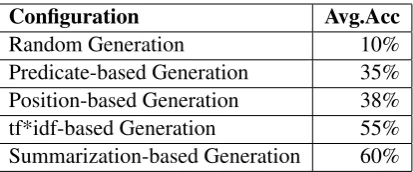
The experiments reported here correspond to the use of different features as input for the classifier. In these experiments we have used a subset of the collected abstracts, they contain predicates which appeared at least 5 times in the corpus. With this restriction in place the original set of predicates used to create the discourse structure is reduced to sixteen (See Table 2), however, the number of pos-sible structures in the reduced corpus is still con-siderable with a total of 179 different structures.
In the experiments we compare several classi-fiers:
• Random Generation selects a predicate at random at each iteration of the algorithm;
• Predicate-based Generation is a SVM classi-fier which uses the two previous predicates to generate the current predicate ignoring sen-tence content;
• Position-based Generation is a SVM classi-fier which also ignores sentence content but uses as features for classification the absolute position of the sentence to be generated;
Configuration Avg.Acc
Random Generation 10%
Predicate-based Generation 35% Position-based Generation 38%
tf*idf-based Generation 55%
Summarization-based Generation 60% Table 3: Average accuracy of different classifica-tion configuraclassifica-tions.
• tf*idf-based Generation is a SVM classifier which uses lemmas of the sentence fragment to be generated to pick up one predicate (note that position features and predicates were added to the mix without improving the clas-sifier);
• Summarization-based Generation is a SVM which uses the summarization and discourse features discussed in the previous section in-cluding contextual information (Predi−2 and
Predi−1– with special values wheni=0 and
i=1).
We measure the performance of each instance of the algorithm by comparing the predicted struc-ture against the true strucstruc-ture. We compute two metrics: (i) accuracy at the sentence level (as in classification), which is the proportion of predi-cates which were correctly generated; and (ii) ac-curacy at the textual level, which is the proportion of abstracts correctly generated. For the latter we compute the proportion of abstracts with zero rors, less than two errors, and less than three er-rors.
For every instance of the algorithm we perform a cross-validation experiment, selecting for each experiment 20 abstracts for testing and the rest of the abstracts for training. Accuracy measures at sentence and text levels are averages of the cross-validation experiments.
the structures are recalled. Differences between the accuracies of the two algorithms (predicate-based and position-(predicate-based) are significant at 95% confidence level (at-testwas used). As it is usu-ally the case in text classification experiments, the use of word level information (lemmas in our case) achieves good performance: 55% classifica-tion accuracy at sentence level, and 18% of full structures correctly predicted. The use of lex-ical (noun and verb heads, arguments), syntac-tic (parts of speech information), and discourse (predicted predicates, position, cohesion) features has the better performance with 60% classifica-tion accuracy at sentence level predicting 21% of all structures with 73% of the structures con-taining less than 3 errors. The differences in accuracy between the word-based classifier and the summarization-based classifier are statistically significant at 95% confidence level (a t-test was used). A Naive Bayes classifier which uses the summarization features achieves 50% classifica-tion accuracy.
Conf. 0 errs <2errrs <3errs
Random 0.3% 4% 20%
Predicate-based 5% 24% 48%
Position-based 8% 33% 50%
tf*idf-based 18% 42% 67%
Summ-based 21% 55% 73%
Table 4: Percent of correct and partially correct structures predicted. Averaged over all runs.
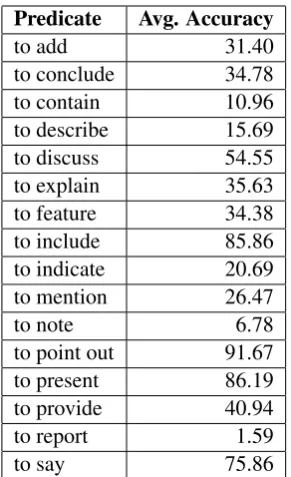
Table 5 shows a partial confusion table for pred-icates “to add”, “to conclude”, “to explain”, and “to present” while and Table 6 reports individual classification accuracy. All these results are based on averages of the summarization-based classifier.
5 Discussion
We have presented here a problem which has not been investigated before in the field of text sum-marization: the addition of extra linguistic mate-rial (i.e., not present in the source document) to the abstract “informational content” in order to create the structure of the abstract. We have proposed an algorithm which uses a classification component at each iteration to predict predicates or phrases to be prepended to fragments extracted from a doc-ument. We have shown that this classifier based on summarization features including linguistic, se-mantic, positional, cohesive, and discursive
infor-mation can predict the local discourse structures in over 60% of the cases. There is a mixed picture on the prediction of individual predicates, with most predicates correctly classified in most of the cases except for predicates such as “to describe”, “to note”, and “to report” which are confused with other phrases. Predicates such as “to present” and “to include” have the tendency of appearing to-wards the very beginning or the very end of the ab-stract been therefore predicted by position-based features (Edmundson, 1969; Lin and Hovy, 1997). Note that in this work we have decided to evaluate the predicted structure against the true structure (a hard evaluation measure), in future work we will assess the abstracts with a set of quality questions similar to those put forward by the Document Un-derstanding Conference Evaluations (also in a way similar to (Kan and McKeown, 2002) who eval-uated their abstracts in a retrieval environment). We expect to obtain a reasonable evaluation result given that it appears that some of the predicates or phrases are “interchangeable” (e.g., “to contain” and “to include”).
Actual Pred. Predicted Pred. Conf.Freq.
to add to add 32%
to explain 16%
to say 10%
to conclude to conclude 35%
to say 29%
to add 7%
to explain to explain 35%
to say 15%
to add 11%
to present to present 86%
to discuss 7%
to provide 1%
Table 5: Classification Confusion Table for a Sub-set of Predicates in the Corpus (Average Fre-quency).
6 Related Work
McK-Predicate Avg. Accuracy
to add 31.40
to conclude 34.78
to contain 10.96
to describe 15.69
to discuss 54.55
to explain 35.63
to feature 34.38
to include 85.86
to indicate 20.69
to mention 26.47
to note 6.78
to point out 91.67
to present 86.19
to provide 40.94
to report 1.59
[image:6.595.109.255.60.299.2]to say 75.86
Table 6: Predicate Classification Accuracy
eown (2002) studied the problem of generating ab-stracts for bibliographical data which although in a restricted domain has some contact points with the work described here. As in their work we use the abstracts in our corpus to induce the model. They rely on a more or less fixed discourse structure to accommodate the generation process. In our ap-proach the discourse structure is not fixed but pre-dicted for each particular abstract. Related to our classification experiments is work on semantic or rhetorical classification of “structured” abstracts (Saggion, 2008) from the MEDLINE abstracting database where similar features to those presented here were used to identify in abstracts semantic categories such as objective, method, results, and conclusions. Related to this is the work by Teufel and Moens (2002) on rhetorical classification for content selection. In cut-and-paste summarization (Jing and McKeown, 2000), sentence combina-tion operacombina-tions were implemented manually fol-lowing the study of a set of professionally written abstracts; however the particular “pasting” oper-ation presented here was not implemented. Pre-vious studies on text-to-text abstracting (Banko et al., 2000; Knight and Marcu, 2000) have studied problems such as sentence compression and sen-tence combination but not the “pasting” procedure presented here. The insertion in the abstract of linguistic material not present in the input docu-ment has been addressed in paraphrase generation (Barzilay and Lee, 2004) and canned-based
sum-marization (Oakes and Paice, 2001) in limited do-mains. Saggion and Lapalme (2002) have studied and implemented a rule-based “verb selection” op-eration in their SumUM system which has been applied to introduce document topics during in-dicative summary generation.
Our discourse structure generation procedure is in principle generic but depends on the availability of a corpus for training.
7 Conclusions
In text summarization research, most attention has been paid to the problem of what information to select for a summary. Here, we have focused on the problem of how to combine the selected content with extra linguistic information in order to create the structure of the summary.
There are several contributions of this work:
• First, we have presented the problem of gen-erating the discourse structures of an abstract and proposed a meta algorithm for predicting it. This problem has not been investigated be-fore.
• Second, we have proposed – based on pre-vious summarization research – a number of features to be used for solving this problem; and
• Finally, we have propose several instantia-tions of the algorithm to solve the problem and achieved a reasonable accuracy using the designed features;
There is however much space for improvement even though the algorithm recalls some “partial structures”, many “full structures” can not be gen-erated. We are currently investigating the use of induced rules to address the problem and will compare a rule-based approach with our classi-fier. Less superficial cohesion features are being investigated and will be tested in this classification framework.
Acknowledgements
References
Michele Banko, Vibhu O. Mittal, and Michael J. Wit-brock. 2000. Headline generation based on statisti-cal translation. InACL ’00: Proceedings of the 38th Annual Meeting on Association for Computational Linguistics, pages 318–325, Morristown, NJ, USA. Association for Computational Linguistics.
Regina Barzilay and Michael Elhadad. 1997. Using Lexical Chains for Text Summarization. In Proceed-ings of the ACL/EACL’97 Workshop on Intelligent Scalable Text Summarization, pages 10–17, Madrid, Spain, July.
R. Barzilay and L. Lee. 2004. Catching the Drift: Probabilistic Content Models, with Applications to Generation and Summarization. In Proceedings of HLT-NAACL 2004.
T. Cohn and M. Lapata. 2008. Sentence compression beyond word deletion. In Proceedings of COLING 2008, Manchester.
H. Cunningham, D. Maynard, K. Bontcheva, and V. Tablan. 2002. GATE: A framework and graph-ical development environment for robust NLP tools and applications. InACL 2002.
H.P. Edmundson. 1969. New Methods in Automatic Extracting. Journal of the Association for Comput-ing Machinery, 16(2):264–285, April.
Brigitte Endres-Niggemeyer. 2000. SimSum: an em-pirically founded simulation of summarizing. Infor-mation Processing & Management, 36:659–682.
R. Gaizauskas, M. Hepple, H. Saggion, and M. Green-wood. 2005. SUPPLE: A Practical Parser for Natu-ral Language Engineering Applications.
Hongyan Jing and Kathleen McKeown. 2000. Cut and Paste Based Text Summarization. In Proceed-ings of the 1st Meeting of the North American Chap-ter of the Association for Computational Linguistics, pages 178–185, Seattle, Washington, USA, April 29 - May 4.
T. Joachims. 1998. Text categorization with support vector machines: Learning with many relevant fea-tures. InEuropean Conference on Machine Learn-ing (ECML), pages 137–142, Berlin. Springer.
Min-Yen Kan and Kathleen R.. McKeown. 2002. Corpus-trained text generation for summarization. In Proceedings of the Second International Natu-ral Language Generation Conference (INLG 2002), pages 1–8, Harriman, New York, USA.
Kevin Knight and Daniel Marcu. 2000. Statistics-based summarization - step one: Sentence compres-sion. In Proceedings of the 17th National Confer-ence of the American Association for Artificial In-telligence. AAAI, July 30 - August 3.
Julian Kupiec, Jan Pedersen, and Francine Chen. 1995. A Trainable Document Summarizer. InProc. of the 18th ACM-SIGIR Conference, pages 68–73, Seattle, Washington, United States.
M. Lapata. 2003. Probabilistic Text Structuring: Ex-periments with Sentence Ordering. InProceedings of the 41st Meeting of the Association of Computa-tional Linguistics, pages 545–552, Sapporo, Japan. Elizabeth D. Liddy. 1991. The Discourse-Level
Struc-ture of Empirical Abstracts: An Exploratory Study. Information Processing & Management, 27(1):55– 81.
C. Lin and E. Hovy. 1997. Identifying Topics by Po-sition. InFifth Conference on Applied Natural Lan-guage Processing, pages 283–290. Association for Computational Linguistics, 31 March-3 April. Inderjeet Mani. 2001. Automatic Text Summarization.
John Benjamins Publishing Company.
D. Marcu. 1997. The Rhetorical Parsing, Summa-rization, and Generation of Natural Language Texts. Ph.D. thesis, Department of Computer Science, Uni-versity of Toronto.
M. Montesi and J. M. Owen. 2007. Revision of au-thor abstracts: how it is carried out by LISA editors. Aslib Proceedings, 59(1):26–45.
M.P. Oakes and C.D. Paice. 2001. Term extrac-tion for automatic abstracting. In D. Bourigault, C. Jacquemin, and M-C. L’Homme, editors,Recent Advances in Computational Terminology, volume 2 ofNatural Language Processing, chapter 17, pages 353–370. John Benjamins Publishing Company. H. Saggion and G. Lapalme. 2002. Generating
Indicative-Informative Summaries with SumUM. Computational Linguistics, 28(4):497–526.
H. Saggion. 2008. Automatic Summarization: An Overview. Revue Franc¸aise de Linguistique Ap-pliqu´ee, XIII(1), Juin.
R. Soricut and D. Marcu. 2007. Abstractive headline generation using WIDL-expressions. Inf. Process. Manage., 43(6):1536–1548.
S. Teufel and M. Moens. 2002. Summarizing Scientific Articles: Experiments with Relevance and Rhetorical Status. Computational Linguistics, 28(4):409–445.
Ian H. Witten and Eibe Frank. 1999. Data Mining: Practical Machine Learning Tools and Techniques with Java Implementations. Morgan Kaufmann, Oc-tober.
Appendix I: Corpus Statistics and Examples
sentences, and 305,105 tokens. The reduced corpus used for the experiments contains 300 abstracts.
Examples
Here we list one example of the use of each of the predicates in the reduced set of 300 abstracts used for the experiments.
Adds that it uses search commands and features that are similar to those of traditional online commercial database services, has the ability to do nested Boolean queries as well as truncation when needed, and provides detailed doc-umentation that offers plenty of exam-ples.
Concludes CNET is a network of sites, each dealing with a specialized aspect of computers that are accessible from the home page and elsewhere around the site.
Contains a step-by-step guide to using PGP.
Describes smallbizNet, the LEXIS-NEXIS Small Business Service, Small Business Administration, Small Business Advancement National Center, and other small business-related sites.
Discusses connections and links between differing electronic mail systems.
Explains DataStar was one of the first on-line hosts to offer a Web interface, and was upgraded in 1997.
Features tables showing the number of relevant, non-relevant, and use retrievals on both LEXIS and WIN for federal and for state court queries.
Includes an electronic organizer, an er-gonomically correct keyboard, an on-line idle-disconnect, a video capture de-vice, a color photo scanner, a real-time Web audio player, laptop speakers, a personal information manager (PIM), a mouse with built-in scrolling, and a voice fax-modem.
Indicates that the University of Califor-nia, Berkeley, has the School of Informa-tion Management and Systems, the Uni-versity of Washington has the Informa-tion School, and the University of Mary-land has the College of Information Stud-ies.
Mentions that overall, the interface is effective because the menus and sear screens permit very precise searches with no knowledge of searching or Dialog databases.
Notes that Magazine Index was origi-nally offered on Lyle Priest’s invention, a unique microfilm reader.
Points out the strong competition that the Internet has created for the traditional on-line information services, and the move of these services to the Internet.
Presents searching tips and techniques.
Provides summaries of African art; Allen Memorial Art Museum of Oberlin Col-lege; Art crimes; Asian arts; Da Vinci, Leonardo; Gallery Walk; and Native American Art Gallery.
Reports that Dialog has announced ma-jor enhancements to its alerting system on the DialogClassic, DialogClassic Web, and DialogWeb services.