!
"
#"#
$ % %#
&
'
((( )
Global Hyperchaos Synchronization of Hyperchaotic Chen and Lorenz Systems by
Active Nonlinear Control
Dr. V. Sundarapandian Professor, Research and Development Centre Vel Tech Dr. RR & Dr. SR Technical University
Avadi, Chennai-600 062, INDIA [email protected]
Abstract: This paper investigates the global exponential synchronization of hyperchaotic systems, viz. identical hyperchaotic Chen systems (Yan and Yu, 2008), identical hyperchaotic Lorenz systems (Wang, Zheng and Liu, 2007), and synchronization of hyperchaotic Chen and Lorenz systems. Active nonlinear feedback control is the method used to achieve the synchronization of the hyperchaotic systems addressed in this paper. Our theorems on global exponential synchronization for hyperchaotic Chen and Lorenz systems are established using Lyapunov stability theory. Since the Lyapunov exponents are not required for these calculations, the nonlinear feedback control method is effective and convenient to synchronize identical and different hyperchaotic Chen and Lorenz systems. Numerical simulations are also given to illustrate and validate the synchronization results for hyperchaotic Chen and Lorenz systems.
Keywords: Chaos Synchronization, Nonlinear Control, Hyperchaotic Chen System, Hyperchaotic Lorenz System, Active Control.
I.INTRODUCTION
Chaotic systems are dynamical systems that are highly sensitive to initial conditions. This sensitivity is popularly referred to as the butterfly effect [1].
Chaos synchronization problem was first described by Fujisaka and Yemada [2] in 1983. This problem did not receive great attention until Pecora and Carroll [3-4] published their results on chaos synchronization in early 1990s. From then on, chaos synchronization has been extensively and intensively studied in the last three decades [3-22]. Chaos theory has been explored in a variety of fields including physical [5], chemical [6], ecological [7] systems, secure communications [8-10] etc.
Synchronization of chaotic systems is a phenomenon that may occur when two or more chaotic oscillators are coupled or when a chaotic oscillator drives another chaotic oscillator. Because of the butterfly effect which causes the exponential divergence of the trajectories of two identical chaotic systems started with nearly the same initial conditions, synchronizing two chaotic systems is seemingly a very challenging problem.
In most of the chaos synchronization approaches, the master-slave or drive-response formalism is used. If a particular chaotic system is called the master or drive system and another chaotic system is called the slave or response system, then the idea of the synchronization is to use the output of the master system to control the slave system so that the output of the slave system tracks the output of the master system asymptotically.
Since the seminal work by Carroll and Pecora [3-4], a variety of impressive approaches have been proposed for the synchronization for the chaotic systems such as PC method [3-4], the sampled-data feedback synchronization method [10-11], OGY method [12], time-delay feedback approach [13], backstepping design method [14], adaptive design method [15-19], sliding mode control method [20], Lyapunov stability theory method [21], hyperchaos [22], etc.
Hyperchaotic system is usually defined as a chaotic system with at least two positive Lyapunov exponents, implying that its dynamics are expanded in several different directions simultaneously. For a continuous dynamical system to exhibit hyperchaotic behaviour, the system must be at least four-dimensional. Hyperchaotic systems have more complex dynamical behaviour, which can be used to improve the security of a chaotic communication system.
This paper has been organized as follows. In Section II, we give the problem statement and our methodology. In Section III, we discuss the chaos synchronization of two identical hyperchaotic Chen systems ([23], 2008). In Section IV, we discuss the chaos synchronization of two identical hyperchaotic Lorenz systems ([24], 2007). In Section V, we discuss the heterogeneous synchronization of hyperchaotic Chen and Lorenz systems. In Section VI, we present the conclusions of this paper.
II.PROBLEM STATEMENT AND OUR METHODOLOGY
Consider the hyperchaotic system described by
x
=
Ax
+
f x
( )
(1)where
x
∈
R
nis the state of the system,A
is then n
×
matrixof the system parameters and
f
:
n n→
R
R
is the nonlinear part of the system. We consider the system (1) as the master or drive system.As the slave or response system, we consider the following hyperchaotic system described by
y
=
By
+
g y
( )
+
u
(2)where
y
∈
R
nis the state vector of the response system,B
isthe
n n
×
matrix of the system parameters,:
n ng
R
→
R
is© 2010, IJARCS All Rights Reserved 279 If
A
=
B
andf
=
g
,
thenx
andy
are the states of twoidentical hyperchaotic systems. If
A
≠
B
andf
≠
g
,
thenx
andy
are the states of two different hyperchaotic systems.In the nonlinear feedback control approach, we design a feedback controller
u
,
which synchronizes the states of the master system (1) and the slave system (2) for all initialconditions
x
(0), (0)
z
∈
R
n.
If we define the synchronization error as
e
=
y
−
x
,
(3) then the synchronization error dynamics is obtained as
e
=
By
−
Ax
+
g y
( )
−
f x
( )
+
u
(4) Thus, the global synchronization problem is essentially to find a feedback controlleru
so as to stabilize the errordynamics (4) for all initial conditions
e
(0)
∈
R
n,
i.e.
lim ( )
0
t→∞e t
=
(5)for all initial conditions
e
(0)
n.
∈
R
We use Lyapunov stability theory as our methodology. We take as a candidate Lyapunov function
V e
( )
=
e Pe
T,
(6)where
P
is a positive definite matrix. Note that:
n nV
R
→
R
is a positive definite function by construction. We assume that the parameters of the master and slave systems are known and that the states of both systems (1) and (2) are measurable.If we we find a feedback controller
u
so that
V e
( )
= −
e Qe
T,
(7)
where
Q
is a positive definite matrix, thenV
:
R
n→
R
nis a negative definite function.Thus, by Lyapunov stability theory [26], the error dynamics (4) is globally exponentially stable and hence the condition (5)
will be satisfied for all initial conditions
e
(0)
∈
R
n.
Then the states of the master system (1) and slave system (2) are globally exponentially synchronized.III.SYNCHRONIZATION OF IDENTICAL HYPERCHAOTIC
CHEN SYSTEMS
In this section, we apply the nonlinear control technique for the synchronization of two identical hyperchaotic Chen systems ([23], 2008).
Thus, the master system is described by the hyperchaotic Chen dynamics as
1 2 1
2 1 1 3 2
3 3 1 2 2 3 1 3 4
4 4 2 3 1 3
(
)
(
)
x
a x
x
x
c
a x
x x
cx
x
bx
x x
x x
x x
x
x
dx
x x
x x
=
−
=
−
−
+
= −
+
−
+
−
= −
+
−
(8)
where
x i
i(
=
1, 2, 3, 4)
are the states anda b c d
, , ,
are positive parameters.
The slave system is also described by the hyperchaotic Chen dynamics as
1 2 1 1
2 1 1 3 2 2
3 3 1 2 2 3 1 3 4 3
4 4 2 3 1 3 4
(
)
(
)
y
a y
y
u
y
c
a y
y y
cy
u
y
by
y y
y y
y y
y
u
y
dy
y y
y y
u
=
−
+
=
−
−
+
+
= −
+
−
+
−
+
= −
+
−
+
(9)
where
y i
i(
=
1, 2, 3, 4)
are the states and
u
=
[
u
1u
2u
3u
4]
T is the nonlinear controller to be designed.The hyperchaotic Chen system (8) is a new 4-D hyperchaotic system derived from the Chen system by Yan and Yu ([23], 2008).
The four-dimensional system (8) is hyperchaotic when
a
=
37,
b
=
3,
c
=
26
andd
=
38.
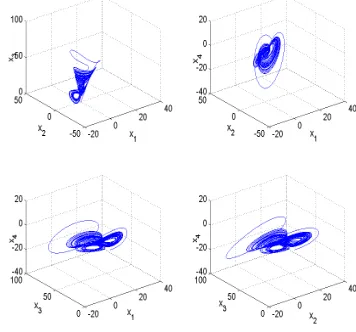
Figure 1 depicts the portrait of the hyperchaotic Chen system (8).
Figure 1. Portrait of the Hyperchaotic Chen System (8)
The synchronization error
e
is defined by
e
i=
y
i−
x
i, (
i
=
1, 2, 3, 4)
(10)The error dynamics is obtained as
1 2 1 1
2 1 2 1 3 1 3 2
3 3 4 1 2 1 2
2 3 2 3 1 3 1 3 3
4 4 2 3 2 3 1 3 1 3 4
(
)
(
)
(
)
(
)
(
) (
)
(
) (
)
e
a e
e
u
e
c
a e
ce
y y
x x
u
e
be
e
y y
x x
y y
x x
y y
x x
u
e
de
y y
x x
y y
x x
u
=
−
+
=
−
+
−
−
+
= −
−
+
−
−
−
+
−
+
= −
+
−
−
−
+
(11)
We choose the nonlinear controller as
1
2 1 2 1 3 1 3
3 4 1 2 1 2 2 3 2 3
1 3 1 3
4 2 3 2 3 1 3 1 3
0
(
1)
(
) (
)
(
)
(
) (
)
u
u
ce
c
e
y y
x x
u
e
y y
x x
y y
x x
y y
x x
u
y y
x x
y y
x x
=
= −
−
+
+
−
=
−
−
+
−
−
−
= −
−
+
−
[image:2.612.351.529.302.468.2]© 2010, IJARCS All Rights Reserved 280 Substituting (12) into (11), we obtain the error dynamics as
1 2 1
2 1 2
3 3
4 4
(
)
e
a e
e
e
ae
e
e
be
e
de
=
−
= −
−
= −
= −
(14)
Next, we consider the candidate Lyapunov function
( )
1
1
(
12 22 32 42)
2
2
T
V e
=
e e
=
e
+
e
+
e
+
e
(15)which is a Lyapunov function on
R
4.
Differentiating
V
along the trajectories of (14), we getV e( )= −ae12
−
e
22−
be
32−
de
42 (16)which is a negative definite function on R4
.
Hence, by Lyapunov stability theory [25], the error dynamics (14) is globally exponentially stable.
Thus, we have proved the following result.
Theorem 1. The identical hyperchaotic Chen systems (8) and (9) are exponentially and globally synchronized for any initial conditions with the nonlinear controller udefined by (12). Numerical Results
For the numerical simulations, the fourth-order Runge-Kutta method is used to solve the systems using MATLAB with time-step equal to
10 .
−6For the hyperchaotic Chen system (8), the parameter values are taken as those which result in the hyperchaotic behaviour of the system, viz.
a
=
37,
b
=
3,
c
=
26
andd
=
38.
The initial values of the master system (8) are taken as
x
1(0)
=
8, (0) 12, (0)
x
2=
x
3=
4, (0)
x
4=
7
while the initial values of the slave system (9) are taken as
y
1(0) 12, (0)
=
y
2=
3, (0)
y
3=
8, (0)
y
3=
2.
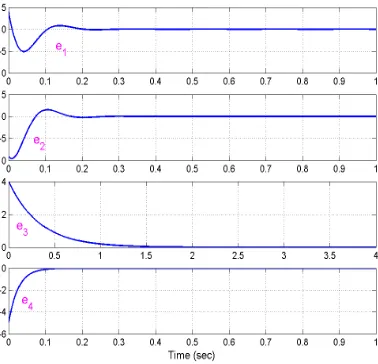
Figure 2 shows that synchronization between the states of the master system (8) and the slave system (9) occur in 4 seconds.Figure 2. Synchronization of the States of (8) and (9)
IV.SYNCHRONIZATION OF IDENTICAL HYPERCHAOTIC
LORENZ SYSTEMS
In this section, we apply the nonlinear control technique for the synchronization of two identical hyperchaotic Lorenz systems ([24], 2007).
Thus, the master system is described by the hyperchaotic Lorenz dynamics as
1 2 1
2 1 2 1 3 4
3 1 2 3
4 1
(
)
x
l x
x
x
mx
x
x x
x
x
x x
nx
x
px
=
−
=
−
−
+
=
−
= −
(17)
where
x i
i(
=
1, 2, 3, 4)
are the states andl m n p
, , ,
arepositive parameters.
The slave system is also described by the hyperchaotic Lorenz dynamics as
1 2 1 1
2 1 2 1 3 4 2
3 1 2 3 3
4 1 4
(
)
y
l y
y
u
y
my
y
y y
y
u
y
y y
ny
u
y
py
u
=
−
+
=
−
−
+
+
=
−
+
= −
+
(18)
where
y i
i(
=
1, 2, 3, 4)
are the states and
u
=
[
u
1u
2u
3u
4]
T is the nonlinear controller to be designed.The hyperchaotic Lorenz system (17) is a new 4-D hyperchaotic system derived from the Lorenz system by Wang, Zheng and Liu ([24], 2007).
The four-dimensional system (17) is hyperchaotic when
l
=
10,
m
=
28,
n
=
28 / 3
andp
=
5.
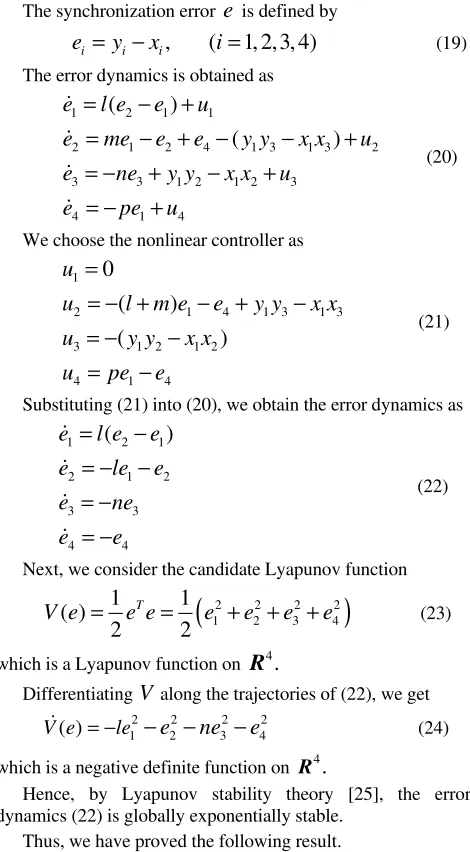
[image:3.612.60.296.75.291.2]Figure 3 depicts the portrait of the hyperchaotic Lorenz system (17).
[image:3.612.349.550.493.684.2] [image:3.612.100.289.528.710.2]© 2010, IJARCS All Rights Reserved 281 The synchronization error
e
is defined by
e
i=
y
i−
x
i, (
i
=
1, 2,3, 4)
(19)The error dynamics is obtained as
1 2 1 1
2 1 2 4 1 3 1 3 2
3 3 1 2 1 2 3
4 1 4
(
)
(
)
e
l e
e
u
e
me
e
e
y y
x x
u
e
ne
y y
x x
u
e
pe
u
=
−
+
=
−
+
−
−
+
= −
+
−
+
= −
+
(20)
We choose the nonlinear controller as
1
2 1 4 1 3 1 3
3 1 2 1 2
4 1 4
0
(
)
(
)
u
u
l
m e
e
y y
x x
u
y y
x x
u
pe
e
=
= − +
−
+
−
= −
−
=
−
(21)
Substituting (21) into (20), we obtain the error dynamics as
1 2 1
2 1 2
3 3
4 4
(
)
e
l e
e
e
le
e
e
ne
e
e
=
−
= −
−
= −
= −
(22)
Next, we consider the candidate Lyapunov function
( )
1
1
(
12 22 32 42)
2
2
T
V e
=
e e
=
e
+
e
+
e
+
e
(23)which is a Lyapunov function on
R
4.
Differentiating
V
along the trajectories of (22), we getV e( )= −le12
−
e
22−
ne
32−
e
42 (24)which is a negative definite function on R4
.
Hence, by Lyapunov stability theory [25], the error dynamics (22) is globally exponentially stable.
Thus, we have proved the following result.
Theorem 2. The identical hyperchaotic Lorenz systems (17) and (18) are exponentially and globally synchronized for any initial conditions with the nonlinear controller udefined by (21).
Numerical Results
For the numerical simulations, the fourth-order Runge-Kutta method is used to solve the systems using MATLAB
with time-step equal to
10 .
−6For the hyperchaotic Lorenz system (17), the parameter values are taken as those which result in the hyperchaotic behaviour of the system, viz.
l
=
10,
m
=
28,
n
=
28 / 3
andp
=
5.
The initial values of the master system (17) are taken as
x
1(0)
=
5, (0)
x
2=
2, (0) 14, (0)
x
3=
x
4=
9
while the initial values of the slave system (18) are taken as
y
1(0) 10, (0) 12, (0)
=
y
2=
y
3=
6, (0) 1.
y
3=
Figure 4 shows that synchronization between the states of the master system (17) and the slave system (18) occur in 4 seconds. [image:4.612.62.297.53.479.2]
Figure 4. Synchronization of the States of (17) and (18)
V.SYNCHRONIZATION OF HYPERCHAOTIC CHEN AND
LORENZ SYSTEMS
In this section, we apply the nonlinear control technique for the synchronization of non-identical hyperchaotic Chen and Lorenz systems. As the master system, we consider the hyperchaotic Chen system ([23], 2008) described by
1 2 1
2 1 1 3 2
3 3 1 2 2 3 1 3 4
4 4 2 3 1 3
(
)
(
)
x
a x
x
x
c
a x
x x
cx
x
bx
x x
x x
x x
x
x
dx
x x
x x
=
−
=
−
−
+
= −
+
−
+
−
= −
+
−
(25)
As the slave system, we consider the hyperchaotic Lorenz system ([24], 2007) described by
1 2 1 1
2 1 2 1 3 4 2
3 1 2 3 3
4 1 4
(
)
y
l y
y
u
y
my
y
y y
y
u
y
y y
ny
u
y
py
u
=
−
+
=
−
−
+
+
=
−
+
= −
+
(26)
where all the parameters are positive real constants and
u
=
[
u
1u
2u
3u
4]
T is the nonlinear controller to be designed.The synchronization error
e
is defined by
e
i=
y
i−
x
i, (
i
=
1, 2,3, 4)
(27)The error dynamics is obtained as
1 2 1 2 1 1
2 1 2 4 1 2
4 1 3 1 3 2
3 3 3 4 1 2 1 2
2 3 1 3 3
4 1 1 4 2 3 1 3 4
(
) (
)(
)
(
)
(
1)
(
)
e
l e
e
l
a x
x
u
e
me
e
e
m c
a x
c
x
x
y y
x x
u
e
ne
b n x
x
y y
x x
x x
x x
u
e
pe
px
dx
x x
x x
u
=
−
+
−
−
+
=
−
+
+
− +
−
+
+
−
+
+
= −
+
−
+
+
−
+
−
+
= −
−
+
−
+
+
[image:4.612.342.547.62.233.2]© 2010, IJARCS All Rights Reserved 282 We choose the nonlinear controller as
1 2 1
2 1 4 1 2
4 1 3 1 3
3 3 4 1 2 1 2 2 3 1 3
4 1 4 1 4 2 3 1 3
(
)(
)
(
)
(
)
(
1)
(
)
u
a l x
x
u
l
m e
e
m c
a x
c
x
x
y y
x x
u
n b x
x
y y
x x
x x
x x
u
pe
e
px
dx
x x
x x
=
−
−
= − +
−
−
− +
+
+
−
+
−
=
−
−
−
+
−
+
=
−
+
−
+
−
(29)
Substituting (29) into (28), we obtain the error dynamics as
1 2 1
2 1 2
3 3
4 4
(
)
e
l e
e
e
le
e
e
ne
e
e
=
−
= −
−
= −
= −
(30)
Next, we consider the candidate Lyapunov function
( )
1
1
(
12 22 32 42)
2
2
T
V e
=
e e
=
e
+
e
+
e
+
e
(31)which is a Lyapunov function on
R
4.
Differentiating
V
along the trajectories of (31), we getV e( )= −le12
−
e
22−
ne
32−
e
42 (32)which is a negative definite function on R4
.
Hence, by Lyapunov stability theory [25], the error dynamics (30) is globally exponentially stable.
Thus, we have proved the following result.
Theorem 3. The non-identical hyperchaotic Chen system (25) and hyperchaotic Lorenz system (26) are exponentially and globally synchronized for any initial conditions with the nonlinear controller udefined by (29).
Numerical Results
For the numerical simulations, the fourth-order Runge-Kutta method is used to solve the systems using MATLAB with time-step equal to
10 .
−6For the hyperchaotic Chen system (25) and hyperchaotic Lorenz system (26), the parameter values are taken as those which result in the hyperchaotic behaviour of the systems, viz.
37,
a
=
b
=
3,
c
=
26,
d
=
38,
l
=
10,
m
=
28,
28 / 3
n
=
andp
=
5.
The initial values of the master system (25) are taken as
x
1(0)
=
9, (0)
x
2=
6, (0) 10, (0)
x
3=
x
4=
4
while the initial values of the slave system (26) are taken as
y
1(0)
=
2, (0) 15, (0)
y
2=
y
3=
4, (0) 10.
y
3=
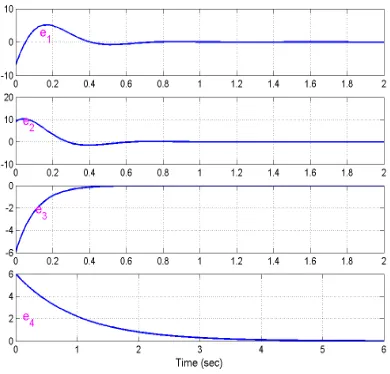
Figure 5 shows that synchronization between the states of the master system (25) and the slave system (26) occur in 5 seconds. [image:5.612.65.297.56.368.2]
Figure 5. Synchronization of the States of (25) and (26)
VI.CONCLUSIONS
Since the hyperchaotic systems have more complex dynamical behaviours, they can be used to improve the security of a chaotic communication system. In this paper, we have used nonlinear control method based on Lyapunov stability theory to achieve global chaos synchronization for the following three cases of hyperchaotic systems:
(A) Identical Hyperchaotic Chen systems (2008). (B) Identical Hyperchaotic Lorenz systems (2007). (C) Non-Identical Hyperchaotic Chen and Lorenz systems.
Simulation results are also given to illustrate and validate the proposed synchronization approach for the global chaos synchronization of the hyperchaotic systems. Since the Lyapunov exponents are not required for these calculations, the nonlinear control method is very effective and convenient to achieve global chaos synchronization for the three cases of hyperchaotic systems discussed in this paper.
VII.REFERENCES
[1] K.T. Alligood, T. Sauer and J.A. Yorke, Chaos: An Introduction to Dynamical Systems, Springer, New York, 1997.
[2] H. Fujisaka and T. Yamada, “Stability theory of synchronized motion in coupled-oscillator systems”, Progress of Theoretical Physics, vol. 69, no. 1, pp. 32-47, 1983.
[3] T.L. Carroll and L.M. Pecora, “Synchronization in chaotic systems”, Phys. Rev. Lett., vol. 64, pp. 821-824, 1990. [4] T.L. Carroll and L.M. Pecora, “Synchronizing chaotic
circuits”, IEEE Trans. Circ. Sys., vol. 38, pp. 453-456, 1991.
[5] M. Lakshmanan and K. Murali, Chaos in Nonlinear Oscillators: Controlling and Synchronization, World Scientific, Singapore, 1996.
[image:5.612.351.546.62.249.2]© 2010, IJARCS All Rights Reserved 283 [7] B. Blasius, A. Huppert and L. Stone, “Complex dynamics
and phase synchronization in spatially extended ecological system”, Nature, vol. 399, pp. 354-359, 1999. [8] J. Lu, X. Wu, X. Han and J. Lu, “Adaptive feedback
synchronization of a unified chaotic sytem”, Phys. Lett. A, vol. 329, pp. 327-333, 2004.
[9] L. Kocarev and U. Parlitz, “General approach for chaotic synchronization with applications to communications”, Phys. Rev. Lett., vol. 74, pp. 5028-5030, 1995.
[10] K. Murali and M. Lakshmanan, “Secure communication using a compound signal using sampled-data feedback”, Applied Mathematics and Mechanics, vol. 11, pp. 1309-1315, 2003.
[11] T. Yang and L.O. Chua, “Generalized synchronization of chaos via linear transformations”, International Journal of Bifurcation and Chaos, vol. 9, pp. 215-219, 1999.
[12] E. Ott, C. Grebogi and J.A. Yorke, “Controlling chaos”, Phys. Rev. Lett., vol. 64, pp. 1196-1199, 1990.
[13] J.H. Park and O.M. Kwon, “A novel criterion for delayed feedback control of time-delay chaotic systems”, Chaos, Solitons and Fractals, vol. 17, pp. 709-716, 2003.
[14] X. Wu and J. Lü, “Parameter identification and backstepping control of uncertain Lu system”, Chaos, Solitons and Fractals, vol. 18, pp. 721-729, 2003.
[15] J. Lu, X. Wu, X. Han and J. Lu, “Adaptive feedback synchronization of a unified chaotic system”, Phys. Lett. A, vol. 329, pp. 327-333, 2004.
[16] Y.G. Yu and S.C. Zhang, “Adaptive backstepping synchronization of uncertain chaotic systems”, Chaos, Solitons and Fractals, vol. 27, pp. 1369-1375, 2006. [17] J.H. Park, S.M. Lee and O.M. Kwon, “Adaptive
synchronization of Genesio-Tesi chaotic system via a novel feedback control”, Physcs Letters A, vol. 371, no. 4, pp. 263-270, 2007.
[18] J.H. Park, “Adaptive control for modified projective synchronization of a four-dimensional chaotic system with uncertain parameters”, J. Computational and Applied Math., vol. 213, no. 1, pp. 288-293, 2008.
[19] J.H. Park, “Chaos synchronization of nonlinear Bloch equations”, Chaos, Solitons and Fractals, vol. 27, no. 2, pp. 357-361, 2006.
[20] H.T. Yau, “Design of adaptive sliding mode controller for chaos synchronization with uncertainties”, Chaos, Solitons and Fractals, vol. 22, pp. 341-347, 2004
[21] R. Suresh and V. Sundarapandian, “ Synchronization of an optical hyper-chaotic system”, International J. Comp. Applied Math., vol. 5, no. 2, pp. 199-207, 2010.
[22] R. Vicente, J. Dauden, P. Colet and R. Toral, “Analysis and characterization of the hyperchaos generated by a semiconductor laser object,” IEEE J. Quantum Electronics, vol. 41, pp. 541-548, 2005.
[23] Z. Yan and P. Yu, “Hyperchaos synchronization and control on a new hyperchaotic attractor”, Chaos, Solitons and Fractals, vol. 35, no. 2, pp. 333-345, 2008.
[24] G.Y. Wang, Y. Zheng and J. Liu, “A hyperchaotic Lorenz attractor and its circuit implementation,” ACTA Phys. Sin., vol. 56, pp. 3113-3120, 2007.
[25] W. Hahn, The Stability of Motion, Springer, New York, 1967.
Author: