Volume 4, No. 4, March-April 2013
International Journal of Advanced Research in Computer Science
RESEARCH PAPER
Available Online at www.ijarcs.info
ISSN No. 0976-5697
Improved techniques for Image Retrieval
Priyanka Gupta*
Dept. Of Computer Science & Electronics
AIM & ACT Banasthali University, Tonk, Rajasthan, India [email protected]
Mr. Umesh Kumar Dept. Of CS & IT
Govt. Mahila Engg. College, Rajasthan, India [email protected]
Abstract: In this paper we are going to discuss content based image retrieval system considering multiple features as color, texture, shape and spatial features to overcome the drawbacks of traditional text based image retrieval and previous content based image retrieval system which considered only single or double features for matching similarity between images. Here we apply a sequence of algorithms for extracting color, texture, shape and spatial features in CBIR for more accurate results, color feature vectors and clusters are formed using statistical color moments along with hierarchical and K-means clustering technique and for texture feature extraction Gabor wavelets algorithm is implemented and on these features extracted images shape features are extracted by implementing invariant moments then on this result images spatial feature is computed using the concept of quad tree decomposition and now on retrieved images relevance feedback analysis is performed for automatic indexing of images for future.
Keywords: CBIR, Clustering, Color moments, Gabor wavelet, invariant moments, quad tree decomposition
I. INTRODUCTION
In content-based systems search is performed by considering actual contents of the image rather than keywords, tags, and annotations associated with the image. This metadata based image retrieval technique can produce much non-relevant result in the search result. So this technique may be inefficient, expensive due to involving manual descriptions and may not be able to capture all keywords to describe the image. The term 'content' in this context might refer to colors, shape, textures, spatial or any other information that can be derived from the image itself. The basic idea of CBIR technique is to generate automatically image descriptors directly by analyzing the actual contents of the images [1]. Different techniques for image retrieval can be implemented as Query by example, Query by Semantic retrieval and other query methods [2].
In Query by image example as search for a particular
image, it is a query technique that involves providing the CBIR system with an example image that it will search based upon this criteria as follows-
a. A preexisting image may be supplied by the user or chosen from a random set already existing image database.
b. The user draws a rough scene for approximation of the image they are looking for.
In Query by Semantic retrieval similar as category
searching, the user makes a request like "find pictures of buildings" or even "find pictures of Indira Gandhi". This type of open-ended task is very difficult for computers to perform .While with this type of method not only images but also documents related to these keywords can also be retrieved in undesirable manner.
Other query methods include browsing for example images as similar to search by association where there is no clear vision about the query image, navigating
customized/hierarchical categories, querying by some image portion (rather than the complete image), querying by multiple example images, and querying by direct specification of image features.
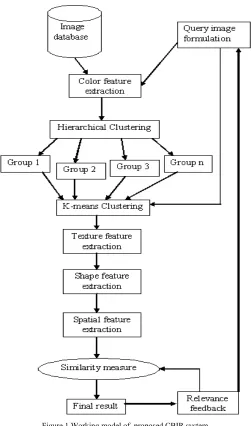
Here in this paper before searching image, some image clusters are computed by grouping images by its similarity in color features. Retrieval algorithms as texture, shape and spatial feature extraction techniques are applied on cluster centers to find the best match to the query image. Then query image is compared to all those clusters images whose cluster centered image is more similar to the query image. Thus due to clustering query image not need to be compared with all database images only with clustered images for faster speed [3].Here image retrieval is based in color, shape, texture and spatial features can be computed individually and simultaneously in the combination option, when all the algorithms are applied one after the other, and each algorithm is applied only over the previous result images. Here we are extracting 4 features as color, texture, shape and spatial as explained in figure 1.
Priyanka Guptaet al, International Journal of Advanced Research in Computer Science, 4 (4), March –April, 2013,28-33
© 2010, IJARCS All Rights Reserved 29 Figure 1.Working model of proposed CBIR system
II. PROPOSEDMETHODOLOGY
A. Color feature extraction:
It is the most common visual feature for recognition and matching purpose for images. Only this feature is not sufficient for comparison of images because same color images may be different semantically [5]. For implementing this system, this feature is extracted using the concept of color moments for red, green and blue component of color separately as mean, variance and skewness which are used for representation of color distribution of images.[4] These are computed as-
mean μ N∑N f
ar σ 1
N f μ
N
skewness s N∑N f μ
Where fij is the value of the i-th color component of the image pixel j, and N is the total number of pixels in the image. Feature vectors for 3 components of color as red, green and blue are: (µR, σR , sR,, µG, σG , sG µB, σB , sB )
B. Cluster Formation:
Clusters of similar images are formed by considering similar color descriptors [6]. Before the searching starts, clusters are formed by applying hierarchical and k-means clustering one after other for fast and accurate image retrieval [3]. No of clusters computed by hierarchical clustering are fed as input for k-means clustering for improving accuracy. When the images in database are clustered retrieval time is summation of 3 factors-
a. Calculation of the similarity between the query and the cluster centers.
b. Calculation of the similarity between the query and the images in the nearest clusters
c. Ranking the images [7].
Goal of performing clustering is to group similar images into clusters and to compute the cluster centers, so that during retrieval, the query image need not be compared exhaustively with all the images in the database.[8] To retrieve similar images for a given query image, the query image is initially compared with all the cluster centers. Then a subset of clusters that have the largest similarity to the query image is chosen and all the images in these clusters are compared with the query image. Most search engines calculate the similarity between the query image and all the images in the database and rank the images by sorting their similarities so retrieval time in this case is more than in this proposed CBIR system. Here query image don’t need to be compared with all data base images.
C. Texture feature extraction:
This feature describes the structural arrangement of surface of images. Due to this feature, sea and water or tree and leaves can be differentiated [5]. Existing gabor wavelet transformation method is used here for texture feature extraction due to analyzing frequency content of image, texture representation and discrimination[9]. This transform represent variations of images at different scales. This technique can tolerate the distortion for pattern recognition tasks as multi-resolution. For this feature descriptors are computed by correlation between query image and gabor filters with each wavelet at different frequencies and directions. A gabor filter is obtained by modulating the sinusoid form of image with the Gaussian envelope as
g x, y,θ, exp
σ exp 2πθi xcos ysin
Where σ is the standard deviation of the Gaussian function in the x and y directions and ω=2πθ denotes the spatial frequency. [10]Family of Gabor kernels can be obtained from this equation by selecting different center frequencies and orientations. These kernels are used to extract features from an image. For given an input image I(x, y), the Gabor Wavelet features are extracted by convolving I(x, y) with g(x, y) as in this equation
Fr milar to the func
Shape feat is also visual arity for identi
f function is tra fined as follow ent, using the f
eature vectors
re feature can b ctionality of p
ture extraction feature for the ification and di are different ty e in this resear
as shape fe hted average ant role in pat es [12]. This nslation, rotatio
that has gray f en two-dimens
anslated by an ws
al moments mp on substituting
ce is a feature of length, ener
used in this re ments of secon lusser [13] and of invariant m mented in MA tion techniques
be extracted as previous equati y the properly mula
search work ar nd and third or d T. Suk. [14]. moments are as ATLAB and c s in this researc
follows which
re based on the rder, according
r the query ima d on intensity t the blocks of be incorporated
onsidering int e in this resear
y image and da ges if the distan eval performan ned as the grea database image searched result eved in the se ch is more restr
III. RELEV
t is automatic, This is perfor etrieved resul ation is the info d to the loca al objects or r ions within th hould be perfe their relative ree decompos
action. It is an ual sized sub-nce is smaller. nce of retrieva s created in th query image s in database a k of query ima wer results are r
DBACKANA for the basis o
image is no have to rank in with the query d as similarity to the databas s will affect th In this research uery image and used which i
between query it is defined fo
Priyanka Guptaet al, International Journal of Advanced Research in Computer Science, 4 (4), March –April, 2013,28-33
© 2010, IJARCS All Rights Reserved 31 jpg.xml’ is created storing information of all its relevant
images.
Images which are marked as relevant views by the user are the first retrieved in result and displayed according to their similarity and threshold values when the same query is put again in future, order by percent of match. After the relevant images, the rest of the retrieved results, if any, are shown. Thus this analysis is performed for automatic image indexing for further image retrieval with accuracy, relevance and speed.
IV. PERFORMANCEMEASUREMENT
Performance of any image retrieval system is measured by accuracy which is defined as the ratio of the number of relevant images retrieved to the total number of images retrieved expressed in percentage.
Where, total number of images retrieved = number of relevant images + number of irrelevant images
For example, if an image query result in 100 images with 75 relevant images, then the accuracy of the retrieval system is given by:
Accuracy is the essential factor for evaluation as direct measurement of the quality and user satisfaction of the image retrieval system.
V. RESULTS
Retrieved image result obtained by considering only single feature is not consistent and relevant. More than one feature are mandatory for accurate and improved image retrieval. The GUI has 4 main sections:
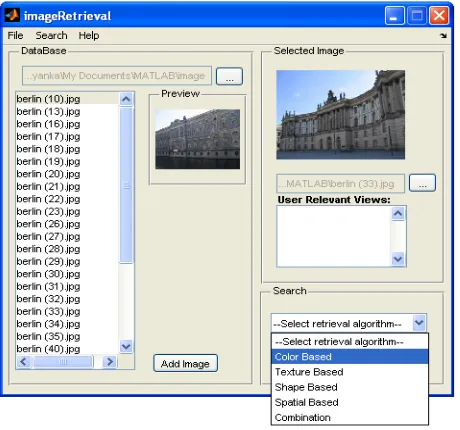
a. Database Section: This section is for selecting the database location and adding new images to database. The supported image formats are .bmp, .jpg and .png. A preview of the selected image is displayed on the top-right side of this section.
b. Selected Image Section: This section is for displaying a preview of the query image after selecting the query image.
c. Search Section: This is for selecting the search algorithm, based on which feature similar images have to be retrieved.
d. Result Section: Once a search has been completed, the results section is revealed in the right side. User can select the images from the retrieved image listing and get the preview of result images.
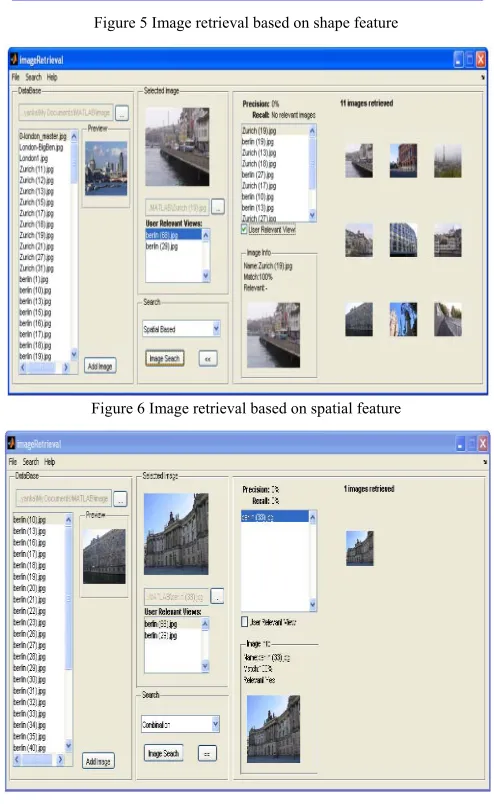
Here in figure 2 simple view of image retrieval system with database section, selected image section and search section has been shown .While considering only color feature result obtained is displayed in figure 3, considering only texture, obtained image result is shown in figure 4, considering only shape feature for image similarity in figure 5, retrieved image result is shown in figure 6 and considering color, texture, shape and spatial features for similar image
retrieval, result is shown in figure 7 which is improved, more relevant and better performance image result than previous. So no any single feature is sufficient or perfect for finding similarity among images.
Figure2.Snapshot of developed CBIR
Figure 3 Image retrieval based on color feature
Figure 5 Image retrieval based on shape feature
Figure 6 Image retrieval based on spatial feature
Figure 7 Image retrieval based on color, texture and shape features
VI. FUTURESCOPE
In this research work not only single feature is considered, more than 1 features color, texture, shape and spatial features are extracted simultaneously for improved, accurate similar image retrieval. For future some weightage can be given for
the features, all feature should not be given same importance it should be given on the basis of database used and on the application because in a huge database weighted combination of features can give optimal image search result. For example if query image is related to machine parts then more weightage should not be given to color feature or texture feature. It is more beneficial to assign more weight for shape feature. So this factor will be considered for future in this developed CBIR system for improved image retrieval result.
VII. REFERENCES
[1]. Linh Viet Tran, “Efficient Image retrieval with Statistical Color Descriptors”, PhD thesis No.810, Linkoping Studies in Science and Technology, may 2003.
[2]. Kavitha H et al, “ Content Based Image Retrieval - A survey” International Journal of Advanced Research in Computer Science, Vol. 4 (1), January 2013, 14-20.
[3]. Priyanka Gupta et al, “Utilization of hierarchical and flat clustering for content based image retrieval” International Journal of Advanced Research in Computer Science, Vol. 3 (7), Nov.-Dec. 2012, 203-205
[4]. Priyanka Gupta et al, “Effective content based image retrieval techniques using clustering for multiple features” International Journal of Advanced Research in Computer Science, Vol. 3 (7), Nov.-Dec. 2012, 91-94
[5]. John Eakins, Margaret Graham,” Content-based Image Retrieval”, JISC Technology Application Report 39, October 1999.
[6]. Murthy V.S.V.S. et al. “Application of hierarchical and K-means techniques in Content based image retrieval”, International Journal of Engineering Science and Technology Vol. 2(5), 2010, 749-755
[7]. Santhana Krishnamachari, Mohamed Abdel Mottaleb, “Hierarchical clustering algorithm for fast image retrieval”,IS&T/SPIE Conference on Storage and Retrieval for Image and Video Databases VII, San Jose, California, January 1999 , pp .427-435.
[8]. V.S.V.S Murthy et al. “Content based image retrieval using Hierarchical and K-means clustering techniques” IJEST Vol. 2 (3), 2010, pp. 209-212.
[9]. Jie Y., Qiang Z., Liang Z. and Wuhan C. Y. “Texture Images Retrieval Based on the Gabor Wavelet Transfor” International Conference on Information Engineering, ICIE 2009, pp. 1:79-82.
[10]. Sujatha C. et al “An optimal solution for image edge detection problem using simplified Gabor wavelet” International Journal of Computer Science, Engineering and Information Technology (IJCSEIT), Vol. 2(3), June 2012,pp: 99-115
[11]. Y.P.Guan “Automatic extraction of lips based on multi-scale wavelet edge detection,” Computer Vision, Vol. 2(1),2008, pp.23-33.
Priyanka Guptaet al, International Journal of Advanced Research in Computer Science, 4 (4), March –April, 2013,28-33
© 2010, IJARCS All Rights Reserved 33
[13]. J. Flusser, "On the Independence of Rotation Moment Invariants", Pattern Recognition, Vol. 33, 2000, pp. 1405– 1410.
[14]. J. Flusser and T. Suk, "Rotation Moment Invariants for Recognition of Symmetric Objects", IEEE Trans. Image Proc., Vol. 15, 2006, pp. 3784–3790.