The Role of Roles in Classifying Annotated Biomedical Text
Son Doan, Ai Kawazoe, Nigel Collier National Institute of Informatics 2-1-2 Hitotsubashi, Chiyoda-ku, Tokyo, Japan
{doan,zoeai,collier}@nii.ac.jp
Abstract
This paper investigates the roles of named entities (NE’s) in annotated biomedical text classification. In the annotation schema of BioCaster, a text mining system for pub-lic health protection, important concepts that reflect information about infectious diseases were conceptually analyzed with a formal ontological methodology. Concepts were classified as Types, while others were iden-tified as being Roles. Types are specified as NE classes and Roles are integrated into NEs as attributes. We focus on the Roles of NEs by extracting and using them in different ways as features in the classifier. Experimental results show that: 1) Roles for each NE greatly helped improve perfor-mance of the system, 2) combining informa-tion about NE classes with their Roles con-tribute significantly to the improvement of performance. We discuss in detail the effect of each Role on the accuracy of text classifi-cation.
1 Introduction
Today, the Internet is a powerful tool for discov-ering novel information via news feed providers. This is becoming increasingly important for the public health domain because it can help to de-tect emerging and re-emerging diseases. In infec-tious disease surveillance systems such as the Global Public Health Intelligence Network (GPHIN) sys-tem (Public Health Agency of Canada, 2004) and
ProMed-Mail (International Society for Infectious Diseases, 2001), the detection and tracking of out-breaks using the Internet has been proven to be a key source of information for public health work-ers, clinicians, and researchers interested in com-municable diseases. The basis for such systems is the monitoring of a large number of news articles simultaneously. The classification of news articles into disease-related or none disease-related classes is the first stage in any automated approach to this task. In practice though there are a large number of news articles whose main subject is related to dis-eases but which should not necessarily be notified to users together with a relatively small number of high priority articles that experts should be actively alerted to. Alerting criteria broadly include news re-lated to newly emerging diseases, the spread of dis-eases across international borders, the deliberate re-lease of a human or engineered pathogen, etc. The use of only raw text in the classification process in-evitably fails to resolve many subtle ambiguities, for example semantic class ambiguities in polysemous words like “virus”, “fever”, “outbreak”, and “con-trol” which all exhibit a variety of senses depending on context. These different senses appear with rela-tively high frequency in the news especially in head-lines. A further challenge is that diseases can be de-noted by many variant forms. Therefore we consider that the use of advanced natural language process-ing (NLP) techniques like named entity recognition (NER) and anaphora resolution are needed in order to achieve high classification accuracy.
Text classification is defined as the task of as-signing documents into one or more predefined
egories. As shown by (Cohen and Hersh, 2005), an accurate text classification system can be espe-cially valuable to database curators. A document in the biomedical domain can be annotated using NER techniques with enriched semantic information in the form of NEs such as the disease, pathogen, loca-tion, and time. NER and term identification in gen-eral have been recognized as an important research topic both in the NLP and biomedical communities (Krauthammer and Nenadic, 2004). However, an in-vestigation into the contribution of NEs on the per-formance of annotated biomedical text classification has remained an open question until now. There are two main reasons for this: Firstly there are a small number of open annotation schema for biomedical text, and secondly there is no benchmark annotated data for testing.
The BioCaster project (Collier, 2006) is working towards the detection and tracking of disease out-breaks from Internet news articles. Although there are several schema for biomedical text (Wilbur et al., 2006), little work has been done on developing one specifically for public health related text. BioCaster therefore provides an annotation schema that can fill this gap. Our schema, which is based on discussions with biologists, computational linguists and public health experts, helps identify entities related to in-fectious diseases which are then used to build up a detailed picture of events in later stages of text min-ing. One significant aspect of the schema is that it is based on conceptual analysis with a formal on-tological methodology. As discussed in (Kawazoe et al., 2006), by applying meta-properties (Guarino and Welty, 2000a; Guarino and Welty, 2000b), our “markable” concepts are classified into “Type” and “Role”. Information about Role concepts is inte-grated into the schema as attributes on NEs. This work takes the investigation one step forward by showing empirical evidence for the usefulness of Role concepts in a practical application.
In this paper, we focus on the task of text classifi-cation, proceeding under the simplifying assumption that given enough annotated training data for NEs and their Roles both can be automatically tagged with high accuracy. In recent years there have been many studies on text classification using general methods (Sebastiani, 2002; Yang and Liu, 1999) semi-structured texts (Kudo and Matsumoto, 2004),
and XML classification (Zaki and Aggarwal, 2003). Other research has investigated the contribution of semantic information in the form of synonyms, syn-tax, etc. in text representation (Bloehdorn and Hotho, 2004; Hotho et al., 2003; Fr¨urnkranz et al., 1998). Feature selection (Scott and Matwin, 1999) has also been studied. The contribution of this paper is to provide an analysis and evaluation on the Roles of NEs in annotated text classification.
The rest of this paper is organized as follows: in Section 2, we outline the BioCaster schema for the annotation of terms in biomedical text; Section 3 presents a description of the BioCaster gold standard corpus; Section 4 provides details of the method and experimental results of classification on the gold standard corpus. Finally we draw some conclusions in Section 5.
2 BioCaster Schema for Annotation of Terms in Biomedical Text
The BioCaster annotation schema is a component of the BioCaster text mining project. We have iden-tified several important concepts that reflect infor-mation about infectious diseases, and created guide-lines for annotating them as target entity classes in texts. Based on the conceptual analysis using meta-properties (rigidity, identity, and dependency) developed by Guarino and Welty (2000a; 2000b), categories of important concepts were classified as Types, i.e., properties which are rigid1 and supply identity conditions, while others were identified as being Roles, properties which are anti-rigid2 and dependent. The 18 categories of Type concepts are specified as NE classes which we denote here in upper case. These include PERSON, LOCA-TION, ORGANIZALOCA-TION, TIME, DISEASE, CON-DITION (status of patient such as “hospitalized” or “in stable condition”), OUTBREAK (event of group infection), VIRUS, ANATOMY (body part), PRODUCT (biological product such as “vaccine”), NONHUMAN (animals), DNA, RNA, PROTEIN, CONTROL (control measures to contain the dis-ease), BACTERIA, CHEMICAL and SYMPTOM. The three Role concepts we explore are case
(dis-1
A property is rigid if every instance of that property neces-sarily has the property, i.e. in every possible world.
2
eased person), transmission (source of infection) and therapeutic (therapeutic agent). These are inte-grated into the annotation schema as XML attributes which are associated with some XML elements de-noting Type concepts. PERSON takes a case at-tribute, NONHUMAN and ANATOMY take
trans-mission, PRODUCT takes transmission and thera-peutic and CHEMICAL takes therathera-peutic. For
PER-SON we added another attribute number (number of people). Each attribute has only one value, the value of number is one or many, and the value of
case, transmission, therapeutic is true or false. This
is summarized in Table 1. In the rest of this paper, we call case, transmission, and therapeutic “Role at-tributes” (or “Role” for short) and number a “Qual-ity attributes” (or “Qual“Qual-ity” for short).
A NE in a biomedical text is annotated following the BioCaster annotation schema in XML format as follows,
<NAME cl="Named Entity"
attribute1="value1" attribute2="value2" ... </NAME>,
where"Named Entity"is one of the names for the 18 BioCaster NEs andattribute1, attribute2, ... are the names of the NE’s Role/Quality at-tributes,"value1", "value2", ...are values cor-responding to Role/Quality attributes. Further de-tails of the annotation guidelines are discussed in (Kawazoe et al., 2006).
3 BioCaster Gold Standard Data Corpus
The BioCaster gold standard corpus was collected from Internet news and manually annotated by two doctoral students. The annotation of a news article proceeded as follows. Firstly, NEs are annotated fol-lowing the BioCaster schema and guidelines. Sec-ondly, each annotated article is manually assigned into one of four relevancy categories: alert, publish,
check, and reject. The assignment is based on
guide-lines that we made following discussions with epi-demiologists and a survey of World Health Organi-zation (WHO) reports (World Health OrganiOrgani-zation, 2004). These categories are currently being used op-erationally by the GPHIN system which is used by the WHO and other public health agencies. Where there were major differences of opinion in NE anno-tation or relevancy assignment between the two
an-notators, we consulted a public health expert in order to decide the most appropriate assignment. Finally we had a total of500articles that were fully anno-tated. While this is small compared to other data sets in text classification, we consider that it is large enough to obtain a preliminary indication about the usefulness of Role attributes.
The following is an example of an annotated arti-cle in the BioCaster gold standard corpus.
Example.
<DOC id="000125" language="en-us" source="WHO" domain="health" subdomain="disease"
date published="2005-03-17"
relevancy="alert"> <NAME cl="DISEASE"> Acute fever </NAME> and <NAME
cl="DISEASE"> rash syndrome </NAME> in <NAME cl="LOCATION">Nigeria</NAME> <NAME cl="TIME"> 17 March 2005 </NAME><NAME cl="ORGANIZATION"> WHO</NAME> has received reports of <NAME cl="PERSON" case="true" number="many"> 1118 cases </NAME>
including <NAME cl="PERSON" case="true" number="many">76 deaths</NAME>case fatality rate, 6.8% reported in 12 Local Government Areas (LGAs) of <NAME cl="LOCATION">damawa </NAME> state, <NAME cl="LOCATION"> Nigeria</NAME> as of <NAME cl="TIME">28 February 2005</NAME>. The cases have been clinically diagnosed as <NAME cl="DISEASE"> measles </NAME> but no laboratory diagnosis has been made to date. Other states, including <NAME cl="LOCATION">Gombe</NAME>, <NAME cl="LOCATION">Jigawa</NAME>,<NAME cl="LOCATION">Kaduna</NAME>, <NAME cl="LOCATION">Kano</NAME>, and <NAME cl="LOCATION">Kebbi</NAME> have all reported <NAME cl="OUTBREAK"> outbreaks </NAME> of <NAME cl="DISEASE"> measles </NAME>... </DOC>
We grouped the500articles into 2 categories:
re-ject and relevant. The rere-ject category corresponds
simply to articles with label reject while the relevant category includes articles with labels alert,
pub-lish, and check. We conflated the alert, publish and check categories because we hypothesized that
Named entity Role/Quality attributes Named entity Role/Quality attributes
PERSON case, number ANATOMY transmission
ORGANIZATION none SYMPTOM none
LOCATION none CONTROL none
TIME none CHEMICAL therapeutic
DISEASE none BACTERIA none
CONDITION none PRODUCT transmission, therapeutic
NONHUMAN transmission DNA none
VIRUS none RNA none
OUTBREAK none PROTEIN none
Table 1: Lists of Named entity classes and their Role/Quality attributes in BioCaster annotation schema.
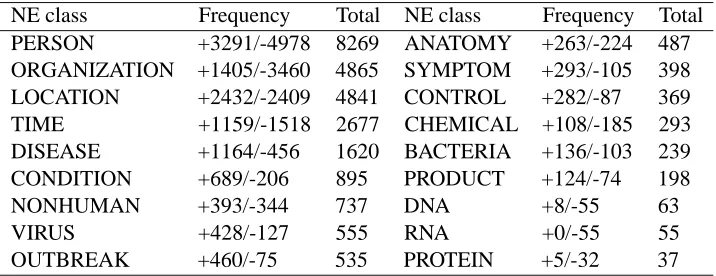
would require higher level semantic knowledge such as pathogen infectivity and previous occurrence his-tory which is the job of the text mining system and the end user. Finally we had a total of 269 news articles belong to the reject category and 231news articles belong to the relevant category. The statis-tical information about NEs is shown in Table 2. In the table, “+” stands for the frequency of NEs in the
relevant category and “-” stands for the frequency of
NEs in the reject category.
4 Experiments
4.1 Method
We used the BioCaster gold standard corpus to in-vestigate the effect of NE classes and their Role at-tributes on performance of classification. In order to avoid unnecessary data, we removed the first line containing DOC tag of all article in the corpus. The validation is as follows. We randomly divided the data set into 10 parts. Each of the first 9 parts has 23 articles belonging to the relevant category and 27 ar-ticles belonging to the reject category; the 10th part has 24 articles belonging to the relevant and 26 arti-cles belonging to the reject categories. Then, we im-plemented 10-fold cross validation: 9 parts for train-ing and 1 part for testtrain-ing sets. For the traintrain-ing set we extracted NEs classes and their Roles as features to build a classifier. The remaining part was used for testing.
The classifier we use in this paper is the standard N¨aive Bayes classifier (Mitchell, 1997). In the pre-processing we did not use a stop list and no word stemming. The experiments were implemented in Linux OS, using the Bow toolkit (McCallum, 1996).
The details of extracting NEs and their Roles from annotated texts are the followings. For the sake of convenience, we divided features into 3 groups: Features for each NE, features for NEs with Role/Quality, and features for combined NEs with Role/Quality.
1. Features for each NE: Each NE is extracted and used with raw text as features. We denoted NE1 as features extracted from named entity NE1. For example, DISEASE1 means features are raw text and DISEASE class, VIRUS1 means features are raw text and VIRUS class. An ex-ample of features for PERSON1 is shown in Table 3.
2. Features for NEs with Role/Quality: We inves-tigated the effect of NEs with Roles/Qualities, i.e., case, number, therapeutic, and
transmis-sion. Features are chosen as follows.
- PERSON+case+number: Raw text and PERSON class with both Role case and Quality number are used as features. - PERSON+case: Raw text and PERSON
class with Role case are used as features. - PERSON+number: Raw text and
PER-SON class and Quality number are used as features.
- NONHUMAN+trans: Raw text and NONHUMAN class and Role
transmis-sion are used as features.
NE class Frequency Total NE class Frequency Total
PERSON +3291/-4978 8269 ANATOMY +263/-224 487
ORGANIZATION +1405/-3460 4865 SYMPTOM +293/-105 398
LOCATION +2432/-2409 4841 CONTROL +282/-87 369
TIME +1159/-1518 2677 CHEMICAL +108/-185 293
DISEASE +1164/-456 1620 BACTERIA +136/-103 239
CONDITION +689/-206 895 PRODUCT +124/-74 198
NONHUMAN +393/-344 737 DNA +8/-55 63
VIRUS +428/-127 555 RNA +0/-55 55
[image:5.612.128.486.55.193.2]OUTBREAK +460/-75 535 PROTEIN +5/-32 37
Table 2: The frequency of NE classes in the BioCaster gold standard corpus, “+” denotes the frequency in the relevant category and “-” denotes the frequency in the reject category.
Example of <NAME cl="ORGANIZATION"> WHO</NAME> has
annotated text received reports of <NAME cl="PERSON" case="true" number="many"> 1118 cases </NAME>
Text only “WHO”, “has”, “received”, “reports”, “of”, “1118”, “cases”
PERSON1 “WHO”, “has”, “received”, “reports”, “of”, “1118”, “cases”, “PERSON” PERSON+case+number “WHO”, “has”, “received”, “reports”, “of”, “1118”, “cases”, “PERSON”,
“case”, “number”
PERSON+case “WHO”, “has”, “received”, “reports”, “of”, “1118”, “cases”, “PERSON”, “case”
PERSON+number “WHO”, “has”, “received”, “reports”, “of”, “1118”, “cases”, “PERSON”, “number”
Table 3: An example of using different features for PERSON class as training data.
- PRODUCT+trans+thera: Raw text and PRODUCT class and both Roles
transmis-sion and therapeutic are used as features.
- PRODUCT+trans: Raw text and PROD-UCT class and Role transmission are used as features.
- PRODUCT+thera: Raw text and PROD-UCT class and Role therapeutic are used as features.
- CHEMICAL+thera: Raw text and CHEMICAL class and Role therapeutic are used as features.
3. Features for combined NEs with Roles. We investigate features for disease-related NEs which include DISEASE, VIRUS, BACTE-RIA, SYMPTOM, CONDITION, CONTROL, DNA, PROTEIN, RNA, OUTBREAK, PROD-UCT, ANATOMY, NONHUMAN, CHEMI-CAL and features for all NEs with their Roles,
i.e., therapeutic and transmission. We investi-gated 5 different features as follows:
- Text only: Only raw text is used as fea-tures.
- Text+DiseaseNEs: Raw text and all 14 NEs disease-related classes are used as features.
- Text+DiseaseNEs+Roles: Raw text and all 14 NEs disease-related classes with Roles are used as features. We note that there are two Roles therapeutic and
trans-mission in this case.
- Text+AllNEs: Raw text and all NE classes are used as features.
- Text+AllNEs+Roles: Raw text and all NE classes with Roles are used as features. In this case we have all 3 Roles case,
thera-peutic and transmission.
[image:5.612.78.538.238.391.2]PER-YES is correct NO is correct
Assigned YES a b
Assigned NO c d
Table 4: A contingency table.
SON class is shown in Table 3.
4.2 Results and Discussions
The details of experimental results are shown in the following sections. We use two performance mea-sures, standard Precision/Recall and accuracy. They are calculated based on the two-way contingency ta-ble in Tata-ble 4. In the tata-ble, a counts the assigned and correct cases, b counts the assigned and incor-rect cases, c counts the not assigned but incorrect cases, and d counts the not assigned and correct cases (Yang, 1999). Then,
Precision= a
a+b, and Recall= a a+c.
Accuracy is defined as accuracy=(a+d)/(a+b+ c+d).
4.2.1 Effectiveness of Each NE Class
In order to investigate the effect of NEs on per-formance, we consider the baseline as the method using text only. In experiment the baseline achieved a performance of74.40%accuracy and64.35% Pre-cision,100%Recall. We can see that Recall always achieves100%in all cases. This may be due to the small size of data. However it is interesting that we can observe the change of Precision measure - an important measure in our case. Hereafter we discuss accuracy and Precision only.
The effectiveness of each NE class is shown in Ta-ble 5. The results show that each NE does not have the same effect. Compared to the baseline, nearly half the total NEs (7/18) help improve performance while the others do not have a significant affect.
Looking at the distribution of NE frequency in Ta-ble 2, it seems that the higher the frequency of the NE class, the better the performance it provides. For example, PERSON achieved the best of all (76.80% accuracy,66.57%Precision compared to74.40% ac-curacy and64.35%Precision when using raw text). However this trend is not always followed, for ex-ample, the TIME class tends to reduce performance
when compared to raw text. This is natural as there is no obvious correlation between time and rele-vancy. From the result tables we can conclude that the effectiveness of each NE on the performance of classification in our corpus is decreased in the fol-lowing order.
PERSON > LOCATION > ORGANIZATION > DISEASE > CONDITION = VIRUS = OUT-BREAK>NONHUMAN = ANATOMY = SYMP-TOM = CONTROL = BACTERIA = PRODUCT = PROTEIN>CHEMICAL = DNA = RNA>TIME In particular, 7 NEs, i.e., PERSON, LO-CATION, ORGANIZATION, DISEASE, CONDI-TION, VIRUS, OUTBREAK improve performance, while TIME significantly reduces it. Two NEs DNA and RNA that have low frequency weakly reduce performance.
4.2.2 Effectiveness of Roles on Classification
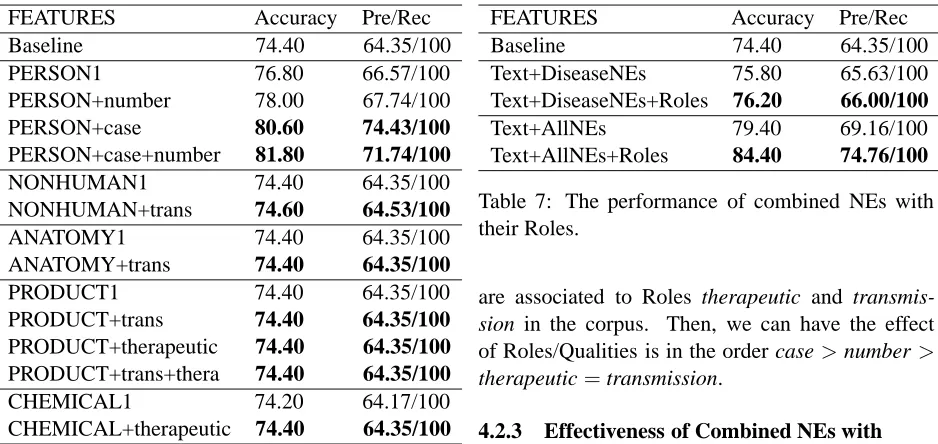
In this Section we investigate the effect of each Role on performance. The experimental results are shown in Table 6. We can easily observe that Roles in NEs improved both the accuracy and Precision significantly.
We first consider the Role case. This Role is as-sociated to PERSON which has highest frequency in the corpus. Role case helped improve the ac-curacy from76.8%to 80.60%, and Precision from 66.57%to74.43%for PERSON. This is significant when we compare to the baseline with 74.4% ac-curacy and 64.35% Precision. We note that PER-SON has another attribute, the Quality number. Role
case helps PERSON with Quality number improve
the accuracy from78.00%to81.80%and Precision from 67.74% to 71.74%. Moreover, we can obvi-ously draw the relative comparison about effective-ness between Role case and Quality number from these results, it yields that case>number.
We proceed to investigate the effect of Roles
ther-apeutic and transmission. Obviously we see that
Named entity Accuracy Pre/Rec Named entity Accuracy Pre/Rec
PERSON1 76.80 66.57/100 ANATOMY1 74.40 64.35/100
ORGANIZATION1 75.40 65.25/100 SYMPTOM1 74.40 64.35/100
LOCATION1 75.60 65.44/100 CONTROL1 74.40 64.35/100
TIME1 73.00 63.11/100 CHEMICAL1 74.20 64.17/100
DISEASE1 75.00 64.89/100 BACTERIA1 74.40 64.35/100
CONDITION1 74.60 64.53/100 PRODUCT1 74.40 64.35/100
NONHUMAN1 74.40 64.35/100 DNA1 74.20 64.17/100
VIRUS1 74.60 64.53/100 RNA1 74.20 64.17/100
[image:7.612.103.507.55.192.2]OUTBREAK1 74.60 64.53/100 PROTEIN1 74.40 64.35/100
Table 5: Performance of each NE class in which features of NEs in bold text have Role attributes.
FEATURES Accuracy Pre/Rec
Baseline 74.40 64.35/100
PERSON1 76.80 66.57/100
PERSON+number 78.00 67.74/100
PERSON+case 80.60 74.43/100
PERSON+case+number 81.80 71.74/100
NONHUMAN1 74.40 64.35/100
NONHUMAN+trans 74.60 64.53/100
ANATOMY1 74.40 64.35/100
ANATOMY+trans 74.40 64.35/100
PRODUCT1 74.40 64.35/100
PRODUCT+trans 74.40 64.35/100
PRODUCT+therapeutic 74.40 64.35/100
PRODUCT+trans+thera 74.40 64.35/100
CHEMICAL1 74.20 64.17/100
CHEMICAL+therapeutic 74.40 64.35/100
Table 6: Performance of Role attributes with their NEs.
Roles on them. Interestingly, while NEs associated to Roles do not improve the accuracy like NONHU-MAN and CHEMICAL, their Roles helped improve the accuracy. Based on the improvements of
trans-mission and therapeutic in Table 6, we can draw
their effectiveness are the same on their NEs, that is therapeutic=transmission.
When we compare the effect of all Roles on per-formance, we can see that the improvements of Role
case and also Quality number are much higher than
the improvements of Roles therapeutic and
trans-mission. We think this is because the frequency of
PERSON (NE associated to Role case and Quality
number) is higher than the frequency of NEs which
FEATURES Accuracy Pre/Rec
Baseline 74.40 64.35/100
Text+DiseaseNEs 75.80 65.63/100
Text+DiseaseNEs+Roles 76.20 66.00/100
Text+AllNEs 79.40 69.16/100
[image:7.612.74.543.234.456.2]Text+AllNEs+Roles 84.40 74.76/100
Table 7: The performance of combined NEs with their Roles.
are associated to Roles therapeutic and
transmis-sion in the corpus. Then, we can have the effect
of Roles/Qualities is in the order case>number>
therapeutic=transmission.
4.2.3 Effectiveness of Combined NEs with Roles
We continue to investigate the effectiveness of Roles for combined NEs. The experimental re-sults are given in Table 7. We note that there are two Roles therapeutic and transmission in disease-related NE classes, and all 3 Roles case, therapeutic and transmission in all NE classes.
We can easily see that Roles improved perfor-mance of text classification significantly. In de-tails, for disease-related NE classes, Roles
thera-peutic and transmission helped to improve the
ac-curacy from74.40%to76.20%, and Precision from 64.35%to 66.% compared to the baseline. For all NE classes, all 3 Roles case, therapeutic, and
5 Conclusion
This paper has focused on the contribution of Roles in biomedical annotated text classification. The ex-perimental results indicated that:
1. Roles of each NE greatly help improve perfor-mance of the system.
2. The effect of Role/Quality attributes on classi-fication was decreased in the order as follows:
case>number>therapeutic=transmission.
3. Combined NE classes with Roles contribute significantly to the improvement of perfor-mance.
Acknowledgments
The authors wish to thank Mika Shigematsu and Kiyosu Taniguchi at the National Institute of Infec-tious Diseases for useful discussions. This work was supported by Grants-in-Aid from the Japan Society for the Promotion of Science (grant no. 18049071).
References
S. Bloehdorn and A. Hotho. 2004. Boosting for text classification with semantic features. In Proc. of the Workshop on Mining for and from the Semantic Web at the 10th ACM SIGKDD 2004, pages 70–87.
A.M. Cohen and W.R. Hersh. 2005. A survey of current work in biomedical text mining. Briefing in BioInfor-matics, 6(3):57–71.
N. Collier. 2006. BioCaster text mining project.http: //biocaster.nii.ac.jp.
J. Fr¨urnkranz, T. Mitchell, and E. Riloff. 1998. A case study in using linguistic phrases for text categorization on the WWW. In Working Notes of the AAAI/ICML Workshop on Learning for Text Categorization, pages 5–13.
N. Guarino and C. Welty. 2000a. A formal ontology of properties. In Proceedings of the 2000 Conference on Knowledge Engineering and Knowledge Management (EKAW-2000), pages 97–112.
N. Guarino and C. Welty. 2000b. Ontological analysis of taxonomic relations. In Proceedings of the Inter-national Conference on Conceptual Modeling, pages 210–224.
A. Hotho, S. Staab, and G. Stumme. 2003. WordNet im-proves text document clustering. In Proc. of the SIGIR 2003 Semantic Web Workshop, 2003.
International Society for Infectious Diseases. 2001. Promed mail. http://www.promedmail.org.
A. Kawazoe, L. Jin, M. Shigematsu, R. Barrero, K. Taniguchi, and N. Collier. 2006. The development of a schema for the annotation of terms in the BioCaster disease detection/tracking system. In Proceedings of the International Workshop on Biomedical Ontology in Action (KR-MED 2006), pages 77–85.
M. Krauthammer and G. Nenadic. 2004. Term identifi-cation in the biomedical literature. Journal of Biomed-ical Informatics, 37(6):512–526.
T. Kudo and Y. Matsumoto. 2004. A boosting algorithm for classification of semi-structured text. In Proceed-ings of the 2004 Conference on Empirical Methods in NLP, pages 301–308.
A.K. McCallum. 1996. Bow: A toolkit for sta-tistical language modeling, text retrieval, classifica-tion and clustering. http://www.cs.cmu.edu/ ˜mccallum/bow.
T.M. Mitchell. 1997. Machine Learning. McGraw-Hill.
Public Health Agency of Canada. 2004. Global Pub-lic Heath Intelligence Network (GPHIN). http: //www.gphin.org.
S. Scott and S. Matwin. 1999. Feature engineering for text classification. In Proc. of International Confer-ence on Machine Learning 1999, pages 379–388.
F. Sebastiani. 2002. Machine learning in automated text categorization. ACM computing survey, 34(1):1–47.
W. J. Wilbur, A. Rzhetsky, and H. Shatkay. 2006. New directions in biomedical text annotation: definition, guidelines and corpus construction. BMC Bioinfor-matics, 7(356):1471–2105.
World Health Organization. 2004. ICD10, Interna-tional Statistical Classification of Diseases and Related Health Problems, Tenth Revision.
Y. Yang and X. Liu. 1999. A re-examination of text categorization methods. In Proc. of 22th ACM Int’l. Conf. on Research and Development in Information Retrieval, pages 42–49.
Y. Yang. 1999. An evaluation of statistical approaches to text categorization. Information Retrieval Journal, 1:69–90.