Co-occurrence Contexts for Noun Compound Interpretation
Diarmuid ´O S´eaghdha Computer Laboratory University of Cambridge
15 JJ Thomson Avenue Cambridge CB3 0FD
United Kingdom [email protected]
Ann Copestake Computer Laboratory University of Cambridge
15 JJ Thomson Avenue Cambridge CB3 0FD
United Kingdom [email protected]
Abstract
Contextual information extracted from cor-pora is frequently used to model seman-tic similarity. We discuss distinct classes of context types and compare their effec-tiveness for compound noun interpretation. Contexts corresponding to word-word sim-ilarity perform better than contexts corre-sponding to relation similarity, even when relational co-occurrences are extracted from a much larger corpus. Combining word-similarity and relation-word-similarity kernels fur-ther improves SVM classification perfor-mance.
1 Introduction
The compound interpretation task is frequently cast as the problem of classifying an unseen compound noun with one of a closed set of relation categories. These categories may consist of lexical paraphrases, such as the prepositions of Lauer (1995), or deeper semantic relations, such as the relations of Girju et al. (2005) and those used here. The challenge lies in the fact that by their very nature compounds do not give any surface realisation to the relation that holds between their constituents. To identify the differ-ence betweenbread knifeandsteel knifeit is not suf-ficient to assign correct word-senses tobread,steel andknife; it is also necessary to reason about how the entities referred to interact in the world. A com-mon assumption in data-driven approaches to the problem is that compounds with semantically sim-ilar constituents will encode simsim-ilar relations. If a hearer knows that afish knifeis a knife used to eat fish, he/she might conclude that the novel compound
pigeon fork is a fork used to eat pigeon given that pigeonis similar tofishandknifeis similar tofork. A second useful intuition is that word pairs which co-occur in similar contexts are likely to enter into similar relations.
In this paper, we apply these insights to identify different kinds of contextual information that cap-ture different kinds of similarity and compare their applicability using medium- to large-sized corpora. In keeping with most other research on the prob-lem,1 we take a supervised learning approach to compound interpretation.
2 Defining Contexts for Compound Interpretation
When extracting corpus information to interpret a compound such asbread knife, there are a number of context types that might plausibly be of interest:
1. The contexts in which instances of the com-pound type appear (type similarity); e.g., all sentences in the corpus that contain the com-poundbread knife.
2. The contexts in which instances of each con-stituent appear (word similarity); e.g., all sen-tences containing the wordbread or the word knife.
3. The contexts in which both constituents appear together (relation similarity); e.g., all sentences containing bothbreadandknife.
4. The context in which the particular compound token was found (token similarity).
1
A simple but effective method for exploiting these contexts is to count features that co-occur with the target items in those contexts. Co-occurrence may be defined in terms of proximity in the text, lexi-cal patterns, or syntactic patterns in a parse graph. We can parameterise our notion of context further, for example by enforcing a constraint that the co-occurrence correspond to a particular type of gram-matical relation or that co-occurrence features be-long to a particular word class.2
Research in NLP frequently makes use of one or more of these similarity types. For example, Culotta and Sorensen (2004) combine word similarity and relation similarity for relation extraction; Gliozzo et al. (2005) combine word similarity and token simi-larity for word sense disambiguation. Turney (2006) discusses word similarity (which he calls ”attribu-tional similarity”) and relation similarity, but fo-cusses on the latter and does not perform a compar-ative study of the kind presented here.
The experiments described here investigate type, word and relation similarity. However, token simi-larity clearly has a role to play in the interpretation task, as a given compound type can have a differ-ent meaning in differdiffer-ent contexts – for example, a school book can be a book used in school, a book belonging to a schoolora book about a school. As our data have been annotated in context, we intend to model this dynamic in future work.
3 Experimental Setup
3.1 Data
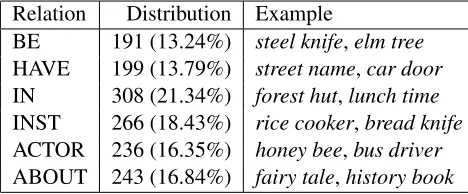
We used the dataset of 1443 compounds whose development is described in ´O S´eaghdha (2007). These compounds have been annotated in their sen-tential contexts using the six deep semantic rela-tions listed in Table 1. On the basis of a dual-annotator study, ´O S´eaghdha reports agreement of 66.2% (κˆ = 0.62) on a more general task of an-notating a noisy corpus and estimated agreement of 73.6% (κˆ = 0.68) on annotating the six relations used here. These figures are superior to previously reported results on annotating compounds extracted from corpora. Always choosing the most frequent class (IN) would give accuracy of 21.34%, and we
2
A flexible framework for this kind of context definition is presented by Pad´o and Lapata (2003).
Relation Distribution Example
[image:2.612.313.547.49.146.2]BE 191 (13.24%) steel knife,elm tree HAVE 199 (13.79%) street name,car door IN 308 (21.34%) forest hut,lunch time INST 266 (18.43%) rice cooker,bread knife ACTOR 236 (16.35%) honey bee,bus driver ABOUT 243 (16.84%) fairy tale,history book
Table 1: The 6 relation classes and their distribution in the dataset
use this as a baseline for our experiments.
3.2 Corpus
The written section of the British National Corpus,3 consisting of around 90 million words, was used in all our experiments. This corpus is not large com-pared to other corpora used in NLP, but it has been manually compiled with a view to a balance of genre and should be more representative of the language in general than corpora containing only newswire text. Furthermore, the compound dataset was also ex-tracted from the BNC and information derived from it will arguably describe the data items more accu-rately than information from other sources. How-ever, this information may be very sparse given the corpus’ size. For comparison we also use a 187 million word subset of the English Gigaword Cor-pus (Graff, 2003) to derive relational information in Section 6. This subset consists of every para-graph in the Gigaword Corpus belonging to articles tagged as ‘story’ and containing both constituents of a compound in the dataset, whether or not they are compounded there. Both corpora were lemmatised, tagged and parsed with RASP (Briscoe et al., 2006).
3.3 Learning Algorithm
In all our experiments we use a one-against-all im-plementation of the Support Vector Machine.4 Ex-cept for the work described in Section 6.2 we used the linear kernelK(x, y) =x·yto compute similar-ity between vector representations of the data items. The linear kernel consistently achieved superior per-formance to the more flexible Gaussian kernel in a range tests, presumably due to the sensitivity of
3http://www.natcorp.ox.ac.uk/ 4
the Gaussian kernel to its parameter settings.5 One-against-all classification (training one classifier per class) performed better than one-against-one (train-ing one classifier for each pair of classes). We es-timate test accuracy by 5-fold cross-validation and within each fold we perform further 5-fold cross-validation on the training set to optimise the single SVM parameterC. An advantage of the linear kernel is that learning is very efficient. The optimisation, training and testing steps for each fold take from less than a minute on a single processor for the sparsest feature vectors to a few hours for the most dense, and the folds can easily be distributed across machines.
4 Word Similarity
´
O S´eaghdha (2007) investigates the effectiveness of word-level co-occurrences for compound interpre-tation, and the results presented in this section are taken from that paper. Co-occurrences were identi-fied in the BNC for each compound constituent in the dataset, using the following context definitions:
win5, win10: Each word within a window of 5 or 10 words on either side of the item is a feature.
Rbasic, Rmod, Rverb, Rconj: These feature sets use the grammatical relation output of the RASP parser run over the written BNC. The Rbasicfeature set conflates information about 25 grammatical relations; Rmod counts only prepositional, nominal and adjectival noun modification; Rverb counts only relations among subjects, objects and verbs; Rconj counts only conjunctions of nouns.
The feature vector for each target constituent counts its co-occurrences with the 10,000 words that most frequently appear in the co-occurrence relations of interest over the entire corpus. A feature vector for each compound was created by appending the vec-tors for its modifier and head, and these compound vectors were used for SVM learning. To model as-pects of co-occurrence association that might be ob-scured by raw frequency, the log-likelihood ratioG2
(Dunning, 1993) was also used to transform the fea-ture space.
5
Keerthi and Lin (2003) prove that the Gaussian kernel will always do as well as or better than the linear kernel for binary classification. For multiclass classification we use multiple
bi-Raw G2
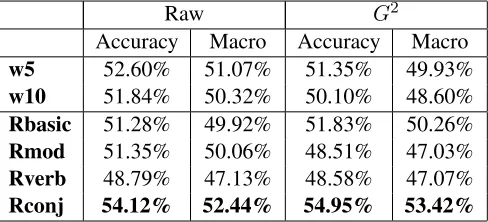
[image:3.612.315.559.49.160.2]Accuracy Macro Accuracy Macro w5 52.60% 51.07% 51.35% 49.93% w10 51.84% 50.32% 50.10% 48.60% Rbasic 51.28% 49.92% 51.83% 50.26% Rmod 51.35% 50.06% 48.51% 47.03% Rverb 48.79% 47.13% 48.58% 47.07% Rconj 54.12% 52.44% 54.95% 53.42%
Table 2: Classification results for word similarity
Micro- and macro-averaged performance figures are given in Table 2. The micro-averaged figure is calculated as the overall proportion of items that were classified correctly, whereas the macro-average is calculated as the average of the accuracy on each class and thus balances out any skew in the class distribution. In all cases macro-accuracy is lower than micro-accuracy; this is due to much better per-formance on the relations IN, INST, ACTOR and ABOUT than on BE and HAVE. This may be be-cause those two relations are slightly rarer and hence provide less training data, or it may reflect a dif-ference in the suitability of co-occurrence data for their classification. It is interesting that features de-rived only from conjunctions give the best perfor-mance; these features are the most sparse but ap-pear to be of high quality. The information con-tained in conjunctions is conceptually very close to the WordNet-derived information frequently used in word-similarity based approaches to compound se-mantics, and the performance of these features is not far off the 56.76% accuracy (54.6% macro-average) reported for WordNet-based classification for the same dataset by ´O S´eaghdha (2007).
5 Type Similarity
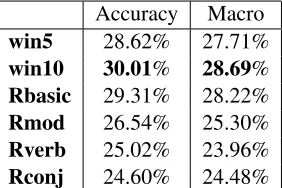
Type similarity is measured by identifying co-occurrences with each instance of the compound type in the corpus. In effect, we are treating com-pounds as single words and calculating their word similarity with each other. The same feature extrac-tion methods were used as in the previous secextrac-tion. Classification results are given in Table 3.
This method performs very poorly. Sparsity is un-doubtedly a factor: 513 of the 1,443 compounds
Accuracy Macro win5 28.62% 27.71% win10 30.01% 28.69% Rbasic 29.31% 28.22% Rmod 26.54% 25.30% Rverb 25.02% 23.96% Rconj 24.60% 24.48%
Table 3: Classification results for type similarity
cur 5 times or fewer in the BNC and 186 occur just once. The sparser feature sets (Rmod, Rverb and Rconj) are all outperformed by the more dense ones. However, there is also a conceptual problem with type similarity, in that the context of a compound may contain information about the referent of the compound but is less likely to contain information about the implicit semantic relation. For example, the following compounds all encode different mean-ings but are likely to appear in similar contexts:
• John cut the bread with thekitchen knife. • John cut the bread with thesteel knife. • John cut the bread with thebread knife.
6 Relation Similarity
6.1 Vector Space Kernels
The intuition underlying the use of relation similar-ity is that while the relation between the constituents of a compound may not be made explicit in the con-text of that compound, it may be described in other contexts where both constituents appear. For ex-ample, sentences containing both bread and knife may contain information about the typical interac-tions between their referents. To extract feature vec-tors for each constituent pair, we took the maximal context unit to be each sentence in which both con-stituents appear, and experimented with a range of refinements to that context definition. The result-ing definitions are given below in order of intuitive richness, from measures based on word-counting to measures making use of the structure of the sen-tence’s dependency parse graph.
allwords All words in the sentence are co-occurrence features. This context may be pa-rameterised by specifying a limit on the win-dow size to the left of the leftmost constituent
and to the right of the rightmost constituent i.e., the words between the two constituents are al-ways counted.
midwords All words between the constituents are counted.
allGRs All words in the sentence entering into a grammatical relation (with any other word) are counted. This context may be parameterised by specifying a limit on the length of the shortest path in the dependency graph from either of the target constituents to the feature word.
shortest path All words on the shortest depen-dency path between the two constituents are features. If there is no such path, no features are extracted.
path triples The shortest dependency path is de-composed into a set of triples and these triples are used as features. Each triple consists of a node on the shortest path (the triple’s centre node) and two edges connecting that node with other nodes in the parse graph (not necessarily nodes on the path). To generate further triple features, one or both of the off-centre nodes is replaced by part(s) of speech. For example, the RASP dependency parse of The knife cut the fresh breadis:
(|ncsubj| |cut:3_VVD| |knife:2_NN1| _) (|dobj| |cut:3_VVD| |bread:6_NN1|) (|det| |bread:6_NN1| |the:4_AT|)
(|ncmod| _ |bread:6_NN1| |fresh:5_JJ|) (|det| |knife:2_NN1| |The:1_AT|)
The derived set of features includes the triples
{the:A:det←knife:N←cut:V:ncsubj,
A:det←knife:N←cut:V:ncsubj,
the:A:det←knife:N←V:ncsubj,
A:det←knife:N←V:ncsubj,
knife:N:ncsubj←cut:V→bread:N:dobj,
N:ncsubj←cut:V→bread:N:dobj,
knife:N:ncsubj←cut:V→N:dobj,
N:ncsubj←cut:V→N:dobj,. . .}
0 100 200 300 400 500
30
35
40
45
50
55
60
Threshold
Accuracy
aw5
[image:5.612.319.515.73.257.2]trip
Figure 1: Effect of BNC frequency on test item ac-curacy for theallwords5andtriplescontexts
Table 4 presents results for these contexts; in the case of parameterisable contexts the best-performing parameter setting is presented. We are currently unable to present results for the path-based contexts using the Gigaword corpus. It is clear from the accuracy figures that we have not matched the performance of the word similarity approach. The best-performing single context definition is all-wordswith a window parameter of 5, which yields accuracy of 38.74% (36.78% macro-average). We can combine the contributions of two contexts by generating a new kernel that is the sum of the lin-ear kernels for the individual contexts;6 the sum of allwords5andtriplesachieves the best performance with 42.34% (40.20% macro-average).
It might be expected that the richer context def-initions provide sparser but more precise informa-tion, and that their relative performance might im-prove when only frequently observed word pairs are to be classified. However, thresholding inclusion in the test set on corpus frequency belies that ex-pectation; as the threshold increases and the
test-6The summed kernel function value for a pair of items is simply the sum of the two kernel functions’ values for the pair, i.e.:
Ksum(x, y) =K1(φ1(x), φ1(y)) +K2(φ2(x), φ2(y))
whereφ1, φ2 are the context representations used by the two
kernels. A detailed study of kernel combination is presented by Joachims et al. (2001).
0 100 200 300 400 500
0
500
1000
1500
Threshold
Size
GW
BNC
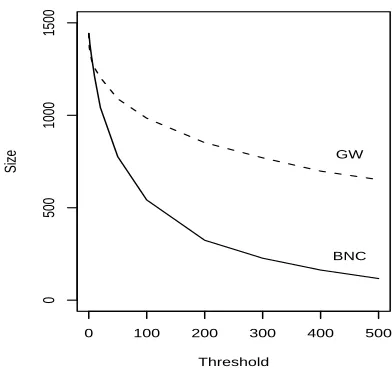
Figure 2: Effect of corpus frequency on dataset size for the BNC and Gigaword-derived corpus
ing data contains only more frequent pairs, all con-texts show improved performance but the effect is strongest for theallwordsandmidwordscontexts. Figure 1 shows threshold-accuracy curves for two representative contexts (the macro-accuracy curves are similar).
For all frequency thresholds above 6, the number of noun pairs with above-threshold corpus frequency is greater for the Gigaword corpus than for the BNC, and this effect is amplified with increasing threshold (see Figure 2). However, this difference in sparsity does not always induce an improvement in perfor-mance, but nor does the difference in corpus type consistently favour the BNC.
BNC Gigaword
Accuracy Macro Accuracy Macro aw 35.97% 33.39% 34.58% 32.62% aw5 38.74% 36.78% 37.28% 35.25% mw 32.29% 30.38% 36.24% 34.25% agr 35.34% 33.40% 35.34% 33.34% agr2 36.73% 34.81% 37.28% 35.59% sp 33.54% 31.51%
[image:5.612.78.275.74.257.2]trip 35.62% 34.39% aw5+ 42.34% 40.20% trip
[image:5.612.315.553.519.674.2]6.2 String Kernels
The classification techniques described in the pre-vious subsection represent the relational context for each word pair as a co-occurrence vector in an in-ner product space and compute the similarity be-tween two pairs as a function of their vector repre-sentations. A different kind of similarity measure is provided by string kernels, which count the num-ber of subsequences shared by two strings. This class of kernel function implicitly calculates an in-ner product in a feature space indexed by all pos-sible subsequences (possibly restricted by length or contiguity), but the feature vectors are not explic-itly represented. This approach affords our notion of context an increase in richness (features can be se-quences of length≥ 1) without incurring the com-putational cost of the exponential growth in the di-mension of our feature space. A particularly flexible string kernel is the gap-weighted kernel described by Lodhi et al. (2002), which allows the subsequences to be non-contiguous but penalises the contribution of each subsequence to the kernel value according to the number of items occurring between the start and end of the subsequence, including those that do not belong to the subsequence (the “gaps”).
The kernel is defined as follows. Let s and t
be two strings of words belonging to a vocabulary
Σ. A subsequenceuofsis defined by a sequence of indices i = (i1, . . . , i|u|) such that 1 ≤ i1 <
. . . < i|u| ≤ |s|, where s is the length of s. Let
l(i) =i|u|−i1+ 1be the length of the subsequence
ins. For example, if sis the string “cut the bread with the knife” anduis the subsequence “cut with” indexed byithenl(i) = 4. λis a decay parameter between 0 and 1. The gap-weighted kernel value for subsequences of lengthnof stringssandtis given by
KSn(s, t) = X
u∈Σn
X
i,j:s[i]=u=t[j]
λl(i)+l(j)
Directly computing this function would be in-tractable, as the sum is over all |Σ|n possible
sub-sequences of lengthn; however, Lodhi et al. (2002) present an efficient dynamic programming algo-rithm that can evaluate the kernel inO(n|s||t|)time. Those authors’ application of string kernels to text categorisation counts sequences of characters, but it
is generally more suitable for NLP applications to use sequences of words (Cancedda et al., 2003).
This kernel calculates a similarity score for a pair of strings, but for context-based compound classi-fication we are interested in the similarity between two sets of strings. We therefore define a context kernel, which sums the kernel scores for each pair of strings from the two context setsC1, C2and
nor-malises them by the number of pairs contributing to the sum:
KCn(C1, C2) =
1
|C1||C2| X
s∈C1,t∈C2
KSn(s, t)
That this is a valid kernel (i.e., defines an inner prod-uct in some induced vector space) can be proven us-ing the definition of the derived subsets kernel in Shawe-Taylor and Cristianini (2004, p. 317). In our experiments we further normalise the kernel to en-sure thatKCn(C1, C2) = 1if and only ifC1=C2.
To generate the context set for a given word pair, we extract a string from every sentence in the BNC where the pair of words occurs no more than eight words apart. On the hypothesis that the context between the target words was most important and to avoid the computational cost incurred by long strings, we only use this middle context. To facilitate generalisations over subsequences, the compound head is replaced by a markerHEADand the modifier is replaced by a markerMOD. Word pairs for which no context strings were extracted (i.e., pairs which only occur as compounds in the corpus) are repre-sented by a dummy string that matches no other. The value ofλis set to 0.5 as in Cancedda et al. (2003). Table 5 presents results for the context kernels with subsequence lengths 1,2,3 as well as the kernel sum of these three kernels. These kernels perform better than the relational vector space kernels, with the ex-ception of the summedallwords5 + tripleskernel.
7 Combining Contexts
Accuracy Macro
n= 1 15.94% 19.88%
n= 2 39.09% 37.23%
n= 3 39.29% 39.29%
[image:7.612.115.258.49.119.2]Σ1,2,3 40.61% 38.53%
Table 5: Classification results for gap-weighted string kernels with subsequence lengths 1,2,3 and the kernel sum of these kernels
Accuracy Macro Rconj-G2+aw5 54.95% 53.50% Rconj-G2+triples 56.20% 54.54% Rconj-G2+aw5+triples 55.86% 54.13% Rconj-G2+KC2 56.48% 54.89%
Rconj-G2+KCΣ 56.55% 54.96%
Table 6: Classification results for context combina-tions
types favour different relations: the summed string kernel is the best at identifying IN relations (70.45% precision, 46.67% recall), but Rconj-G2 is best at identifying all others. This intuition is confirmed by our experiments, the results of which appear in Ta-ble 6. The best performance of 56.55% accuracy (54.96% macro-average) is attained by the com-bination of the G2-transformed Rconj word simi-larity kernel and the summed string kernel KCΣ.
We note that this result, using only information ex-tracted from the BNC, compares favourably with the 56.76% accuracy (54.60% macro-average) results described by ´O S´eaghdha (2007) for a WordNet-based method. The combination of Rconj-G2 and triplesis also competitive, demonstrating that a less flexible learning algorithm (the linear kernel) can perform well if it has access to a richer source of information (dependency paths).
8 Comparison with Prior Work
Previous work on compound semantics has tended to concentrate on either word or relation similarity. Approaches based on word similarity generally use information extracted from WordNet. For example, Girju et al. (2005) train SVM classifiers on hyper-nymy features for each constituent. Their best re-ported accuracy with an equivalent level of supervi-sion to our work is 54.2%; they then improve
perfor-mance by adding a significant amount of manually-annotated semantic information to the data, as does Girju (2006) in a multilingual context. It is difficult to make any conclusive comparison with these re-sults due to fundamental differences in datasets and classification schemes.
Approaches based on relational similarity of-ten use relative frequencies of fixed lexical se-quences estimated from massive corpora. Lap-ata and Keller (2004) use Web counts for phrases Noun P Noun whereP belongs to a predefined set of prepositions. This unsupervised approach gives state-of-the-art results on the assignment of prepo-sitional paraphrases, but cannot be applied to deep semantic relations which cannot be directly identi-fied in text. Turney and Littman (2005) search for phrases Noun R Noun where Ris one of 64 “join-ing words”. Turney (2006) presents a more flexible framework in which automatically identified n-gram features replace fixed unigrams and additional word pairs are generated by considering synonyms, but this method still requires a Web-magnitude corpus and a very large amount of computational time and storage space. The latter paper reports accuracy of 58.0% (55.9% macro-average), which remains the highest reported figure for corpus-based approaches and demonstrates that relational similarity can per-form well given sufficient resources.
We are not aware of previous work that compares the effectiveness of different classes of context for compound interpretation, nor of work that investi-gates the utility of different corpora. We have also described the first application of string kernels to the compound task, though gap-weighted kernels have been used successfully for related tasks such as word sense disambiguation (Gliozzo et al., 2005) and re-lation extraction (Bunescu and Mooney, 2005).
9 Conclusion and Future Work
[image:7.612.72.303.183.267.2]On the other hand it might be expected to be very useful for disambiguating relations more typical of news stories (such astax cut,rail strike).
Future research directions include developing more sophisticated context kernels. Cancedda et al. (2003) present a number of potentially useful re-finements of the gap-weighted string kernel, includ-ing “soft matchinclud-ing” and differential values ofλfor different words or word classes. We intend to com-bine the benefits of string kernels with the linguis-tic richness of syntaclinguis-tic parses by computing subse-quence kernels on dependency paths. We have also begun to experiment with the tree kernels of Mos-chitti (2006), but are not yet in a position to report results. As mentioned in Section 2, we also intend to investigate the potential contribution of the sen-tential contexts that contain the compound tokens to be classified (token similarity).
While the BNC has many desirable properties, it may also be fruitful to investigate the utility of a large encyclopaedic corpus such as Wikipedia, which may be more explicit in its description of re-lations between real-world entities than typical text corpora. Wikipedia has shown promise as a re-source for measuring word similarity (Strube and Ponzetto, 2006) and relation similarity (Suchanek et al. (2006)).
References
Ted Briscoe, John Carroll, and Rebecca Watson. 2006. The second release of the RASP system. In Proceed-ings of the ACL-06 Interactive Presentation Sessions.
Razvan C. Bunescu and Raymond J. Mooney. 2005. Subsequence kernels for relation extraction. In Pro-ceedings of the 19th Conference on Neural Informa-tion Processing Systems.
Nicola Cancedda, Eric Gaussier, Cyril Goutte, and Jean-Michel Renders. 2003. Word-sequence kernels. Jour-nal of Machine Learning Research, 3:1059–1082.
Chih-Chung Chang and Chih-Jen Lin, 2001. LIB-SVM: a library for support vector machines. Soft-ware available at http://www.csie.ntu.edu.
tw/˜cjlin/libsvm.
Aron Culotta and Jeffrey Sorensen. 2004. Dependency tree kernels for relation extraction. InProceedings of ACL-04.
Ted Dunning. 1993. Accurate methods for the statistics of surprise and coincidence. Computational Linguis-tics, 19(1):61–74.
Roxana Girju, Dan Moldovan, Marta Tatu, and Daniel Antohe. 2005. On the semantics of noun compounds. Computer Speech and Language, 19(4):479–496.
Roxana Girju. 2006. Out-of-context noun phrase seman-tic interpretation with cross-linguisseman-tic evidence. In Proceedings of CIKM-06.
Alfio Gliozzo, Claudio Giuliano, and Carlo Strapparava. 2005. Domain kernels for word sense disambiguation. InProceedings of ACL-05.
David Graff, 2003. English Gigaword. Linguistic Data Consortium, Philadelphia.
Thorsten Joachims, Nello Cristianini, and John Shawe-Taylor. 2001. Composite kernels for hypertext cate-gorisation. InProceedings of ICML-01.
S. Sathiya Keerthi and Chih-Jen Lin. 2003. Asymptotic behaviors of support vector machines with Gaussian kernel.Neural Computation, 15:1667–1689.
Mirella Lapata and Frank Keller. 2004. The Web as a baseline: Evaluating the performance of unsupervised Web-based models for a range of NLP tasks. In Pro-ceedings of HLT-NAACL-04.
Mark Lauer. 1995. Designing Statistical Language Learners: Experiments on Compound Nouns. Ph.D. thesis, Macquarie University.
Huma Lodhi, Craig Saunders, John Shawe-Taylor, Nello Cristianini, and Chris Watkins. 2002. Text classifica-tion using string kernels. Journal of Machine Learning Research, 2:419–444.
Alessandro Moschitti. 2006. Efficient convolution ker-nels for dependency and constituent syntactic trees. In Proceedings of ECML-06.
Sebastian Pad´o and Mirella Lapata. 2003. Constructing semantic space models from parsed corpora. In Pro-ceedings of ACL-03.
Diarmuid ´O S´eaghdha. 2007. Annotating and learn-ing compound noun semantics. InProceedings of the ACL-07 Student Research Workshop.
John Shawe-Taylor and Nello Cristianini. 2004. Kernel Methods for Pattern Analysis. Cambridge University Press, Cambridge.
Michael Strube and Simone Paolo Ponzetto. 2006. WikiRelate! computing semantic relatedness using Wikipedia. InProceedings of AAAI-06.
Fabian M. Suchanek, Georgiana Ifrim, and Gerhard Weikum. 2006. LEILA: Learning to extract infor-mation by linguistic analysis. InProceedings of the ACL-06 Workshop on Ontology Learning and Popula-tion.
Peter D. Turney and Michael L. Littman. 2005. Corpus-based learning of analogies and semantic relations. Machine Learning, 60(1–3):251–278.