Original Research Article
Evaluation of factor VIII value in normal women and whom
encountered recurrent pregnancy loss: is there any
significant difference?
Douaa Al Rez
1, Hasan Naser Eldine
1, Marwan Alhalabi
2,3*
INTRODUCTION
Recurrent pregnancy loss (RPL), either early or late in the gestational period is a serious problem and has both psychological and social impacts on the women who suffer from it. In some cases, it may lead to divorce or
other social problems.1
Recurrent pregnancy loss (RPL), defined as two or more consecutive pregnancy losses before the fetus has reached birth at 24 weeks, is a serious reproductive problem,
affecting 1-5% of reproductive-age woman.2,3 There is a
strong belief that RPL is a multifactorial condition that
many factors affect such as chromosomal abnormalities, uterine anatomic malformation, endocrine dysfunction, immunologic factors, infections, and environmental
factors.4-6
However, the etiology of RPL remains unknown in ~50%
of cases.7,8 Pregnancy is a hypercoagulable state
secondary to an increase in the concentrations of pro-coagulant factors, a reduction in the concentrations of the naturally occurring anticoagulant proteins and a decrease
in fibrinolysis.9 A successful pregnancy requires the
development of adequate placental circulation. Multiple studies have shown that thrombophilia increase the risk
ABSTRACT
Background: Recurrent pregnancy loss (RPL) is a serious problem on the women, it defined as two or more consecutive pregnancy losses before the fetus has reached birth. The aim of this study is to evaluate the association between the elevation in the factor VIII and RPL. Because women who have thrombophilia have increased risk of fetal loss in most studies.
Methods: A total 72 women were recruited in this case control study. They divided into two groups: the RPL group included 41 women with a history of recurrent pregnancy loss and the control group included 31 healthy women, who had at least one successful pregnancy and none of them had a history of fetal loss or complicated pregnancy.
Results: A majority of the patients of this study didn't have a high level of factor VIII, 9 of 41 (22%) patients of RPL group in comparison with 21 of 32 (65,6%) of control group, that suffer from the increase rate of FVIII, this means that factor VIII doesn't effect on RPL.
Conclusions: The present study showed that the serum elevation in the factor VIII is not significantly associated with RPL.
Keywords: Factor VIII, Recurrent pregnancy loss, Thrombophilia DOI: http://dx.doi.org/10.18203/2320-1770.ijrcog20200870
1Department of Biology, Faculty of Sciences, Damascus University, Damascus, Syria
2Department of Reproductive Medicine, Embryology and Genetics, Faculty of Medicine, Damascus University,
Damascus, Syria
3Assisted Reproduction Unit, Orient Hospital, Damascus, Syria
Received: 29 November 2019
Revised: 27 December 2019
Accepted: 02 January 2020
*Correspondence:
Dr.Marwan Alhalabi,
E-mail: [email protected]
of recurrent first and second trimester pregnancy losses
through thrombosis of the placental bed.10-13
Thrombophilia was identified as a major cause of recurrent pregnancy loss (RPL), after chromosomal abnormalities with a rate of up to 40%, especially in the
first half of pregnancy.14 Although many studies are
available on thrombophilia. It is very different from one study to another due to different selection criteria of
patients.13 Thrombophilia describes an increased
tendency to develop thrombosis, either venous or
arterial.15
Thrombophilia may either be inherited or acquired and include protein C deficiency, protein S deficiency, antithrombin deficiency, and the less potent factor V
Leiden (FVL) and prothrombin gene mutation (PGM).
15-18 The combined prevalence of these thrombophilia in the
general population exceeds one in ten.15,17-22
It is hypothesized that thrombophilia may increase the risk of placental insufficiency because of placental micro and/ or macro-vascular thrombosis, as well as effects on
trophoblast growth and differentiation.1,23,24
Factor VIII (FVIII) is an essential blood-clotting protein, also known as anti-hemophilic factor (AHF). in humans the factor VIII is encoded and produced by the F8 gene
[image:2.595.52.288.420.591.2]shown in (Figure 1).19,25
Figure 1: Gene location of factor VIII on human chromosome X.
Factor VIII is produced in liver sinusoidal cells and
endothelial cells outside the liver throughout the body.26
People with high levels of factor VIII are at increased risk
for deep vein thrombosis and pulmonary embolism.27
Copper is a required as cofactor for factor VIII and copper deficiency is known to increase the activity of
factor VIII.28 This objective is to evaluate the association
between the elevation of factor VIII level in serum and RPL as a causative factor.
METHODS
The study group included 72 women included 41 women
with a history of RPL (two or more abortions before 20th
week of gestation, mean±SD: 4±2.31, range 2-11) and 31 healthy women (control group), who had at least one successful pregnancy and none of them had a history of miscarriage or complicated pregnancy, who referred to
Orient Hospital, Damascus, Syria, for medical
consultation between January 2017 to January 2018.
Study followed the methods of Mohammad et al.29 All
women with known independent risk factor for pregnancy complication, such as endocrine abnormality (prolactin, thyroid stimulating hormone, follicular stimulating hormone and luteal hormone during the early follicular phase), uterine malformation, systemic disease (diabetes mellitus, lupus erythematosus) and women who received induced abortion upon their request, were excluded, in addition to women with other thrombophilic defects, such as deficiency of activities of antithrombin III, protein C, and protein S or antiphospholipid antibodies syndrome.
The control group included 31 healthy women (mean±SD: 28.8±6.8 years, range 17-41 years) from the same ethnic background, who had at least one successful pregnancy, and none of them had a history of miscarriage or complicated pregnancy.
All women in this study had no history or family history of thrombosis. All participants gave informed consent, according to the protocol approved by local Ethics Committee at Damascus University and Health Ministry.
Venous blood samples were collected into Vacutainer tubes containing trisodium citrate, blood centrifuged at 2000-2500g for 15 minutes, plasma was obtained and assayed on STA compact automated coagulations analyzer using STA- Staclot VIII kit, both of Diagnostica Stago, S.A.S. France. The principle of this assay was thoroughly explained by Ali A et al, which is based on the ability of reference plasma and test plasma to correct the prolonged APTT of plasma deficient in the factor VIII that is being assayed. reference plasma with known content of all the factors and factor VIII deficient plasma with factor level less than 1% activity must be available
for the assay.30 One part of test plasma and one part of
factor VIII deficient plasma (Stago) and one part of APTT reagent (CK PREST, STAGO) are mixed then
incubated at 37⁰C, in addition, one part of calcium
Statistical analysis
For the analysis of the data, Pearson chi-square and continuity correction chi-square tests have been used. For all analyses, a value of less than 0.05 was considered statistically significant. SPSS Software (version 25) was used for the analysis.
RESULTS
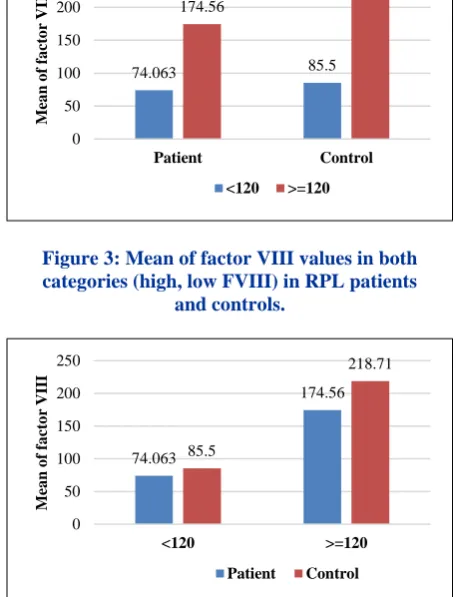
[image:3.595.310.535.70.211.2]A majority of the patients of this study didn't have a high level of factor VIII, 9 of 41 (22%) of RPL patients suffer from the increase of the VIII in comparison with 21 of 32 (65.6%) healthy women that suffer from the increase rate of VIII. Normal levels of factor VIII are 50-120%.
[image:3.595.52.543.305.368.2]Figure 2: Mean of factor VIII in the patients and controls groups.
Table 1: The Arithmetical averages and the standard deviations of the values of the factor VIII in the blood in RPL patients and controls.
Low F VIII (% 120 <) High F VIII (<= 120%) Total
Average N Average N Average N
Patient 74.06±25.78 32 174.56±55.83 9 96.12±53.96 41
Control 85.5±24.37 10 218.71±71.33 21 157.74±87.05 31
[image:3.595.52.281.427.726.2]Total 76.79±25.64 42 205.47±69.23 30 130.40±80.12 72
Figure 3: Mean of factor VIII values in both categories (high, low FVIII) in RPL patients
and controls.
Figure 4: Mean of factor VIII values in RPL patients and controls in the two categories (high, low FVIII).
The following Table 1 and also Figure 2, 3 and 4 explain the arithmetic averages and the standard deviations of the factor VIII in blood for the women's two groups of RPL patients and controls.
There are no variances with a statistical significance to the average of factor VIII values in blood between the two samples of controls and patients in the category in which the values of this factor are less than the value 120%. (where t = 1.24, p value = 0.222 > 0.05) (Figure 4).
DISCUSSION
This Results confirmed that the increase of FVIII levels in blood does not have an effect on RPL.
The rate of RPL patients having an increase of FVIII levels was less than the rate of increase of FVIII in the control group, 9 of 41 RPL patients suffer from the increase of the FVIII, in comparison with 21 of 32 healthy women that suffer from the increase rate of FVIII, which indicate that there is no statistical correlation between FVIII and RPL.
This result show a disagreement with another study carried out in 2012 which concluded a strong correlation between FVIII and RPL, this study shows that the pregnancy complications were found with the increase of
the FVIII with a percentage of 66.66%.31
96.12
175.74
0 50 100 150 200
M
ea
n
o
f
fa
ct
o
r
V
III
Patient Control
74.063 85.5
174.56
218.71
0 50 100 150 200 250
Patient Control
M
ea
n
o
f
fa
ct
o
r
V
III
<120 >=120
74.063
174.56
85.5
218.71
0 50 100 150 200 250
<120 >=120
M
ea
n
o
f
fa
ct
o
r
V
III
Meanwhile, this study is in agreement with multiple studies carried out on thrombophilia in general, a study carried out in 2002 concluded that the thrombophilia has no association with RPL, and with a study carried out in 2011 in Palestine which concluded that there is no statistical correlation between high FVIII levels and RPL, also with two studies carried out in 2016 and 2012 which
confirmed the same conclusion.32-35
CONCLUSION
According to these results obtained from this study in the middle east about the increase of the FVIII and its effects on RPL, there is no significant statistical correlation between the factor VIII and RPL.
ACKNOWLEDGMENTS
Authors would like to thank Dr Adnan Alkhatib and Dr Nawras Alhalabi for their kind collaboration. Authors also acknowledge the scientific research committee of Damascus university for providing a grant to carry out this study.
Funding: The study was funded by Damascus University and Orient Hospital Research Budget
Conflict of interest: None declared
Ethical approval: The study was approved by the Institutional Ethics Committee
REFERENCES
1. Brenner B. Commentary: thrombophilia and
pregnancy loss in first intended pregnancy. J Thrombosis Haemosta. 2005;3(10):2176-7.
2. Meka A, Reddy BM. Recurrent spontaneous
abortions: an overview of genetic and non-genetic backgrounds. Int J Human Genet. 2006;6(2):109-17.
3. Pandey MK, Rani R, Agrawal S. An update in
recurrent spontaneous abortion. Arch Gynecol Obstet. 2005;272(2):95-108.
4. Ford HB, Schust DJ. Recurrent pregnancy loss:
etiology, diagnosis, and therapy. Rev Obstet Gynecol. 2009;2(2):76.
5. Garcıa-Enguıdanos A, Calle ME, Valero J, Luna S,
Domınguez-Rojas V. Risk factors in miscarriage: a review. Eur J Obstet Gynecol Reprod Biol. 2002;102(2):111-9.
6. Ghumman S. Recurrent Miscarriage. World Clin
Obstet Gynecol. 2011;1(1):70.
7. Allison JL, Schust DJ. Recurrent first trimester
pregnancy loss: revised definitions and novel causes.
Current Opin Endocrinol Diab Obes.
2009;16(6):446-50.
8. Cleary-Goldman J, Nakhuda GS, Zimmermann RC,
Sauer MV. The role of factor V Leiden mutation in recurrent pregnancy loss. J Am Med Women's Associat. 2003;58(3):165-72.
9. Clark P, Brennand J, Conkie JA, McCall F, Greer
IA, Walker ID. Activated protein C sensitivity,
protein C, protein S and coagulation in normal
pregnancy. Thrombosis Haemostasis.
1998;79(6):1166-70.
10. Kovalevsky G, Gracia CR, Berlin JA, Sammel MD,
Barnhart KT. Evaluation of the association between hereditary thrombophilias and recurrent pregnancy
loss: a meta-analysis. Arch Internal Med.
2004;164(5):558-63.
11. Rey E, Kahn SR, David M, Shrier I. Thrombophilic
disorders and fetal loss: a meta-analysis. The Lancet. 2003;361(9361):901-8.
12. Wu O, Robertson L, Twaddle S, Lowe GD, Clark P,
Greaves M, Walker ID, et al. Screening for thrombophilia in high-risk situations: systematic
review and cost-effectiveness analysis. The
thrombosis: risk and economic assessment of thrombophilia screening (TREATS) study. Health Technol Assess. 2006;10(11):1-110.
13. Alhalaki WIA, Altanoukhi, Alhalabi M. The
association of activated protein C resistance (aPCR) with recurrent pregnancy loss in syrian population. Inter J Pharma Sci Rev Res. 2016;38(151):290-5.
14. Brenner B, Sarig G, Weiner Z, Younis J, Blumenfeld
Z, Lanir N. Thrombophilic polymorphisms are common in women with fetal loss without apparent cause. Thromb Haemos. 1999;82(7):6-9.
15. Brown, K., et al., Risk of venous thromboembolism
associated with a G to A transition at position 20210
in the 3′‐untranslated region of the prothrombin gene.
Br J Haematol. 1997;98(4):907-9.
16. Walker ID, Greaves M, Preston F. Investigation and
management of heritable thrombophilia. Br J Haematol. 2001;114(3):512-28.
17. Kraaijenhagen RA, Koopman MM, Reitsma PH,
Prins MH, van den Ende A, Büller HR. High plasma concentration of factor VIIIc is a major risk factor for venous thromboembolism. Thromb Haemost. 2000;83(01):5-9.
18. van der Meer FJ, Koster T, Vandenbroucke JP, Briet
E, Rosendaal FR. The Leiden thrombophilia study (LETS). Thromb Haemost. 1997;78(1):631-5.
19. Koster T, Vandenbroucke JP, Rosendaal FR, Briët E,
Blann AD. Role of clotting factor VIII in effect of von Willebrand factor on occurrence of deep-vein thrombosis. The Lancet. 1995;345(8943):152-5.
20. Poort SR, Rosendaal FR, Reitsma PH, Bertina RM.
A common genetic variation in the 3'-untranslated region of the prothrombin gene is associated with elevated plasma prothrombin levels and an increase in venous thrombosis. Blood. 1996;88(10):3698-703.
21. Rodeghiero F, Tosetto A. The epidemiology of
inherited thrombophilia: the VITA Project. Vicenza Thrombophilia and Atherosclerosis Project. Thromb Haemost. 1997;78(1):636.
22. Tizzano EF, Soria JM, Coll I, Guzmán B, Cornet M,
23. Isermann B, Sood R, Pawlinski R, Zogg M, Kalloway S, Degen JL, et al. The thrombomodulin– protein C system is essential for the maintenance of pregnancy. Nature Med. 20039(3): p. 331.
24. Shetty S, Salvi V, Satoskar P, Ghosh K.
Thrombophilia and unexplained pregnancy loss in Indian patients. National Med J India. 2008;21:116-9.
25. Toole JJ, Knopf JL, Wozney JM, Sultzman LA,
Buecker JL, Pittman DD, et al. Molecular cloning of a cDNA encoding human antihaemophilic factor. Nature. 1984;312(5992):342-7.
26. Derrier, M. and A. Mercatello. Role of non-steroidal
anti-inflammatory agents in the perioperative period. Usefulness and limitations. Ann Fr Anesth Reanim. 1997;16(5):498-520.
27. Jenkins PV, Rawley O, Smith OP, O'Donnell JS.
Elevated factor VIII levels and risk of venous thrombosis. Br J Haematol. 2012;157(6):653-63.
28. Milne DB, Nielsen FH. Effects of a diet low in
copper on copper-status indicators in
postmenopausal women. The Am J Clin Nutrit. 1996;63(3):358-64.
29. Mohammadi MMA, Al-Halabi MG, Monem FMS.
Prevalence of factor V leiden mutation and its relation with recurrent spontaneous pregnancy loss in a group of Syrian women. Middle East Fertil Society J. 2007;12(3):179.
30. Ali A, Pushpavalli Mohan HK, Muhammed MK.
Elevated factor VIII levels and shortened APTT in recurrent abortions. J Clin Diagnos Res. JCDR. 2016;10(1):EC04.
31. Hansda J, Roychowdhury J. Study of thrombophilia
in recurrent pregnancy loss. The J Obstet Gynecol India. 2012;62(5):536-40.
32. Carp H, Salomon O, Seidman D, Dardik R,
Rosenberg N, Inbal A. Prevalence of genetic markers for thrombophilia in recurrent pregnancy loss. Human Reproduct. 2002;17(6):1633-7.
33. Abu- Abu-Asab NS, Ayesh SK, Ateeq RO, Nassar
SM, El-Sharif WA. Association of inherited thrombophilia with recurrent pregnancy loss in palestinian women. Obstet Gynecol Inter. 2011;2011.
34. Patounakis G, Bergh E, Forman EJ, Tao X, Lonczak
A, Franasiak JM, et al. Multiple thrombophilic single nucleotide polymorphisms lack a significant effect on outcomes in fresh IVF cycles: an analysis of 1717 patients. J Assisted Reprod Genet. 2016;33(1):67-73.
35. Cardona H, Castañeda SA, Cardona Maya W,
Alvarez L, Gómez J, Gómez J, et al. Lack of association between recurrent pregnancy loss and inherited thrombophilia in a group of Colombian patients. Thrombos. 2012;2012.
Cite this article as: Rez DA, Eldine HN, Alhalabi
M.Evaluation of factor VIII value in normal women