Access Point Selection for Adaptive Load
Balancing in WLANs
Sushma. H.1, Sheela Sridhar2
P.G. Student, Department of Computer Science & Engineering, BNMIT, Bengaluru, Karnataka, India1 Associate Professor, Department of Computer Science & Engineering, BNMIT, Bengaluru, Karnataka, India1
ABSTRACT: Load Balancing is distribution of workload among multiple resources, such as computers, clusters, network links and CPUs. Load Balancing optimizes resource use, maximizes throughput, minimizes response time and avoids overload of a single resource. Conventional modes of Load Balancing are Least Loaded First Scheme [8], Distance Algorithm, Theta Algorithm and Load Balancing Agent Algorithm [5, 6]. Through exhaustive data analysis, it has been understood that users’ social activity may result in significant Access Point (AP) Load Imbalance issues. The proposed solution involves usage of Socially Aware AP Selection Scheme (S3) that actively interprets user history and assigns users’ requests to different APs based on the obtained knowledge. The objective of this study is to develop a Socially Aware AP Selection Scheme aimed at resolving Load Balancing problems in WLANs and designing an adaptive load distribution technique to improve user experience [3]. Results show that S3 is feasible and can achieve better balancing performance.
KEYWORDS: Access Point, Load Balancing, WLAN.
I. INTRODUCTION
The remote neighbourhood (WLAN) [4] is today a universal gadget regularly underestimated as a default interface for organized gadgets by clients and makers alike. In any case, quite recently, it was without a doubt not really. Rewind the clock 10 years back to 1998 and not just are there astringent specialized and business consortia contrasts on WLAN approaches, yet there is great suspicion and variety in assessment concerning how, or regardless of the fact that, WLANs can ever turn into a standard system interface. The WLAN of that day seemed to need both the throughput of the wired neighbourhood, (for example, 10/100 Ethernet LAN) and the scope of the cell system (which should be "quickly" moving up to Mb/s information execution). The WLAN to that point had largely advanced as a moderate and inconsistent imitating of the wired LAN, just without the wire. What's more, all things considered the items and benchmarks to a great extent imagined the end application for WLAN as a trade for wired LAN in big business or grounds situations where versatile clients would meander with their organized (PCs).
In the mid-1990, WLANs discovered no achievement in offering to big business or grounds situations as wired LAN substitutions or empowering agents of portability. The WLAN results of that day were unreasonably moderate, excessively costly, excessively cumbersome, and too control hungry. Moreover, versatile system availability was just not yet an executioner application. The "survivor" organizations of that age were the ones who concentrated on adjusting WLAN innovation to forte specialties, for example, retailing, neighbourliness, and logistics. Associations that pursued the "enormous" business sector of big business organizing, and there were numerous that did, either went bankrupt or turned out to be to a great extent downsized divisions of vast organizations.
thusly influences the administration of the pooled assets in the coordinated system. There have been some underlying takes a shot at this issue in the writing, for example, [2]. In this study, our goal is to build up a more far-reaching arrangement to the asset administration issue and consider more usage particular issues, so that top-notch administrations are given and the general use is expanded. In the first place, the activity loads of various administrations ought to appropriately convey to the cell system and WLAN by confirmation control. Further, the activity burdens ought to be progressively exchanged between the two systems by means of vertical handoff when a client moves around inside of the overlaying zone served by both the cell system and WLAN. In this article, we examine this heap adjusting issue with a policy based asset administration structure and go for amplifying the interworking adequacy and improving the QoS provisioning.
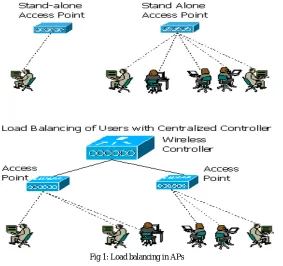
Fig 1: Load balancing in APs
II. SYSTEM REQUIREMENTS
To be utilized productively, all PC programming needs certain equipment segments or other programming assets to be available on a PC. These essentials are known as (PC) framework necessities and are frequently utilized as a rule instead of a flat out standard. Most programming characterizes two arrangements of framework prerequisites: least and prescribed. With expanding interest for higher handling force and assets in more up to date variants of programming, framework prerequisites tend to increment after some time. Industry examiners recommend that this pattern have greater impact in driving moves up to existing PC frameworks than innovative progressions.
SOFTWARE REQUIREMENTS
Operating system : Windows XP/7/8
Technology : Java 7
HARDWARE REQUIREMENTS
Pentium IV 2.8 GHz Processor and above
RAM 512MB and Above
Hard Disk Space 80GB and Above
III.MODULE DESCRIPTION
User and Base Station: This module creates user and base stations by using basic attributes such as Username, Coordinates, System Name and Port Number and provides authentication for both user and base station modules.
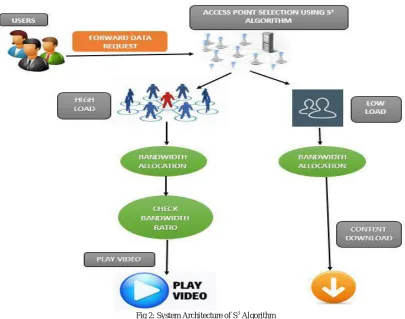
AP Discovery: This module links the User to the Access Point. Access Point coordinates are determined, and the covered mobility region in which users are present is fixed. AP Selection using S3 Algorithm: Fig 2 shows the System Architecture [7] of the proposed system. Once a data request is sent from the user, AP is selected based on the request content. APs are categorized as High Load and Low Load, based on data load that they encounter. Bandwidth allocation to service the request is an ongoing background process, based on bandwidth ratio.
Fig 2: System Architecture of S3 Algorithm
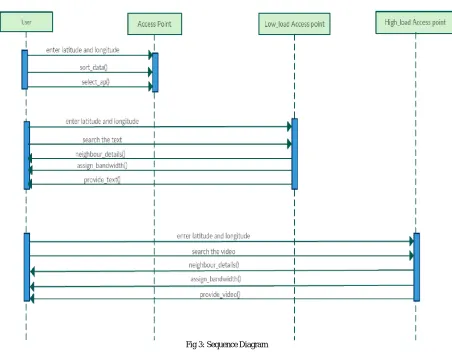
Fig 3: Sequence Diagram
IV.AP SELECTION ALGORITHM
The AP selection algorithm [1] adopted in S3 is described. The design principles followed by the detailed algorithm is as given below:
Design Principles:
As a rule, the issue is to disseminate clients to an arrangement of various APs so that the aggregate of the social connection file d between every pair of clients on each AP under a controller is minimized. Toward this objective, client sets with tight d ought to be scattered to various APs. For this reason, clients are increased to APs so that the augmentation on the aggregate d is negligible.
AP Selection Algorithm:
For simplicity of presentation, the accompanying documentations are utilized. Let S(APi), i = 1,…, n be the arrangement of clients related in the ith AP. The AP determination calculation will yield the ID of an AP, say 1 ≤ j ≤ n, to another client u. In particular, if S(APi) is void or there are various hopeful APs to pick, basically apply LLF (Least Loaded First).
Let T(APi) = ∑u € S(APi) w(u) be the activity at the APi and C(APi) be the aggregate social connection file when u is added to APi, that is,
w € S(APi)
The expense will be set as unbounded if the data transfer capacity requirement cannot be fulfilled. The interest of every client data transmission w(u) can be evaluated utilizing the history hint of u.
V. EXPERIMENTAL RESULTS
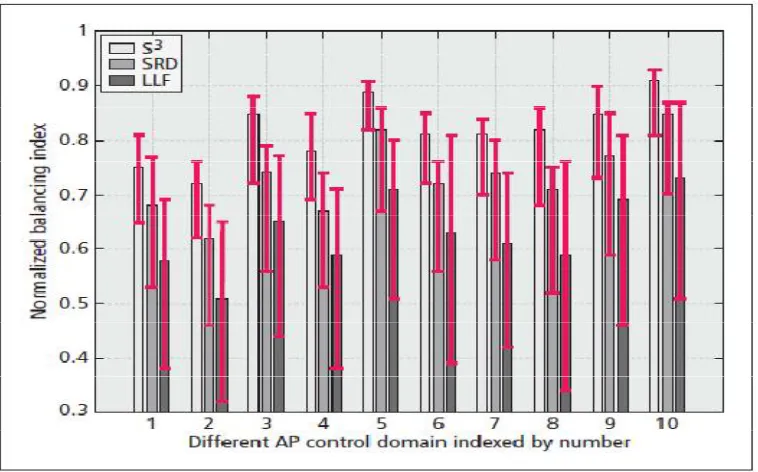
We contrast S3, LLF and SRD.We take all preparation information for building up pairwise social connections and utilize the same test information for every one of the calculations to appoint clients to APs. Fig 4 demonstrates the normal standardized adjusting file with a 95 percent certainty mistake bar over all WLAN controllers and every single test data as a component of time in daytime. There are two fundamental perceptions found in Fig 4. To start with, it can be seen that S3 beats both LLF and SRD over generally time. Overall, S3 can accomplish around 41.2 and 22.4 percent adjusting record pick up contrasted with LLF and SRD, individually. Second, the execution of S3 is more steady and hearty against client conduct than that of LLF.
Fig 4: Comparison result of S3, SRD, LLF Algorithms
VI. CONCLUSION
In this Study, load-balancing problems in enterprise WLANs have been studied with intent to find plausible solutions. By systematically analysing the WLAN traces that were collected, it has been determined that the load balancing problems are the basic cause of Churns. It has also been observed that social behaviour can be characterized with users’ application profiles. Therefore, S3 Algorithm definitely offers a user-friendly solution for steady load balancing in enterprise WLANs. S3 Algorithm is resilient to WLAN Churns and user experience is unhampered without need for user migration among APs. S3 design in the prototypes and simulations have proven efficiency in active usage.
REFERENCES
[1] Guangtao Xue, Yanmin Zhu, Zhenxian Hu, Hongzi Zhu, Chaoqun Yue and Jiadi Yu, “Characterizing Sociality for User-Friendly Steady Load Balancing in Enterprise WLANs”, IEEE 0890-8044, 2015.
[3] M. Dong,X. Liu, Z. Qian, A. Liu and T. Wang, “Quality-of-Experience (QoE) in Emerging Mobile Social Networks”,IEICE Trans. Info. and Sys. vol. 97, no. 10, 2014, pp. 2606–12, 2014.
[4] Kevin J. Negus et al., “History of Wireless Local Area Networks (WLANs) in the Unlicensed Bands,” 2008.
[5] J. Kleinberg, E. Tardos, and Y. Rabani, “Fairness in Routing and Load Balancing,” Comp. and Sys. Sciences, vol. 63, no. 1, 2001, pp. 2–20, 2001.
[6] J. MacQueen, “Some Methods for Classification and Analysis of Multivariate Observations,” 5th Berkeley Symp. Math Statistics and Probability, 1967, pp. 281–97, 1967.
[7] G. Xue, Q. He, H. Zhu, T. He and Y. Liu,“Sociality-Aware Access Point Selection in Enterprise Wireless LANs,” IEEE Trans. Parallel and Distributed Systems, vol. 24, no. 10, 2013, pp. 2069–78, 2013.