DOI: 10.1534/genetics.104.032136
Insertion-Sequence-Mediated Mutations Isolated During Adaptation
to Growth and Starvation in
Lactococcus lactis
J. Arjan G. M. de Visser,*
,1Antoon D. L. Akkermans,* Rolf F. Hoekstra
†and Willem M. de Vos*
*Laboratory of Microbiology, Wageningen University, 6703 CT Wageningen, The Netherlands and†Laboratory of Genetics, Wageningen University, 6703 BD Wageningen, The Netherlands
Manuscript received June 9, 2004 Accepted for publication August 10, 2004
ABSTRACT
We studied the activity of three multicopy insertion sequence (IS) elements in 12 populations of Lactococcus lactisIL1403 that evolved in the laboratory for 1000 generations under various environmental conditions (growth or starvation and shaken or stationary). Using RFLP analysis of single-clone representa-tives of each population, nine IS-mediated mutations were detected across all environmental conditions and all involving IS981. When it was assumed that these mutations were neutral, their frequency was higher under shaken than under stationary conditions, possibly due to oxygen stress. We characterized seven of the nine mutations at the molecular level and studied their population dynamics where possible. Two were simple insertions into new positions and the other five were recombinational deletions (of ⬍1–⬎10 kb) among existing and new copies of IS981; in all but one case these mutations disrupted gene functions. The best candidate beneficial mutations were two deletions of which similar versions were detected in two populations each. One of these two parallel deletions, affecting a gene involved in bacteriophage resistance, showed intermediate rearrangements and may also have resulted from increased local transposition rates.
P
REDICTING the long-term outcome of evolution straints, as well as common adaptive pathways (Rainey et al. 2000;Travisano2001;Otto2002).is largely impossible due to the unpredictable nature
Insertion sequences (IS) are short DNA sequences of two key variables: the environmental conditions that
(at most a few kilobases), consisting of a transposase will prevail and the genotypes that will arise. While
un-gene flanked by two inverted repeats, which are able to certainties like these may seem insurmountable
obsta-mobilize themselves via transposition (Mahillonand cles to the development of a predictive theory of
evolu-Chandler1998). IS elements in bacterial genomes can tion, the use of micro-organisms in laboratory evolution
be a significant source of spontaneous mutation. By experiments offers a promising approach for the
empiri-inserting into coding regions they can cause the disrup-cal exploration of the evolutionary role of even such
tion of a gene, while an increase in gene expression may stochastic variables (Elena and Lenski 2003). Their
occur when an element carrying an outward-reading rapid generations, large populations, ease of
experi-promoter inserts directly upstream of a gene (
Schnei-mental control, and wealth of genetic and physiological
derandLenski2004 and references therein). Different information are among the many benefits provided by
copies of the same IS element may also form the sub-microbes for a systematic study of both the effect of
strate for recombination and result in chromosomal environmental conditions and the properties of
muta-rearrangements such as deletions, duplications, or in-tions. Of particular interest is the identification and
versions (Drlica and Riley 1990; Gray 2000). The characterization of those rare mutations that are
respon-evolutionary role of IS elements is unclear; some view sible for adaptation, as they are the ones that direct
them as genomic parasites with mainly deleterious ef-most evolution. At the phenotypic level, information on
fects on their host (Charlesworthet al. 1994), while the frequency and fitness effects of beneficial mutations
others have shown their involvement in host adaptation is needed for population-genetic models of adaptive
(Chaoet al. 1983;Moxonet al. 1994;Riehleet al. 2001; evolution (ImhofandSchlo¨ tterer2001;Rozenet al.
Edwards et al. 2002; Wery et al. 2002; Bongers et al. 2002;Orr2003). At the molecular level,
characteriza-2003). IS elements can even be seen as adaptive mutator tion of individual beneficial mutations may lead to the
genes, since the mutations they mediate can occur at identification of underlying molecular rules and
con-increased rates (Chaoet al. 1983; Moxonet al. 1994;
Cooperet al. 2001). This may be particularly the case during adverse conditions such as starvation or oxygen
1Corresponding author:Laboratory of Genetics, Wageningen
Univer-stress (Naaset al. 1994;MahillonandChandler1998;
sity, Arboretumlaan 4, 6703 BD Wageningen, The Netherlands.
E-mail: [email protected] Hall1999a,b). The evolutionary role of IS elements has
(Bolotin et al. 2001) was used to found 12 experimental
been studied mostly in gram-negative bacteria. These
populations that were started by inoculating test tubes with
studies often involved simple homogeneous
environ-10 ml M17 broth (Difco). Six cultures were propagated under
ments with conditions that either allowed regular growth growth conditions (G) by transferring a small aliquot with (Chaoet al. 1983;Papadopouloset al. 1999;Schneider 105-fold dilution (containing 3⫻104cells) into 10 ml fresh
medium three times per week. This transfer regime led to an et al. 2000;Cooperet al. 2001;Edwardset al. 2002) or
effective population size,Ne, of 5⫻105(Lenskiet al. 1991) and caused starvation (Naas et al. 1994; Kim et al. 2001);
16.6 cell generations between transfers, resulting in ⵑ1000
we know of only one study that compared IS-mediated
generations in 5 months. The remaining six populations were
mutations under growth and starvation conditions (Hall maintained under starvation conditions (NG) in the original
1999a). Differences among these studies in strains and M17 culture without transfer to fresh medium during the
same 5 months. (Although probably fewer generations elapsed
under evolutionary conditions complicate a systematic
in the NG populations than in the G populations during these
comparison of the role of IS-mediated mutations under
5 months, we refer to 1000 generations of evolution for both.)
different environmental conditions.
Three cultures each of the growing and starving populations
Here, we seek to detect and characterize IS-mediated were shaken at 100 rpm to cause oxygen stress (S), and the mutations in populations of the gram-positive bacterium other three growing and three starving populations were kept
without shaking (NS). All 12 populations were maintained Lactococcus lactis IL1403 that are adapting to various
at a constant temperature of 30⬚ in the dark. The starved
environmental conditions in the laboratory. L. lactis
populations declined toⵑ5⫻106cells (i.e., 10⫺3of the station-IL1403 has an anaerobic lifestyle and the analysis of its
ary-phase size of the growing populations) within 2 weeks
known 2.3-Mb genome sequence predicts the presence and roughly maintained these densities after 6 and 10 weeks. of 43 IS elements (Bolotinet al. 2001). Variation in IS [Similar densities were observed during 350 days of starvation
in M17 with no additional glucose ofL. lactisstrain LL41-1
copy number and position among relatedL. lactisstrains
(Kimet al. 2001).] Because no viable cells could be isolated
suggests that at least some of these elements are mobile
from two of the 6 starved populations after 5 months, the
(RomeroandKlaenhammer1993). We were
particu-analysis was limited to the 10 surviving populations.
larly interested in the effect of stress due to starvation During evolution, samples of 1 ml from each of the six G and increased oxygen levels, as some have suggested populations were stored at⫺80⬚ at 100-generation intervals, that these adverse conditions activate IS elements (Naas after plating on selective and permissive plates to check for contaminants. To prevent exhaustion of the NG populations, et al. 1994;MahillonandChandler1998; Hall 1999a),
samples of 0.1 ml were frozen only once,i.e., after 2 weeks of
thereby perhaps helping their host to adapt to these
evolution (equaling 100 generations for the G populations).
adverse conditions. Basically, stressful conditions can After 1000 generations, samples from all populations (G and enhance the transposition rate of IS elements, but also NG) were plated and a single random colony was isolated, the selection of the resulting IS-mediated mutations, grown overnight in M17 containing 0.5% glucose, and frozen at ⫺80⬚. To be able to correlate possible phenotypic and
and our approach cannot distinguish between these
genotypic changes, all analyses were performed on these
sin-possibilities. However, our approach does allow a
sys-gle-clone representatives of the 10 surviving populations,
ex-tematic comparison of these combined effects of stress
cept where indicated differently. We assumed that, because
on the frequency of IS-mediated mutations after evolu- the probability was high that these randomly picked cells be-tion. Using single-clone representatives of each popula- longed to the majority genotype, they should be good
repre-sentatives of the evolved populations.
tion, we detected nine and characterized seven
IS-medi-Fitness measurements of 1000-generation clones:To
deter-ated mutations, all involving one element (IS981). The
mine the extent of adaptation, competition experiments were
detection of these mutations by picking random clones
performed between the evolved clones and a genetically marked
makes it likely that they had reached a relatively high version of the ancestor in the same environment where the frequency, either due to the selective benefit they caused clone had evolved. A single spontaneous rifampicin-resistant themselves or due to hitchhiking along with other bene- colony was isolated from the ancestral strain on medium con-taining 50 g/ml rifampicin; this marker was shown to be
ficial mutations. We were especially interested in those
neutral under all test conditions. Competition experiments
mutations that were repeatedly found in independent
were started by growing frozen samples of both competitors
populations, as these are thought to contribute to adap- overnight in M17 containing 0.5% glucose. On the next day, tation (Wichmanet al. 1999;WahlandKrakauer2000; diluted samples were transferred separately to the medium
Dunhamet al. 2002;Cooperet al. 2003), occur at a high under conditions that prevailed during experimental evolu-tion to allow physiological acclimaevolu-tion for 2 days. For the
rate, or both (Moxonet al.1994;Cooperet al. 2001).
G populations, both competitors were then diluted 105-fold, While our incentive was the fundamental study of
evolu-mixed 1:1 into fresh medium, and allowed to compete under
tion, knowledge of the variables affecting genomic
sta-the relevant conditions during one growth cycle of 16.6
gener-bility ofL. lactisis relevant for the control of the indus- ations (ⵑ2 days). At the start and the end of competition, trial fermentation of dairy products, for which this diluted samples were plated on M17⫹0.5% glucose agar with and without 50g/ml rifampicin to estimate the numbers of
species is widely used.
both competitors. Plates were counted after at least 2 days of incubation at 30⬚. For the NG populations, competitions were done similarly, except that they were started by mixing 5 ml MATERIALS AND METHODS
of 2-day-old, stationary-phase acclimatized cultures of each competitor, which were then allowed to compete for 7 days Experimental evolution:A single spontaneous
replicate competition experiments were performed. Competi- these fragments and the genes that were affected. For this, HindIII-digested DNA fragments of a size similar to the tions were run in two separate blocks for G and NG
popula-tions. changed hybridization fragments were cut from the gel and DNA was extracted using the Concert Nucleic Acid purifica-Because starvation conditions do not allow net population
growth (but rather cause decline of numbers), fitness could tion system (GIBCO-BRL, Gaithersburg, MD). These frag-ments were ligated into vector pUC18eryand cloned into
Esche-not be defined as the ratio of the Malthusian parameters of
evolved over ancestral strain (Lenskiet al. 1991). Rather, we richia coli strain JM109, using conditions recommended by the supplier. To detect transformants carrying fragments that used a derived measure, the selection-rate constant, which can
be expressed as contain IS981, we performed PCR using IS981 primers on pools of lysed cells of 10 transformants/reaction. On positive ri j⫽{Ln[Ni(t)/Nj(t)]⫺Ln[Ni(0)/Nj(0)]}/t, pools, a separate PCR on each of the 10 constituent trans-formants was performed to single out the transformant car-whereNiandNjare the numbers of competitoriandj,
respec-rying the IS981fragment. More than 2000 transformants were tively, measured at the start (t⫽0) and end (t⫽t) of
competi-screened this way, allowing the isolation of seven of the nine tion, with unit per day (Lenski et al. 1991). This measure,
novel or changed IS981 fragments. Plasmid DNA of trans-therefore, reflects the change in the log ratio of evolved and
formants was isolated using a QIAprep Spin miniprep kit (QIA-ancestral strain per unit time. We used this measure for all
GEN, Chatsworth, CA). The DNA sequence flanking these populations, GandNG, so that their adaptive improvement
IS981 fragments was determined using labeled primers for could be directly compared.
the left and right part of IS981 that are directed outward DNA isolation, digestion, and hybridization: Single-clone
(IS981Lout 5⬘-CGGATTGACCAGAATGATAG-3⬘ and IS 981-representatives of each evolved population, as well as
popula-Rout 5⬘-CCATCAAAGTTTAGGGTATC-3⬘) and a LI-COR (Lin-tion samples taken at intermediate time points of three
grow-coln, NE) DNA sequencer 4000L. Sequences were read semiau-ing populations were used for DNA isolation for restriction
tomatically and checked and corrected manually. Sequences fragment length polymorphism (RFLP) analysis. Five-milliliter
were compared to the sequence of IL1403 (Bolotin et al. overnight cultures of clones or populations in M17 broth
2001) at the NCBI (http://www.ncbi.nlm.nih.gov/BLAST) and containing 0.5% glucose were harvested, resuspended in a
MOLOKO (http://www.spock.jouy.inra.fr/) databases using 6.7% sucrose 10 mmTris-HCl buffer (pH 8), and treated with
BLAST (Altschulet al. 1997). lysozyme (at 8 mg/ml), SDS (at 1%), and proteinase K (at
Second, we performed PCR analysis on clones with changed 140g/ml) at 37⬚. Two phenol extractions were followed by
IS981hybridization profiles with primers that amplify the junc-a DNA precipitjunc-ation, using sodium junc-acetjunc-ate (junc-at 0.3 m) and
tion between each of the 10 ancestral IS981copies and their ethanol, spooling out the DNA and resuspending in 0.05m
flanking sequence on both sides. This was done to confirm the TBE (1mTBE is 1mTris base, 1mboric acid, and 20 mm
information obtained from sequence analysis, to distinguish EDTA). The DNA was then treated with RNase (at 130g/
between conservative and replicative transposition, and to re-ml) at 37⬚, and a phenol/chloroform and chloroform
extrac-veal possible involvement of the ancestral IS981 copies in tion were carried out. Finally, the DNA was ethanol
precipi-chromosomal rearrangements. PCR analysis was performed tated again, washed with 70% ethanol, and resuspended in
with one primer directed outward from IS981 (IS981Right 100l water. A 10-fold dilution of this DNA solution was used
5⬘-GTTTGTATGGTTTGAGCC-3⬘, and IS981 Left 5⬘-CTTG in PCR reactions.
AATCTTGGCATGGAC-3⬘) and another primer correspond-For RFLP analysis,ⵑ3g DNA was digested with HindIII
ing to a neighboring gene on both sides of each ancestral under conditions specified by the supplier (Biolab), and the
IS981copy (see Table 1). Absence of flanking sequences would resulting fragments (⬎103) were separated by electrophoresis
suggest the involvement of particular IS981 copies in re-on a 0.8% agarose gel.HindIII does not cut within the three
arrangements such as deletions. To determine the extent of IS elements studied. To verify conclusions drawn from changes
a deletion, PCR analysis using primers atⵑ2, 4, 6, 8, and 10 inHindIII profiles, similar Southern hybridizations were
per-kb from the IS981copy, involved together with the appropriate formed usingMspI andEcoRI digestions; neither enzyme cuts
outward-directed IS981primer, was performed. within IS981.
Digested DNA was blotted onto a nitrocellulose membrane using vacuum blotting. Hybridization (in 0.5mNaHPO4, 1%
BSA, 1 mmEDTA, 7% SDS, pH 7.2) was done overnight at RESULTS 65⬚with a radioactively labeled probe (using nick translation
Adaptation to laboratory environments: Three
repli-of the PCR amplicon with [␣32]ATP for each of the three IS
elements (IS904, IS983, and IS981). The following primers cate populations ofL. lactisstrain IL1403 were allowed
were used to obtain the probes used for hybridization: IS904f to adapt to each of four conditions during 1000 genera-5⬘-CTTGAAGAGGGTTACTCTGT-3⬘; IS904r 5⬘-GGTCATGT tions of evolution in an undefined rich medium (M17): CTCCCAGCCATA-3⬘, resulting in a probe of 641 bp; IS983f
growth (G) under shaken (S) and stationary (NS)
condi-5⬘-GCCAGAGCAAAGGGAAACAC-3⬘; IS983r 5⬘-CTTTGCCG
tions and starvation (NG) under S and NS conditions.
CCTTATACTGC-3⬘, resulting in a probe of 417 bp; IS981f
5⬘-ACCCTTATCGCCTTCTATCA-3⬘; and IS981r 5⬘-CACTTA After evolution, a single random clone was isolated from
GTGAGTATCCAGGC-3⬘, resulting in a probe of 552 bp. Hy- each of the 10 surviving populations for phenotypic bridized membranes were nonstringently washed (2⫻5 min
and genetic analyses. To determine the fitness of these
at 20⬚ using 5⫻SSC, 5 mmEDTA, pH 8.0, followed by 2⫻
clones, we estimated the selection-rate constant from
20 min at 20⬚using 2⫻SSC, 0.1% SDS, pH 7.2) and used to
direct competition experiments against a marked
ver-develop a phosphor screen, which was read with a STORM
scanner and software (Molecular Dynamics, Sunnyvale, CA). sion of the ancestor (Lenskiet al. 1991). (When fitness
Molecular characterization of IS981-mediated mutations: of the evolved G clones is expressed as their Malthusian Two strategies were followed to identify the genetic events
un-parameter relative to that of the ancestor, fitness
im-derlying the observed changes in IS981hybridizations. First,
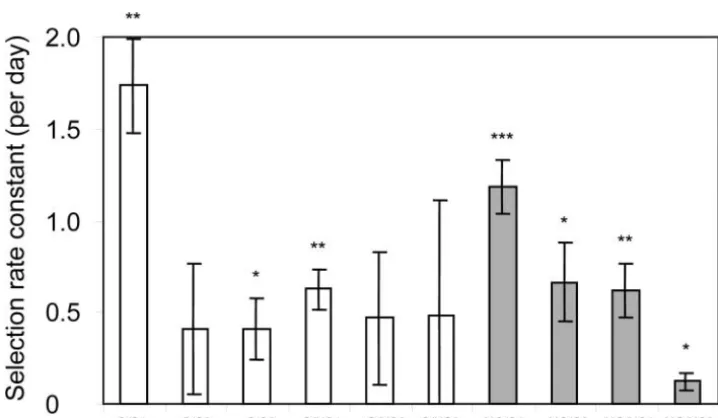
provement is on average 22%.) Although all 10 clones
fragments with changed position were isolated, and sequence
TABLE 1
Primers used to amplify both flanking sequences of the 10 ancestral IS981copies in the evolved populations
Left Right
IS981copy Primer Gene Primer Gene
A 5⬘-GGCTTTTGCTTACCCTTG-3⬘ yajA 5⬘-GAGTTTGGCGGTAACGTT-3⬘ yajF B 5⬘-GGAACTGTATAAACTGGC-3⬘ yajF 5⬘-AGTTCATTGGCTTTGTCG-3⬘ yajB C 5⬘-GGATTGGCTTCGTAAGCA-3⬘ ygeD 5⬘-GCAACAATCATGGTCACT-3⬘ ygfA D 5⬘-GAGTCCAAGTAGAATCGG-3⬘ yhcI 5⬘-GTTGATGTCTAAGTTGCAG-3⬘ yhcK E 5⬘-CTGCGATGTTTGCACCTC-3⬘ ymbH 5⬘-GTTTTACTTTAACGCCTCC-3⬘ ymbJ F 5⬘-AGCGAAGCTAACATGTAC-3⬘ ymcC 5⬘-GCAACATCCAGGTTTGCG-3⬘ ymc E G 5⬘-GATTCACTGAGTAGCAAG-3⬘ ymhA 5⬘-GAACTCAACTTGCACATG-3⬘ ymhC H 5⬘-CCATTACCATTTTCTCCG-3⬘ ypiH 5⬘-CCTCGGCCATATTATTTG-3⬘ ypiJ I 5⬘-CATCAAAGCTATCCCACTG-3⬘ yre E 5⬘-GTAGTGACGAGATAAGGG-3⬘ yrdB J 5⬘-CTGGAGAACCACCAATAG-3⬘ dpsA 5⬘-GGAGCCAAAAATACTTCC-3⬘ comC
10 clones is the improvement relative to the ancestor tral genome contains a total of 43 copies of the IS ele-ments IS1077 (7 copies), IS904 (9 copies), IS905 (1 significant [using a one-tailedt-test of the five replicate
estimates per clone and correcting for multiple testing copy), IS981 (10 copies), IS982 (1 copy), and IS983
(15 copies;Bolotinet al. 2001). We performed RFLP (Rice1989)]. Despite large variation of fitness among
replicate assays and among populations (F9,39 ⫽ 2.98, analysis of the genome from the ancestor and the single-clone representatives of each evolved population,
di-P⫽0.0086), the average fitness improvement of the 10
clones is highly significant (t⫽4.61, d.f.⫽9, two-tailed gested withHindIII, using probes for the three elements with most copies, IS904, IS981, and IS983.
Hybridiza-P ⫽0.0013). The reason for the large fitness variance
is unknown, but might be related to their high death tions with probes for IS904 and IS983 did not reveal any variation in the banding pattern (data not shown). rate in stationary phase in rich media (see Korona
1996). Indirect support based on the number of muta- However, Southern hybridization with IS981showed at least nine changes of band positions, including two ap-tions observed (seediscussion) also indicates that these
populations have adapted to their environments parent losses, three shifts, and four gains of fragment positions (Table 3).
through the selection of spontaneous beneficial
muta-tions. Using two-way analysis of variance of the mean The nine observed changes in IS981 hybridization profiles occurred in 6 of the 10 populations, with one relative fitness per population, no significant difference
could be detected between growth and starvation condi- population showing two and another three changes, while the other four changes each happened in a differ-tions or between shaken and nonshaken condidiffer-tions
(Ta-ble 2). ent population. Using Fisher’s exact probability test, we
found no significant effects on the number of IS981 -RFLP analysis with IS elements as probes:The
ances-Figure1.—Fitness improvement
TABLE 2 treatment. Then, the frequency of mutations in NG and G populations remained nonsignificantly different (P⫽ Analysis of variance of the mean of five fitness estimates of
0.133 to find at least five mutations in the NG
popula-the evolved populations relative to popula-their common ancestor
tions based on the Poisson expectation for the G popula-tions), but the frequency in S populations was
signifi-Mean
Source d.f. square F P cantly higher than that in NS populations (P⫽0.0011 to observe at least seven mutations in the S populations
Growth 1 0.0040 0.0167 0.901
based on the Poisson expectation for the NS
popula-Shaken 1 0.4586 1.9033 0.217
tions). No significant relationship could be shown
be-Interaction 1 0.0303 0.1258 0.735
Residual 6 0.2410 tween the number of fragment changes of a population and its level of fitness improvement (Spearman-rank correlation coefficient⫽ 0.466,n ⫽10,P ⬎0.05).
Molecular characterization and timing of IS981
-medi-ated mutations:To understand the molecular
mecha-mediated mutations that were due to starvation (three
nisms responsible for the observed IS981-mediated mu-of four NG populationsvs.three of six G populations;
tations, seven of the nine fragment changes in the IS981 P⫽0.381) or to shaking (four of five S populationsvs.
hybridization profiles were further characterized. Screen-two of five NS populations;P ⫽ 0.238). However, this
ing ⬎2000 transformants containing HindIII-digested test lacks power, because it ignores multiple mutations
genomic fragments of approximately the predicted size in the same population. Assuming that these mutations
with PCR analysis was insufficient to isolate the re-were neutral, we then calculated the Poisson
expecta-maining two changes (both novel IS981 fragments in tion for the observed frequency under one treatment
on the basis of the observed frequency for the other the clone from population NG/S2). It is unlikely,
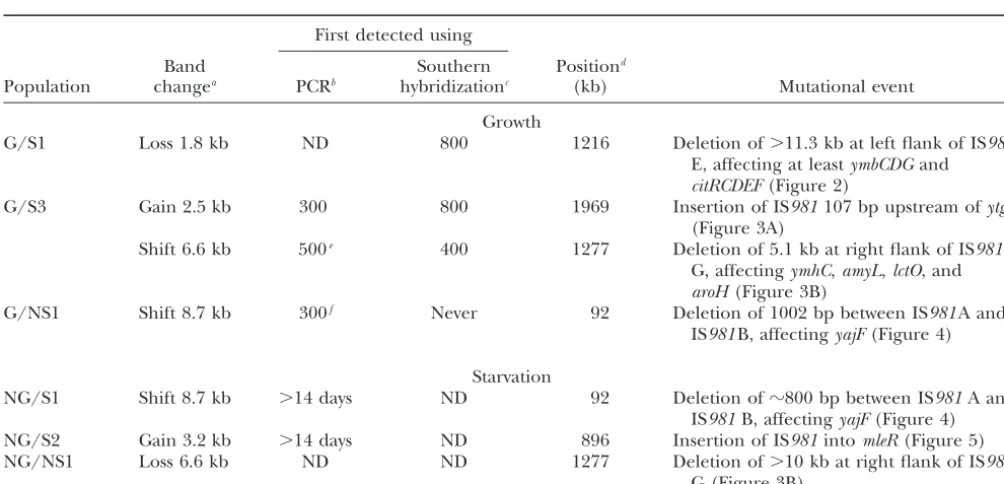
how-TABLE 3
IS981-mediated mutations detected in single-clone representatives of the evolvedL. lactispopulations
First detected using
Band Southern Positiond
Population changea PCRb hybridizationc (kb) Mutational event
Growth
G/S1 Loss 1.8 kb ND 800 1216 Deletion of⬎11.3 kb at left flank of IS981 E, affecting at leastymbCDGand citRCDEF(Figure 2)
G/S3 Gain 2.5 kb 300 800 1969 Insertion of IS981107 bp upstream ofytgF (Figure 3A)
Shift 6.6 kb 500e 400 1277 Deletion of 5.1 kb at right flank of IS981 G, affectingymhC,amyL,lctO, and aroH(Figure 3B)
G/NS1 Shift 8.7 kb 300f Never 92 Deletion of 1002 bp between IS981A and IS981B, affectingyajF(Figure 4)
Starvation
NG/S1 Shift 8.7 kb ⬎14 days ND 92 Deletion ofⵑ800 bp between IS981A and IS981B, affectingyajF(Figure 4) NG/S2 Gain 3.2 kb ⬎14 days ND 896 Insertion of IS981intomleR(Figure 5) NG/NS1 Loss 6.6 kb ND ND 1277 Deletion of⬎10 kb at right flank of IS981
G (Figure 3B)
G, growth; NG, starvation; S, shaken; NS, nonshaken; ND, not determined.
aDetected on genomicHindIII digestions hybridized with a probe against IS981(seematerials and methods).
bTime in generations (growing populations) or days (starving populations), based on PCR analysis of population samples isolated at 100-generation intervals; for starving populations, only a single sample taken after 14 days of evolution was available for the timing of the mutational events.
cTime in generations, using Southern hybridizations of population samples isolated at 200-generation intervals. dChromosomal coordinates of (one of the) IS981element(s) involved in the mutation.
eThe 5.1-kb deletion in G/S3 probably happened via at least one intermediate step, as a (probably smaller) deletion was visible on Southern hybridizations from generation 400, while PCR amplification of the final 5.1-kb deletion end point was possible only with samples from generation 500 and later.
Figure2.—Deletion of⬎11.3 kb directly left of ancestral copy IS981E, causing the apparent loss of a 1.8-kbHindIII fragment (indicated by the double-headed arrow) in population G/S1. The deletion (indicated by the bold arrow below) affected at least three genes coding for unknown proteins (ymbCDG) and the citrate lyase operon (citRCDEF). The next gene upstream,mae encoding malate oxidoreductase, may also be affected. Block arrows indicate the direction of transcription in this and all other figures. The mutation had reached a sufficiently high frequency to cause the visible loss of the ancestral 1.8-kbHindIII fragment on Southern hybridization after 800 generations. Primers Lout and EL (arrowheads) were used to amplify the junction between IS981E and its left flank; primer EL was used in combination with 2kEL, 4kEL, 6kEL, 8kEL, and 10kEL (all arrowheads) to try to determine the size of the deletion, but did not yield a product.
ever, that these two changes were the result of recombi- mutation arose. The 1.8-kb HindIII fragment became visible on Southern hybridizations after 800 genera-national deletions involving IS981, because PCR analysis
showed that the flanking sequences of the 10 ancestral tions, suggesting that the mutation had reached a rela-tively high frequency by then.
IS981 copies were all still present. The loss ofHindIII
restriction sites can also be ruled out as the cause of Insertion of IS981 upstream of ytgF in population G/S3:
This rearrangement is shown in Figure 3A. We observed these two changes, because all HindIII fragments
car-rying the 10 ancestral IS981 copies were still present. a new 2490-bp HindIII fragment containing IS981 in this clone. Sequence analysis showed that IS981 had Table 3 summarizes the results of the molecular analyses
of the seven IS981-mediated mutations, which are de- inserted between two genes with unknown function,
ytgFandytgG, 107 bp upstream ofytgF. BLAST analysis scribed in more detail below.
Deletion of ⬎11.3 kb of the left flank of IS981E in pop- suggested thatytgFis a member of the HD superfamily of hydrolases that include well-studied enzymes such as
ulation G/S1:This rearrangement is illustrated in Figure
2. It was detected as the apparent loss of the 1.8-kb the stringent response genes spoT and relA of E. coli
(AravindandKoonin1998).ytgGshows homology to
HindIII fragment containing IS981E (the 10 ancestral
copies of IS981are designated A–J). PCR amplification bacterial glucosamine-6-phosphate isomerases. Sequence analysis did not reveal a new hybrid promoter caused by revealed the absence of the immediate left flank of
IS981E only. However, attempts to amplify the region the insertion of IS981, as was recently reported for this element in another strain ofL. lactis, where it caused the 10 kb to the left of IS981E (with primers at 2-kb
inter-vals) were not successful. As no newHindIII fragment transcriptional activation of lactate dehydrogenase gene
ldhB(Bongerset al. 2003). RT-PCR analysis showed that containing IS981⬍4.2 kb was found, the deletion must
include theHindIII site at 11.3 kb to the left of IS981E the insertion had also not disrupted transcription of
ytgF. The insertion resulted from replicative transposi-and thus be ⬎11.3 kb. The rearrangement probably
resulted from the replicative transposition of IS981 to tion of IS981, because PCR amplification of the flanking regions verified that all ancestral copies were still pres-a position ⬎11.3 kb to the left of IS981E, followed by
recombination between the new copy and IS981E and ent (except the right flank of IS981G; see below). PCR amplification showed that the insertion was first de-deletion of the intervening sequence. The genes that
are affected by this deletion include at least three genes tected in a sample from 300 generations. Southern hy-bridizations indicated that the insertion had become with unknown function: ymbCDG, the citrate lyase
op-eron citCDEF (converts citrate into pyruvate) and its relatively common by generation 800.
Deletion of 5.1 kb of the right flank of IS981G in population
regulatorcitR, and possiblymaeencoding malate
Figure3.—Two rearrangements detected in population G/S3. (A) Insertion of IS981107 bp upstream ofytgF, causing a new 2490-bpHindIII fragment (indicated by the double-headed arrow).ytgF andytgG are genes with unknown function, butytgF resembles members of the HD superfamily of hydrolases and ytgG shows homology to glucosamine-6-phosphate isomerases (pentose phosphate pathway).gmkencodes a guanylate kinase (nucleotide transport and metabolism). The mutation was detectable with PCR analysis using primers Lout andytgGr (arrowheads) from generation 300 and was common by 800 generations. (B) Deletion of 5.1 kb of the right flank of ancestral copy IS981G, causing the shift of a 6.6-kb fragment to an 8.1-kbHindIII fragment. The deletion affected four genes:ymhCwith homology to a rhamnosyltransferase (synthesis of lipopolysaccharides),amyL encod-ing an␣-amylase (degradation of polysaccharides),lctOencodingl-lactate oxidase (lactate utilization), andaroHencoding a trp-sensitive aldolase (biosynthesis of aromatic amino acids).metEandmetFencode enzymes involved in methionine biosynthesis, ymiAencodes a metalloregulator, andmtgAa cation-transporting P-ATPase. An unknown intermediate deletion was detectable on Southern hybridizations from generation 400, because amplification of the deletion end point with primers Rout and 6kGR (arrowheads) showed that the final rearrangement was present only from generation 500. A similar, but larger, deletion of⬎10 kb involving the right flank of IS981G was detected in population NG/NS1.
IS981G and caused the shift of the ancestral 6.6-kb to end point showed the presence of the final rearrange-ment only in population samples from generation 500 an 8.1-kbHindIII fragment. The affected four genes are
ymhCwith homology to the rhamnosyl transferase gene onward. The deletion thus probably happened via one or more unknown intermediate rearrangements.
eps9KofStreptococcus thermophilus(synthesis of
lipopoly-saccharides);amyLencoding an␣-amylase (degradation Deletion of 1.0 kb between IS981A and IS981B in popula-tion G/NS1:The details of this rearrangement are given of polysaccharides);lctOencodingl-lactate oxidase
(lac-tate utilization); andaroHencoding a tryptophane-sensi- in Figure 4. The rearrangement was detected on South-ern hybridizations, where it appeared as a shift of the tive aldolase (biosynthesis of aromatic amino acids).
PCR analysis showed that the mutation is the result of ancestral 8.7-kbHindIII fragment to a 7.7-kb fragment. Sequence analysis revealed that the shift was due to a a replicative transposition of IS981 to a position 5.1
kb to the right of IS981G, followed by recombination deletion of 1002 bp between (and partly of) the ances-tral elements IS981A and IS981B, affecting yajF with between these two elements and deletion of the
in-tervening sequence. The mutation was first detected by 28% homology toorf XofL. lactis cremorisassociated with an abortive infection mechanism against bacteriophages the shift of the fragment containing IS981G (from 6.6
to 8.1 kb) on Southern hybridizations in a population (O’Connoret al. 1996).
PCR amplification of the region between IS981A and sample from generation 400, suggesting that it was
in-Figure4.—Deletion of 1.0 kb between IS981A and IS981B, causing the shift of the ancestral 8.7-kbHindIII fragment containing both IS981copies to a 7.7-kb fragment, in population G/NS1. (A) The deletion affected geneyajFwith unknown function, but associated with genes involved in phage resistance through abortive infection. (B) PCR analysis using primers Lout and Rout showed that the final deletion of 1002 bp occurred only at generation 1000 after at least one intermediate deletion of 878 bp in this population. (Two products ofⵑ1 and 0.5 kb appeared from generation 200 and disappeared after 400, but their molecular bases were not characterized.) The deletion of 878 bp was first detected at generation 300 and was dominant from generation 400 onward. A PCR product ofⵑ0.5 kb consistent with a deletion ofⵑ0.8 kb was observed in the clone from population NG/ S1. This deletion was not yet detectable after 2 weeks.
tervals revealed five products over the course of evolu- repetitive sequences that could have served as substrate for recombination.
tion (Figure 4B). PCR analysis of 20 randomly picked
clones from generation 300 showed that the different Deletion of 0.8 kb between IS981A and IS981B in popula-tion NG/S1: A deletion involving IS981A and IS981B products were the result of a polymorphism with
differ-ent clones each expressing a single product. The ances- similar to that in population G/NS1 was observed in a clone isolated from population G/NS1. Both Southern tral 1316-bp fragment was visible through generation
300. From generation 200 through 400, two additional hybridizations and PCR analysis (Figure 4B) of the re-gion between the two IS981copies are consistent with PCR products ofⵑ1 and 0.5 kb were visible at similar
intensity; these products were not further characterized. a deletion ofⵑ800 bp. Although it was not verified with sequence analysis, the deletion probably resulted from Consistent with a shift on Southern hybridizations (data
not shown), PCR analysis showed that from generation replicative transposition of IS981and subsequent dele-tion caused by homologous recombinadele-tion. It is unclear 400 onward the clone with the 878-bp deletion
domi-nated the population. Hence, the clone from genera- whether this rearrangement was preceded by intermedi-ate rearrangements such as in population G/NS1; at tion 1000 with the 1002-bp deletion was a minority
geno-type. Both the final 1002-bp and intermediate 878-bp the time of the only sample, after 2 weeks of evolution, the ancestral arrangement still dominated the popula-deletion probably resulted from the replicative
transpo-sition of IS981into (different positions within) the right tion (Figure 4B).
Insertion of IS981 into mleR in population NG/S2: This end of IS981A, followed by recombination between the
Figure 5.—Insertion of IS981intomleR, the regulator of the malolactic fermentation, resulting in a new 3236-bp HindIII fragment in starved population NG/S2.yijD encodes an ABC transporter ATP-binding protein;yijE is a hypothetical protein (with similarity to a conserved domain inspoTofClostridium acetobutylicum). PCR analysis using primers Rout andmleRf (arrow-heads) showed that this insertion was not yet present in this population after 2 weeks.
tions and characterized by sequence analysis of the re- tions of adaptation to various conditions in the labora-gions flanking IS981 in this fragment. PCR analysis tory. Our interests were twofold: (i) to study the effect showed that none of the ancestral IS981 copies had of starvation and oxygen stress on the frequency of IS-disappeared, indicating that the insertion resulted again mediated mutations during adaptation to these stresses from replicative transposition. The function of themleR and (ii) to find similar IS-mediated mutations in inde-gene, encoding the activator of the malolactic fermen- pendent populations. Once discovered, these IS-medi-tation and a member of the lysR family of regulators ated mutations, especially if they occurred in multiple (Renaultet al. 2000), was most likely disrupted by the populations, are then candidates for the further study insertion. PCR analysis indicated thatmleRin this popu- of their involvement in adaptation (Schneider and lation did not yet contain the insertion after 14 days of Lenski2004). Using RFLP analysis, we found that only
starvation. IS981showed activity, with nine fragment changes in 6
Deletion of⬎10 kb of the right flank of IS981G in popula- of the 10 populations. We characterized seven of these
tion NG/NS1:This rearrangement was detected by the fragment changes at the molecular level and found that apparent loss of the 6.6-kbHindIII fragment containing all seven resulted from the mobility of IS981 rather IS981G. PCR analysis showed that only the right flank- than from the loss of restriction sites. Because the two ing region of IS981G had disappeared, but we were uncharacterized changes also were not caused by the unable to verify the size of the deletion using PCR ampli- loss of restriction sites as all ancestral IS981 fragments fication with primers up to 10 kb to the right of IS981G. were still present, these, too, were the likely result of The most likely scenario is a deletion caused by the IS981 activity. PCR analysis of the flanking sequences replicative transposition of IS981to a position⬎10 kb to of the 10 ancestral IS981 copies showed that all nine the right of IS981G, followed by recombination between IS981-mediated mutations started with the replicative IS981G and the new copy and the deletion of the in- transposition of IS981, suggesting that this is the pre-tervening sequence. The rearrangement thus resembles ferred mechanism of mobility of this element.
that involving IS981G observed in population G/S3 IS-mediated mutations are of particular interest for (Figure 3B), except that the deletion was larger and the study of bacterial adaptation for two reasons. First, affected at least four additional genes: metE and metF IS elements provide a molecular handle that allows the
involved in methionine biosynthesis, the metalloregula- detection and manipulation of IS-mediated mutations tor ymiA, and the cation-transporting P-ATPase mgtA. in experiments. Second, IS-mediated mutations are a PCR analysis on a population sample taken after 14 days significant source of mutations in bacteria (see Schnei-of starvation showed that the right flank Schnei-of IS981G was derandLenski2004), and their involvement in
adapta-still present then. tion has frequently been observed. In this light, the great
variation in the frequency of IS elements in bacterial genomes, with some species harboring tens to hundreds
DISCUSSION
of copies and others none, is intriguing. Correlating the presence of IS elements with the ecology of the species We studied the activity of three multicopy IS elements
elements in the future, but is at present impossible due stationary conditions. If so, shaken conditions would pro-to a general lack of knowledge of the ecology of most vide more opportunities for IS-mediated mutations to
bacterial species. hitchhike with other beneficial mutations. Our data do
Frequency of IS-mediated mutations:Our results sug- not support this explanation, because fitness improve-gest that IS981is a more active element than IS904and ment was not higher under shaken than under station-IS983 under a variety of environmental conditions or ary conditions (Table 2). Second, shaken conditions is more often involved in adaptive mutations than the could lead to a higher rate of IS981-mediated mutations, other two elements, or both. The frequency of IS-medi- possibly stimulated by increased oxygen stress. L. lactis
ated mutations that we observed forL. lactisis in general is an obligatory anaerobic species, whose low tolerance agreement with observations inE. coliunder conditions of oxygen may imply high intracellular concentrations of regular growth. Papadopoulos et al. (1999) found of oxygen radicals under the aerobic conditions of the on average 0.03076 changes/1000 generations/copy for evolution experiment, possibly enhanced by a slightly 38 copies of seven IS elements in two evolving E. coli increased growth rate (seeBolotinet al. 2001).
Envi-populations. Assuming that these mutations are neutral ronmental stimuli for transposition of IS981 are un-(and thus hitchhiked to fixation with other beneficial known, but the involvement of the SOS system in the mutations), the Poisson probability that we observe at activation of other transposable elements (Mahillon least four changes during 1000 generations in six grow- andChandler1998) suggests that cellular mechanisms ing L. lactis populations for 34 copies of three IS ele- by which oxygen radicals can activate transposition do ments is 0.8736. Moreover, like inE. coli, we observed exist. Alternatively, oxygen radicals could enhance the substantial variation in the activity among genetically mutation rate of the transposase or its regulatory ele-different IS elements, as well as in the number of IS- ments, which may sometimes lead to mutants with
in-mediated mutations per population. creased IS activity.
Although based on low numbers, we found roughly Role of IS981-mediated mutations in adaptation:Can similar frequencies of mutations for conditions of we be certain that the clones that we studied improved growth and starvation. Our results corroborate earlier their fitness, despite the lack of significant competition findings that starving bacterial populations are dynamic results for some clones? Had adaptation not occurred, due to natural selection of spontaneous mutants with neutral theory (
Kimura 1983) predicts that it would improved adaptation to these adverse conditions (
Zam-take each mutation in the order of Ne (the effective branoet al. 1993;Naaset al. 1994;FinkelandKolter
population size) generations to increase to fixation. 1999;Kimet al. 2001). The fact that two of the six starved
Since the populations were maintained at an Ne of at populations went extinct is consistent with this notion
least 5 ⫻ 105, it would be extremely unlikely to find and emphasizes that long-term survival under these
con-any fixed mutation after 1000 generations by picking ditions relies on the chance occurrence of relatively
random clones from these populations. That most muta-rare beneficial mutations. However, our results do not
tions we observed had reached a relatively high fre-support the suggestion that IS-mediated mutations
oc-quency was suggested by their detection with Southern cur more frequently or are more often associated with
hybridizations using whole-population DNA. Moreover, beneficial effects during starvation than during growth
three of the four mutations in the G populations were (Naaset al. 1994; Hall 1999a). Papadopoulos et al.
shown to persist at a detectable frequency on Southern (1999) observed a similar frequency of IS-mediated
mu-hybridizations after their first discovery, suggesting tations after 4 years of adaptation ofE. coliB to
condi-again the systematic effect of selection rather than the tions of regular growth as did an earlier study for E.
erratic effect of drift. Hence, genetic drift alone is not
coliK12 after 30 years of starvation (Naaset al. 1994).
a sufficient explanation, and we need to invoke natural Neglecting differences in evolutionary conditions, the
selection to explain the detection of nine IS981 -medi-different time scales for these two studies suggest a lower
ated mutations in the evolved populations. Two possibil-frequency under starvation. Analysis of the four
muta-ities remain: (i) these mutations themselves caused a tions with an advantage in stationary phase in E. coli
fitness benefit or (ii) the IS-mediated mutations were identified so far also indicates that they are of diverse
without fitness benefit, and hitchhiked to high fre-nature, with one of the four mutations involving IS
quency along with beneficial mutations elsewhere on activity (ZinserandKolter2004). Note, however, that
the chromosome. these studies as well as ours observed the combined
To distinguish between these two possibilities, we effects of mutation and natural selection on the
fre-would need to move the mutations into the ancestral quency of IS-mediated mutations.
strain and perform competition experiments in the envi-When the IS981-mediated mutations were assumed
ronment where the mutations arose (Schneider et al. to be neutral, their observed frequency was higher in
2000;Cooperet al. 2003;SchneiderandLenski2004). shaken than in stationary cultures. Two different
mecha-While we may do so in the future, at present we can nisms can explain a higher frequency. First, shaken
muta-tions on the basis of their detection in multiple popula- three of the deleted genes, the fitness consequences of this deletion are unpredictable.
tions and on the genes that are affected.
Insertions: Two of the seven mutations were simple The first deletion of which similar variants were found in two different populations involved the right flanking insertions after replicative transposition of IS981 into
new positions. In population G/S3, IS981inserted 107 sequence of IS981G: deleting 5.1 kb in population G/S3 and ⬎10 kb in population NG/NS1. The genes that bp upstream ofytgF, a gene with unknown function that
contains a domain typical for the HD superfamily of were affected in both populations wereymhC with ho-mology to a rhamnosyl transferase gene,amyLencoding hydrolases that include the stringent response
regula-torsspoTandrelAofE. coli(AravindandKoonin1998). an␣-amylase,lctOencodingl-lactate oxidase, andaroH
encoding a trytophane-sensitive aldolase. Although the The stringent response ofL. lactisis involved in stress
tolerance (Ralluet al. 2000) and may thus affect fitness repeated deletion of genes in independent populations may be indicative of their adaptive nature (Wichman
through a general change of cell physiology. However,
there were no indications that the insertion affected et al. 1999;Wahl andKrakauer 2000;Dunham et al. 2002;Cooperet al. 2003), here repeatability was limited. transcription ofytgF: it did not establish a new hybrid
promoter resulting in increased expression (cf.Bong- The deletion was found in only two populations, which furthermore adapted to rather different selective
condi-erset al. 2003), nor was expression disrupted. The
inser-tion was thus probably without fitness effects. tions (one was a shaken culture undergoing regular growth and the other a starving stationary culture). De-The other simple insertion was observed in the clone
isolated from population NG/S2, where IS981inserted spite the need for different cell physiologies under these contrasting conditions, it is conceivable that the deletion into the coding region of mleR, the positive regulator
of the malolactic fermentation and member of thelysR of each of these four genes conferred a fitness advan-tage under both conditions. ymhC is likely involved in family of positive regulators (Renaultet al. 2000). Since
no malate was present in the medium, this function was the synthesis of lipopolysaccharides, and the deletion of genes involved in lipopolysaccharides inE. coli popu-unnecessary. However, it is unlikely that disruption of
this function due to IS981 insertion in its regulator lations that were adapting to conditions of regular growth at increased temperature was associated with a liberated energy, because in the absence of malate the
genes involved are not transcribed. Therefore, unless 25% fitness benefit (Riehleet al. 2001). Genes involved in the degradation of polysaccharides (amyL) and in
mleRhad other physiological effects, it is most likely that
this insertion was also without fitness consequences. the biosynthesis of amino acids (aroH) seem, at first glance, obsolete, because polysaccharides are not and Deletions:Five of the seven mutations were replicative
transpositions of IS981followed by recombinational de- amino acids are provided in the medium at nonlimiting concentrations. However, lactate is an important fer-letions between the new copy and an existing one. Of
these five mutations, four consisted of two different mentation end product and thus a likely component in the medium, and the deletion of lctOinvolved in the rearrangements of which similar variants were observed
in two independent populations each. The excess of utilization of lactate may have been deleterious. The fitness effect of deleting all four genes together is unpre-genomic deletions that we found is consistent with a
pervasive bias toward higher frequencies of deletions dictable and can be addressed only in further experi-ments.
rather than insertions shaping the evolution of bacterial
genomes (Miraet al. 2001). The other repeated deletion involved a sequence
be-tween the closely residing IS981copies A and B, affect-The only unique event was a deletion of ⬎11.3 kb
left of IS981E in the clone from population G/S1. The ingyajFwith homology to abortive infection genes, ob-served in clones from populations G/NS1 and NG/S1. affected genes included three genes with unknown
func-tion: the citrate lyase operoncitCDEFwith its regulator Both deletions were similarly small (1.0 kb in population G/NS1 and 0.8 kb in population NG/S1), while the
citR involved in the metabolization of citrate and the
malate oxidoreductase genemaethat catalyzes the con- variant observed in growing population G/NS1 resulted in at least one intermediate rearrangement that reached version between malate and oxaloacetate. There is no
simple physiological reason why the deletion of these high frequency within 400 generations (see Figure 4). The repeatability of this deletion was again limited functions should improve fitness in the evolutionary
environment. Although both the citrate lyase operon to two populations adapting to rather different condi-tions, and hence it is not immediately likely that the and the malate oxidoreductase were dispensable due
to the lack of citrate and malate in the medium, it is deletion was adaptive. However, the fact that IS981
was first discovered in association with genes involved uncertain that their deletion liberated energy for other
functions. This could be so for the citrate lyase operon, in abortive infection resistance against prolate-headed phage (Romero and Klaenhammer 1993) suggests a since it is constitutively expressed in another L. lactis
strain (Magniet al. 1999); the regulation of transcrip- long-term adaptive role of these genes and thus perhaps of their deletion in these two populations. The close tion ofmaeis unknown. Due to additional uncertainties
detec-microorganisms: the dynamics and genetic bases of adaptation.
tion of intermediate rearrangements is also consistent
Nat. Rev. Genet.4:457–469.
with an increased transposition rate, possibly due to Finkel, S. E., andR. Kolter, 1999 Evolution of microbial diversity
during prolonged starvation. Proc. Natl. Acad. Sci. USA96:4023–
the presence of a second transposase promoter nearby
4027.
(MahillonandChandler1998). The repeated
detec-Gray, Y. H. M., 2000 It takes two transposons to tango. Trends
tion of this deletion may thus have resulted from a Genet.16:461–468.
Hall, B. G., 1999a Spectra of spontaneous growth-dependent and
combination of a (locally) increased rate of
transposi-adaptive mutations atebgR.J. Bacteriol.181:1149–1155.
tion and an adaptive benefit.
Hall, B. G., 1999b Transposable elements as activators of cryptic
To conclude, of the seven IS981-mediated mutations genes inE. coli.Genetica107:181–187.
Imhof, M., andC. Schlo¨ tterer, 2001 Fitness effects of
advanta-that we characterized, two similar deletions advanta-that were
geous mutations in evolving Escherichia coli populations. Proc.
found in two independent populations each are the
Natl. Acad. Sci. USA98:1113–1117.
best candidates of beneficial mutations (Wichmanet al. Kim, W. S., J. H. Park, J. Ren, P. SuandN. W. Dunn, 2001 Survival response and rearrangement of plasmid DNA ofLactococcus lactis
1999;WahlandKrakauer2000;Dunhamet al. 2002;
during long-term starvation. Appl. Environ. Microbiol.67:4594– Cooperet al. 2003). Competition experiments between 4602.
ancestral strains with and without these mutations Kimura, M., 1983 The Neutral Theory of Molecular Evolution. Cam-bridge University Press, CamCam-bridge, UK.
should be performed to be able to distinguish between
Korona, R., 1996 Adaptation to structurally different environments.
the possibility that these mutations conferred a selective Proc. R. Soc. London Ser. B263:1665–1669.
advantage themselves or hitchhiked along with other Lenski, R. E., M. R. Rose, S. C. SimpsonandS. C. Tadler, 1991 Long-term experimental evolution inEscherichia coli. I. Adaptation
beneficial mutations. Only then can we learn whether
and divergence during 2,000 generations. Am. Nat.138:1315–
IS-mediated mutations are a common cause or a conse- 1341.
quence of bacterial adaptation. Magni, C., D. de Mendoza, W. N. KoningsandJ. S. Lolkema, 1999
Mechanism of citrate metabolism inLactococcus lactis: resistance We thank N. Fitzsimons, K. Fritsche, H. Heilig, and B. Koop- against lactate toxicity at low pH. J. Bacteriol.181:1451–1457. manschap for help in the laboratory and J. van der Oost, M. Maas, Mahillon, J., andM. Chandler, 1998 Insertion sequences. Micro-and D. Rozen for discussion Micro-and comments. J.A.G.M.V. was supported biol. Mol. Biol. Rev.62:725–774.
by a grant from the Netherlands Organization for Scientific Research. Mira, A., H. OchmanandN. A. Moran, 2001 Deletional bias and the evolution of bacterial genomes. Trends Genet.17:589–596.
Moxon, E. R., P. B. Rainey, M. A. NowakandR. E. Lenski, 1994
Adaptive evolution of highly mutable loci in pathogenic bacteria. Curr. Biol.4:24–33.
LITERATURE CITED Naas, T., M. Blot, W. M. Fitch andW. Arber, 1994 Insertion sequence-related genetic rearrangements in restingEscherichia
Altschul, S. F., T. L. Madden, A. A. Schaffer, J. Zhang, Z. Zhang
coliK-12. Genetics136:721–730.
et al., 1997 Gapped BLAST and PSI-BLAST: a new generation
O’Connor, L., A. Coffey, C. Daly and G. F. Fitzgerald, 1996
of protein database search programs. Nucleic Acids Res.25:3389–
AbiG, a genotypically novel abortive infection mechanism en-3402.
coded by plasmid pCI750 of Lactococcus lactis subsp. cremoris
Aravind, L., andE. V. Koonin, 1998 The HD domain defines a
UC653. Appl. Environ. Microbiol.62:3075–3082. new superfamily of metal-dependent phosphohydrolases. Trends
Orr, H. A., 2003 The distribution of fitness effects among beneficial
Biochem. Sci.23:469–472.
mutations. Genetics163:1519–1526.
Bolotin, A., P. Winkler, S. Mauger, O. Jaillon, K. Malarmeet
Otto, S. P., 2002 Evolving beyond point mutations. Trends Ecol.
al., 2001 The complete genome sequence of the lactic acid
Evol.17:110. bacteriumLactococcu lactisssp.lactis IL1403. Genome Res. 11:
Papadopoulos, D., D. Schneider, J. Meier-Eiss, W. Arber, R. E.
731–753.
Lenskiet al., 1999 Genomic evolution during a
10,000-genera-Bongers, R. S., M. H. N. Hoefnagel, M. J. C. Starrenburg, M. A. J.
tion experiment with bacteria. Proc. Natl. Acad. Sci. USA96:
Siemerink, J. G. A. Arendset al., 2003 IS981-mediated adaptive
3807–3812. evolution recovers lactate production byldhBtranscription
activa-Rainey, P. B., A. Buckling, R. KassenandM. Travisano, 2000 The
tion in a lactate dehydrogenase-deficient strain of Lactococcus emergence and maintenance of diversity: insights from experi-lactis.J. Bacteriol.185:4499–4507.
mental bacterial populations. Trends Ecol. Evol.15:243–247.
Chao, L., C. Vargas, B. B. SpearandE. C. Cox, 1983 Transposable Rallu, F., A. Gruss, S. D. EhrlichandE. Maguin, 2000 Acid- and
elements as mutator genes in evolution. Nature303:633–635. multistress-resistant mutants ofLactococcus lactis: identification of
Charlesworth, B., P. SniegowskiandW. Stephan, 1994 The evo- intracellular stress signals. Mol. Microbiol.35:517–528.
lutionary dynamics of repetitive DNA in eukaryotes. Nature371: Renault, P., C. GaillardinandH. Heslot, 2000 Product of the
215–220. Lactococcus lactis gene required for malolactic fermentation is
Cooper, T. F., D. E. RozenandR. E. Lenski, 2003 Parallel changes homologous to a family of positive regulators. J. Bacteriol.171:
in gene expression after 20,000 generations of evolution inEsche- 3108–3114.
richia coli.Proc. Natl. Acad. Sci. USA100:1072–1077. Rice, W. R., 1989 Analyzing tables of statistical tests. Evolution43:
Cooper, V. S., D. Schneider, M. BlotandR. E. Lenski, 2001 Mech- 223–225.
anisms causing rapid and parallel losses of ribose catabolism Riehle, M. M., A. F. BennettandA. D. Long, 2001 Genetic architec-in evolvarchitec-ing populations ofEscherichia coli B. J. Bacteriol. 183: ture of thermal adaptation inEscherichia coli.Proc. Natl. Acad.
2834–2841. Sci. USA98:525–530.
Drlica, K., andM. Riley, 1990 The Bacterial Chromosome. American Romero, D. A., andT. R. Klaenhammer, 1993 Transposable
ele-Society for Microbiology, Washington, DC. ments in Lactococci: a review. J. Dairy Sci.76:1–19.
Dunham, M. J., H. Badrane, T. Ferea, J. Adams, P. O. Brownet al., Rozen, D. E., J. A. G. M. de VisserandP. J. Gerrish, 2002 Fitness
2002 Characteristic genome rearrangements in experimental effects of fixed beneficial mutations in microbial populations. evolution ofSaccharomyces cerevisiae.Proc. Natl. Acad. Sci. USA Curr. Biol.12:1040–1045.
99:16144–16149. Schneider, D., andR. E. Lenski, 2004 Dynamics of insertion
se-Edwards, R. J., R. E. Sockett andJ. F. Y. Brookfield, 2002 A quence elements during experimental evolution of bacteria. Res.
simple method for genome-wide screening for advantageous in- Microbiol.155:319–327.
sertions of mobile DNAs inEscherichia coli.Curr. Biol.12:863–867. Schneider, D., E. Duperchy, E. Coursange, R. E. LenskiandM. Blot, 2000 Long-term experimental evolution inEscherichia coli.
IX. Characterization of insertion sequence-mediated mutations Wichman, H. A., M. R. Badgett, L. A. Scott, C. M. Boulianne
and rearrangements. Genetics156:477–488. andJ. J. Bull, 1999 Different trajectories of parallel evolution
Travisano, M., 2001 Evolution: towards a genetical theory of adapta- during viral adaptation. Science285:422–424.
tion. Curr. Biol.11:R440–R442. Zambrano, M. M., D. A. Siegele, M. Almiro´ n, A. Tormo andR.
Wahl, L. M., andD. C. Krakauer, 2000 Models of experimental Kolter, 1993 Microbial competition: Escherichia coli mutants
evolution: the role of genetic chance and selective necessity. that take over stationary phase cultures. Science259:1757–1760. Genetics156:1437–1448. Zinser, E. R., andR. Kolter, 2004 Escherichia colievolution during
Wery, J., B. Hidayat, J. KieboomandJ. A. M. de Bont, 2002 An stationary phase. Res. Microbiol.155:328–336.
insertion sequence preparesPseudomonas putidaS12 for severe