Virtual Calculator using Hand Gesture
Recognition via Support Vector Machine
Preeti Niranjan1, Brijesh Pandey2,F. Masooma Nigar2
P.G. Student, Department of Computer Science and Engineering, Goel Institute of Technology and Management,
Lucknow, India1
Assistant Professor, Department of Computer Science and Engineering, Goel Institute of Technology and Management,
Lucknow, India2
ABSTRACT: Computer vision technology and human-computer interaction have helped in designing and implementing many natural forms of human-computer interaction systems. These include interactions through gestures, speech, facial expressions, etc. Hand gesture recognition system thus is a human-computer interaction system that is capable of recognizing various gestures of a human hand. The human gesture can be static or dynamic. Different methods have been proposed and implemented for recognizing human hand gestures. Some methods make use of external devices like gloves and some make use of skin colour to segment the hand features. This research work makes use of Support Vector Machine along with morphological operations in recognizing hand gestures for a natural HCI system. In this work we use the concepts of Vision based gesture recognition system in understanding the hand gestures for making a virtual touch screen of numbers. The virtual touch screen then shall be used for computing simple mathematical operation of Addition. Image classification of gestures is done using State Vector machine.
KEYWORDS:Text Hand gesture, SVM, Virtual calculator.
I. INTRODUCTION
Many diversified applications consider virtual environments as an efficient human computer interaction forms. There are many applications that require natural form of human computer interaction. Existing human-computer interactions method using mouse, keyboards and pens are not sufficient to support natural interaction with the computer. Hence, researchers always had an interest to explore new and natural form of human-computer interactions. Hand gestures based methods opened the gateway for the new methods of human computer interactions. In the beginning Gloves and sensor based tracker methods were introduced. These methods were not efficient, had many limitations and were not comfortable in use. Thus, new innovative methods were searched for a natural form of human computer based interaction. Direct use of hand through graphical based interfaces has proved to be a better from of natural human computer interaction.
is given in section below after theoretical description. Methodology first explains the overall system workflow diagram and each step of the diagram and the process undertaken in it are explained in the section following it. Finally the experimentation and the results are described in sections following it.
II. BACKGROUND
II(1) HAND DETECTION
Gesture is a sort of non-verbal method of conveying message where in a bodily based actions are used to communicate a message. Gestures are categorized as static or dynamic. In the first form of category the static gesture the bodily part remain in certain pose or positions and are thus easier to compute and in dynamic gesture the bodily part is represented through sequence of postures and is more complex in nature to compute. Since communication is evolving so are new methods of communication are sought for [2]. Among them one of the emerging methods are acquiring information of message through recognition of gestures systems. Existing methods on gesture recognition focus on devices like data gloves, colour markers, skin colour, hand body part movement etc.[5].
Gesture recognition has opened gates for new methods of Human-Computer interaction even more powerful than Graphical User interfaces based on mouse and keyboards. Gesture recognition can enable human to interact with the machine with no external devices like mechanical devices in use. Gesture recognition is broadly classified as Glove based Gesture Recognition and Vision-Based Gesture Recognition. Glove based Gesture recognition has a drawback that it hides the naturalness as it needs accessories in the form of devices to interact with machines[ 4]. But Vision-based gesture recognition uses features from the Visual image of body part like hand and compares its features with those features extracted from web camera [3].
II(2) CANNY EDGE DETECTION
The Canny edge detection is an edge location algorithm that uses a multi-stage calculation to detect edges of the image [4]. It was developed by John F. Shrewd in 1986. Canny edge detection algorithm process is given below:
• First make use of Gaussian channel based filter to blur the picture • Compute the force inclinations of the given input image.
• Then non-greatest concealment is applied to dispose of any suspicious points which acts as hindrances to edge discovery
• Twofold limit is applied on the image to help in deciding the edges
• Finally the edges are recognized by smothering the edges that are frail and not associated with solid edges.
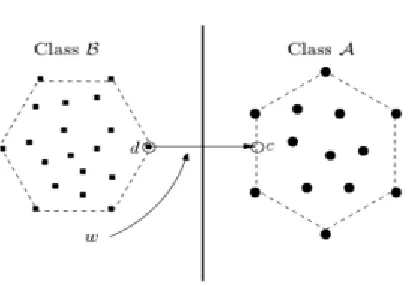
II(3) SUPPORT VECTOR MACHINE
Figure 1: SVM Classifier
III.METHODOLOGY
The gesture recognition system is capable of identifying meaningful gesture in real-time from color image sequences using SVM. The steps and the explanation for the given methodology are given below:
Step 1: Feature extraction
For each binary image of the hand, a Fourier descriptor is formed which represents the boundary of the image. The boundary of the image is represented as bk= xk+jyk where xk and yk represent the boundary pixels. This number is
resampled at fixed length sequences. Thus, for an image a discrete vector is formed which represents the features of the image like centroid, orientation etc. this discrete vector is given to the SVM as an input [6].
Step 2: SVM-based gesture recognition
The final step is the classification of the image into the set of already defined hand gestures.
Main algorithm
Step 1: Collect the data set and read the images of the dataset. Step 2: preprocessing of the image
Image may be noisy thus to make the image perfect for hand detection it is essential to do some preprocessing of the image. This includes segmentation of the image, morphological operations, filtering and de-noising of the image.
First, the image is converted into HSV scale from the colored RGB model. This generates a binary image with binary threshold values [4].
Now in the segmentation process, the background image and the foreground image is segmented using a selection of an adequate threshold of gray level. This segmentation separates the hand part of the image from the background image. Existing Research has proved that OStu segmentation algorithm has good results on hand gestures and hence this algorithm is used for segmentation of the image [8].
The segmented image using Otsu algorithm has some background part with 1 values as background noise and some hand part of the image as 0 values as gesture noise. This morphological filtering consisting of dilation and erosion is used to get an image with smooth and closed filtered image [7].
To have accurate hand gesture position in the image blob detection is carried out on the image. This helps in identifying the centroid point, boundary area and bounding box for the hand gesture.
Canny edge detection algorithm is applied to the image to smooth the image, eliminate any noises if any then find the edges of the hand gesture giving a black and white image with white lines representing the boundary or the edge of the hand gesture.
Step 3: For each image of the data set extract features of each image of the dataset and store them in a database. Step 4: Display the numeric pad
Step 6: Extract features of the input image.
Step 7: Classify the input image features from database features images using SVM classifier to be built. Step 8: Do steps 5, 6, 7 for another test image 2.
Step 9: Compute addition of input image 1 and 2. Step 10: Display result of computation.
To eliminate small objects, connected component labelling is applied to the resultant image.(c) represents text detection by applying second set of criteria which eliminates all the objects whose area is less than 300 and filled area is less than 500.
IV. EXPERIMENTATION AND RESULTS
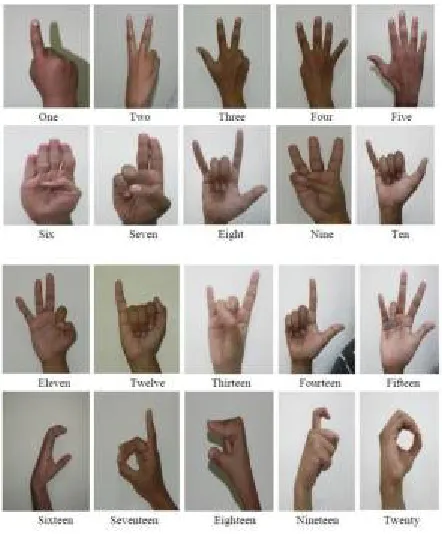
IV(1) DATASET FOR CLASSIFICATION
Figure 2: Data set for Classification
IV(2) RESULTS
Input image 1:
Figure 3: gesture recognition of number 1.
Figure 4: gesture recognition of number 1.
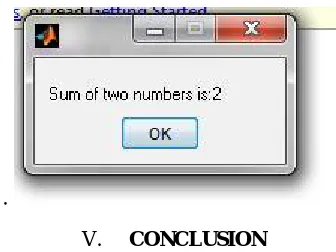
Final output
Sum of two numbers is: 2
.
V. CONCLUSION
system in understanding the hand gestures for making a virtual touch screen of numbers. The virtual touch screen is used for computing simple mathematical operation of Addition. Image classification of gestures is done using State Vector machine
REFERENCES
[1] Anzai, Y., 2012. Pattern Recognition & Machine Learning.Elsevier.
[2] Chen, F.S., Fu, C.M. and Huang, C.L., 2003. Hand gesture recognition using a real-time tracking method and hidden Markov models. Image and vision computing, 21(8), pp.745-758.
[3] Ionescu, B., Coquin, D., Lambert, P. and Buzuloiu, V., 2005. Dynamic hand gesture recognition using the skeleton of the hand. EURASIP Journal on Advances in Signal Processing, 2005(13), pp.1-9.
[4] Lee, H.K. and Kim, J.H., 1999. An HMM-based threshold model approach for gesture recognition. Pattern Analysis and Machine Intelligence, IEEE Transactions on, 21(10), pp.961-973.
[5] Sarkar, A.R., Sanyal, G. and Majumder, S., 2013. Hand gesture recognition systems: a survey. International Journal of Computer Applications, 71(15).
[6] Yang, M.H. and Ahuja, N., 2001. Recognizing hand gestures using motion trajectories. In Face Detection and Gesture Recognition for Human-Computer Interaction (pp. 53-81). Springer US.
[7] Yeasin, M. and Chaudhuri, S., 2000. Visual understanding of dynamic hand gestures. Pattern Recognition, 33(11), pp.1805-1817.