ABSTRACT
LAI, JUMING. Parameter Estimation of Excitation Systems. (Under the direction of Mesut E. Baran).
The purpose of the research has been to develop a methodology to simplify the
process of parameter estimation of excitation systems. There are two parts in the estimation
process, which are the simulation and the optimization.
For the simulation part, the AC1A excitation system model and AC8B excitation
system model have been implemented in MALTAB/Simulink, based on the IEEE standard
421.5, which is updated in 2005. On the other hand, for the optimization part, the goal is to
look for suitable parameters such that, with the same input, the simulation output will match
the field data from the real machine. We formulated the problem as a least square problem
and applied Damped Gauss-Newton method (DGN) and Levenberg-Marquardt (LM) method
to solve it. We used both the MATLAB Parameter Estimation Toolbox and the MATLAB
programs developed by us to implement the algorithms and get the parameters. For both of
the AC1A models and AC8B, we did the case studies and validation. And this is also a
project sponsored by Progress Energy, who provided two suites of “bump-test” field data of
AC1A excitation system and AC8B excitation system as well. Besides the results, we
determined that the process of parameter estimation of excitation systems would be try DGN
first, and if the simulation response cannot match the measured response well, try LM to get
Parameter Estimation of Exitation Systems
by Juming Lai
A thesis submitted to the Graduate Faculty of North Carolina State University
in partial fulfillment of the requirements for the Degree of
Master of Science
Electrical and Computer Engineering
Raleigh, North Carolina
2007
APPROVED BY:
Dr. William W Edmonson Jr. Dr. Alex Q Huang
BIOGRAPHY
Juming Lai was born and grew up in Guangzhou, Guangdong, China on March 5,
1984. Her father is a civil engineer specialized in air transportation that brought her interests
in engineering from her childhood. She showed her interests in math from elementary school,
which helps her a lot in the study of engineering. She entered the South China University of
Technology (SCUT) in Guangzhou in September, 2002 and got her Bachelor degree majored
in Electrical Engineering in June, 2006. And in August of the same year, she entered North
Carolina State University as a master student. She is currently a master student in NCSU and
graduating in December 2007.
She has wide interests, two of which are music and traveling. At the age of 4 years
old, she passed the entrance exam of Xinghai Conservatory of Music in Guangzhou, which
only took 15 students out of 1500, and started learning the piano. Now playing piano
becomes an important hobby of hers. And from she was 5 years old, she with her parents
keeps traveling to either a different province in China or a different country if possible,
which makes her an easy-going person who can communicate well and get well along with
ACKNOWLEDGMENTS
Firstly, I would like to thank my parents who bring me a family full with love. Thank
my father who can always answer my “whys” and keep me curious to the new things. Thank
my mother who always tries her best to take care of me in every little detail. And then, I
would like to thank my advisor, Dr. Mesut Baran who is professional in academic. He not
only advises me on my research, but also listens to my opinions and tells me how to think
when meeting a new problem. Also, thanks would be truly sent to every instructor who
taught me in the past one and a half year. I did gain a lot from the classes and projects. At last,
I would like to thank all my friends, roommates and colleagues in my lab, SPEC, 1250
Partner I, for all the help for my study and life in NC State.
I would like to acknowledge to Progress Energy, Inc. for sponsoring the research.
And I also acknowledge the Semiconductor Power Electronic Center (SPEC) for providing
TABLE OF CONTENTS
LIST OF TABLES... vi
LIST OF FIGURES... vii
Chapter 1... 1
Introduction... 1
1.1 Background... 1
1.2 Problem Description... 4
1.3 Related Work... 5
1.3.1 Scope of the Thesis:... 10
1.4 Abbreviation... 10
Chapter 2... 11
AC Excitation System Model... 11
2.1 Overview... 11
2.2 Per Unit System... 15
2.3 AC Excitation System Model Examples... 16
2.4 Model Details for the Excitation Systems... 17
2.4.1 Terminal Voltage Transducer and Load Compensator Models... 17
2.4.2 Amplifier... 18
2.4.3 Exciter... 19
2.4.3.1 Saturation Function... 21
2.4.4 Rectifier... 21
2.5 Summary... 22
Chapter 3... 23
Parameter Estimation using Least Square Method... 23
3.1 Objective function... 23
3.2 Gauss Newton method [12]... 24
3.3 Calculating the Jacobian numerically... 25
3.4 Damped Gauss-Newton method... 28
3.5 Levenberg-Marquardt Method... 29
3.6 Approach I: MATLAB/Simulink Parameter Estimation Toolbox... 29
3.6.1 Simulink in MATLAB... 30
3.6.2 Parameter Estimation (PE) toolbox in MATLAB... 31
3.7 Approach II : Parameter estimation using LM & DGN... 31
3.8 Summary... 32
Chapter 4... 34
Case Studies and Validations... 34
4.1 Case 1: AC1A with typical parameters... 35
4.1.1 Parameter Estimation Using Matlab PE Toolbox... 36
Parameter Trajectory... 38
4.1.2 Parameter Estimation using Damped Gauss Newton... 40
4.1.3 Parameter Estimation using LM and DGN... 41
4.1.3.2 Damped Gauss Newton... 43
4.2 Case 2: AC1A with good initial paramters... 45
4.2.1 Parameter Estimation Using Matlab PE Toolbox... 46
4.2.2 Damped Gauss Newton... 49
4.3 Case 3: AC1A with Low Parameters... 50
4.3.1 Levernberg Marquardt... 51
4.3.2 Damped Gauss Newton... 53
4.4 Case 4: AC1A with high parameters... 55
4.4.1 Levernberg Marquardt... 56
4.4.2 Damped Gauss Newton... 58
4.5 Case 5: AC8B with good initial guess... 60
4.5.1 Parameter Estimation Using Matlab PE Toolbox... 63
4.5.1.1 Data Unit 1 ... 63
4.5.1.2 Data Unit 2... 65
4.5.2 Damped Gauss Newton... 68
4.5.2.1 Data Unit 1... 68
4.5.2.2 Data Unit 2... 69
4.6 Verification of AC1A excitation system model... 71
4.6.1 About PSS/E... 71
4.6.2 Comparison of simulation output of AC1A excitation system in both MATLAB and PSSE... 71
4.7 Validation of AC8B excitation system... 74
4.9 Summary... 77
Chapter 5... 79
Conclusion and Future Work... 79
5.1 Conclusion... 79
5.2 Future work... 79
LIST OF TABLES
Table 1 Iteration history of parameter estimation of AC1A starting from typical parameters using DGN ... 40 Table 2 Iteration history of parameter estimation of AC1A starting from typical parameters using LM ... 42 Table 3 Iteration history of parameter estimation of AC1A starting from PL using DGN ... 43 Table 4 Iteration history of parameter estimation of AC1A starting from PL using DGN ... 49 Table 5 Iteration history of parameter estimation of AC1A starting from low parameters using LM ... 51 Table 6 Iteration history of parameter estimation of AC1A starting from PL using DGN ... 53 Table 7 Iteration history of parameter estimation of AC1A starting from high parameters using LM ... 56 Table 8 Iteration history of parameter estimation of AC1A starting from PL using DGN ... 59 Table 9 Iteration history of parameter estimation of AC8B starting from good initial
parametersusing DGN (Unit 1) ... 68 Table 10 Iteration history of parameter estimation of AC8B starting from good initial
LIST OF FIGURES
Fig. 1. 1 Type AC1A excitation system (Alternator-rectifier excitation system with
non-control rectifiers and feedback from exciter field current) ... 5
Fig. 1. 2 The excitation response from the stage test3... 5
Fig. 2. 1 The real generator and excitation system ... 12
Fig. 2. 2 Inside of the excitation system part ... 12
Fig. 2. 3 The structure of Mark III Brushless exciter... 13
Fig. 2. 4 The circuit of Generator excitation system... 14
Fig. 2. 5 Functional block diagram of a detailed excitation system model [1]... 15
Fig. 2. 6 Simplified functional block ... 15
Fig. 2. 7 A partial AC1A Excitation System Block Diagram Showing Major Functional Blocks ... 16
Fig. 2. 8 A partial AC8B Excitation System Block Diagram Showing Major Functional Blocks ... 17
Fig. 2. 9 Terminal Voltage Transducer and Optional Load Compensation Elements ... 17
Fig. 2. 10 Amplifier model [10]... 18
Fig. 2. 11 Non-windup limiter with sample time constant [1]... 19
Fig. 2. 12 Implementation of non-windup limiter... 19
Fig. 2. 13 Block diagram of an AC exciter ... 20
Fig. 2. 14 AC exciter saturation characteristic... 21
Fig. 2. 15 Rectifier regulation model [10] ... 22
Fig. 3. 1 a simple system for Jacobian approximation test (k=xtest(1), a=xtest(2))... 26
Fig. 3. 2 A sketch map showing how PE toolbox works ... 31
Fig. 3. 3 Optimization environment ... 32
Fig. 4. 1 Test system for estimating parameters of AC1A excitation system... 34
Fig. 4. 2 Implementation of AC1A excitation system in MATLAB/Simulink ... 35
Fig. 4. 3 Model response with typical parameters of AC1A excitation system... 36
Fig. 4. 4 Cost function and step size of each iteration with typical parameters of AC1A excitation system... 37
Fig. 4. 5 Estimated parameters of AC1A excitation system starting from typical parameters37 Fig. 4. 6 Final terminal output of generator with typical parameters of AC1A excitation system ... 38
Fig. 4. 7 Parameter trajectory when estimating parameters of AC1A excitation system ... 39
Fig. 4. 8 Final terminal output of generator starting from typical parameters using DGN .... 41
Fig. 4. 9 Final terminal output of generator starting from typical parameters using LM ... 43
Fig. 4. 10 Final terminal output of generator when estimating AC1A excitation starting from L P using DGN... 45
Fig. 4. 11 Model response with good parameters of AC1A excitation system ... 46
Fig. 4. 12 Cost function and step size of each iteration when estimating AC1A excitation system with good initial paramteres ... 47
Fig. 4. 14 Final terminal output of generator when estimating AC1A excitation system
starting from good parameters (Grey - Desired curve, Blue – Simulation output)... 49
Fig. 4. 15 Final terminal output of generator when estimating AC1A excitation starting from a good initial point ... 50
Fig. 4. 16 Model response with low parameters of AC1A excitation system ... 51
Fig. 4.17 Final terminal output of generator starting from low parameters using LM ... 53
Fig. 4. 18 Final terminal output of generator when estimating AC1A excitation using DGN starting fromPL... 55
Fig. 4. 19 Model response with high parameters of AC1A excitation system ... 56
Fig. 4.20 Final terminal output of generator starting from high parameters using LM ... 58
Fig. 4. 21 Final terminal output of generator when estimating AC1A excitation using DGN starting from L P ... 60
Fig. 4. 22 Implementation of AC8B excitation system in MATLAB/Simulink... 61
Fig. 4. 23 Model response with good parameters of AC8B excitation system... 62
Fig. 4. 24 Model response with good parameters of AC8B excitation system (Data Unit 2) 63 Fig. 4. 25 Cost function and step size when estimating AC8B excitation system with good initial parameters(Unit 1) ... 64
Fig. 4. 26 Estimated parameters of AC8B excitation system(Unit 1) ... 64
Fig. 4. 27 Final terminal output of generator when estimating AC8B excitation system (Grey - Desired curve, Blue – Simulation output) (Unit 1) ... 65
Fig. 4. 28 Cost function and step size of each iteration when estimating AC8B excitation system (Unit 2)... 66
Fig. 4. 29 Estimated parameters of AC8B excitation system(Unit 2) ... 67
Fig. 4. 30 Final terminal output of generator when estimating AC8B excitation system (Grey - Desired curve, Blue – Simulation output) (Unit 2) ... 68
Fig. 4. 31 Final terminal output of generator when estimating AC8B excitation system (Data Unit 1) ... 69
Fig. 4. 32 Final terminal output of generator when estimating AC8B excitation system (Data Unit 2) ... 70
Fig. 4. 33 Simulation outputs of AC1A excitation system in MATLAB and PSS/E with the parameters provided by Optimization Toolbox ... 72
Fig. 4. 34 Simulation outputs of AC1A excitation system in MATLAB and PSS/E with the parameters provided by Case 1 in section 4.4... 72
Fig. 4. 35 Simulation outputs of AC1A excitation system in MATLAB and PSS/E with the parameters provided by Case 2 in section 4.4... 73
Fig. 4. 36 Simulation outputs of AC1A excitation system in MATLAB and PSS/E with the parameters provided by Case 3 in section 4.4... 74
Fig. 4. 37 Data plot of responses of bump test from Progress Energy ... 75
Fig. 4. 38 The final plot when estimating the parameters of AC8B excitation system ... 76
Chapter 1
Introduction
1.1 Background
Today, many of the power system planning and design problems are addressed by
performing system simulations in time domain. The most common studies are small signal,
transient and dynamic stability analyses. Fairly standard models have been developed to
represent the system component for these studies – generators, transmission lines and loads.
One of the main challenges using these simulation tools is the data needed to represent the
system components, as the results are only as accurate as the underlying models and data
used in the computer analysis.
The generators are the most important components in these analyses, and unfortunately,
determining a proper model and the corresponding parameters is the challenge, as it requires
extensive testing of these systems. There are three main components of a generator, which
are the synchronous machine, prime mover (turbine/governor) and the excitation system.
Among these components, the excitation system plays a critical role of providing field
current to the generator, and hence, controlling the terminal voltage of the generator, and also
helping to stabilize the system oscillations after a system disturbance.
To accurately represent the excitation system, it is necessary to have adequate model
structures and suitable parameter values. Models are usually provided by manufacturers or
representations (Laplace Transform transfer functions). These standards provide suitable
models for different “types” of excitation systems. The standards also provide “typical”
values for each model. Moreover, the manufacturers of the excitation systems provide data
for their excitation systems. Currently it is quite common that in system studies, without any
actual data, the engineers have to choose one of these sources to get the model parameter data
they need for system studies. Another common problem is that the models available on the
commercial software used for the study, such as PSS/E®, may not have the same model
provided by the manufacturer. Hence, the engineer has to translate the data from one model
to another “similar” model.
The need for more accurate equipment models and model parameter identification has
been recognized by organizations responsible for system reliability, such as the North
American Electric Reliability Council (NERC) [4]. NERC requires unit-specific dynamics
data for the dynamic simulations performed by Transmission Planning organizations.
The resulting models provide a much more accurate representation of
generator/excitation system dynamic performance in computer simulations. Some of the
benefits of improved models are as follows.
z Better assessment of a generator’s transient stability margin
z Better assessment of a generator’s dynamic stability margin
z More confidence in simulation results
z Compliance with existing and future NERC reliability data requirements
Model parameters, either manufacturer specified or “typical” values, may be grossly
individual component separately, without considering the effects of loading conditions, and
the effects of nonlinear interaction between excitation system and the rest of the system [3].
Moreover, parameters change due to retuning, aging, and equipment changes. Therefore,
tools and methods are needed for deriving model parameters from staged tests on the units.
Staged field tests, which provide sufficient information to identifying the parameters, are
divided into two groups [4]. One is collecting steady-state measurements, which includes the
open circuit saturation curve measurement and online measurements. The former one is the
measurement of terminal voltage, field voltage and field current when the generator field
excitation is varied. But for brushless excitation system, only terminal voltage can be
measured. And the later ones are taken at different load level, the typical points of which are
recorded at certain level when the reactive power output changes due to variation of
generator field data. The other step is obtaining the dynamic response. The purpose of the
dynamic tests is to provide a simple and safe disturbance to excite the system. [4] By
comparing the model responses and those obtained from field test, it is obvious to judge the
accuracy of parameters, i.e. the less different the response from each other, the more accurate
the parameter values.
The traditional way to “tune” the parameter is to have skilled engineers select initial
parameters, calculate the difference between measured output and simulation output, and
adjust the parameter to reduce the difference. However, the method requires familiarities
with the equipment functions and the effects of the change of parameters toward the dynamic
response. Unfortunately, such familiarities are quite rare. [4] As a result, the parameter
1.2 Problem Description
The focus of this thesis is to develop a process or methodology for determining appropriate
parameters of an excitation model selected to represent the specific generator excitation
system under consideration.
For this study, two excitation systems and the models to represent them have been
provided by Progress Energy. Fig. 1. 1 shows one of the models, AC1A, which represents an
Alternating Current (AC) type excitation system. The excitation models are used by the
dynamic simulation package PSS/E, and hence PSS/E will be used to compare and validate
the models to be replicated on Simulink/Matlab. Progress energy has also provided the staged
test results for the two excitation systems. Fig. 1. 2 shows the excitation response curve
obtained from the stage tests. As the figure shows, the stage test involves applying a step
change in the set point of the excitation system, which determines the terminal voltage of the
generator, and the response obtained is the output, the terminal voltage of the generator. This
test is referred in practice as the “bump test”. The problem hence is to estimate the
parameters of the selected model such that the response of the model will match the stage test
Fig. 1. 1 Type AC1A excitation system (Alternator-rectifier excitation system with non-control rectifiers and feedback from exciter field current)
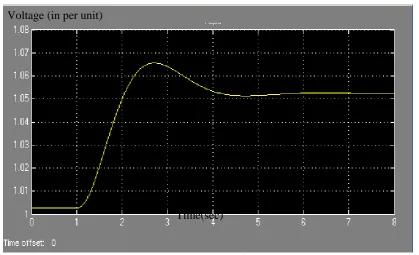
Fig. 1. 2 The excitation response from the stage test
1.3 Related Work
The AC excitation system models represented in IEEE standard 421.5 are nonlinear system
models. Most previous work of parameter estimation of the models was either using linear Time(sec)
model to approximate the given models, such as the Autoregressive (AR) model, or applying
frequency response techniques to identify the parameters of specific exciters [3 5 6 7].
However, most of these approaches require the output of exciter, which cannot be obtained in
a brushless excitation system. And errors can come from the process of transferring the
parameters in approximated model to the ones of given model. Besides, most of previous
work addressed on their own system models rather than the IEEE standard models.
In [3], a time domain approach has been developed to identify the parameters of AC1A in
IEEE standard 421.5[1]. They used ARX model, a linear discrete time model, to approximate
the transfer function of the system, which is a nonlinear model. ARMAX (Autoregressive
moving average with exogenous input model) model is one of the ARX models. The model
ARMAX(p,q,d) can be represented as
∑
∑
∑
= − = − − = + + + = q i b i i t i i t i i t p i i t
t X d
X 1 1 1 η ε θ ϕ
ε , where
i i i θ η
ϕ , , are parameters, Xt−i is the past value of the signal, εt−i is the error which is
generally assumed to be independent identifically-distributed random variables (i.i.d)
sampled from a normal distribution with zero mean, and dt−i is known as the exogenous
input. So a model ARMAX(p, q, d) contains the AR(p) and MA(q) models and a known
external time series dt. Besides ARMAX model, basic ARX model also includes BJ
(Box-Jenkins) and OE (Output-Error) model, which will be used in different cases.
There are two methods to estimate the coefficients in ARX model structure: Lease square
and Instrumental variables. The author used the least-square method to obtain the parameters
of approximated model. For the optimization algorithm, a Gauss-Newton method was
the ARX model, the parameter values of AC1A model were estimated.
The advantage of the method is that after getting the linear expression of the system,
many approaches can be used for estimating the parameters of it. They are to increase the
speed of calculation and reduce the cost of it. But the disadvantage is that the approach may
bring more errors when both approximating the system model with the linear one and
transferring the parameters back from the approximated model to the system model.
In [4], a program was developed by using Simulink and Optimization Toolbox in
MATLAB. Simulink allows an easy implementation of the model, in which the system
models are represented in Laplace frequency domain. And the Optimization Toolbox is a
collection of optimization algorithms with graphic user interface. For the least-square curving
fitting problem, the algorithm can be Gauss-Newton and Levenberg Marquardt. Optimization
algorithm determines new parameters and passes it to the Simulink, Simlink then gives the
corresponding response. “A comparison of the simulation output and the desired one is
displayed for each successive pass of the optimization process.” Hence, the users can see
how the response changed to fit the given response during the solution process. The author
gave an example of implementation of IEEE type 1 excitation system.
Simulink is a convenient graphical tool to implement different excitation models. The
user can change a part of the model or the desired curve freely. However, the algorithms are
limited to the ones provided in Optimization Toolbox. Besides, MATLAB is interpretive
language which takes much more time when running the programs in MATLAB, rather than
the compiler languages like C. We tried to use the approach at the beginning of the research,
Marquardt. In the thesis, we programmed in MATLAB for it have a good communication
with the system model which we have built in MATLAB/Simulink. But for the following
step, we will transplant the program into C or JAVA and have it communicate with the
developed model in PSS/E, which is commercial simulation software.
In [5], a time domain method has been developed to identify IEEE- DC1 and IEEE-
AC1A model parameters. Similar to the approach in [3], the author used a discrete time
model to approximate the system model. Then the least-square method was used to construct
the objective function of the problem. But the difference is that in this paper, they use
stochastic approximation (SA) to find the point at which the objective function can be
minimized to get the parameters. The optimization theory includes two branches known as
deterministic optimization and stochastic optimization. And the stochastic approximation
(SA) is a cornerstone of stochastic optimization. SA methods are used whenever the noise in
the data cannot be ignored. So the SA method creates stochastic equivalents to the classical
conjugate gradient methods. An implementation of SA method is shown in the paper to
estimate the parameters of AC1 type excitation system. In our case, the noises of signals are
in tolerance, so that we did not get into SA methods.
In [6], the discrete-time ARMA (Autoregressive moving average) model was used to
approximate each block of the model by matching the frequency response of them. ARMA
model is also known as Box-Jenkins models, which is one of the ARX models. The model
consists of two parts, autoregressive (AR) part and a moving average (MA) part. [14] The
former part is to represent the signal by itself and the later part is to represent the signal by
(i.i.d.), sampled from a normal distribution with zero mean (εt ~ N(0,σ2) ). In the paper,
the author obtained parameters of approximated ARMA model of each system block and
then transferred them back the ones of excitation system model. The approach is similar with
the one in reference [3], but the ARMA model would be simpler in this paper, for the author
approximated the block of the excitation system separately. We did not choose it because
both the approximated model may bring more error and we cannot have so much real data
from industry, especially for the brushless machines.
In [7], parameter estimation was performed in frequency-domain. The author utilized
FFT and complex curve fitting technique to estimate the parameters of a excitation system
model, which is a model developed by Taiwan Power Company. About the curve fitting, the
main topics include scatter plot, least square regressions (linear and nonlinear), correlation,
normal probability plots and residual plot. Among them, the nonlinear least square regression
is widely used, which nicely integrates algebra and statistics. A modified weighted least
square (WLS) is described in the paper to obtain the objective function of the curve fitting
problem. Then the author performed Fourier Transformation on the time domain responses
to an injected wide-bandwidth signal of the system to obtain the frequency response data, in
order to estimate the parameters of the model. We did not choose the method for we did not
consider the noise of the signal in the problem.
To sum up, the main considerations of choosing algorithms are the speed of convergence,
the cost of calculations and the accuracy of the results. And for adopting the algorithm, we
have to consider the limitation of tool and data available. Therefore, we plan to develop an
which, when we got data from stage test, we can get the appropriate parameters of the model
correspondingly.
1.3.1 Scope of the Thesis:
The study involved first getting a general understanding of each component of the model.
Then, models have been implemented in Simulink and verified by using PSS/E. Then a
literature review has been conducted. After the review of related work on this problem, we
adopted the least square approach to estimate the model parameters. Two optimization
methods have been adopted and implemented to solve the least square problem. Two
excitation systems have been used to test and assess the performance of the proposed method.
1.4 Abbreviation
IEEE Institute of Electrical and Electronics Engineering
NERC North American Electric Reliability Council
AC Alternating Current
ARMAX Autoregressive Moving Average with Exogenous input model
BJ Box-Jenkins
OE Output-Error
SA Stochastic Approximation
ARMA Autoregressive Moving Average
GLS Generalized Least Square
Chapter 2
AC Excitation System Model
2.1 Overview
To capture the behavior of synchronous machine accurately in power system stability studies,
it is essential that their excitation systems are modeled in sufficient detail. The models must
be suitable for representing the actual excitation equipment performance for large, severe
disturbances as well as for small perturbations. [8] Based on excitation power source,
excitation systems are categorized into three groups showing as follows, in which the AC
excitation systems are what we are concerning in the thesis.
Type DC Excitation Systems which utilized a direct current generator with a
commutator as the source of excitation system power. [9]
Type AC Excitation Systems which use an alternator (ac machine) and either
stationary or rotating rectifiers to produce the direct current needed for the generator field.
Type ST Excitation Systems in which excitation power is supplied through
transformers and rectifier.
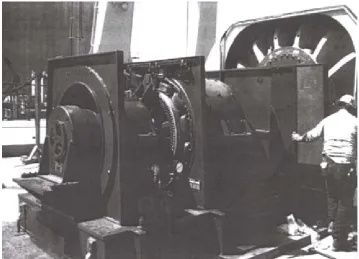
Fig. 2. 1 The real generator and excitation system
Fig. 2. 2 Inside of the excitation system part
Fig. 2. 3 The structure of Mark III Brushless exciter
Brushless Exciter
Main Generator
Fig. 2. 4 The circuit of Generator excitation system
In figure 2.5 there is a general functional block diagram, which shows various
synchronous machine excitation subsystems with a common nomenclature performed in
IEEE std 421.5. Showing in the diagram, the terminal output voltage is sent to the excitation
control elements as a feedback signal (VC and VS). So when VT is unstable, the control
elements provide VR to control the output of exciter, i.e. adjust the field voltage and field
current to have VT back to steady state. VREF is an important input of the control part of
excitation systems. Dynamic responses will be recorded, when a step signal is input to the
REF
V port. And comparing dynamic responses of simulation output and the ones from real
machine is the method which is used to ensure the accuracy of models. VOEL and VUEL
describe the output signals from overexcitation limiters and underexcitation limiters,
respectively, the modeling of which have become a very popular topic recently. [1] VR,
which is the output of voltage regulator, controls the field voltageEFD, in order to control the
Fig. 2. 5 Functional block diagram of a detailed excitation system model [1]
To simplify the problem, the “terminal voltage transducer and load compensator” and
“power system stabilizer and supplementary discontinuous excitation controls” are not
considered in the thesis. We can simply represent the block as shown in figure 2.6, in which
the excitation system includes both excitation control elements and exciter.
Fig. 2. 6 Simplified functional block
2.2 Per Unit System
The per-unit system is the expression of system quantities as fractions of a defined base unit
quantity. [10] i.e. the signals in per-unit systems are normalized to some defined bases. Generator
Excitation System VREF
Firstly, we can define one per unit generator voltage as rated voltage. One per unit exciter
output voltage is that voltage required to produce rated generator voltage on the generator air
gap line.
Also, excitation system models must interface with the synchronous machine model at
both the field terminals and armature terminals. The input control signals to the excitation
system are the synchronous machine stator quantities and rotor speed. The per-unit systems
used for expressing these input variables are the same as those used for modeling the
synchronous machine. Thus, a change of per unit system is required only for those related to
the field circuit.
2.3 AC Excitation System Model Examples
The AC1A excitation model and AC8B excitation model are shown in Figure 2.7 and Figure
2.8, respectively.
AC1A Excitation System
Fig. 2. 7 A partial AC1A Excitation System Block Diagram Showing Major Functional Blocks
Excitation Control Elements
Exciter
AC8B Excitation System
Fig. 2. 8 A partial AC8B Excitation System Block Diagram Showing Major Functional Blocks
2.4 Model Details for the Excitation Systems
2.4.1 Terminal Voltage Transducer and Load Compensator Models
These are the components that transmit the terminal voltage back to the input of the
excitation systems.
Fig. 2. 9 Terminal Voltage Transducer and Optional Load Compensation Elements
VT: Terminal voltage
T
I : Terminal current
C C jX
R + : Load compensator impedance
R
T : Regular input filter time constant
Exciter
2.4.2 Amplifier
Amplifier, represented as the main regulator transfer function, may be the magnetic,
electronic or rotating type. The first two types can be represented by the block diagram of
figure 2.10.
Fig. 2. 10 Amplifier model [10]
A
K : Voltage Regular Gain
A
T : Voltage amplifier time constant
max
R
V : Maximum value of VR
min
R
V : Minimum value of VR
Non-windup limiter
and implementation of which is shown in Figure 2.11 and Figure 2.12, respectively. Then in
principle, we have:
f= Vi−V0 /TA
if V0 = VRmax , and f > 0, then dy/dt is set to 0
if V0 = VR min , and f < 0, then dy/dt is set to 0
otherwise, VR min< V0 < VRmax , then dy/dt = f.
Fig. 2. 11 Non-windup limiter with sample time constant [1]
Fig. 2. 12 Implementation of non-windup limiter
2.4.3 Exciter
The exciter is the part in excitation system which connects to generator. It is the component
who provides the field current to excite the generator. Among the blocks, the vx =VESE(VE)
always approximated by BEXEX
EX X E X
X E S E A e
V = * ( )= .
Fig. 2. 13 Block diagram of an AC exciter
E
T : Exciter time constant
E
V : Exciter internal voltage
E
S : Saturation function
E
K : Exciter constant related to self-excited field
FD D I
K * : Armature reaction demagnetizing effect.
D
2.4.3.1 Saturation Function
Saturation function (per unit):
B B A E
SE X
− =
) (
Fig. 2. 14 AC exciter saturation characteristic
2.4.4 Rectifier
Rectifier is to transfer the Alternative current to direct current, which is required for the field
Fig. 2. 15 Rectifier regulation model [10]
EFD: exciter output voltage(applied to generator field)
EFD = FEX * VE: a function of commutation voltage drop
IFD: generator field current
IN: exciter internal current
FEX = f(IN): the three modes of rectifier circuit operation
Mode 1: f(IN)=1.0−0.577IN, if IN ≤0.433
Mode 2: f(IN)= 0.75−IN2,if0.433<IN <0.75
Mode 3: f(IN)=1.732(1.0−IN),if0.75≤IN ≤1.0
N
I should not be greater than 1.0, but if it is, FEXshould be set to zero.
2.5 Summary
There are three basic elements of an excitation system: excitation control components,
exciter and rectifier. Besides, terminal voltage transducer and compensator components, and
power system stabilizer are additional ones to keep terminal output voltages stable. To know
the typical structure of each functional block and understand the function of each suite of
blocks in typical models is important in modeling an accurate excitation system and
Chapter 3
Parameter Estimation using Least Square Method
Since we want the simulation output of excitation model to follow the measured response at
each time point, we can model the problem as a least square problem. To solve this least
square problem, we tried the Damped Gauss Newton method and Levenberg Marquardt
method, which are two basic method for non-linear optimization problems, to get the local
solution of the least square problem.
3.1 Objective function
Let’s restate the problem. It is a nonlinear least squares problem with an objective function
of the form
) ( ) ( 2 1 ) ( 2 1 ) ( 1 2 t R t R x r x f T M i i = =
∑
= (3.1)in which ri(x)=vi(t:x)−~vi(t),1≤i≤M,t =1,2,..., the vectors viand v~ are the simulation i
output of an nonlinear model and the measured output of the terminal voltage of the
generator, respectively, the vector R=(r1,r2,...,rM)is called the residual,
andx=(p1,p2,...,pN)Tis the vector of unknown parameters. M is the number of
observations and N is the number of parameters. For these problems, M>N, so we say the
problem is an overdetermined problem.
measure data with model function vi(x), which has nonlinear dependence on variables x.
The best approximation means that the sum of squares of residuals ri(x) is the lowest
possible.
The M×N Jacobian R'of R is defined by
N j M i x r x R j i
ij ∂ ≤ ≤ ≤ ≤
∂
= 1 , 1 ))
( '
( (3.2)
With this notation, it is easy to show that
N T R x R x R x
f = ∈
∇ ( ) '( ) ( ) (3.3)
The necessary conditions for optimality imply that at the minimizerx*,
0 ) ( ) (
' x* R x* =
R T (3.4)
There are two main algorithms for solving least square problems, Gauss-Newton method
and Levenberg-Marquardt method, which will be introduced as follows.
3.2 Gauss Newton method [12]
Steps of Gauss-Newton method
• set xc =x0.
• While ∇f(xc)>τrτ0 +τa & iteration < iteration_max. (τ =(τr,τa)is the termination
criteria)
(a) Compute the step s
(b) xt =xc+s
The Gauss-Newton(GN) algorithm computes the step s as ) ( ) ( ' )) ( ' ) ( ' ( ) ( )) ( ' ) ( '
( 1 1 c
T c c T c c c T
c R x f x R x R x R x R x
x R
s=− − ∇ =− − (3.5)
where R' is the Jacobian of R.
3.3 Calculating the Jacobian numerically
Since the GN method requires computing the gradient∇f(x), we need to get Jacobian, since
) ( * ) ( ' )
(xc R xc R xc
f =
∇ (3.6)
Since we have the model simulated in MATLAB simulink, rather than a formula expression
of the system, we used the Finite Difference Method to obtain an approximated Jacobian.
There are three forms of the method, which include forward difference method (formula 3.7),
backward difference method (formula 3.8), and central difference method (formula 3.9). The
central difference method is chosen, for in principle it will bring less errors than either of the
other two does.
Forward difference method :
h x f h x f x
f'( ) ( 0 ) ( 0)
0
− +
= (3.7)
Backward difference method :
h h x f x f x
f'( ) ( 0) ( 0 )
0
− −
= (3.8)
Central difference method:
h h x f h x f x f 2 ) ( ) ( ) (
' 0 0
0
− −
+
= (3.9)
Verification of getting Jacobian using central difference method
identify the two unknown parameters (k and a) of a system a s
k
+ (Figure 3.1) by minimizing
the difference of a numerical prediction and measured data.
Fig. 3. 1 a simple system for Jacobian approximation test (k=xtest(1), a=xtest(2))
Let x=(k,a)T be the vector of unknown parameters. When the dependence on the
parameters needs to be explicit, we will write v(t:x) instead ofv(t). If the outputs are
sampled at M
j j
t } 1
{ = , wheretj =(j−1)T/(M−1), then the observation for output will be M j j
v } 1 { = ,
then the object function is
) ( ) ( 2 1 ) : ( 2 1 ) ( 1 2 x R x R u x t u x f T M j j = − =
∑
= (3.10)on the interval [0,T], where R(x)=
[
u(1:x)−u1, u(2:x)−u2, L u(M:x)−uM]
TThe Jacobian of f is
⎥ ⎥ ⎥ ⎥ ⎥ ⎥ ⎥ ⎦ ⎤ ⎢ ⎢ ⎢ ⎢ ⎢ ⎢ ⎢ ⎣ ⎡ ∂ ∂ ∂ ∂ ∂ ∂ ∂ ∂ ∂ ∂ ∂ ∂ = a x M u k x M u a x u k x u a x u k x u x R ) : ( ) : ( ) : 2 ( ) : 2 ( ) : 1 ( ) : 1 ( ) ( ' M M (3.11) Where h h k t u h k t u k x t u 2 ) : ( ) : ( ) : ( = + − − ∂ ∂
,t=1,2,...,M
Jac_true = 0 0 0.0906 -0.0175 0.1648 -0.0616 0.2256 -0.1219 0.2753 -0.1912 0.3161 -0.2642 0.3494 -0.3374 0.3767 -0.4082 0.3991 -0.4751 0.4174 -0.5372 0.4323 -0.5940 0.4446 -0.6454 0.4546 -0.6916 0.4629 -0.7326 0.4696 -0.7689 0.4751 -0.8009
Absolute error:
Jac_true – Jac_approx =
0 0 -0.0000 -0.0002 -0.0001 -0.0003 -0.0001 -0.0003 -0.0001 -0.0002 -0.0001 -0.0001 -0.0001 0.0001 -0.0001 0.0003 -0.0001 0.0006 -0.0001 0.0009 -0.0001 0.0013 -0.0000 0.0017 -0.0000 0.0022 -0.0000 0.0026 -0.0000 0.0031 -0.0000 0.0035
Relative error: true Jac approx Jac true Jac _ _ _ − =
NaN NaN -0.0004 0.0108 -0.0003 0.0046 -0.0003 0.0024 -0.0003 0.0013 -0.0002 0.0005 -0.0002 -0.0002 -0.0002 -0.0007 -0.0002 -0.0012 -0.0001 -0.0017 -0.0001 -0.0022 -0.0001 -0.0027 -0.0001 -0.0031 -0.0001 -0.0036 -0.0001 -0.0040 -0.0001 -0.0044
) ( ) ( ' ) ) ) : ( ( ) : ( ) ) : ( ( ) : ( ( ) ( 1 1 x R x R u x t u a x t u u x t u k x t u x f j M j j M j = − ∂ ∂ − ∂ ∂ = ∇
∑
∑
= = (3.12)By using the time domain solution of the system a s
k
+ , we have the function analytically:
f(t) = (1 at) e a
k − −
(3.13)
As a result, the exact Jacobian can be calculated.
Selecte k=4 a=2 as the optimum parameters and use k=5 a=2.5 as the initial points in
simulation. The results are as follows:
Jac_approx= 0 0 0.0907 -0.0173 0.1649 -0.0613 0.2257 -0.1216 0.2754 -0.1910 0.3161 -0.2641 0.3495 -0.3374 0.3768 -0.4085 0.3991 -0.4757 0.4174 -0.5381 0.4324 -0.5953 0.4446 -0.6471 0.4547 -0.6937 0.4629 -0.7352 0.4696 -0.7720 0.4751 -0.8044
As listed above, the errors are very small, so that we can use approximated Jacobian instead
3.4 Damped Gauss-Newton method
The Gauss-Newton (GN) direction is a descent direction, but the GN method do not have a
good global convergence performance. When the initial iteration is near the solution, it dose
not suffer from poor scaling of f and converges rapidly. However, when far away from the
solution, the Hessian of GN may not be positive definite and the method will fail. To apply
the Newton method to a global convergence problem, the combination of
Gauss-Newton direction with Armijo rule is made, which is called damped Gauss-Gauss-Newton.
Armijo rule
The Armijo rule is based on a general convergence theorem showing that modified steepest
descent algorithms converge under some conditions.
Principal: If λ is an arbitrarily assigned positive number, λm =λ/2m−1,m=1,2,...,and
) (
1 k m k
k x f x
x
k∇
− =
+ λ , where mk is the smallest positive integer for which
,... 2 , 1 , 0 , ) ( ) ( )) (
(x − ∇f x − f x < ∇f x 2 k =
f k λmk k k αλmk k (3.14)
Then the sequence {xk}∞k=0 converges to the point *
x which minimizes f.
Steps of Damped Gauss-Newton method
1 xc =x0.
2 While ∇f(xc)>τrτ0+τa & iteration < iteration_max. (τ =(τr,τa)is the termination
(a) Compute the direction of a new step dc.
(b) Set the step size λ=1
(c) xt =xc+λdc.
(d) Compute ∇f(xt)
(i) Apply Armijo rule to find an appropriate λm
(ii) Update xt and ∇f(xt)
3.5 Levenberg-Marquardt Method
The damped Gauss Newton algorithm is effective when used for solving zero residual and
small residual problems. But it may fail when the condition number of the matrix
)} ( ' ) ( '
{ T c
c R x
x
R is too small. Therefore, for the medial residual problems,
Levenberg-Marquardt method is chosen.
The Levenberg-Marquardt methods add a regularization parameter v>0to
)} ( ' ) ( ' { c T c R x
x
R in determining the step s
s=−(vcI+R'(xc)TR'(xc))−1R'(xc)TR(xc) (3.15)
where Iis the N×N identity matrix. The matrix vcI+R'(xc)TR'(xc) is positive definite.
And again, if combining the Levenberg-Marquardt with Armijo rule, it become a globally
convergent method for the overdetermined least squares problems.
3.6 Approach I: MATLAB/Simulink Parameter Estimation Toolbox
Gauss-Newton (GN) and Levenberg-Marquardt (LM) methods to solve the least square
problem. The Gauss-Newton method is given as the “fast” option that provides more precise
results, but it may fail when the initial guess for the parameters are far from the solution. It
quits when the condition number of matrices in the algorithm is too low or the step length is
too small. The condition number is a ratio of the largest singular value to the smallest. The
toolbox offers also the “robust” option which uses the Levenberg-Marquardt when
Gauss-Newton quits [14]
To facilitate modeling of the system, the toolbox has interface with the simulink.
Hence, the model can be developed in simulink. During iterations, the PE toolbox sends the
adjusted parameters to the simulink and gets the simulation results from it. The iterations will
be terminated generally when either the difference between two curves is smaller than the
tolerance that we set before, or the algorithm quits as mentioned before.
3.6.1 Simulink in MATLAB
Simulink is a graphical tool for modeling, simulation and analysis of dynamic systems, in
which the systems can be represented by blocks in frequency domain as the ones shown in
IEEE std 421.5[1]. Most of the blocks with certain functions can be found in Simulink library,
a database in MATLAB, and users can write their own ones by using the “s-function” blocks.
With the initial parameters, when the structure of a system is decided, the simulation can be
implemented by simply drawing the blocks from the library to Simulink window, connecting
3.6.2 Parameter Estimation (PE) toolbox in MATLAB
Optimization Tool box is a collection of routines that extend the capability of MATLAB for
problems as nonlinear minimization, equation solving and curve fitting. [3] And the PE
toolbox is actually an interface which has the optimization toolbox and the system model in
Simulink communicate to each other. (Figure 3.2) Moreover, both of PE toolbox and
Simulink have a good communication with workspace in MATLAB. For nonlinear least
squares and curve-fitting problems, the desired curve data and initial parameter values can
be saved in workspace and input to the toolbox by selecting the names of the vectors
correspondingly. The algorithms are mentioned in the previous section. And the output
results, which will be shown in the interface of PE toolbox, include the solutions that
minimize the difference of between simulation output and desired curve data, and a record of
cost function and step size of each iteration.
Fig. 3. 2 A sketch map showing how PE toolbox works
3.7 Approach II : Parameter estimation using LM & DGN
Instead of of Simulink and the existed methods in Optimization toolbox in MATLAB, we
would like to use other simulation tools. At this rate, we may be able to simulate the system
faster using software developed for power system simulation such as PSS/E, and implement
more algorithms to efficiently and accurately estimate the parameters.
The interaction between the simulation tool and optimization tool is shown in Figure 3.3. PE Toolbox
Simulink system model
With initial parameters, simulation output will be obtained from simulation box, which will
be entered into some optimization programs, in which the difference of simulation output and
desired output will be calculated. If the difference does not satisfy the requirement, the
program will adjust the parameter values and get a set of new parameters. With the new
parameters, the system simulates again and produces another suite of outputs.
Fig. 3. 3 Optimization environment
As the first step of the implementation, we will use the simulink for simulation, and
implement the optimization algorithms in Matlab. Later on, after making sure the program do
perform well, we will transplant the program into other computer languages, such as Java or
C and use other simulation tool like PSS/E or ETAP to provide the simulation output.
In this thesis, we tried to program the codes of damped Gauss Newton method, which is a
typical global optimization method for the nonlinear parameter identification. The results of
the implementation of the program on AC1A and AC8B excitation system will be given in
the next chapter.
3.8 Summary
We have got two algorithms and two approaches for solving the least squares problem in
order to estimate the parameter of excitation system. The algorithms used for least square SIMULATION
(Simulink) (PSS/E)
OPTIMIZATION (Optimization Toolbox)
problems are Gauss-Newton (GN) method and Levenberg-Marquardt (LM) method. GN is
effective when there is a good initial guess, but may quit when the initial guess is bad, while
LM will always gives a result when the initial guess is far from the solution, but not as
effective as GN does. By combining either of the algorithm with Armijo rule, it can be
applied to a global convergence problem, for the Armijo rule is for making sure that the step
sizes sufficiently decrease.
For solving the parameter estimation problem, we developed two approaches. One is to
estimate the parameter of excitation system with MATLAB/Simulink and Parameter
Estimation (PE) Toolbox in MATALB, which already has a collection of functions for
solving the least square problem. The other one is to do parameter estimation with
MATLAB/Simulink and the program developed by ourselves. We are using the same
algorithms with the ones used in PE Toolbox, so that we can compare the results of them.
And then, in the following work, we can transplant the algorithm to C or Java to increase the
speed of operation. Moreover, we may try to implement other algorithms other than the two
Chapter 4
Case Studies and Validations
Progress Energy gave us the data from “bump test”, we are using the data to test the method
for parameter estimation. As mentioned in Chapter 1, the system consists of a generator and
its excitation system, shown in Figure 4.1. The generator is set to rotate as the speed of 1 p.u.
(per unit). The excitation system gets the terminal voltage as the feedback from generator and
provides the excitation voltage to the generator.
Fig. 4. 1 Test system for estimating parameters of AC1A excitation system
Our project sponsor, Progress Energy, has provided two sets of data for the two excitation
systems they had performed the bumped test recently. Both of these excitation systems are
of AC type and hence, we choose AC1A and AC8B models to represent them, as suggested
by the manufacturer and the Progress Energy.
Generator
4.1 Case 1: AC1A with typical parameters
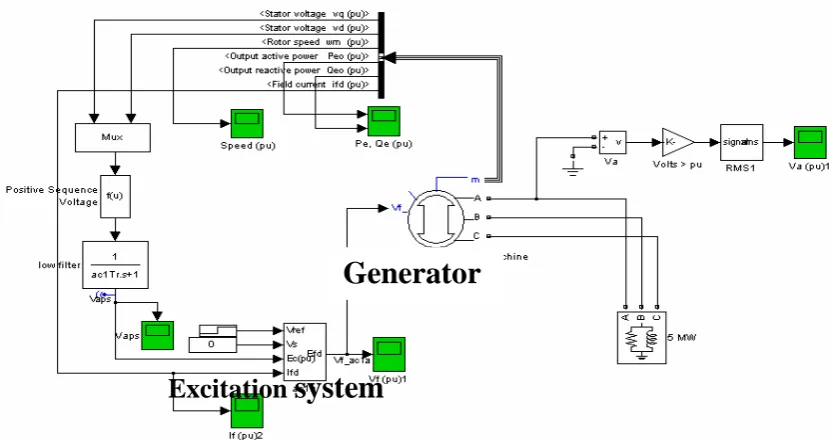
Before doing the parameter estimation, the excitation system has been simulated in
MATLAB/Simulink, which is shown in Fig. 4.2.
Fig. 4. 2 Implementation of AC1A excitation system in MATLAB/Simulink
There are 6 parameters of this system: ac1Ka, ac1Ta, ac1Te, ac1Kf, ac1Tf, ac1Kc, ac1Kd
Progress Energy has provided the initial values for them, which are basically the typical
values given for this type of exciter:
Regulator gain: ac1Ka = 766 Regulator time constant: ac1Ta = 0.0200 Exciter time constant: ac1Te = 1.3000 Damping filter gain: ac1Kf = 0.0240 Damping filter time constant: ac1Tf = 1.0000 Rectifier loading factor: ac1Kc = 0.4860 Demagnetizing factor: ac1Kd = 0.3556
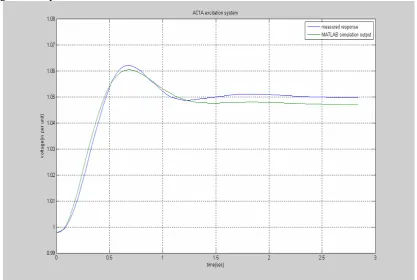
Fig. 4.3 compares the simulation response with these initial values with the actual
Fig. 4. 3 Model response with typical parameters of AC1A excitation system
4.1.1 Parameter Estimation Using Matlab PE Toolbox
Firstly, the Matlab PE Toolbox has been used to estimate the parameters based on the bump
test results given in Fig. 4.3. (Blue line) The robust option has been used for the solution.
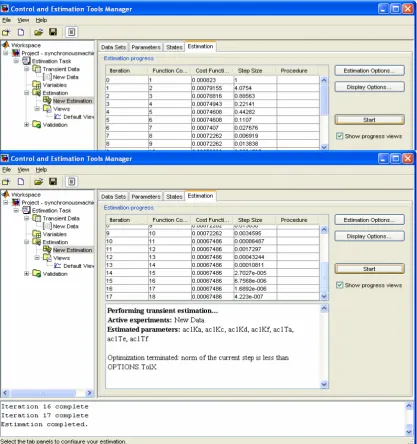
Figure 4.4, shows the iterations that were taken and, cost function and step size of each
iteration. Cost function shows the difference between the simulation output and measured
output. And the step size shows convergence speed. As shown in the figure, the optimization
terminated for the step size is too small, which means the program cannot find a good enough
Fig. 4. 4 Cost function and step size of each iteration with typical parameters of AC1A excitation system
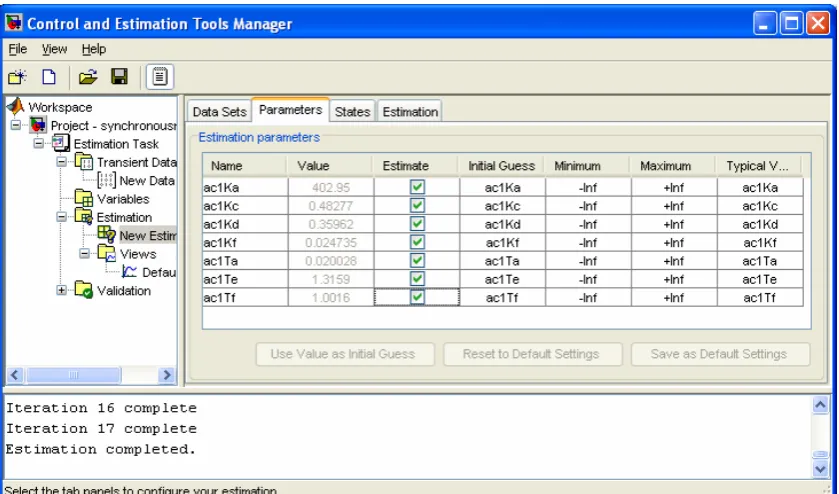
The Parameters obtained are as follows:
Fig. 4. 5 Estimated parameters of AC1A excitation system starting from typical parameters
Figure 4.6 compares the simulation response using the estimated parameters with the
measured response.
Fig. 4. 6 Final terminal output of generator with typical parameters of AC1A excitation system (Grey - Desired curve, Blue – Simulation output)
Parameter Trajectory
Sensitivity of parameters is another important issue. With knowing the sensitivity of each
parameter, when manually adjusting the parameters, the engineer can adjust the one who has
the most sensitivity. It will increase the efficiency of the work. From figure 4.5, we can see
They can be considered as the main factors for the curve fitting, which means that they have
the most sensitivity. There is another plot provided by the PE toolbox, which can also be
used to estimate the sensitivity. That is the parameter trajectory plot (figure 4.7), from which
we can see the changes of parameters by iteration.
4.1.2 Parameter Estimation using Damped Gauss Newton
As the second option, the damped Gauss Newton Method which has been implemented
in MATLAB codes has been used to estimate the parameters, using the same initial
parameter values. In table 1 listed the iteration history of the operation.
Table 1 Iteration history of parameter estimation of AC1A starting from typical parameters using DGN
Norm(gc) f(xc) Armijo iter. Iteration
0.0034 0.0023 0 0
0.0033 0.0018 9 1
0.0086 0.0018 0 2
0.0036 0.0006 0 3
0.0016 0.0003 0 4
0.0005 0.0002 0 5
0.0002 0.0001 0 6
0.0004 0.0001 0 7
0.0003 0.0001 0 8
0.0004 0.0001 0 9
0.0004 0.0001 0 10
This method yielded the following values:
Xmodel_GN=
ac1Ka ac1Kf ac1Te ac1Tf ac1Ta ac1Kc ac1Kd 669.3898 0.0502 3.0419 1.7159 0.0339 0.5123 -0.3254
Fig. 4.8 compares the simulation response with the test data. As it indicates, it is a good
fit. The method did converge, but did not converge to the best solution. Since we did not
Fig. 4. 8 Final terminal output of generator starting from typical parameters using DGN
4.1.3 Parameter Estimation using LM and DGN
For improving the result, we choose the combination of Levenberg Marquardt method and
Damped Gauss Newton method. The LM method has been used to get the better start point
L
P first and then DGN method has been used to get the solution. The initial parameters are
the same as the previous case, which is
X0 =
ac1Ka ac1Kf ac1Te ac1Tf ac1Ta ac1Kc ac1Kd 766 0.0200 1.3000 0.0240 1.0000 0.4860 0.3556
4.1.3.1 Levernberg Marquardt
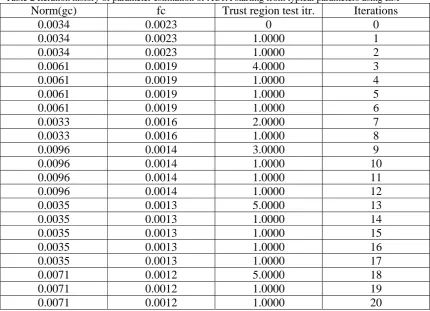
Table 2 Iteration history of parameter estimation of AC1A starting from typical parameters using LM
Norm(gc) fc Trust region test itr. Iterations
0.0034 0.0023 0 0
0.0034 0.0023 1.0000 1
0.0034 0.0023 1.0000 2
0.0061 0.0019 4.0000 3
0.0061 0.0019 1.0000 4
0.0061 0.0019 1.0000 5
0.0061 0.0019 1.0000 6
0.0033 0.0016 2.0000 7
0.0033 0.0016 1.0000 8
0.0096 0.0014 3.0000 9
0.0096 0.0014 1.0000 10 0.0096 0.0014 1.0000 11 0.0096 0.0014 1.0000 12 0.0035 0.0013 5.0000 13 0.0035 0.0013 1.0000 14 0.0035 0.0013 1.0000 15 0.0035 0.0013 1.0000 16 0.0035 0.0013 1.0000 17 0.0071 0.0012 5.0000 18 0.0071 0.0012 1.0000 19 0.0071 0.0012 1.0000 20
This method yielded the following values:
Xmodel_LM =
ac1Ka ac1Kf ac1Te ac1Tf ac1Ta ac1Kc ac1Kd 500.8150 0.0271 2.0854 1.0073 0.0186 0.4747 0.3537
According to the values of cost functions, the iterations converged. It terminated due to
the maximum iteration limit, which means that the program stopped before finding the best
solution. As indicated in the Fig. 4.9, the curves did not match to each other well, for the
Fig. 4.9 compares the result with data.
Fig. 4. 9 Final terminal output of generator starting from typical parameters using LM
4.1.3.2 Damped Gauss Newton
In Table 3 shows the history of the iteration when using Gauss Newton starting from the
parameters getting from Levenberg Marquardt method PL, which is
xstart =
ac1Ka ac1Kf ac1Te ac1Tf ac1Ta ac1Kc ac1Kd 500.8150 0.0271 2.0854 1.0073 0.0186 0.4747 0.3537
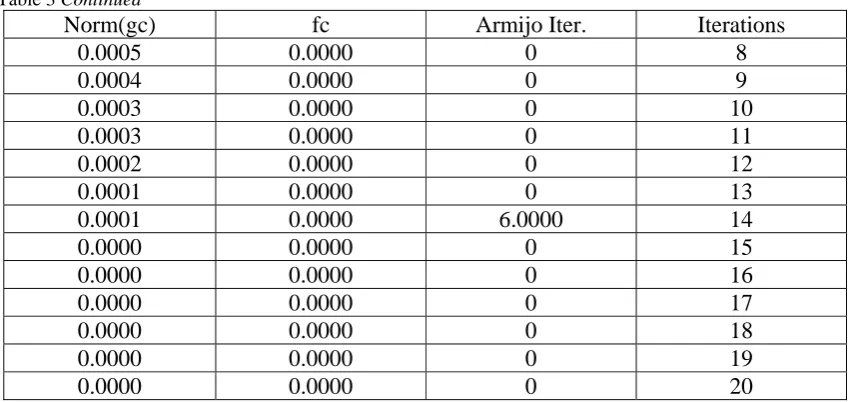
Table 3 Iteration history of parameter estimation of AC1A starting from PL using DGN
Norm(gc) fc Armijo Iter. Iterations
0.0006 0.0004 0 0
0.0008 0.0002 0 1
0.0011 0.0001 0 2
0.0011 0.0001 0 3
0.0010 0.0001 0 4
0.0008 0.0001 0 5
0.0007 0.0000 0 6
Table 3 Continued
Norm(gc) fc Armijo Iter. Iterations
0.0005 0.0000 0 8
0.0004 0.0000 0 9
0.0003 0.0000 0 10
0.0003 0.0000 0 11
0.0002 0.0000 0 12
0.0001 0.0000 0 13
0.0001 0.0000 6.0000 14
0.0000 0.0000 0 15
0.0000 0.0000 0 16
0.0000 0.0000 0 17
0.0000 0.0000 0 18
0.0000 0.0000 0 19
0.0000 0.0000 0 20
This method yielded the following values:
xcurrent =
ac1Ka ac1Kf ac1Te ac1Tf ac1Ta ac1Kc ac1Kd
1.0e+003 *
1.0427 0.0001 0.0050 0.0018 0.0001 0.0003 -0.0002
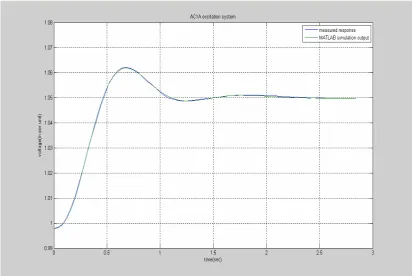
The method did converge. Fig. 4.10 shows that the model response matches the
Fig. 4. 10 Final terminal output of generator when estimating AC1A excitation starting from PL using DGN
4.2 Case 2: AC1A with good initial paramters
When started with typical parameter values, the two methods did not reach the same solution.
To find a better solution, John O’connor who is the expert on using these models in Progress
Energy, adjusted the parameter values manually to find a better initial point. This new initial
parameters have been given as:
As Fig.4.11 shows these values indeed yield a simulation response that is much closer to the
actual response than that of the original parameter values.
Fig. 4. 11 Model response with good parameters of AC1A excitation system (Grey - Desired curve, Blue – Simulation output)
4.2.1 Parameter Estimation Using Matlab PE Toolbox
For the case, again we tried Matlab PE Toolbox first to estimate the parameters. The fast
option has been used for the solution, for it has good initial points. Figure 4.12 shows the
iterations that were taken and, cost function and step size of each iteration. The program may
not find a good enough solution before it converge, for the optimization terminated for the
Parameters obtained are:
Fig. 4. 13 Estimated parameters of AC1A excitation system starting from good initial parameters
We get: Initial value: Regulator gain: ac1Ka = 402.95 ac1Ka = 400 Regulator time constant: ac1Ta = 0.020028 ac1Ta = 0.0200 Exciter time constant: ac1Te = 1.3159 ac1Te = 1.3000 Damping filter gain: ac1Kf = 0.024735 ac1Kf = 0.0240 Damping filter time constant: ac1Tf = 1.0016 ac1Tf = 1.0000 Rectifier loading factor: ac1Kc = 0.54693 ac1Kc = 0.4860 Demagnetizing factor: ac1Kd = 0.35962 ac1Kd = 0.3556
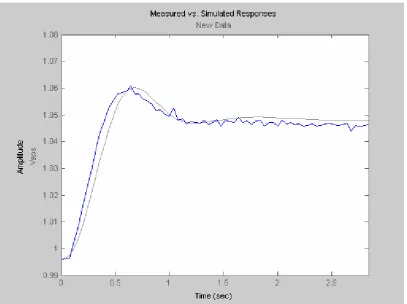
Figure 4.14 compares the model response using the estimated parameters with the
Fig. 4. 14 Final terminal output of generator when estimating AC1A excitation system starting from good parameters (Grey - Desired curve, Blue – Simulation output)
4.2.2 Damped Gauss Newton
The damped Gauss Newton Method implemented in Matlab has also been used to estimate
the parameters using the same initial parameter values. Here we also only use DGN method,
rather than use the combination of GN method and LM method. In Table 4 listed the iteration
history of the operation.
Table 4 Iteration history of parameter estimation of AC1A starting from PL using DGN
Norm(gc) f(xc) Armijo iter. Iteration
0.0237 0.0066 0 0
0.0035 0.0001 0 1
0.0025 0.0001 0 2
0.0012 0.0000 0 3
0.0005 0.0000 0 4
0.0007 0.0000 0 5
This method yielded the following values:
Xmodel=
ac1Ka ac1Kf ac1Te ac1Tf ac1Ta ac1Kc ac1Kd
364.1523 0.0413 1.6724 1.4580 0.0542 0.4860 0.4039
cost: fc = 1.0498e-005
The method converged fast(only 6 iterations) and sufficiently reduced the residuals to 1e-5,
which can tell us DGN method works well. When starting from a good initial points, using
DGN, the iteration converges well and provides good results The terminal output curve is
shown in Fig. 4.15.
Fig. 4. 15 Final terminal output of generator when estimating AC1A excitation starting from a good initial point
4.3 Case 3: AC1A with Low Parameters
To test the method, we tried two more cases using the combination of LM and DGN. One of
X0 = ac1Ka ac1Kf ac1Te ac1Tf ac1Ta ac1Kc ac1Kd
383.0000 0.0100 0.6500 0.0120 0.5000 0.2430 0.1778
Fig 4.16 shows the simulation with the initial parameters.
Fig. 4. 16 Model response with low parameters of AC1A excitation system
4.3.1 Levernberg Marquardt
Table 5 shows the history of the iteration when using Levenberg Marquardt.
Table 5 Iteration history of parameter estimation of AC1A starting from low parameters using LM
Norm(gc) fc Trust region test itr. Iterations
0.0378 0.0244 0 0
0.0378 0.0244 1.0000 1
0.0378 0.0244 1.0000 2
0.0378 0.0244 1.0000 3
0.0286 0.0096 2.0000 4
0.0286 0.0096 1.0000 5
0.0286 0.0096 1.0000 6
0.0102 0.0046 2.0000 7