Effective Needs of Space-Time-Frequency
Coding in MIMO-OFDM Communication
over Frequency Selective Fading Channels
Sardar Khame Singh, Dr. Shah Aqueel Ahmed
Research Scholar, Rayalaseema University, Kurnool, AP, India.
Principal, Maulana Mukhtar Ahmad Nadvi Technical Campus, Malegaon, Dist. Nasik, India.
ABSTRACT: This paper proposes novel Space-Time-Frequency [STF] coding for multiantenna Orthogonal Frequency
Division Multiplexing [OFDM] transmissions over frequency particular Rayleigh blurring channels. Joining sub channel gathering what's more, picking proper framework parameters, we initially change over our framework into an arrangement of gathering STF [GSTF] frameworks. This empowers improvement of STF coding inside each GSTF system. We infer plan criteria for STF coding and adventure existing ST coding systems to develop both STF square and trellis codes. The subsequent codes are appeared to be equipped for accomplishing greatest differing qualities also, coding picks up, while managing low-multifaceted nature unraveling. The execution benefit of our plan is affirmed by confirming reenactments and contrasted and existing options.
KEYWORDS: STF-Coding, MIMO-OFDM, Diversity Channel Analysis, Channel Fading Analysis, Transmit Antenna
Diversity.
I. INTRODUCTION
The significant driver for broadband remote interchanges has been dependable high-information rate administrations [e.g., ongoing interactive media services]. This, together with the shortage of data transmission assets, persuade inquire about toward creating productive coding and tweak conspires that enhance the quality and transfer speed effectiveness of remote frameworks. In remote connections, multipath blurring causes execution debasement and constitutes the bottleneck for expanding information rates. Customarily, the most well known strategy to battle blurring has been the abuse of assorted qualities.
Space-Time-Frequency [ST] coding has been demonstrated compelling in battling blurring, and upgrading information rates; see the references in that. Abusing the nearness of spatial assorted qualities offered by numerous transmit and additionally get reception apparatuses, STF coding depends on concurrent coding crosswise over space and time to accomplish differences pick up without fundamentally giving up valuable transmission capacity. Two commonplace cases of ST codes are ST trellis codes and ST piece codes.
In ST coding, the most extreme achievable assorted qualities advantage is equivalent to the result of the quantity of transmit and get reception apparatuses; along these lines, it is compelled by the size and cost a framework can manage. The last thought processes abuse of additional assorted qualities measurements, for example, multipath differing qualities. Multipath assorted qualities ends up plainly accessible when recurrence selectivity is available, which is the run of the mill circumstance for broadband remote channels [16].
[4], [14], [18], [2]. Among them, [14] and [2] depend on consolidating ST codes with excess or no redundant straight proceeds.
Most extreme differing qualities pick up is accomplished in [14] and [2] to the detriment of data transfer capacity productivity [14] or expanded unraveling multifaceted nature [14]. Then again, [1], [4], [5], [12], and [18] depend on space-recurrence [SF] coding, which adds up to at the same time coding over space and recurrence. Be that as it may, because of the restrictive unpredictability in building the codes, no SF codes have been composed in [1], [4], [12], or [18]. Rather, [1], [4], [12], and [18] just receive existing codes [ST piece codes in [4] and trellis-coded tweak [TCM] codes in [1], [4], [12], [18]], without greatest differing qualities pick up ensures. In [5], a SF code is proposed to accomplish most extreme differing qualities pick up to the detriment of transfer speed productivity.
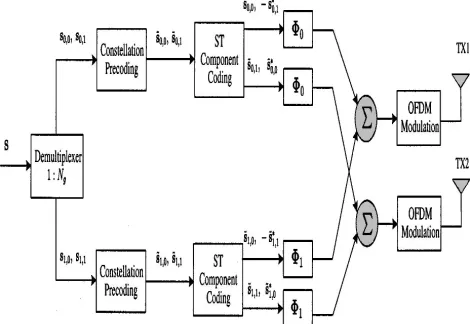
Additionally, issues relating to boosting the coding increase of ST-coded transmissions over recurrence particular channels presently can't seem to be tended to. Concentrating on multiantenna orthogonal recurrence division multiplexing [OFDM] transmissions through recurrence particular Rayleigh blurring channels, this paper seeks after a novel way: joint space-time-frequency [STF] coding over space, time, and recurrence. Turning to sub-channel gathering [10], [17], [24] and by picking appropriate framework parameters, we initially isolate the arrangement of for the most part connected OFDM subchannels into gatherings of subchannels. We consequently change over our framework into an arrangement of what we term bunch STF [GSTF] subsystems, inside which STF coding is considered. By inferring outline criteria for STF codes, we give a connection between STF codes and existing ST codes. We demonstrate that subchannel gathering preserves most extreme differing qualities picks up while streamlining the code development as well as the unraveling calculation altogether also.
II. PROPOSED SYSTEM SUMMARIZATION
Going for augmenting both differences and coding picks up, we build two sorts of STF codes [STF piece [STFB] codes and STF trellis [STFT] codes], whose execution is explored both by hypothetical investigates and by substantiating reproductions.
The significant commitments of this paper are the accompanying.
For multiantenna OFDM frameworks, we present the idea of STF coding to empower most extreme assorted qualities, high coding increases, and low interpreting multifaceted nature.
For GSTF frameworks, we infer plan criteria of STF codes and expressly connect them to those of ST codes. The last encourages misuse of existing ST coding methods in planning STF codes.
Under the built up outline criteria, we develop STFB and STFT codes, which perform well in different channel situations.
III. LITERATURE SURVEY
In the year of 2001 the authors "Y. Liu, M. P. Fitz, and O. Y. Takeshita" dictated into their paper titled "Space-time codes performance criteria and design for frequency selective fading channels" such as the space time code design for single carrier transmission over frequency selective fading channels. The design criteria are derived first and then we apply the algebraic /spl Sigma//sub 0/-rank theory to show how to design codes to take advantage of space and frequency diversity simultaneously. Finally, example codes are shown to achieve desired level of diversity by simulation results.
In the year of 2001 the authors "Z. Liu and G. B. Giannakis" dictated into their paper titled "Space-time block coded multiple access through frequency-selective fading channels" such as the performance and capacity of space time block coded (STBC) multi-user CDMA system over Rayleigh fading channel condition using multiple transmit antennas is investigated in this approach. Using simulation and analytical approach, we show that STBC CDMA system has increased performance in cellular networks. We also compare the performance of this system with the typical CDMA system and show that STBC and multiple transmit antennas for multi-user CDMA system provide performance gain without any need of extra processing or bandwidth.
IV. ISSUES IN SYSTEM MODELING
In this area, we address a few plan issues by giving responses to the accompanying two inquiries.
Question-1) How much differences advantage is adequate?
Question-2) is it better to utilize STF piece or STF trellis coding?
(i). Request of Diversity Advantage
As said in Section I, the real inspiration driving STF coding is to enhance the differing qualities advantage from arrange NtNr (in a ST coded framework) to arrange by promoting likewise on multipath assorted qualities. Then again, instinct recommends that execution change by expanding will in the end immerse as the differing qualities arrange develops past a specific level [22]. Subsequently, STF coding bodes well when we are managing frameworks having few radio wires, which is additionally industrially best. Specifically, we are occupied with a negligible multiantenna framework with and for downlink applications. As contended in [22], when , little can picked up by utilizing more than transmit recieving wires in a ST coded framework.
Henceforth, ought to be sufficient to give adequate differences advantage in our STF framework with and , which is attractive on the off chance that we review that the littler the , the lower the translating multifaceted nature for both STFB and STFT codes. Up until this point, we have confined to be the physical channel arrange. In the spin-off, we lift this confinement by letting signify the physical channel arrange and the direct request expected in planning STF codes. Clearly, can be for the most part not the same as. In ordinary remote conditions, we have.
Keeping in mind the end goal to limit translating many-sided quality, we can basically pick and outline our STF codes as point by point in Sections III–V. Truth be told, if , the subsequent framework will have the capacity to accomplish differing qualities preferred standpoint of request and high coding advantage. Unmistakably, the accomplished execution will be problematic for this situation, yet it will be adequately useful for most functional applications.
(ii). STF Block Coding Versus STF Trellis Coding
Likewise, the development of STF piece codes is simpler than that of STF trellis codes. Then again, STF trellis coding works in a path like regular channel coding; along these lines, it can be effectively joined to existing correspondence frameworks. For instance, a ST trellis decoder can be specifically connected to STF trellis codes.
V. EXPERIMENTAL RESULTS
Notwithstanding hypothetical examination and dialogs, we introduce reenactments to explore the execution of our plans in a base multiantenna OFDM framework with Nt=2 and Nr=1. Our figure of legitimacy is OFDM image mistake rate (OFDMSER), which we normal more than 100 000 channel acknowledge. To look after reasonableness, we will settle the transmission rate at bps/Hz in all recreations. The irregular channels are created by two diverse channel models.
Fig.3 Comparative Resulting Analysis
VI. CONCLUSION
We planned STF codes for multi-antenna OFDM transmissions over recurrence particular Rayleigh blurring channels. So as to improve the plan, we initially performed sub-channel gathering to change over the complex STF codes outline into less complex GSTF plans per gathering. In light of the determined plan criteria, we built both GSTF piece codes, and GSTF trellis codes. We demonstrated that the subsequent GSTF codes are fit for accomplishing the full assorted qualities pick up, which squares with the result of the quantity of transmit and get receiving wires times the channel length. Notwithstanding improved plan and low interpreting multifaceted nature, the execution of our outlines has been affirmed by reproductions that likewise represent its benefits in respect to contending plans.
REFERENCES
[1] D. Agrawal, V. Tarokh, A. Naguib, and N. Seshadri, “Space-time coded OFDM high data-rate wireless communication over wideband channels,” in Proc. Veh. Technol. Conf., Ottawa, ON, Canada, May 18–21, 1998, pp. 2232–2236.
[2] S. M. Alamouti, “A simple transmit diversity technique for wireless communications,” IEEE J. Select. Areas Commun., vol. 16, pp. 1451–1458, Oct. 1998.
[3] S. Baro, G. Bauch, and A. Hansmann, “Improved codes for space-time trellis-coded modulation,” IEEE Commun. Lett., vol. 4, pp. 20–22, Jan. 2000.
[4] H. Bölcskei and A. Paulraj, “Space-frequency coded broadband OFDM systems,” in Proc. ofWireless Commun. Networking Conf., Chicago, IL, Sept. 23–28, 2000, pp. 1–6.
[6] J. Boutros and E. Viterbo, “Signal space diversity: A power- and bandwidth-efficient diversity technique for the rayleigh fading channel,” IEEE Trans. Inform. Theory, vol. 44, pp. 1453–1467, July 1998.
[7] “Channel models for Hiperlan/2 in different indoor scenarios,” Eur. Telecommun. Stand. Inst., Sophia-Antipolis, Valbonne, France, Norme ETSI, document 3ERI085B, 1998.
[8] M. O. Damen, A. Chkeif, and J. C. Belfiore, “Lattice code decoder for space-time codes,” IEEE Commun. Lett., vol. 4, pp. 161–163, May 2000. [9] X. Giraud, E. Boutillon, and J. C. Belfiore, “Algebraic tools to build modulation schemes for fading channels,” IEEE Trans. Inform. Theory, vol. 43, pp. 938–952, May 1997.
[10] D. L. Göeckel, “Coded modulation with nonstandard signal sets for wireless ofdm systems,” in Proc. Int. Conf. Commun., Vancouver, BC, Canada, June 1999, pp. 791–795.
[11] J. C. Guey, M. P. Fitz, M. R. Bell, and W. Y. Kuo, “Signal design for transmitter diversity wireless communication systems over rayleigh fading channels,” IEEE Trans. Commun., vol. 47, pp. 527–537, Apr 1999.
[12] Y. Li, J. C. Chung, and N. R. Sollenberger, “Transmitter diversity for OFDM systems and its impact on high-rate data wireless networks,” IEEE J. Select. Areas Commun., vol. 17, pp. 1233–1243, July 1999.
[13] Y. Liu, M. P. Fitz, and O. Y. Takeshita, “Space-time codes performance criteria and design for frequency selective fading channels,” in Proc. . Int. Conf. Commun., Helsinki, Finland, June 11–15, 2001, pp. 2800–2804.
[14] Z. Liu and G. B. Giannakis, “Space-time block coded multiple access through frequency-selective fading channels,” IEEE Trans. Commun., vol. 49, pp. 1033–1044, June 2001.
[15] Z. Liu, G. B. Giannakis, S. Barbarossa, and A. Scaglione, “transmit antennae space-time block coding for generalized OFDM in the presence of unknown multipath,” IEEE J. Select. Areas Commun., vol. 19, pp. 1352–1364, July 2001.
[16] Z. Liu, G. B. Giannakis, B. Muquet, and S. Zhou, “Space-time coding for broadband wireless communications,” Wireless Syst. Mobile Comput., vol. 1, no. 1, pp. 33–53, Jan.–Mar. 2001.
[17] Z. Liu, Y. Xin, and G. B. Giannakis, “Linear constellation precoding for OFDM with maximum multipath diversity and coding gains,” in Proc. 35th Asilomar Conf. Signals, Syst., Comput., Pacific Grove, CA, Nov 4–7, 2001, pp. 1445–1449.
[18] B. Lu and X. Wang, “Space-time code design in OFDM systems,” in Proc. Global Telecommun. Conf., vol. 2, San Francisco, CA, Nov.–Dec. 27–1, 2000, pp. 1000–1004.
[19] A. F. Naguib, N. Seshadri, and R. Calderbank, “Increasing date rate over wireless channels,” IEEE Signal Processing Mag., vol. 17, pp. 76–92, May 2000.