Energy Efficient LTE-Advanced Device to
Device Communication
Ravindra S 1, Dr. Siddesh G K 2
Research Scholar, Department of Electronics and Communication Engineering, DSCE, K.S.Layout, Bengaluru, India1 Professor, Department of Electronics and Communication Engineering, JSSATE, Kengeri Rd, Bengaluru, India2
ABSTRACT: In Device-to-device communications two user equipments communicates directly without using the base station and hence, reduces the cellular traffic. D2D communication helps to improve energy efficiency, throughput and reduces the delay in cellular networks. This paper mainly focuses on energy-efficient device-to-device (D2D) communications in cellular networks. We aim to maximize the overall energy-efficiency (EE) of D2D users and regular cellular users (RCUs) considering the circuit power consumption and the quality-of-service (QoS) requirements for both types of users. This paper presents a flexible mode selection scheme using the proposed Branch and Bound algorithm which also helps in power control. The developed framework is used to analyze and understand how the underlying D2D communication affects the cellular network performance. Through comprehensive numerical analysis, we investigate the expected performance gains and provide guidelines for selecting the network parameters.
KEYWORDS:D2D, Energy efficiency, QoS, Spectral efficiency, LTE-A. I. INTRODUCTION
D2D communications in LTE-A cellular networks provides a great attention for increasing the cellular capacity, improving throughput, energy efficiency and increasing the battery lifetime of user equipments. D2D underlying a licensed cellular network, provides more service guarantee in a controlled environment, enables a user equipment unit (UE) to communicate with another nearby UE directly over a D2D link under the cellular network channel resources, without extra hops through the central base station (BS). D2D communication allows fast access to the radio spectrum with controlled interference levels and holds the promise of four types of gain: the proximity gain, the reuse gain, the hop gain, and the paring gain [6]. The typical D2D communication applications are peer-to-peer file sharing, local voice service, video streaming, and content-aware applications. Mode selection for spectrum sharing between D2D links and cellular UEs in a wireless network has been studied in [7] and [8]. Resource optimization in D2D systems using time–frequency hopping is presented in [9]. Power control in D2D communications to minimize the total downlink transmission power subject to the quality-of-service (QoS) demands of UEs is considered in [10]. To improve the scalability of D2D communications, distributed resource allocation methods for D2D communications are discussed in [1]. Interference management to improve the reliability of D2D communications are studied in [2], and some state-of-art interference management mechanisms for D2D networks are proposed in [3] and [4]. D2D communications under multiuser MIMO channels are investigated in [5].
between a UE pair does not need to traverse through the eNB (abbreviation for evolved Node B or eNodeB) as long as they are in region of proximity. When the devices are not in the region of proximity, the D2D communication takes place through eNB. Since eNB is not involved in communication with UEs when they are in the region of proximity, energy efficiency can be increased.
Fig.1. Different UE communication modes
Because of short communication range between a D2D pair, D2D communication helps in improving energy efficiency, throughput, delay, spectrum efficiency etc. Energy efficiency is defined as information bits per unit of energy. It is an essential requirement for the design of future wireless communication in addition to spectral efficiency. The applications of D2D communication include content sharing, gaming, traffic offloading, disaster relief, etc.
The main contribution of this paper can be summarized as follows:
1. We propose a EE optimization model for D2D communications by mode selection, power allocation, and spectrum partitioning.
2. The proposed technique is implemented using Branch and Bound algorithm considering the most required parameters for communication and we show the improvement of the proposed technique comparing with the early attempts to solve the EE optimization problems using Dinkelbach method.
3. Through simulation, we have shown the effectiveness of the proposed optimal D2D mode switching algorithm. We compare both algorithms in terms of device to device distance and EE using computer simulations. Result shows that the proposed algorithm offers near optimal performance with less computational cost.
The rest of the paper is organized as follows. In Section II, the system model and problem formulation is described. In Section III, the energy efficiency analysis is described to solve the EE optimization problems. Then, we present simulation results in Section IV. Finally, conclusions are drawn in Section V.
II. SYSTEM MODEL AND PROBLEM FORMULATION
For the analysis of our model we considered the D2D uplink EE is based on a MAC (Multi Access Channel) system composed of one BS and 3 users: UE1 , UE2 and UE3 . Where UE1 and UE2 have a directional D2D communication where UE1 the transmitter and UE2 the receiver and where UE3 has an uplink with BS. The system has a total bandwith W shared by all users. The power radiated from the D2D transmitter user equipments is noted pdc. Let M
the half-duplex decode-and-forward fashion, to assist in the transmissions [1]. The information delivery process within the considered D2D system is carried out in the reuse-mode coexists with the uplink transmissions of a cellular user C. D2D communications in general allowed for geographically closed users, the typical transmission power levels are constrained. If the D2D users are located in an indoor environment, an extra penetration loss induced by building walls would appear in the path loss model between the D2D and cellular systems [2]. Considering that cellular base stations have stronger interference cancellation capabilities, we neglect the interference from D2D users to the cellular system, but the uplink transmissions of C would interfere the D2D receivers. For presentation simplicity, we assume that all links within the D2D system experience a similar level of propagation loss.
All the D2D users transmit with identical power P. Each message contains the same information rate R (in bits) and its transmission spans one unit-bandwidth TDMA time slot [4]. The analysis presented later can also be extended to general cases. The considered system studies the situation that all the N destinations are interested in all the M source messages. Hence if every destination is capable of recovering IS1, . . . , ISM without any error, the communication is successful [10]. Otherwise, if at least one of the destinations cannot obtain any message, the communication is declared to be failed. In addition, the channel codes employed on the physical layer are assumed to be sufficiently strong. The error probability at each receiver is therefore dominated by the outage probability. The delivery of IS1, . . . , ISM from the sources to the destinations consumes a total of M+K time slots. At the mth (1 ≤ m ≤ M) slot, Sm broadcasts ISm to all the relays and destinations. The remaining K time slots are assigned to the K relays respectively. If Rk (1 ≤ k ≤ K) correctly recovers all the M source messages using its received signals from S1, · · · , SM,R1, · · · ,Rk−1, it combines IS1 , · · · , ISM to a new codeword IRk and broadcasts IRk to all the remaining relays and the destinations, at the (M + k)th time slot. Otherwise, Rk remains silent to avoid error propagation [1].
Each eNodeB coverage area is spread all over its cell. Consider C cells, where each cell is covered by eNodeBs around it. The total number of all eNodeBs in this model is E. There are different types of MTCs in each cell, say T types. The devices are categorized into types based on their traffic characteristics as MTCs could be carrying signal data, voice, video and web traffic, etc. There are N devices in each type T, i.e., T (1, 2, 3,…, N). We consider the case of two eNodeBs serving three areas. Area1 is served by eNodeB 1 only and area 2 is served by eNodeB 2 only. The overlapping area 3 is the common coverage area between area 1 and area 2 and can communicate with either eNodeB 1 or 2. In particular, if multiple concentrators are available, devices choose to communicate with only one eNodeB at a time. The particular channel realizations are transparent to the algorithms to be developed in the sequel, and the considered model is general enough to apply to many instances of communication systems in which a primary and a secondary link interfere with one another [9]. In D2D cellular communications, a pair of neighboring terminals bypasses the base station directly communicating with each other over a resource block used by a cellular user. The primary link is identified with the link between the cellular user and the base station, while the secondary link is represented by the D2D pair.The cellular user suffers no interference from other cellular users, since it uses a dedicated resource block, which is the case in present 4G systems (e.g. LTE-A networks).
III. ENERGY EFFICIENCY ANALYSIS
The achievable energy efficiency, denoted by ξEE, is defined as the average successful transmission data rate between
the sources and the destinations, in bits per unit of bandwidth by using one joule energy. For D2D communication, the sum of the power of all bands should equal the total transmission power, which is determined by D2D terminals[4]. To calculate ξEE, we use Pout to denote the system outage probability, i.e., the probability that the communication fails or
at least one destination cannot successfully obtain all the source messages. Then the system achievable spectral
efficiency ηSE is defined as
ηSE = (1−Pout) R (1)
Where R = MR M+K is the average transmission rate of the M-source D2D network (M + K) is the number of time slots consumed to complete transmission) [4]. In addition, we denote the total power consumption of the system by Ptotal. Clearly, Ptotal consists of two parts: the sources’ power consumption and relays’. The former can be expressed by M(P + Pdc), where P is transmit power of each D2D device and Pdc represents circuit power of the device. The total power consumption is calculated using the following equation.
Ptotal = M(P+Pdc) + ∑ ((1−Pout, k)(P + Pdc) + Pout, kPidle) (2)
If the user equipment terminals are not in the proximity of service i.e they are in need of cellular BS to communicate. Hence we use the following equation to find total power.
Ptotal = M(P+Pc) + ∑ ((1−Pout, k)(P + Pc) + Pout, kPidle) (3)
Now the system energy efficiency can be expressed by [4]
ξEE =ηSE/Ptotal (4)
Equations (11) and (12) state the target rate that should be kept on the network and the largest power consumption setup (all traffic is carried over power consuming cellular links) respectively. In order to reduce this consumption, we allow some of the cellular users to switch to D2D transmission mode (decrease and increase ) as shown in Algorithm 1. The output of this procedure is the combination ( ∗ , ∗ ) that attains the original network throughput at the target ∗S.
The proposed BB algorithm can be essentially perceived to be an improved version of the exhaustive enumeration method, where the candidate solutions to the problem are enumerated systematically in order to find the optimal solution that maximize the objective function. Specifically, we can interpret the set of candidate solutions as a rooted tree, where the root and the branches represent the full set and subsets of the solution set, respectively
Algorithm: The Branch and Bound Algorithm
Input: M, P, Pdc, Pout,k, Pidle, Ptotal; Output: ξEE;
1: Initialize the D2D distance between user equipments; 2: Calculate ; Pout,k;
3: while(the devices in the proimity of service) 4: Find ηSE and Ptotal using euation (2) and (3)
5: do
6: ξEE =ηSE/Ptotal
7: if(the devices are not in the proimity of service) then 8: Find ηSE, Ptotal and ξEE using euation (2), (4) and (5)
9: else
11: end if 12: end while 13: return ξEE
All branches of the tree are explored and before enumerating the candidate solutions of a branch, we estimate the upper bound of the objective function in this branch. If the upper bound is not greater than the best function value found so far, then this branch is discarded, namely pruned from the search space. After all branches are explored, the solution that yields the maximum value is regarded as the final optimal solution. Obviously, whether a branch will be pruned or not is not predictable. if the optimal solution is acquired in the first branch, then all the unexplored branches will be pruned to reduce computational complexity. All the elements that are necessary to calculate the energy efficiency are attained.
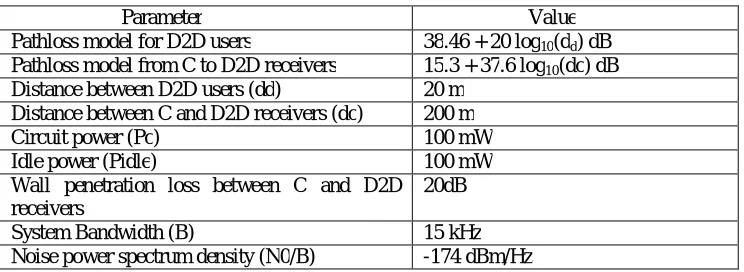
TABLE 1
SYSTEM AND CHANNEL PARAMETERS Parameter Value Pathloss model for D2D users 38.46 + 20 log10(dd) dB
Pathloss model from C to D2D receivers 15.3 + 37.6 log10(dc) dB
Distance between D2D users (dd) 20 m Distance between C and D2D receivers (dc) 200 m Circuit power (Pc) 100 mW Idle power (Pidle) 100 mW Wall penetration loss between C and D2D
receivers
20dB System Bandwidth (B) 15 kHz Noise power spectrum density (N0/B) -174 dBm/Hz
The parameters related to Energy efficiency and Spectral efficiency with their values are shown in Table 1. The initial distance between D2D user equipments is taken as 20m and increased to 200m. The circuit power consumption is 100mW and it increases as the distance between user equipments increases. The other parameters are taken as given in [3].
IV. SIMULATION RESULTS
The average transmission data rate Ris chosen to be 3 bits/Hz/s. By changing P, Fig. 2 displays ξEE versus D2D distance between user equipments, when R= 3 bits/Hz/s. Fig.2 (a) shows the variation of energy efficiency with D2D distance for the proposed technique. Fig.2 (b) shows the variation of energy efficiency with D2D distance for the iterative technique. It is seen that the proposed scheme achieves considerably larger energy efficiency than the iterative transmission scheme. For a small value of Pout (e.g., Pout ≤ 10−2), direct transmission requires much larger transmit power P to reach the outage probability target, compared with the network-coding cooperative scheme. Again, the performance gap becomes more significant when N increases. In addition, it is interesting to see that when Pout is large, direct transmission may outperform the proposed scheme. The performance of the proposed scheme is illustrated using simulation results. In this simulation, we put the distance between the D2D receiver and the D2D transmitter 20 meters. we change randomly the position of the cellular user N times and we perform an average calculation for N.
dissipation as a constant, but in reality if terminal executes heavy calculations, this imply an increase of power dissipation also.
In this simulation we compare performances in terms of spectrum efficiency and EE of the proposed algorithm with the algorithm which uses an iterative method when the distance changes between the D2D receiver and transmitter. From the simulation result we can see that the energy efficiency is 950Mbits/joule when the UEs are at distance of 20m from the proposed technique and it is 700Mbits/joule from the iterative method. Hence there is a high increase in energy efficiency from the proposed technique.
(a) (b)
Fig.2. (a) Energy efficiency versus D2D distance (Proposed technique) (b)Energy efficiency versus D2D distance (Dinkelbach method)
For each D2D distance d, i.e 20m we performed an average calculation. Simulations in Fig.2(a) and (b), represents the EE variation in terms of distance show naturally that the nearest distance is the highest EE is. From these results we can observe that the energy efficiency is greatly increased using the proposed method than other method.
V. CONCLUSION
REFERENCES
[1] Jiajia Liu., Nei Kato., Jianfeng Ma., and Naoto Kadowaki., “Device-to-Device Communication in LTE-Advanced Networks: A Survey”,
IEEE Communications Surveys Tutorials, Vol. 17, pp.3-5, 2015.
[2] R. Mahapatra., Y. Nijsure., G. Kaddoum., N. U. Hassan., and C. Yuen., “Energy efficiency trade off mechanism towards wireless green
communication: A survey,” IEEE Communications Surveys Tutorials, vol. 18, pp. 686–705, 2016.
[3] D. H. Lee., K. W. Choi., W. S. Jeon., and D. G. Jeong., “Two-stage semi-distributed resource management for device-to-device
communication in cellular networks,” IEEE Trans. Wireless Commun., Vol. 13, pp.1908–1920, 2014.
[4] X. Lin., J. Andrews., A. Ghosh., and R. Ratasuk., “An overview of 3GPP device-to- device proximity services”, IEEE Commun. Mag. Vol.
52, pp. 40–48, 2014
[5] Feng., Guanding Yu., Cong Xiong., Yi Yuan-Wu., and Geoffrey Ye Li., “Mode Switching for Energy-Efficient Device-to-Device
Communications in Cellular Networks”, IEEE Transactions on Wireless Communications, Vol. 14, pp.2-5, 2015.
[6] Yuan Wu., Jiaheng Wang., Liping Qian., and Robert Schober., “Optimal Power Control for Energy Efficient D2D Communication and Its
Distributed Implementation”, IEEE Communications Letters, Vol. 19, pp.5-7, 2015.
[7] Guanding Yu., Lukai Xu., Daquan Feng., Rui Yin., Geoffrey Ye Li., and Yuhuan Jiang., “Joint Mode Selection and Resource Allocation for
Device-to-Device Communications”, IEEE Transactions on Communications, Vol. 62, pp.4-8, 2014.
[8] Min Sheng., Yuzhou Li., Xijun Wang., and Jiandong Li., “Energy Efficiency and Delay Tradeoff in Device-to-Device Communications
Underlaying Cellular Networks”, IEEE Journal on Selected Areas in Communications, Vol. 34, pp.3-7, January 2016.
[9] Lili Wei., Rose Qingyang Hu., and Yi Qian.,”Energy Efficiency and Spectrum Efficiency of Multihop Device-to-Device Communications
Underlaying Cellular Networks”, IEEE Transactions on Vehicular Technology, Vol. 65, pp.4-9, 2016.
[10] Kai Yang., Steven Martin., and Chengwen Xing., “Energy-Efficient Power Control for Device-to-Device Communications”, IEEE Journal on