Comparative Performance Evaluation of
Routing Protocols for Wireless Ad hoc
Network
S V. Athawale 1, M A Pund 2
Assistant Professor, Department of Computer Engineering, AISSMS Engineering College, Pune, India1
Professor Computer Science & Engineering PRMIT & R, Badnera Amravati, India, India2
ABSTRACT: This paper evaluate several routing protocols for wireless ad hoc network with packet level simulations
in ns-2 environment. The protocol suite includes routing protocols specially designed for wireless ad hoc routing they are more traditional protocols, like link state and distance vector; used for dynamic networks, Performance is evaluated with respect to packets delivery, end-to-end delay and routing load for a given traffic scenario and mobility model in 802.11. It is observed that the new demand of routing protocols use much lower routing load. We examine only SPF, DSDV, DSR, and AODV Protocols. However the conventional link state and distance vector protocols provide better packet delivery and delay performance.
KEYWORDS: Network simulator (ns-2), Wireless Lan (802.11), Open Shortest Path First (SPF), Distance vector
routing protocol (DSDV), Dynamic source routing protocol (DSR), Ad hoc on-demand distance vector routing protocol
(AODV).
I. INTRODUCTION OFROUTINGPROTOCOL
Wireless ad hoc networks are an promising class of communication networks. The research in the field of these networks is at present going through an important revolution and opens significant perspectives in numerous fields of application. In an ad hoc wireless network routing protocol are sole of wireless communication and node are the body it decide packet route among devices. Ad hoc network nodes are not really familiar with network topology. An ad hoc wireless network routing protocol play important and vital role in efficient communication. A problem of efficient data routing in wireless ad-hoc networks remains a significant topic among researcher [1]. For the moment, a huge amount of various algorithms and routing schemes have been developed in order to solve specific routing issues in specific wireless networks, algorithms which aim at solving generic data routing problems in ad-hoc networks, which is the main focus of the this paper.
II. RELATEDWORK
AODV Protocol The ad hoc on demand distance vector [4] is an on demand algorithm, meaning that it builds routes between nodes only as selected by source nodes. It maintains these routes as long as they are needed by the sources. AODV uses sequence numbers to ensure the clearness of routes. This routing protocol builds routes using a route request on a route reply query cycle. The AODV route table contains the following information address of destination: IP address for destination node. Sequence Number of destination. Next hop the next neighbour of a particular node in the direction of destination. Hop Count represents the number of hops to the destination. List of active neighbour: it represents the neighbour nodes, which are actively using this route entry. DSR Dynamic source routing or DSR uses a technique where the source of a data packets determines the complete sequence of nodes through which to forward the packet; the source specifically lists this route in the packet’s header.DSR has an unique advantage by virtue of source routing. As the route is a part of the packet itself, routing loops, either short- or long-lived, cannot be formed as they
can be rapidly detected and eliminated. This property opens up the protocol to a variety of useful optimizations. DSDV
the destination sequence distance vector or DSDV protocol has been specifically targeted for wireless ad hoc networks.
SPF (Open Shortest Path First) and use of distance vector protocol in RIP (Routing Information Protocol) SPF expends significantly more routing load than the other protocols [5]. Many Unique characteristics of ad hoc networks lift several requirements for routing protocol design. A lot of routing schemes have been presented [6] to provide adequate performance of ad hoc networks. They were proposed classified into proactive routing and reactive routing based on when routes are determined. Real-world wireless ad hoc networks under different conditions this paper were [7] presented data dissemination performance of real world. The DSR in more stressful situations, with widening performance gaps with increasing accentuation (e.g. more load higher mobility). DSR, however, consistently generates less routing load than AODV and other routing protocols [8].They have studied the effect of TCP and UDP on the performance of wireless ad-hoc networks [9].
Different routing protocols are present in ad hoc network which are responsible for the communication purpose for e.g., DSR, AODV,SPF, and DSDV. These protocol works only with the assumption that if network is completely joined, it means source and sink are in the same network or there is end-to-end communication path exist between them [10].
The routing algorithm surveys are summarized as follows.
1. An Ad-hoc Network is a collection of wireless terminals or node that is capable to dynamically form a
temporary network without any aid from fixed infrastructure or centralized administration [11].
2. A very few work has been done on the performance analysis [12], [13] routing protocols by varying the
underlying metric mobility and quality assurance model (QOS) [14], [15].
3. Wireless LAN networks were grouped into three main groups: end-to-end approaches, split connection
approaches and proxy-based approaches in this TCP performance degradation in wireless LANs.
4. Performance of the overall network in terms of interference, average number of hops and path capability.
Numerical results have been also verified by ns-2 simulations.
III.OVERVIEW OF PERFORMANCE METRICS
In order to measure the performance of various routing techniques in wireless ad hoc networks, we considered the following metrics.
Energy Consumption: it is the average of the total energy consumed for transmitting a data packet from a source to
destination.
Packet Delivery Factor (PDF): it represents the ratio of the number of data [16] packets successfully delivered to
destinations to the total number of packets coming from all network sources. This parameter implies the correctness and the completeness of the routing technique. Mathematically, the PDF can be defined as:
1 1
_of_packet_recived /
_of_packet_send
n n
i i
nb
nb
Throughput: It represents the ratio of the total number of data packets delivered to the total duration of simulation time in ad hoc network. This metric determine how well the network can continually provide data to the sink. It is expressed as:
_
_
_
/ Simulation_Time
Throught
Nb of
bit
recived
Packet Lost: This represents the total number of data packets dropped during the simulation. The loss [17] of a packet
may be due to a collision during the transmission process. This metric is calculated as follows:
_
_
_
_
_
_
_Recived
Packet
Loss
Nb of
Packet
Send
Nb of
Packet
IV.SIMULATIONRESULTANDANALYSIS
Simulation Set up Parameters our simulation that we have a single sink. All other nodes are considered as sources. We carry out different simulation scenarios where the number of nodes and transmission range are varied. In the case of variable transmission range the values are taken between 200 m.
Simulation Parameters
Routing Protocol AODV,SPF,DSR,DSDV
MAC Protocol 802.11
Simulation Time 1600 second
Simulation Area 600 x 600 m
Number of Nodes 100
Packet Size 1024 Bytes
0 500 1000
10 15 20 25 30 35 40 45 50
DSR AODV DSDV SPF
E
n
e
rg
y
c
o
n
s
u
m
p
ti
o
n
%
Transmission Range
V.
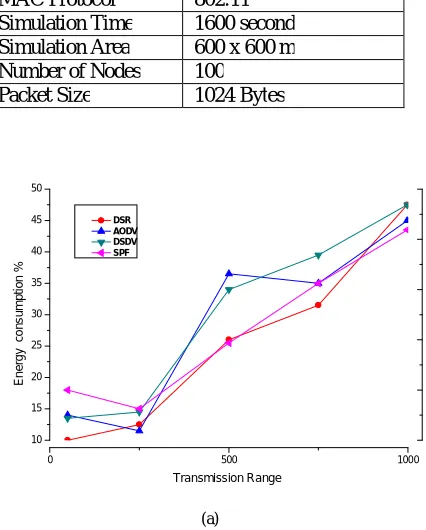
Fig. 1. Total energy consumption as a function of transmission
Energy Consumption: The total energy consumption is illustrated in Figure 1 as a function of transmission range.
We observe that the as the transmission range increases, then more energy consumption is important. It is also seen that
for the foresaw routing techniques, total energy consumption increases with the number of nodes. On the other hand, simulation results show that DSR protocol permits for better energy consumption comparing AODV, DSDV, and SPF.
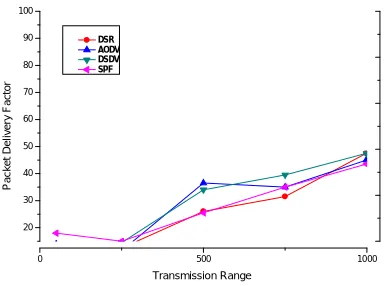
Packet Delivery Factor (PDF): Figure 2 shows that the ratio of data packets that are successfully delivered to the
destination as a function of transmission range. We consider as 100 numbers of nodes and several routing protocols are considered. It is obvious that the greater value of PDF implies better performance of the routing technique. Therefore, we deduce for short transmission range communication range, transmission range allows for satisfying results [18], [19].
0 500 1000
20 30 40 50 60 70 80 90 100
DSR AODV DSDV SPF
P
a
c
k
e
t
D
e
liv
e
ry
F
a
c
to
r
Transmission Range
Fig. 2. Packet delivery factor as a function of transmission range.
Throughput: Simulations of the throughput metric are illustrated in Figure 3. As formerly, based on three routing
techniques, 100 nodes are considered and transmission ranges are tested. As observed in Figure 3, all routing protocols have good results for short range and also for a variable communication range. In addition, we note that for the DSR routing technique, it is even preferable to use transmission range that provides better throughput compared to the other transmission ranges.
0 5 0 0 1 0 0 0
1 0 1 5 2 0 2 5 3 0 3 5 4 0 4 5 5 0
D SR A O D V D SD V SP F
A
v
e
ra
g
e
th
ro
u
g
h
p
u
t
T ra n s m is s io n R a n g e
Fig. 3. Packet delivery factor as a function of transmission range.
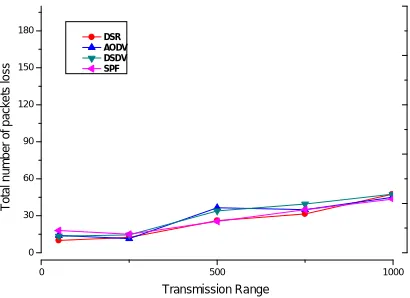
Packet Lost: Figure 4 shows the performance of four routing protocol (AODV, DSR, SPF and DSDV) in terms of
0 500 1000 0
30 60 90 120 150 180
DSR AODV DSDV SPF
T
o
ta
l
n
u
m
b
e
r
o
f
p
a
c
k
e
ts
l
o
s
s
Transmission Range
Fig. 4. Total number of packets lost during simulation
VI. CONCLUSION
The transmission nodes range as a system parameter affects the overall energy utilization and performance of wireless ad hoc network. Certainly the communication range of the wireless ad hoc network node is a very important metric which can have influence on the network connectivity. This paper investigated the impact of variable transmission range on performance metrics of three most popular and distinct feature routing protocols AODV, SPF, DSR and DSDV. By comparing these routing mechanisms on the basis of various performance metrics we came to conclusion that the variable transmission range offers a good performance for all metrics and it is more suitable especially for high and secure communication range.
REFERENCES
[1] D. Dugaev, S. Zinov, E. Siemens, V. Shuvalov,"A Survey and Performance Evaluation of Ad-Hoc Multi-Hop Routing Protocols for Static Outdoor Networks”, International Siberian Conference on Control and Communications (SIBCON), pp.1-11, 2015.
[2] Tamanna Afroze,"Performance Evaluation of the Hostile Environment in Mobile Ad-hoc Network", pp. 1-11, 2012.
[3] A. Mendez, Member, M. Panduro, J. Huerta and A. Reyna,"Performance Evaluation of MAC Protocol and Routing in Multi-Rate Wireless Ad-Hoc Networks",IEEE LATIN AMERICA TRANSACTIONS, VOL. 13, NO. 1, pp 84-89, 2015.
[4] Mehdi Boualleguel, Kosai Raoo, Maha Ben Zitf, Ridha Bouallegui,"IMPACT OF VARIABLE TRANSMISSION POWER ON ROUTING PROTOCOLS IN WIRELESS SENSOR NETWORKS",pp 494-496,2014.
[5] Samir R. Das, Robert Castaiieda ,Jiangtao Yan, Rimli Sengupta,"Comparative Performance Evaluation of Routing Protocols for Mobile, Ad hoc Networks",pp 153-161,1998.
[6] Seungjoon Lee, Bohyung Han, Minho Shin,"Robust Routing in Wireless Ad Hoc Networks",Proceedings of the International Conference on Parallel Processing Workshops (ICPPW’02),pp 73-78,2002.
[7] RezaAzizi,Gurcu Oz,"Performance Evaluation of Data Dissemination in Real-World Wireless Ad Hoc Networks",International Conference on Communications and Information Technology (ICCIT),pp 176-179,2011.
[8] Charles E. Perkins, et al. "Performance Comparison of Two On-Demand Routing Protocols for Ad Hoc Networks", IEEE Personal Communications, pp 16-28, 2002.
[9] T.Gopinath, A.S.Rathan Kumar, Rinki Sharma,"Performance Evaluation of TCP and UDP over Wireless Ad-hoc Networks with Varying Traffic Loads”, International Conference on Communication Systems and Network Technologies,pp 281-285,2013.
[10] Mayank Gupta,Sachin Kumar,"PERFORMANCE EVALUATION OF DSR, AODV AND DSDV ROUTING PROTOCOL FOR WIRELESS ADHOC NETWORK",IEEE International Conference on Computational Intelligence & Communication Technology,pp 416-421,2015. [11] Makoto Ikeda, Elis Kulla, Leonard Barolli, Makoto Takizawa, and Rozeta Miho,"Performance Evaluation of Wireless Mobile Ad-hoc
Network via NS-3 Simulator”, International Conference on Network-Based Information Systems,pp 135-141,2011.
[12] Amandeep Kaur,"Mobility Model Based Performance Analysis of DSDV Mobile Ad Hoc Routing Protocol”, International Conference on Recent Advances and Innovations in Engineering (ICRAIE),pp1-7, 2014.
[14] Alberto Zanella, Alessandro Bazzi et al.,"On the Impact of Routing Strategies on the Interference of Ad Hoc Wireless Networks",IEEE TRANSACTIONS ON COMMUNICATIONS, VOL. 61, NO. 10, pp.4322-4333, 2013.
[15] S V Athawale, Dr M A Pund."ACIPS: Improvement of Client-Server based Intrusion Prevention System for Wireless LAN",International Journal of Innovative Research in Computer and Communication Engineering,(IJIRCCE)Vol. 5, Issue 4,pp.6868-6871,2017.
[16] S V Athawale1, M A Pund,"Intrusion Prevention System for Wireless LAN Security: A Study”, International Journal of Advanced Research in Computer and Communication Engineering,(IJARCCE),Vol. 5, Issue 10,pp.421-423,2016.
[17] S V Athawale1, M A Pund,"A Novel Algorithm to Determine the Attacks Intention in Wireless Ad hoc Networks”, International Journal Of Engineering And Computer Science, Volume 5 Issue 12, pp.19283-19287, 2016.
[18] S V Athawale1, M A Pund,"The Modern Approach in Wireless Intrusion Prevention System for Ad hoc Network: A Target Oriented Approach”, International Journal of Advanced Research in Computer Science and Software Engineering,(IJARCSSE),Volume 7, Issue 2,pp.1-7,2017.
[19] S V Athawale1, M A Pund," Real-time Intrusion Prevention System to Increase Computer Security in Wireless LAN”, International Journal for Research in Applied Science and Engineering Technology,(IJRASET), Volume 5, Issue IX ,pp.1428-1432,2017.
BIOGRAPHY
Shashikant V.Athawale received his B.E (Comp Sc.) degree from University of Ammaravati, India
and M.Tech (Comp Sc.) from Bharati vidyapeeth,pune in 2005 and 2010 respectively.
He is currently a Ph.D. candidate in computer science at the Sant Gadge Baba Amravati University,Amaravti, India. His research interests include the analysis and development of IPS concepts with a special focus on are in the area of wireless in solving complex problems in area communication networks. He has published many papers in journals, conferences and workshops in
the area of wireless network.He is a member of many Professional Societies such as
UACEE,ICGST,SDIWC,ISCO,IACSIT.
Dr. Mahendra A Pund is working as Professor in Computer Engineering Department at
Prof. Ram Meghe Institute of Technology & Research, Badnera-Amravati, India. He has 22 years experience in teaching profession. Total 24 papers are published in International &National Conferences and International Journals. His research interest is in the areas of wireless network, ad hoc network and security issues, Image processing, Machine Learning, Image Processing and Pattern Recognition, Feature Extraction. He is guiding many research scholars and he is a member of CSTA, New York, CSI, ISTE, Associate Member of I.E, IACSIT, Singapore and IAENG, Hong Kong. Also, he is Advisory consultant to CapeArc