Survey on Transmission Lines Fault Detection
Classification & Location Based Soft
Computing Techniques
K.Manikandan1, N.Gowthami2
Assistant Professor, Department of Computer Science, PSG College of Arts and science, Coimbatore,
Tamilnadu, India1
Research Scholar, Department of Computer science, PSG College of Arts and science, Coimbatore, Tamilnadu, India2
ABSTRACT:Transmission lines, is affected from unexpected failures due to various random causes. This review is based on detecting, classifying and locating faults on transmission lines. The protective relaying is to identify the abnormal signals on a power transmission system. Three common faults were discussed; single phase, ground faults, and double phase. In this review is uses artificial neural network and Fuzzy logic techniques for fault detection, classification and location.
KEYWORDS:Fault, Transmission Lines, Artificial Neural Networks,Back propagation Algorithm, Fuzzy Logic, Fuzzy logic, PSCAD/EMTDC.
I. INTRODUCTION
Transmission lines are massive transformation towards smart power grids with the help of rapidly developing monitoring and control methodology. Detecting the fault and the phase which underwent the fault is of great importance. Classification of fault has the area of interest for numerous researchers and as an outcome several fault classification methods have been implemented over the time. Some of the salient methods are: Neural network technique, wavelet transforms technique, fuzzy and fuzzy-network technique, etc. [1].
Any abnormal flow of current in a power system’s components is called a fault. Faults can be of various types namely Transient, persistent, symmetric or asymmetric faults [2]. Some of the important challenges for the incessant supply of power are detection, classification and location of faults [3]. We concentrating on detect and identify the type of fault in the phase and to determine which zone (segment) of the phase has become faulty. The methods in the second category use the high frequency components of currents and voltages caused by the inceptions of faults and the ensuing voltage and current traveling waves between the fault and the line terminals [12].To identify the existence of faults in the system voltage and current signals of a phase are observed. These signals are also used to specify the fault type and location [4].An Artificial Neural Network (ANN) can be described as a set of elementary neurons that are usually connected in biologically inspired architectures and organized in several layers [11].
II. RELATEDWORK
The transmission line system has been used 500kV with 300Km distance each located on either ends of the transmission line along with a three phase fault simulator used to simulate at various positions on the transmission line. The power system model single line diagram for the simulation is shown in Figure 1.
Figure 1. Power system model
The simulations present three categories namely (i) phase to ground faults
(ii) phase to phase faults and (iii) double-phase to ground faults
In neural network SimPower system toolbox in Simulink by the Math Works used to simulate the faults.
IIIEXPERIMENTAL RESULTS
A. FAULT DETECTION
Fault detection in a transmission line fault enables quick separation of the faulty line from service and protecting it from the harmful effects of the fault.
TRAINING THE FAULT DETECTION NEURAL NETWORK
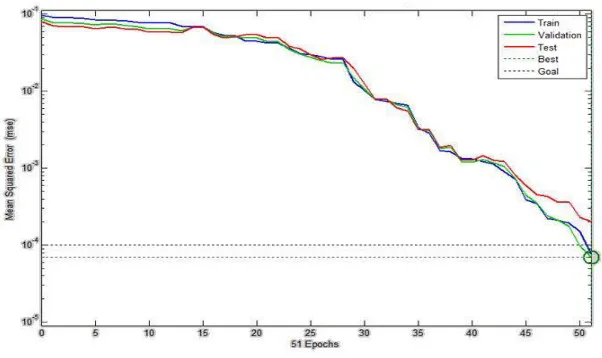
The output of the neural network is just a yes or a no (1 or 0) depending on whether or not a fault has been detected [2]. In Figure 2 the overall MSE of the trained neural network is the value of 0.0001 and actual is 6.9776e-5 end of the training process. The activation function at input layer is linear (-1, 1) function while at hidden layer and output layer is logistic function [2].
Figure 3. Output error for the BP neuralnetwork 6-3-1
The selected networks performance and error plots associated with this architecture are given by Figure (3) and (4) [4].
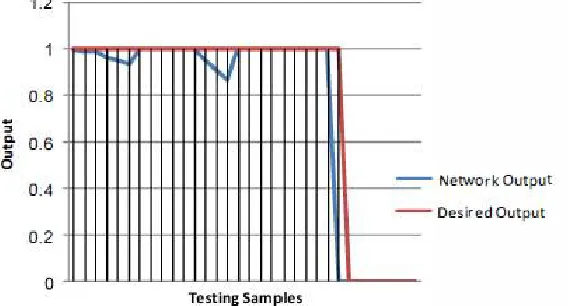
Figure 4. Network output versus desired output for BP neural network 6-3-1.
TESTING THE FAULT DETECTION NEURAL NETWORK
Once the neural network has been trained, its performance has been tested by three different factors.
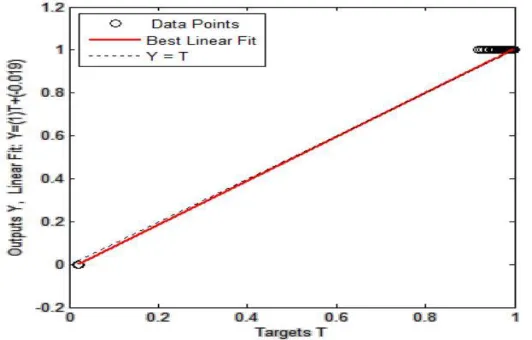
Figure 5. Regression fit of the outputs vs. targets forBP neural network 6-3-1.
Figure 6. Testing samples output error for the network (6-10-5-3-1).
A fault cases for each category of fault were utilized in the test set. Appendix includes the variables considered to form the test set. Error plot of the testing set is shown in figure (6). Performance of network is shown in figure (7) [1].
Figure 7. Testing samples Network output versus desired output for the BP neural network 6-3-1.
B. FAULT CLASSIFICATION
Once a fault has been detected on the power line, the next step is to identify the type of fault. A review of the different neural networks that were analyzed is provided which is followed by the chosen network [2].
TRAINING THE FAULT CLASSIFIER NEURAL NETWORK
Figure 8. Mean-square error performance of thenetwork with configuration (6-35-4).
Figure 8 shows the training performance plot of the neural network 6-35-4 (6 neurons in the input layer, 1 hidden layer with 35 neurons in it and four neurons in the output layer). The Mean Square Error (MSE) by the end of the training process in this case is 0.00359 [2].
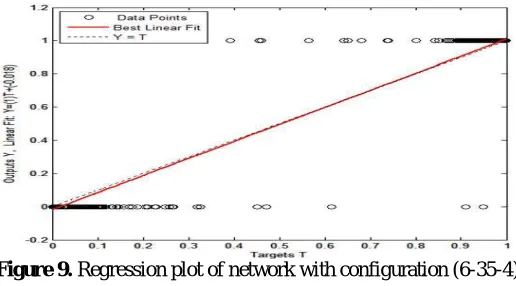
Figure 9. Regression plot of network with configuration (6-35-4).
TESTING THE FAULT CLASSIFIER NEURAL NETWORK
The correlation coefficient in this case was found to be 0.98108 which indicates satisfactory correlation between the targets and the outputs. It can be seen that both these lines track each other very closely which is an indication of very good performance by the neural network [2].
THE FAULT ISOLATION/LOCATIONNEURAL NETWORK
The design and development of the detection neural network is followed in order to choose the most suitable network as a fault isolator. The network is assumed to identify the location of the fault by classifying the identified fault into one of the three fault phases.
The training includes some of the selected networks, namely structures, 6-5-5-3, 6-6-6-3, 6-7-6-3 and 6-5-4-3. It is found experimentally through trial and error that a BP network with two hidden layers provides the best training performance [1].
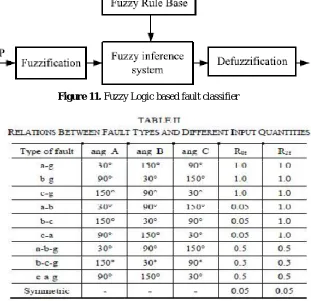
C. FUZZY LOGIC BASED FAULT CLASSIFICATION
In some conditions input variables outstrip margins of their regions. Hence, some of the inputs enter to certain region of other inputs instead of its given region [5].
Figure 11. Fuzzy Logic based fault classifier
The Full Cycle Discrete Fourier Transform (FCDFT) is applied to compute the fundamental sequence components of each current phasor in this work. Hence, the time taken by this technique is about 20 ms for a 50 Hz system.
III.CONCLUSION
REFERENCES
1. Avagaddi Prasad*, J. Belwin Edward, C. Shashank Roy, G. Divyansh and Abhay Kumar., “Classification of Faults in Power Transmission Lines using Fuzzy-Logic Technique”, Indian Journal of Science and Technology, 2015 Nov, 8(30): 10.17485.
2. Ankit Jain, Beaulah Moses, “Soft Computing Based Fault Detection & Classification for Transmission Lines”, International Conference on Electrical, Electronics, and Optimization Techniques (ICEEOT), 2016, 978-1-4673-9939-5.
3. Saha MM, Das R, Verho P, Novosel D., “Review of fault loca distribution systems”, Proceedings of Infrastructure for the Future Conference, Beijing, 2002, 6p.
4. Eisa Bashier M. Tayeb Orner AI Aziz AlRhirn., “Transmission Line Faults Detection, Classification and Location using Artificial Neural Network”, IEEE, April, 2013, 13432093.
5. Kaveh Razi, Tarafdar Hagh, and Gh. Ahrabian., “High accurate fault classification power transmission lines using fuzzy logic”, The 8th
international power engineering conference (IPEC 2007).
6.Dalstein T, Kulicke B., “Neural network approach to fault classification for high speed protective relaying”, IEEE Transactions, Power Delivery. 1995 Apr; 10(2):1002–11.
7. A.Ferrero, S.Sangiovanni, and E.Zapitelli., “A Fuzzy set approach to fault type identification in digital relaying”, IEEE Trans. Power Delivery, vol. 10, pp. 169-175, Jan 1995.
8. H.Wang and W.W.L. Keerthipala, “Fuzzy neuro approach to fault classification for transmission line protection”, IEEE Trans. Power Delivery, vol. 13,pp. 1093-1104, Oct. 1998.
9. P.K.Dash, A.K. Pradhan, and G.Panda, “A Novel Fuzzy neural Network Based Distance relaying Scheme”, IEEE Trans. Power Delivery, vol. 15, no.3, July 2000.
10. Biswarup Das, and J.Vittal Reddy, “Fuzzy-logic-based fault classification scheme for Digital Distance Protection,” IEEE Trans. On Power Delivery. Vol. 20, no. 2, pp. 609-616, April 2005.
11. Cook V, “Fundamental aspects of fault location algorithms used in distance protection,” Proceedings of IEEE conference 133(6), 1986, pp. 359-368.
![TABLE 1 Voltage and Current Per Unit ValuesUsed As Training Set [4]](https://thumb-us.123doks.com/thumbv2/123dok_us/1584370.1195159/3.595.148.450.261.414/table-voltage-current-unit-valuesused-training-set.webp)