DOI: 10.1534/genetics.106.065177
Mutation of a Ubiquitously Expressed Mouse Transmembrane Protein
(
Tapt1
) Causes Specific Skeletal Homeotic Transformations
Gareth R. Howell,* Mami Shindo,
†Stephen Murray,* Thomas Gridley,*
Lawriston A. Wilson* and John C. Schimenti*
,1†Department of Biomedical Sciences, College of Veterinary Medicine, Cornell University, Ithaca, New York 14853 and *The Jackson Laboratory, Bar Harbor, Maine 04660
Manuscript received August 22, 2006 Accepted for publication November 21, 2006
ABSTRACT
L5Jcs1is a perinatal lethal mutation uncovered in a screen for ENU-induced mutations on mouse chromosome 5.L5Jcs1homozygotes exhibit posterior-to-anterior transformations of the vertebral column midsection, similar to mice deficient forHoxc8andHoxc9. Positional cloning efforts identified a mutation in a novel, evolutionarily conserved, and ubiquitously expressed gene dubbedTapt1(Transmembrane anterior posterior transformation 1). TAPT1 is predicted to contain several transmembrane domains, and part of the gene is orthologous to an unusual alternatively spliced human transcript encoding the cytomegalovirus gH receptor. We speculate that TAPT1 is a downstream effector of HOXC8 that may act by transducing or transmitting extracellular information required for axial skeletal patterning during development.
T
HE axial skeleton consists of the skull, vertebral column, and thoracic rib cage. The vertebral col-umn contains five types of vertebrae—cervical, thoracic, lumbar, sacral, and caudal—defined by anatomical fea-tures and position within the anterior–posterior axis. Variation within the vertebral column plays a significant role in morphological distinctions among species.In vertebrate embryos, the somites are derived from the paraxial mesoderm and in turn give rise to the sclerotome and the dermomyotome. Chick/quail chi-mera experiments showed that the sclerotome gives rise to the axial skeleton (Huang et al. 2000). Grafting
experiments in the chicken demonstrated that poste-rior portions of the paraxial mesoderm, when trans-planted anteriorly, gave rise to posterior structures equivalent to those expected at the original site. There-fore, specification of the vertebral column occurs early in development, prior to the compaction of the paraxial mesoderm into somites (Kienyet al.1972). Key factors
known to play a role in this specification are the Hox genes. These encode transcription factors that can re-press or activate downstream genes. A number of direct targets have been identified, particularly in Drosophila melanogaster, but it has been difficult to unequivocally identify mammalian target genes whose expression is directly controlled by Hox genes in vivo (Akin and
Nazarali 2005; Pearson et al. 2005). Chromatin
im-munoprecipitation and microarray experiments are
enabling progress in this area, although potential tar-gets identified require functional validation. Similarly, the mechanisms of Hox gene regulation in mammals are quite complicated, prompting the use of elaborate chromosomal engineering strategies to understand the colinearity of expression within Hox clusters (Tarchini
and Duboule2006). Most of the individual regulators
of Hox gene expression remain to be found.
Forward genetic screens are a powerful way to elu-cidate biological pathways, having the ability to uncover gene–phenotype correlations and developmental hier-archies. Recently, a region-specific ENU mutagenesis screen directed at proximal mouse chromosome 5 yielded 37 embryonic lethal mutations (Wilson et al. 2005).
Here, we describe the characterization and positional cloning of one of these ENU-induced perinatal lethal mutations (L5Jcs1) that causes a homeotic transforma-tion of the axial skeleton similar to that in Hoxc8 knockout mice (LeMouellic et al.1992). This novel,
ubiquitously expressed gene, which otherwise would not be suspected to yield such a phenotype, uncovers a new aspect of vertebrate axial skeleton patterning.
MATERIALS AND METHODS
Phenotype analysis:TheL5Jcs1mutation was maintained in transto the Rump white (Rw) inversion (for details see Wilson
et al.2005). Homozygous embryos or neonates were obtained from intercrossing Rw/L5Jcs1 mice. Skeletal preparations were based on a published protocol (Kessel and Gruss
1991). Animals were skinned and eviscerated prior to being soaked in 100% ethanol for 4 days. They were then soaked in acetone for 3 days. Animals were rinsed in water and then 1Corresponding author:Department of Biomedical Sciences, College of
Veterinary Medicine, Cornell University, T9014A Vet Research Tower, Ithaca, NY 14853. E-mail: [email protected]
stained (2 vol 0.14% alcian blue (Sigma, St. Louis) in 70% ethanol, 1 vol 0.12% alizarin red (Sigma) in 95% ethanol, 8 vol 100% glacial acetic acid, and 50 vol 70% ethanol) for 10 days. Stain was removed and replaced with 20% glycerol and 1% KOH and incubated at 37° for 16 hr and then at room temperature until the tissue cleared. Preparations were stored in 2:1:1 100% ethanol:glycerol:benzyl alcohol prior to photography.
Mapping L5Jcs1: For recombination mapping, Rw/L5Jcs1 mice were crossed to CAST/Ei, and non-Rw F1 progeny (L5Jcs1/CAST) were intercrossed to produce F2’s. These were genotyped with the following polymorphic markers:D5Mit353, D5Mit129, D5Mit78, D5Mit105, D5Mit231, D5Mit106, and D5Mit107. The sequences of primer pairs that we developed for mapping deletion breakpoints are as follows:D5Jcs608, TAAGTCTGGAGGTGGGGATG and GGCTGTCTTCCTCTC TGTGG;D5Jcs614, GCATGAACCTGCACACAGAT and ATGC TGGGAGCAGAACAGTC.
Identification of the Tapt1 mutation and RT–PCR: RNA
was prepared from whole E12.5 embryos using a QIAGEN (Chatsworth, CA) RNeasy kit. Primer pairs used for RT–PCR of the 59-end of Tapt1 (Transmembrane anterior posterior trans-formation 1) were Tapt1.1F (CAATGTAGCTTTTAACTCT CACAACA) and Tapt1.1R (TGGCTTCCTTCACGTATTGA). These same primers were used to evaluate tissue-specific expression, using a normalized cDNA panel (BD Biosciences Clontech). Genomic DNA was amplified using the primers Tapt1.G2F (TGACAAAGATGGTATTTCTGTTGC) and Tapt1. G2R (TCAACATTTGCTTATGGTAATGAG) to sequence the mutation.
In silico analyses: Multiple sequence alignments were carried out using ClustalW, and the output was formatted using Multiple Align Show (http://bioinformatics.org/sms/ multi_align.html). Programs used to detect potential nuclear localization were PredictNLS (http://cubic.bioc.columbia. edu/predictNLS/) and NucPred (http://www.sbc.su.se/
maccallr/nucpred/). Predicted transmembrane domains were identified by the programs TMPRED (http://www.ch. embnet.org/software/TMPRED_form.html) and TMHMM (http://www.cbs.dtu.dk/services/TMHMM/).
RNA in situ hybridization: Embryos were rinsed in 13
phosphate buffered saline (PBS) plus Tween 20 before fixa-tion overnight in 4% paraformaldehyde (PFA). They were then dehydrated by 25, 50, and 75% methanol in PBS before being stored in 100% methanol at20°. ATapt1riboprobe vector was generated by amplifying a 608-bp RT–PCR product corresponding to nucleotides 1760–2368 of the cDNA, using the following primers that contained SP6 and T7 primer sites, respectively: H3RS7F, GCGATTTAGGTGACACTATAGAATA CTGGATGCTGACACTTGAACA; H3RS7R GCGTAATACG ACTCACTATAGGGAGACCTTTAACTTGGAATAACCAATG. The amplimer wasin vitrotranscribed, incorporating digox-ygenin-dUTP.
LacZ staining inHoxc8knockin mice:E12.5 embryos were harvested, rinsed in 13PBS, and fixed in 4% PFA in PBS at 4° for 5 min. Embryos were stained in X-Gal overnight at 37°and then postfixed in 4% PFA in PBS at 4°overnight. Embryos were placed in 100% glycerol for photography and storage.
RESULTS
The L5Jcs1 mutation causes homeotic-like transfor-mations of the axial skeleton and perinatal lethality: L5Jcs1 is one of 37 lethal mutations recovered in a region-specific ENU mutagenesis screen directed at the Rwinversion region of proximal mouse chromosome 5
(Wilsonet al.2005). The majority of animals
homozy-gous for L5Jcs1 survived to approximately embryonic day 18.5 (E18.5), but either were born dead or sur-vived until1 day postpartum. Newborns or C-section-derived E18.5 homozygous mutants were observed to breath, turn pink, and move actively. Rare homozygotes survived up to several days postpartum, but they were smaller than littermates and never survived to weaning age. The cause of lethality remains unknown (but see
discussion).
As first reported anecdotally (Wilson et al. 2005),
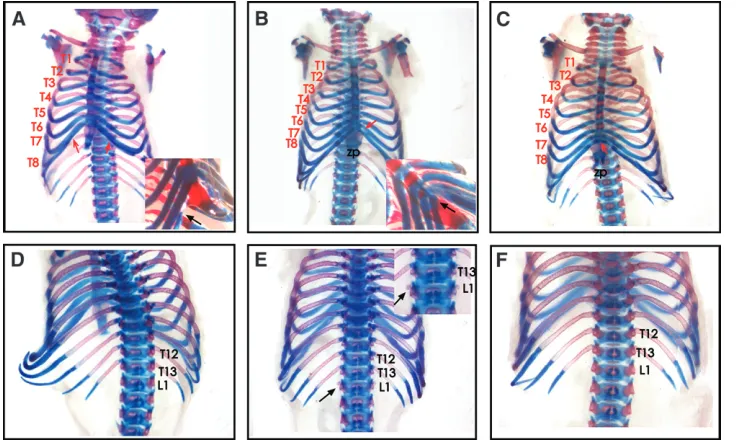
skeletons from L5Jcs1/L5Jcs1 mice exhibited certain posterior-to-anterior transformations (Figure 1; Table 1). Specifically, the axial skeleton showed posterior-to-anterior transformations of the thoracic and lumbar vertebrae. Unlike normal mice in which the eighth rib (thoracic segment 8–T8) terminus is free floating, it typically becomes attached to the sixth sternebra in L5Jcs1homozygotes. In nearly half the animals, the first lumbar vertebra (L1) showed the development of a 14th pair of ribs. Judging from rib length, it appears that the 9th–13th thoracic vertebrae (T9–13) are transformed into more anterior structures. In addition, the xiphoid process was overgrown and splayed in most mutants (Figure 1, B and C; supplemental Figure 1, B and C, at http://www.genetics.org/supplemental/; Table 1).
Positional cloning ofL5Jcs1: As previously reported, L5Jcs1was never observed to recombine intransto the Rwinversion, which spans the26- to 74-Mb interval on chromosome 5. The chromosomal deletion Qdprdf3J
failed to complement L5Jcs1 (Wilson et al. 2005).
Specifically, noL5Jcs1/Qdprdf3Jweanlings were observed
of 23 produced byRw/L5Jcs13Qdprdf3J/1intercrosses,
thus localizing the mutation to this15- to 17-Mb in-terval (Figure 2). To refine the critical region, comple-mentation tests were performed with three other deletions in the Qdpr complex: Qdprdf2J
, Qdprdf6J
, and Qdprdf11J
(Figure 2). None complementedL5Jcs1; of the 22, 11, and 31 non-Rwprogeny, respectively, examined from crosses of each deletion toL5Jcs1/Rw, none con-tained the deletion. This localized the mutation to the 2.5-Mb region betweenD5Mit105andD5Jcs614.
To confirm that the failure to obtainL5Jcs1/deletion animals was due to noncomplementation rather than to synthetic lethality, timed matings were conducted be-tweenQdprdf2J/1 andRw/L5Jcs1mice, and the skeletal
phenotypes of three Qdprdf2J/L5Jcs1 E18.5 pups were
examined. All three showed the same thoracic rib trans-formation observed in L5Jcs1 homozygotes, not only demonstrating that L5Jcs1 lies within the Qdprdf2J
de-letion, but also suggesting that it is a null mutation (supplemental Figure 1 at http://www.genetics.org/ supplemental/).
To further narrow the interval, recombination map-ping was conducted by intercrossing L5Jcs1/Cast F1
heterozygotes and genotyping unaffected F2 progeny.
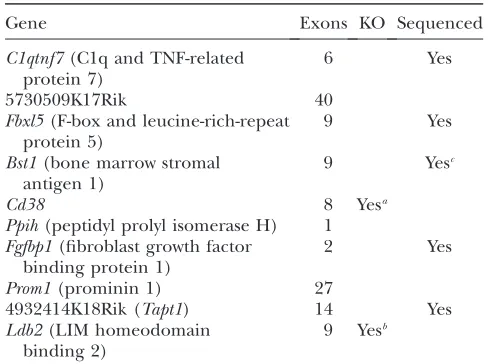
not contain L5Jcs1. These data, combined with data from deletion mapping, localized the mutation to a 1.6-Mb region (betweenD5Mit105andD5Mit106) con-taining 10 Refseq genes (Table 2). Of these, we elim-inated several as L5Jcs1 candidates on the basis of their known mutant phenotypes. Two (Cd38andLdb2) have been knocked out in mice, and homozygotes for both are viable. Mutations in Prom1 cause retinal de-generation in humans, while RNAi inhibition of Ppih and 5730509K17Rik inCaenorhabditis elegansgives wild-type viable phenowild-types.
To identify possible mutations in the remaining six genes, we began generating RT–PCR products from L5Jcs1/L5Jcs1,L5Jcs1/1, and1/1E12.5 embryos. No mutations were found in C1qtnf7, Fbxl5, and Fg f bp1 (Table 2). In the case of the novel 14-exon mouse gene 4932414K18Rik, a size difference was observed between L5Jcs1/L5Jcs1and wild-type-derived products when am-plifying between exons 6 and 9. Two bands were ob-served in heterozygotes (Figure 3A). Sequencing the
products revealed that the mutant amplimers lacked exon 7. Analysis of exon 7 and flanking genomic se-quence in the mutant revealed a T-to-A transition in the 59splice site of intron 7 (39of exon 7); this is likely responsible for the skipping of exon 7 during splicing (Figure 3B and Figure 4). This causes an altered reading frame (exon 7 is 70 nucleotides long), resulting in the introduction of 12 anomalous amino acids after N279, followed by a premature termination that probably causes a severe disruption of function. However, the mu-tant message may also be subject to nonsense-mediated decay; the mutant transcript appears to be present at much lower levels compared to the wild-type transcript in heterozygotes (Figure 3A).
The presence of this mutation in the small, ge-netically defined mutant interval strongly implicates 4932414K18Rik as L5Jcs1. It is unlikely that another locus in the critical region is the causative gene; Keays
et al. (2006) demonstrated that the probability of a cosegregating ENU-induced mutation in a 5-Mb interval (theTapt1interval is only 1.6 Mb) is exceedingly small (P,0.002).
Tapt1, the gene mutated inL5Jcs1, encodes a highly conserved putative transmembrane protein that over-laps the human cytomegalovirus gH receptor: 4932414K18Rik encodes a 565-amino-acid protein an-notated as LOC231225 in GenBank. Due to the likeli-hood that mutation of this gene underlies the L5Jcs1 phenotype, we have renamed it Tapt1 (Transmembrane anterior posterior transformation 1), thus making the allele designationTapt1L5Jcs1
.
The predicted TAPT1 protein is evolutionarily con-served. Highly similar orthologs exist from vertebrates to yeast (Figure 4; Figure 5). The overall genomic structure and sequence of Tapt1 and its vertebrate
Figure 1.—Homeotic-like
trans-formations of L5Jcs1 skeletons. Shown are E18.5 skeletons stained with alcian blue and aliza-rin red. The top and bottom rows are ventral and dorsal views, re-spectively. The lumbar (‘‘L’’) and thoracic (‘‘T’’) vertebrae are numbered. (A and D) Wild type. The inset in A is a ventrilateral closeup of T6 and T7 attachment to the sternum; the black arrow points to the terminus of T8, which is unattached to the ster-num. (B and E) Homozygous mutant. The inset in B is a ven-trilateral closeup of T8 attach-ment to the sternum (black arrow). The inset in E shows a close-up of the dorsal vertebral column exhibiting partial trans-formation of L1 into a thoracic-like identity (arrows). (C and F) Homozygous mutant showing the fusion of T8 to the sternum (red arrow in C), but not the L1 partial transformation. Note the splayed xiphoid processes (zp) in B and C.
TABLE 1
Penetrance of skeletal abnormalities
Genotype T8.T7 L1.T14 Splayed XP
L1/L1 10/13 6a/13 11/13
Rw/1or L1/1 1/30b 1/30b 5/30
Fisher’s exact test P,0.0001 P¼0.00165 P,0.0001 XP, xiphoid process. L1,L5Jcs1. All animals were E18.5–1 day postpartum.
a
Five of the six had bilateral extra ribs.
b
orthologs are conserved (Figure 4). A variety of ESTs led to the derivation of a consensus RefSeq structure for mouse Tapt1, with the exception of one alternatively spliced 66-bp exon that is present in some ESTs and that corresponds to conserved vertebrate sequences in homology plots (Figure 4).
The intron/exon structure of the human ortholog aligns well with mouse, with the exception of AF189251,
a cDNA corresponding to exon 1, part of exon 4, and a portion of intron 4, in which it terminates. This cDNA was reported to encode the human cytomegalovirus (HCMV) gH receptor (Baldwinet al.2000). A BLAST
search of the mouse TAPT1 amino acid sequence against human proteins revealed a high similarity to that part of the AF189251 protein encoded by exons 1 and 4. However, our analysis with the now-available human genome sequence shows that much of the pre-dicted AF189251 protein corresponds to that encoded by the intron 4 sequence. Interestingly, this intron-4-encoded amino acid sequence includes the receptor for the HCMV gH glycoprotein ligand and is essential for virus infectivity (Baldwinet al.2000). The ability of
anti-AF189251 monoclonal antibodies to block viral infec-tion provides experimental support for the predicinfec-tion that the intron-4-encoded epitopes of the protein are present at the cell surface (Baldwinet al.2000), but it is
not clear which amino acids are responsible for placing the protein at the cell surface. Interestingly, the AF189251 cDNA is unique; no mouse or human ESTs exhibit a sim-ilarly spliced form. Furthermore, VISTA analysis (Mayor
et al.2000) indicates that the intron-4-coding region is not evolutionarily conserved (not shown).
Other than this unusual AF189251 transcript, no other information on the cellular function of mamma-lian TAPT1 exists. Analysis with the TMPRED and TMHMM protein analysis algorithms indicates that TAPT1 contains as many as six transmembrane domains (supplemental Figure 2 at http://www.genetics.org/ supplemental/). Alignment of the predicted amino acid sequence reveals high levels of conservation from mammals to yeast, especially near its central region
Figure 2.—Map of the L5Jcs1
region. (Top) Map of theRw in-version region of mouse chromo-some 5. Some gene loci are indicated. (Bottom) The region surrounding the Qdpr deletion complex is expanded. The ex-tents of deletions are indicated as thick horizontal bars. The thin-ner bars at the ends of the thicker bars indicate the intervals in which the breakpoints lie. The re-gion to whichL5Jcs1was mapped in the F2cross is indicated. Micro-satellite loci are abbreviated with the prefix ‘‘M’’ instead of D5Mit. Numbers under these markers are megabase coordinates accord-ing to the February 2006 mouse genome assembly Build 36. The L5Jcs1critical region is indicated.
TABLE 2
Genes in theL5Jcs1critical region
Gene Exons KO Sequenced
C1qtnf7(C1q and TNF-related protein 7)
6 Yes
5730509K17Rik 40
Fbxl5(F-box and leucine-rich-repeat protein 5)
9 Yes
Bst1(bone marrow stromal antigen 1)
9 Yesc
Cd38 8 Yesa
Ppih(peptidyl prolyl isomerase H) 1 Fgfbp1(fibroblast growth factor
binding protein 1)
2 Yes
Prom1(prominin 1) 27
4932414K18Rik (Tapt1) 14 Yes
Ldb2(LIM homeodomain binding 2)
9 Yesb
C1qtnf7is subject to alternative splicing; all isoforms were sequenced. Primers used for sequencing are in supplemental Table 1 at http://www.genetics.org/supplemental/. KO, knock-out allele available.
a
Mutants are viable.
b
A Lexicon viable mutant.
c
(Figure 5). TheL5Jcs1mutation lies within this highly conserved region, near the end of a 133-amino-acid stretch that (with one residue exception) is perfectly identical among humans, mice, chickens, and zebrafish. Yeast deleted for theirTapt1ortholog (an uncharac-terized ORF called YER140W) are viable, although C. elegansRNA interference (RNAi) screens (summarized in WormBase) report that one of five RNAi molecules directed against the worm ortholog cause 24–100% embryonic lethality. The YER140W gene product was found to interact, in two-hybrid screens, with Mch1p, Dhh1p, and Tma19p (Ito et al. 2001). Mch1p has
similarity to mammalian monocarboxylate permeases, which are involved in transport of monocarboxylic acids across plasma membranes. However,mch1mutants are not deficient in monocarboxylic acid transport (Makuc
et al.2001). Dhh1p is a putative DexD/H-box helicase, involved in mRNA export and translation.TMA19is a nonessential gene encoding a putative ribosomal pro-tein (according to the Saccharomyces Genome Data-base). In sum, while there have been no directed studies of Tapt1 or its homologs in experimental organisms, evidence suggests that it is a transmembrane protein involved in transporting molecules across membranes and may be required for normal embryonic develop-ment in both worms and mice.
Tapt1 expression:Despite the specific skeletal defect exhibited by mutant embryos,Tapt1is widely expressed. Public databases contain 223Tapt1ESTs stemming from 30 different cDNA libraries, according to Unigene and the Stanford S.O.U.R.C.E. (Diehnet al.2003). We
con-ducted RT–PCR analysis to confirm the apparently ubiq-uitous pattern ofTapt1expression in both adult tissues and whole E7–E17 embryos (Figure 3C). All samples yielded similar amounts ofTapt1product from normal-ized cDNA sources (seematerials and methods). To
determine if Tapt1 is expressed in distinct embryonic structures that might correspond to the observed ske-letal defects, whole-mount RNA in situ hybridization was performed on E9.5 embryos.Tapt1message, as de-tected by two nonoverlapping probes (Figure 3D; data not shown), was present throughout the embryo.
Hox gene expression inL5Jcs1mutants:This skeletal phenotype is remarkably similar to mice with a knock-out ofHoxc8, and to a somewhat lesser degree, Hoxc9 (Le Mouellic et al. 1992; Suemori et al. 1995).
Mutations in genes that cause axial skeletal patterning defects typically disrupt the expression pattern of a Hox gene(s) that, when mutated, causes a similar phenotype (seediscussion). We therefore explored whether
mu-tation ofTapt1disruptsHoxc8expression, exploiting an allele ofHoxc8containing a knocked-in LacZ reporter
Figure3.—Identification of mutation inTapt1
that is expressed in a pattern that reflects endogenous Hoxc8transcription (LeMouellicet al.1992). Double
heterozygotes (L5Jcs1/1; Hoxc8/1) were crossed to L5Jcs1heterozygotes, and the embryos were stained for LacZ and genotyped. There was no alteration in LacZ expression in embryos homozygous for theL5Jcs1 mu-tation and that contained theHoxc8allele (Figure 6).
DISCUSSION
Function of TAPT1 in development: All or most
known mouse mutations that cause homeotic skeletal transformations either are in the Hox genes them-selves or affect Hox gene expression. The latter include polycomb and trithorax genes (Hanson et al. 1999),
theE2f6 transcription factor (Storre et al. 2002), the
homeobox geneCdx1 (Subramanianet al. 1995), the
TGF-bfamily memberBmp11(McPherronet al.1999),
Plzf(Barnaet al.2000), and others (van derLugtet al.
1996; Ohand Li1997; Collinset al.2002). The TAPT1
protein sequence itself does not contain any apparent nuclear localization signals or DNA-binding motifs, suggesting that it does not directly modulate gene expression. Indeed, we found that Hoxc8 expression appeared unaffected in L5Jcs1 mutants, although it remains possible that TAPT1 affects the expression of other Hox genes. Thus, it appears that TAPT1 functions at a unique level in the regulatory hierarchy of axial skeletal patterning among molecules known to be involved in the process.
The most enigmatic aspect of Tapt1 is that its mu-tation causes a specific developmental defect yet its
expression is widespread. There are at least two models that we can envision to reconcile this paradox. One is that TAPT1 is a ubiquitously expressed receptor that enables developmentally specific functions by trans-ducing extracellular signals that are acted upon by effectors downstream of Hox genes. Specificity of action at particular times and places during development would be conferred by the ligands. The idea that TAPT1 is a cell surface receptor is consistent with the presence of several transmembrane domains and with the fact that an alternatively spliced human ortholog encodes the HCMV gH cell surface receptor (with many caveats related to the ‘‘normal’’ TAPT1 as discussed below).
The second model is that Tapt1is not truly ubiqui-tously expressed during development, but rather its expression is modulated in certain cell types at partic-ular times that are important in patterning the skeleton. The Hox family of transcription factors is the most well-studied group of genes affecting segmental identity of the axial skeleton (reviewed by Favier and Dolle
1997). In mouse, the Hox genes are expressed in par-tially overlapping regions including mesoderm, neuro-ectoderm, and endoderm from the base of the head to the tail. As indicated earlier, disruption of both Hoxc8 andHoxc9leads to posterior-to-anterior transformations of the thoracic and lumbar vertebrae similarly toL5Jcs1, that is, attachment of T8 to the sternum, formation of a partial 14th pair of ribs on the first lumbar segment, and a malformed xiphoid process (LeMouellicet al.1992;
Suemoriet al.1995). In addition to other axial skeleton
abnormalities,Hoxc4mutant mice often display the T8 sternum attachment and xiphoid process malforma-tions similarly to L5Jcs1 homozygotes (Saegusa et al.
Figure4.—Structure of the mouse and human Tapt1 genes. The genomic structures of mouseTapt1(4932414K18Rik) and
humanTapt1 (FLJ90013), as represented in the University of California at Santa Cruz (UCSC) Genome Browser as of April 2006 are shown, as are three human mRNAs from GenBank. The AF189251 mRNA was reported to encode the HCMV gH receptor
(Baldwinet al.2000). Exons are represented by vertical bars along the horizontal lines and are numbered. Transcription is to the
1996). TheL5Jcs1phenocopy raises the possibility that one or more Hox genes regulate the pattern ofTapt1in development and thatTapt1, possibly acting at the cell surface, affects specification of developing axial skeletal components.
Progress in identifying downstream targets of HOX proteins in mice has been limited. Notably, Lei et al.
(2005) identified potential targets ofHoxc8regulation by overexpressing Hoxc8 in mouse embryonic fibro-blasts and then performing microarray analysis. They identified 34 genes that were up-or downregulated, but none wereTapt1.
Other roles in homeostasis and development:A ma-jor unanswered question about the biological role(s) ofTapt1concerns the cause of lethality. It is unlikely to be due to the skeletal defects per se, since mice with similar transformations (such asHoxc8/
) can be viable
and fertile. Because the gene is expressed ubiquitously, defects in other tissues are probably responsible. In an attempt to gain insight into the cause of death, we completely sectioned the head and thoracic region of a single mutant sickly animal that survived 3 days postpartum. Abnormalities noted were an infarction in brain, nasal congestion, pneumonia, and a potential swelling of heart vessels that might underlie the other phenotypes. Additional work will reveal if these defects are direct manifestations of theL5Jcs1mutation.
On the role of TAPT1 as a HCMV receptor:A very interesting finding is that an unusual isoform of the
human TAPT1gene encodes the HCMV gH receptor.
The identity of this receptor was uncovered by screening of cDNA expression libraries with monoclonal anti-bodies against the gH receptor (Baldwin et al.1996,
2000). The DNA sequences of these clones were
Figure 5.—Alignment of TAPT1
determined before the human genome sequence and EST collections were available. As we describe in the
results, the clones identified by Baldwin and
col-leagues represent an alternatively spliced form of TAPT1 that is not found in any EST sequenced to date. Given that only three clones containing this gH receptor isoform were identified from two human embryonic lung cell cDNA libraries, it is likely that this is an extremely rare isoform and/or is restricted to a small number of tissues.
Our observation that much of the HCMV coding region lies in what is an intron with respect to the ‘‘normal’’ transcription unit, and that this region is apparently not conserved, raises interesting questions about the mechanisms by which receptors for patho-gens can arise. One possibility is that this alternative coding region predated the mammalian radiation, serving some function that became important exclu-sively for humans, only to be exploited by CMV after the divergence of species. Alternatively, it may have arisen in the primate lineage and fortuitously (for CMV)
en-coded a protein variant (essential or not) that CMV exploited.
During the course of scrutinizing the amino acid sequence of TAPT1 for similarity to known conserved motifs using Pfam, we noted that unfortunately this database lists the central half of the sequence as being a member of the ‘‘DUF747, eukaryotic membrane protein (cytomegalovirus gH-receptor) family.’’ However, most of this DUF747 region consists of amino acids that are not encoded by the gH receptor cDNA isoform, but rather correspond to the highly conserved region of mouse TAPT1 stretching from residues 148 to 459. This annotation is therefore potentially very misleading to those studying any of the TAPT1 orthologs. There are no apparent paralogs in the mouse genome.
The authors thank Tim O’Brien for experimental advice and Rod Bronson for evaluation of pathology. This work was funded by grant HD35984 to J.C.S. from the National Institute of Child Health and Human Development.
LITERATURE CITED
Akin, Z. N., and A. J. Nazarali, 2005 Hox genes and their candi-date downstream targets in the developing central nervous sys-tem. Cell. Mol. Neurobiol.25:697–741.
Baldwin, B., M. Kleinbergand S. Keay, 1996 Molecular cloning and expression of receptor peptides that block human cytomeg-alovirus/cell fusion. Biochem. Biophys. Res. Commun.219:668– 673.
Baldwin, B., C. Zhangand S. Keay, 2000 Cloning and epitope mapping of a functional partial fusion receptor for human cyto-megalovirus gH. J. Gen. Virol.81:27–35.
Barna, M., N. Hawe, L. Niswanderand P. P. Pandolfi, 2000 Plzf regulates limb and axial skeletal patterning. Nat. Genet.25:166– 172.
Collins, E. C., A. Appert, L. Ariza-McNaughton, R. Pannell, Y. Yamadaet al., 2002 Mouse Af 9 is a controller of embryo pat-terning, like Mll, whose human homologue fuses with Af9 after chromosomal translocation in leukemia. Mol. Cell. Biol. 22: 7313–7324.
Diehn, M., G. Sherlock, G. Binkley, H. Jin, J. C. Mateseet al., 2003 SOURCE: a unified genomic resource of functional anno-tations, ontologies, and gene expression data. Nucleic Acids Res. 31:219–223.
Favier, B., and P. Dolle, 1997 Developmental functions of mamma-lian Hox genes. Mol. Hum. Reprod.3:115–131.
Hanson, R. D., J. L. Hess, B. D. Yu, P. Ernst, M.vanLohuizenet al., 1999 Mammalian Trithorax and polycomb-group homologues are antagonistic regulators of homeotic development. Proc. Natl. Acad. Sci. USA96:14372–14377.
Huang, R., Q. Zhi, C. Schmidt, J. Wilting, B. Brand-Saberiet al., 2000 Sclerotomal origin of the ribs. Development127:527– 532.
Ito, T., T. Chiba, R. Ozawa, M. Yoshida, M. Hattoriet al., 2001 A comprehensive two-hybrid analysis to explore the yeast protein interactome. Proc. Natl. Acad. Sci. USA98:4569–4574. Keays, D. A., T. G. Clarkand J. Flint, 2006 Estimating the number
of coding mutations in genotypic- and phenotypic-driven N-ethyl-N-nitrosourea (ENU) screens. Mamm. Genome17:230–238. Kessel, M., and P. Gruss, 1991 Homeotic transformations of
mu-rine vertebrae and concomitant alteration of Hox codes induced by retinoic acid. Cell67:89–104.
Kieny, M., A. Maugerand P. Sengel, 1972 Early regionalization of somitic mesoderm as studied by the development of axial skele-ton of the chick embryo. Dev. Biol.28:142–161.
Lei, H., H. Wang, A. H. Juanand F. H. Ruddle, 2005 The identi-fication of Hoxc8 target genes. Proc. Natl. Acad. Sci. USA102: 2420–2424.
Figure6.—Hoxc8expression inL5Jcs1mutant and control
LeMouellic, H., Y. Lallemandand P. Brulet, 1992 Homeosis in the mouse induced by a null mutation in the Hox-3.1 gene. Cell 69:251–264.
Makuc, J., S. Paiva, M. Schauen, R. Kramer, B. Andre et al., 2001 The putative monocarboxylate permeases of the yeast Sac-charomyces cerevisiae do not transport monocarboxylic acids across the plasma membrane. Yeast18:1131–1143.
Mayor, C., M. Brudno, J. R. Schwartz, A. Poliakov, E. M. Rubin et al., 2000 VISTA: visualizing global DNA sequence alignments of arbitrary length. Bioinformatics16:1046–1047.
McPherron, A. C., A. M. Lawlerand S. J. Lee, 1999 Regulation of anterior/posterior patterning of the axial skeleton by growth/ differentiation factor 11. Nat. Genet.22:260–264.
Oh, S. P., and E. Li, 1997 The signaling pathway mediated by the type IIB activin receptor controls axial patterning and lateral asymmetry in the mouse. Genes Dev.11:1812–1826.
Pearson, J. C., D. Lemonsand W. McGinnis, 2005 Modulating Hox gene functions during animal body patterning. Nat. Rev. Genet. 6:893–904.
Saegusa, H., N. Takahashi, S. Noguchi and H. Suemori, 1996 Targeted disruption in the mouse Hoxc-4 locus results in axial skeleton homeosis and malformation of the xiphoid pro-cess. Dev. Biol.174:55–64.
Storre, J., H. P. Elsasser, M. Fuchs, D. Ullmann, D. M. Livingston et al., 2002 Homeotic transformations of the axial skeleton that accompany a targeted deletion of E2f6. EMBO Rep. 3: 695–700.
Subramanian, V., B. I. Meyerand P. Gruss, 1995 Disruption of the murine homeobox gene Cdx1 affects axial skeletal identities by altering the mesodermal expression domains of Hox genes. Cell 83:641–653.
Suemori, H., N. Takahashiand S. Noguchi, 1995 Hoxc-9 mutant mice show anterior transformation of the vertebrae and malfor-mation of the sternum and ribs. Mech. Dev.51:265–273. Tarchini, B., and D. Duboule, 2006 Control of Hoxd genes’
collinearity during early limb development. Dev. Cell 10: 93– 103.
van derLugt, N. M., M. Alkema, A. Berns and J. Deschamps, 1996 The Polycomb-group homolog Bmi-1 is a regulator of murine Hox gene expression. Mech. Dev.58:153–164. Wilson, L., Y.-H. Ching, M. Farias, S. A. Hartford, G. Howellet al.,
2005 Random mutagenesis of proximal mouse chromosome 5 uncovers predominantly embryonic lethal mutations. Genome Res.15:1095–1105.