INHERITANCE AND PHYSIOLOGY OF EFFICIENCY I N I R O N UTILIZATION I N SOYBEANS
MARTIN G. WEISS
Division of Forage Crops and Diseases, Bureau of Plant Industry, Soils, and Agricdtural Engineering, Agriculturd Research Administration, U . S. Deft.
of Agric. and Iowa State College, Ames, Iowa
Received January 23, 1943
INTRODUCTION
T R I K I N G differences in chlorosis typical of iron deficiency were noted in
s
I938 among a considerable number of soybean varieties when tested on calcareous soils for the first time since their introduction into the United States from Manchuria. Because these strains were not greatly different morphologi- cally, it was thought that such wide differences in chlorosis would lend them- selves especially well to a study of the inheritance and physiology of iron avail- ability in plants.Reported casks "1 significant differential responses of diverse plant geno- types within the same species to varying nutrient levels are not numerous. The more important to date have been reviewed recently by BURKHOLDER and MCVEIGH (1940) and will not be discussed here. They largely concern differ- ential response of inbred lines and hybrids of corn to varying increments or sources of the major growth elements.
No previous report has been found of intraspecific heritable differences in the hydrogen-ion concentration of vegetable plant tissues. Genetically con- trolled differences in the acidity of flower petal sap of Primula sinensis and other species have been reported by SCOTT-MONCRIEFF (1936, 1939). Macerated petal tissue of plants homozygous for the single c,37----%e gene causing low acidity showed a p H of approximately 6.0 while the dominant allele resulted in a flower petal p H of approximately 5.3.
Although numerous investigations have been conducted on the availability of iron to plants, the problem is still unsolved in several aspects. Chlorosis due to iron deficiency has frequently been reported when plants were grown in either soils containing an excess of lime or nutrient solutions with high pH. Most early investigators assumed that the low hydrogen-ion concentration in either case caused iron to be precipitated in the medium, thereby rendering it non-available to plants. Discoveries that in many cases chlorotic tissues con- tained as much or more iron than normal tissues have altered the concepts of iron availability. Since iron may occur in abundance in tissues of chlorotic plants, it would seem that much or all of this iron is in non-available form, sug- gesting that some internal factors may be involved in its availability to chloro- phyll-containing cells.
1 Submitted in partial fulfillment of the requirements for the degree of Doctor of Philosophy at IOWA STATE COLLEGE. Contribution from the former U. S. REGIONAL SOYBEAN INDUSTRIAL PRODUCTS LABORATORY, U. S. DEPT. OF AGRIC., and the FARM CROPS SUBSECTION OF THE IOWA AGRICULTURAL EXPERIMENT STATION, Ames, Iowa. Journal paper No. J903, of the IOWA AGRI-
CULTURAL EXPERIMENT STATION, Project 168.
254 MARTIN G. WEISS
Growth of Zea mays and other species, when plotted against p H of full nu- trient solution media to which iron had been added in an inorganic form, was found by OLSEN (1935) to follow a bi-modal curve. Plants grown in solutions held a t p H 4.5 or 8 developed no chlorosis, but those grown in solutions
of
p H 6 or 7 exhibited severe iron deficiency symptoms. Solution analyses revealed decreasing soluble iron with increasing p H until a minimum was encountered a t p H 6. Corn tissue analyses revealed larger amounts of iron in chlorotic (pH 6 and 7) than in normal cultures (pH 4.5 and 8). OLSEN concluded that al- though adequate iron was absorbed in all cultures, a t p H 6 and 7 considerable phosphate ions were also absorbed, resulting in precipitation of iron as ferric phosphate within the vascular bundles. At p H 8 a large portion of the phosphate was precipitated in the solution as calcium phosphate, thereby rendering phos- phate concentration low in the tracheal sap resulting in adequate availability of iron. OLSEN contended that a t p H 4 and 5, corn plants normally absorb less phosphate than a t a higher pH, and, furthermore, as numerous investiga- tions have shown that p H of the growth medium influences p H of cell sap to some extent, the sap was adequately high in hydrogen-ion concentration to prevent precipitation of iron. Later work supported these conclusions. No
chlorisis occurred in media with p H from 4 to 8 when phosphate was restricted. With abnormally high phosphate, chlorosis occurred a t the highest p H as well as a t p H 6 and 7. OLSEN surmised that in the latter case phosphate was added in excess of calcium in the solution which permitted absorption of adequate quantities to precipitate the iron in the tracheal vessels. Low calcium content of plants grown under these conditions substantiated this yiewpoint.
MATERIALS AND METHODS
Source of genetic material
From approximately 2 0 soybean introductions from the Orient by the DIVISION OF PLANT EXPLORATION AND INTRODUCTION, U. S. DEPT. OF AGRI- CULTURE, that exhibited iron deficiency symptoms, six were selected for this study. The efficient types were pure lines of four standard varieties that ex- hibited chlorosis only on soils containing above 40 percent calcium carbonate. Crosses were made reciprocally in all possible combinations in 1939 and 1940 between and among the four efficient and six inefficient varieties, and backcrosses were made to the inefficient parents. The F1, Fz, Fa, and backcross generations of these crosses were grown in the greenhouse and in the field and the classification of their efficiency in iron utilization determined in a special nutrient solution described below.
Media for genotype dassijcation
IRON UTILIZATION IN SOYBEANS 2 5 5 ing rendered this soil sufficiently homogeneous in available iron to permit clas- sification in the early stages of development.
Use of quartz gravel, sub-irrigated with nutrient solution, was attempted. Neither partial removal with acids of iron naturally present in crushed quartz nor complete removal with subsequent addition of magnetite proved suitable under the conditions of these experiments.
Nutrient solutions seemed to offer greater homogeneity than any other growth medium. I n full nutrient solutions, however, adequate amounts of available iron could not be maintained for normal growth of even efficient varieties without maintaining the solution a t a p H well below 6. Since nutrient absorption caused the p H of solutions to fluctuate greatly, this method was considered impractical.
Preliminary studies had shown that when phosphorus was restricted in the nutrient solution no iron deficiency symptoms occurred even though the p H remained a t approximately 7.4. Furthermore, it was found that when an excess of iron tartrate was added to the solution, phosphate could be added in increas- ing amounts until the concentration of available iron was such that the iron efficient varieties were normal in every respect while the inefficient varieties exhibited severe chlorosis a t the first trifoliate leaf stage. To maintain this differentiating level of available iron it was necessary to add small quantities of phosphate to the solution every few days. If no additional phosphate was added, the chlorotic plants slowly developed chlorophyll presumably because absorption of th’e phosphates in the solution rendered additional iron available. Since the differentiating level could be maintained readily, this medium was chosen for classification of genotypes. SMITH’S (1934) nutrient solution was used minus KHZPO4. Approximately one part per million of iron was added in the form of ferric tartrate. An initial addition of slightly more than one part per million of the phosphate ion established the desired differentiating level of available iron. The solution was replenished with approximately one-fifth part per million of phosphate every two days to maintain the desired level of avail- able iron.
Classification of genetic material
Seeds for the F1, Fz, FB, backcrosses, and parents were germinated in gravel, and, after emergence, the seedlings were transferred to nutrient solution tanks. The extent of differentiation in chlorosis among the parents was used as a criterion for establishing the appropriate level of available iron. All material was inspected a t least three times a t two-day intervals and classified according to iron deficiency symptoms as evidenced by chlorosis. Each plant was as- signed a score ranging from zero (dark green) to five (bleached yellow appear- ance to complete necrosis of the leaf and death of the growing point).
S a m p l i n g j o r compositional dijerences between parents
256 MARTIN G. WEISS
chlorosis was allowed to develop in the first trifoliate leaf of the inefficient varieties to prove their genetic purity. When approximately 4 ppm of iron in the tartrate form was supplied, all plants developed normal chlorophyll, and subsequent leaves showed no iron deficiency symptoms. Phosphate was added frequently in very small quantities, and it was presumed an adequate amount was available, since no plants exhibited nutrient deficiencies.
When the plants attained a height of approximately 14 inches two replica- tions were removed from the tank, and the four plants of each variety, which constituted an experimental unit, were separated into stem and leaf samples. The leaves were rapidly divided into two samples by cutting each leaflet longi- tudinally with nickel plated shears. Stems were cut into one-half-inch lengths, mixed thoroughly, and divided into two samples. One of the two leaf and stem samples was immediately placed in a small, tightly stoppered vial and frozen on a layer of dry ice. The other sample was dried a t 125OC.
Several hours later the frozen samples were removed as needed, the vials immersed in tepid water for several minutes, and the composite tissue fluid ex- tracted in a small plant press constructed of low-iron brass. The fluid was caught in a glass vial and the desired amount transferred to the small cup of a glass electrode attachment to a Coleman 3C p H electrometer suitable for mak- ing determinations in micro-quantities of 1iquids.After the pH was determined, one ml of the filtered fluid, or a known portion of one ml, was pipetted into a Pyrex test tube for subsequent determination of soluble iron.
The oven dried samples were ground with a mortar and pestle, again placed in the drying chamber for several days, and stored in a desiccator until total iron determinations were made.
The remaining two replications in the nutrient solution tank were harvested two weeks later and prepared for analysis as previously described.
A nalytical procedure
The tissue fluids ( I ml) and dry tissue samples (0.5 gm) were analyzed for
iron using the o-phenanthroline method as described by SAYWELL and CUN- NINGHAM (1937). Deviations from their technique consisted only in choice of acids for wet ashing, method of determining color intensity, and o-phenan- throline solvent used. One ml concentrated H2S04 and one-half ml concen- trated HN03 were used for digestion of organic matter. All excess HNOI was removed by boiling. Reduction of the ferric iron was accomplished with an excess of hydroxylamin-hydrochloride. One ml 0. I O percent aqueous solution
of o-phenanthroline was subsequently added. The sample was then diluted with two ml of distilled water to diminish the violence of subsequent neutral- ization with concentrated NH40H. Congo red paper was used as an indicator. The solution was made up to I O ml volume in the case of stem samples and 50
ml volume in the case of leaf samples.
IRON UTILIZATION IN SOYBEANS 257 (1938). The absorption curve was determined by galvanometer readings for standard iron solutions of various concentrations when plotted against parts per million of iron. This enabled direct transposition of galvanometer readings of samples with unknown iron content to parts per million.
The ground, dried leaf tissue was also analyzed for total potassium. The procedure employed was the modified sodium cobaltinitrite method as de- scribed by BROWN, ROBINSON, and BROWNING (1938). Sample size and method of digestion were the same as used for the determination of total iron. Per- centage of potassium was calculated on a dry weight basis.
RESULTS
Parental dijerentiation on calcareous soil
T o test the magnitude of differential performance of the five efficient and six inefficient varieties, four seedlings of each variety were transplanted into
TABLE I
Analysis of variance of dry top weights of four e$cient and s i x inejicient soybean varieties when grown in normal and calcareous soil.
MEAN SQUARES
SOURCE OF VARIATION D F
NORMAL SOIL CALCAREOUS SOIL
Reps. Varieties:
Eff. vs. Ineff. Within Eff. Within Ineff. Error
2
I 3 5 I8
6 . 8 9 0 . 0 7
9 . 1 9 34.35*
4 . 2 0 0 . 3 3
2 . 2 0 0 . 2 5
2 . 3 0 2 0.188
* F value exceeds the I percent point in level of significance.
pots of normal soil and soil obtained from a naturally occurring calcareous area containing approximately 3 0 percent calcium carbonate and having a p H of approximately 7.3. These treatments were replicated three times. Ex-
treme chlorosis occurred in the inefficient plants when grown on the high car- bonate soil, while no deficiency symptoms occurred in the efficient genotypes. The analysis of variance for dry weight of tops a t four weeks after trans- planting is given in table I . Differences within the efficient and the inefficient
varieties on either calcareous or normal soils were not significant. Although on normal soils the mean dry weights of the two groups were not significantly different, the differences when grown on calcareous soil were highly significant.
Inheritance of eficiency i n iron utilization
258 MARTIN G. WEISS
Although the testing of progenies extended throughout periods of low and adequate light intensities, as encountered throughout the winter and spring seasons, overlapping of classification of the efficient and inefficient parents occurred infrequently. Therefore, all tests of plants with comparable genetic constitution were grouped regardless of the period of testing.
Performance of parents
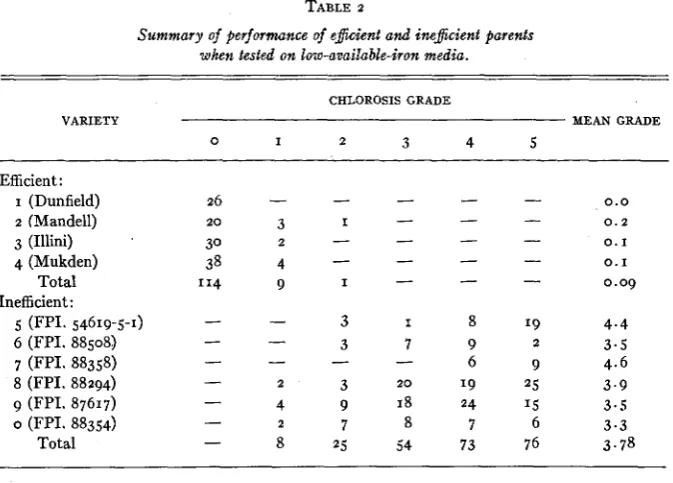
The performance of all parental varieties which were included in the various tests is summ'arized in table 2 . The average chlorosis grade of the efficient
parents was 0.09, while the mean of the inefficient parents was 3.78. Only one plant of the efficient parents was assigned a chlorosis grade above I, and only 8 inefficient parent plants were given a grade below 2. Consequently, if the
genotypes of these plants had not been known, and if all plants assigned chlo- rosis grades of o and I had been considered efficient genotypes and plants
TABLE 2
Summary of performance of e&ient and ine$cient parents
when tested on low-available-iron media.
CHLOROSIS GRADE
VARIETY MEAN GRADE
0 I 2 3 4 5
~ ~~ ~~ ~~
Efficient :
I (Dunfield) 2 (Mandell)
3 (Illini) 4 (Mukden)
Total Inefficient:
5 (FPI. 54619-5-1) 6 (FPI. 88508) 7 (FPI. 88358)
8 (FPI. 88294) 9 (FPI. 87617)
o (FPI. 88354) Total
0.0
0 . 2
0. I
0. I
0.09
4.4
3.5
4.6 3.9 3.5 3.3 3.78
assigned graaes of 2 to 5 inefficient genotypes, nine plants out of 360, or one
out of 40 would have been classified erroneously. The frequency of error in genotype classification in segregating progenies was probably of this magni- tude.
Performance of F, crosses
The frequency distribution of F, crosses within the six chlorosis grades in comparison with that of the parents appears in table 3. I n this classification grades o to I included plants in which no definite iron chlorosis appeared, and
IRON UTILIZATION IN SOYBEANS
TABLE 3
Frequency distribution of chlorosis grades of parents and. various FI crosses when grown in media low in available iron.
2 5 9
CHLOROSIS GRADES GENETIC MATERIAL
STUDIED
0 TOTAL
0 TO I
I 2 3 4 5 2 T O 5
I -
-
-
Eff. Parents 114 9 123 i
8 8 25 54 73 76 228
Ineff. Parents
-
Eff.XEff. Fi 44 3 47 0
Ineff. X Ineff
.
Fl - I I 6 14 23 86 1291neff.XEff. F1 87 5 92 0
- -
-
--
--
-TABLE 4
Numbers of eficient and inefiient plaltts in 122 populations resulting from
crosses between eficient and inefiient varieties.
CHI-SQUARE*
CROSS EFFICIENT INEFFICIENT
(3 :I)
1 x 5 1 x 6 1x7
I X8
1 x 9
I x o
2 x 5 2 x 6 2x7 2 x 8 2 x 9
2x0
3 x 5 3 x 6 3 x 7 3 x 8 3 x 9 3 x 0
4 x 5 4 x 6 4x7 4 x 8 4 x 9 4 x 0
45 37 38 40 41 33 38 38 26 38 36 43 4 0 44 43 41 41 4' 2 1 30 35 26 38 I3 I4 1 7 15 2 1 I 2 I 2 16 1.5 9 I4 I O I O 8 I 2 I 1 I3 I5 4 0.05
3 4 3 0.15 0.16 0.07
I . 2 1
0.65 0.31
0.01
0.10
0.26
I .06
0.15
I . 21
0.01
0.01
0.01 0.16
0. I O
0.29 0.03 1.44 0.31 0.02
Total all FZ 886 30.5 0.69
260 MARTIN G . WEISS
toms. The frequency distributions have been grouped into these two major classes.
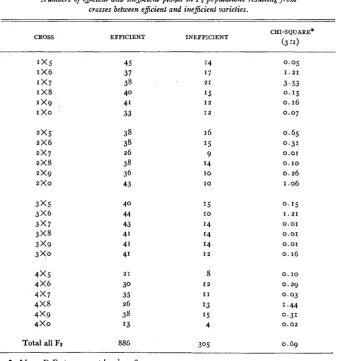
I n all six efficient Xefficient crosses only efficient F, plants were obtained. The 14 F, crosses of inefficientxinefficient types resulted only in inefficient progeny, indicating that all the inefficient varieties possessed a common gene or genes conditioning the inefficiency in iron utilization. F, plants in each of
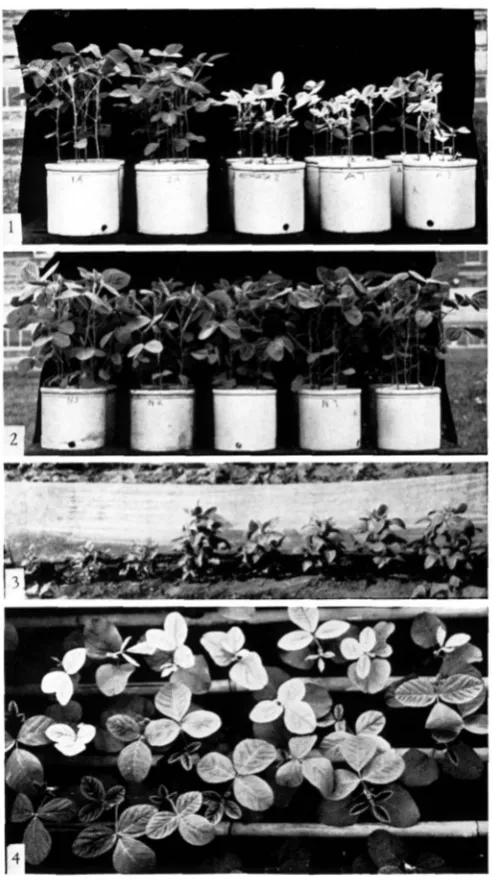
14 crosses between inefficient and efficient varieties were as efficient in iron utilization as their efficient parents, indicating complete dominance of this type. The dominance of iron efficiency under field conditions on calcareous soil is illustrated in figure 3.
Performance of efficient
x
inefficient FZ populationsFz populations of all possible crosses between the four efficient and six in- efficient parents were tested in a nutrient solution rendered low in available iron (table 4). The ratio of efficient to inefficient plants in the total for all Fz populations did not deviate significantly from the ratio of a 3 : I hypothesis.
Each cross was also tested for conformity to this ratio by the chi-square test and revealed close agreement. The difference between the four efficient and six inefficient varieties in efficiency of iron utilization seemed to be conditioned by a single major gene.
Performance of backcross populations
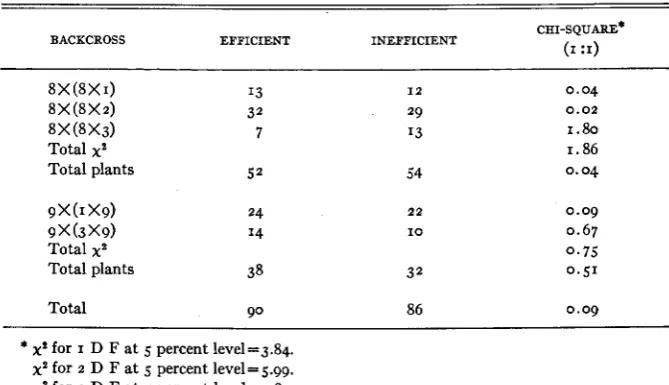
F, plants from five crosses between two inefficient and three efficient parents were backcrossed to their respective inefficient parents. The frequency dis- tributions of the backcross populations in regard to iron utilization efficiency appear in table 5 .
TABLE 5
Numbers of e&ient and ineficient plants in backcross populations.
BACKCROSS EFFICIENT INEFFICIENT CHI-SQUARE* (I
:I)
8X (8X I) '3
8
x
(8x
2)8 X @X 3) 7
Total plants 5 2
9
x
(1 X9) 249
x
(3 X9) I4Total plants 38
32
Total xa
Total xa
1 2
29 I3
54
22
I O
32
0 . 0 4
1.80 1.86
0.04
0.09 0.67 0 . 7 5 0.51
0 . 0 2
Total 90 86 0 . 0 9
* x* for I D F at 5 percent level=3.84. x* for 2 D F at 5 percent leve1=5.99. x* for 3 D F a t 5 percent level=7.81.
I’IGUR): I.-Four ellicieiit (left four pots) and six inellicient (right six pots) soybean varieties growing in soil with low available iron.
FIGURE 2.-Four eficient (left four pots) and six inenicient (right six pots)
soybean varieties growing in soil with adequate available iron.
FIGURE 3.-Three plants of parent 8 (left), three 8x4 F1 plants, and two plants of parent 4 when growing on calcareous soil.
IRON UTILIZATION I N SOYBEANS 261 Performance of F3 lines
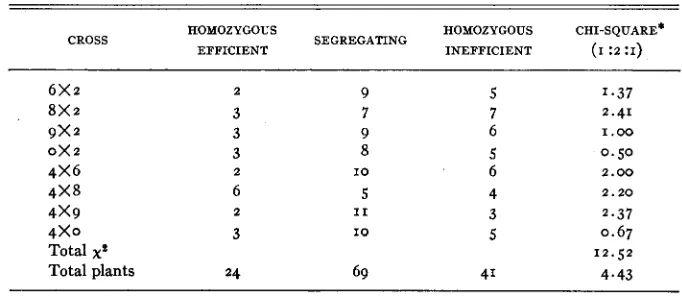
During the summer of 1940, Fz populations from efficientxinefficient crosses involving efficient parents 2 and 4, and inefficient parents 6, 8, 9, and 0, were grown to maturity in soil with adequate available iron. The progeny of a limited number qf Fz plants, selected a t random from each cross, were tested to determine their efficiency in iron utilization when grown in nutrient solution containing a low level of available iron. Because of limited facilities, only ten
F3 plants'were grown as a test of each Fz individual. If a single factor difference is assumed, this small number of plants could result in erroneous classification of approximately seven percent of the segregating progenies. Performance of Fa progenies appears in table 6.
A
segregating line grown by chance between apparently homozygous efficient and inefficient lines is shown in figure 4.TABLE 6
Classification of e&ientXine&ient F2 populations on the basis of their progeny performance in the Fs generation when grown i n media low in available iron.
HOMOZYGOUS HOMOZYGOUS CHI-SQUARE'
CROSS SEGREGATING
EFFICIENT INEFFICIENT ( I :2 :I)
6 x 2 2 9 5
8 x 2 3 7 7
9 x 2 3 9 6
0x2 3 8 5
4 x 6 2 I O 6
4 x 8 6 5 4
4 x 9 2 I 1 3
4 x 0 3 I O 5
Total xf
Total plants 24 69 41
* ~2 for z D F at 5 percent level=5.99. xz for 16 D F at 5 percent level=26.30.
1.37 2.41
0 . 5 0 1.00
2 . 0 0 2 . 2 0
2.37 0.67
1 2 . 5 2
4.43
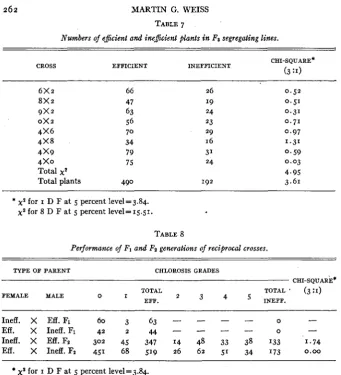
The proportion of homozygous efficient, segregating, and homozygous in- efficient Fa lines in none of the Fz populations deviated significantly from the expected I : 2 : I ratio. Furthermore, the sum of the chi-square values for all populations, and the chi-square value calculated from the deviations of total plants in each class from the expected number were also non-significant. Dis- tribution of types in the segregating lines is shown in table 7.
None of the population totals for segregating lines deviated significantly from the 3: I ratio. The total chi-square, as well as the chi-square for the ratio of all efficient and inefficient plants in the segregating lines, also indicates con- formity with the single factor hypothesis.
Maternal inheritance test
262 MARTIN G. WEISS TABLE 7
Numbers of ejkient and {nejkient plants i n Fa segregating lines.
CROSS EFFICIENT INEFFICIENT CHI-SQUARE*
(3 :I)
6 x 2 66
8x2 47
9 x 2 63
ox 2 56
4 x 6 7 0
4 x 8 34
4 x 9 79
4 x 0 75
Total x2
Total plants 490
* x2 for I D F a t 5 percent level=3.84.
x2 for 8 D F a t 5 percent level=15.51.
26 19 24 23 29 16 31
24
0.52 0.51 0.31 0 . 7 1 0.97 1.31 0.59 0.03 4.95 3.61
TABLE 8
Performance of F1 and Fe generations of reciprocal crosses,
T Y P E O F P A R E N T CHLOROSIS GRADES
CHI-SQUARE*
TOTAL TOTAL ' (3 :I)
0 I
INEFF.
FEMALE MALE
EFF.
Ineff. X Eff. FI 60 3 6 3 - - - -
-
Eff. X Ineff. FI 42 2 4
- -
- -
-
Ineff. X Eff. Fn 302 45 347 14 48 33 38 133 1.74 Eff. X Ineff. FZ 451 68 519 26 62 51 34 173 0.00
0
0
*
x2 for I D F a t 5 percent level=3.84.Absence of maternal inheritance was evidenced by the similarity in per- formance of reciprocal crosses in both the F, and
FZ
generations.Physiological study
Leaf and stem tissues of the four efficient and six inefficient varieties used in the inheritance study were subjected to certain chemical analyses as previously outlined.
The following analyses were made: (I) pH of composite tissue fluid ex- pressed after freezing samples of leaves and stems, (2) soluble iron in one ml
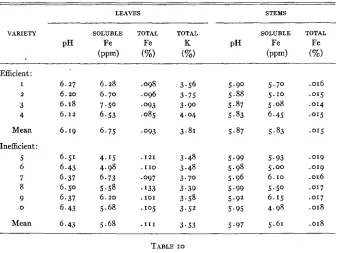
of composite tissue fluid from leaves and stems, (3) total iron in dried stem and leaf tissues, and (4) total potassium in dried leaf tissues. Mean values of the four replications fo; the four efficient and six inefficient varieties appear in table 9.
IRON UTILIZATlON I N SOYBEANS 263
TABLE 9
Mean p H and soluble iron values of composite tissue jluids, soluble and total iron of leaf and stem tissues, and total potassium of leaf tissues (dry weight basis) of jour e$cient and six inejicient soybean varieties.
LEAVES STEMS
VARIETY SOLUBLE TOTAL TOTAL SOLUBLE TOTAL
PH Fe Fe K PH Fe Fe
( P P 4
(%I
(%I
( P P 4(%I
Efficient :
I
2
3 4
Mean
Inefficient :
5 6 7
8
9
0
Mean
6 . 2 7 6.28 .098 3.56 6.20 6.70 .096 3.75
6.18 7.50 .093 3.90
6.12 6.53 .085 4.04
6.19 6.75 .093 3.81
6.51 4.15 . I 2 1 3.48 6.43 4.98 . I 1 0 3.48 6.37 6.73 .097 3.70 6.50 5.58 .I33 3.39 6.37 6.20 .IO1 3.58 6.43 5.68 .Io5 3.52
6.43 5.68 . I I I 3 4 3
5.90 5.70 .016
5.87 5.08 .or4
5.88 5.10 .or5
5.83 6.45 .OI5
5.87 5.83 . o q
5.99 5.93 .or9 5.98 5.00 .019
5.96 6.10 .or6
5.99 5 . 5 0 .017 5.92 6.15 . o r 7 5.95 4.98 .OI8
5.97 5.61 .or8
TABLE IO
and total potassium of leaf tissue of ten soybean varieties. Analysis of variance of p H , soluble iron, and total iron of leaf and stem tissues,
WEAN SQUARES
Leaves:
Replications 3 .0034 0. IO .000264 * I425
Varieties
Eff. and Ineff. I .5520t II.IO* .00327I* .8IO9t
Within Ineff. 5
Within Eff. 3 .or64 1.12
.
0001 26 .1668Error 27 .00584 1.519 . O O O I ~ ~ O .090zz
.OI51* 3.81 .000742t .0438
Stems:
Replications 3 .0?06 0.32
.
000000Varieties:
Eff. and Ineff. I .09zot 0.48 .oooo616~
Within Eff. 3 .0039* 1.39 .0000033
Within Ineff. 5 .0028 1.14
.
ooooo38*.OOII8 0.810 .OOOOOI33
Error 27
* F value exceeds the 5 percent point in level of significance.
264 MARTIN G. WEISS
The analysis of variance shows that efficient and inefficient varieties differed significantly in hydrogen-ion concentration of composite tissue fluid of both leaves and stems. Although significant differences were found in the p H of leaf tissue among the inefficient, and in the p H of stems among the efficient varieties, these differences were far less in magnitude than differences between the efficient and inefficient varieties. The F values for leaves and stems of the latter were, respectively, 1 2 and I O times the value necessary for highly sig-
nificant differences.
These differences were substantiated by p H determinations of co,mposite leaf tissue fluid of the ten varieties when grown in the field on non-calcareous soil during the summer of 1940. Under these conditions the F value of the pH difference between the two types exceeded that of the one percent point in level of significance by five times.
Differences in total iron content of tissues closely paralleled differences in p H of tissue fluid. Inefficient varieties contained a surprisingly greater amount of total iron than the efficient varieties. Analyses for soluble iron showed a significantly larger quantity in the expressed sap of leaf tissue from the effi- cient type. Although soluble iron in the stems showed the same relationship, the differences were statistically non-significant. Total potassium was sig- nificantly greater in the efficient varieties, while varieties within the two groups did not differ significantly.
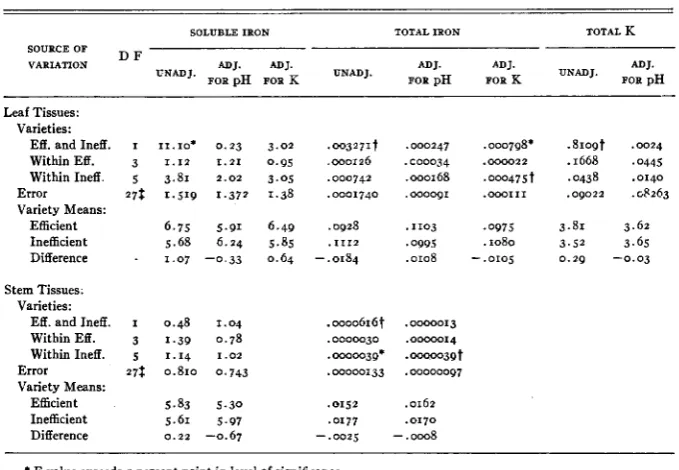
The gene conditioning greater efficiency in iron utilization thus seems to be expressed by its action in producing higher hydrogen ion concentration, higher soluble iron, higher potassium and lower total iron content of aerial tissues than its allele which, when in the homozygous state, conditions inefficiency in iron utilization. A study of the associations between these various composi- tional criteria was made by means of the covariance method of analysis a s outlined by SNEDECOR (1940). The relative degree of association was con- sidered a possible means of approaching the cause and effect relationship. The following associations in the leaf tissues were investigated: p H and soluble iron, potassium and soluble iron, p H and total iron, potassium and total iron, and p H and potassium. The stem analysis associations studied were p H and soluble iron, and p H and total iron. The resulting errors of estimate mean squares and adjusted mean values for the efficient and inefficient varieties appear in table 11. Mean squares from the analysis of variance and unadjusted
mean values for the two types of varieties are included to facilitate comparison of adjusted and unadjusted values.
The mean squares of errors of estimate indicate a close association between the hydrogen iron concentration of the expressed juice and total iron within the leaf and stem tissues. Highly significant total iron differences between the efficient and inefficient varieties were rendered non-significant after due allow- ance was made for pH differences.
IRON UTILIZATION IN SOYBEANS 265
TABLE 11
Mean squares of errors of estimate and adjusted mean values of eficient and inefiient varieties resulting from the anelysis of covariance of various compositional criteria.
SOLUBLE IRON TOTAL IRON TOTAL K
ADJ. AD J.
D F SOURCE OF
VARIATION ADJ.
FORPH F O R K FOR pH
U N A D J .
FoyJdH
F2K
UNADJ.Leaf Tissues: Varieties:
Eff. and Ineff. Within Eff. Within Ineff. Error Variety Means:
Efficient Inefficient Difference
Stem Tissues. Varieties:
Eff. and Ineff, Within Eff. Within Ineff. Error Variety Means:
Efficient Inefficient Difference
I II.IO* 0 . 2 3 3 . 0 2 .003271t ,000247 .000798* .8109t .OO24 3 I . 1 2 I . 21 0.95 .cm0126 .coo034 . O O O O Z ~ .1668 ,0445
5 3.81 2 . 0 2 3 . 05 .000742 .ooo168
.
ooo475t .0438 .0140 27: 1.519 1.372 1.38 .WO1740 .00009I .OOOIII ,09022 .Os2636 . 7 5 5 . 9 1 6 . 4 9 ,0928 .1103 .OW5 3 . 8 1 3 . 6 2 5 . 6 8 6 . 2 4 5 . 8 5 . I I I ~ .0995 ,1080 3.52 3.65
. 1 . 0 7 - 0 . 3 3 0 . 6 4 -.0184 .or08 -.0105 0.29 -0.03 I 0 . 4 8 1 . 0 4 . w o o 6 1 6 t .0000013
3 1 . 3 9 0 . 7 8 .0000030 .0000014
5 1 . 1 4 1.02 .oOOW39* .0000039t
271 0.810 0 . 7 4 3 .WO00133 .WO00097
5 . 8 3 5 . 3 0 .or52 .or62
5.61 5.97 .0177 .or70
0.22 -0.67 - . 0 0 2 5 - . W O 8
* F value exceeds 5 percent point in level of significance.
t F value exceeds I percent point in level of significance. $ 2 6 D F for mean squares of errors of estimate.
seem t o account for as much of the iron variation as was explained by the hydrogen-ion concentration differences.
DISCUSSION
I n view of the complex nature of mineral absorption and utilization in plants, the monogenic simplicity of the genetic control of iron utilization effi- ciency discovered in these investigations seems remarkable. Although some variation of efficiency was noted among the inefficient varieties, the magnitude of expression of any modifying genes was negligible in comparison with that of the major gene involved. Designation of the recessive gene conditioning inefficiency in iron utilization by the symbol fe is suggested. The dominant allele conditioning efficiency would therefore be Fe.
Since the gene conditioning efficiency proved identical in the six varieties, and since 14 additional inefficient varieties probably carried this gene, an effort was made to trace the origin of varieties of this type. These varieties came from central and southern Manchuria or northern Chosen. Several of the inefficient varieties were collected from the same locality, but in all cases efficient varieties were also obtained from the same locality. No marked selec- tion against the inefficient genotype seems to have occurred. This is especially odd since calcareous and alkaline soils of various kinds have been found by
266 MARTIN G . WEISS
Since soybean varieties in the Orient are generally developed for local areas and normally do not spread rapidly, it is possible that the inefficient varieties were grown on upland soil from which lime had been leached, and no selection against this genotype occurred.
Chemical analyses of stem and leaf tissues were made to determine the physiological differentiation between the genotypes. Differences in hydrogen- ion concentration of expressed tissue fluid were most consistent of the con- stituents measured. Such differences were obtained not only when the two genotypes were grown in nutrient solutions but also when grown on normal soil under field conditions. The identification of the hydrogen-ion concentration of expressed cell sap with the true intracellular p H is open to criticism. As pointed out by OSTERHOUT (1922), expressed juice does not represent an unaltered cell sap, for, in crushing the cells, the sap may be changed by chemical reac- tions, absorption, or admixture with intercellular substances. ROGERS and SHIVE (1932) found that although various tissues within a plant differed greatly in hydrogen-ion concentration, the pH of expressed fluid was fairly constant and approximated the mean hydrogen-ion concentration of the vari- ous tissues. Furthermore, the p H of composite tissue fluid of various species was proportionate to the p H of similar tissues within the different species. The observed pH difference of the efficient and inefficient soybean varieties is therefore believed to be proportional to the intracellular p H difference of the two types.
Relatively lower solubility of the iron and lower potassium content was associated with the higher p H of the inefficient genotype. The interrelation of cell sap pH, total and soluble iron, and potassium content of plant tissues is not well understood although various associations have been reported. The investigations of INGALLS and SHIVE (1931) and ROGERS and SHIVE (1932)
showed a definite relationship between the p H of expressed tissue fluid and the solubility and quantity of iron present within the plant.
HOFFER and TROST (1923) contended that excessive accumulations of iron in the nodal regions of the corn stem were often associated with inadequate supplies of available potassium in the growth medium, and consequently, in the corn stems. The converse interrelation of potassium and calcium absorp- tion by plants, as found by LOEHWING (1928), may be of significance. Media with high calcium resulted in high sap p H and copious precipitation of iron in root and lower stem regions, while a consistent decrease of pH in the expressed plant sap was associated with the addition of potassium to the growth medium. This relationship was considered responsible for a lack of iron deficiency symp- toms accompanying the potassium treatment.
IRON UTILIZATION I N SOYBEANS 267 analyses of iron and potassium should give further information on this com- plex cause-and-effect relationship.
SUMMARY
Marked differences in chlorosis were noted among soybean varieties when tested on calcareous soils for the first time since their introduction into the United States from Manchuria. Testing of these varieties in nutrient solution cultures and in sub-irrigated crushed quartz media proved that this differential performance could be induced when the plants were grown on media in which the concentration of available iron was low. When grown on such media, vari- eties which were efficient in iron utilization made normal, green growth, while inefficient varieties showed severe chlorosis symptomatic of iron deficiency which ultimately resulted in death of the plant. The deifference between effi- cient and inefficient genotypes was of sufficient magnitude to permit classifica- tion when grown in media rendered low in available iron, which made possible a study of the mode of inheritance of efficiency differences.
On the basis of Fz and FI populations of crosses between four efficient and six inefficient varieties, and of backcross populations, differences in efficiency of iron utilization were shown to be conditioned by a single gene. Inefficiency of F, plants from all crosses among the six inefficient varieties established allelism of the gene conditioning inefficiency, and the assumption was made that the inefficient gene was identical in these varieties. The recessive gene conditioning inefficiency in iron utilization was assigned the symbol fe.
Performance of F, plants from crosses between efficient and inefficient vari- eties indicated complete dominance of the
Fe
allele. Absence of maternaljn- heritance was evidenced by similar performance of reciprocal crosses between theFe
and fe genotypes in the F, and FZ generations.Composition in aerial plant tissues, as conditioned by the inefficient gene, consisted of relatively higher pH, lower soluble iron, higher total iron, and lower potassium content. Although the data furnished no definite information as t o identity of the primary causal agent, the assumption was made that rela- tively low solubility of iron ininefficient genotypes was induced by the com- paratively high pH. On the other hand, relatively low potassium content might have accounted for the low hydrogen-ion concentration.
LITERATURE CITED
BROWN, D. S., R. R. ROBINSON, and G. M. BROWNING, 1938 Determination of small amounts
of potassium. Ind. and Eng. Chem., Anal. Ed. IO: 652-654.
BURKHOLDER, P. R., and I. MCVEIGH, 1940 Growth and differentiation of maize in relation to nitrogen. Amer. J. Bot. 27: 414-424.
FORTUNE, W. B., and M. G. MELLON, 1938 Determination of iron with o-phenanthroline. Ind. and Eng. Chem., Anal. Ed. IO: 60-64.
HOFFER, G. N., and J. F. TROST, 1923 The accumulation of iron and aluminum compounds in corn plants and its probable relation to root rots. J. Amer. Soc. Agron. 15: 323-331. INGALLS, R.'A., and J. W. SHIVE, 1931 Relation of H-ion concentration of tissue fluids to the
distribution of iron in plants. Plant Physiol. 6: 103-126.
268 MARTIN G. WEISS
OLSEN, C., 1935 Iron absorption and chlorosis in green plants. C. R. Trav. Lab. Carlsberg, Chim. 21: 15-51.
OSTERHOUT, W. J. V., 1922 Some aspects of selective absorption. J. Gen. Physiol. 5: 225-230.
ROGERS, C. H., and J. W. SHIVE, 1932 Factors affecting the distribution of iron in plants. Plant Physiol. 7: 227--252.
SAYWELL, L. G., and B. B. CUNNINGHAM, 1937 Determination of iron. Ind. and Eng. Chem., Anal. Ed. 9 : 67-69.
SCOTT-MONCRIEFF, R., 1936 A biochemical survey of some mendelian factors for flower colour.
J. Genet. 32: 117-170.
1939 The genetics and biochemistry of flower colour variation. Ergebnisse der Ensym- forschung 8: 277-306.
SMITH, S. N., 1934 Response of inbred lines and crosses in maize to variations of nitrogen and phosphorus supplied as nutrients. J. Amer. Soc. Agron. 26: 785-804.
SNEDECOR, G. W., 1940 Statistical Methods. 3d ed. pp. 249-273. Ames, Iowa: Iowa State College Press.