Studies in Triphenylmethane Dyes -
Surfactant (Eab and Tx-100) Interaction for
Microdetermination of Transition Metal Ions
Dr. Suparna Deshmukh
Assistant Professor, Dept. of Chemistry, S.K.Gandhi College of Arts, Commerce and Science, Kada Dist. Beed, India
ABSTRACT: The chelation reactions of some Transition Metal Ions in the presence of Triton-X 100, have been studied in detail. The complexes show a large bathochromic shift. The composition of chelates of Cd(II), and Hg(II) was found to be 1:2 in the absence of surfactant which changes to 1:1 in the presence of surfactant TritonX-100. However, the composition of Cu(II) was found to be 1:1 both in absence and presence of TX-100. The stability constants were evaluated. Various analytical parameters were evaluated to prove the utility of EAB, in the spectrophotometric microdetermination of metal ions under study. The effect of foreign ions on the systems was studied in the presence of large number of cations.
KEYWORDS: Surfactant, Bathochromic shift, Spectrophotometric Micro- determination,
I. INTRODUCTION
The addition of quaternary salts to the deeply colored solution of dyes, causes a marked color change with the change in wavelength of maximum absorption. The bathochromic shift is caused by short range electrostatic forces on the surface of the micelle double layer. The interesting property of the aggregates formed is their ability to form colored complexes with various cations. Another advantage is that the determination of microamounts of metal ions can be done with much higher sensitivity in the presence of these long chain quaternary salts.
This unusual property has applied for microdetermination of Transition metal ions in present studies. Addition of Cetyl Pyridinium Bromide shifts the maximum absorption to 630nm and doubles the sensitivity of 1:2:4 Rhodium-dye-quaternary salt complex. Systematic design of surfactants induced dye-metal ion interactions leading to the sensitized photometric metal ion determination would obviously be facilitated by an accurate model of detail chemistry involved.With this aim present studies has been undertaken and involves a detail study of the interaction of surfactant, Triton X 100 with a Triphenyl Methane Dye, Eriochrome Azurol-B. The dye detergent complex thus formed was used to study the complexation reactions of Cu(II), Cd(II) and Hg(II)and compared with the complexation reaction of these metal ions with the EAB in absence of detergents.
II. RELATED WORK
Subsequent developments showed that the addition of detergent solution to a specific organic dye solution forms a new modified reagent species as a dye :surfactant complex, To this when metal ion is added it resulted in water soluble , highly colored complexes with much greater molar absorptivities and sensitivity. This increased sensitization of color reactions of metal ions is most advantageous for analysis . The selection of appropriate surfactant is done on the basis of Sign Rule proposed by Hartley.
Copper forms 1:1:2 complex with Bipyridyl and Eriochrome Cyanine R, in the presence of Triton X-100. The use of Cu-Bipyrydyl- Eriochrome Cyanine R complex has been reported for the determination of copper traces by Shifu, Z; Liang, X. W etal.
micellar systems which indicates that micellar system do indeed shift pK values. Zade,A.B., and Munshi. K.N, has found out that the solubilisation in cationic micelles causes the pK value of organic dyes to shift in opposite direction from solubilisation in anionic micelles.
The complex is formed in a stepwise manner through a series of equilibria. These stepwise equilibria were first shown by Bjerrum and Leden working independently.A convenient method for determination of composition of solutions were studied by Dey and coworkers and they were able to develop the method for colored reactants and colored complexes formed. According to their studies mixtures were prepared according to the method of continuous variations and their absorbances were measured at fixed wavelength. Graph is plotted as Absorbance against [M]/[M]+[Ke]. Chernova and co-workers studied effect of surfactants on the spectrophotometric charecteristics of metal chelate with dyes as chromophoric reagents. Surfactants used were found to increase the color contrast intensity, selectivity, and sensitivity of the spectrophotometric determination of metal ions with chromophore chelate forming reagents. Analytical parameters such as pH of optimum stability , concentration, range of adherence to Beer’s law, extinction coefficient and complex composition were found out for the colometric analysis of some metal ions using TPM dyes and quternary salts.
III. EXPERIMENTAL
Instruments : The absorption measurements were done on a UV Shimadzu spectrophotometer UV-240. Glass cuvettes of 1cm thickness supplied with the instrument were used; distilled water blanks were used. For pH measurements, Elico pH meter LI-10 operated on 220volts stabilized AC mains were used, with a glass calomel electrode system. Materials: All the reagents used were of BDH, Anal R grade purity. The surfactant, Triton-X-100 in 20% aq. methanol. The Dye solution was prepared in double distilled water by dissolving their purified samples and the standard solutions of metal solutions were prepared from different salts.
Procedure: Preparation of mixtures, measurements of absorbance, adjustment of pH etc. were carried out at room temperature. In all the experiments, TX solution was added to the reagent solutions which was for atleast 20min for maximum decolorizing effect to which metal ions solution was then added. The absorbance readings were recorded only after 30 minutes of the addition of the reactants, a time necessary for equilibration.
IV. RESULTS AND DISCUSSION
Absorption Spectra
Absorption spectra of ECR solution was recorded from pH1.0 to 12.0. The spectral studies in the presence of ten times excess of TX-100 were also recorded from pH1.0 to 12.0. The max values in the absence as well as in the presence of TX-100 are summarized below
TABLE-1
max OF EAB AT DIFFERENT pH VALUES
pH max nm in absence of TX-100 max nm in presence of TX-100
1.0 – 2.0 470 470
3.0 490 480
4.0 500 520
5.0 440 420
6.0 425 460
7.0- 11.0 425 430
12.0 595 595
Dissociation Constant (pK values) of EAB
The EAB contains three replaceable protons in its molecule. Tow of it correspond to-COOH groups while the third corresponds to-OH group. The equilibrium reaction which occurs in the stepwise dissociation of EAB can be written as follows.
H₃EAB pK₁ H₂EAB⁻ pK₂ pK
The above equilibrium reaction shows three pK values of EAB. Experiments were carried out for the determination of pK values of EAB in the presence and absence of surfactant Triton X – 100. From the results, pK values obtained are recorded in Table 2
TABLE - 2 Dissociation Constants of EAB
pK values In absence of surfactant In presence of TX -100
pK1 3.00 2.90
pK2 5.69 5.60
pK3 11.13 11.00
Lowering of pK values indicates the action of surfactants on EAB.
Composition Of EAB-TX Complex :
The effect of varying concentration of TX on EAB absorbance was also studied at pH 5.0 and at 530nm. The absorbance of EAB decreases linearly upto a definite ratio of EAB:TX, as 1:1, is reached. After this point the addition of surfactant , even in excess amount did not alter the absorbance of EAB to any significant extent. Thus the complex formed can be represented as [ EAB(TX)].It is represented in fig.1
Composition Of EAB-TX-100 Complex
Effect Of Mineral Salts : The effect of mineral salts on the absorption spectrum of EAB in the presence of TX. The cations , , did not show any effect on the absorbance of dye-detergent solution. Nitrates has shown some effect at pH 5.0, as the absorbance goes on increasing upto certain extent after which it remains unaltered
Absorption Spectra Of The Complexes:
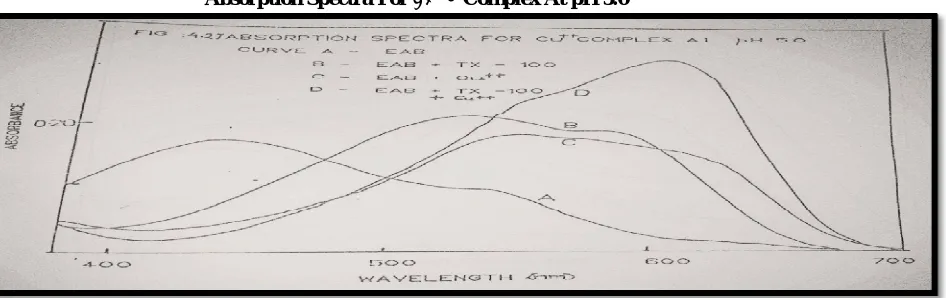
The absorption spectra of EAB, EAB-metal ion, EAB- TX, EAB-Metal ion-TX were recorded at the pH of study i.e 5.0. The nature of complexes formed between EAB and Cu(II), Cd(II) and Hg(II) has been studied in detail. A representative absorption spectrum is shown in Fig.2 to indicate the methodology used. The change in the spacing of low lying π- electronic energy levels resulting from chelation causes a shift in the wavelength of absorption bands and hence a change in color. The extent of shift may depend on the type of complex formed. EAB in aqueous solution by addition of TX was found to be fairly stable between pH range 4.0 to 6.0. Below pH3.0 there is no evidence of complex formation in the present cases while above pH6.0 the metal ions under study starts hydrolyzing. The spectral studies carried out between 380nm to 700nm in all cases indicated the formation of only one stable complex under the present conditions of study. The max of the complexes formed, both in the absence as well as in the presence of surfactants are recorded in Table 3.
Absorption Spectra For Complex At pH 5.0
Composition Of EAB Chelates:
Composition of EAB chelates was stud ied by Jobs Method Of Continuous Variation at pH and wavelength of study. Two types of metal-ligand chelates are observed for EAB either at M:L ratio as 1:1 or as 1:2 for the metal ions under study. The solutions of metal ions and EAB were taken in three different equimolar concentrations .All these solutions were mixed in such a way that the total volume remains constant as 25ml. The stoichiometric composition between the metal ions and EAB in the presence of TX-100 are recorded in Table 3.
TABLE 3
Composition Of EAB Chelates
Systems pH max nm Composition By Jobs Method
Cu – EAB 5.0 560 1:1
Cu - EAB – TX 5.0 610 1:1:1
Cd - EAB 5.0 540 1:2
Cd - EAB – TX 5.0 610 1:1:1
Hg - EAB 5.0 540 1:2
The composition of the complexes formed in presence as well as in the the absence of TX remains same in case of Cu complex, while it changes in case of Cd, and Hg complexes. This change in nature of the complexes may be attributed due to involvement of cationic micelles attachment to the neutral micelles attachment to the chelating positions of EAB.As these positions are already occupied by TX, another anion of the ligand must be involved in the complexation to fulfil the coordination sphere of the metal ion thus changing the composition from 1:1 to 1:2.
Stability Constant :
The values of logK of chelates of metal ions under study in the absence and in presence of TX-100 are reported in table 4
TABLE 4
Composition And log K Values Of Chelates Of EAB In Presence And Absence Of TX-100.
Chelates max nm Composition LogK values (+_0.2) by Jobs Method
Cu – EAB 560 1:1 3.7
Cu – EAB - TX 610 1:1:1 4.2
Cd – EAB 540 1:2 9.7
Cd – EAB - TX 610 1:1:1 11.2
Hg - EAB 540 1:2 10
Hg – EAB - TX 600 1:1:1 10.7
In almost all cases increase in logK values has been observed wherever the compositions may change. This may be due to TX reacting with EAB to allow an early dissociation of protons from the EAB which participates in the complex formation , thus allowing the attachment of the metal ion more easily at the pH of study and therefore increasing the value of stability constant.
Analytical Applications:
In all the experiments, surfactant solutions is added to EAB solution. This was kept for 0.5hr. for completion of the reaction to which the metal ion solution was added. Effect of temperature on the absorbance of metal ion chelates of EAB in the presence of five fold excess of surfactant,TX-100, by varying temperature from 25 to60 C. It has been observed that in the presence of TX remains constant in this range of temperature. The color formation does not depend upon reaction time and is instantaneous. However, the mixtures were kept for 0,5hr. after their preparation for equilibration in the absence as well as TX-100. The color was stable upto 3 to 4 hrs. after which the absorbance shows a decreasing trend.
Effect Of Reagent Concentration:
Studies are made by noting the absorbance of the systems made by taking a constant concentration in the presence of five fold excess of TX-100. It was observed that in the presence of and in the absence of surfactant the maximum absorbance is attached in case of all metal ions to have maximum color development.
pH Range Of Stability Of The Absorbance of The Systems:
A series of solutions of metal : reagent in ratio were prepared at different pH values. In the presence of surfactants, the ratio of reagent: TX was kept in proportion 1:10 proportion. The absorbance was noted at the wavelength of study of the systems. The pH- range within which the absorbance values do not change significantly is taken as the pH range of stability of the absorbance of the colored systems. The pH range of stability for all the systems is recorded in Table 5
pH Range of Stability, Range Of Concentration For Adherence to Beer’s Law and For Effective Photometric Determination
System Wavelength Of
Study(nm)
pH range of stability Beer’s Law Range (ppm) concentration
Photometric Range conc. (ppm)
Cu(II)-EAB-TX 610 4.5 - 5.5 0.55-1.91 0.91 – 1.06
Cd(II)-EAB-TX 610 5.0 – 6.5 0.75 – 3.99 2.82 – 4.46
Hg(II)-EAB-TX 600 4.0 – 6.0 2.01 – 8.02 3.23 – 5.49
Sensitivity And Molar Absorptivity :
The sensitivity of the color reactions of different metal ions with EAB for log = 0.001, as defined by Sandell, and Molar Absorptivity of the systems are listed in table 6.
Table 6
Sandell’s Sensitivity And Molar Absorptivities Of The Systems.
Systems Wavelength Of
Study(nm)
pH Of Study Sandell’s Sensitivity SX10
Molar Absorptivity Em x 10
Cu-EAB-TX 610 5.0 2.2 20.4
Cd –EAB-TX 610 5.0 4.9 16.7
Hg-EAB-TX 600 5.0 9.8 18.5
Procedure For Microdetermination :
The pH of the metal ion solution, containing concentration of metal ion as per given in table 5, as effective photometric range for different metal ions, is to be adjusted to pH 5.0. Add four fold excess of modified EAB solution of the same pH and make up the volume to 25ml with distilled water. Modified EAB is prepared by adding to it about five fold excess of TX solution and then keeping it for half an hour for equilibration and full color development. Measure the absorbance of this solution at the respective wavelength of study against modified reagent as blank. Compare the absorbance of this solution from the calibration curve obtained under similar conditions.
V. CONCLUSION
The mean absorbance, mean deviation, and relative mean deviation by taking ten repeated analysis with aliquots containing metal ions, are calculated. Also i) the Root Mean Square deviation, ii) the Most Probable Analytical error, and iii) the Difference Between Arithmatic Mean, and the true or Most Expected Value of the absorbance for the systems are studied. The Precision and Accuracy data recorded revealed that the method proposed is both precise as well as accurate.
REFERENCES
1. Duchkova , H; Cermakova, L; Malat, M; Complexation Studies Of Rhodium with surfactant CPB, Anal. Lett; 8, 115,(1975). 2. Zhaoai , N; Yongfu, M; Studies On Chelation Of Rare Earth s With CAS and Cationic Surfactants.; Fenxi Huaxue; 13, 29 (1985). 3. Jarosz, M; Studies Of Ternary Complexes Of Ga, Th,and In with CAS, ECR, PCV and Surfactants.; Chem. Anal; 33, 675 (1988).
4. T. S. West, R. M. Dognali, J.E Chester and W. Bailay;, Sensitisation Of PCV By CTAB For Determination of Mo, Sb, and Al.; Talanta, 51, 1359 (1968); 17, 13 (1970).
5. A. B. Zade and K.N. Munshi, K.L.Mittal(ed), Procd. International Conference On Surfactants in Solution, Plenum Press, 5( Part II), 713 (1988). 6. C.R. Vekhande and K. N. Munshi; ,Effect Of Micelles On Methyl Thymol Blue; J. Indian Chem. Soc., 50, 384 (1973).
7. Albert and E.P. Serjeant, The Determination of Stability Constants, Champman and Hall(1971).
8. Quanzhang, D; Kailong, L; Huagong Yejin; Photometric Analysis Of Chromium Using TPM Dyes; 12, 71 (1991); Chem Abs. 115, 40818x (1991).
11.Moumita Chakraborty, Amiya Kumar Panda; Spectral Behaviour Of Eosin Y In Different Solvents and Aqueous Surfactant Media.; Spectrochimicia Acta Part A 81 458-465 (2011).
12. M.N. Khan; Anila Sarwar; Study Of Dye Surfactant Interaction – Aggregation and Dissolution In N-dodecyl Pyridinium Chloride.; Fluid Phase Equilibria 239 (2) : 166 – 171; January 2006.
13. Akbas H, Kartal C; Spectrophotometric Studies Of Anionic Dye- Cationic Surfactant Interactions In Mixture Of Cationic and Non- Ionic Surfactants.; Spectrochim Acta A Mol Bioml Spectrosc. Dec;65 (5): 1241-2, (2006).