Evaluation of Major Problems Faced by the
Members of Self Help Groups: A Study of
Punjab
Lakhwinder Kaur1, Divya Sachan2
Research Fellow, Department of Extension Education and Communication Management, College of Home Science,
Punjab Agricultural University, Ludhiana, Punjab, India
ABSTRACT: Empowerment is an active process of enabling women to realize their full identity and power in all spheres of life. Entrepreneurship is the dynamic process of creating incremental wealth. The process of empowerment among women can be institutionalized through Self Help Groups (SHG). The SHGs are characterized by a focused attention on providing employment opportunities by imparting training in order to generate both income as well as employment. Today the SHGs are the largest Micro– Finance (MF) programme in the world. In spite of the speedy increase in the number of self-help groups, the full potential of utilizing self-help groups remains unexploited due to some problems faced by the members of self help groups. The results of the study reported that production problems were found to be the most serious problem perceived by the members of three self help groups with the average percentage mean score of 62.5. It was followed by the family and marketing problems with the average percentage mean score of 58.88 and 50.55 respectively. There is need to overcome these hurdles by providing appropriate facilities like provision of good quality raw material, access to latest information, facilitation of loan, strong networking with other groups etc. for smooth functioning of self help groups.
KEYWORDS: Evaluation, Problems, Members, Self Help Groups.
I. INTRODUCTION
Formation of self help group (SHG) is a path breaking initiative that can transform the lives of a number of families. SHG approach has emerged as a successful strategy for women in present time. The concept of SHG was started in 1975 and gained significance, especially after 1975 when Professor Mohammed Yunus of Bangladesh began experimenting with micro-credit and women SHGs. The strategy made a quiet revolution in Bangladesh in poverty eradication by empowering the poor women [1]. In India, the concept of self-help groups can be traced back to the Gandhian Grama Swaraj movement. It was mainly concerned with the poor and it was for the people and of the people. SHGs were widespread in the traditional and ancient times and they were the main basis of functioning of these societies. These groups acted as a major source for providing social and material support to individuals, families and communities in times of need.
II. LITERATURE SURVEY
Problems are hindering factors or constraints faced by the members of self help groups. A study conducted by [3] revealed that due to lack of knowledge and education, people were not aware of self help groups and its formation in the initial stages created lot of problems. There was much resistance not only from the prospective members but also from their spouse. Lack of leadership qualities was another problem faced in initial stages of forming the group, which was due to inadequate education and their low socio-economic background. Similarly [4] reported that problem of illiteracy was main hindrance in the formation of group. Moreover, there was little consensus in the group about the productive activity to be taken up. Findings of [5] revealed that financial institutions did not give loan to the groups in time. The other problems like difficulty in getting raw materials, competition from mechanized and better quality products, marketing and low price were the major hurdles in the successful operation of the groups. A study in Tamil Nadu by [6]reported that most of the SHG women have been involved only in the micro credit savings. They were not properly facilitated through conducting periodical meetings, training programmes and awareness camps for their improvement. Their active participation in economic activities was very much limited due to the lack of adequate approach by the NGOs. Though the women have formed groups they had poor decision making capacity for their self-developmentA study conducted by [7] on the self help groups of Punjab and the data revealed that there was lack of training opportunities and limited opportunity for income generating activities as faced by 30 and 18 per cent of the respondents. Nearly 21 per cent reported that there was lack of guidance and support from the promoting agency. Lack of transparency in keeping records and irregularity holding meetings was reported by 6.67 per cent members. Further [8] found major problem faced by the SHGs was delay in sanctioning the loan (21.33%) followed by poor response of authorities (18.67%), lack of administrative experience (18%), difficulty to approach the authorities (12%), inadequate loan amount (14.67%), limited number of installment (8%) and the problem of lack of cooperation among the members (7.33%). The main problems in bank linkages were reported to be lack of cooperation, lack of government support, procedural delays, apathetic attitude of bank officials and poor saving rates.
III. MATERIALS AND METHODS
The study was conducted in three cultural zones of Punjab (Majha, Malwa and Doaba). Three groups were selected from each zone. Thus Maha Laxmi self help group, Assal self help group and Sada Shiv Modern self help group from Majha, Malwa and Doaba were selected randomly. All the members of these groups were selected. Thus sample comprised of 60 members for the present study. An interview schedule was prepared for the collection of data from the members regarding difficulties faced by the members of self help groups. Statements were prepared and responses were recorded in yes and no form along with open ended questions. The data were analysed by using frequency, percentages, rank and average percentage mean score.
IV. RESULTS AND DISCUSSION
Socio-personal characteristics of the respondents
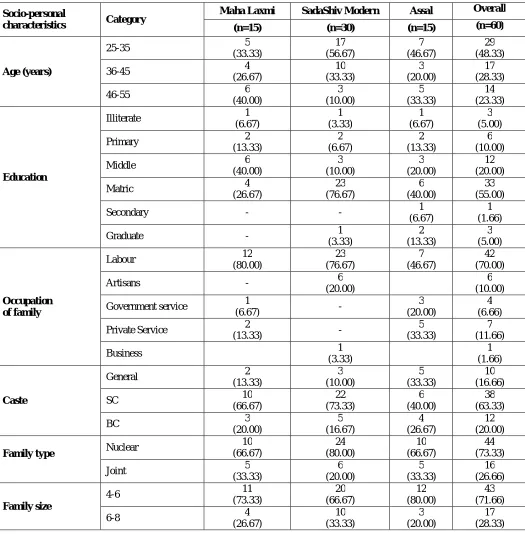
The comprehensive information about traits of the respondents pertaining to age, education, occupation, caste, family type and family size are presented in Table 1. The probe into data revealed that majority of the members (48.33%) belonged to the age group of 25-35 years. This may be due to the reason that young women are energetic and having strong urge to achieve their goal, there-in participating actively in the group. However 28.33 per cent and 23.33 per cent belonged to the age group of 36-45 and 46-55 years respectively
.
The data presented in Table1 reported that more than half of the respondents (55%) were literate having educational qualification up to Matric whereas twenty per cent respondents were middle education.
The data presented in Table1 reported that more than half of the respondents (55%) were literate having educational qualification up to Matric whereas twenty per cent respondents were middle education.
Table 1: Profile of the members of self help groups (SHGs) in Punjab
Socio-personal
characteristics Category
Maha Laxmi SadaShiv Modern Assal Overall
(n=15) (n=30) (n=15) (n=60)
Age (years)
25-35 5
(33.33) 17 (56.67) 7 (46.67) 29 (48.33)
36-45 4
(26.67) 10 (33.33) 3 (20.00) 17 (28.33)
46-55 6
(40.00) 3 (10.00) 5 (33.33) 14 (23.33) Education
Illiterate 1
(6.67) 1 (3.33) 1 (6.67) 3 (5.00)
Primary 2
(13.33) 2 (6.67) 2 (13.33) 6 (10.00)
Middle 6
(40.00) 3 (10.00) 3 (20.00) 12 (20.00)
Matric 4
(26.67) 23 (76.67) 6 (40.00) 33 (55.00)
Secondary - - 1
(6.67)
1 (1.66)
Graduate - 1
(3.33) 2 (13.33) 3 (5.00) Occupation of family
Labour 12
(80.00) 23 (76.67) 7 (46.67) 42 (70.00)
Artisans - 6
(20.00)
6 (10.00)
Government service 1
(6.67) -
3 (20.00)
4 (6.66)
Private Service 2
(13.33) -
5 (33.33)
7 (11.66)
Business 1
(3.33)
1 (1.66)
Caste
General 2
(13.33) 3 (10.00) 5 (33.33) 10 (16.66)
SC 10
(66.67) 22 (73.33) 6 (40.00) 38 (63.33)
BC 3
(20.00) 5 (16.67) 4 (26.67) 12 (20.00)
Family type Nuclear
10 (66.67) 24 (80.00) 10 (66.67) 44 (73.33)
Joint 5
(33.33) 6 (20.00) 5 (33.33) 16 (26.66) Family size
4-6 11
(73.33) 20 (66.67) 12 (80.00) 43 (71.66)
6-8 4
Regarding caste, majority of the respondents (63.33%) belonged to SC category. It may be due to the reason that these women were poor and joined the group to improve their economic conditions. Furthermore 20 and 16.66 per cent of the respondents belonged to BC and General category respectively.
An overview of the family type publicized that majority (73.33%) of the respondent’s belonged to nuclear family whereas 26.66 per cent of the respondents belonged to joint family. It is attributed to the fact that joint family is losing its importance and people are more likely to live independently. The results were in track with the findings of [11]. As regards as family size, majority of the respondents (71.66%) had a family size of 4-6 members while 28.33 per cent had a family size of 6-8 members. The findings of [12] and [13] also found family size of 6-8 members.
A scrutiny of the data in Table 2 indicated that majority of the respondents (53.33%) of all the three modern had medium level of social participation. This may be due to reason that most of the respondents were member of Panchayat, Mahila mandals, NGOs and Welfare societies. It can be also noted from the Table 2 that frequency of contact made by the respondents (45%) with the extension personnel was ‘high’ on the average of all the groups whereas 38.33 and 16.66 per cent of respondents was found to be ‘high’ and ‘low’ for seeking information regarding self help groups.
Mass media exposure to gain information regarding development work being carried out by different agencies and groups was found to be medium (45%) followed by high (41.66%) and low (13.33%) respectively.
Table 2: Distribution of the respondents based on their social participation, mass media exposure, extension contacts
Socio-personal
Characteristics Category
Maha Laxmi SadaShiv
Modern Assal
Overall
(n=15) (n=30) (n=15) (n=60)
Social participation
Low (0-2) 1
(6.67)
18 (60.00)
7 (46.67)
26 (43.33)
Medium (2-4) 14
(93.33)
10 (33.33)
8 (53.33)
32 (53.33)
High (4-6) 2
(6.67)
2 (3.33)
Extension contacts
Low (0-2) 10
(33.33)
10 (16.66)
Medium (2-4) 1
(6.67)
20 (66.67)
2 (13.33)
23 (38.33)
High (4-6) 14
(93.33)
13 (86.67)
27 (45.00)
Mass media exposure
Low (0-2) 1
(6.67)
4 (13.33)
3 (20.00)
8 (13.33)
Medium (2-4) 1
(6.67)
18 (60.00)
8 (53.33)
27 (45.00)
High (4-6) 13
(86.66)
8 (26.67)
4 (26.67)
25 (41.66)
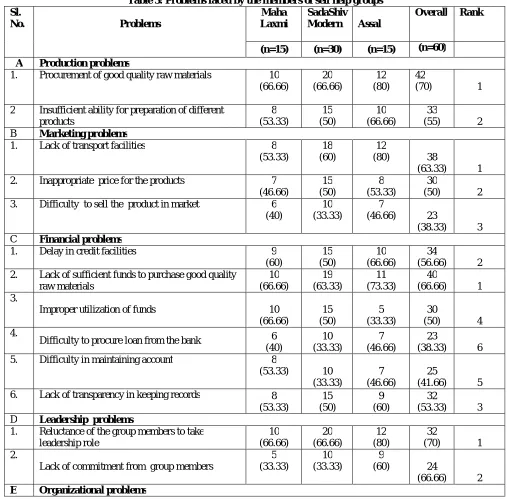
Problems perceived by the members of three self help groups of three cultural zones (Majha, Malwa and Doaba) are presented in Table 3. It is evident from the data that seventy per cent of the members of three groups faced problem in procurement of good quality raw material while fifty five per cent of them perceived insufficient ability for the preparation of different products.
It can be further seen from the Table 3 that majority of the respondents (66.66%) of all the groups found lack of sufficient funds to purchase good quality raw material followed by delay in credit facilities (56.66%), lack of transparency in keeping records (53.33%) and improper utilization of funds (50%).
Among leadership problems, majority of the respondents (70%) had unwillingness to take leadership role while lack of commitment from group members was perceived by 24 per cent of the respondents. The findings were in tune with the results of [14].
Table 3: Problems faced by the members of self help groups Sl.
No. Problems
Maha Laxmi
SadaShiv
Modern Assal
Overall Rank
(n=15) (n=30) (n=15) (n=60)
A Production problems
1. Procurement of good quality raw materials 10
(66.66)
20 (66.66)
12 (80)
42
(70) 1
2 Insufficient ability for preparation of different products
8 (53.33)
15 (50)
10 (66.66)
33
(55) 2
B Marketing problems
1. Lack of transport facilities 8
(53.33)
18 (60)
12
(80) 38
(63.33) 1
2. Inappropriate price for the products 7
(46.66)
15 (50)
8 (53.33)
30
(50) 2
3. Difficulty to sell the product in market 6
(40)
10 (33.33)
7
(46.66) 23
(38.33) 3
C Financial problems
1. Delay in credit facilities 9
(60)
15 (50)
10 (66.66)
34
(56.66) 2
2. Lack of sufficient funds to purchase good quality
raw materials
10 (66.66)
19 (63.33)
11 (73.33)
40
(66.66) 1
3.
Improper utilization of funds 10
(66.66)
15 (50)
5 (33.33)
30
(50) 4
4.
Difficulty to procure loan from the bank 6
(40)
10 (33.33)
7 (46.66)
23
(38.33) 6
5. Difficulty in maintaining account 8
(53.33) 10
(33.33)
7 (46.66)
25
(41.66) 5
6. Lack of transparency in keeping records 8
(53.33)
15 (50)
9 (60)
32
(53.33) 3
D Leadership problems
1. Reluctance of the group members to take
leadership role
10 (66.66)
20 (66.66)
12 (80)
32
(70) 1
2.
Lack of commitment from group members
5 (33.33)
10 (33.33)
9
(60) 24
(66.66) 2
1. Inadequate support from agency providing facilitation
6 (40)
12 (40)
10
(66.66) 28
(46.66) 2
2.. Insufficient innovative training opportunities to enhace skills
8 (53.33)
14 (46.66)
9 (60)
31
(51.66) 1
3. Lack of guidance from promoting agency to plan
future projects
6
(40) 15
(50)
5 (33.33)
26
(43.33) 3
F Social problems
1.
Lack of unity among members
6
(40) 12
(40)
10 (66.66)
28
(46.66) 3
2.
Lack of mutual trust
6
(40) 10
(33.33)
7 (46.66)
23
(38.33) 4
3.
Lack of communication regarding group activities 9
(60)
12 (40)
9 (60)
30
(50) 2
4. Conflicts arising during decision making process 9
(60)
14 (46.66))
12 (80)
35
(58.33) 1
G Family problems
1. Discouragement of the members by the family to
join the groups
9 (60)
15 (50)
6 (40)
30
(50) 3
2. Non-cooperation of the family to attend training
outstations
11 (73.33)
21 (70)
7 (46.66)
39
(65) 1
3.
Male dominance 10
(66.66)
20 (66.66)
7 (46.66)
37
(61.66) 2
A probe into organizational problems revealed that insufficient innovative training opportunities to enhace skills, inadequate support from agencies providing facilitation and lack of guidance from promoting agencies to plan future projects were the problems perceived by 51.66, 46.66, and 43.33 per cent of the respondents of three groups of cultural zones respectively. The results are corroborated with the findings of [15] who also observed lack of training opportunities and lack of guidance from promoting agencies limit the scope of self help groups.
As regards to social problems, conflicts arose during decision making process, lack of communication regarding group activities, lack of unity among members and lack of mutual trust were problems perceived by 58.33, 50, 46.66 and 38.33 per cent respondents of all the self help groups respectively
Data contained in Table 3 further indicated family problems such as non-cooperation of the family to attend trainings at the outstations (65%), male dominance limited the participation of women in self help group activities (61.66%) and discouragement of the members by the family to join the groups (50%). This may be due to the fact that the Indian women amidst the social taboos and restrictions, are not supported much to undertake entrepreneurship by their family members. One-fourth members of all the groups were discouraged by the family to join the group due to inferiority complex. The study conducted by researchers [16] and [17] stated that lack of family support proved to be major difficulty faced by the members while working in the group. This indicated that women are still not independent and is under the control of her father in childhood, her husband after marriage and her son in old age as in Indians philosophy. Therefore even the working women are also dominated by the husband and family.
problems and leadership problems with a average percentage mean score of 58.88, 50.55, 51.10, 48.33, 47.21 and 46.66 respectively.
Table 4: Problems faced by the members of self help groups based on the average percentage mean score and
rank
n=60
Sl. No. Problems Average percentage
mean score
Rank
1. Production problems 62.50 I
2. Marketing problems 50.55 III
3. Financial problems 51.10 IV
4. Leadership problems 46.66 VII
5. Organizational problems 47.21 VI
6. Social problems 48.33 V
7. Family problems 58.88 II
V. CONCLUSION
Women members of self help groups are being encountered by series of problems that create hurdle in the success of self help groups. It is apparent from the study that production, family and marketing problems were found to be the most serious and hindered the path of women empowerment. Therefore immediate action for the fruitful working of group activities is the need of hour. The concept of SHGs in Punjab for women empowerment has not yet run its full course in attaining its objectives. Further efforts in refining group characteristics and realigning group objectives can ensure furtherance of effectiveness of SHGs in translating rural women into a more powerful section of the society. Hence, the efforts are required by the members for efficient use of limited resources, analyse procurement of raw material, various types of marketing channels and prepare them to take decisions independently and inculcate themselves leadership traits to face various hurdles in the group.
REFERENCES
[1]Anonymous, “Status of micro finance in India. Taking rural India forward. Micro creditNinnovations department, National Bank for Agriculture and Rural Development, 2013.
[2]Khangjarakpam, S., “Impact of farmers’ group in Punjab”, Ph.D. Dissertation, Punjab Agricultural University, Ludhiana, India, 2013.
[3]Kumaran, K. P., “Role of self help groups in promoting micro enterprise through microcredit: An empirical study”, Journal of Rural Development” Vol.21, 231-50, 2002.
[4]Sud, N., “Experience of SGSY in Gujrat”, Economic Political Weekly, Vol 38, 4085-87, 2003.
[5]Nirmala, V., Bhat, K. S. and Buvaneswari, P. “SHGs for poverty alleviation in Pondicherry”, Journal of Rural Development, Vol. 23, 203-215, 2004. [6[Sheela, J. and Jayamala, M., “Role of self help groups women in value based emancipation”, Social Welfare, Vol. 55, 5-9, 2008.
[7]Singh, S., “Adoption of selected resource conservation technologies by the farmers of Ludhiana and Moga district of Punjab”, M.Sc. Thesis. Punjab Agricultural University, Ludhiana. India, 2011.
[8]Das, K. S., “Group realities of self help group- Bank Linkage Programme: An Empirical analysis”, International Journal of Research in social sciences, Vol.2, 1-16, 2012.
[9]Lokhande, M. A., “Micro Finance for Women Empowerment - A Study of Self-help Groups-Bank Linkage Programme”, International Centre for Business Research, Vol. 2, 1-8, 2013.
[10]Sharmila, K., “Profile of activities and magnitude of abuse among street children in Ludhiana city: A situational analysis”, Ph.d Dissertation, Punjab Agricultural University, Ludhiana, Punjab, 2014.
[11]Kalra, R. K., Anil, B., Siddique, K. and Tonts, M., “Self help Groups in Indian Agriculture: A case study of Farmer Groups in Punjab, Northern India”, Journal of Sustainable Agriculture, Vol.37, 509-530, 2012.
[12]Baite, J. D., “Impact analysis of Progressive beekeepers association of Punjab”, Ph.d Dissertation, Punjab Agricultural University, Ludhiana, Punjab, 2013. [13]Kasthuri, R., Thamilarasan, S., Arul, K. and Jayaraman, K., “A case study of self help groups in Dharmapuri district”, International Journal of Business and Administration, Vol. 2, 135-143, 2014.
[14]Ghosh, S., Chandra, D. and Nanda, P., “Assessment of recommended water management technologies”, Indian Journal of Extension Education, Vol. 42, 1-7, 2006. [15]Singh, G., “An evaluative study on self help groups of Punjab”. Msc. Thesis. Punjab Agricultural University, Ludhiana, 2011.
[16]Minimol, M. C. and Makesh, K. G., “Empowering rural women in Kerala: A study on the role of self help groups”, International Journal of Sociology and Anthropology, 2012. Retrieved from www.academicjournals.org/journal/IJS/article-full.../DABCA945105.