©
DOI: 10.1534/genetics.104.033803
A Spatial Statistical Model for Landscape Genetics
Gilles Guillot,*
,1Arnaud Estoup,
†Fre´de´ric Mortier
‡and Jean Franc¸ois Cosson
§*Unite´ de Mathe´matiques et Informatique Applique´es, INRA-INAPG-ENGREF, Paris, France 75231,†Centre de Biologie et de Gestion
des Populations, INRA-ENSAM-IRD-CIRAD, Montpellier, France F-34988,‡CIRAD, De´partement Foreˆt, Montpellier, France F-34398
and§Centre de Biologie et de Gestion des Populations, INRA-ENSAM-IRD-CIRAD, Montpellier, France F-34988
Manuscript received July 21, 2004 Accepted for publication October 31, 2004
ABSTRACT
Landscape genetics is a new discipline that aims to provide information on how landscape and environ-mental features influence population genetic structure. The first key step of landscape genetics is the spatial detection and location of genetic discontinuities between populations. However, efficient methods for achieving this task are lacking. In this article, we first clarify what is conceptually involved in the spatial modeling of genetic data. Then we describe a Bayesian model implemented in a Markov chain Monte Carlo scheme that allows inference of the location of such genetic discontinuities from individual geo-referenced multilocus genotypes, without a priori knowledge on populational units and limits. In this method, the global set of sampled individuals is modeled as a spatial mixture of panmictic populations, and the spatial organization of populations is modeled through the colored Voronoi tessellation. In addition to spatially locating genetic discontinuities, the method quantifies the amount of spatial dependence in the data set, estimates the number of populations in the studied area, assigns individuals to their population of origin, and detects individual migrants between populations, while taking into account uncertainty on the location of sampled individuals. The performance of the method is evaluated through the analysis of simulated data sets. Results show good performances for standard data sets (e.g., 100 individuals genotyped at 10 loci with 10 alleles per locus), with high but also low levels of population differentiation (e.g.,FST⬍
0.05). The method is then applied to a set of 88 individuals of wolverines (Gulo gulo) sampled in the north-western United States and genotyped at 10 microsatellites.
R
ECENT developments in molecular markers and ers (e.g., microsatellites) and collected at a finer scalethan that typical of phylogeography. Therefore, in con-statistical tools, combined with powerful
comput-ers have led to the emergence of a new scientific field, trast to phylogenetics, landscape genetics tends to focus
on the understanding of the microevolutionary pro-landscape genetics, which is an amalgamation of
popula-tion genetics and landscape ecology (Manelet al.2003). cesses that generate genetic structure across space. The
two key steps of landscape genetics are the detection and This discipline aims to provide information on how
landscape and environmental features influence gene location of genetic discontinuities and the correlation of
these discontinuities with landscape and environmental flow, population structure, and local adaptation. It also
aids in identifying cryptic genetic discontinuities, which features (e.g., mountains, rivers, roads, gradient of
hu-midity, and deforested areas) (Manel et al.2003).
Ide-are breaks in gene flow without any obvious cause, or
secondary contact among previously isolated popula- ally, the first step should be based on methods that
do not require assumptions of population boundaries tions. The spatial delineation of genetic discontinuities
within a species allows that of operational units, an im- beforehand. This implies that the individual is the
oper-ational unit of study. However, this unit can be extended portant issue for species management (i.e., for pest
con-trol, as well as the monitoring of game or threatened to a priori defined populations if enough populations
can be sampled and individuals are not too sparsely species). Moreover, identifying the abiotic and biotic
factors involved in evolutionary processes is essential distributed in space within each population sample.
Several recent methods based on cluster models and for modeling and predicting the evolution of genetic
diversity under different scenarios, especially those re- likelihood computation have the potential to both
group individuals into populational units and detect lated to environmental changes due to human activity
(e.g., habitat fragmentation). Landscape genetics usu- migrants between those units, without requiring the a
prioridefinition of populational limits (Pritchardet al.
ally makes use of data obtained at highly variable
mark-2000;DawsonandBelkhir2001;Falushet al.2003).
However, these methods do not explicitly take into ac-1Corresponding author:Unite´ de Mathe´matiques et Informatiques
count the spatial nature of the problem of detecting
Applique´es, INRA-INAPG-ENGREF, Institut National Agronomique,
and locating genetic discontinuities. In formal terms,
16 rue Claude Bernard, 75231 Paris Cedex 5, France.
E-mail: [email protected] they are all based on the assumption that the variable
HIERARCHICAL SPATIAL MODEL
coding the assignment to a population isa priori
inde-pendent and identically distributed among individuals. The global set of sampled individuals is viewed as
rep-As a consequence, they do not make use of spatial coor- resentative of one or several panmictic populations
sepa-dinates of sampled individuals, except in some ad hoc rated by geographic borders across space. Our modeling
postprocessing schemes like those consisting of drawing strategy is hierarchical in the sense that we first specify
by hand the spatial convex hull of each inferred popula- how the populations are spatially organized and then
tion. Hence these methods cannot objectively identify we specify the statistical genetic properties of each
popu-the spatial location of genetic discontinuities between lation conditionally on this spatial organization.
populations. Hidden model of spatial organization through
Voro-Although a large body of statistical literature is avail- noi tessellation:Let⌬be the geographical region under
able on the clustering of spatially explicit data (Lawson study. We denote byz⫽(z
1, . . . ,zn) the vector of
geno-andDenison2002), the models available are devoted to
types of thendiploid individuals (although other
ploi-the analysis of quantitative and univariate data, whereas
dies could be considered) observed at Lloci, zi being
genetic data are categorical and strongly multivariate
a collection of pairs of alleleszi,l ⫽{ai,l,bi,l}, withl ⫽
by nature. The work ofVounatsouet al.(2000) should,
1, . . . ,L, and we denote byt⫽(t1, . . . ,tn) the vector
however, be mentioned, since it aims to relate haplotype
of the two-dimensional spatial coordinates of these indi-frequencies to spatial coordinates and environmental
viduals.
covariates. Nevertheless, this method starts from aknown
We consider that there are K different populations
clustering of data, which is injected as a prior
informa-present in the spatial domain under study and that those tion on the spatial dependence through a conditional
populations occupy some subdomains⌬1, . . . ,⌬K. The
autoregressive model. In a different spirit,Dupanloup ⌬
kform a partition of⌬, namely ⌬ ⫽ ⌬1傼 . . . . 傼 ⌬K
et al.(2002) proposed to cluster populations by
maximi-with⌬k傽⌬l⫽0, fork⬆l. We consider the setting where
zation of a differentiation criterion between
popula-we have no knowledge about the shape and location of tion clusters, the criterion being the proportion of total
these subdomains, and part of this article is devoted to genetic variance due to differences between clusters. As
their estimation from spatial and genetic data t and
the effective maximization is numerically prohibitive,
z. A geographical subdomain being possibly extremely
Dupanloupet al.(2002) suggest using a simulated
an-complex, we need to make a few assumptions on the nealing approach in which the random search strategy
shape and locations of the⌬k, to reduce the complexity,
makes use of the spatial coordinates of the population
namely the number of parameters, of the problem. For samples (note that the unit of treatment could be an
several reasons discussed later, we assume that each sub-individual rather than a population). This can lead to
domain⌬kcan be approximated by a union of convex
certain local maxima easy to reach from a given spatial
polygons. This assumption is not restrictive as any com-sampling configuration and to the identification of
rele-plex domain can be arbitrarily well approximated by vant genetic discontinuities between groups of
popula-such union of convex polygons provided enough poly-tions. However, their criterion does not rely on the
gons are considered. As we do not know where such coordinates in its definition; therefore the global
maxi-polygons should be placed to approximate some true mum searched does not depend itself on the
coordi-spatial organization of the population under study, we nates, and the method turns out to be spatial mainly
model the locations of these polygons as random vari-through the heuristic optimization strategy, whose
con-ables with uniform distribution over the whole spatial vergence properties still have to be assessed.
domain. In this article, we describe a new statistical model that
More formally, we consider that there is a point pro-aims at inferring and locating genetic discontinuities
cess (a set of random points in the spatial domain, between populations in space from individual
multi-the number of points itself being random) that has locus genetic data. Our central assumption throughout
realization denoted by (u1, . . . ,um). Eachui(referred
this work is that some spatial dependence is often
pres-to hereafter as nucleus) defines a setAi around it,
de-ent among individuals. On the basis of this sensible
as-fined as Ai⫽ {s, dist(s, ui)ⱕ dist(s,uj), ∀j⫽ 1, . . . ,
sumption, we developed a hierarchical spatial model in
m}. Namely,Aiis the set of geographical sites closer to
which we formally inject a priori information on how
uithan to any other points among (u1, . . . ,um). Each
the individuals are spatially organized. In addition to
Aiis a convex polygon and the setA1, . . . ,Amis known
the detection of genetic discontinuities between
popula-as the Voronoi tesselation of⌬, as it splits⌬inm
non-tions, our method also addresses the following points:
overlapping subdomains. We now assume that each of (i) denoising blurred coordinates of sampled individuals,
theseAicontains individuals of one subpopulation only.
(ii) estimating the number of populations in the studied
Hence, eachAican be labeled by a number between 1
area, (iii) quantifying the amount of spatial dependence
andKthat we denote byc(ui).
in the data, (iv) assigning individuals to their population
In mathematical terms, we parameterized these sub-of origin, and (v) detecting individual migrants between
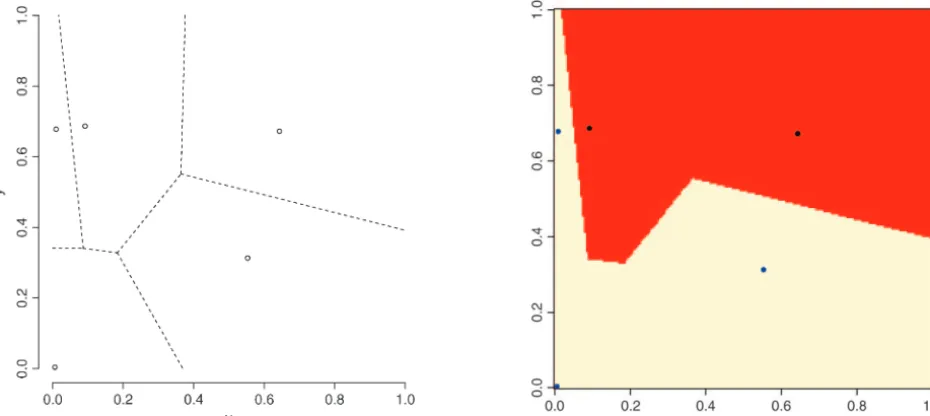
underly-Figure1.—Random tessellation of a unit square into two spatial domains through a colored Voronoi tiling. Left, realization of a Poisson point process with Voronoi tessellation induced. Right, partition obtained after union of tiles belonging to the same population (coded as two colors).
ing Voronoi cells induced by a homogeneous Poisson tends to favor partitions that are spatially organized. To
a certain extent, our model is very similar in spirit to
point process. For any arbitrary point x in ⌬, c(x) is
defined as the population of its closest nucleus. The those used in image analysis, where the purpose is to
retrieve a true scene blurred by a certain noise. In this
domain finally covered by populationkis the union of
context, it is widely admitted that even when very little
cells of the same population, namely ⌬k⫽
傼
c(ui)⫽kAi.is known about the true scene, it is useful to use a prior The belonging of any point of the domain to the
popula-tions can be thought of as a coloring; hence this model assuming some spatial organization; seeBesag(1986)
orHurnet al. (2003) for a recent review. The advantages
is sometimes referred to as colored Voronoi tiling. (See
Figure 1 for an illustration withK ⫽2 andm⫽ 5.) It of our spatial model are (1) the possibility for better
clas-sification with limited data due to a more informative is widely used in earth sciences to model spatial
organiza-tion of categorical variables such as geological forma- prior and (2) the direct inference about range
bound-aries. However, with large amounts of data (and a given
tions, or soil occupation (Lantue´joul2002), and has
also been used in genetics in a different framework by K), the posterior assignments of individuals should be
the same under the spatial model as for the nonspatial
Dupanloupet al.(2002).
We assume that all populations have a priori equal model.
The amount of spatial dependence prescribed by the probability; therefore, we assume that each tile belongs
to a population with probability 1/K, independently. colored Voronoi tesselation depends on how the
do-mains⌬kare themselves fragmented in smaller polygons
Although reasonably simple, our model allows
depar-ture from the so-called independent identically distrib- Ai. Let us denote by the rate of the Poisson process
u1, . . . ,um. This parameter controls the number of
poly-uted (i.i.d.) mixture model commonly used in
nonspa-tial cluster models (Pritchardet al. 2000;Falushet al. gons in⌬and hence the amount of spatial dependence
in the hidden clustering. Low values of correspond
2003). In the latter method, the joint prior probability
that individualibelongs to populationkand individual to weakly fragmented partitions of⌬and thus to strong
dependence of the hidden spatial organization of
pop-i⬘belongs to populationk⬘is equal to 1/K2(the product
of the marginals) whatever the geographical distance ulations, whereas large values of correspond to high
fragmentation and weak spatial dependence. When the between the individuals may be.
In the colored Voronoi tiling model that we propose number of pointsmis very large, each tile contains only
one sampled individual and our tessellation model to use, the marginal is uniform, but the joint probability
does not factorize. More specifically, the joint probabil- behaves like an i.i.d. mixture model similar to the prior
on the clustering used by Pritchard et al. (2000),
ity that any two individuals belong to the same
popula-tion decreases with the geographical distance between Coranderet al.(2003), orFalushet al. (2003).
It is worth noting that the model allows the definition them. In other words, i.i.d. mixture models such as those
not take into account the fact that allele frequencies tend to be similar in different populations.
Following this line of thought,Falushet al. (2003)
introduced interpopulation correlation in frequencies by introducing a hypothetical ancestral population with allele frequenciesfAlj,l⫽1, . . . ,L,j⫽1, . . . , Jl
(fre-quency of allelejat locuslin the ancestral population,
whereJlis the number of alleles at locusl), from which
present populations have diverged according to drift
factors d1, . . . , dK. In this second model (referred to
as F-model and spatial F-model when embedded in our spatial scheme), the frequencies at each locus in the ancestral population follow a Dirichlet(1, . . . , 1)
distri-bution. Falushet al. (2003) relate frequencies in the
present populations to those of the ancestral population
Figure2.—Illustration of the need for a tessellation prior and to the drift factors through allowing nonconnected components.
fkl.ⵑ Dirichlet
冢
fAl11⫺dk
dk
, . . . ,fAlJ l
1⫺dk
dk
冣
,
the sampling window (see Figure 2). Hence, our model
k⫽1, . . . ,K,l⫽1, . . . ,L. (2)
should not overestimate the number of populations in
these particular although potentially frequent cases. This equation accounts for the fact that if a set of
Moreover, as is shown later, this feature makes it possi- populations have split from an ancestral population
ble to visually detect migrants and identify their spatial at a given time, their allele frequencies will differ. The
domain of origin. amount of differentiation depends on many factors
Although it can sometimes be relevant to model ani- that are quantitatively unknown. The vectord1, . . . ,dK
mal territories as Voronoi cells (Blackwell2001), we parameterizes our uncertainty about the level of
differ-do not give to the cells any strong biological interpreta- entiation.
tion, neither do we see this tiling model as a realistic Anticipating the discussion that follows, we may fear
representation of the true organization of populations. that the F-model embedded in our full Bayesian
inferen-This prior on the partition allows penalizing only very tial scheme, including inference ofK(see below), may
loosely spatially organized clustering, as we believe that be excessively flexible, since in contrast toFalushet al.
populations tend to be spatially organized in real life. (2003), we do not prescribe how many populations
However, our model does not penalize too strongly con- there are, and neither does the F-model state how
differ-nected components of small to moderate sizes. This entiated these populations are. This may lead to
infer-feature complies well with the fact that our prior knowl- ence of spurious populations. Therefore, although the
edge on the level of spatial fragmentation of popula- F-model sounds theoretically more appealing than the
tions is usually rather limited. Therefore, the colored D-model, we keep attention on both models throughout
Voronoi tiling model is a good trade-off between nu- this article.
merical tractability and more complicated partition mod- Conditional model for genotypes:Given the partition
els like those ofNicholls(1997),Møller andWaage- and the allele frequenciesfklj, we assume that the
geno-petersen(1998), orMøllerandSkare(2001). types in each population are independent draws from
Model for frequencies: It is commonly assumed in the discrete multivariate distribution specified by thefklj,
population genetics that the allele frequencies follow which is equivalent to the assumption of Hardy-Weinberg
independent Dirichlet distributions, namely equilibrium within, and linkage equilibrium, between loci.
fkl.ⵑDirichlet(␣, . . . ,␣), k⫽1, . . . ,K,l⫽1, . . . ,L,
(1) FULL BAYESIAN SPECIFICATION
where fkl. denotes the vector whose entries arefklj (fre- All nonobserved quantities involved are treated as
quency of allele j at locus l in population k), (e.g., unknown. For full Bayesian inference we place priors
Rannala andMoutain 1997; Pritchard et al. 2000; on them, and the model can be summarized as follows.
Estoupet al. 2004). This model (referred to hereafter Number of populations: K ⵑ Uniform({Kmin, . . . ,
as D-model and spatial D-model when embedded in our Kmax}). This is a weakly informative prior for which the
spatial scheme) is attractive, because of its conjugacy only subjective inputs areKmin, usually set to 1, andKmax,
properties and its biological relevance according to the set to a large value as compared to the maximum
num-theory of evolutionary neutral mutation process of ber of populations that can be reasonably expected, so
that the choice is numerically inconsequential.
Number and location of tiles: We consider thatmⵑ case of units localized at a coarse administrative level only, or simply the case of measurement errors. To
ac-Poisson() and that (u1, . . . ,um) ⵑ
i.i.d.
Uniform(D). This
count for this uncertainty, eachtistands for the observed
is the usual homogeneous Poisson process. The
com-location whereas the true com-location is denoted by si.
plete randomness of the locations of the points makes
These unobservedsi are treated as unknown hereafter
this prior noninformative about the locations of the
and are part of the parameters to be estimated. The borders between populations, and it is numerically
con-true coordinates si are naturally related to observed
venient. The unknown amount of spatial organization
coordinatestithrough
is controlled by, on which we place a flat hyper-prior,
assuming that ⵑ
u
([0, max]). As previously men- ti⫽si⫹εi, (3)
tioned, for large-values, the tessellation model behaves
whereεiis an i.i.d. additive noise chosen in a suitable
like an i.i.d. mixture model. As max should be taken
parametric distribution. Even when the coordinates are large enough to cover a large range of spatial
organiza-recorded with a good precision with respect to the size
tion from strong ( ⬇0) to weak spatial organization,
of the domain under study, it is useful to introduce such
we suggest takingmaxequal to the number of sampled
an additive noise to allow individuals with the same individuals.
coordinates to belong to different populations.
Colors of tiles: c1, . . . ,cm ⵑ
i.i.d.
Uniform{1, . . . ,K}.
Subdomains of populations: ⌬k⫽
傼
cj⫽kAj fork⫽ 1,. . . , K, where (A1, . . . , Am) are the Voronoi tiles in- MARKOV CHAIN MONTE CARLO INFERENCE
duced by (u1, . . . ,um).
We denote by ⫽(K,m,u,c,d,f,fA,s) the vector
Drift: The drift parameters prescribe the amount of
of unknown parameters to be estimated. The likelihood genetic differentiation between the present-time
popu-of the data (t,z) is
lations and the ancestral population and, hence, be-tween the present-time populations themselves. Although
(t,z|)⫽ (t|)(z|t,)⫽ (t|)
兿
n
i⫽1
兿
L
l⫽1
(zi,l|).
it may be sometimes possible to have a rough idea of the (4)
amount of differentiation between populations under
The terms of the product are given by the allelic
study (e.g., in terms of classical measures, such asFST),
frequencies: it seems, however, difficult to express this prior
knowl-edge in terms of a prior on the drift parameters. To
(zi,l⫽(␣,)|)⫽
冦
2fk l␣fkl if␣⬆
f2
k l␣ if␣ ⫽ .
(5) assess the relation between the drift factors and the
differentiation we carried out a small set of simulations.
The inference ofwill be made through the
investiga-We simulated 1000 data sets, each made of two
popula-tion of its posterior distribupopula-tion(|t,z). We consider
tions of 50 individuals genotyped at 10 loci with 10
a hybrid algorithm based on sequential updates of the alleles per locus. All frequencies were preliminarily
sam-various blocks of parameters. All parameters are
ran-pled from the F-model with driftd1 ⫽ d2 uniform on
domly initialized from the prior. Then the moves are [0, 1]. The level of differentiation between population
proposed in a deterministic order as follows: (1) update
samples was measured using the parameterFSTestimated
d; (2) update fAl (these two steps are skipped in the
followingWeir andCockerham(1984). Results show
D-model; seeappendix,Details of MCMC computations);
a close linear relation betweend andFST. It therefore
(3) updatefkl.; (4) updatecjforj⫽1, . . . ,m; (5) update
sounds natural to place a prior on dk, putting most
ujforj⫽1, . . . ,m; (6) updatesifori⫽1, . . . ,n; (7)
weight on the left side of [0, 1] with a negligible weight
discard or add a tile (increase or decreasemby 1); and
for values⬎0.3, instead of a prior uniform on [0, 1].
(8) split one existing population into two or merge two An independent Beta(2, 20) prior complies well with
into one (i.e., increase or decreaseKby 1). Convergence
these requirements (see Figure 3). Note that a limited
follows from detailed balance, irreducibility, and aperio-number of test simulations indicated that the choice
dicity (seeappendixfor computational details).
of prior ondkdid not affect the results of the overall
In practice the number of populations is first esti-algorithm (results not shown).
mated by computing the mode of the posterior
distribu-Frequencies in the ancestral population:fAl1, . . . ,fAl Jlⵑ
tion:Kˆ ⫽ArgmaxK[K|t,z] from a first run (t)t⫽1,...,T.
Dirichlet(1, . . . , 1),l⫽1, . . . ,L. Then, because it is meaningless to compute empirical
Frequencies in the present population:fk l.ⵑDirichlet means on values of
tcorresponding to different values
(fAl1((1⫺dk)/dk), . . . ,fAl Jl((1⫺dk)/dk)),k⫽1, . . . , ofK, one can either work on subsamples of (t)t⫽1,...,T
K,l⫽1, . . . ,L. obtained by restricting to the states corresponding to
Locations of individuals:The recorded locationtiof K⫽ Kˆ or simply rerun the Markov chain Monte Carlo
sampled individuali may not be representative of the (MCMC) algorithm with fixedKset toKˆ.
true location of the individual. Consider, for instance, As in all mixture problems, this model is not
identifi-the case of sedentary animals (where identifi-the true location able as the likelihood is invariant under any relabeling of
the populations (Celeux1997;Stephens1997;Robert
Figure 3.—Relationship between drift fac-tor andFST. Results are from simulated data.
The driftsd1andd2were equal and sampled
from a Beta(2, 20) prior (x- axis).
and Mengersen 1999; Celeux et al. 2000; Stephens The whole algorithm has been programmed in
For-2000). Consequently, it may happen that along an MCMC tran 77, making use of the numerical library for random
run (especially if the numbers of loci and alleles are number generation, Randlib1.3. The machine time
re-small), a move from say stateci⫽ktoci⫽ l does not quired for 105iterations on a data set of 1000 individuals
correspond to a reassignment of the ith cell but to a genotyped at 10 loci with 10 alleles per locus with 10
relabeling of the populations (switch betweenkandl). loci is typically of 1 hr on a PC equipped with a 2-GHz
Although more theoretically rooted methods are avail- chip set.
able (Celeuxet al. 2000;Stephens2000) we used the
expedient (when label switching was suspected), which consists of imposing after the run the following
identi-RESULTS FROM SIMULATED DATA SETS
fying constraints on the frequency of the first locus,
Number of populations:A first interesting feature of
fk11⬍fk⬘11 for allk,k⬘,k⬍k⬘, (6) this model is its ability to deal with an unknown number
of populations. Because the effective value of the model where the loci are sorted by an increasing number of
depends on the precision in the estimation of K, this
alleles. This rule enabled us to fix the label-switching
key point has been investigated by analyzing data sets issue only when the frequencies did not overlap in the
simulated using the prior of the previously described chains, and we found that it is advisable to check visually
spatial F-model. To retrieve the knownKparameters that
the trace of frequencies in the MCMC run to detect a
served to build the data set, we ran the MCMC scheme possible switch.
using the spatial F-model or the spatial D-model as a We observed that label switching could be frequent
prior in the inference and computed Kˆ after 50,000
when working with small data sets (⬍100 individuals, 1
iterations. or 2 loci, few polymorphisms) and becomes rare with
We first started by building 50 data sets of n ⫽ 50
larger and more traditional microsatellite data sets (e.g.,
individuals withK⫽1 (only one population). For each
at least 100 individuals genotyped at 10 loci with 10
data set, we get estimatedK, and thus we end up with
alleles per locus). When such a relabeled sample is
avail-50 estimated values corresponding to the avail-50 simulated
able, the conditional posterior [c(s)|K ⫽ Kˆ, z, t] is
data sets. This procedure has been repeated for various estimated by the corresponding empirical mean.
Simi-values ofKwith data sets of 50Kindividuals. Everywhere
larly,d,fA, andfare estimated by their means over the
Figure 5.—Empirical relationship between FST and the
number of populationsKˆestimated using the spatial F-model (circle) and the spatial D-model (triangles) as a prior in the MCMC inference. The 50 simulated data sets are made ofK⫽ 2 populations, withL⫽Jl⫽1,...,L⫽10.
describe how the model behaves with respect to the amount of spatial and genetic structure present in the data. We simulated 1000 data sets using the spatial F-model, with 100 individuals organized in two popula-tions (50 individuals per population), with 10 loci and 10 alleles per locus and then with only 3 loci and 10
Figure4.—Estimated number of populationsKˆ. Each histo- alleles per locus. Each of these data sets has been first gram shows estimates over 50 different simulated data sets analyzed using the spatial F-model as a prior in the withK⫽1, 2, 5, 9, first using the spatial F-model (left) and
MCMC scheme. However, since we know from the
re-then using the spatial D-model (right) as a prior for the allele
sults of the previous section that using the F-model can
frequencies. The vertical dashed line depicts the true value.
be misleading about the number of populations, we also analyzed our simulated data sets with the spatial D-model as a prior in the MCMC scheme.
per locus was Jl⫽1,...,L ⫽ 10. The simulation process is
An inference of all parameters (including the number
described in theappendix.
of populations) could have been made. However, we
The histogram of estimatedK is shown in Figure 4.
wished to compare our method to methods that do It can be seen that the spatial D-model leads to excellent
not handle the inference ofK. Therefore we chose to
results and whatever the level of differentiation between
considerKas a known parameter and to compare the
populations is as measured by FST (see Figure 5). In
different methods when K is known and equal to 2.
contrast, very poor results were obtained when using
As already mentioned, most of the existing clustering the spatial F-model, although the latter model was used
models are based on i.i.d. mixtures. Therefore we have to simulate the test data sets. The model tends to
over-compared our spatial model to nonspatial clustering estimate systematically the true number of populations
models obtained by replacing our spatial prior on the (see Figure 4) and the overestimation is stronger on
clustering variablec by an i.i.d. prior, giving the
non-weakly differentiated data sets (Figure 5). The spatial
spatial F-model and nonspatial D-model. The nonspa-F-model proved to work well only for data sets with a
tial D-model turns out to be the model described by
high level of differentiation (FST⬎0.5, data not shown).
Pritchard et al. (2000) in the no-admixture case, Results were improved for lower levels of differentiation
whereas the nonspatial F-model can be viewed as a by increasing the number of loci. However, even for
simplified version of the model ofFalushet al. (2003),
L⫽ 200 andJl⫽1,...,L⫽ 10, the spatial F-model seems to
where linkage equilibrium is assumed.
overestimateKby a factor of 5 whenK⫽ 2.
Each data set has been analyzed in parallel by the
Assignment to population of origin: One other
fea-four methods, from which we can derive the false clas-ture on which our model can be evaluated is its ability
sification rate defined as to assign individuals to their population of origin. We
have several goals in mind here: (i) assessing the ability FCR⫽ number of wrongly assigned individuals/
of the model to correctly classify individuals; (ii)
com-total number of individuals. (7)
paring our model to nonspatial approaches suggested in
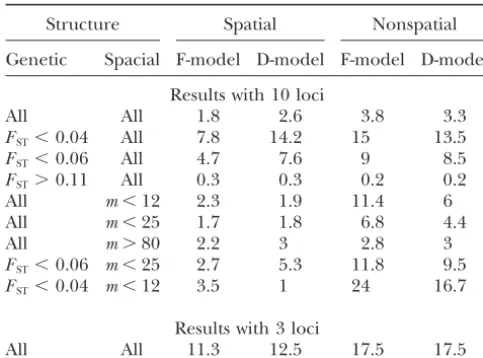
the literature; and (iii) as the model is specifically tai- Results on the whole set of simulations and on various
TABLE 1 Individual genotypes were obtained with the software
Easypop(Balloux2001) by simulating two populations
Average false classification rates (in percentage)
exchanging different numbers of migrants per
genera-for all simulated data sets and subsamples with
tion. In a first data set (referred to hereafter as set
various levels of genetic and spatial structure
A), the two populations are considerably differentiated
Structure Spatial Nonspatial (FST ⫽ 0.16), in a second set (B) the populations are
less differentiated (FST⫽0.06), and in a third data set
Genetic Spacial F-model D-model F-model D-model
(C), they are very weakly differentiated (FST⫽0.01). In
Results with 10 loci each set we haven⫽200 individuals (with 100
individu-All All 1.8 2.6 3.8 3.3 als per population) and L ⫽ 10 loci with Jl⫽1,...,L⫽ 10
FST⬍0.04 All 7.8 14.2 15 13.5 alleles per locus. Individuals of each population were
FST⬍0.06 All 4.7 7.6 9 8.5 randomly located on each part of an oscillating curve
FST⬎0.11 All 0.3 0.3 0.2 0.2
on the unit square.
All m⬍12 2.3 1.9 11.4 6
The ability of the model to find the actual partition
All m⬍25 1.7 1.8 6.8 4.4
of space is illustrated in Figure 7, set A, which displays
All m⬎80 2.2 3 2.8 3
FST⬍0.06 m⬍25 2.7 5.3 11.8 9.5 the posterior probability(c(s)⫽k|t,z) for any pixel
FST⬍0.04 m⬍12 3.5 1 24 16.7 to belong to the two populations. We observe that the
true partition is very well detected. We obtained similar
Results with 3 loci
results on the two other data sets, although the
bound-All All 11.3 12.5 17.5 17.5
ary between the two domains was detected with less
The level of genetic and spatial structure increases withFST precision with data sets B and C (results not shown).
and decreases withm, respectively. Results are shown from We then quantitatively assessed how the level of differen-1000 simulated data sets of 100 individuals in two populations,
tiation influences the precision in the estimation of the
withL⫽Jl⫽1,...,L⫽10 andL⫽3,Jl⫽1,...,L⫽10.
border. This can be viewed from the map of␦(s), where
␦(s) is any suitable measure of the dispersion of[c(s)|t,
z,K]. As[c(s)⫽j|t,z,K] is a probability measure on ture are given in Table 1. The quantiles at levels (0.1,
0.25, 0.75) of the empirical distributions of FSTand m {1, . . . , K} whose weights can be zero, the entropy is
not defined, and therefore we used instead were used to obtain subsets with various levels of genetic
differentiation and of spatial organization, respectively.
␦(s)⫽
兺
K
j⫽1
2[c(s)⫽k|t,z,K] (8)
The quantiles at probabilities (0.1, 0.25, 0.75) were
re-spectively (0.04, 0.06, 0.1) forFSTand (12, 25, 80) for
m. For instance, subsets for which the number of Voro- as an index of the dispersion of the distribution[c(s)⫽
k|t,z,K]. The right-hand side of Equation 8 is minimal
noi tilesmwere less than 12 correspond to highly
spa-tially structured populations, whereas those for which when all the colors have equal probability, which
corre-sponds to a flat posterior. Thus, the pointssfor which
m⬎80 correspond to loose spatial organization.
Exam-ples illustrating simulated data sets with various levels ␦(s) is high are those confidently classified, whereas
those where␦(s) is low correspond to poorly classified
of spatial organization are shown in Figure 6.
Results from the whole data set show that spatial meth- points that might correspond to transition regions or
to sparsely sampled regions. The maps of␦(s) given in
ods give lower FCR values than nonspatial methods and
that this trend is strengthened for a low number of loci Figure 8 for the three data sets show that the lower
values of ␦(s) are along the true line of discontinuity
(e.g., three loci). The improvement of spatial as
com-pared to nonspatial methods is the greatest when both (darker color), and that the accuracy in the estimation
increases with the level of differentiation between
popu-the level of spatial organization is large (m⬍12) and
the level of differentiation is weak (FST⬍ 0.04). lations.
Detection of migrants: Since populations exchange Hence, in addition to giving better results than the
spatial F-model for the estimation of the number of pop- migrants, it is sensible to assess whether the presence
of such migrants would affect the spatial detection of ulations, the spatial D-model compares favorably with
the spatial F-model for the assignment of individuals to genetic discontinuities and whether migrants could be
detected and spatially located by our method, for differ-their populations, even when the data depart from the
model assumed in the inference (c f. the data sets that ent levels of differentiation between populations.
To address these points, we mimicked the presence were simulated according to the spatial F-model).
There-fore in the following we focus on the spatial D-model of first-generation migrants in our previous data sets A,
B, and C by moving one individual from the upper only.
Mapping borders between populations:Mapping bor- population to the lower population and another one in the opposite direction. Figure 9 shows that the presence ders between populations represents one of the major
interests of our spatial model: it is presented through of these first-generation migrants did not affect the
Figure6.—Examples of simulated spatial organization of 100 individuals (black dots) into two populations (coded as two colors) with various levels of spatial dependence. This level is controlled by parameterm(number of Voronoi tiles). The nuclei of the tiles are not depicted for clarity.
to spatially locate the genetic discontinuity. The figure tion),L⫽Jl⫽1,...,L⫽ 10, and the level of differentiation
between populations was relatively low (FST⫽0.08). The
also shows that the two migrants are easily detected (i.e.,
visualized) for data sets A, B, and C. The population of true positions si were blurred by an additive noise εi
uniform on [⫺0.15, 0.15]2, so that the observed
posi-origin of each migrant could be easily deduced from
its coloring pattern, including when more than two pop- tions were ti ⫽ si ⫹ εi. The model was first run
con-sidering that the given positions were true (ε⬅0) and
ulations shared the domain (results not shown).
Effect of errors on the locations of individuals: We in a second run the uncertainty was accounted for by
injecting the information that εi ⵑ Uniform[⫺0.15,
show here how errors on the locations of individuals may
lead to poor results and how accounting for errors in 0.15]2. We also considered the case where the true
coor-dinates were used whereas wrong coorcoor-dinates were as-the positioning of individuals allows us to retrieve most
of the underlying signal. This question was addressed sumed, and finally we give the results for true
coordi-nates considered as true coordicoordi-nates. The results are through the analysis of a new set of simulations.
Three independent populations separated by straight summarized in Figure 10. It can be clearly observed
from the figure that accounting for uncertainty in the lines were positioned on the unit square. The number
pre-Figure7.—Maps of posterior probabilities, simulated data set A. The dashed green line depicts the true sine-shaped line of discontinuity.FST⫽0.16,L⫽Jl⫽1,...,L⫽10.
cision in the detection of the true borders when some includes 200,000 iterations and a short burn-in period.
The posterior distribution gave a mode atK⫽6, with
errors on the position of individuals exist (Figure 10,
line 1 vs. line 2). Moreover, adding position noise in a nonnegligible occurrence atK⫽5 (Figure 11). Then
the model was rerun along 50,000 iterations with a fixed the model does not alter the results for data sets without
position errors (Figure 10, line 3vs. line 4). value for K⫽ 6. Maps of the posterior probability for
any pixel of the domain to belong to each population could then be derived (Figure 12).
APPLICATION TO MONTANA WOLVERINES We also computed for each pixelsthe modal popula-(GULO GULO)
tion, namely the populationkfor which(c(s)⫽ k|t,
z) is maximum (Figure 13). Two of the six inferred
We now analyze a previously published data set on
populations (i.e., Figure 12, populations 2 and 5) do wolverines (Gulo gulo), a medium-sized carnivore wildly
not appear to be the modal population for any pixel. distributed in North America. Wolverines are highly
mo-Moreover, these two populations have very low posterior bile, with the ability to disperse up to 300 km within a
probabilities and an analysis of a detailed map suggests year, but are also highly sensitive to habitat disturbance
that the areas of these populations are very similar. by humans. Eighty-nine individuals were sampled in
Although results from theNumber of populationssection
Montana and genotyped at 10 microsatellite loci
Cegel-suggest that one can be very confident in the spatial
skiet al. (2003). Samples are nearly evenly distributed
D-model to infer the right number of populations, we do over an area that corresponds to a landscape highly
not have straightforward interpretation of the “ghost” fragmented by human development and disturbance.
populations 2 and 5 (but seediscussionsection).
Using nonspatial Bayesian clustering procedures and
The spatial partition in four populations with high
assignment tests implemented in the programsStructure
posterior probabilities considerably (but not entirely) (Pritchardet al. 2000) andGeneclass(Cornuetet al.
decreased genetic structure within samples fromFIS ⫽
1999), Cegelskiet al. (2003) provided some evidence
0.180 to 0.088, with single-populationFISvalues ranging
for the existence of three populations of wolverines in
from 0.038 to 0.110. Hardy-Weinberg equilibrium could
Montana, withFSTvalues ranging from 0.08 to 0.10. The
not be rejected in two of the four inferred populations authors also provided some evidence for the
identifica-(Fisher’s exact test,P ⬎ 0.05;RaymondandRousset
tion of 11–22 migrants or offspring of migrants
(de-1995). Hence, our spatial method gives strong evidence pending on the method used for migrant detection).
for the presence of (at least) one more population than We reanalyzed the Wolverine data set (excluding one
previously detected using nonspatial statistical approaches sample whose spatial coordinates were missing) by
pro-(i.e., Figures 12 and 13, population 6). The three other cessing 10 independent MCMC runs of our spatial
populations occupy spatial domains rather similar to
D-model. We used priors onK- uniform between 1 and
Figure8.—Delineation of lines of discontinuities from the dispersion␦(s) of the posterior probability[c(s)|t,z].
The main added value of our spatial approach is thus map in Figure 2 ofCegelskiet al. (2003) shows that the
spatial domains of our populations 3 and 6 are separated the delineation of a fourth population located north
of population 3. Populations 3 and 6 were previously by a narrow extent of man-made habitats (i.e., grasslands
and grazing lands) that may have reduced wolverine
confounded using nonspatial methods. PairwiseFST
be-tween the four populations inferred by our method are movements.
Our spatial approach also allows detection of five indi-FST1–3⫽0.151,FST1–4⫽0.13,FST1–6⫽0.174,FST3–4⫽0.108,
FST3–6⫽0.079, andFST4–6⫽0.176. TheFST- value between viduals that genetically differ considerably from their
spatial neighbors (Figure 13). These individuals can be the previously confounded populations is thus the
low-est of all pairwiseFST. interpreted as first-generation migrants as suggested by
Figure9.—Maps of posterior probabilities(c(s)|t,z) in the presence of one migrant on both sides of the line of discontinuity. The migrants from the upper to lower popula-tion and from the lower to upper populapopula-tion are depicted by triangles and circles, respectively.
these putative individual migrants have been previously locus genotype data, without anya prioriknowledge on
detected byCegelskiet al. (2003). the populational units and limits. Once genetic
discon-tinuities have been detected and spatially located using the observed genetic data, accurate landscape
descrip-DISCUSSION tors implemented, for example, in a geographic
infor-mation system (GIS) can be used to associate the inferred The two key steps of landscape genetics are the
detec-genetic discontinuities with landscape features and hence tion and location of genetic discontinuities and the
cor-generate hypotheses about the cause of genetic bound-relation of these discontinuities with landscape and
en-aries; seePiertneyet al.(1998) for an attempt in this
vironmental features. Efficient methods to achieve the
direction. first step have been lacking so far; our method provides
Our spatial method appears well suited for revealing the first efficient tool for locating genetic discontinuities
suit-Figure10.—Maps of the posterior probability[c(s)⫽k|t,z] when coordinatessiare blurred by a uniform noise. First row,
wrong coordinates, assumed true; second row, wrong coordinates, assumed wrong; third row, true coordinates, assumed wrong; fourth row, true coordinates, assumed true.FST⫽0.08,L⫽Jl⫽1,...,L⫽10. Dashed black lines are the true borders.
able approach for the detection of migrants (i.e., individ- individuals sampled in the northwestern United States
and genotyped at microsatellite markers (Cegelskiet al.
uals poorly genetically related to their spatial neighbors)
and their assignment to their population of origin. This 2003). In addition to the populations previously
identi-fied byCegelskiet al. (2003) using nonspatial methods,
rium with one another within populations (the effect of deviations from the second assumption is discussed further in this section). The accuracy of our method increases with the sampling effort (number of individu-als and loci) as well as the strength of the genetic discon-tinuity between populations. However, our analysis of both simulated and real data sets showed good perfor-mances of the method for data sets of standard size (e.g., 100 individuals genotyped at 10 loci with 10 alleles per locus), with mild to low levels of population
differen-tiation (e.g.,FST⬍0.1). Regarding individual sampling
strategy, efficient inference in landscape genetics im-plies random sampling across the entire study area and not just sampling some individuals in each of several
a priori defined populations (Manel et al. 2003). This
also holds for our spatial method. Because methods to treat spatially approximately evenly distributed individ-ual genetic data sets have not been available so far, such a sampling design has been rarely applied. We anticipate that our spatial method will stimulate population geneti-cists and ecologists interested in determining landscape and environmental factors influencing population
ge-Figure11.—Posterior distribution of the number of popula- netic structure to modify their sampling strategy. The tions for the wolverine data. effect of a traditional sampling scheme (i.e., several
groups of individuals collected on a limited area) on the performance of our method still needs to be assessed
our spatial approach allowed us to delineate a fourth using simulated data sets. However, preliminary tests
population separated from others by a narrow extent suggest that this effect may be small if enough of such
of human-made habitats. Our analysis hence strength- sampling groups have been collected.
ens the conclusion that, even for a highly mobile species, An interesting feature of our method is its propensity
habitat disturbance by humans may considerably limit to infer that several spatial domains that may be
appar-movements and creates spatial genetic structure. Our ently unconnected within the sampling window can
be-approach also allowed detection of migrants between long to the same population unit. This represents a
populations that were not previously distinguished, us- significant advantage in comparison to previous
meth-ing nonspatial approaches (e.g., Figure 13, two migrants ods that aimed to define population (or individual)
originating from population 6). The overall larger num- groups and hence genetic discontinuities. Hence our
ber of potential migrants detected by Cegelskiet al. method is capable of treating complex spatial situations.
(2003) using assignment methods implemented in the In the meantime, we have demonstrated that our model
package Geneclass (Cornuet et al. 1999) may be due does not artificially enforce a spatial substructure when
to: (i) a lower power of our spatial method for detecting it does not exist (see especially caseK⫽1 in Figure 4).
migrants and offspring of migrants, although this re- Another major advantage of our approach as a whole
mains to be assessed; (ii) some Wahlund effect in at compared to earlier methods (Pritchard et al. 2000;
least one population identified byCegelskiet al. (2003); Dupanloupet al. 2002; Falushet al. 2003) is that the
and (iii) an excess of the first type of error (i.e., resident number of population units is treated here as an
un-individuals identified as migrants) produced by most known parameter. AlthoughCoranderet al. (2003) also
assignment methods, as previously shown from simu- did so, their method is not spatially explicit and aims
lated and empirical data sets (Berryet al. 2004;Paet- first at grouping populations rather than individuals.
kau et al. 2004). The exact behavior of our spatial Regarding inference of the number of population units,
method with respect to old migrants (e.g., F1, F2, and the spatial D-model was found to perform better than the
backcross migrants) still has to be assessed. Note that spatial F-model. The latter model tends to largely
over-these cases are explicitly treated in the admixture case estimate the number of population units, especially for
of theStructureapproach (Falushet al. 2003). low levels of population differentiation. To capture
sub-Although theoretically applicable to any type of quali- tle genetic structures, the F-model gives a rather loose
tative variable, our method was more specifically designed definition of what a population is. Embedding it in a
for genetic codominant markers (e.g., allozymes, micro- fully Bayesian model where the number of these loosely
satellites, single nucleotide polymorphisms). It assumes defined populations is itself unknown seems to place too
equilib-Figure12.—Maps of the posterior probability to belong to each population for the wolverine data. Unit of axis is kilometers.
agreement with those ofFalushet al. (2003), who found mated values, and graphical outputs about all
parame-ters involved can be derived from one single MCMC that, in a nonspatial context, the F-model was in general
more permissive than the D-model (additional popula- run. However, from a user point of view, it is more
con-venient to launch a first run processing all parameters tions being fitted to a data set), as it permits the
exis-tence of two or more populations with very similar allele in, from which onlyKˆ is derived, and then to launch
a second run withK⫽Kˆ, and from which all remaining
frequencies (particularly if the prior on the drift factor
is chosen to favor small values). parameters will be investigated. All computations
de-scribed in this article used the previous rule. It is worth We proposed a full Bayesian inference of the
parame-ters of our spatial model through MCMC simulations. mentioning that additional test computations performed
esti-Figure12.—Continued.
assumptions of our model were somewhat violated have in such situations, more could be gained from model
improvement than from inference algorithm improve-shown that results from one single run could be
mis-leading, as the Markov chain could get stuck to some ment.
Postprocessing issues were also encountered when local modes of the posterior. In this case we found,
in agreement withCorander et al. (2003, 2004), that computing modal populations on the wolverine data as
their number was smaller than the number of inferred processing several independent runs and ranking them
according to the posterior density could be an aid in populations. Such an issue has not been encountered
with simulated data. The reason why this has been ob-the interpretation of results. We believe, however, that
served in the wolverine data set has to be further as-sessed. However, we may speculate that, as often in the
MCMC algorithm for mixture models (Falushet al. 2003),
some rarely visited states lead to inferred populations that do not appear to be the modal population for any individuals. Such populations may be interpreted as spurious populations that have not been successfully removed by the MCMC algorithm (and, hence, as a con-vergence flaw of the algorithm) or as populations stand-ing for complex multimodality in the posterior. From a user point of view, these ghost populations have just to be ignored, and focus can be restricted to modal populations.
Some other forms of spatial dependence may occur in addition to that due to the presence of genetic discon-tinuities. These include isolation by distance between
individuals,i.e., a regular increase of differentiation
be-tween individuals with geographic distance due to
lim-ited dispersal (Rousset2000;Lebloiset al. 2003); kin
clustering,i.e., spatial clustering of highly related
indi-viduals at least before dispersal (e.g.,Kelly1994); and
a certain rate of selfing reproduction for some species
Figure13.—Map of the mode of the posterior probability
(WolfandTakebayashi2004). The problem of
isola-to belong isola-to each class for the wolverine data. Large character
tion by distance has been already mentioned by
Dupan-numbers indicate population labels. Arrows indicate putative
stepping-Geostatistics, edited byW. J. KleingeldandD. G. Krige. De Beers,
stone migration model, their method found significant
Cape Town.
clustering of populations in the absence of any genetic Balloux, F., 2001 EASYPOP (version 1.7), A computer program
boundary. It is expected that isolation by distance, kin- for the simulation of population genetics. J. Heredi.92:301–302.
Berry, O., M. TocherandS. Sarre, 2004 Can assignment tests
clustering, or selfing decrease the performance of our
measure dispersal? Mol. Ecol.13:551–561.
spatial method since the latter assumes Hardy-Weinberg Besag, J., 1986 On the statistical analysis of dirty pictures. J. R. Stat.
and linkage equilibrium among loci within populations Soc. Ser. B48(3): 259–302.
Blackwell, P., 2001 Bayesian inference for a random tesselation
separated by genetic discontinuities. In particular, it is
process. Biometrics57(2): 502–507.
expected that deviations from random assortment that Byers, S., andA. Raftery, 2002 Bayesian estimation and
segmenta-are not caused by genetic discontinuity will tend to over- tion of spatial point processes using Voronoi tilings, pp. 109–121
inSpatial Cluster Modelling, edited by A. B.Lawsonand D. G. T.
estimate the number of population units (Pritchard
Denison. Chapman & Hall, London/New York.
et al. 2000;Falushet al. 2003). However, to which extent Cegelski, C., L. WaitsandJ. Anderson, 2003 Assessing population
additional forms of spatial dependence would affect the structure and gene flow in Montana wolverines (Gulo, gulo) using
assignment-based approaches. Mol. Ecol.y12:2907–2918.
performance of our method to detect and locate genetic
Celeux, G., 1997 Discussion of the paper by Richardson and Green
discontinuities between populations still needs to be “On Bayesian analysis of mixtures with an unknown number of
assessed, analyzing simulated data sets. Given the com- components.” J. R. Stat. Soc. Ser. B59(4): 775–776.
Celeux, G., M. HurnandC. Robert, 2000 Computational and
plexity of genetic data sets at highly variable markers,
inferential difficulties with mixture posterior distributions. J. Am.
our spatial model had to remain as simple as possible. Stat. Assoc.95(451): 957–970.
A simple way to achieve spatial dependence was to as- Corander, J., P. WaldmannandM. Sillanpa¨a¨, 2003 Bayesian
anal-ysis of genetic differentiation between populations. Genetics163:
sume a dependence on the class variable and an
inde-367–374.
pendence of z(s) within populations. However, this Corander, J., P.Waldmann, P.Martinenand M.Sillanpa¨a¨, 2004
basic model might be improved in several ways. For BAPS2: enhanced possibilities for the analysis of genetic
popula-tion structure. Bioinformatics20(15): 2363–2369.
instance,Allard andGuillot (2000) proposed in a
Cornuet, J., S. Piry, G. Luikart, A. EstoupandM. Solignac, 1999
different context a model where the population label New methods employing multilocus genotypes to select or exclude
variable is not spatially dependent (unlike here where populations as origins of individuals. Genetics153:1989–2000.
Dawson, K., andK. Belkhir, 2001 A Bayesian approach to the
identi-the population variablecis spatially organized) and the
fication of panmictic populations and the assignment of
individu-datazare spatially dependent within populations. This als. Genet. Res.78:59–77.
model tended to cluster samples in a way very different Dupanloup, I., S. SchneiderandL. Excoffier, 2002 A simulated
annealing approach to define genetic structure of populations.
from that of the current model. Although this model
Mol. Ecol.11:2571–2581.
is not straightforwardly transposable to genetic data, the Estoup, A., M. Beaumont, F. Sennedot, C.Moritzand J.Cornuet,
introduction of within-population dependence while 2004 Genetic analysis of complex demographic scenarios:
spa-tially expanding populations of the cane toad, Bufo marinus.
keeping the spatial dependence of the class variable is
Evolution58:2021–2036.
certainly a promising way to improve spatial models for Falush, D., M. StephensandJ. Pritchard, 2003 Inference of
popu-genetic data and, more specifically, to take into account lation structure using multilocus genotype data: linked loci and
correlated allele frequencies. Genetics164:1567–1587.
other forms of spatial dependence such as isolation by
Hurn, M., O. HusbyandH. Rue, 2003 A tutorial in image analysis,
distance, kin clustering, or selfing. pp. 86–141 inSpatial Statistics and Computational Methods(Lecture
The whole computer code (including Fortran MCMC, Notes in Statistics). Springer, Berlin/Heidelberg, Germany/New
York.
postprocessing subroutines, and R data handling and
Ihaka, R., andR. Gentleman, 1996 R: a language for data analysis
graphical interfaces) used to carry out computations and graphics. J. Comput. Graph. Stat.5(3): 299–314.
under our spatial model will be made available soon on Kelly, J., 1994 The effect of scale dependent processes on kin
selec-tion: mating and density regulation. Theor. Appl. Genet.46:32–57.
the web page of G. Guillot and Comprehensive R
Ar-Lantue´joul, C., 2002 Geostatistical Simulation. Springer,
Berlin/Hei-chive Network (IhakaandGentleman1996;R Devel- delberg, Germany/New York.
opment Core Team2004) as an R package calledGene- Lawson, A., andD. Denison(Editors), 2002 Spatial Cluster Modelling. Chapman & Hall, London, New York.
land.
Leblois, R., A. EstoupandF. Rousset, 2003 Influence of muta-The wolverine data set was kindly provided by Chris Cegelski and tional and sampling factors on the estimation of demographic Lisette Waits from the Department of Fish and Wildlife Resource, parameters in a ‘continuous’ population under isolation by
dis-tance. Mol. Biol. Evol.20:491–502. University of Idaho. We thank Stuart Baird for constructive comments
Manel, S., M. Schwartz, G. LuikartandP. Taberlet, 2003 Land-on the manuscript and Mark HewisLand-on for comments Land-on an earlier
scape genetics: combining landscape ecology and population ge-draft. G. Guillot thanks Joe¨l Chadœuf, Christian Robert, Eric Parent,
netics. Trends Ecol. Evol.18(4): 189–197. Olivier Franc¸ois, Jesper Møller, and Rasmus Waagepetersen for
stimu-Møller, J., and Ø.Skare, 2001 Coloured Voronoi tesselations for lating comments at various stages of this work. We also thank two
Bayesian image analysis and reservoir modelling. Stat. Mod.1:
reviewers and Laurent Excoffier as associate editor for constructive 231–252.
remarks. This work was partly supported by a grant to the authors Møller, J., andR. Waagepetersen, 1998 Markov connected com-from Bureau des Ressources Ge´ne´tiques. ponent fields. Adv. Appl. Probab.30:1–35.
Nicholls, G., 1997 Coloured continuum triangulation models in the Bayesian analysis of two dimensional change point problems, pp. 143–150 inThe Art and Science of Bayesian Image Analysis: Leeds Annual Statistics Research Workshop, edited by K. V.Mardiaand LITERATURE CITED
R. G.Aykroyd. Leeds University Press, Leeds, UK.
Paetkau, D., R. Slade, M. BurdensandA. Estoup, 2004 Genetic
Allard, D., and G. Guillot, 2000 Clustering geostatistical data,
migra-tion rate: a simulamigra-tion-based exploramigra-tion of accuracy and power. Notes in Statistics), edited by Jesper Møller. Springer, Berlin/Hei-delberg, Germany/New York.
Mol. Ecol.15:55–65.
Rousset, F., 2000 Genetic differentiation between individuals. J. Evol.
Piertney, S., A. MacColl, P. Bacon andJ. Dallas, 1998 Local
Biol.13:58–62. genetic structure in red grouse (Lagopus lagopus scoticus): evidence
Stephens, M., 1997 Discussion of the paper by Richardson and from microsatellite DNA markers. Mol. Ecol.7(12): 1645–1654.
Green “On Bayesian analysis of mixtures with an unknown
num-Pritchard, J., M. StephensandP. Donnelly, 2000 Inference of
ber of components.” J. R. Stat. Soc. Ser. B59(4): 768–769. population structure using multilocus genotype data. Genetics
Stephens, M., 2000 Dealing with label-switching in mixture models.
155:945–959.
J. R. Stat. Soc. Ser. B62:795–809. RDevelopment Core Team, 2004 R: A Language and Environment
Tavare´, S., andO. Zeitouni, 2001 Proceedings of Saint Flour Summer for Statistical Computing. (http://www.R-project.org).
School in Probability and Statistics (Lecture Notes in Statistics).
Rannala, B., andJ. Moutain, 1997 Detecting immigration by using
Springer, Berlin/Heidelberg, Germany/New York. multilocus genotypes. Proc. Natl. Acad. Sci. USA94:9197–9201.
van Lieshout, M., 2000 Markov Point Processes and Their Applications.
Raymond, M., andF. Rousset, 1995 Genepop (version 1.2): a
popu-Imperial College Press, London. lation genetic software for exact test and ecumenicism. J. Hered.
Vounatsou, P., T. SmithandA. Gelfand, 2000 Spatial modelling
86:248–249.
of multinomial data with latent structure: an application to
geo-Richardson, S., and P.Green, 1997 On Bayesian analysis of
mix-graphical mapping of human gene and haplotype frequencies. tures with an unknown number of components. J. R. Stat. Soc. Biostatistics1(2): 177–189.
Ser. B59(4): 731–792. Weir, B., andC. Cockerham, 1984 Estimating F-statistics for the
Robert, C., and K. Mengersen, 1999 Reparameterisation issues analysis of population structure. Evolution38(6): 1358–1370. in mixture modelling and their bearing on MCMC algorithms. Wolf, D., andN. Takebayashi, 2004 Pollen limitation and the evo-Comput. Stat. Data Anal.29:325–343. lution of androdioecy from dioecy. Am. Nat.163:122–137.
Roberts, G., andP. Dellaportas, 2003 Introduction to MCMC,
pp. 1–86 inSpatial Statistics and Computational Methods(Lecture Communicating editor: L.Excoffier
APPENDIX
Description of simulation study:The exact algorithm described inNumber of populationsis detailed in pseudo-code below:
doKin (1, 2, 5, 10)
do isim in 1:50
draw (m,u,c,d,f,fA,s) from Fmodel(m,u,c,d,f,fA,s|K)
drawzfrom(z|)
simulate sample ()(Dtmodel) fromDmodel(|z)
computeKˆDmodel[isim]⫽posterior mode ofKin ()(
t)
Dmodel
simulate sample ()(Ftmodel) fromFmodel(|z)
computeKˆFmodel[isim]⫽posterior mode of Kin ()(
t)
Fmodel
enddo
plot histogram ofKˆD
plot histogram ofKˆF
enddo
In words, we simulated spatialized data sets with various sets of parameters and tried to retrieve these parameters, considered as unknown, via our algorithm with a special emphasis on the number of populations.
Details of MCMC computations: Six block updates (namely, those of u, c, p, f, fA, and s) do not change the
dimensionality of, and two updates (Kandm) are of jump type, increasing or decreasing the length of.
Update of drifts:This is done through Metropolis-Hastings updates, as described byFalushet al.(2003).
Update of frequencies in the ancestral population:This is done through Metropolis-Hastings updates, as described by
Falushet al. (2003).
Update of frequencies in the present-time population:This is done through Gibbs updates, as described byFalushet al.
(2003).
Update of the colors of tile:This is a Metropolis-Hastings update. We make componentwise updates ofc: sequentially
for each tile with colorcj, we propose a new valuec*j from the prior, namely(c*j ⫽l|K⫽k)⫽1/k.
This proposal is accepted according to the usual M-H acceptance probability
␣(,*)⫽1∧(t,z|K,m,u,c*,d,f,fA,s) (t,z|K,m,u,c,d,f,fA,s)
, (A1)