An Experimental Study to Analyze the
Strength and Thermal Insulation Properties of
E-Waste (FR-4) Concrete with Partial
Replacement of Fine Aggregate
A. A. Dhanraj1, C. Selvamony2
Research Scholar, Department of Civil Engineering, Sathyabama University, Rajiv Gandhi Road,
Jeppiaar Nagar, Chennai, Tamil Nadu, India1
Department of Civil Engineering, PSN College of Engineering and technology, Palayamkottai,
Tirunelveli, Tamilnadu, India2
ABSTRACT: Electronic waste or waste electronic and electrical equipment is an emerging issue posing serious pollution problems to the human and the environment. New effective waste management options need to be considered especially on recycling concepts. This research presents the results of an investigation to study the performance of M30 concrete prepared with E-plastic waste (PCB cutting waste) as part of fine aggregate. A detailed experimental study has been done to analyze the durability characteristics of conventional concrete by casting the specimen such as Cubes, Cylinder and Beams and to analyze the steady state condition in a concrete slab. Also the tested were conducted such as Compressive strength test, Split tensile test and Flexural test. From the results we had found that the E-waste aggregate up to 5% weight of the fine aggregate and replacement of cement with fly ash (10% by weight) can be used effectively in concrete and thus results in waste reduction and resources conservation. In this paper, the investigation was made by the partial replacement in the coarse aggregate with E-waste (PCB cutting waste) (FR-4) in the conventional concrete. The durability test such as compressive strength test, split tensile and flexure strength were made and the results analyzed. The investigation is made by casting slab panels of various thickness (1’ x 1’ x 0’-2”, 1’ x 1’ x 0’-4”, 1’ x 1’ x 0’-6”, 1’ x 1’ x 0’-8” & 1’ x 1’ x 0’-10”) with same area and different temperature. These panels were allowed for curing of 28 days and tested in a closed chamber. The heat was transferred from one part of chamber to another chamber through the slab element. Then the heat transformation and U-factor will be calculated and the insulation properties of the e-waste concrete with conventional concrete
I. INTRODUCTION
Electronic and Electrical waste, popularly known as e-waste products, do not decompose or rot away. The information and communication technology (ICT) sector in the last twenty years or so in India has revolutionized life of one and all, ratcheting a viral effect on electronic manufacturing industries leading to phenomenal growth in terms of both, volume and applications. Digital development has become the new mantra having its all engulfing footprints everywhere. The booming usage of electronic and electrical equipment has created a new but very dangerous stream of waste, called “electronic-waste”, or simply known as e-waste.
ISSN(Online) : 2319-8753 ISSN (Print) : 2347-6710
I
nternational
J
ournal of
I
nnovative
R
esearch in
S
cience,
E
ngineering and
T
echnology
(An ISO 3297: 2007 Certified Organization)
Website: www.ijirset.com
Vol. 6, Issue 1, January 2017
field survey conducted in the Chennai, a metropolitan city of India to assess the average usage and life of the personal computers (PCs), television (TV) and mobile phone showed that the average household usage of the PC ranges from 0.39 to 1.70 depending on the income class (Shobbana Ramesh and Kurian Joseph, 2006). In the case of TV it varied from 1.07 to 1.78 and for mobile phones it varied from 0.88 to 1.70. The low-income households use the PC for 5.94 years, TV for 8.16 years and the mobile phones for 2.34 years while, the upper income class uses the PC for 3.21 years, TV for 5.13 years and mobile phones for 1.63 years. Although the per-capita waste production in India is still relatively small, the total absolute Volume of wastes generated will be huge. Further, it is growing at a faster rate. The growth rate of the mobile phones (80%) is very high compared to that of PC (20%) and TV (18%).
III. THERMAL INSULATION OVERVIEW
The thermal insulation varies inversely with density, light weight concrete has better thermal insulation properties then the normal conductivity for conventional Concrete. The thermal conductivity for conventional concrete is 20.8 w/m o C. Lightweight Concrete is generally lesser than the conventional concrete. The power supply for the heat application a micro processer board is used which is the board function of (Programmed). The heat energy is applied at the one side and it is measured by the sensors. While on the other side, the thermal observed (overall heat transfer coefficient) measured by the sensor using the steady state measurement technology, the thermal transfer is calculated. Thermal Conductivity for FR-4 is 0.29w/m oK to 1.059w/m oK.
IV. METHODOLOGY & FORMULA
Fig.1. (a) Setup Fig.1. (b) Display unit
An incandescent lamp is an extremely inefficient light source. A 100 watt bulb is 2.1% efficient. In other words, it produces about 2 watts of light and 98 watts of heat make ESU 200 incandescent ‘Bright light ’. The heat mass pass through the medium (Slab of conventional concrete and e-waste concrete with the size of 0.3m X 0.3m area) with various thickness Fig. 1 (a) and (b) shows the experimental setup and display unit. The calculation part is carried out by the following equation.
ENERGY
Energy = power x time. Unit: watt sec
In purpose, energy unit is KWH. 1 joule= one watt sec Q= KAΔT / l
V. EXPERIMENTAL DETAILS MATERIALS
1. CEMENT:
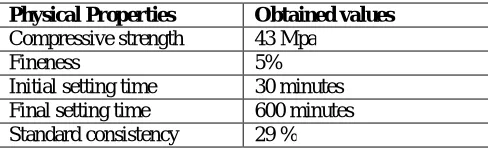
43 grade of Ordinary Portland cement was used. The property of the Cement is as show in table 1.
Table 1: Properties of 43 grade Cement
Physical Properties Obtained values
Compressive strength 43 Mpa
Fineness 5%
Initial setting time 30 minutes Final setting time 600 minutes Standard consistency 29 %
2. FINE AGGREGATE:
RIVER SAND:
ISSN(Online) : 2319-8753 ISSN (Print) : 2347-6710
I
nternational
J
ournal of
I
nnovative
R
esearch in
S
cience,
E
ngineering and
T
echnology
(An ISO 3297: 2007 Certified Organization)
Website: www.ijirset.com
Vol. 6, Issue 1, January 2017
Figure 2: Fine Aggregate
Table 2: Properties of Fine aggregate
Physical Properties Obtained values
Size Passing through 4.75mm
Bulk density 1721 kg/ m3 Fineness modulus 2.9
Specific gravity 2.65
3. E-WASTE:
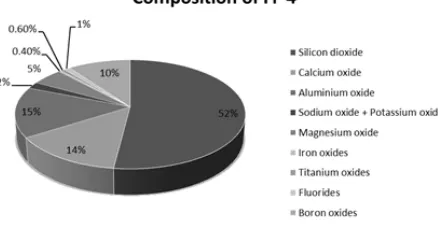
In our experimental study we have decided to use PCB cutting waste (FR-4) as a fine aggregate (partial replacement). FR4 is a grade designation assigned to glass-reinforced epoxy laminate sheets, tubes, rods and printed circuit boards (PCB). FR-4 is a composite material composed of woven fiberglass cloth with an epoxy resin binder that is flame resistant (self-extinguishing). "FR" stands for flame retardant, and denotes that safety of flammability of FR-4 is in compliance with the standard UL94V-0. FR-4 is created from the constituent materials (epoxy resin, woven glass fabric reinforcement, brominated flame retardant, etc.) by NEMA in 1968. FR-4 glass epoxy is a popular and versatile high-pressure thermoset plastic laminate grade with good strength to weight ratios.
Figure 4: FR-4
Table 3: Properties of e-waste (FR-4)
Parameter Value
Specific gravity/density 1,850 kg/m3 (3,120 lb/cu yd) Water absorption −0.125 in < 0.10%
Temperature index 140 °C (284 °F)
Rockwell hardness 110 M scale
Compressive strength – flatwise > 415 MPa (60,200 psi)
4. COARSE AGGREGATE:
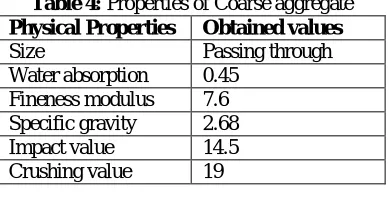
Crushed Blue metals obtained from a local quarry were used as Coarse aggregate. The properties of the coarse aggregate are shown in table 4.
Table 4: Properties of Coarse aggregate
Physical Properties Obtained values
Size Passing through
Water absorption 0.45 Fineness modulus 7.6 Specific gravity 2.68 Impact value 14.5 Crushing value 19
CONTROL MIX AND MIX PROPORTION
Mix design for M30 grade concrete according to BIS method (IS 10262:2009). The mix proportion for concrete is shown in the table 5.
Table 5: Control mix
Cement kg Fine Aggregate kg
Coarse Aggregate kg
Water
380 711 1283 160
1 1.87 3.37 0.42
ISSN(Online) : 2319-8753 ISSN (Print) : 2347-6710
I
nternational
J
ournal of
I
nnovative
R
esearch in
S
cience,
E
ngineering and
T
echnology
(An ISO 3297: 2007 Certified Organization)
Website: www.ijirset.com
Vol. 6, Issue 1, January 2017
Table 6: Mix Specification
Mix proportion Control mix
A B C D E F
Proportion of E-waste + 10% of fly ash 0% 5% 10% 15% 20 %
25%
Mix proportion Control mix
G H I J K -
Proportion of E-waste + 10% of fly ash 30% 35% 10% 15% 20 %
-
VII. TESTS ON CONCRETE
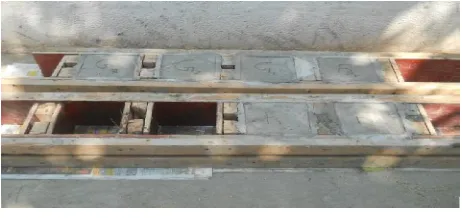
From the above observation and results of materials such as cement, Fine aggregate, e-waste, coarse aggregate and water the required design mix was prepared and the final ratio was 1:1.71:2.70 with the water cement ratio of 0.44. Then the specimens such as Cubes ( 150mm x 150mm x150mm), Cylinder (150mm diameter & 300mm length) and Beam (100mm x 100mm x 500mm) was casted to evaluate the Compressive strength , Split tensile strength and Flexural strength of the concrete.
Figure 5: Casted Specimen
Compressive Strength
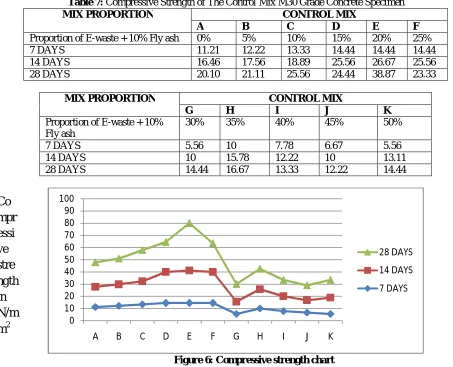
To evaluate the Compressive strength of the concrete we have casted 9 cubes for each percentage of e-waste with aggregate. Therefore totally 66 cubes was caste and allowed for curing process.. Then the cubes are tested for the compressive strength using CTM machines. The average values of samples from 7 days, 14 days and 28 day are tabulated in table
Split Tensile Test
To determine the Split tensile of the concrete we have casted 33 numbers of cylinders of 300mm length and 150mm diameter
Flexural Strength Test
To evaluate the flexural strength we have casted 33 numbers of beams of size 100mm x 100mm x 500mm and allowed for curing of 7 days, 14 days and 28 days.
IX. RESULT AND DISCUSSION
excess than the calculated value. An important thing is the gradual increase of FR-4 in fine aggregate decrease weight of the Concrete i.e. Light weight concrete.
Table 7: Compressive Strength of The Control Mix M30 Grade Concrete Specimen
MIX PROPORTION CONTROL MIX
A B C D E F
Proportion of E-waste + 10% Fly ash 0% 5% 10% 15% 20% 25%
7 DAYS 11.21 12.22 13.33 14.44 14.44 14.44
14 DAYS 16.46 17.56 18.89 25.56 26.67 25.56
28 DAYS 20.10 21.11 25.56 24.44 38.87 23.33
MIX PROPORTION CONTROL MIX
G H I J K
Proportion of E-waste + 10% Fly ash
30% 35% 40% 45% 50%
7 DAYS 5.56 10 7.78 6.67 5.56
14 DAYS 10 15.78 12.22 10 13.11
28 DAYS 14.44 16.67 13.33 12.22 14.44
Figure 6: Compressive strength chart
2.
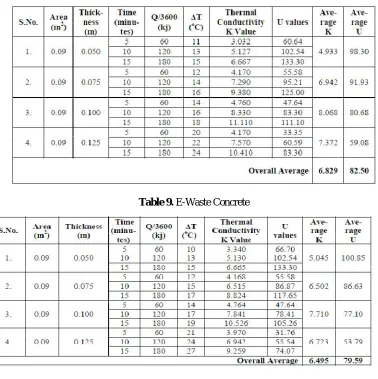
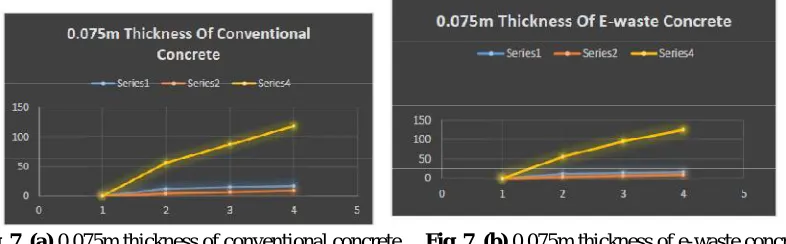
The casted panels of slab are tested in well closed container be the length of 1.5m, the medium (slab) are placed centrally and the heat energy produced by 200watts incandescent bulb. The observation were shown below in Table 8 and Table 9for various thickness and Fig. 7. (a) and (b) shows the graph plot.0 10 20 30 40 50 60 70 80 90 100
A B C D E F G H I J K
28 DAYS
14 DAYS
7 DAYS
ISSN(Online) : 2319-8753 ISSN (Print) : 2347-6710
I
nternational
J
ournal of
I
nnovative
R
esearch in
S
cience,
E
ngineering and
T
echnology
(An ISO 3297: 2007 Certified Organization)
Website: www.ijirset.com
Vol. 6, Issue 1, January 2017
Table 8. For Conventional Concrete
Fig. 7. (a) 0.075m thickness of conventional concrete Fig. 7. (b) 0.075m thickness of e-waste concrete
X. CONCLUSION
E-waste concrete U factor values are more than the conventional concrete slab with the same area and different thickness. It shows that the R value (heat resistance) for e-waste concrete is lesser than the conventional concrete and the energy stored in the body of e-waste concrete is also lesser than the conventional concrete. So we can prefer e-waste by replacing with fine aggregation portion by 20 %.By adding FR-4 to the fine aggregate, it decrease the weight of the concrete and it can provide fine strength and durability like conventional concrete.
REFERENCES
[1] R. Lakshmia and S. Naganb, Investigations On Durability Characteristics Of E-Plastic WasteIncorporated Concrete, Asian journal of civil engineering (building and housing) vol. 12, no.6,pp 773-787, 2011.
[2] Lakshmi. R and Nagan.S, Studies on Concrete containing E Plastic Waste, InternationalJournal of Environmental Sciences Volume 1, No 3, 2010. [3] Kurian Joseph, Electronic Waste Management In India–Issues And Strategies, Centre forEnvironmental Studies, Anna University, Chennai, India, Sardinia 2007, EleventhInternational Waste Management and Landfill Symposium.
[4] AjeetSaoji, E-Waste Management: An Emerging Environmental and Health Issue in India,National Journal of Medical Research, Volume 2 Issue 1, pp 107-110, 2012.
[5] M.Mittelacher,Effect of Hoteathering concrete condition on the strength performance of theset retarded field concrete, in Temperature Effects on Concrete , ASTM Sp, tech Publ. No.858.
[6] N.I. Fattuhi, The setting of morter mixes subjected to difference temperature, Cement andConcrete Research.
[7] Adel Abdou and M. Budaiwi, “Measurement of Building Insulation Materials under VariousOperation Temperature” Journal of Building Physics, 29(2), p 171, 2005.
[8] Suman B. M and Srivastava, R. K, “Insulation Roof for Energy saving and thermal comfort inBuilding”, NBMCI, Central Building Research Institute, Roorkee, India, 2008.
[9].Kurian Joseph, ELECTRONIC WASTE MANAGEMENT IN INDIA–ISSUES AND STRATEGIES KURIAN JOSEPH, Centre for Environmental Studies, Anna University, Chennai, India, Sardinia 2007, Eleventh International Waste Management and Landfill Symposium. [10].AjeetSaoji, E-WASTE MANAGEMENT: AN EMERGING ENVIRONMENTAL AND HEALTH ISSUE IN INDIA, National Journal of Medical Research, Volume 2 Issue 1 Jan – March 2012 ISSN 2249 4995. PAGES 107-110.
[11] Dhanraj AA, Selvamony C. A Comparative Study on Thermal Insulation Properties of Partial Replacement of Fine Aggregate by E-Waste Material (FR-4) In M 30 Grade with Conventional Concrete. Key Engineering Materials. 2016 Apr 9:692;104-109.