An Experimental Study on Hardened and
Thermal Properties of Fly ash Bricks Using
Polystyrene Beads as Partial Replacement of
Sand
Saride Lakshmi Ganesh1, Sambangi Arunchaitanya2
P.G. Student, Department of Civil Engineering, Gudlavalleru Engineering College, Gudlavalleru, A.P, India1 Assistant Professor, Department of Civil Engineering, Gudlavalleru Engineering College, Gudlavalleru, A.P, India2
ABSTRACT: As we all know that walls are main source of conduction of heat from atmosphere to building; hence necessary measures are adopted to insulate them. Walls are mainly composed of bricks. So, if thermal conductivity of brick reduces obviously the insulating property of wall increases which results in less energy consumption. Hence the present thesis focused on the study of hardened and thermal properties of fly ash bricks by use of polystyrene beads in varying proportions. Polystyrene is selected as it is lightweight in nature and is having good thermal insulating property leading mainly to non-structural applications.
This paper shows the results of an experimental investigation on hardened and thermal properties of fly ash bricks containing expanded polystyrene beads (EPS) as a partial replacement of natural fine aggregates. The properties investigated in this paper were compressive strength, water absorption, efflorescence and thermal conductivity. The natural fine aggregate were replaced with 0%, 5%, 10%, 15%, 20%, and 25% (by volume) of EPS. There was a slight decrease in water absorption and a decreasing in compressive strength and thermal conductivity with the increase in EPS content in fly ash bricks.
KEYWORDS: fly ash bricks, expanded polystyrene beads (EPS), thermal conductivity, compressive strength.
I. INTRODUCTION
Now a day’s there are two major environmental issues that are discussing around the world. One is conservation of natural energy resources and other is environmental pollution due to non degradable materials like polythene etc. So recyclable and eco friendly materials are getting high importance, hence several research work is going on the acceptability of such recyclable and eco friendly materials as construction materials.
In this thesis also importance is given for use of non degradable material like polystyrene which is used as packing material and having good heat resisting capacity, use of fly ash which is also a waste material produced by burning of coal at thermal power plants. As polystyrene and fly ash are light weight materials, usage of such materials will be advantageous in structural point of view to produce low dead weights on to the structure.
At present global warming is also increasing day by day, the atmospheric temperatures are also getting high. Hence people are choosing air conditioning devices which conserve more electrical energy to cool their living environment. Normally houses are mainly composed of walls that are constructed with bricks. So, if thermal conductivity of brick reduces that will directly improves the heat resisting capacity of walls, which helps in keeping the room temperatures lower than outer temperatures and also helps in saving electrical energy.
II. PROPERTIESOFMATERIALS
Various materials used for this experimental work are cement, sand, fly ash, expanded polystyrene beads (EPS) and water. Several tests are conducted on individual materials to find their material properties like density, specific gravity etc.
[1] Fly ash:
Fly ash used for this experimental work is of class F collected from thermal power plant located at Vijayawada. The tests are conducted on this material as per IS: 1727 – 1967. The properties calculated are as follows:
Specific gravity : 1.75
Density : 0.89 gm/cc
[2] Cement:
Ordinary Portland cement of 53 Grade was preferred for this study. The physical properties of cement are categorized in table 1.
TABLE 1
PHYSICAL PROPERTIES OF CEMENT
S.No Properties Value
1 Specific Gravity 3.13
2 Initial setting time 48min
3 Final setting time 290 min
4 Fineness test 5% retained
[3] Sand:
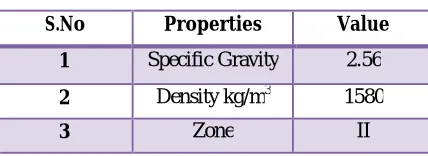
Locally available river sand was used as fine aggregate for entire experimental work. The physical properties of sand was carried out as per IS 383-1970 and IS 2386-1963. Table 2 shows the properties of sand that were tested in laboratory.
TABLE 2
PROPERTIES OF FINE AGGREGATE
S.No Properties Value
1 Specific Gravity 2.56
2 Density kg/m3 1580
3 Zone II
[4] Expanded Polystyrene (EPS) beads:
III.EXPERIMENTALMETHOD
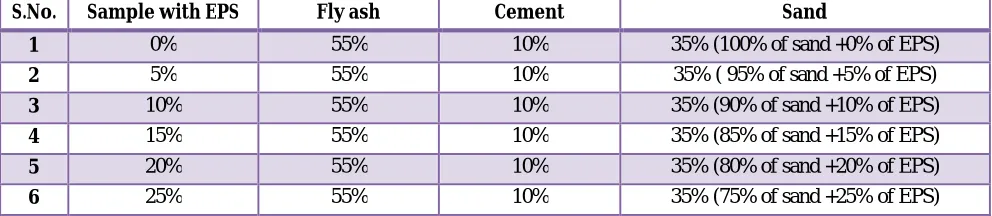
After studying various journal papers, research articles and guidelines of government bodies to the brick manufacturing industries, several trail mixes are casted for various proportions of brick materials. Finally good strength properties were observed for brick having compositions as fly ash 55%, sand 35%, cement 10% with water to binder ratio of 0.40. Keeping these mix proportions as constant sand is replaced partially with EPS beads in different proportions. Table 3 shows the percentage of materials that were used in different brick samples. As polystyrene is light weight in nature replacement of sand is done on volumetric basis.
TABLE 3 MIX PROPORTIONS
S.No. Sample with EPS Fly ash Cement Sand
1 0% 55% 10% 35% (100% of sand +0% of EPS)
2 5% 55% 10% 35% ( 95% of sand +5% of EPS)
3 10% 55% 10% 35% (90% of sand +10% of EPS)
4 15% 55% 10% 35% (85% of sand +15% of EPS)
5 20% 55% 10% 35% (80% of sand +20% of EPS)
6 25% 55% 10% 35% (75% of sand +25% of EPS)
IV.EXPERIMENTALRESULTS
After completion of manufacturing of bricks with different proportions several tests are conducted to find strength and thermal properties. The various tests conducted and results obtained are displayed below.
[A] Compressive Strength Test
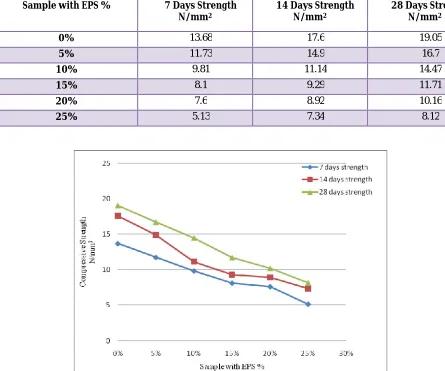
This test is conducted by using compression testing machine. The sample to be tested is placed on the lower plate of machine on its flat face and load is applied. The maximum load where the sample broken is noted and that maximum load divided by area of brick gives the compressive strength. The test is conducted as per IS 3495: 1992 (part 1). Table 4 shows the results of compressive strength test performed at 7, 14, 28 days for different proportions. Figure 1 shows the graph of variation of compressive strength with increase in EPS percentage. It clearly shows that there is a considerable decrement with increase in EPS content in 7, 14, 28 days strength test. The compressive strength is given by formula
TABLE 4
RESULTS OF COMPRESSIVE STRENGTH TEST
Sample with EPS % 7 Days Strength
N/mm2
14 Days Strength
N/mm2
28 Days Strength
N/mm2
0% 13.68 17.6 19.05
5% 11.73 14.9 16.7
10% 9.81 11.14 14.47
15% 8.1 9.29 11.71
20% 7.6 8.92 10.16
25% 5.13 7.34 8.12
Fig 1: Graph Showing Compressive Strength Results at 7, 14, 28 days
[B] Water Absorption Test
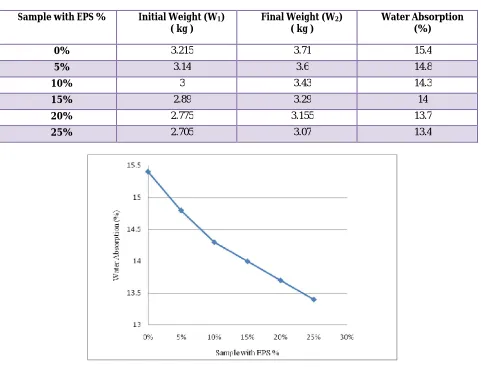
Water absorption test is conducted as per IS 3495: 1992 (part 2). In this test first dry weight of brick is taken and noted as W1. Then the weight of brick is noted as W2 which was kept under water for 24 hours. Table 5 shows the results of water absorption test that was conducted in laboratory. Figure 2 shows the graphical variation of water absorption for bricks of different proportions. It clearly shows that there is a continuous decrement in water absorption with increase in EPS content in bricks. Water absorption is calculated by formula
TABLE 5
RESULTS OF WATER ABSORPTION TEST
Sample with EPS % Initial Weight (W1)
( kg )
Final Weight (W2)
( kg )
Water Absorption (%)
0% 3.215 3.71 15.4
5% 3.14 3.6 14.8
10% 3 3.43 14.3
15% 2.89 3.29 14
20% 2.775 3.155 13.7
25% 2.705 3.07 13.4
Fig 2: Graph Showing Water Absorption Test Results at 28 days
[C] Efflorescence Test
[D] Thermal Conductivity Test
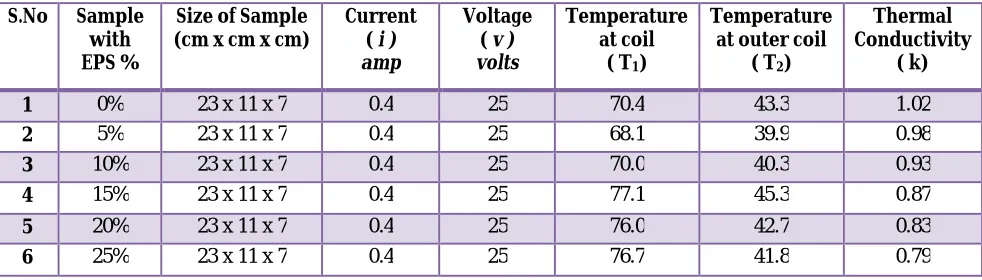
Thermal conductivity test is performed based on the concept of steady state condition and as per IS 3346: 1980. In this test a heater coil is placed in between two bricks and two bricks are tied together to avoid heat loss. A thermocouple is also placed near heater coil to measure the temperature. The whole assembly except 2 sides is insulated with a highly insulating material named glass wool to avoid heat loss from other directions and to allow heat flow in one direction. Another two thermocouples are placed at other two faces which are exposed to air. The heater coil is connected to electric circuit through ammeter, volt meter and dimmer stat. The whole arrangement is kept in a closed room to avoid air flow which causes delay in formation of steady state condition. Then switch on the power to start the experiment and power input will be adjusted by dimmer stat. After switching on the power the temperature at heater coil raises and the temperature at outer face also raises after some time. After achieving the steady state condition temperatures at heater coil is noted as T1 and temperature at outer surface is noted as T2. The current supplied is noted from ammeter as
i and the voltage drop is noted from voltmeter as v.
Table 6 shows the values of Thermal conductivity for different samples. Figure 3 is the graph showing variation of thermal conductivity with increase in EPS content of bricks and it clearly describes that thermal conductivity decreases with increase in EPS content in bricks. Figure 4 is test setup to calculate thermal conductivity where ammeter, volt meter, dimmer stat are connected to heater coil which is placed in between two bricks and insulated using glass wool. Thermal conductivity for sample is calculated by using formula given below.
Thermal Conductivity (k) = ∗ ∗
∗( )
W/m-o C
Where i = current in amperes
v = voltage drop in volts
l = depth of the specimen A = area of sample
T1 = temperature at heater coil T2 = temperature at outer surface
TABLE 6
RESULTS OF THERMAL CONDUCTIVITY TEST
S.No Sample
with EPS %
Size of Sample (cm x cm x cm)
Current ( i ) amp
Voltage ( v ) volts
Temperature at coil
( T1)
Temperature at outer coil
( T2)
Thermal Conductivity
( k)
1 0% 23 x 11 x 7 0.4 25 70.4 43.3 1.02
2 5% 23 x 11 x 7 0.4 25 68.1 39.9 0.98
3 10% 23 x 11 x 7 0.4 25 70.0 40.3 0.93
4 15% 23 x 11 x 7 0.4 25 77.1 45.3 0.87
5 20% 23 x 11 x 7 0.4 25 76.0 42.7 0.83
Fig 3: Graph Showing Thermal conductivity Test Results Fig 4: Thermal conductivity Test Setup
V. CONCLUSION
The following observations are made after conducting an experimental study on hardened and thermal properties of fly ash bricks by using expanded polystyrene beads as partial replacement of sand with different proportions.
(a) The compressive strength of the brick decreases with increasing in EPS content. The maximum compressive strength at 28 days was observed as 19.05 N/ mm2 for no EPS case and minimum compressive strength at 28 days was observed as 8.12 N/ mm2 for brick with 25% EPS content.
(b) Water absorption is also decreasing with increase in EPS content. Minimum water absorption is observed as 13.4 % for brick with 25% EPS.
(c) It is observed that there is no change in efflorescence with increase in EPS content in bricks. There is a very slight efflorescence less than 10% was observed on bricks.
(d) With increase in EPS content thermal conductivity is also decreasing. Minimum thermal conductivity is observed as 0.79 W/m-oC for brick with 25 % EPS content.
(e) With this experimental study it was proved that brick with 25% EPS content is having low thermal conductivity and low water absorption with good compressive strength of 8.12 N/mm2 is advantageous.
REFERENCES
1) Er. Rinku Kumar, Er. Naveen Hooda, “AN EXPERIMENTAL STUDY ON PROPERTIES OF FLY ASH BRICKS”, international journal of research in aeronautical and mechanical engineering, Volume 2, Issue 9, Page: 56 –67, September 2014.
2) A. Sumathi, K. Saravana Raja Mohan, “Compressive Strength of Fly Ash Brick with Addition of Lime, Gypsum and Quarry Dust”, International Journal of ChemTech Research, Vol.7, No.01, pp 28-36, 2014-15.
3) Nutan C. Patel, Prof. Jayeshkumar Pitroda, “fly ash brick: glass fiber the innovative concept for getting higher strength brick”,International Journal of Innovative Research in Science, Engineering and Technology (IJIRSET), Vol. 2, Issue 3, page 1 -9, March 2013.
4) Idawati Ismail, A.Aziz Saim, Abd Latif Saleh, “PROPERTIES OF HARDENED CONCRETE BRICKS CONTAINING EXPANDED POLYSTYRENE BEADS”, Proceedings of the 5th Asia-Pacific Structural Engineering and Construction Conference (APSEC 2003) Johor Bahru, MALAYSIA, page 171-179, 26 – 28 August 2003.
5) Balaraju sivagnanaprakash, palaniswamy murthy, alan sekharan, “A Study on Structural Applicability of Fly ash Bricks with Quarry Dust- an Ecofriendly Alternative for Clay Bricks”, Pol. J. Environ. Stud. Vol. 24, no. 2, 695-699, (2015).
6) Ravi Kumar, Vandana Patyal, Balwinder Lallotra and Deepankar Kumar Ashish, “ STUDY OF PROPERTIES OF LIGHT WEIGHT FLY ASH BRICK”, International Journal of Engineering Research and Applications (IJERA) ISSN: 2248-9622 National Conference on Advances in Engineering and Technology (AET),page 49-53, 29th March 2014.
7) Guidelines for manufacturing quality fly ash bricks by NTPC.
10) IS: 3346-1980, method of determination of thermal conductivity of thermal insulation materials- specification, Bureau of Indian Standards, New Delhi.
BIOGRAPHY
Saride Lakshmi Ganesh was born in 1992 in East Godavari District, Andhra Pradesh. He received his Bachelor of Engineering degree in civil engineering from the S R K R Engineering College, Andhra University in 2013. At present he is final year student of M.Tech in Structural Engineering from Gudlavalleru Engineering College, Gudlavalleru.