Qualitative Review of Response Spectrum
Analysis in Vertically Irregular RC Buildings,
Using Capacity Spectrum Method
Hafsa Basheer 1
Assistant Professor, Department of Architecture, DC School of Architecture and Design, Pullikkanam, Kerala, India1
ABSTRACT: Earthquakes caused by movements on the earth surface results in different levels of ground shaking resulting in damage and collapse of buildings and other Infra-structures. Irregularities in arrange and lack of symmetry might imply vital eccentricities between building mass and stiffness centers, giving rise to damaged couple lateral response. During an earthquake failure starts at point of weakness and this point of weaknesses arise due to discontinuity in mass, geometry and stiffness. Hence detail seismic analysis of structures is a necessity before determining the design parameters. The present study provides insight to the utility of response spectrum analysis as an effective method of deriving design parameters during initial stages of construction of vertically irregular RC buildings. The suitability is analyzed in reference to capacity spectrum method. ETABS V.9.7.4 and ETABS 2015 is used for analysis.
KEYWORDS:Seismic analysis, response spectrum analysis, capacity spectrum method
I. INTRODUCTION
Seismic analysis is a major tool in earthquake engineering which is used to analyse the response of structure due to seismic excitations in simple manner. Earth quakes are a major trigger for instability in all kinds of infra structure. Nowadays, the buildings are asymmetrical in both plan and elevation. The response of a building varies widely as the nature of irregularity changes. Generalizing analysis methods for such cases of irregularity will prevent errors that arise due to inadequate analysis at the same time saves time, effort and cost by using advanced methods on all occasions . The vertical irregularities in buildings arise in various forms. The IS 1893 definition of irregular structures name five types of irregularities namely stiffness, geometric, mass, in-plane discontinuity. (1) Stiffness irregularity: Found in two forms , soft storey and extreme soft storey. This occurs due to variation of lateral stiffness of adjacent storeys. (2) Geometric irregularity : This arises when horizontal dimension of the lateral force resisting system in any storey is more than 150 percent of that it is in its adjacent. (3) Mass irregularity: Exists when the seismic weight of any storey is more than 200 percent of that of the adjacent.
There are different types of analysis viz. linear and non linear analysis. Response spectrum analysis is the most basic linear analysis method that can be conducted to derive the base parameters for initial design purposes. A response spectrum is simply a plot of peak steady –state response of a series of oscillators of varying natural frequency. To study the suitability of response spectrum analysis , the parameters obtained must be compared with results of an advanced analysis. Thus the capacity spectrum method used as a reference of review since non –linear models produce more realistic seismic response analysis than elastic models. This method, by means of graphical procedure, compares the capacity of the structure with the demands of the earthquake ground motion of the structure.
In this study , the suitability of RSA as a secure analysis method before design of vertically irregular RC buildings is completed. For the present study low rise, mid rise and high rise models with geometric, mass and stiffness irregularity is considered. Geometrical irregularity is achieved by varying horizontal dimension of storeys. The mass
building. The condition of stiffness irregularity is attained by discontinuous column distribution and varying storey height in the base floor of the model .
II. RELATEDWORK
The response spectrum method is a common method adapted in the initial stages of analysis and design of a structure. It gives fairly workable values in elastic range and slightly over estimated values as the complexity of frames. The functions required to complete the linear analysis can be easily calculated. The amount of data that is already available in reference with the history of ground motions affects the obtained result of analysis. Extensive the available data, more precise the results are. Capacity spectrum method is used to analyze the possible behavior of structure in a particular or generalized earthquake motion. It graphically represents the demand of structure versus the capacity of structure. It gives accurate values over non-linear response range and hence states the art of failure of structure.
III.MODELINGINETABS
Modeling and analysis of the RC buildings, for the present study, is performed in ETABS V.9.7.4 Three base models namely, low rise of G+9 storey, a mid rise model of G+15 and high rise model of G+30 are completed for each condition of irregularity.
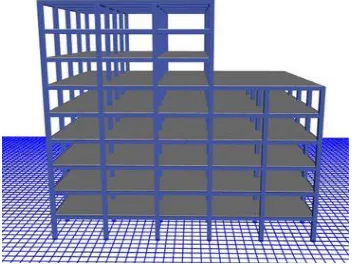
Geometric irregularity: The low rise and mid rise buildings are 30X20m. 5 bays of 6m each in global X direction and 4m each on global Y direction. The high rise building is 36X25m. The condition of irregularity was fulfilled by reducing the number of bays in X direction as 3, from 6th storey in low rise and mid rise and from 9th storey in high rise models.
Fig 1. Low rise model with geometric irregularity
Stiffness irregularity: The low rise models and mid rise models are 30X20m with 5m wide bays in X and Y directions. The high rise model is of 36X20m. The conditions of stiffness irregularity is fulfilled by providing discontinuous column distribution in base and varying the 3.2m storey height to a 4m in the base.
Mass irregularity: The models are 30X20m in dimensions. The condition of irregularity is fulfilled by defining one of the storey with thicker slab and larger load distribution.
IV.LOADSCONSIDEREDINTHESTUDY
The model is defined with basic loads of dead, live, super imposed dead and seismic loads. The load combinations are considered as per design requirements. The combinations with response spectrum functions and capacity spectrum functions are also considered in addition to the base load combinations.
V. SECTIONDETAILS
Irregularity Low rise Mid rise High rise Geometric irregularity
a. Grade of concrete M25, M35 M25, M35 M25, M35 b. Beam size 450 X430mm 550X530mm 600X57mm c. Column size 500X530mm 530X550mm 800X770mm d. Thickness of slab 120mm 120mm 120mm Stiffness irregularity
a. Grade of concrete M35 M35 M35 b. Beam size 470X470mm
550X530mm
550X530, 580X530, 600X650mm
400X340 ,450X470, 500X450mm
c. Column size 800X770, 600X550 770X750, 800X770mm 780X760,900X880mm d. Thickness of slab 120mm 120mm 120mm
Mass irregularity
a. Grade of concrete M35 M35 M35
b. Beam size 300X200,430X400mm 380X280, 400X350mm 400X300 ,430X380mm c. Column size 550X530, 660X620mm 550X530,580x560mm 730X700, 780X760mm d. Thickness of slab 120mm,150mm 100mm,150mm 110mm , 180mm
VI.ANALYSISRESULTS
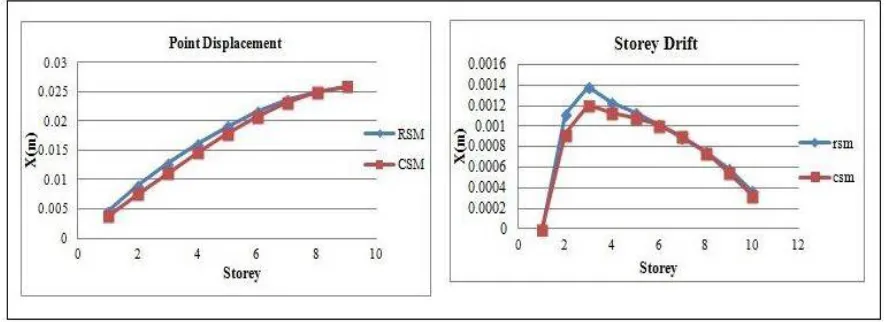
First, response spectrum analysis is conducted in models. The point displacement and storey drift are obtained. Non linear functions are defined and capacity spectrum analysis is done. The base parameters of both the analyses are compared to study the nature of values from RSA. Points of over estimation, under statements and smoothing out of results are find out by plotting graphs . A Sample of the base parameter graphs are shown in figure 3.
The maximum possible point displacement is taken from response spectrum analysis and the hinge formation for the same is obtained using capacity spectrum analysis. Then the point displacement at which collapse hinges are formed is found . The rate of formation of hinges is plotted against defining the demand of the building and capacity of building. The rate and nature of formation of hinges are studied and suitability of RSA is derived.
The analysis results obtained for various conditions of irregularities are as follows :
1. Geometric irregularity : The results obtained from RSM analysis on base parameters shows visible difference
from CSM method in case of mid rise and high rise models. The discrepancies are due to over estimation and smoothening out of values. The points of fault can be determined by referring to a non linear analysis and rectified. The displacement at which collapse hinges are formed is at a higher value than that of maximum possible point displacement of low rise and mid rise models. The hinges formed are at a gradual rate. In case of high rise models, once the hinges are formed at intermediate occupancy range, then there is a rapid succession in the rate of hinge formation within adjacent displacement values.
Fig 4: Hinge formation
2. Stiffness irregularity: The results obtained from RSM analysis on the base parameters shows visible difference in case of mid rise and high rise models. The discrepancies are due to smoothening out of values. The displacements points are seen to be smoothened to a linear variation when compared with CSM results. This is due to the absence of non-linear considerations. Even though the point of faults can be identified by plotting against the CSM results, blind rectification by changing dimensions might result in uneconomic and unscientific sections. The displacement at which collapse hinges are formed is at a higher value than that of the possible point displacement. The hinge formation is at uniform rate in low rise and mid rise models. Whereas in the high rise models, there is a rapid succession in formation of hinges after intermediate occupancy range within adjacent displacement values.
3. Mass irregularity : The results obtained from RSM analysis on base parameters are very comparable with that
Thus the demand of the building is lower and safer when compared with the capacity of building modeled using RSA analysis.
VII.CONCLUSION
The study was conducted to evaluate the usefulness of response spectrum analysis in vertically irregular RC buildings. The qualitative review of the RSM method was conducted using capacity spectrum analysis. It can be concluded that (1). The response spectrum method derives comparable results in low rise and mid rise models of all cases.
(2). A non linear analysis can be used as reference to identify and rectify the faults that arises in these models.
(3). High rise model with geometric irregularity can be conducted with RSA in reference to another linear or non linear analysis.
(4). The high rise models with stiffness irregularity shall not be designed in reference with RSM results (5). RSM method can be effectively used for the safe designing of all cases of mass irregularity
REFERENCES
[1] Praveen K Malhotre ; “Seismic response spectra for probabilistic analysis of non linear systems”; Journal of Structural Engineering 2011 (ASCE) [2] Kisper Peter, Mare Badaux “Application of capacity spectrum method on RC building with bearing walls” ; World Conference of Earthquake engineering2000
[3] Robert villaverde, A.E.Hasaballah; “Seismic analysis of a RC building using Response spectrum method”; Journal of mechanicand civil IOSR 2013
[4] Praveen ashok shirule, Bharathi.V.mahajan; “Response spectrum analysis of asymmetrical buildings”; Journal of earthquake engineering structural dynamics wiley ; 2013 (sciencedirect)
[5] Dubal A C, Dr. M. Shindey ; , “Capacity spectrum method for cracked and uncracked sections”, Journal of mechanical and civil engineeringIOSR 2015
[6] B K Raghu Prasad, A Seetha Rammaiah ,” Capacity spectrum method for asymmetric plan”, WCEE 2004
[7] N Sivakumar, S Thyagarajan, S Saravan; “Seismic vulnerability of open grounfd floor columns in multi storey RC building” ; Journal of scientific engineering and Research 2013(sciencedirect)
[8] A J Kappoos, Tsaklos; “Influence of capacity design method on the response of RC columns”; Journal of Engineering Structures (Sciencedirect.com)2013
[9] Koichi Kusunoki, Masomi Teshigwara“Development of residual seismic capacity evaluation with capacity spectrum method”, NCEE,2014 [10] Haluk Sucugaul, M Selim Gunay, ” Performance based rehabilitation of damaged reinforced concrete buildings ”, Journal of structural engineering 2004
[11] J H Cassis, E H Cornejo, “ Influence of vertical irregularities in the response of earthquake resistant structures”, 11th WCEE,copywright
Elseveir
[12] K Matsukawa, M Maeda “Practical collapse assessment for the reinforced concrete structure based on seismic response spectrum”; WCEE,2014 [13] Ali Demir, Hakam Besaran,Muhiddin Bagci;“A comparative assessment of existing structure by performance based analysis”; Americal Journal of Engineering and Technology 2014