DOI: 10.1051/0004-6361:20041668
c
ESO 2004
Astrophysics
&
Nonlinear particle acceleration at reverse shocks
in supernova remnants
D. C. Ellison
1, A. Decourchelle
2, and J. Ballet
21 Department of Physics, North Carolina State University, Box 8202, Raleigh NC 27695, USA
e-mail:[email protected]
2 Service d’Astrophysique, DSM/DAPNIA, CEA Saclay, 91191 Gif-sur-Yvette, France
e-mail:[adecourchelle;jballet]@cea.fr
Received 15 July 2004/Accepted 7 September 2004
Abstract. Without amplification, magnetic fields in expanding ejecta of young supernova remnants (SNRs) will be orders of magnitude below those required to shock accelerate thermal electrons, or ions, to relativistic energies or to produce radio synchrotron emission at the reverse shock. The reported observations of such emission give support to the idea that diffusive shock acceleration (DSA) can amplify magnetic fields by large factors. Furthermore, the uncertain character of the amplification process leaves open the possibility that ejecta fields, while large enough to support radio emission and DSA, may be much lower than typical interstellar medium values. We show that DSA in such low reverse shock fields is extremely nonlinear and efficient in the production of cosmic-ray (CR) ions, although CRs greatly in excess of mc2 are not produced. These nonlinear effects,
which occur at the forward shock as well, are manifested most importantly in shock compression ratios4 and cause the interaction region between the forward and reverse shocks to become narrower, denser, and cooler than would be the case if efficient cosmic-ray production did not occur. The changes in the SNR structure and evolution should be clearly observable, if present, and they convey important information on the nature of DSA and magnetic field amplification with broad astrophysical implications.
Key words.ISM: cosmic rays – acceleration of particles – shock waves – ISM: supernova remnants – X-rays: ISM
1. Introduction
It is clear in many supernova remnants (SNRs) that the forward, blast wave shock, interacting with the interstellar medium (ISM) magnetic field, produces radio (and some-times X-ray) synchrotron emission. Presumably this is ac-complished when the forward shock accelerates thermal and pre-existing cosmic-ray (CR) electrons by diffusive shock acceleration (DSA) (also called the first-order Fermi mecha-nism). The reverse shock, however, will not produce relativis-tic electrons from thermal ones if the only magnerelativis-tic field that is present is the ambient field from the progenitor star. Any pro-genitor field will be vastly diluted by expansion and flux freez-ing and, for expected white dwarf or massive star magnetic field values, after<100 yr, will fall below levels necessary to support particle acceleration to radio emitting energies.
For example, if the surface field of a white dwarf of radius RWD =107 m is BWD =109 G, the diluted magnetic field af-ter∼100 yr at the reverse shock, which is typically at a radius Rsk ∼1 pc from the explosion site, is B ∼ BWD(RWD/Rsk)2 ∼ 10−10G. For 10−10G, the diffusive acceleration time to 10 GeV is>∼100 yr and the upstream diffusion length at a 104 km s−1 shock of a 10 GeV electron is >1 pc, making the produc-tion of radio emitting electrons unlikely. Similar results are
expected for massive progenitors. Furthermore, with such low fields, even if relativistic electrons are present in large numbers from compressed pre-existing cosmic rays or whatever, the ra-dio emissivity may be too low to be observable.
The expanded ejecta bubble may be one of the lowest mag-netic field regions in existence and if reverse shocks in some SNRs are accelerating electrons by DSA to radio emitting ener-gies or higher (as has been suggested by recent radio and X-ray observations, e.g., Gotthelf et al. 2001; DeLaney et al. 2002; Rho et al. 2002), there are important consequences for:
– magnetic field generation and amplification in strong
shocks;
– the intrinsic efficiency of DSA and cosmic-ray production, including heavy elements; and
– the structure and evolution of the X-ray emitting interaction
Berezhko & Völk 2004). If such amplification occurs generally, SNRs will be capable of accelerating cosmic rays to above 1017 eV (e.g., Ptuskin & Zirakashvili 2003; Drury et al. 2003), pos-sibly solving the decades old problem of smoothly generating CRs to the spectral knee near 1015eV and beyond. Since DSA is expected to occur in diverse environments on all astrophys-ical scales, the confirmation and characterization of magnetic field amplification is of extreme importance.
In this paper, we first discuss in Sect. 2 the general effects of a low magnetic field on the efficiency of DSA. We show that nonlinear effects, most noticeable in producing compression ra-tios4, can be extremely large for a range of magnetic field below that of the average ISM (i.e., for B<BISM∼3×10⁻⁶G). We then discuss in Sect. 3 the relevance of low fields and strong nonlinear effects in DSA at reverse shocks in SNRs. To our knowledge, this is the first attempt to consider such effects in an evolutionary model of SNRs. A number of aspects concern-ing the acceleration process, the nature of the magnetic field, and the physical conditions in the unshocked ejecta material (e.g., temperature, ionization fraction, etc.) are not well-known. Because of these uncertainties, we show a number of examples where important parameters are varied over fairly wide ranges. We emphasize, however, that the effects of efficient DSA on the structure and evolution of SNRs may be large and current in-struments should be sensitive enough to importantly constrain many of these poorly known parameters.
2. Nonlinear diffusive shock acceleration
Nonlinear DSA is a complex process that is difficult to describe completely. In order to allow the coupling of the particle accel-eration to a hydrodynamic model of SNR evolution, we use an approximate, algebraic model of DSA developed by Berezhko & Ellison (1999) and Ellison et al. (2000). While more com-plete models exist (e.g., Berezhko et al. 1996), they tend to be more computationally intensive and not as easy to include in a hydrodynamical simulation. Despite the simplifications made in our acceleration model, we believe it adequately de-scribes the essential physics when the maximum momentum of accelerated particles pmaxAmpc. It is less accurate when
pmax ∼Ampc as we describe more fully below. Here, A is the mass number, mpis the proton mass, and c is the speed of light. In a complicated, nonlinear fashion, the acceleration effi -ciency (i.e., the fraction of total ram kinetic energy going into superthermal particles)1depends on the sonic and Alfvén Mach numbers (MS =
ρ0Vsk2/(γP0) and MA =
4πρ0Vsk2/B0 re-spectively), on the particle injection and on the maximum par-ticle momentum achieved pmax. Here,ρ0is the unshocked mass density, P0is the unshocked pressure, B0is the unshocked mag-netic field, Vskis the shock speed, andγis the ratio of specific heats. The particle injection is modeled by two parameters: the injection efficiencyηinj, i.e., the fraction of total particles which end up with superthermal energies, andλinj, which de-termines the value of the injection momentum (=λinjAmpCs2,
1 Note the difference between injection efficiencyη
injand
acceler-ation efficiency. The acceleration efficiency can and does vary with shock parameters even for a constantηinj.
where Cs2 is the sound speed in the downstream region). The parameterλinj, by definition>1, is arbitrarily taken to be 4 in our calculations (see Berezhko & Ellison 1999, for a full dis-cussion).
For simplicity, in all our examples we assume a single ion species, generally protons, but in Sect. 4.4, oxygen, with the electron temperature equal to the ion temperature=104K. We ignore any wave damping from neutral material (see Sect. 5.2.5 below for a discussion). The maximum momentum protons achieve is determined by setting the acceleration time equal to the SNR age tSNR, or by setting the diffusion length of the high-est energy particles equal to some fraction, fsk, of the shock radius Rsk, whichever gives the lowest pmax(see, for example, Baring et al. 1999).
We assume strong turbulence (i.e., Bohm diffusion) so that the scattering mean free path is on the order of the gyroradius, i.e.,λ ∼ ηmfprg, withηmfp = 1. The magnetic field strength is thus an important factor in determining pmax. If the turbu-lence is, in fact, weaker than Bohm diffusion (ηmfp >1), pmax will be smaller for a given background B and the shock com-pression ratio rtotwill be less. Consistent with assuming strong turbulence (ηmfp=1), we set, following Völk et al. (2002), the downstream magnetic field B2=
1/3+2r2 tot/3 B0.2
In the acceleration model of Berezhko & Ellison (1999), the magnetic field also enters in a calculation of the transfer of energy from energetic particles to the background gas via Alfvén waves, i.e.,
uργ (γ−1)
∂ ∂x
Pgasρ−γ
=VA
∂PCR
∂x , (1)
where VA=B/
4πρis the Alfvén velocity, u is the flow speed, Pgasis the pressure in the background gas, and PCRis the pres-sure in the relativistic particles, i.e., cosmic rays. It is implicitly assumed that the turbulence saturates whenδB/B∼1 and the wave energy is then rapidly damped to heat. Thus, magnetic field amplification is not included in this description.
It is via this energy transfer from energetic particles that the magnetic field has its largest effect on the acceleration pro-cess and even small amounts of background heating from the damping of Alfvén waves can significantly reduce the accel-eration efficiency compared to the case where only adiabatic heating is included.
As explained in detail in Berezhko & Ellison (1999), com-pression ratios>4 occur in DSA for two reasons. First, as rela-tivistic particles are produced and contribute significantly to the total pressure, their softer equation of state makes the shocked plasma more compressible (asγ→4/3, rtot →7). Second, as the highest energy particles escape from the shock, they drain away energy flux which must be compensated for by ramping up the overall compression ratio to conserve the fluxes. Just as in radiative shocks, this is equivalent toγ→1 and rtotcan be-come arbitrarily large. Compression ratios as large as we show here occur in independent steady-state calculations of nonlin-ear DSA which account for particle loss (e.g., Eichler 1984; 2 Everywhere, the subscript 0 (2) implies unshocked (shocked)
Jones & Ellison 1991; Malkov 1998; Blasi 2002). We note that as the overall compression ratio increases (rtot > 4), the sub-shock compression ratio, rsub, which is responsible for heating the gas, becomes less than the test-particle value (rsub < 4), causing the temperature of the shocked gas to drop below test-particle values.
Two important qualifications must be made concerning par-ticle escape and the production of compression ratios greater than 7. First, the explicit assumption in the model of Berezhko and Ellison (and the others mentioned above) is that steady-state conditions apply and particle acceleration is terminated as particles diffuse away from the shock. If, instead, the accel-eration time becomes comparable to the shock age while the diffusion length is still a small fraction of the shock radius, the acceleration process may terminate without particle escape (e.g., Drury 1983). It is less clear what happens in this case, although the work of Berezhko and co-workers (e.g., Berezhko 1996; Berezhko et al. 1996) suggests that for the forward shock in SNRs, geometrical factors determine pmaxover most of the lifetime. These geometrical factors, i.e., the diffusion of parti-cles upstream from the shock, the increase in the shock size and upstream volume, the slowing of the shock speed, and the adia-batic cooling of the energetic particles, produce effects similar to those from escaping particles even though particles, in fact, remain in the SNR system (see a comparison of the model-ing of SN1006 usmodel-ing the simple, steady-state model used here with the time-dependent model of Berezhko and co-workers in Ellison et al. 2000).
The situation is more uncertain for the inward facing, re-verse shock since the upstream region has a finite volume and particles streaming far upstream can conceivably reach the shock on the opposite side of the explosion site without being lost. In this case, particles may still be lost from spatial effects if they diffuse far enough downstream to reach the contact dis-continuity. However, large magnetic fields are expected at the contact discontinuity due to compression and stretching of the field lines by Rayleigh-Taylor instabilities, and might act as a magnetic wall confining the particles in the ejecta material.
In any case, for either the forward or reverse shock, a pre-cise determination of the compression ratio in a time-dependent situation requires a detailed knowledge of the wave-particle in-teractions in the self-generated magnetic turbulence responsi-ble for particle diffusion. This knowledge does not yet exist so approximations remain necessary. We simply assume that par-ticles at either the forward or reverse shock leave the system when their acceleration time>tSNRor their upstream diffusion length> fskRsk. In all of the SNR models we show in this pa-per, we arbitrarily take fsk = 0.05 and note that pmax and rtot would increase with increasing fsk.
The second qualification is that the approximations in the Berezhko and Ellison model assume that pmax Ampc and thus, that a sizable fraction of the total pressure is in rela-tivistic particles. Despite this limitation, we show cases where pmax >∼ 2Ampc and warn that our lower pmax results have a greater intrinsic error than those with pmax Ampc. In fact, from comparisons with Monte Carlo results (not shown here), we find that the Berezhko and Ellison model underestimates rtot when pmax∼Ampc.
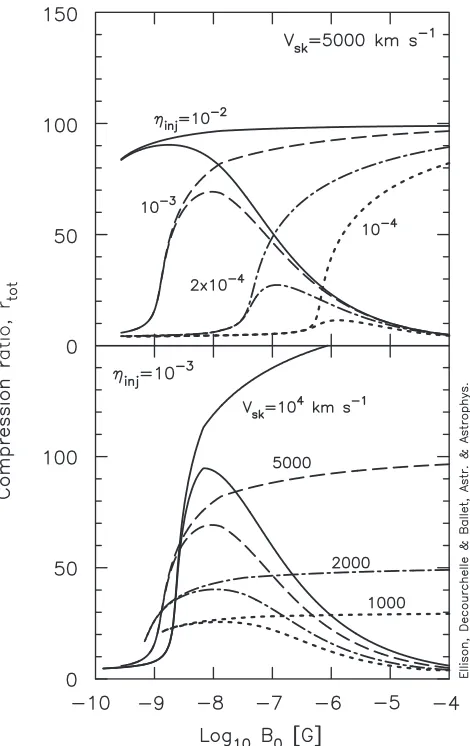
Fig. 1. Compression ratio versus unshocked magnetic field for a constant shock speed Vsk and different values of the injection effi
-ciencyηinj(top panel), and for a constant injection efficiency and
dif-ferent values of the shock velocity (bottom panel). For each set of parameters, the upper curve corresponds to adiabatic heating in the precursor and the lower one to Alfvén-wave heating in the precursor. In the latter case, rtotis dramatically reduced as B0increases.
3. Efficient diffusive shock acceleration in weak magnetic fields
In this section, we investigate how the acceleration efficiency depends on the upstream magnetic field B0 for a fixed set of parameters; Rsk, fsk, tSNR, and proton number density np. We chose a value of tSNRlarge enough to ensure that pmaxis deter-mined by diffusive escape. In this case, since we setηmfp =1 and Rskand fskare fixed, pmaxdepends only on B0and Vsk:
pmax3 Ze fskRskB0Vsk/c, (2) where Z is the charge number or ionization state and e is the electronic charge.
np = 0.3 cm−3, and the plasma is composed of protons and electrons only.
Each value ofηinjhas two curves, one with only adiabatic heating in the precursor and one with Alfvén-wave heating in the precursor. The transfer of energy from the energetic par-ticles to the background gas via Alfvén waves reduces rtot dramatically as B0increases. With Alfvén-wave heating, very large compression ratios are obtained only for values of the magnetic field much lower than that typical of the interstel-lar medium (i.e., for B0 3×10⁻⁶ G). This compression ra-tio increases with decreasing magnetic field up to a maximum, whose position and intensity depend on the injection parame-ter, and then decreases to the test-particle value of 4.
In the top panel, the sonic Mach number is fixed and the only relevant varying parameters are pmaxand the Alfvén Mach number, MA. As B0 decreases, pmax decreases and MA in-creases. For B0 >∼ 2 ×10⁻⁸ G, the magnetic field is strong enough to allow a significant transfer of energetic particle en-ergy through Alfvén waves to heat, lowering the acceleration efficiency. The greater B0, the smaller MAand the more impor-tant this effect becomes, causing rtot→4. For B0<∼2×10⁻⁸G,
MAis large enough that it is no longer important, but now pmax becomes small enough that the fraction of pressure in relativis-tic parrelativis-ticles drops below that required to maintain a strongly modified shock. As B0decreases, the transition from a strongly modified shock with rtot4 to an unmodified one with rtot∼4 occurs and can be extremely abrupt. As explained in Berezhko & Ellison (1999), the largerηinj is, the more difficult it is to have a high-Mach number, unmodified solution. This is the rea-son that the maximum value of the compression ratio increases, and that the position of the maximum shifts towards lower B0, asηinjincreases.
In the bottom panel, both MS and MAvary. With Alfvén-wave heating, as B0decreases, the curves for Vsk =1000 and 2000 km s−1 end before the compression ratio drops to 4: in these cases, pmax becomes low enough (<∼2 mpc) to invalidate the approximations of the Berezhko and Ellison model.
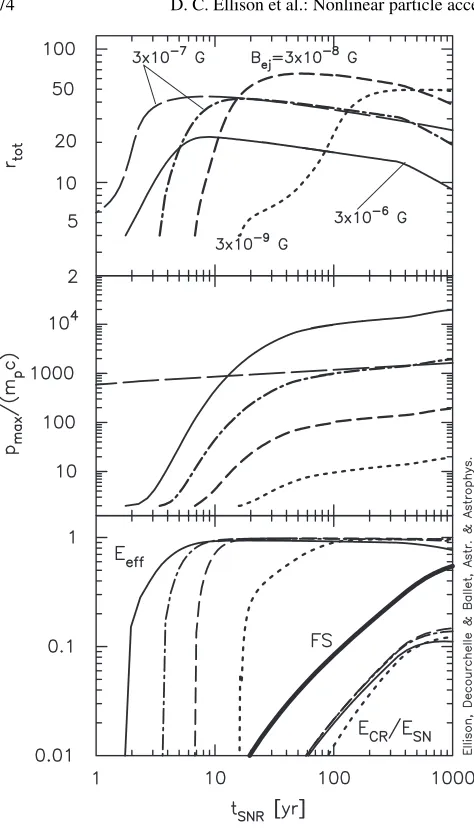
As B0increases and MAdrops, the damping effects of the magnetic field increase and cause rtotto drop toward 4, regard-less of the sonic Mach number. For values of magnetic field near 10−8G in the Alfvén-wave heating curves, the compres-sion ratio peaks strongly as the shock velocity and, therefore, MS increase. As B0 decreases below ∼10−8 G, the lowering of pmax, and subsequent reduction of pressure in relativistic particles, causes the transition to unmodified solutions regard-less of MS. The magnetic field where rtotis a maximum shifts slightly toward lower B0as MSincreases. Using the Berezhko and Ellison model, an approximate expression for the magnetic field strength, B∗, at the transition point between unmodified and strongly modified solutions can be derived in two regimes (for pmax≤or>100 Ampc):
B∗
x1/ √
104 x2
V3 sk
η4 injc2
(3)
if pmax>100 Ampc,
or B∗ x
2 1
x2
Vsk
η2 inj
(4) if pmax<100 Ampc,
where x1 =
rsub−1 2λinj√rsub ×
γ+1
2γ−γM−12 S
(rtot/rsub)γ+1
(5)
x2 =
3 fskZeRsk
Aηmfpmp
· (6)
At the transition, rtotcan be estimated as 0.65 MS3/4and rsub=4 (Berezhko & Ellison 1999). The break at 100 Ampc mirrors the break in the Berezhko and Ellison model between a three-component power law when pmax ≥ 100 Ampc and a two-component power law when pmax<100 Ampc.
Figure 1 illustrates that even if extremely high compression ratios are theoretically possible, normal ISM magnetic field values, i.e., BISM >∼ 3×10⁻⁶ G, with Alfvén-wave heating, are sufficiently high to limit compression ratios to rtot<∼20, re-gardless of how efficient the injection is or how high the sonic Mach number is. The energy converted to magnetic turbulence and heat lowers the subshock Mach number and the overall ac-celeration efficiency. Also, when MA is low, the speed of the magnetic scattering centers in the fluid (assumed to be Alfvén waves) can become comparable to the shock speed, lowering the effective difference (for acceleration) between the down-stream and updown-stream flow speeds3. The low magnetic fields in expanding supernova ejecta offer a unique possibility of seeing non-radiative shocks with rtot>∼20.
4. Particle acceleration at reverse shocks in SNRs
4.1. Assumptions and parameters for the CR-hydro simulation
We model the effects of cosmic-ray acceleration on the evo-lution of a SNR using a one-dimensional, cosmic-ray hydro-dynamic (CR-hydro) simulation as described in Ellison et al. (2004).
We initialize the CR-hydro simulation at some time t0 af-ter the explosion with a power-law ejecta density distribution,
ρej ∝r−n(of index n =7), combined with a constant density plateau region at small radii. The plateau is required to keep the total ejecta mass finite. Beyond the ejecta, we assume a uniform ISM mass densityρISM = 5×10⁻²⁵g cm−3corresponding to a proton number density of 0.3 cm−3. A constant density ISM is more appropriate for a type Ia supernova, whereas a type II supernova is likely to explode in a pre-SN stellar wind with a
ρ∝r−2density structure. The presence of a stellar wind will af-fect the density and temperature structure of the shocked ejecta 3 Note that even though we consider cases where the speed of the
and this, in turn, will change the quantitative aspects of particle acceleration at the reverse shock. Qualitatively, however, the effects we describe for a uniform ISM will be present in type II supernovae as well.
The hydrodynamical simulation only recognizes the matter density, but the acceleration model depends on the ion species and is limited to a single species, as we discuss below. We as-sume that the ejecta speed varies linearly with radius from zero to some maximum speed Vmaxej . In the simulation, the initial maximum radius of the ejecta is set by the maximum ejecta speed and t0. Thus, the early stages of the simulation will de-pend on Vmaxej and t0. As long as the total kinetic energy and ejecta mass stay the same, however, the later evolution of the SNR is independent of both Vmaxej and t0.
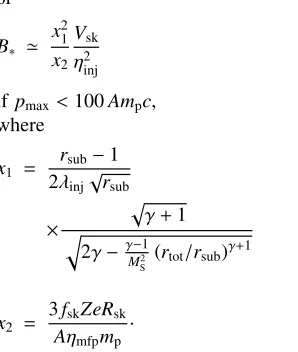
In Fig. 2 we show how the early evolution depends on Vmaxej for a particular set of SNR parameters. For all of our other examples, except those indicated in Fig. 2, we take Vmaxej = 3×10⁴km s−10.1c. As long as t
0is earlier than the time when
pmaxbecomes greater than 2 Ampc, as is the case in Fig. 2, our results are independent of t0.
For comparison, we also show in Fig. 2 (dot-dashed curve) the results obtained analytically for the same set of parameters using modified Chevalier solutions (Decourchelle et al. 2000). Good agreement is reached after a few tens of years and, in fact, all of our simulation results, after a few decades, are inde-pendent of our starting conditions and consistent with analytic solutions, as long as the self-similar conditions required for the analytic solutions are valid.
4.2. Constant ejecta magnetic field
Given the general behavior of DSA in low magnetic fields, we begin our study of SNRs by assuming a constant ejecta mag-netic field upstream from the reverse shock.
For the CR-hydro model, we use the following parame-ters: supernova explosion kinetic energy ESN=1051erg, ejecta mass Mej =1.4 M, and BISM =3×10⁻⁶G for the upstream ISM field (this is B0 for the forward shock). For the accelera-tion calculaaccelera-tion, we takeηinj =10−3here and in all following models for both the forward and reverse shocks4.
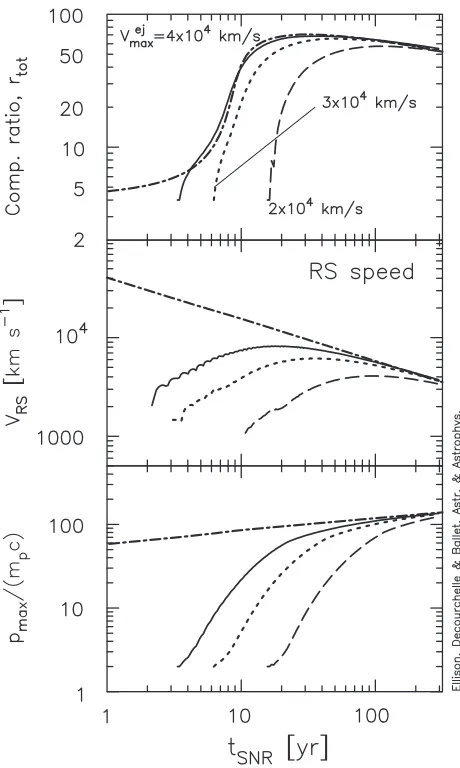
The top panel of Fig. 3 shows the variation of the compres-sion ratio with SNR age for different values of the constant up-stream ejecta magnetic field Bej(B0for the reverse shock). For
Bej ≥3×10⁻⁶G, the compression ratio is smaller than 20 for a SNR age larger than 100 yr. For Bej≤3×10⁻⁷G, however, the reverse shock compression can be extremely high: rtot∼60 at tSNR ∼100 yr for Bej=3×10⁻⁸G (dashed curve). The an-alytical results for Bej=3×10⁻⁷G are shown as long-dashed curves in the top two panels. As explained for Fig. 2, the early evolution depends on Vmaxej but good agreement is obtained for higher Vmaxej or, in any case, after ∼10 yr. The change in the slope in the simulation curves at∼400 yr corresponds to the 4 In an actual SNR, of course, the injection efficiency might vary
with time, vary over the shock surface, or be different at the forward and reverse shocks (as in our model of Kepler’s SNR; Decourchelle et al. 2000). If the actualηinjis less than 10−3, the nonlinear effects we
show will be less dramatic.
Fig. 2. All curves are for the reverse shock and use the same set of parameters with a constant magnetic field Bej = 3×10⁻⁸ G. The
only variable is the maximum speed of the ejecta Vmaxej which is
4×10⁴km s−1for the solid curves, 3×10⁴km s−1for the dotted curves,
and 2×10⁴km s−1for the dashed curves. For comparison, we show the
results obtained analytically, where Vmaxej is not limited, for the same
set of parameters using modified Chevalier solutions. While all curves converge after several decades, the early evolution depends on the different hydrodynamic initial conditions. The simulation curves are truncated when pmax<2mpc.
passage of the reverse shock from the power-law envelope into the plateau. Such a transition is not included in the analytic re-sult which is only valid while the reverse shock remains in the power-law profile.
Fig. 3. In each panel, RS results are shown for Bej=3×10⁻⁶G (solid
curves), 3×10⁻⁷G (dot-dashed curves), 3×10⁻⁸G (dashed curves),
and 3×10⁻⁹G (dotted curves). The long-dashed curves in the top and
middle panels are analytic results with Bej=3×10⁻⁷G. In the bottom
panel, Eeffis the RS acceleration efficiency and ECR/ESNis the fraction
of SN explosion energy going into CRs. The curve labeled “FS” is
ECR/ESNfor the FS (FS results are insensitive to Bej). In all cases, BISM=3×10⁻⁶G and curves are truncated when pmax<2mpc.
but less than∼3×10⁻⁶G so that the full nonlinear effects of efficient Fermi acceleration of ions occurs5.
The efficiency of the DSA process can be extremely high. In the bottom panel of Fig. 3 we show the instantaneous ac-celeration efficiency Eeff, defined as the fraction of incoming energy flux (in the shock rest frame) put into relativistic parti-cles. After a few decades, all of the models show Eeff >∼0.9. The curves in the bottom panel on the right show the fraction of the supernova explosion energy ESNput into relativistic par-ticles, i.e., ECR/ESN. The reverse shocks are able to put∼10% of ESNinto CRs after 1000 yr. The forward shocks put∼50%
5 Note that we do not show solutions in Fig. 3 for p
max<2 mpc, i.e.,
below the limit of validity of the Berezhko and Ellison model.
Fig. 4. The top panel shows the plasma density vs. radius and the bottom panel shows the temperature vs. radius. In both panels, the solid curves include the effects of efficient DSA with a constant ejecta magnetic field Bej = 3×10⁻⁶ G, the dashed curves assume Bej = 3×10⁻⁸ G, and the dotted curves are results with no
accel-eration (i.e., test-particle). In all cases the results are calculated at
tSNR=1000 yr with BISM=3×10⁻⁶G.
of ESN into CRs, as shown by the heavy-weight solid curve labeled “FS”6.
In the strong nonlinear regime, radical changes in the struc-ture of the interaction region between the forward and reverse shocks occur. In Fig. 4 we compare nonlinear density and tem-perature profiles with Bej = 3 ×10⁻⁶ G (solid curves) and
Bej=3×10⁻⁸G (dashed curves) against profiles obtained with no acceleration (dotted curves). All of the profiles are plotted at tSNR=1000 yr. In the cases with efficient particle acceleration, the increased compression ratios make the interaction region narrower, denser, and cooler than with no acceleration. This is particularly true for the width of the shocked ejecta region which, compared to the case with no acceleration, shrinks by a factor of∼5 when Bej=3×10⁻⁸G and where the temperature drops from greater than 108K to∼106K.
6 As noted by Berezhko et al. (2002), injection may vary over the
Note that the density and temperature profiles drop abruptly with no apparent precursors (the small precursors seen in Figs. 4 and 6 below, are numerical from a finite grid). This is because our current CR-hydro model does not explicitly include the cosmic-ray precursor in the hydrodynamics. The precursor effects essential for the nonlinear acceleration (i.e., shock smoothing and pre-heating) are included in the particle acceleration model. For the solid curves in Fig. 4, the upstream density precursor at the reverse shock would be∼0.2 pc in ex-tent to be consisex-tent with our assumption that fskRsk sets the upstream diffusion length of particles of momentum pmax. We further note that regardless of the density precursor, a precur-sor in thermal X-rays is not expected because the temperature in the precursor is too low. The nonthermal X-ray precursor will be much narrower than the density precursor if the elec-tron spectrum is limited by cooling, as suggested by the narrow width of the filaments.
The changes in structure and evolution of the SNR brought about by efficient DSA are so large that, even considering the difficulties projection effects present and other uncertainties, they should be observable with current techniques. On the other hand, if radio emission is unambiguously observed at reverse shocks without such dramatic structural changes, this would be evidence for either magnetic field amplification beyond sev-eralµG, or that DSA doesn’t produce large compression ratios as the theory with particle escape predicts, or that the injection rate is considerably lower than the valueηinj = 10−3we have assumed.
4.3. Non-uniform, diluted ejecta field
The structure of the magnetic field in SNR ejecta is clearly more complex than assumed in the previous section. As the ejecta expands, the conservation of magnetic flux will cause the field strength to decrease rapidly and after only a few years, Bejmay fall below the 3×10⁻⁸G value used in Fig. 3. The high-est possible initial values of the magnetic field are expected for white dwarf (WD) progenitors of type Ia supernovae and range between 105and 109G (e.g., Liebert 1995). Further enhance-ment of the WD magnetic field by convection effects could oc-cur prior to explosion during the phase of quasi-static burning of carbon and could possibly lead to equipartition between the kinetic energy density and magnetic field density. If this occurs, fields as high as 1010−1011G might result (e.g., Ruiz-Lapuente & Spruit 1998), providing the upper limit on the initial mag-netic field intensity we consider in the following.
After the explosion of the progenitor, the rapid expansion of the ejecta will dilute the magnetic field. We obtain expressions for the magnetic field at time, t, in the core (i.e., the plateau region) of the ejecta Bcore, and in the outer, power-law part of the ejecta BPL, as a function of fluid speed V, by assuming that the magnetic field is initially uniform in a constant density pro-genitor and then carried passively over during the explosion with the magnetic flux being conserved during the expansion. Therefore,
Bcore = BWD
Vejt
Ra
−2
(7)
BPL = Bcore V Vej −2 × 1+ 3
n−3 1−
V Vej
3−n
2 3 · (8)
Here, BWDis the magnetic field in the white dwarf before the explosion, Vejis the constant fluid velocity at the core-power-law transition point, Ra is the radius within the white dwarf
enclosing the mass of what will become the core of the ejecta, and n is the ejecta density power-law index. Given Vmaxej , ESN and t0, Vejis obtained numerically in the hydro simulation and
Ra=RWD
n−3
n−3(Vmaxej /Vej)3−n
1/3
, (9)
where RWDis the white dwarf radius before the explosion. Despite specifying white dwarf parameters in the above equations, similar behavior is expected for the ejecta in type II supernovae but starting with a lower magnetic field at a larger radius. Basically, any pre-SN field will be diluted by the ex-panding ejecta such that Bej∝R−2.
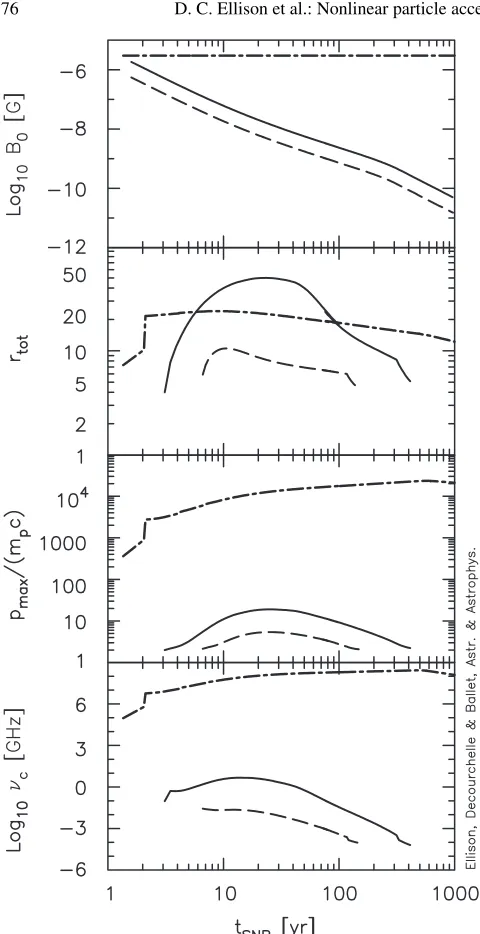
In Fig. 5, we show the variations of rtot, pmax, andνcversus
tSNR for a diluted field B0, as defined by Eqs. (7) and (8). The frequencyνcis the critical frequency (e.g., Rybicki & Lightman 1979) where synchrotron emission from an electron of pmax peaks, i.e.,
νc=3p2maxeB/
4π(mec)3
. (10)
Here meis the electron mass and we have taken the sine of the pitch angle=1 for convenience.
The solid curves in Fig. 5 show the extreme case with BWD =1011 G. In this case, the ability of the reverse shock to produce∼10 GeV particles lasts until tSNR ∼50 yr, after which
B0drops below∼10−8G. The dashed curves show results for
BWD=3×10¹⁰G. Despite BWDbeing as high as 3×10¹⁰G, few GeV particles are produced at the RS. This is contrasted by the FS (dot-dashed curves) where>104m
pc particles are produced after∼100 yr.
Even though the maximum momenta produced in these di-luted magnetic field examples are low, large structural changes occur early in the evolution, as shown in Fig. 6, where the den-sity and temperature profiles are plotted at tSNR =100 yr. The differences between the test-particle case (dotted curves) and the efficient acceleration cases (solid and dashed curves) are greater for the forward shocks, but are substantial at the reverse shocks. The structure changes at the reverse shocks lessen as tSNRbecomes greater than 100 yr.
Fig. 5. Results from two models with diluted magnetic fields are shown. In all panels, the solid curves are RS values with BWD =
1011G, the dashed curves are RS values with B
WD=3×10¹⁰G, and
the dot-dashed curves are FS values, which are insensitive to BWD. For
both models, BISM=3×10⁻⁶G and only values where pmax>2 mpc
are plotted.
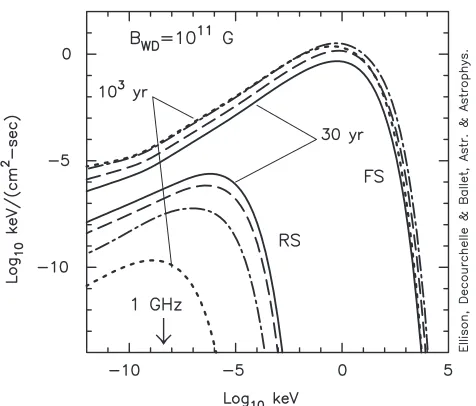
tSNR =1000 yr at a distance of 2 kpc, typical of SN1006. At 1 GHz radio frequencies, the reverse shock emission from even the most extreme white dwarf case with dilution falls more than 5 orders of magnitude below that of the forward shock7. For the constant Bej=3×10⁻⁸G case, the reverse shock emis-sion is about a factor of 100 below the reverse shock emisemis-sion with Bej=3×10⁻⁶G at 1 GHz. Note that the 3×10⁻⁸G field is too weak to produce X-ray synchrotron emission as reported for SNR RCW 86 (Rho et al. 2002).
7 The properties of the forward shock are quite insensitive to the
ejecta magnetic field so each of these four models have similar forward shock synchrotron emission.
Fig. 6. This figure shows the density and temperature profiles with diluted ejecta fields. The dotted curves are results with no shock ac-celeration, the solid curves are results with BWD = 1011 G, and the
dashed curves are results with BWD=3×10¹⁰G.
Fig. 7. Integrated synchrotron emission for constant and diluted ejecta magnetic fields at tSNR =1000 yr. The upper three curves are
calcu-lated assuming a constant field B0 =3×10⁻⁶G upstream of the
for-ward shock and constant Bejas labeled. The solid and dashed curves
are the emission from the reverse shock assuming a diluted white dwarf field of BWD = 1011 G and BWD = 3×10¹⁰G, respectively.
Fig. 8. Integrated synchrotron emission for a diluted ejecta magnetic field of BWD=1011G calculated at different ages: 30 yr (solid curves),
100 yr (dashed curves), 300 yr (dot-dashed curves) and 103 yr
(dot-ted curves). The upper set of curves is from the forward shock and the lower set is from the reverse shock. Note that the dotted and dot-dashed curves for the FS almost overlay each other. The shock and SNR parameters are the same as in Fig. 7.
The evolution of the synchrotron emission is shown in Fig. 8 for our extreme diluted ejecta magnetic field BWD = 1011G. The difference in radio emission at 1 GHz between the forward and reverse shocks is about a factor of 20 at 30 years and drops to more than five orders of magnitude at 1000 years, as shown in Fig. 7.
4.4. Heavy elements plasma
In the examples we have shown so far we considered only ac-celeration in fully ionized hydrogen. However, ejecta material is expected to be composed mainly of heavy elements and, in particular, type Ia supernovae are essentially devoid of hydro-gen. There are two reasons for the acceleration process to be modified in the case of heavy elements.
First, the acceleration time and diffusion length depend on charge. For relativistic particles, the time required to acceler-ate an ion with charge q = Ze to momentum p is propor-tional to 1/Z. Likewise, the diffusion length of an ion with momentum p is proportional to 1/Z (e.g., Baring et al. 1999). Therefore, for given shock parameters, pmax ∝ Z regardless of whether pmax is determined by a finite shock age or size. A higher pmax tends to increase the acceleration efficiency if heavy ions are dominant compared to protons being dominant. Second, a species with mass number A must have momen-tum>A mpc to be relativistic. Since pmaxonly increases as Z, this tends to result in a lower fraction of relativistic particles, and aγcloser to 5/3, than in the case where protons are dom-inant. This tends to decrease the acceleration efficiency. In a mixed plasma containing light and heavy ions, the modified shock structure resulting from efficient DSA produces an addi-tional effect whereby ions with the largest mass to charge ratio
Fig. 9. Reverse shock rtot’s and pmax’s for material containing only
pro-tons or fully ionized oxygen, as labeled. The ejecta magnetic field is taken to be constant at Bej=3×10⁻⁸G in the solid and dashed curves,
while a diluted field with BWD=1011G is used for the dot-dashed and
dotted curves. Only results where pmax>2 Ampc are shown.
are accelerated from thermal energies most efficiently. This is described in detail in Ellison et al. (1997) but is not considered here where we treat only single component plasmas.
In Fig. 9, using a constant Bej = 3 × 10⁻⁸ G (solid and dashed curves) and our extreme white dwarf diluted field BWD = 1011 G (dot-dashed and dotted curves), we compare
5. Discussion
5.1. Observational evidence for DSA at reverse shocks
Projection effects and other problems make it difficult to reli-ably associate radio or X-ray nonthermal emission with reverse shocks in SNRs. Nevertheless, there have been recent claims for both.
Gotthelf et al. (2001) have identified the forward and re-verse shocks in Cassiopeia A and showed that radio and Si emissivity radial profiles both show a sharp rise at what they characterize as the reverse shock. The sharp rise and fairly sharp falloffin radio emissivity as one moves outward from the center of the Cas A SNR is a good indication of the local accel-eration of relativistic electrons, but, as noted, projection effects make the precise determination of the reverse shock difficult. Furthermore, Gotthelf et al. (2001) chose to ignore a secondary Si peak near 80 arcsec inside the main Si peak. The main Si peak seems clearly associated with radio emission, but the inner secondary peak is not and could alternately mark the reverse shock.
Using new VLA observations of Kepler’s SNR, DeLaney et al. (2002) suggest that two distinct radio structures are present. These flat- and steep-spectrum components are par-tially decoupled in some areas and the steep-spectrum compo-nent tracks the X-ray emission seen by ROSAT, which is mainly line emission from shocked ejecta. They conclude that the flat-and steep-spectrum radio emission come from the forward flat-and reverse shocks, respectively. However the steep regions could also mark the interface rather than the reverse shock. For exam-ple, Vink & Laming (2003) interpreted the (steep) radio emis-sion from Cas A as arising at the interface.
Rho et al. (2002) claim that the detailed morphology of soft and hard X-rays in SNR RCW 86 strongly supports the case for different origins for these components. They conclude that the hard X-rays are most likely a combination of a synchrotron continuum plus Fe Kαemission from shocked ejecta material. This implies, in their estimation, that the reverse shock may be accelerating electrons to energies of the order of 50 TeV!
While other interpretations are certainly possible, e.g., rel-ativistic electrons produced at the forward shock might travel to the reverse shock and brighten in radio in the compressed magnetic field, the above observations provide some evidence that reverse shocks in SNRs can directly produce relativistic electrons; GeV in the case of radio and TeV in the case of nonthermal X-rays. If this is so, there are a number of impor-tant consequences both for interpreting a wide range of astro-physical sources where DSA is believed to generate relativistic electrons, and for our understanding of the basic functioning of DSA.
5.2. Implications
5.2.1. Magnetic field amplification
If relativistic electrons are accelerated at the reverse shock, the production of observable radio emission requires that the mag-netic field upstream of the reverse shock be amplified by many orders of magnitude over values expected in the expanding
unshocked ejecta. If such field amplification is taking place, it is likely that it is directly associated with DSA (i.e., Bell & Lucek 2001).
We speculate that early in the SNR evolution (i.e., tSNR <∼ 10 yr) the unamplified ejecta field may be strong enough to start the DSA process even with dilution. Once energetic particles are produced, the magnetic field may be amplified by them and maintained against dilution at a level where DSA continues.
Shocks are widespread in astrophysics with parameters not widely different from those in SNRs. If DSA can amplify mag-netic fields in SNR shocks, the process should work in other environments as well. Since the maximum energy individual particles obtain in DSA scales as B, widespread B-field am-plification will lead to a systematic increase in the expected maximum proton energy produced by astrophysical shocks.
5.2.2. Extreme nonlinear effects
The theory of nonlinear diffusive shock acceleration predicts compression ratios far in excess of the test-particle value of rtot 4 (e.g., Eichler 1984; Ellison & Eichler 1984; Malkov 1998; Bell 1987; Berezhko & Ellison 1999; Blasi 2002). For high sonic Mach numbers, M2S > MA, and strongly modified steady-state conditions, the compression ratio can be approxi-mated by rtot ∼1.3 M3S/4or by rtot∼1.5M3A/8when M2S<MA (Kazanas & Ellison 1986; Berezhko & Ellison 1999).
We have shown that if Bej falls in a range 3×10⁻⁸ <
Bej < 3 ×10⁻⁶ G with typical SNR parameters, rtot ∼ 60 may occur (see Fig. 3); a value considerably larger than is likely to occur in any other non-radiative astrophysical envi-ronment. Compression ratios this large should produce unmis-takable changes in the SNR structure (see Figs. 4 and 6) and X-ray emission, thermal and nonthermal. Confirmation of this prediction would support the premise that DSA is intrinsically extremely efficient.
Unfortunately, shock compression ratios are not directly observable for remote systems such as SNRs with large Mach numbers (see Sects. 2.2.3.1 and 2.4 in Drury et al. 2001; Raymond 2001, respectively). Shocks in the heliosphere are di-rectly observable but have low Mach numbers and even here, the direct measurement of compression ratios requires multiple spacecraft simultaneously sampling the upstream and down-stream plasmas. Until the launch of CLUSTER this was not possible and the prediction of rtot > 4 has not been clearly demonstrated in astrophysical shocks, although indirect sup-port does exist for the Earth bow shock (Ellison et al. 1990).
The energy which goes into relativistic ions comes out of the bulk thermal plasma and produces a drastic reduction in the shock temperature.
5.2.3. Cosmic-ray production
Direct observations of shocks in the heliosphere and most theo-ries of DSA show that collisionless shocks put far more energy into ions than electrons. Thus, even though the presence of rel-ativistic electrons suggested our description of strong nonlin-ear effects, the signature of nonlinear DSA in the structure and evolution of the radio and X-ray emitting interaction region be-tween the forward and reverse shocks, will be evidence for the efficient production of cosmic-ray ions, not necessarily elec-trons (see Berezhko et al. 2003a, for a discussion of SN 1006 in this regard). Detection of pion-decayγ-rays would be a more direct confirmation that relativistic ions are produced in SNRs, however this has not yet been unambiguously done. It is also clear fromγ-ray models of young SNRs, that parameters can be chosen where efficient DSA occurs, but either theγ-ray flux is below detectable levels, or detectable TeVγ-rays are domi-nated by inverse-Compton emission from electrons rather than protons (e.g., Ellison et al. 2001).
Modeling the SNR structure offers two advantages. First, if rtot >4 is inferred from observations, it is evidence for the ef-ficient production of CR ions whether or not a pion-decay fea-ture is observed since the observability of pion-decayγ-ray’s depends on other factors besides acceleration efficiency (e.g., ambient density). Second, if the structure is inconsistent with efficient DSA and rtot <∼ 4, this is clear evidence that the ef-ficient shock acceleration of ions is not occurring. Due to the freedom ofγ-ray models, the lack of aγ-ray detection is un-likely ever to be able to eliminate the possibility that efficient DSA is occurring.
5.2.4. X-ray emission
For efficient particle acceleration, the postshock densities are larger and the postshock temperatures smaller than in the test-particle case (see Figs. 4 and 6). As a consequence, the heating of electrons in the downstream region by Coulomb interaction with the population of protons (Tp 1836 Tewithout further heating at the shock) will be more efficient than in the test-particle case. In the shocked ejecta, the electron temperature can be almost equal to that of the protons for an injection of 10−2, while in the shocked ambient medium the electrons may reach up to 30 % of the proton temperature (Decourchelle & Ellison 2001).
Another constraint on the efficiency of particle acceleration comes from the observation of a strong Fe K-alpha line in the shocked ejecta of young SNRs (like Cas A, Kepler and Tycho). In Kepler, for efficient particle acceleration at the reverse shock, it was shown that the shocked ejecta temperature gets too low to produce the Fe K-line (Decourchelle et al. 2000). Line exci-tation by the nonthermal population can be invoked, however the ionization state of iron is expected to be very low even when taking into account the ionization from a nonthermal
power-law population (Porquet et al. 2001). Thus, the predic-tion from efficient DSA that postshock temperatures are low in the RS presents a problem in SNRs where a strong Fe K-alpha line is observed.
5.2.5. Ionization fraction of ejecta material
For DSA acceleration to occur at all, the unshocked ejecta ma-terial must be fully ionized or, at least, have a sizable ioniza-tion fracioniza-tion. Otherwise the magnetic turbulence necessary to scatter particles will be damped (e.g., Drury et al. 1996). The expanding ejecta will cool rapidly and would be largely neutral unless ionized by some source. This could possibly be X-ray emission from shock heated gas or the cosmic rays may con-tribute to the ionization themselves. If the ionization fraction is initially large enough for some cosmic-ray production to occur, these CRs may further ionize the precursor material, making acceleration more efficient, etc.
The Balmer-dominated spectra of nonradiative shocks in a number of SNRs (e.g., Ghavamian et al. 2001) has been in-terpreted as charge exchange between protons and neutrals. If synchrotron radio and/or X-ray emission is observed at these shocks as well, which is possibly the case in the northeastern rim of Tycho, this would indicate that DSA is at work even in a partially neutral medium. The reported presence of reverse shock radio emission suggests that the ejecta material is ion-ized, at least in the region upstream of the shock, where DSA is taking place.
6. Conclusions
It has long been believed that forward shocks in SNRs sweep up and accelerate ISM ions to produce galactic cosmic rays and to accelerate electrons to produce in situ radio emission. The mechanism most likely responsible for this is DSA, which is predicted to be extremely efficient, i.e.,>50% of the ram ki-netic energy may go into relativistic ions. At reverse shocks in young SNRs, however, straightforward estimates of the diluted ejecta magnetic field from the pre-SN white dwarf or massive star show it to be many orders of magnitude below that required to either accelerate relativistic electrons from the thermal ground, or to produce observable radio intensities from back-ground cosmic-ray electrons.
to explore the ramifications of efficient DSA at reverse shocks in young SNRs.
While radio observations imply magnetic field amplifica-tion to values far larger than the diluted progenitor field, there is, as yet, no way to precisely determine the value. This opens the possibility that the ejecta field Bejis large enough to pro-duce observable radio emission, but still far lower than normal ISM values. We have shown here that, for typical SNR param-eters, having 3×10⁻⁸ <Bej<3×10⁻⁶G results in extremely large nonlinear effects in DSA, i.e., compression ratios 4 and shocked temperaturesthan test-particle temperatures. If these nonlinear effects occur, they will produce large changes in the structure and evolution of SNRs which should be ob-servable with existing instruments. We have detailed these ef-fects in the remnant hydrodynamics and estimated synchrotron emission for a limited range of parameters.
Supernova remnants may offer the best known labora-tory for studying both magnetic-field amplification and DSA. Current and future ground and space-based observatories offer high spatial and energy resolution of several remnants and pro-vide information that is available nowhere else. Shocks in the Heliosphere are accessible to spacecraft and a great deal has been learned of their properties. However, the point-like nature of heliospheric observations, the low Mach number and small size of heliospheric shocks which limits particle acceleration, and the unique geometry of the intensely studied Earth bow shock, limit what can be learned and transferred to other astro-physical systems. The difficult plasma physics has also limited the success of analytic investigations, and direct PIC computer simulations are decades away from being able to simulate the injection and acceleration of a electron-proton plasma to rela-tivistic energies.
Acknowledgements. The authors wish to thank J. Blondin for
pro-viding his hydrodynamic simulation code VH-1 and for other help with this project. We are also grateful to the International Space Science Institute (ISSI) in Bern, Switzerland, where some of this work was done. This work was supported, in part, by a NSF-CNRS grant (NSF INT-0128883, CNRS-12974) and by an NASA ATP grant (ATP02-0042-0006).
References
Baring, M. G., Ellison, D. C., Reynolds, S. P., Grenier, I. A., & Goret, P. 1999, ApJ, 513, 311
Bell, A. R. 1987, MNRAS, 225, 615
Bell, A. R., & Lucek, S. G. 2001, MNRAS, 321, 433
Berezhko, E. G. 1996, Astropart. Phys., 5, 367 Berezhko, E. G., & Ellison, D. C. 1999, ApJ, 526, 385
Berezhko, E. G., Elshin, V. K., & Ksenofontov, L. T. 1996, JETP, 82, 1
Berezhko, E. G., Ksenofontov, L. T., & Völk, H. J. 2002, A&A, 395, 943
Berezhko, E. G., Ksenofontov, L. T., & Völk, H. J. 2003, A&A, 412, L11
Berezhko, E. G., Pühlhofer, G., & Völk, H. J. 2003, A&A, 400, 971 Berezhko, E. G., & Völk, H. J. 2004, A&A, 419, L27
Blasi, P. 2002, Astropart. Phys., 16, 429
Decourchelle, A., & Ellison, D. C. 2001, Space Sci. Rev., 99, 219 Decourchelle, A., Ellison, D. C., & Ballet, J. 2000, ApJ, 543, L57 DeLaney, T., Koralesky, B., & Rudnick, L. 2002, ApJ, 580, 914 Dorfi, E. A. 1990, A&A, 234, 419
Drury, L. O’C. 1983, Rep. Prog. Phys., 46, 973
Drury, O. C., Duffy, P., & Kirk, J. G. 1996, A&A, 309, 1002 Drury, L. O’C., Ellison, D. C., Aharonian, F. A., et al. 2001, Space
Sci. Rev., 99, 329
Drury, L. O’C., van der Swaluw, E., & Carroll, O. 2003 [arXiv:astro-ph/0309820]
Eichler, D. 1984, ApJ, 277, 429
Ellison, D. C., Berezhko, E. G., & Baring, M. G. 2000, ApJ, 540, 292
Ellison, D. C., Decourchelle, A., & Ballet, J. 2004, A&A, 413, 189 Ellison, D. E., Drury, L. O’C., & Meyer, J.-P. 1997, ApJ, 487, 197 Ellison, D. C., & Eichler, D. 1984, ApJ, 286, 691
Ellison, D. C., Möbius, E., & Paschmann, G. 1990, ApJ, 352, 376 Ellison, D. C., Slane, P., & Gaensler, B. M. 2001, ApJ, 563, 191 Ghavamian, P., Raymond, J., Smith, R. C., & Hartigan, P. 2001, ApJ,
547, 995
Gotthelf, E. V., Koralesky, B., Rudnick, L., et al. 2001, ApJ, 552, L39 Jones, F. C., & Ellison, D. C. 1991, Space Sci. Rev., 58, 259 Kazanas, D., & Ellison, D. C. 1986, ApJ, 304, 178
Liebert, J. 1995, in Cape Workshop on Magnetic Cataclysmic Variables, ed. D. A. H. Buckley, & B. Warner (San Francisco: ASP), ASP Conf., 85, 59
Lucek, S. G., & Bell, A. R. 2000, MNRAS, 314, 65 Malkov, M. A. 1998, Phys. Rev. E, 58, 4911
Porquet, D., Arnaud, M., & Decourchelle, A. 2001, A&A, 373, 1110 Ptuskin, V. S., & Zirakashvili, V. N. 2003, A&A, 403, 1
Raymond, J. 2001, Space Sci. Rev., 99, 209
Rho, J., Dyer, K. K., Borkowski, K., & Reynolds, S. P. 2002, ApJ, 581, 1116
Ruiz-Lapuente, P., & Spruit, H. C. 1998, ApJ, 500, 360
Rybicki, G. B., & Lightman, A. P. 1979, Radiative Processes in Astrophysics (John Wiley & Sons), 171
Vink, J., & Laming, J. M. 2003, ApJ, 584, 758