New Teachers Working in High-Poverty Schools: An Exploration of Views and Teaching Practices (Under the direction of Dr. Peter Hessling and Dr. Lance Fusarelli).
The purpose of this qualitative study was to examine new teacher perceptions regarding their induction and mentor programs, paying particular attention to how the instructional supports and psychological supports in their induction and mentor programs shaped their current views about teaching in a high-poverty school and their instructional practices. Data were collected from focus group interviews, individual interviews,
fieldnotes, and documents. Analysis of the data followed qualitative study procedures. This study resulted in four findings: (1) a lack of teachers, mentors, and high quality, aligned professional development at the school site created a perception that there is not a clear articulated plan for support and development of new teachers; (2) the informal mentoring structure has made a notable impact on teacher satisfaction, retention, current views, and current teaching practices; (3) teachers advocated for the prioritization of psychological support throughout the first three years of teaching through their induction and mentor programs; and (4) teachers in the study believe five mindsets (belief in students, care for students, teacher efficacy, humility about your experience, and a desire to serve as a role model for students) are necessary in order to be an effective teacher in a high-poverty school. These beliefs were developed through informal mentoring, personal experience, and personal backgrounds. The findings from this study have implications for state departments of
by
Brandy Rene Nelson
A dissertation submitted to the Graduate Faculty of North Carolina State University
in partial fulfillment of the requirements for the degree of
Doctor of Education
Educational Administration and Supervision
Raleigh, North Carolina 2016
APPROVED BY:
_______________________________ ______________________________
Lance D. Fusarelli, Ph.D. Peter A. Hessling, Ph.D.
Committee Co-Chair Committee Co-Chair
________________________________ ________________________________
DEDICATION
BIOGRAPHY
ACKNOWLEDGMENTS
TABLE OF CONTENTS
LIST OF TABLES ... ix
LIST OF FIGURES ... x
CHAPTER 1: INTRODUCTION ... 1
Induction and Mentoring ... 4
Purpose of the Study ... 10
Overview of Research Design ... 11
Significance of the Study ... 12
Assumptions, Delimitations, and Limitations of the Study ... 14
Definition of Terms ... 14
Organization of the Study ... 15
CHAPTER 2: LITERATURE REVIEW ... 17
High Quality Teachers ... 18
Teacher Retention ... 20
Effective Teachers in High-Poverty Schools ... 23
Teacher Induction and Mentor Programs ... 24
Studies Investigating Teacher Induction and Mentor Programs ... 27
Studies Investigating Teacher Induction and Mentoring Programs in High-Poverty Schools ... 35
Significance of Perceptions ... 45
CHAPTER 3: METHODOLOGY ... 51
Research Design ... 52
Research Questions ... 52
Setting Selection ... 53
Data Collection ... 56
Focus Groups ... 57
Individual Interviews ... 58
Field Notes ... 59
Documents ... 60
Participant Descriptions ... 61
Data Analysis ... 66
Subjectivity Statement ... 66
Trustworthiness ... 68
Chapter Summary ... 69
CHAPTER 4: FINDINGS ... 70
School Descriptions ... 71
Instructional Support in Induction and Mentor Programs ... 75
Technology ... 76
Performance Excellence for All Kids (PEAK) ... 77
Teach For America (TFA) ... 78
Themes ... 83
Structure and Strategy ... 84
School-Based Professional Development ... 85
Attending Professional Development ... 86
Psychological Support in Induction and Mentor Programs ... 87
Teacher-led Social Gatherings ... 89
School-Sponsored Experiences ... 91
Student Relationships ... 92
School-Based Mentor or TFA Instructional Coach ... 94
Prioritize Psychological Supports ... 97
Informal Mentoring ... 98
Induction and Mentor Programs Shaped Current Views ... 101
Lack of a Formal Program ... 102
Informal Mentoring and Personal Experiences ... 104
Induction and Mentor Programs Shaped Current Teaching Practices ... 113
TFA Training and Coaching ... 114
Data Usage ... 115
Chapter Summary ... 116
CHAPTER 5: DISCUSSION ... 120
Finding 1: Lack of an Articulated Strategy of Support ... 122
Finding 3: Prioritize Psychological Support ... 126
Finding 4: Belief, Care, Efficacy, Humility, and Role Models Required ... 127
Implications for Research ... 129
Implications for Practice ... 129
Implications for State Departments of Education ... 131
Implications for School Districts ... 131
Implications for Institutions of Higher Education ... 132
Chapter Summary ... 133
REFERENCES ... 136
APPENDICES ... 148
Appendix A ... 149
Appendix B ... 155
Appendix C ... 162
Appendix D ... 165
Appendix E ... 168
LIST OF TABLES
LIST OF FIGURES
CHAPTER 1: INTRODUCTION
students in high-poverty schools “have less than a 50% chance of getting a science or
mathematics teacher who holds a license and a degree in the field in which he or she teaches” (Darling-Hammond, 1996, p. 195). The quality of the teaching corps in a high-poverty school is less than schools not impacted by poverty (Darling-Hammond, 1996, 2007; Fantilli & McDougall, 2009; Haberman, 2010; Haycock, 1998). As Boyd, Lankford, Loeb, Rockoff, & Wyckoff (2008) explain, “Across several different states and at least one other country, low-performing, poor, and minority students systematically are taught by teachers with the weakest credentials” (p. 794).
underperform in years wherein the teacher turnover rate is higher (Ronfeldt, Loeb, & Wyckoff, 2013).
In high-poverty schools, teacher turnover is at least fifty percent higher than in
schools with significantly less poverty (Ingersoll, 2001). This problem with teacher retention has resulted in a “disproportionate number of inexperienced, uncertified and/or
under-qualified teachers placed in urban schools” (Fantilli & McDougall, 2009, p. 814). Darling-Hammond (2000) contends that having new, under-prepared, and less experienced teachers teach high-poverty students adds to the disparity in the achievement of the high-poverty students and their non-impacted peers. This conclusion is supported by Ronfeldt et al.’s (2013) work that shows teacher turnover in both mathematics and English/Language Arts explained the achievement gap between schools with higher proportions of low-achieving and African-American students and schools with smaller proportions of low-achieving and African-American students.
In an effort to try to address these challenges of underprepared teachers, unqualified teachers and teacher retention in high-poverty schools, many school districts are
implementing a wide range of interventions to support, train, retain, and improve the effectiveness of teachers in these settings. This study focuses on one such intervention: induction and mentor programs. In high-poverty school districts, these induction and mentor programs range from traditional programs in colleges and universities to alternative
Educators of Change in Florida, as well as district- and state-sponsored alternative/lateral entry programs.
This study focuses on a teacher induction and mentor program in a southern urban school system, paying particular attention to teachers entering classrooms with a large percentage of students from disadvantaged backgrounds. Specifically, this study examines novice teacher perceptions regarding their induction and mentor programs while working in high-poverty schools. Special consideration is given to how the instructional and
psychological support these teachers received during the program shaped their views about teaching in a high-poverty school and their instructional practices.
Induction and Mentoring
Mentoring is a major component of teacher induction programs (Bartell, 2005; Brock & Grady, 2007; Drummond et al., 1990; Feiman-Nemser, 2001; Stotko et al., 2007).
Mentoring can be defined as “one-to-one support of a novice or less experienced practitioner (mentee) by a more experienced practitioner (mentor), designed primarily to assist the development of the mentee’s expertise and facilitate their induction into the culture of the profession” (Hobson et al., 2009, p. 207). Most mentoring programs include coaching by the mentor to the mentee around content and pedagogy in addition to counseling and
psychological support for the mentee (Harrison, Dymoke, & Pell, 2006).
The benefits of teacher induction and mentor programs, according to Bartell (2005), are numerous:
(a) higher retention of beginning teachers, (b) increased levels of professional
efficacy and satisfaction, (c) improved teacher performance, (d) earlier identification of weak teachers for assistance or termination, (e) more consistent use of instructional practices that lead to higher levels of student achievement, (f) more varied and more complex instructional practices being used by teachers, [and] (g) improved ability of new teachers to engage in reflective practice and critical examination of their work, establishment of professional norms of collegiality and expectations for continued learning. (p. 16)
of teaching, teacher induction and mentor programs could possibly help reduce teacher turnover.
demands of teaching in schools with a large percent of high-poverty students. Amatea and West-Olatunji (2007) effectively summarize the range of challenges faced by new teachers:
increased levels of anxiety and depression, a greater incidence of behavioral
difficulties, and a lower level of positive engagement in school…They [students] also exhibit a greater incidence of school failure, developmental difficulties and delays, lower standardized test scores and graduation rates, and higher rates of school tardiness, absenteeism, and school dropout than their middle-class peers. (p. 81) These challenges may explain why the attrition rates for new teachers in high-poverty
schools exceed other schools. According to Amatea and West-Olatunji, they average forty to fifty percent over the first five years of teaching. If researchers ignore school contexts as factors in designing support systems for new teachers, they could miss out on critical information that could be useful in creating and implementing the most effective ways to assist those who serve the most at-risk students.
The number of such high-risk students is increasing with changes in the
demographics of the United States. There has been an increase in the proportion of non-White students in public schools (Clayton, 2010; Fry & Pew Hispanic Center, 2007; U.S. Department of Education, 2014). The U.S. Department of Education (2014) publicized the following statistics: “From fall of 2001 through fall of 2011, the number of White students enrolled in prekindergarten through 12th grade in U.S. public schools decreased from…60 to
Department of Education, 2014). With respect to income levels, the “numbers of low income students in the nation’s public schools grew by 32 percent” in ten years (Suitts, Sabree, & Dunn, 2013). Most notably, the enrollment of Hispanic students in American schools has tripled since 1968 (Clayton, 2010), and “in 2002, the Hispanic share of public school enrollment exceeded the Black share and has since remained higher than the Black share in each subsequent year through 2011” (U.S. Department of Education, 2014, p. 2).
participation based on the percentage of identified students enrolled in their schools, school districts, and/or state education programs (U.S. Department of Agriculture, 2016a). As of September 2014, in North Carolina, 65% of school districts across the state are participating in the CEP program, with 25% of the state’s schools participating, serving free breakfast and free lunch to approximately 309,181 students out of almost 1.5 million students across the state (North Carolina Department of Public Instruction, 2016; U.S. Department of
Agriculture, 2016b). These data show the volume of students served free breakfast and/or lunch in typically a high-needs school in the state. With student populations labeled the minority increasingly becoming the majority in many school districts, and a growth in the number of students entering schools with various needs, the problems of teacher retention and lack of high quality teachers in high-poverty schools becomes an issue of pressing concern.
It is predicted that in 2023, White enrollments will continue to decrease to 45 percent, with White students less than 50 percent starting in 2014, Hispanic students constituting 30 percent by 2023, Black students constituting 15 percent, and Asian/Pacific Islander students constituting 5 percent (U.S. Department of Education, 2014). Establishing effective
Purpose of the Study
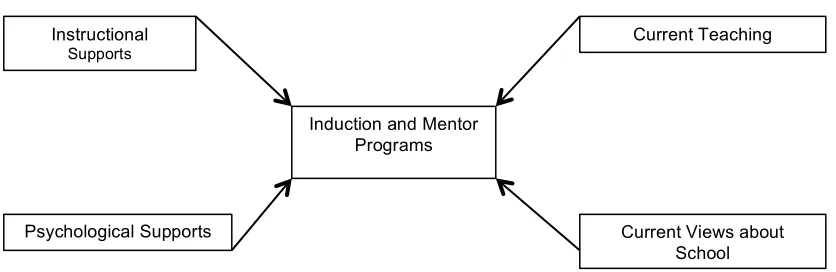
The goal of this study is to understand new teacher perceptions regarding their induction and mentoring program, paying particular attention to the instructional and psychological support in their induction and mentor programs and how their induction and mentor programs have shaped their current views about teaching in a high-poverty school and their instructional practices.
Figure 1. A visual model of the research questions for this study. This figure illustrates how the research questions fit together into a framework for the study.
Instructional Supports
Psychological Supports Current Views about
School Current Teaching
Practices
The research questions guiding this inquiry were:
1. When specifically examining instructional support, how do teachers in their first three years of teaching perceive their experiences in their induction and mentor program while working in a high-poverty school?
2. When specifically examining psychological support, how do teachers in their first three years of teaching perceive their experiences in their induction and mentor program while working in a high-poverty school?
3. How do teachers in their first three years of teaching perceive their experiences in their induction and mentor program while working in a high-poverty school that shape their current views about working in their school?
4. How do teachers in their first three years of teaching perceive their experiences in their induction and mentor program while working in a high-poverty school that shape their current teaching practices?
This study was designed to contribute to the literature regarding the development of induction and mentor programs for teachers working specifically in high-poverty schools. The next section provides an overview of the research design, which describes how the study was conducted.
Overview of Research Design
were collected from focus group interviews, individual interviews with current and former first-year, second-year, and third-year teachers in a large urban school district in the southeastern United States, field notes, and documents. As the primary researcher, I followed the steps outlined by Creswell (2013), where I reviewed the data, identified major themes from the data and grouped major themes together. From these groupings,
descriptions of study participant experiences with their induction and mentor program, the context in which they experienced their induction and mentor program, and how their induction and mentor program impacted their experiences in their high-poverty school were developed (Creswell, 2013).
Significance of the Study
It is difficult to ignore the impact of a quality education on the life path of a student. It is a predictor of whether an adult makes minimum wage or achieves financial stability (Day & Newburger, 2002). For many children attending underperforming high-poverty schools, the type of education they receive has defined their destiny. Ultimately, the effectiveness of teachers in a high-poverty school can greatly contribute to the academic success and life outcomes of the students they teach (Haycock, 1998; Sanders & Rivers, 1996).
perceptions of those teachers working in these schools. This study of teacher perceptions of their induction and mentor programs includes an exploration of how these teachers
understand or make meaning of their world through their senses. Examining perceptions is critical because as humans, we compose various perceptions in our brains which we then act on (Link, Monahan, Stueve, & Cullen, 1999). If a teacher in their first three years of
teaching perceives the components of their induction and mentor programs in a positive way, it might improve their teaching strategies and their job satisfaction in a positive way
(Marable & Raimondi, 2007; Soares & Lock, 2007; van den Berg, 2002). Thus, insights from this research can help program designers, educators, and policymakers to better understand relationships that might exist between induction and mentor programs and the attitudes and actions of teachers in high-poverty schools, possibly influencing the quality of their teaching and their retention.
Studies regarding teacher mentoring and induction attempt to address the needs of teachers in all schools in a district, state, or country. Examining teachers in aggregate presumes that induction and mentor programs are impacting all teachers in the same way. Given that some teachers in high-poverty schools face different challenges than their peers in other settings, it is important to take a closer look at this subgroup of teachers. Findings from this study could lead to recommendations for professional development designers, and
Assumptions, Delimitations, and Limitations of the Study
When conducting this study, as the researcher, I assumed that participants would provide truthful and candid responses in interviews and focus groups to promote openness. Informed consent was secured from each participant, confidentiality was maintained
throughout the study, and participants were able to opt out of participating at any time. I also assumed that the perceptions of the teachers, of their experiences, and their descriptions of their beliefs and instructional practices reflect what was actually happening in their schools. Additionally, I assumed that teacher perceptions of induction and mentor programs shaped the behavior of those teachers.
This study was conducted in an urban school system in the state of North Carolina. This study did not represent every geographic region in the country, but did provide insight for similar districts, notably large urban districts with high-poverty schools that struggle to retain teachers to serve their diverse student populations. Also, this study was neither conceived nor conducted as a formal evaluation of the effectiveness of an induction and mentor program, but rather is intended as an exploration of the perceptions of an induction and mentor program for teachers in their first three years of teaching in an urban southern school district.
Definition of Terms
High-poverty school is a school that has been identified as a Title 1 school where they have at least a 40% poverty level, as measured by the number of children enrolled in a free or reduced price-lunch program. According to the U.S. Department of Education’s (n.d.) Office of Student Achievement and School Accountability Programs, schools with at least 40% of their students from low-income families are eligible to use their Title 1 funds to implement school-wide programs to support all students and especially students currently failing or at most risk of failing.
Mentoring/Mentoring Program is a structured program where a novice teacher is paired with an experienced teacher for the purpose of guiding and/or coaching the novice through instructional practices, classroom management strategies, time management, and school specific acculturation (Hobson et al., 2009; Orland-Barak, 2014).
First-year teacher is a teacher of record employed for more than five months and less than twelve months during the calendar year of the study. A first-year teacher working for at least five months will encounter multiple experiences in their induction and mentor program.
Second-year teacher is a teacher of record employed for more than twelve months but less than twenty-four months during the calendar year of the study.
Third-year teacher is a teacher of record employed for more than twenty-four months but less than 36 months during the calendar year of the study.
Organization of the Study
CHAPTER 2: LITERATURE REVIEW
In order to impact the success of students, we must have confident and competent teachers in every classroom (Darling-Hammond, 2007; Gold, 1996; Haberman, 2010; Lyman & Villani, 2004). The work of school districts is to ensure teachers in each classroom have a positive effect on the academic success of their students. In high-poverty schools, there are added challenges while working in those schools (Ametea & West-Olatunji, 2007). In addition to school-level challenges, many school districts struggle to retain strong teachers, especially in high-poverty schools (Ingersoll, 2001; Stanulis & Floden, 2009). In an effort to address these challenges of teacher quality and teacher retention, school districts have
their induction and mentor programs as well as an exploration of how their program affected their experiences in their high-poverty school.
This chapter will review the relevant literature pertaining to induction and mentor programs in general and in high-poverty schools specifically. The chapter begins with a review of the literature pertaining to the impact of high quality teachers on student success, the challenge of teacher retention, key characteristics of successful teachers in high-poverty schools, the origins of induction and mentor programs, and the research regarding induction and mentor programs schools in general and schools impacted by poverty. Research
regarding instructional and psychological supports teachers receive through induction and mentor programs is also explored. The chapter ends with a general summary.
High Quality Teachers
The difference in student achievement between a high performing teacher and a low performing teacher can be measured (Haycock, 1998; Sanders & Rivers, 1996). In Boston, students taught by low performing teachers showed no academic growth over the course of an entire school year, in comparison to their peers taught by top performing teachers
students within one year, but the “residual effects of relatively ineffective teachers from prior years can be measured in subsequent student achievement scores” (Sanders & Rivers, 1996, p. 4). Sanders and Rivers (1996) argue when a student experiences two consecutive years of a low performing teacher and one year of a high performing teacher that student performs almost twenty-four percentile points below a fellow student that experiences three
consecutive years of high performing teachers. Chetty, Friedman, and Rockoff’s (2014) study of more than one million children in an urban school district produced positive findings as to the long-term impacts of an effective teacher on students. Using value-added data coupled with tax data, the researchers were able to track students starting in elementary school and ending in as young adults (Chetty, Friedman, & Rockoff, 2014). They measured the wages, attendance in college and birth rates of these individuals and found that students of teachers with high levels of value-added data performed better academically, earned higher wages, attended college and constituted lower teenage birth rates (Chetty, Friedman, & Rockoff, 2014). The researchers state, “the financial value of having a one standard
deviation higher VA teacher [value-added teacher] is 1.34 percent × $522, 000 ≃ $7, 000 per
grade. The undiscounted lifetime earnings gain is approximately $39,000 per student (Chetty, Friedman, & Rockoff, 2014, p. 2655). In short, for every year a student has an effective teacher, they could increase their earnings by nearly $39,000. The Chetty, Friedman, and Rockoff study as well as the Sanders and Rivers study helps support the claim that the impact of a teacher on a student’s academic success can be evident throughout that student’s
In high-poverty schools, the quality of the teaching cadre is less than schools not impacted by poverty (Darling-Hammond, 1996; Haberman, 2010; Haycock, 1998). For students attending high-poverty schools, the quality of the teacher is critically important and their impact is measurable (Sanders & Rivers, 1996). Sanders and Rivers’ (1996) study also found that as a teacher becomes more effective, low achieving students were the first to benefit from the growth of the teacher. In schools, and especially high-poverty schools, students benefit from high quality instruction delivered by a high performing teacher that continuously improves their performance over a period of time.
Teacher Retention
or transfer when they were teaching lower-achieving students and second, some teachers were significantly affected by working in a school with low-performing students, while others were not affected (Boyd et al., 2011). The researchers’ last finding indicated that “teachers who lived farther from their school prior to beginning their job were more likely to quit or transfer” (Boyd et al., 2011, p. 171). This study and other studies into teacher
retention indicate that more often under-prepared and less experienced teachers are teaching students in urban high-poverty schools (Darling-Hammond, 2003, 2007). Many of these urban educators “enter the classroom with little training and leave soon after, creating greater instability in their wake. Meanwhile, affluent students receive teachers who are typically better prepared than their predecessors, further widening the achievement gap…between affluent and high-poverty schools” (Darling-Hammond, 2007, p. 1). Olsen and Anderson (2007) add evidence to the constant churn of teachers in high-poverty schools stating, “high-poverty schools often fill vacancies with underqualified teachers who are not only less prepared to teach but also migrate and leave schools at higher rates than their certified peers” (p. 6). In short, low-income students are most likely to enroll in schools where the teaching quality is significantly lower than their higher-income peers (Darling-Hammond, 2007).
showed that the effects of high teacher turnover extend beyond the individual teacher that left the classroom, but impacts other teachers and students at the school. There are fewer expert teachers in the building, providing less support and coaching (Ronfeldt et al., 2013). It is important to find ways to retain current high-quality veteran teachers and find ways to retain new teachers, giving them an opportunity to become high-quality over time.
When examining high-poverty schools specifically, teacher turnover is higher
(DeAngelis, Wall, & Che, 2013; Ingersoll, 2001). School districts with higher percentages of low-income and low-performing schools have a more difficult time retaining teachers
these students, it is critical that we examine efforts to increase teacher quality in high-poverty schools as well as continuing to retain potentially high performing new teachers to the
profession.
Effective Teachers in High-Poverty Schools
Despite the challenges of working in a high-poverty school, there are teachers that find success in working with this population of students. These teachers exhibit strong beliefs in student and school success, express a desire to help others, are relentless in their pursuits, demonstrate reflection and humility, and grow in self-efficacy and confidence (Lyman & Villani, 2004; Stotko et al., 2007). These effective teachers maintain high expectations for their students, stay flexible in their planning and execution, cooperate with their disillusioned peers, and are sensitive to a culturally diverse community (Lyman & Villani, 2004; Stotko et al., 2007).
In their book, Best Leadership Practices for High-Poverty Schools, Lyman and Villani (2004) argue that the rewards of working with high-needs schools far outweigh the challenges. However, teachers in these schools must be conditioned to believe in the ability of every child, take risks to be innovative in their teaching, remain relentless in their
encouragement, and maintain high expectations for every student while also showing
humility for their students’ families and each child’s circumstance (Lyman & Villani, 2004). Haberman (1995), in his seminal book, Star Teachers. The Ideology and Best Practice of Effective Teachers of Diverse Children and Youth in Poverty also articulated these
In addition to the mindsets stated above, Stotko et al.,’s (2007) review of the literature on the characteristics of effective urban educators produced several dispositions and beliefs:
They are persistent: They refuse to give up on their students. They are flexible: They are willing to modify various aspects of practice (e.g., planning, classroom
management, instructional strategies) to improve student learning. They set high standards for their students…They are cooperative: They are willing to work with other teachers, administrators, parents, students, and leaders in their community. They believe in professional development and lifelong learning: They are constantly engaging in activities designed to improve their knowledge and skills. (p. 40-41) The researchers go on to say that effective urban teachers must also be able to navigate working with disillusioned colleagues and dysfunctional school bureaucracies while
remaining sensitive to a culturally diverse community of parents and caregivers (Stotko et al., 2007). Successful urban teachers maintain strong beliefs in the success of students and their schools, they express a desire to help others, remain relentless and persistent, demonstrate humility and cultural sensitivity, and grow in their self-efficacy (Chester & Beaudin, 1996; Haberman, 1995; Lyman & Villani, 2004; Stotko et al., 2007).
Teacher Induction and Mentor Programs
of induction and mentor programs participants found most influential to their practice, their satisfaction and/or their retention.
Induction programs are designed to provide professional development for a new teacher during their first three years of teaching (Bartell, 2005): “Although the public expects beginning teachers’ performance to resemble that of experienced teachers, novices without adequate support need 3 to 7 years of teaching to reach their maximum impact on student learning” (Stanulis & Floden, 2009, p. 112). Induction programs have varied in their complexity; however, most induction programs include opportunities for participants to attend courses, workshops and/or seminars (Bickmore & Bickmore, 2010; Franklin & Molina, 2012), interact with a mentor from the same field, engage in subject specific activities, participate in common planning with teachers of the same content (Lewis et al., 1999; Luft et al., 2003; Morton, 2005; Smith & Ingersoll, 2004; Wang et al., 2008), test instructional strategies and gather feedback on their practices from more experienced teachers (Oliver, 2009; Ponticell & Zepeda, 1997; Soares & Lock, 2007), and experience ongoing support and coaching from a mentor (Lewis et al., 1999; Ponticell & Zepeda, 1997; Smith & Ingersoll, 2004).
by a more experienced teacher in order to assist the novice in their teaching practices, and their assimilation into the school culture and the teaching profession (Hobson et. al, 2009). Smith and Ingersoll’s (2004) study found that having a mentor in one’s field of practice reduced the risk of a teacher leaving the profession in the first year by thirty percent. Lewis et al.’s (1999) study regarding the impact of mentors found that “70 percent of teachers who were mentored at least once a week reported that it improved their teaching” (p. v). Andrews and Quinn (2005) in their study of the effects of mentoring used a questionnaire to measure the impact of mentoring and non-mentoring on first-year teachers in a diverse school district. The researchers found a “significant difference between the amount of support received, as perceived by teachers with a mentor assigned by the school district versus those without an assigned mentor” (Andrews & Quinn, 2005, p. 113). Stanulis and Floden’s (2009) study of twenty-four beginning teachers working in an urban school setting found that the teachers participating in the intensive mentoring program increased their effectiveness over the comparison group in the study in the areas of classroom environment, instruction and content, classroom management and student engagement. At the start of the study, the experimental group of teachers exhibited scores below their comparison group. Through intensive mentoring, which included weekly interactions with their mentor related
the new teachers. These studies may help support the claim that mentors matter for teachers new to the profession.
Studies Investigating Teacher Induction and Mentor Programs
Most studies focused on teacher induction and mentoring include an examination of the instructional supports offered through these programs and their impact on teacher retention, teacher perceived effectiveness and teacher satisfaction (Bickmore & Bickmore, 2010; Morton, 2005; Ponticell & Zepeda, 1997; Wang et al., 2008). In 2011, Ingersoll and Strong conducted a critical review of fifteen empirical studies examining the impact of induction and mentor programs for beginning teachers. These studies fell into three categories: “(a) teacher job satisfaction, commitment, retention and turnover, (b) teacher classroom teaching practices and pedagogical methods, and (c) student achievement” (p. 211). They found through their review of the literature that induction for new teachers as a positive impact on satisfaction, commitment or retention (Ingersoll & Strong, 2011). Also noteworthy, the authors indicate
for teachers’ classroom practices, most of the studies reviewed showed that beginning teachers who participated in some kind of induction performed better at various aspects of teaching, such as keeping students on task, developing workable lesson plans, using effective student questioning practices, adjusting classroom activities to meet students’ interests, maintaining a positive classroom atmosphere, and
participated in some kind of induction had higher scores, or gains, on academic achievement tests. (p. 225)
Instructional supports, as defined by Krull (2005), are the knowledge and skill supports a new teacher might need in order to successfully execute in the classroom. These
instructional supports include workshops and seminars, subject specific content activities, common planning, instructional activity support and feedback, and coaching support from a mentor.
Workshops and seminars serve as one component of teacher induction programs. In Franklin and Molina’s (2012) study of agricultural education, they found through a survey of sixty-two teacher education institutions that 73.3% of the programs conduct workshops for new teachers. In Bickmore and Bickmore’s (2010) study of suburban first-year and second-year teachers in the southeast U.S., they examined the implementation and effectiveness of an induction program created and implemented in two middle schools. The induction programs included five components: orientation, individual tutoring, interdisciplinary teams, support from administration and professional development workshops and seminars
responsibilities and other teaching duties (Bickmore & Bickmore, 2010, p. 1012). Despite the time management challenge, this research shows that teacher workshops and professional development occur in induction programs and are generally viewed by participants as a positive instructional support in their development as teachers.
Teacher engagement in activities that are subject specific and allow them to plan collaboratively with other teachers, including a mentor in their subject area, have made positive contributions to the satisfaction, perceived effectiveness and/or retention of those teachers (Lewis et al., 1999; Morton, 2005; Smith & Ingersoll, 2004). Wang et. al.’s (2008) research argues “induction support might need to focus on subject-specific pedagogy instead of general pedagogy” (Wang et al., p. 141). Lewis et al.’s (1999) research affirms,
“Increased time spent in professional development and collaborative activities was associated with the perception of significant improvements in teaching” (Lewis et al., 1999, p. v). In a year-long study by Morton (2005), the researcher maintained a relationship with two third-grade teachers, as their mentor, to uncover strong collaboration practices, mentoring
practices, and obstacles to collaboration. Morton (2005) used collaborative action research to allow participants to study what was happening in their classrooms and actively make
Morton’s (2005) findings support Luft, Roehrig, and Patterson’s (2003) study of subject specific induction programs for science teachers. The researchers used a mixed-methods approach to understand the impact of science induction programs on beginning science teachers’ instructional methods, their beliefs, and their experiences (Luft et al., 2003). The induction program consisted of subject specific support, collaboration, and feedback through monthly workshops, unlimited access to a strong science teacher, and monthly observations and feedback around science instruction (Luft et al., 2003). The eighteen beginning teachers in the study were split into three groups with one group
experiencing an intensive science-based induction program, the second group experiencing a traditional induction program, and the final group experiencing no induction program (Luft et al., 2003). The researchers found that teachers who participated in the science-based
induction program “enacted more extended inquiry lessons…used various forms of student work groups more frequently” and identified challenges in their schools but did not fixate on the problems (Luft et al., 2003, p. 87). The researchers concluded that induction programs must provide opportunities for teachers to engage in subject specific content as often as possible (Luft et al., 2003). According to the researchers, embedding induction and mentoring practices within content-specific practices improved the study participants’ beliefs, their lessons for their students, and their ability to navigate constraints at their schools (Luft et al., 2003).
were statistically significant components that should be included. After using data from the 1999-2000 Schools and Staffing Survey, the researchers uncovered positive effects for teacher retention when certain components of induction programs were in place and of high quality. They examined: (a) whether the new teacher was working with a mentor in the same subject area as the teacher, (b) whether the teacher participated in any kind of collaborative supports, and (c) whether the teacher received any additional assistance to help them in easing into the transition of teaching. The researchers found
some types of activities appear to be more effective than others in reducing turnover. The most salient factors were having a mentor from the same field, having common planning time with other teachers in the same subject or collaboration with other teachers on instruction, and being part of an external network of teachers. (Smith & Ingersoll, 2004, p. 706)
In short, the researchers indicated that “having common planning time with other teachers in their subject area or participating in regularly scheduled collaboration with other teachers on issues of instruction reduced the risk of leaving…by 43%” (Smith and Ingersoll, 2004). Each of these studies found that opportunities for teachers to collaborate with other teachers
around subject specific activities positively impacted their satisfaction, retention and perceived effectiveness (Luft et al., 2003; Morton, 2005; Smith & Ingersoll, 2004).
Research examining the impact of induction and mentor program components related to testing instructional activities with their students and receiving feedback from an
2005; Oliver, 2009; Ponticell & Zepeda, 1997; Soares & Lock, 2007). Rudolf van den Berg’s (2002) examination of program elements that impact strong professional development found that opportunities for teachers to work with content they are currently teaching,
experiment in real-time with the new learning, and reflect on their successes and failures based on their execution were the most significant. Ponticell and Zepeda’s (1997) study of sixty-two first-year teachers in three suburban high schools in Illinois, examined the teachers' struggles with learning 1) the organizational context of their individual schools, 2) the
climate and culture of the school, and 3) the politics of the human relationships among teachers, administrators, parents, and students in the school. The participants completed an open-ended question survey and participated in focus groups. The teachers in the study indicated that a sense of “connectedness” and “ongoing dialogue” was necessary in assisting them in overcoming obstacles (Ponticell & Zepeda, 1997, p. 13). A teacher in the study stated, “I need acknowledgement, guidance, and evaluation of my current progress – both positive and negative. As a new teacher, I cannot grow without criticism. Constructive advice on how to improve could possibly enable me to drop what wasn’t working or refine and expand upon what was working” (Ponticell & Zepeda, 1997, p. 19). The researchers uncovered that the teachers “wanted more classroom pop-in visits with constructive criticism and feedback” (Ponticell & Zepeda, 1997, p. 18).
preparation program on the type of feedback new teachers received from their mentors. Soares and Lock (2007) used an open-ended questionnaire to measure teacher perceptions of the feedback they received three times over the course of fifteen weeks. Teachers in the study found mentor comments related to content specific strategies, tips and suggestions to be the most helpful in their practice (Soares & Lock, 2007). The researchers concluded that any mentors working with new teachers need training to “address topic-specific pedagogy in a more comprehensive way” (Soares & Lock, 2007, p. 87). The new teachers valued the feedback and preferred subject specific feedback to “generic teaching issues, classroom management and control” (Soares & Lock, 2007, p. 82). Like Ponticell and Zepeda’s (1997) study, Soares and Lock (2007) found that critical, subject specific feedback was an important component of teacher induction and mentor programs.
This theme of action and feedback from a mentor was also asserted in Oliver’s (2009) study of new science and/or math teachers, their mentors, and their principals working in schools across western Australia. The study participants completed written applications and surveys, and participated in focus groups conducted at the start and the end of their
Evidence of the impact of a mentor on a beginning teacher’s success has also been studied (Lewis et al., 1999; Ponticell & Zepeda, 1997; Smith & Ingersoll, 2004). Smith and Ingersoll’s study (2004), found that 91.6% of participants found their mentor helpful to their teaching. Additionally, Ponticell and Zepeda’s (1997) study of sixty-two first-year teachers in three suburban high schools in Illinois provided more evidence that mentor programs greatly impacted teachers’ feelings of success in the first few years of teaching. Wang et al.’s (2008) review of the literature regarding factors that might influence new teachers’ performance when supported by a mentor purports that the quality of the mentor-mentee relationship, the mentor’s skill in articulating a clear vision of strong teaching and providing support to help the teacher achieve this vision, and the mentor’s ability to “practice, model, analyze, and reflect” at a high level with the new teacher are key to the effectiveness of any mentor (Wang et al., 2008, p. 144).
participate in common planning with teachers of the same content (Lewis et al., 1999; Luft et al., 2003; Morton, 2005; Smith & Ingersoll, 2004; Wang et al., 2008), test instructional strategies and gather feedback on their practices from more experienced teachers (Ponticell & Zepeda, 1997; Soares & Lock, 2007; Oliver, 2009), and experience ongoing support and coaching from a mentor (Lewis et al., 1999; Ponticell & Zepeda, 1997; Smith & Ingersoll, 2004). Missing from many of these studies is the context of the study. As supported by Stanulis and Ames’ (2009) study of mentoring training and development, the researchers acknowledge that context makes a difference in the effectiveness of a mentor’s impact on a teacher. It is alarming the limited research into the perceptions of teachers in high-poverty schools. This study contributes to this gap in literature through its examination of new teacher perceptions regarding their induction and mentor program while working in a high-poverty school. Given the changing demographics of our country, this study could serve as a significant contribution to the literature.
Studies Investigating Teacher Induction and Mentoring Programs in High-Poverty Schools
trial study of new teachers working in low-income schools in a large urban school district. The researchers found that “after beginning teachers had experienced two years of induction there were significant differences between the treatment and control groups in the
achievement of their students” (Ingersoll & Strong, 2011, p. 226). Unfortunately, there were no effects, according to the researchers, on the teachers’ instructional strategies or retention of the treatment group of teachers versus the control group of teachers (Ingersoll & Strong, 2011). More research is necessary to understand how to best craft strong induction and mentor programs for teachers in high-poverty schools. Given the limited research that is available regarding teacher induction and mentor programs specifically designed for teachers entering high-poverty schools, it will be important to note studies that include teachers working in a variety of settings and teachers working only in schools impacted by poverty.
The literature related to teacher induction and mentor programs specifically designed for teachers entering high poverty schools include the general instructional supports
established in previous sections of this literature review as well as activities that address psychological supports for these teachers. These activities include emotional support and encouragement as well as context and content embedded observation and feedback from mentors and others. (Chester & Beaudin, 1996; Gaikhorst et al., 2014). These activities impact teacher self-efficacy, teacher mindsets and teacher satisfaction (Chester & Beaudin, 1996; Gaikhorst et al., 2014; Jorissen, 2002). Additional studies examining the
Johannessen, 2004; Odell & Ferraro, 1992).
When examining psychological supports for all teachers, Krull (2005) defines psychological support as providing emotional support, being empathetic to the teacher and meeting their needs. This may look like “helping a beginning teacher in terms of how to cope with his or her class” (Krull, 2005, p. 147). Hoy and Spero (2005) described
psychological support as social or verbal persuasion by another person. “Social or verbal persuasion may entail a ‘pep talk’ or specific performance feedback from a supervisor, colleague, or students” (Hoy & Spero, 2005, p. 346). In 1992, Odell and Ferraro attempted to understand the psychological support found in mentoring that supported teacher retention. Prior to this study, there was limited research into the impact of psychological support for new teachers (Odell & Ferraro, 1992). Odell and Ferraro (1992) conducted a 12-item survey to a diverse group of beginning teachers, not in urban schools exclusively, to determine what elements of their mentor support made a difference in their decisions to remain in teaching. Odell and Ferraro (1992) argue in their study that mentor emotional support is a key
component of the induction experience and needs to be examined more closely. The
researchers “traced two cohorts of beginning elementary teachers who had participated for a year in a large, collaborative university/school system teacher mentoring program to
used “peer coaching, shared teaching, and questioning, that guided and encouraged the beginning teachers to identify what they were thinking and what they were focusing on in their teaching” in an non-evaluative way (Odell & Ferraro, 1992, p. 201). The researchers found that “beginning teachers who were still teaching after 4 years most valued the
emotional support that they received from their mentors in the first year of teaching” (Odell & Ferraro, 1992, p. 203). According to the researchers, emotional support was a key
component in improving the retention of a variety of teachers over time. Unfortunately, this study did not examine teachers in high-poverty schools exclusively, but does provide
foundational evidence to support the need for psychological supports for teachers new to the profession.
In McCann and Johannessen’s (2004) study of high school English teachers in the early stages of their careers working in urban and non-urban schools, the researchers wanted to know frustrations of teachers that influenced their decisions to leave as well as uncover the critical supports, resources, and preparations teachers received that influenced teacher
retention (McCann & Johannessen, 2004). Like Odell and Ferraro (1992), the researchers interviewed teachers in a variety of settings, not just teachers in high-poverty schools. The study was an “investigation into the concerns that drive new teachers from the profession and the attitudes and support systems that help retain them” (p. 138). Over two years, the
Johannessen, 2004, p. 138). They then conducted follow-up interviews with six of the original eleven teachers and an additional twenty-three more interviews with both novice and experienced teachers (McCann & Johannessen, 2004). The researchers found that “those teachers who seem unlikely to persevere in teaching talk about how the workload is
unreasonable and hopeless” (McCann & Johannessen, 2004, p. 141). They summarize, “The beginning teachers identified several concerns, all of varying gravity. We advise that those who train teachers and support their professional development focus on two areas: alleviating a potentially demoralizing workload and developing positive relationships with students” (McCann & Johannessen, 2004, p. 145). The participants argued that the quality of the mentor-mentee relationship and the novice teacher work sessions impacted retention directly (McCann & Johannessen, 2004). Participants also requested therapy to battle feelings of doubt, “Beginning teachers may need some kind of counseling, and engage in conversations, which may ease depression. Having an opportunity for personal connections can make the experience more pleasant” (McCann & Johannessen, 2004, p. 144). Although this study, like Odell and Ferraro’s (1992) study, includes a variety of teachers and not teachers working in high-poverty schools specifically, it makes the case for the need to include psychological support to help novice teachers manage the workload as part of any teacher induction and mentor program.
For teachers in high-poverty schools, Jorissen’s (2002) study examined the
of teaching and could include counseling support, empathy, and positive affirmations to a new teacher (Krull, 2005). Jorissen (2002) wanted to “explore how these teachers
constructed meanings from the process, events, and relationships they experienced to identify common themes among them” (p. 3). She studied thirteen teachers in Minneapolis and St. Paul, Minnesota still teaching in urban schools in the 1997-98 school year that were involved in the 1991-92 alternative license cohort (Jorissen, 2002). All the participants were
elementary teachers of color (Jorissen, 2002). The researcher’s case study methodology included an information questionnaire, “in-depth phenomenological interviews using an interview guide,” and “the human instrument skills of the researcher” (Jorissen, 2002, p. 4). Jorrissen found that mentoring and cohorts played key roles in the persistence of the study subjects. Mentors helped the alternatively licensed teachers translate instructional theory from coursework to classroom practice, provided emotional support both personally and professionally, and generally improve their teaching practices (Jorissen, 2002). Confirming the psychological support of mentors, responses from the participants included, “It gave me a feeling of security that I knew there was someone…I could plug into, should I need some help” (Jorissen, 2002, p. 15). The cohort model in the study also provided psychological support to the alternatively licensed teachers. Comments from participants included,
We studied together…we cried together…I made them pray together…We would call each other every night and cry…Here were people who had decided to go into
other to think of ways to survive…We gave each other support, spiritually and emotionally, to not give up. (Jorissen, 2002, p. 20)
Jorissen’s (2002) study supports the claim that psychological support from a cohort and a mentor played critical role in the retention of these teachers over the course of the teaching career, many years later.
Given the previous studies examining the activities related to the psychological support novice teachers found most positive, Gaikhorst et al. (2014) wanted to take a closer look at ways to increase teacher retention through the type of support structures and culture activities urban educators in Dutch primary schools would need in their first years of teaching. After completing a qualitative, descriptive study using in-depth semi-structured interviews with eight beginning teachers and eleven principals, Gaikhorst et al. (2014) found that “in schools where teachers judged the support practice positively, support was focused on the specific urban challenges that the teachers experienced” (p. 32). The participants believed that classroom visits, support from a coach or mentor, and video conferencing with other teachers or specialists, with a special emphasis on “the specific problems that teachers experience within the context of their work–in this case, the urban educational context” made the difference in their development and retention (Gaikhorst et al., 2014, p. 32).
In addition to limited research regarding the use of psychological support to help new teachers manage working conditions in high-poverty schools, there is limited research into the impact of induction and mentor program components on the beliefs and views of teachers working in these schools. Strong teachers working in high-poverty schools demonstrate a belief in the success of students and the schools they teach, a desire to help others, and positive self-efficacy beliefs (Chester & Beaudin, 1996; Haberman, 1995; LeLand & Harste, 2005; Obidah & Howard, 2005; Stotko et al., 2007). Induction and mentor programs in high-poverty schools should provide psychological supports that impact teacher mindsets.
McCann and Johannessen’s (2004) study of the teaching frustrations of high school English teachers working in high-poverty schools and schools not impacted by poverty uncovered similar results. As explained earlier, the researchers studied the anxieties of departing teachers and the resources and support of teachers that remained in teaching (McCann & Johannessen, 2004). For the teachers in this study that decided to stay in teaching, they reported that their mentor and induction produced a belief in the success of their students and their school, a desire to help others, and strong reflection (McCann & Johannessen, 2004). As cited by the researchers, “Those likely to continue in the profession express…a sense of duty to help young people benefit from instruction…an interest in developing their teaching skills…a belief that bad experiences in school are evidence of the need for good teachers…” (McCann & Johannessen, 2004, p. 142).
practices for new teachers in urban school settings. The researchers wanted to highlight the personal characteristics and school practices that contribute to changes in self-efficacy of newly hired teachers (Chester & Beaudin, 1996). In Connecticut, 173 newly hired teachers were surveyed at the start of the school year and in February of that same school year to examine “whether specific teacher, assignment, and school practice variables, affect changes” in their self-efficacy beliefs (Chester & Beaudin, 1996, p. 241). The researchers found that multiple observations with focused, content specific feedback from supervisors resulted in an increase in self-efficacy. Additionally, when the researchers controlled for age in their model, they found “beginning teachers who were assigned to schools in which they perceived high degrees of collaboration among teachers and administrators reported
substantially higher values of change in self-efficacy beliefs than those who worked in schools with little opportunity for collaboration with other adults” (Chester & Beaudin, 1996, p. 251). Ultimately, psychological support in the form of emotional support and
encouragement, in addition to context and content embedded observation and feedback from mentors and others may support the positive development of teacher self-efficacy, teacher mindsets and teacher satisfaction (Chester & Beaudin, 1996; Gaikhorst et al., 2014; Jorissen, 2002; McCann & Johannessen, 2004; Odell & Ferraro, 1992).
seminars, interact with a mentor from the same field, engage in subject specific activities, participate in common planning with teachers of the same content, test instructional strategies and gather feedback on their practices from more experienced teachers and experience ongoing support and coaching from a mentor. As an additional layer of support for teachers in a variety of school settings, teacher induction and mentor programs should also include activities that provide psychological supports to new teachers. This
psychological support in the form of emotional support and encouragement, in addition to context and content embedded observation and feedback from mentors and others may support the positive development of teacher self-efficacy, teacher mindsets and teacher satisfaction (Chester & Beaudin, 1996; Gaikhorst et al., 2014; Jorissen, 2002; McCann & Johannessen, 2004; Odell & Ferraro, 1992). Unfortunately, the research is limited regarding high-poverty school induction and mentor programs specifically and more research is
necessary to understand how to best craft strong induction and mentor programs components related to instructional supports and psychological supports for teachers in high-poverty schools. This study intends to contribute to this gap in literature through examining how induction and mentor programs in high-poverty schools provide instructional and
Significance of Perceptions
There is a need for high quality induction and mentor programs for beginning teachers working in high-poverty schools given the multiple challenges these schools face daily. Additionally, the research is limited in soliciting the unique perceptions of these teachers with respect to their induction and mentor programs. This study looks to examine these unique perceptions through interviews and focus groups with these teachers in an effort to understand better their experiences in their induction and mentor programs and how their perceptions of these experiences have shaped their current views and their teaching practices.
Perception, as defined by the Random House College Dictionary (1984), is “the act or faculty of apprehending by means of the senses or of the mind; cognition; understanding” (p. 985). Consequently, a study in perceptions would include an exploration of how individuals understand or make meaning of their world through their senses. In his article, Pure
Perception: God as Art, MacQueen (2011) articulates perception creation as a phenomenon unique only to humans. MacQueen argues that we already know we have the ability to create in our brains. One of the many things we create in our brains is a perception of the
world. The brain’s capacity to create perceptions is initiated internally and not forced onto the brain from the outside world. Most importantly, these perceptions are influenced by our cultural contexts and experiences (MacQueen, 2011). The argument that context and
experience matters is supported by Ferrari, Robinson, and Yasnitsky’s (2010) discussion that “human beings...are distinct in that they use also what Vygotsky refers to as historical
experience of one’s own creativity and imagination as a prediction for virtually all
transformative and active adaptations” (p. 104-5). In the end, we create perceptions in our brains and we leverage our culture, our environment, and our experiences in generating these positive or negative perceptions of our world.
After composing these perceptions in our brains, we then act based on those
perceptions. As stated by Link, Monahan, Stueve, and Cullen (1999), “we propose a specific application of the idea that people’s definitions of situations shape their behavior” (Link, Monahan, Stueve, & Cullen, 1999). Merton (1995) adds evidence to this claim through the Thomas theorem that “if men define situations as real, they are real in their
consequences” (Merton, 1995, p. 380). In 1857, Schopenhauer observed that “it is not what things objectively and actually are, but what they are for us in our way of looking at them that makes us happy or unhappy (quoted in Merton, 1995, p. 382). Within the context of this study, these perceptions help teachers create a set of opinions that ultimately drive their behaviors. In full, every teacher “has a set of opinions that may clearly differ from those of his or her colleagues (van den Berg, 2002, p. 589). These opinions or perceptions are the result of “an interaction between the personal experiences of teachers and the social, cultural, and institutional environment in which they function on a daily basis” (van den Berg, 2002, p. 589).
more likely to devote more time and energy to improving themselves. Over time, new teachers learn more, interact more, and through discussions and debates, preferably in a positive way with a mentor or teacher leader, begin to alter their perceptions and make new meanings about their views and their teaching practices. They are constantly testing their perceptions and building new meanings or confirming their currently held perceptions (van den Berg, 2002). This adds evidence to the assumption that teacher perceptions and
“meaning making” contribute to how they interact with others and make choices about their teaching practices.
The power of a positive perception can be found in studies regarding teacher
professional development. Drummond, Grimes and Terrell (1990) found in their study that implementers of a beginning teacher program should continuously monitor the program because they found “that attitude is an important variable in how individuals perceive and perform in the implementation of a program” (Drummond, Grimes, & Terrell, 1990, p. 189). In 1999, Lewis et al.’s study of teacher quality, they found that a teacher’s perception of preparedness impacted the quality of the teacher. These studies support the claim that perceptions of the quality of a program could contribute to the action of a teacher in their own classroom.
Chapter Summary
schools, the quality of the teacher is critically important and their impact is measurable (Sanders & Rivers). Sanders and Rivers’ (1996) study found that as a teacher becomes more effective, low achieving students were the first to benefit from the growth of the teacher. Unfortunately, school districts with higher percentages of low-income and low-performing schools have a more difficult time retaining teachers (DeAngelis et al., 2013). Ingersoll (2001) argues that the turnover rate in schools with academically disadvantaged students is at least fifty percent higher than schools with less poverty. The impact of this high teacher turnover is evidenced in student academic gains, financial costs to recruit, hire, train, and pay new teachers, as well as a lack of experienced staff to mentor and support these new teachers (Amatea & West-Olantunji, 2007; Goldberg, 2001).
supports that study participants found had a positive impact on their effectiveness, their retention or satisfaction included opportunities for participants to attend courses, workshops and/or seminars (Bickmore & Bickmore, 2010; Franklin & Molina, 2012), interact with a mentor from the same field, engage in subject specific activities, participate in common planning with teachers of the same content (Lewis et al., 1999; Luft et al., 2003; Morton, 2005; Smith & Ingersoll, 2004; Wang et al., 2008), test instructional strategies and gather feedback on their practices from more experienced teachers (Ponticell & Zepeda, 1997; Soares & Lock, 2007; Oliver, 2009), and experience ongoing support and coaching from a mentor (Lewis et al., 1999; Ponticell & Zepeda, 1997; Smith & Ingersoll, 2004). These supports exist in high-poverty schools and schools not impacted by poverty.
Studies examining psychological supports in induction and mentor programs identified emotional support and encouragement, in addition to context and content embedded observation and feedback from mentors and others as necessary components in any program (Chester & Beaudin, 1996; Gaikhorst et al., 2014; Jorissen, 2002; McCann & Johannessen, 2004; Odell & Ferraro, 1992). For high-poverty schools, emotional support and context and content observation and feedback were especially influential in positively impacting teacher self-efficacy, teacher mindsets and teacher satisfaction (Chester & Beaudin, 1996; Gaikhorst et al., 2014; Jorissen, 2002).
the instructional supports and psychological supports for this growing subgroup of teachers. This study contributes to the current literature through an examination of how induction and mentor programs in high-poverty schools provide instructional and psychological support to teachers and shape their views and teaching practices in their schools. This study is relevant because of the changing demographics of our country, the increases in the number of
students attending diverse schools in urban centers, and the limited research currently available regarding teacher perceptions of their induction and mentor programs while working in high-poverty schools. This study did not address the need for induction and mentor programs, but explored the perceptions of new teachers working in those schools and their experiences related to their induction and mentor programs.
This chapter began with a review of the literature pertaining to the impact of excellent teachers on student success, the challenge of teacher retention, key characteristics of
successful teachers in high-poverty schools, the origins of induction and mentor programs, and research regarding induction and mentor programs schools in general and schools impacted by poverty. Studies examining instructional and psychological supports for new teachers through induction and mentor programs were also explored. The chapter ended with a case for the relevancy of this study and a general summary. The following chapter outlines the methodology of this study. It includes descriptions of the research approach, data
CHAPTER 3: METHODOLOGY
Using a qualitative approach, this study examines novice teacher perceptions regarding their induction and mentor program while working in a high-poverty school. Special attention is given to how the instructional supports and psychological supports these teachers received shaped their views about teaching in a high-poverty school and their instructional practices. This study is relevant because of the changing demographics of our country, the increases in the number of students attending diverse schools in urban centers, and the limited research regarding induction and mentor programs high-poverty schools. Most critically, for many children attending high-poverty schools, the success of their teachers greatly contributes to their own academic success and life outcomes (Chetty, Friedman, & Rockoff, 2012; Haycock, 1998; Sanders & Rivers, 1996). This study also provides suggestions to key stakeholders about how they might adjust their mentor and induction programs to positively impact the effectiveness, satisfaction, and retention of those teachers in their highest-needs schools.