The
extended auricle1
(
eta1
) Gene Is Essential for the Genetic Network Controlling
Postinitiation Maize Leaf Development
Karen S. Osmont, Lynne A. Jesaitis
1and Michael Freeling
2Department of Plant and Microbial Biology, University of California, Berkeley, California 94720 Manuscript received April 8, 2003
Accepted for publication July 11, 2003
ABSTRACT
The maize leaf is composed of distinct regions with clear morphological boundaries. The ligule and auricle mark the boundary between distal blade and proximal sheath and are amenable to genetic study due to the array of mutants that affect their formation without severely affecting viability. Herein, we describe the novel maize geneextended auricle1(eta1), which is essential for proper formation of the blade/ sheath boundary. Homozygouseta1individuals have a wavy overgrowth of auricle tissue and the blade/ sheath boundary is diffuse. Double-mutant combinations of eta1 with genes in the knox and liguleless pathways result in synergistic and, in some cases, dosage-dependent interactions. While the phenotype of eta1mutant individuals resembles that of dominantknoxoverexpression phenotypes,eta1mutant leaves do not ectopically expressknoxgenes. In addition,eta1interacts synergistically withlg1andlg2, but does not directly affect the transcription of either gene in leaf primordia. We present evidence based on genetic and molecular analyses thateta1provides a downstream link between theknoxandligulelesspathways.
I
N plants, lateral organs such as leaves are born on further, allowing the leaf blade to bend out horizontally the flanks of meristems (SteevesandSussex1989). from the main axis.This is a reiterative process, which originates with re- Our understanding of ligule and auricle development cruitment of segment initial cells to form a phytomer stems from analysis of leaf structures in wild-type plants composed of leaf, node, internode, and axillary bud as well as in mutant plants that show disruptions at the (Scanlon et al. 1996). A subset of these cells initiates blade/sheath boundary. Aberrations in the auricle are the leaf and is termed the leaf founder cells (Poethig often associated with a disrupted ligule, implying that 1984). These founder cells divide, giving rise to leaf their development is closely linked. Mutants that affect primordia, which undergo longitudinal differentiation the auricle and/or the blade/sheath boundary include that occurs basipetally (from tip to base such that blade lg1, lg2, rs2, Rs1, Lg3, Kn1, and Gn1 (see below and differentiates prior to sheath) as well as laterally from Table 1). These mutants can be divided into two distinct the midrib to the margin (HarperandFreeling1996b). groups. The first group is defined by recessive mutants The maize leaf provides a simple model for examining that show altered ligule and auricle development re-the genetic cues involved in organ regional identity and sulting from absence of essential proteins during leaf
cell fate determination. primordial development. The second group is defined
The ligule, a morphological feature of the grasses, is by mutants that affect proximodistal identity and ectopi-an epidermal fringe of tissue derived from the adaxial cally express KNOX proteins in the leaf.
leaf surface. The ligule bisects the longitudinal, or proxi- The first group of genes consists ofliguleless(lg1) and modistal, axis of the leaf into proximal sheath and distal liguleless2 (lg2). Recessive mutants of lg1 remove both blade (Figure 1). Along with the ligule, a pair of triangu- the ligule and auricle, but a rudimentary ligule is formed lar-shaped auricles forms the blade/sheath boundary. in the upper leaves (Becraftet al.1990;Sylvesteret Differentiation of auricle is first visible as a thin line of al. 1990). Recessive mutants of lg2 remove the ligule cells that separates the blade and sheath, which can be and auricle in the first one to three leaves. The ligule seen only after initiation of the ligule (Becraft et al. and auricle recover in later leaves but the blade/sheath 1990). The auricle cells enlarge concomitantly with lig- boundary remains displaced. Double-mutant analysis of ule outgrowth and then divide as the blade and sheath lg1 and lg2 revealed that these two genes interact in expand. After the leaf emerges, the auricle cells expand a dosage-dependent manner (Harper and Freeling 1996a). Double-mutantlg1 lg2plants fail to form a ligule or auricle and the blade/sheath boundary is diffuse
1Present address:Pointilliste, 2541 Leghorn St., Suite 4, Mountain
(Harper and Freeling 1996a). Reverse transcriptase
View, CA 94043.
(RT)-PCR analysis showed that LG2 expression
pre-2Corresponding author:Department of Plant and Microbial Biology,
cedes that of LG1 (Walshet al. 1998). These genetic
University of California, 111 Koshland Hall, Berkeley, CA 94720.
E-mail: [email protected] and molecular analyses have shown thatlg1andlg2act
The class 1 knotted1-like homeobox (knox) genes rough sheath1 (rs1), gnarley1 (gn1), and liguleless3 (lg3) have also been defined by dominant mutants (Becraftand Freeling1994;FowlerandFreeling1996; Kerstet-teret al.1997;Fosteret al.1999). On the basis of loss-of-function phenotypes, theknoxgenes are thought to be required for meristem maintenance and to repress differentiation, although the precise function of these genes has not been determined (Kerstetteret al.1997; Vollbrechtet al.2000). In Arabidopsis, theknoxgenes
SHOOT MERISTEMLESS (STM) and KNAT1
(KNOT-TED1-LIKE IN ARABIDOPSIS THALIANA) may act re-dundantly to confer meristematic identity (Longet al. 1996;Byrneet al.2002).
Another member of the second group has been de-fined by recessive mutants in rough sheath 2 (rs2). Mu-tants of rs2 have several phenotypic effects, including
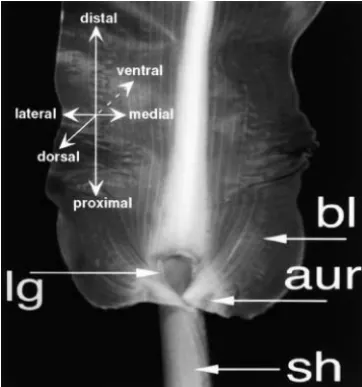
Figure1.—A typical maize leaf can be divided along three dwarfing, disruption of the blade sheath boundary,
twist-axes, the proximodistal, mediolateral, and dorsiventral or ad/ ing of the leaves, loss of blade tissue, and disorganization abaxial. Auricle (aur) and ligule (lg) mark the proximodistal of cell division resulting in leaf proximalization ( Schnee-boundary between proximal sheath (sh) and distal blade (bl).
berger et al. 1998). RS2 encodes a MYB-domain-con-taining factor with homology to thePHANTASICA(PHAN) gene from Antirrhinum and theASYMMETRIC LEAVES1 in the same genetic network late in leaf development
(AS1) gene from Arabidopsis (Timmermanset al.1999; to induce ligule and auricle formation (Harper and
Tsiantiset al.1999;Byrneet al.2000;Oriet al.2000). Freeling 1996a;Walshet al. 1998). Bothlg1 andlg2
AS1is required for suppression of the ArabidopsisKNOX have been cloned and encode nuclear-localized proteins
genesKNAT1,KNAT2, andKNAT6 in the leaf (Oriet with homology to squamosa promoter binding proteins
al. 2000). Genetic evidence suggests thatSTM acts to and bZIP transcription factors, respectively (Morenoet
suppressAS1andAS2in the meristem to prevent initia-al.1997;Walshet al.1998).
tion of the leaf developmental program (Byrne et al. The second group of genes affecting the blade/sheath
2000, 2002). In addition, thePICKLE(PKL) gene, which boundary includes mutants that ectopically express
encodes a chromatin-remodeling factor of the CHD KNOX proteins in the leaf, resulting in alteration of
class, enhancesas1andas2mutants, indicating thatPKL regional identity and formation of proximal tissues
may have a general role in repression of KNOXgenes more distally (i.e., the sheath forms or extends into the
in the leaf via changes in chromatin structure (Oriet leaf blade; Freeling 1992; Muehlbauer et al. 1997).
al.2000). Expression studies ofrs2mutants revealed the Theknotted1(kn1) gene was first defined by dominant
knox genes lg3, kn1, and rs1 are ectopically expressed alleles that cause formation of knots over lateral veins
in the leaf (Schneebergeret al.1998). Thers2gene is and ectopic ligule in the blade (Freeling and Hake
normally expressed in leaves whereas knox genes are 1985), and the mutant phenotype was found to be
expressed in the shoot apical meristem (Timmermans caused by ectopic expression ofkn1, a homeobox gene,
in the leaves (Hakeet al.1989;Vollbrechtet al.1991). et al.1999;Tsiantiset al.1999). These molecular and
TABLE 1
Alleles used in this study
Allele Dominance Protein homologies Phenotypes Reference
lg1-R Recessive Squamosa-like BP Absence of ligule, auricle Morenoet al.(1997) lg2-219 Recessive bZIP TF Absence of ligule, auricle in Walshet al.(1998)
lower leaves
Kn1-N Semidominant Class 1knoxTF Ectopic knots, ligule prominent Vollbrechtet al.(1991) venation
backgrounds. The dominant dosage effect ofeta1-R
heterozy-genetic data suggest that the RS2/AS1/PHAN protein
gotes withlg2-219was seen in all double-mutant families
inde-family functions to repressknoxgenes in the leaf.
pendent of background. The genotypes of individuals
dis-Other components of theknoxgene pathway include playing theeta1-R/⫹lg2-219/lg2-219dosage phenotype were the maize mutantsemaphore1(sem1). sem1acts to repress determined with the SSR marker linked toeta1-R. They were
also test crossed to theeta1-Rsingle mutant to confirm the
a subset of theknoxgenes in the maize leaf, mainly the
dosage effect. Thers2-Rallele was obtained from the Maize
genomic duplicatesgn1andrs1(Scanlonet al.2002).
Genetics Stock Center and backcrossed into the inbred line
KNOX proteins appear to function through interactions
Mo17 for five generations. Homozygouseta1-Rindividuals in
with the BEL1 class of homeodomain proteins in both the Mo17 background were crossed tolg1-Randrs2-R homozy-monocots and dicots (Bellaoui et al.2001; Mueller gotes in the Mo17 background. The resultant F1individuals were self-pollinated and scored in the F2generation. TheLg3-O
et al.2001;Smithet al.2002). Plant growth hormones
andRs1-Oalleles were obtained from the Maize Genetics Stock
are also regulated byknoxgene action. KNOX proteins
Center and backcrossed for seven generations into the Mo17
inhibit the expression of GA 20-oxidase in tobacco,
to-background. Individuals heterozygous for either Lg3-O or
mato, and Arabidopsis, presumably inhibiting GA bio- Rs1-Owere crossed to eta1-Rhomozygous individuals in the synthesis, while overexpression of knotted1 causes in- Mo17 background. The resultant F1individuals were either
self-pollinated in the case of Rs1-0 or outcrossed to eta1-R
creased levels of cytokinin in tobacco (Li et al. 1992;
homozygotes in the case ofLg3-O(see Table 2). Oriet al.1999;Sakamotoet al.2001;Hayet al.2002).
PCR:DNA was isolated for PCR using the method described
We have identified a novel maize gene calledextended
previously (Edwardset al.1991). The primers umc1221
for-auricle1(eta1) on the basis of the behavior of a recessive ward and reverse were used to amplify the SSR linked toeta1-R mutant allele. Homozygouseta1individuals have a wavy (umc1221 forward, GCAACAGCAACTGGCAACAG; umc1221
reverse, AAACAGGCACAAAGCATGGATAG). Additional SSR
overgrowth of auricle tissue and the blade/sheath
primers used in mapping included umc1171 forward and
re-boundary is diffuse. However, one or two doses ofeta1
verse, mmc0081 forward and reverse, and umc1060 forward
mutant alleles result in synergism and enhancement
and reverse (for primer sequences and amplification
condi-ofligulelessandknoxphenotypes. We provide evidence tions refer to http://www.agron.missouri.edu). The RFLP based on genetic and molecular analyses witheta1that csu308 was also used in fine mapping theeta1-Rmutation. theknoxandligulelesspathways are linked in the genetic Environmental scanning electron microscope analysis:
Seed-lings were harvested at 4 weeks from aneta1-Rsegregating
network controlling maize leaf development. These data
family in the W23 background. Fresh leaves were dissected
also suggest thateta1may function downstream of these
and mounted on metal stubs for imaging with an Electroscan
pathways and show it is a key player in maize leaf devel- E3 environmental scanning electron microscope (ESEM)
lo-opment. cated at the Electron Microscope Laboratory (UC-Berkeley).
Reverse transcriptase-PCR gel blot analysis:RNA was iso-lated from 3-week-old seedlings ineta1-Rsegregating families in the Mo17 and W22 backgrounds. The meristems and p1–5 MATERIALS AND METHODS
leaves from three individuals were pooled as were the p6–8 leaves at the ligule ridge stage. RNA isolation was performed Origin of theeta1-Rallele:Theeta1reference allele,eta1-R,
originated from an EMS screen of M2 segregating families using TRIzol (Invitrogen, San Diego). RNA was treated with DNaseI and then reverse transcribed using Superscript II re-performed by the Hollick lab (UC-Berkeley).
Mapping and introgression:Theeta1-Rmutation was intro- verse transcriptase (RT) and an oligo(dT) primer (Invitro-gen). Gene-specific primers for theliguleless1,ubiquitin(
Mor-gressed five to seven times into the inbred lines Mo17, B73,
W22, W23, and A188 via backcrossing and self-pollination. eno et al. 1997), liguleless2 (Walsh et al. 1998), knotted1, gnarley1, roughsheath1, liguleless3, liguleless4a, and liguleless4b Individuals homozygous for eta1-R were pollinated by B-A
translocation stocks for mapping (Beckett1994a). Resultant genes were used to PCR amplify the corresponding genes from the resulting cDNAs. The PCR reactions were run for F1individuals were planted, scored, and compared to
segregat-ing eta1-R families derived from the same parental eta1-R 20 cycles. The gene products were detected via Southern blot hybridization with gene-specific probes. RT-PCR was per-plants. Families segregatingeta1-Rwere outcrossed to the
in-bred lines Mo17, B73, and W22 and then self-pollinated. The formed on independent RNA pools at least three times for each gene. RT-PCR reactions were repeated with the knox subsequent F2families were used for fine mapping with simple
sequence repeats (SSRs) and restriction fragment length poly- gene primers and amplified for 30 cycles to confirm expression patterns in theeta1-R segregating families. Primers for the morphisms (RFLPs).
Double-mutant stocks:Sarah Hake kindly providedKn1-N knox genes were as follows: kn1-5⬘, AGCTCGCTCAAGCAA GAACTGTC; kn1-B2, CATAGGCGCATATAGATAGAGTAGC andGn1-Rin the W22 background. HeterozygousKn1-Nand
Gn1-Rindividuals were crossed to homozygouseta1-Rindividu- AAC; gn1-B1, TACGCAGAAACACTCCGACACGGTCG; gn1-F2, GGAAGACGACGACATGGATCCGAG; rs1-11464, TTCTGAAG als in the W22 background. F1individuals displaying theKn1-N
orGn1-Rphenotypes were backcrossed toeta1-Rhomozygotes ATGACATGGACCCGAATGGTC; rs1-pbo7, GAGAACTACAA GCCATGCATAGACGCTAC; lg3/4-1, GTGGAACACGCACTAC in the case ofKn1-Nor self-pollinated in the case ofGn1-R.
The spontaneouslg1-Rmutation was originally obtained from CGCTG; lg3-D2, TGAGCTGGCCAGTTGTCATCCC; lg4a-B1, CCAGTATGCTGAGTGTACCTACCGACAC; and lg4b-B1, CGA the Maize Genetics Stock Center (Urbana, IL) and
back-crossed six generations into the Mo17 background. Thelg1-R CAATACACGTTGTCGCCCATGC.
Northern blot analysis:RNA was isolated from 3- to 4-week-mutation was crossed toeta1-Rin the Mo17 background. The
lg2-219allele was isolated in a directedMutator-tagging experi- old seedlings in an eta1-R Kn1-N-segregating family in the W22 background. RNA was isolated using the TRIzol method ment (Walshet al.1998) and was backcrossed into the inbred
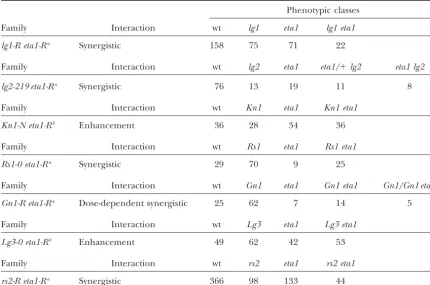
TABLE 2
Double-mutant analysis
Phenotypic classes
Family Interaction wt lg1 eta1 lg1 eta1
lg1-R eta1-Ra Synergistic 158 75 71 22
Family Interaction wt lg2 eta1 eta1/⫹lg2 eta1 lg2
lg2-219 eta1-Ra Synergistic 76 13 19 11 8
Family Interaction wt Kn1 eta1 Kn1 eta1
Kn1-N eta1-Rb Enhancement 36 28 34 36
Family Interaction wt Rs1 eta1 Rs1 eta1
Rs1-0 eta1-Ra Synergistic 29 70 9 25
Family Interaction wt Gn1 eta1 Gn1 eta1 Gn1/Gn1 eta1
Gn1-R eta1-Ra Dose-dependent synergistic 25 62 7 14 5
Family Interaction wt Lg3 eta1 Lg3 eta1
Lg3-0 eta1-Rb Enhancement 49 62 42 53
Family Interaction wt rs2 eta1 rs2 eta1
rs2-R eta1-Ra Synergistic 366 98 133 44
aSegregating families resulted from a self-pollination event of an F
1individual heterozygous for both alleles. bSegregating families resulted from an outcross of heterozygous F
1individuals to individuals homozygous
for theeta1-Rallele.
mately 2g poly(A)⫹RNA was loaded on a formaldehyde-con- wild type (Figure 2, Evs.F). The blade/sheath boundary taining 1% agarose gel and subjected to gel electro- normally runs perpendicular to the proximodistal axis phoresis at 72 V for 2.5 hr. The RNA was transferred for 4 hr
of the leaf, thus forming a boundary between blade and
to nylon membrane (Hybond-NX). Membranes were
hybrid-sheath. However, the blade/sheath boundary of eta1
ized in 1msodium phosphate buffer, pH 7.2, 7% SDS, and
individuals runs nearly parallel to the proximodistal leaf
1 mmEDTA. Akn1cDNA probe obtained from the Hake lab
was used for hybridization (Smith et al. 1992). An ubiqitin axis (Figure 2F). In addition, the ligule fails to form probe was used as a loading control. completely ineta1mutants. Although somewhat
disorga-nized, morphologically recognizable blade, sheath, lig-ule, and auricle cells are visible ineta1individuals.
Exam-RESULTS
ination of the auricle cells ineta1mutants reveals some
Phenotypic analysis and effect of genetic background aberrant, disorganized divisions, but the auricle cell
oneta1:Theeta1-Rmutation was originally isolated from shape and size are comparable to those of wild type an EMS mutagenesis screen. Theeta1phenotype segre- (Figure 2, G and H).
gates as a single recessive locus in F2families. The most Given the pleiotropic nature of the eta1-Rallele, it
notable phenotype ofeta1is an overgrowth or extension was introgressed into five different maize inbred lines of auricle tissue. The eta1 mutant is pleiotropic and to determine the most expressive phenotypes and to displays a range of phenotypes, including displacement help elucidate a precise eta1 function. As with many of the blade/sheath boundary, disruption of the ligule, maize developmental mutants,eta1displays background reduction in internode spacing and overall plant height, effects, but is fully penetrant in all inbred lines tested. and the production of smaller, more compact ear shoots Background effects have been previously documented
(Figure 2, A–D). with maize heterochronic mutants as well as with
ture similar to the morphology of the blade/sheath long arm of chromosome 5. The phenotype ofeta1-R hemizygotes is equivalent to eta1-R homozygotes, sug-boundary of rice (Figure 3A). The auricle phenotype
gesting that theeta1-Rallele is an amorph or has com-is least severe in B73 with auricle extension only along
plete loss of function. SSR markers (Smithet al.1997) the margin in adult leaves and little to no auricle
exten-were then used to fine mapeta1. Linkage was first found sion in juvenile leaves (Figure 3B). In all of the genetic
to the marker mmc0081, which maps to bin 5.05 (bin backgrounds tested,eta1mutant plant height compared
number is a positional designation along maize chromo-to wild-type siblings was similarly reduced (see Table
somes; for example, chromosome 5 is divided into nine 3). The most penetranteta1phenotypes were the
reduc-bins). SSRs in bins 5.04 and 5.05 were then tested for tion in plant height and the displacement of the blade
linkage. The SSR umc1221 located at position 329.5 in sheath boundary, which enabled consistent scoring even
bin 5.04 was found to be closely linked to eta1 at a in weakly expressing backgrounds.
recombination distance of 1 cM. This marker was
subse-Mapping and dosage:Theeta1mutation was initially
quently used for determination ofeta1genotype. mapped using B-A translocation stocks, using standard
procedures (Beckett 1994b). The translocation 5Ld
uncovered theeta1phenotype, indicating that theeta1 Double-mutant analysis locus is distal to this chromosome breakpoint on the
eta1 interacts synergistically with the
liguleless1/lig-uleless2pathway:Both thelg1andlg2genes function in
formation of the blade/sheath boundary and elabora-tion of ligule and auricle. Mutants oflg1andlg2show a dosage-dependent genetic interaction, suggesting that they function in the same developmental network. To test whethereta1may be involved in this network, we generated double mutants witheta1-Randlg1-Rorlg2-219.
A synergistic interaction was seen betweenlg1-Rand eta1-R(Figure 4). Thelg1-R eta1-Rhomozygotes show a marked displacement of the blade/sheath boundary, which is more severe than the displacement seen with either of the single mutants (Figure 4D). In addition, eta1-Rhomozygotes form ligule tissue andlg1-R homozy-gotes form a rudimentary ligule, but the double mutant fails to form ligule or auricle. Unusual protrusions of undifferentiated tissue were observed on the abaxial leaf surface of double-mutant individuals (Figure 4E, arrows), which are not seen in either lg1-R or eta1-R
TABLE 3
Effect of genetic background oneta1plant height
Background n Heighta(SD) % wild type
B73
wt 30 191 (⫾23)
eta1 11 93 (⫾15) 49
Mo17
wt 29 197 (⫾14)
eta1 11 117 (⫾10) 59
W23
wt 30 193 (⫾16)
eta1 14 98 (⫾12) 51
A188
wt 13 175 (⫾10)
eta1 4 98 (⫾7) 56
aAll height measurements are in centimeters and were
taken at time of anthesis from the base of the plant to the tip of the tassel.
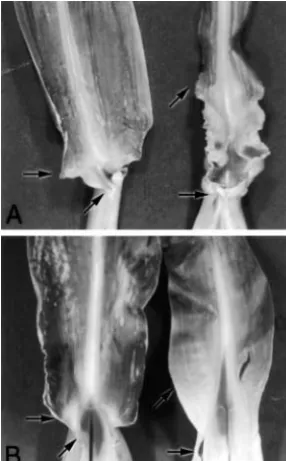
Figure3.—Theeta1-Rmutant displays background effects. (A) Leaf 10 in aneta1-R-segregating family in the W23 back-ground, wild type on the left and eta1 on the right. Note
displacement of the blade/sheath boundary and auricle exten- tion of the blade/sheath boundary and formation of sion (arrows). (B) Leaf 10 in aneta1-R-segregating family in
proximal structures more distally. Of the regional
iden-the B73 background, wild type on iden-the left andeta1 on the
tity mutants, we tested the interaction ofeta1-Rwith two
right. Note reduction of auricle extension (arrows) but blade/
sheath boundary remains displaced. of the semidominant class 1knox mutants, Kn1-Nand Lg3-O. To simplify the analysis, only one dose ofKn1-N andLg3-O was used. The eta1-Rmutant enhanced the single mutants. These protrusions did not coincide with Kn1-N phenotype (Figure 6). Individuals homozygous venation and were localized to the proximal blade re- foreta1-Rand heterozygous forKn1-Ndisplayed an in-gion in the presumptive auricle domain. The novel phe- crease in the number and size of knots, an increase in notype oflg1-R eta1-Rdouble mutants suggests that these prominent venation, and an increase in ectopic patches two genes interact synergistically and not additively. of ligule compared to heterozygous Kn1-N siblings A synergistic interaction was also observed withlg2- (compare Figure 6B with 6D). There is no increase in 219 and eta1-R, but surprisingly, our double-mutant auricle extension or in displacement of the blade/ analysis uncovered a dominant dosage effect of the sheath boundary in the Kn1-N/⫹ eta1-R mutant indi-eta1-Rallele (Figure 5). In the upper adult leaves of the viduals, suggesting that eta1-Ris enhancing theKn1-N lg2-219 mutants, ligule and auricle recover. However, phenotype.
lg2-219homozygotes that were heterozygous foreta1-R Similarly,eta1-Renhances theLg3-O mutant pheno-displayed extension of auricle in the upper adult leaves type (Figure 7). Individuals homozygous foreta1-Rand (Figure 5C). This dominant dosage effect was confirmed heterozygous for Lg3-O phenocopied Lg3-O homozy-both genetically and molecularly. No notable pheno- gotes. Again, there was no significant increase in the typic dosage effect was seen with eta1-R homozygotes amount of auricle tissue in double-mutant individuals, carrying a single copy of the lg2-219 allele (data not but the leaves were severely proximalized. Double-shown). Plants homozygous for bothlg2-219andeta1-R mutant phenotypes included severe displacement of the were extremely short, twisted, and often infertile (Figure blade/sheath boundary, ectopic ligule along the midrib, 5F). The blade/sheath boundary of double-mutant indi- twisting of the midrib, and alteration in leaf attitude viduals was extremely displaced toward the distal por- (Figure 7, D and E).
tion of the leaf compared to either of the single mutants, We also tested the interaction of eta1 with a fully but ligule outgrowth was still apparent. Taken together, dominant class I knox gene, Gnarley1 (Foster et al. the synergistic interaction of lg1-R andeta1-R and the 1999).eta1-Rshows a dosage effect withGn1-Ras seen synergistic dominant dosage effect of eta1-R with lg2- in Figure 8. Plants homozygous foreta1-Rwith one copy 219place eta1in theliguleless1/2network of function. ofGn1-R display an increase in leaf width, an increase in extension of auricle tissue into blade along the
mar-eta1enhances regional identity phenotypes:Theeta1
disrup-Figure4.—Synergistic inter-action oflg1-Randeta1-Rin the Mo17 background. Adaxial views of leaf 10: (A) wild type, (B)eta1-R/eta1-R, (C) lg1-R/lg1-R, and (D)eta1-R/eta1-R lg1-R/ lg1-R. Note the increased dis-placement of the ligule/auri-cle line in the double mutant vs.that in either of the single mutants (solid arrows). (E) lg1-R/lg1-R eta1-R/ eta1-R individ-ual. Open arrows point to ectopic protrusions on the adaxial leaf surface just distal to the blade/ sheath boundary.
In families segregating Gn1-R alone, Gn1-R homo- downregulate RS1 in the leaves (Schneeberger et al. 1998). When combined witheta1-R, rs2-Rshows a syner-zygotes are indistinguishable from heterosyner-zygotes (Foster
et al. 1999). However, when a second dose of Gn1-R is gistic interaction such that theeta1-Rphenotype is exac-erbated as well as thers2-Rphenotype (Figure 9). The added in families segregating foreta1-R, the phenotype
is severely enhanced (Figure 8, E and F). The blade/ double-mutant individuals show a reduction in height, excessively rough sheath, reduction in sheath length, sheath boundary is severely distorted and the width of
blade and sheath is increased. In addition, the leaf is increased auricle extension, and an overall increase in the proximalization of the leaf compared toeta1-Rand increasingly proximalized with increasing dosage of
Gn1-R,as sheath and auricle are displaced distally into rs2-Rsingle-mutant siblings (compare Figure 9B and 9C with 9D). However, the synergistic interaction ofRs1-O blade, especially in the region flanking the midrib
(Fig-ure 8F). In other words, theeta1-Rbackground permits andeta1-Ris subtly different. The overall plant height ofRs1-O eta1-Rdouble-mutant individuals is greatly re-aGn1-R dosage effect that is not evident in a wild-type
background. duced and the sheath length is reduced as is seen with
thers2-R eta1-Rdouble mutants. The focus of the ectopic Both rs2-R and Rs1-O show a strong synergistic
in-teraction witheta1-R(Figure 9). RS2 has homology to knoxgene action is shifted distally so that the phenotype is most severe at the auricle region, and the sheath is MYB-like transcription factors and RS1 is a class 1knox
transcription factor. One of the functions of RS2 is to not particularly rough compared to the Rs1-O single
early p1–5 leaf primordia but can be seen only in p6–8 leaves (Walsh et al. 1998). We isolated mRNA from either meristem and p1–5 or p6–8 leaf primordia and then subjected it to RT-PCR with lg1- and lg2-specific primers. No difference in mRNA expression of either LG2 or LG1 was found in leaves of eta1-Rmutantsvs. their wild-type siblings (Figure 10A). On the basis of these data,eta1is not likely to function upstream oflg1 orlg2.
Leaves of eta1 mutant plants do not ectopically ex-pressknoxgenes:The phenotype ofeta1mutants
resem-Figure6.—eta1-RenhancesKn1-N.Adaxial view of leaf 12
bles a number of maize mutants where the molecular
from aKn1-N/⫹ eta1-R-segregating family in the W22
back-cause of the mutant phenotype is ectopic expression of
ground is shown. This family resulted from an outcross of a
plant heterozygous for bothKn1-Nandeta1-Rto an individual knox genes. Because of this, KNOX-mRNA expression
homozygous foreta1-R. (A) Wild type; (B)Kn1-N/⫹; (C)eta1- was assayed via RT-PCR with primers specific for lg3, R/eta1-R; (D)Kn1-N/⫹eta1-R/eta1-R. lg4a, lg4b, rs1, gn1, orkn1. No notable differences were
seen ineta1 individualsvs. their wild-type siblings with any of these probes. For example, KN1-mRNA expres-sion was detected in meristems of both wild-type and mutant. In addition, Rs1-O eta1-R double-mutant
indi-eta1 mutant individuals, but not in developing leaves viduals do not show any ligule outgrowth, are
increas-(Figure 10B). The same expression pattern was seen ingly proximalized with auricle extension flanking the
with RS1 and GN1 (data not shown). Even after 30 margin, and have very prominent venation in the
ex-cycles of PCR, we detected no ectopic KN1, GN1, or tended blade/sheath boundary region.
RS1 expression in eta1 or wild-type developing leaves (data not shown). LG3-mRNA expression was detected
Molecular analyses
at high levels in meristems and at low levels in
devel-eta1 does not affect lg1 or lg2 expression: To test oping leaves of wild-type and eta1 mutant individuals whether or noteta1functions to regulatelg1orlg2gene (Figure 10B). Both LG4A and LG4B were expressed in expression, we used RT-PCR to analyze expression of the same pattern as LG3 (data not shown). These results LG1- and LG2-mRNA in a family segregating foreta1-R. suggest that eta1 may act downstream of the ectopic Previous studies have shown that LG2-mRNA expression knoxpathway since it does not cause ectopicknoxgene precedes LG1-mRNA and can be detected in p1–5 leaves expression.
Northern blot analysis:The severity of theKn1 pheno-(Walshet al. 1998), whereas LG1 is not expressed in
Figure8.—Theeta1-Rmutation shows a dosage effect with Gn1-R. Adaxial view of adult leaves from a family segregatingeta1-R Gn1-Rin the W22 background is shown. This family resulted from self-pollination of a plant heterozygous for both Gn1-Randeta1-R. (A) Wild type; (B)eta1-R/eta1-R; (C) Gn1-R/⫹; (D) Gn1-R/⫹ eta1-R/eta1-R; (E) Gn1-R/Gn1-R eta1-R/eta1-R; (F) whole-plant view of aGn1-R/Gn1-R eta1-R/eta1-Rindividual.
type has been correlated with increased KN1-mRNA genes (Timmermans et al. 1999; Tsiantis et al. 1999; Scanlonet al.2002). Whileeta1is involved in proximo-expression in the leaves (Smithet al.1992). We wanted
to determine if the severeKn1-N eta1-Rdouble-mutant distal patterning in the leaf, eta1 is unique in that it is not involved in regulating knox gene expression. In phenotype could be attributed to increased KN1-mRNA
levels or if mRNA levels were unchanged. KN1-mRNA addition, eta1 enhances the phenotypes of all known mutants affecting proximodistal patterning in the maize is abundant and is easily visualized using Northern blot
analysis, which is optimal for direct comparison of RNA leaf. Thus, our findings implicate eta1 as a novel and essential component of the developmental genetic net-concentrations. Figure 10C shows the results of a
North-ern blot analysis with aKn1-N eta1-R-segregating family work controlling maize leaf development.
The nature of the eta1-R mutation and background
in the W22 background. No KN1-mRNA can be detected
in eta1-R mutant leaves, which is consistent with our effects: Genetic evidence from B-A translocations re-ported here suggests that theeta1-Rallele is a complete RT-PCR findings. Levels of KN1-mRNA did not differ
significantly between Kn1-N/⫹ and Kn1-N/⫹ eta1-R/ loss-of-function mutation. This amorphy is essential when inferring a functional role foreta1. The effect of eta1-Rleaves (lane 4vs.8). These results further suggest
that eta1 functions downstream of the ectopic knox background on the eta1 phenotype is not surprising given that background effects are well documented in pathway.
maize. However, it is intriguing thateta1-Rdisplays back-ground expressivities similar to Lg3-O(Poethig1988;
DISCUSSION
FowlerandFreeling1996), being most severe in Mo17 and least severe in B73. This could indicate that similar Much effort in recent years has focused on identifying
novel loci in the developmental genetic network con- modifiers are involved in either enhancing or suppressing the aspects of proximodistal patterning in leaf develop-trolling proximodistal patterning in the maize leaf. We
describe a recessive mutation of theeta1 gene,eta1-R, ment controlled byeta1and disrupted byLg3.
Interaction with theligulelesspathway:Previous work which affects proximodistal patterning in the maize leaf.
To date there are only two published recessive mutations withlg1andlg2suggests that this phenotype is saturated. For example, 18 independentlg1alleles and 9 indepen-in maize,rs2andsem1, that are implicated in
Figure9.—Theeta1-Rmutation interacts synergistically withrs2-R andRs1-O. (A–D) Abaxial view of leaf 12 from a family segregatingrs2-R eta1-Rin the Mo17 background. This family resulted from a self-pollination of an individual heterozygous for bothrs2-Randeta1-R. (A) Wild type; (B)eta1-R/eta1-R; (C)rs2-R/rs2-R; (D)rs2-R/rs2-R eta1-R/eta1-R.(E–H) Abaxial view of leaf 12 from a family segregatingRs1-Oandeta1-Rin the Mo17 background. (E) Wild type; (F)eta1-R/eta1-R; (G)Rs1-O/Rs1-O; (H) Rs1-O/Rs1-O eta1-R/eta1-R.
screens to identify other genes in theligulelesspathway, Freeling 1999). lg2is involved in early establishment of the blade/sheath boundary during early vegetative but no novel genes have been discovered (D. Braun
and J. Walsh, personal communication). It was pro- stages and in the transition from vegetative to floral branching in the apical tassel meristem (Walsh and posed that other factors in theligulelesspathway would
be either pleiotropic or lethal (HarperandFreeling Freeling1999).
Consequently, the synergistic interaction ofeta1with 1996a). On the basis of genetic interactions ofeta1with
lg1andlg2and theeta1phenotype,eta1can be consid- lg1 indicates thateta1 plays a role in the formation of the blade/sheath boundary and in the elaboration of ered a pleiotropic factor in theligulelessnetwork of
func-tion. However, given the pleiotropic nature of eta1, it the ligule. Notably, thelg1single mutant fails to develop ligule and auricle in the lower leaves but a rudimentary is unlikelyeta1is exclusively functioning in this pathway.
RT-PCR gel blot analyses showeta1 does not affectlg1 ligule is formed in upper leaves. In contrast, the eta1 lg1double mutants do not form rudimentary ligule and orlg2expression. However,eta1may act onlg1and/or
lg2at the protein level or perhaps could affect the spatial the blade/sheath boundary is displaced over the midrib (Figure 4D). This double-mutant phenotype indicates distribution of LG-mRNAs, which is difficult to test given
that the expression patterns of lg1 and lg2 have not eta1is involved in formation of the rudimentary ligule in the absence of lg1. This is similar to the dosage-been precisely discerned. It is likely that eta1 function
is necessary along with lg1 and lg2 during early leaf dependent synergistic interaction seen betweenlg1and lg2. Double mutants of dominant Lg3 andLg4 alleles development for correct formation and differentiation
of the blade/sheath boundary.lg1function seems to be with lg1andlg2also fail to form a rudimentary ligule, but do not enhance the ectopic knox phenotypes specific to ligule and auricle induction whilelg2
documented (Fowler and Freeling 1996). Interest-ingly,eta1 can phenocopy dominantknoxmutations in mutant combination. For example, the double-mutant phenotype ofLg3-O eta1-R(Figure 7) is nearly identical to the double-mutant phenotype of Lg3-O Lg4-O(FowlerandFreeling1996). This is also true of theKn1-N eta1-R(Figure 6) double-mutant phenotype, which mimics that ofKn1-O Rs1-O(Fowlerand Free-ling1996). Since the severity ofKn1-N eta1-R double-mutant individuals is not a direct result of increased KN1-mRNA levels andeta1-Rin double-mutant combi-nation with knox genes results in severe phenotypes, eta1-Rlikely functions either downstream of the path-way perturbed byknox neomorphs or in a parallel but convergent pathway that promotes differentiation.
Figure10.—(A) RT-PCR gel blot analysis of LG1 and LG2
In theRs1-O mutant, the area of ectopic RS1-mRNA
expression in aneta1-R-segregating family. Lane 1, wild-type
meristems and p1–5 leaves; lane 2, wild-type p6–8 leaves; lane expression is greater than one would expect given the
3,eta1-Rmeristems and p1–5 leaves; lane 4,eta1-Rp6–8 leaves. phenotypic consequences of that expression ( Schnee-Ubiquitinwas used as a loading control. (B) RT-PCR gel blot
bergeret al.1995). Specifically, ectopic RS1-mRNA
ex-analysis ofkn1 andlg3in aneta1-R-segregating family. Lane
pression can be detected in most cell types but only the
1, wild-type meristems and p1–5 leaves; lane 2, wild-type p6–8
sheath and the ligular region display developmental
leaves; lane 3,eta1-Rmeristems and p1–5 leaves; lane 4,eta1-R
p6–8 leaves.Ubiquitinwas used as a loading control. (C) North- defects. The authors propose that this could be due to
ern blot analysis of a Kn1-N/⫹ eta1/eta1-segregating family. competency of cells to respond to ectopic RS1 expres-Lane 1, wild-type meristems and p1–5 leaves; lane 2, wild-type
sion. Perhapseta1is essential in competency and without
p6–8 leaves; lane 3,Kn1meristems and p1–5 leaves; lane 4,
its normal function cells are increasingly sensitive or
Kn1p6–8 leaves; lane 5,eta1meristems and p1–5 leaves; lane
responsive to ectopicknoxgene expression. This could
6,eta1p6–8 leaves; lane 7,eta1 Kn1meristems and p1–5 leaves;
lane 8,eta1 Kn1p6–8 leaves. Lanes 1 and 2 are from a different be one explanation for the change in focus of ectopic Northern blot than lanes 3–8; however, they represent RNA RS1 action in theRs1-O eta1-Rdouble mutants. from the sameKn1-N eta1-R-segregating family.
Interestingly, the phenotype ofrs2-R eta1-Rdouble mu-tants is slightly different from that of the Rs1-O eta1-R double mutants. Both double-mutant analyses were car-ried out in the same genetic background, which cannot lg1-R and heterozygous and/or homozygous for lg2-R
failed to form the rudimentary ligule and had a dis- account for the differences observed. It is possible that the difference in the synergistic interaction ofrs2-R eta1-R placed blade/sheath boundary (HarperandFreeling
1996a). These data indicateeta1functions in the same compared toRs1-O eta1-R can be attributed to as yet unidentified downstreamrs2targets, which are likely to genetic network aslg1.
In addition tolg1interactions,eta1has a directional be misexpressed. In addition, the spatial and temporal expression ofknoxgenes is likely to differ inRs1-Oand dosage-dependent interaction withlg2. Theeta1-Rallele
behaves dominantly to extend auricle tissue in the upper rs2-R. For example, in Arabidopsis, the rounded-leaf phenotype ofas1mutants differs from that of the lobed-leaves oflg2-219homozygous plants. Thelg2 eta1double
mutants also showed extreme displacement of the leaf phenotype of 35S:KNAT1 plants (Oriet al. 2000; Theodoriset al.2003).
blade/sheath boundary relative toeta1andlg2
homozy-gotes. The observation that the double-mutant plants More surprising is theeta1 Gn1dosage effect.Gn1-R acts as a true dominant and thereforeGn1heterozygotes were able to produce ligule suggests that neither of
these genes is specifically involved in ligule induction, cannot be distinguished from homozygotes.rs1andgn1 are duplicate genes (Foster et al. 1999); therefore, it but may be involved prior to that in establishment of
the blade/sheath boundary. These data indicate thatlg2 is interesting that we see a dosage effect only withGn1-R and eta1-R and not with Rs1-O and eta1-R. There are andeta1have partially overlapping functions in properly
delineating the blade/sheath boundary. multiple explanations for this. One possibility is that the dosage interaction witheta1-RandGn1-Ris due to
Interaction with proximodistal axis regional identity
mutants: While the mutant eta1 phenotype resembles allelic differences between Gn1-R and Rs1-O. Another possibility is that there is a modifier in W22 that confers that of rs2and the dominant knox mutants, we found
that theeta1mutation does not ectopically express any dosage sensitivity withGn1-R eta1-Rand this modifier is not present in Mo17, the background in which theRs1-O of the class 1knoxgenes (Figure 10). However,
proxi-modistal regional identity mutants including class 1knox eta1-R double-mutant analysis was performed. A third possibility is that although Rs1andGn1are thought to genes interact genetically with eta1. Interactions
support and guidance in this research, which was supported by
Na-evolved slightly disparate functions and thus we found
tional Institutes of Health grant 5R01 GM42610 to M.F.
proximodistal identity to be more sensitive to dosage ofGn1whenEta1⫹function is lost. These data uncover a threshold of responsiveness to ectopic GN1 that is
LITERATURE CITED
seen when Eta1⫹ function is lost, which is consistent
Beckett, J. B., 1994a Comprehensive list of B-A translocations in
with eta1playing a role in competency.
maize, pp. 336–341 inThe Maize Handbook, edited by M.Freeling
Alternative modes ofeta1action:Our current
under-and V.Walbot. Springer-Verlag, New York/Berlin.
standing of genetic control of patterning in simple Beckett, J. B., 1994b Locating recessive genes to chromosome arm with B-A translocations, pp. 315–327 inThe Maize Handbook, edited
leaves comes primarily from work with maize,
Antirrhi-by M.Freelingand V. Walbot. Springer-Verlag, New York/
num, and Arabidopsis. Although there is no precedent
Berlin.
in maize for the breadth of interaction seen between Becraft, P. W., andM. Freeling, 1994 Genetic analysis of rough sheath1 developmental mutants of maize. Genetics136:295–311.
eta1and thelgandknoxpathways, there is a clue from
Becraft, P. W., D. K. Bongard-Pierce, A. W. Sylvester, R. S. Poe-Arabidopsis on howeta1may be functioning. Thepickle
thigandM. Freeling, 1990 The liguleless-1 gene acts tissue
(pkl) mutant, which encodes a chromatin-remodeling specifically in maize leaf development. Dev. Biol.141:220–232.
Bellaoui, M., M. S. Pidkowich, A. Samach, K. Kushalappa, S. E. factor, enhances the as1 mutant phenotype, but does
Kohalmiet al., 2001 The Arabidopsis BELL1 and KNOX TALE
not ectopically express knox genes on its own (Oriet homeodomain proteins interact through a domain conserved al.2000). These authors propose thatPKLfunctions to between plants and animals. Plant Cell13:2455–2470.
Byrne, M. E., R. Barley, M. Curtis, J. M. Arroyo, M. Dunhamet limit accessibility ofKNOXgenes to their gene targets,
al., 2000 Asymmetric leaves1 mediates leaf patterning and stem
whileas1confers specificity for repression of theKNOX cell function in Arabidopsis. Nature408:967–971.
genes (Ori et al. 2000). Interestingly, the phenotype Byrne, M. E., J. SimorowskiandR. A. Martienssen, 2002 ASYM-METRIC LEAVES1 reveals knox gene redundancy in Arabidopsis.
of pkl as1 double mutants mimics that of 35S:KNAT1
Development129:1957–1965.
overexpression lines (Oriet al. 2000), much like eta1 Edwards, K., C. JohnstoneandC. Thompson, 1991 A simple and in double-mutant combination withknoxgenes mimics rapid method for the preparation of plant genomic DNA for Pcr
analysis. Nucleic Acids Res.19:1349.
dominantknox double mutants. Oriet al.(2000)
pro-Foster, T., J. Yamaguchi, B. C. Wong, B. VeitandS. Hake, 1999
pose that PKL may play a role in restricting competency Gnarley1 is a dominant mutation in the knox4 homeobox gene of cells to respond to morphogenetic factors. Given affecting cell shape and identity. Plant Cell11:1239–1252.
Fowler, J. E., andM. Freeling, 1996 Genetic analysis of mutations
the pleiotropic phenotype ofeta1and its many genetic
that alter cell fates in maize leaves: dominant liguleless mutations.
interactors, it is possibleeta1 may have a general func- Dev. Genet.18:198–222.
tion in altering chromatin states and therefore compe- Freeling, M., 1992 A conceptual framework for maize leaf develop-ment. Dev. Biol.153:44–58.
tency similar topkl.
Freeling, M., andS. Hake, 1985 Developmental genetics of mutants
An alternative possibility is thateta1functions simply that specify knotted leaves in maize. Genetics111:617–634. Hake, S., E.Vollbrechtand M.Freeling, 1989 Cloning knotted
in restricting cell proliferation at the blade/sheath
the dominant morphological mutant in maize using Ds2 as a
boundary. This seems unlikely given the effects ofeta1
transposon tag. EMBO J.8:15–22.
in double-mutant combination with theknoxgenes and Harper, L., andM. Freeling, 1996a Interactions of liguleless1 and
liguleless2 function during ligule induction in maize. Genetics
liguleless genes. Since lg2 andGn1 share only a defect
144:1871–1882.
in proper initiation of the blade/sheath boundary, it is
Harper, L., andM. Freeling, 1996b Studies on early leaf
develop-more likely thateta1 functions in establishment of the ment. Curr. Opin. Biotechnol.7:139–144.
Hay, A., H. Kaur, A. Phillips, P. Hedden, S. Hakeet al., 2002 The
blade/sheath boundary given its dosage interactions
gibberellin pathway mediates KNOTTED1-type homeobox
func-with bothlg2andGn1(Figures 5 and 8). We have shown
tion in plants with different body plans. Curr. Biol.12:1557–1565.
that the increase in auricle tissue at the blade/sheath Kerstetter, R. A., D. Laudencia-Chingcuanco, L. G. SmithandS. Hake, 1997 Loss-of-function mutations in the maize homeobox
boundary is not solely due to an increase in cell
expan-gene, knotted1, are defective in shoot meristem maintenance.
sion because the auricle cells ineta1 leaves are similar Development124:3045–3054.
in size to auricle cells of wild-type siblings (Figure 2, G Li, Y., G. HagenandT. J. Guilfoyle, 1992 Altered morphology in transgenic tobacco plants that overproduce cytokinins in specific
and H). Another possibility is thateta1acts as a receptor
tissues and organs. Dev. Biol.153:386–395.
or in the reception end of the pathway that establishes Long, J. A., E. I. Moan, J. I. MedfordandM. K. Barton, 1996 A the blade/sheath boundary. Further research is focused member of the KNOTTED class of homeodomain proteins
en-coded by the STM gene of Arabidopsis. Nature379:66–69.
on the cloning of newly derivedeta1alleles in hopes of
Moreno, M. A., L. C. Harper, R. W. Krueger, S. L. Dellaporta shedding some light on its complex series of genetic andM. Freeling, 1997 Liguleless1 encodes a nuclear-localized interactions. Regardless, eta1 proves to be an essential protein required for induction of ligules and auricles during
maize leaf organogenesis. Genes Dev.11:616–628.
component in the genetic circuitry involved with
proxi-Muehlbauer, G. J., J. E. FowlerandM. Freeling, 1997 Sectors
modistal patterning in the maize leaf. expressing the homeobox gene liguleless3 implicate a
time-dependent mechanism for cell fate acquisition along the proxi-Many thanks go to Sarah Hake for alleles, probes, and helpful
mal-distal axis of the maize leaf. Development124:5097–5106. comments; to Frank Baker for providing the marked B-A translocation
Mueller, J., Y. Wang, R. Franzen, L. Santi, F. Salamini et al., stocks; to Randall Tyers for design of theknoxprimers; and to George 2001 In vitro interactions between barley TALE homeodomain Theodoris, Randall Tyers, Frank Baker, Noriko Inada, and Nick proteins suggest a role for protein-protein associations in the Kaplinsky for critical reading of the manuscript. Many thanks also go regulation of Knox gene function. Plant J.27:13–23.
Ori, N., M. T. Juarez, D. Jackson, J. Yamaguchi, G. M. Banowetzet
al., 1999 Leaf senescence is delayed in tobacco plants expressing 1997 An evaluation of the utility of SSR loci as molecular mark-ers in maize (Zea may L.): comparisons with data from RFLPS the maize homeobox gene knotted1 under the control of a
senes-and pedigree. Theor. Appl. Genet.95:163–173. cence-activated promoter. Plant Cell11:1073–1080.
Smith, H. M. S., I. BoschkeandS. Hake, 2002 Selective interaction
Ori, N., Y. Eshed, G. Chuck, J. L. BowmanandS. Hake, 2000
Mech-of plant homeodomain proteins mediates high DNA-binding af-anisms that control knox gene expression in the Arabidopsis
finity. Proc. Natl. Acad. Sci. USA99:9579–9584. shoot. Development127:5523–5532.
Steeves, T. A., andI. M. Sussex, 1989 Patterns in Plant Development,
Poethig, R. S., 1988 Heterochronic mutations affecting shoot
devel-Ed. 2. Cambridge University Press, New York/Cambridge, UK. opment in maize. Genetics119:959–974.
Sylvester, A. W., W. Z. CandeandM. Freeling, 1990 Division
Poethig, S., 1984 Cellular parameters of leaf morphogenesis in
and differentiation during normal and liguleless-1 maize leaf maize Zea-mays and tobacco Nicotiana-tabacum, pp. 235–260 in
development. Development110:985–1000.
Contemporary Problems in Plant Anatomy; Symposium, Chapel Hill,
Theodoris, G., N. InadaandM. Freeling, 2003 Conservation and
North Carolina, edited by R. A.Whiteand W. C.Dickison.
Aca-molecular dissection ofROUGH SHEATH2 andASYMMETRIC
demic Press, Orlando, FL/London.
LEAVES1 function in leaf development. Proc. Natl. Acad. Sci.
Sakamoto, T., N. Kamiya, M. Ueguchi-Tanaka, S. IwahoriandM.
USA100:6837–6842.
Matsuoka, 2001 KNOX homeodomain protein directly
sup-Timmermans, M. C. P., A. Hudson, P. W. Becraftand T. Nelson, presses the expression of a gibberellin biosynthetic gene in the
1999 Rough sheath2: a Myb protein that represses knox homeobox tobacco shoot apical meristem. Genes Dev.15:581–590.
genes in maize lateral organ primordia. Science284:151–153.
Scanlon, M. J., R. G. SchneebergerandM. Freeling, 1996 The
Tsiantis, M., R. Schneeberger, J. F. Golz, M. FreelingandJ. A.
maize mutant narrow sheath fails to establish leaf margin identity
Langdale, 1999 The maize rough sheath2 gene and leaf devel-in a meristematic domadevel-in. Development122:1683–1691.
opment programs in monocot and dicot plants. Science 284:
Scanlon, M. J., D. C. HendersonandB. Bernstein, 2002
SEMA-154–156. PHORE1 functions during the regulation of ancestrally
dupli-Vollbrecht, E., B. Veit, N. SinhaandS. Hake, 1991 The develop-cated knox genes and polar auxin transport in maize.
Develop-mental gene knotted-1 is a member of a maize homeobox gene
ment129:2663–2673. family. Nature350:241–243.
Schneeberger, R. G., P. W. Becraft, S. HakeandM. Freeling, Vollbrecht, E., L. ReiserandS. Hake, 2000 Shoot meristem size 1995 Ectopic expression of the knox homeo box gene rough is dependent on inbred background and presence of the maize sheath1 alters cell fate in the maize leaf. Genes Dev.9:2292–2304. homeobox gene, knotted1. Development127:3161–3172.
Schneeberger, R., M. Tsiantis, M. FreelingandJ. A. Langdale, Walsh, J., andM. Freeling, 1999 The liguleless2 gene of maize 1998 The rough sheath2 gene negatively regulates homeobox functions during the transition from the vegetative to the repro-gene expression during maize leaf development. Development ductive shoot apex. Plant J.19:489–495.
125:2857–2865. Walsh, J., C. A. WatersandM. Freeling, 1998 The maize gene
Smith, L. G., B. Greene, B. VeitandS. Hake, 1992 A dominant liguleless 2 encodes a basic leucine zipper protein involved in mutation in the maize homeobox gene, Knotted-1, causes its the establishment of the leaf blade-sheath boundary. Genes Dev. ectopic expression in leaf cells with altered fates. Development 12:208–218.
116:21–30.